Real Time AI Video API Cost Comparison 2026
fal H3 Max vs MiniMax H3: live API prices, 1,000-second costs, retake math, the 2K crossover, latency, limits, and who should pick each.
Published
 By Omid Saffari



Real time AI video API cost comparison 2026: pick fal MiniMax H3 Max for a five-second 768p review loop, and pick MiniMax H3 when the clip must finish at 2K or use reference video and editing. Verified on 31 August 2026, H3 Max costs $0.20 per five-second clip during its final launch-price day and $0.40 from 1 September, exactly the same as MiniMax H3 at 768P. The cost decision flips at three candidates: rough at 768p and generate one chosen direction again at 2K instead of paying 2K rates for every option.
Which One Should You Pick?
Choose fal MiniMax H3 Max when the person making the creative decision is waiting for the model. A creative director reviewing five-second product shots, an ad team trying hooks during a meeting, or a product returning motion previews to a user gets a meaningful benefit from fal's displayed 2.53-second inference example.
Choose MiniMax H3 when the output needs to survive finishing. Its direct API adds 2K output, reference video and audio, a larger image-reference pack, and editing. Those capabilities matter more than a fast first answer when the brief depends on exact character, brand, motion, or sound references.
After H3 Max's launch discount ends on 1 September, both cost $0.08 per output second at 768p. The durable decision is therefore not price at that resolution. It is latency versus control.
- Pick H3 Max for 768p directions that need to appear inside a live review loop.
- Pick MiniMax H3 for a 2K delivery lane or a reference-heavy job.
- Use both when three or more directions must be explored before one gets a 2K final pass.
- Do not switch for speed when generation already runs overnight or human approval is the slower clock.
H3 Max makes completed clips, not a continuous avatar stream. If the product needs a speaking face that stays connected through a live session, use the broader real-time AI video API comparison instead.
Real Time AI Video API Cost Comparison 2026 at a Glance
The prices for both were verified against the vendors' live pages on 31 August 2026. fal's H3 Max endpoint still displayed $0.04 per second at 768p and said the rate becomes $0.08 on 1 September. MiniMax's direct API pricing displayed $0.08 at 768P and $0.13 at 2K.
That date is not a footnote. A cost comparison that carries H3 Max's launch rate forward as its normal price understates every durable workload by half.
AI Video API Pricing Comparison on the Same Workload
The cleanest normalization is output time. Both APIs bill the generated clip by the second, so compare the same number of seconds before adding references, storage, orchestration, retries, and review.
At 768p, a five-second H3 Max clip costs $0.20 during the launch window and $0.40 at list price. A five-second MiniMax H3 clip also costs $0.40 at 768P. Moving H3 to 2K raises that clip to $0.65.
Scale the same workload to 100 five-second clips, or 500 output seconds:
- H3 Max launch price: $20.
- H3 Max list price: $40.
- MiniMax H3 at 768P: $40.
- MiniMax H3 at 2K: $65.
At 1,000 output seconds, the normalized costs are $40, $80, $80, and $130 respectively. This is the number an application owner can put into a usage forecast. A clip count alone hides duration, while a subscription comparison hides the amount of media generated.
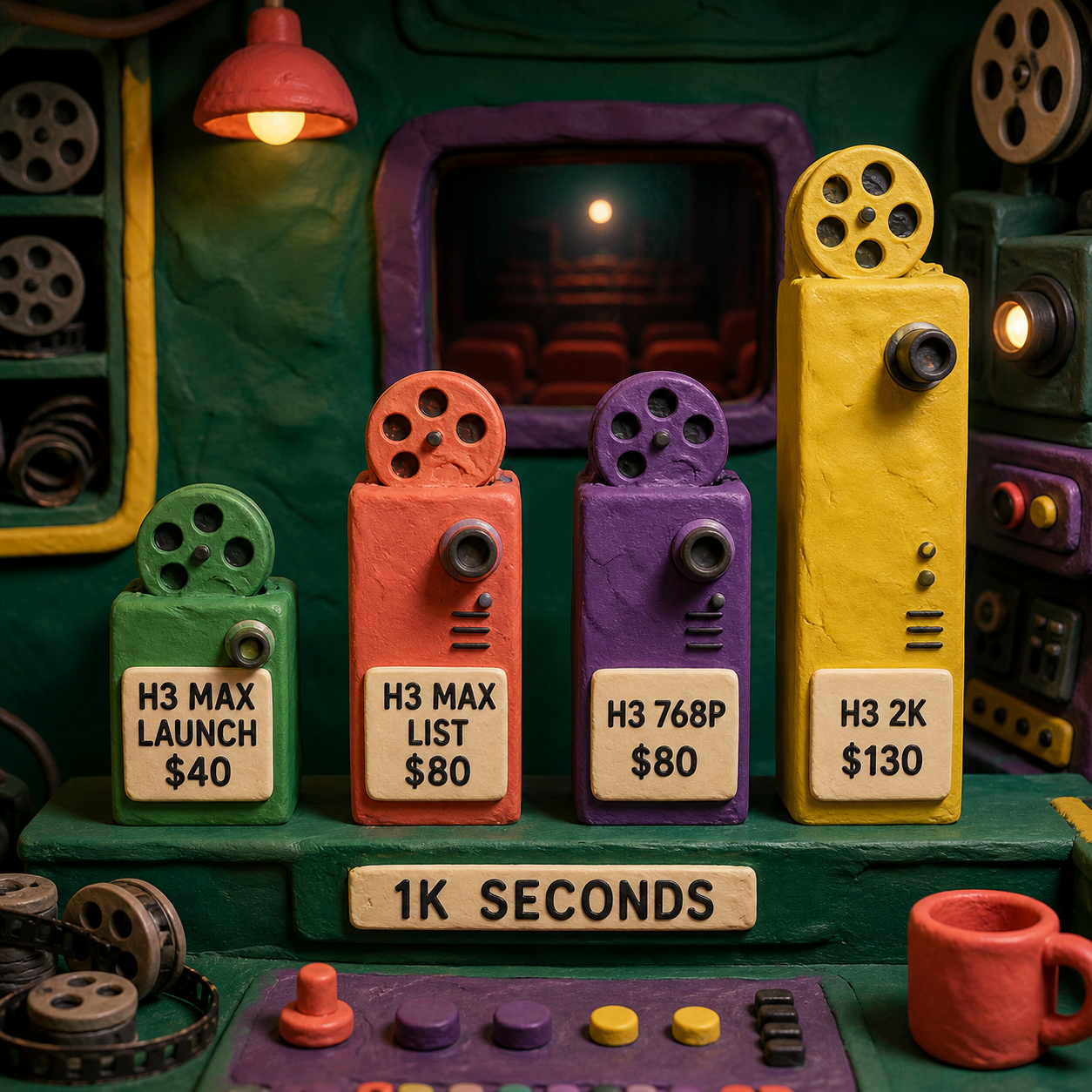
The two 768p rates scale in straight lines. There is no volume point where one becomes cheaper after the H3 Max promotion ends because neither page publishes a subscription minimum or volume step for these pay-as-you-go rates. The choice flips only when a workflow needs a capability that changes the number or type of paid attempts.
AI Video Generator Cost: Retakes Change the Winner
Cost per approved clip is the useful budget unit. A model can be cheap per generation and expensive per usable result if every direction needs several attempts.
Use a planning case with a 20% acceptance rate, meaning one approved direction for every five paid attempts. This is a worked scenario, not a measured acceptance benchmark for either model.
At durable list prices, five 768p attempts cost $2.00 on either H3 Max or MiniMax H3. Generating all five at 2K costs $3.25. Running five fast H3 Max roughs and then making one new 2K MiniMax H3 final costs $2.65. During the H3 Max promotion, that mixed workflow costs $1.65.
For a DTC brand reviewing five motion treatments of one approved product still, the practical question is not whether $0.40 is affordable. It is whether 768p shows enough of the camera move, timing, and sound direction to reject four options without paying 2K rates for them.
H3 Max wins this category when speed lets a reviewer respond while the brief is still active. MiniMax H3 wins when the references themselves are what make an attempt usable. If the job needs nine identity and style images, for example, MiniMax includes the first five and charges $0.04 for each of the remaining four. A five-second 2K output with that nine-image pack comes to $0.81: $0.65 for the output plus $0.16 for the extra images.
Video references move the budget faster. A five-second 2K input video and five-second 2K output total $1.30 at MiniMax's published input and output rates. That is not a reason to avoid references. It is a reason to price the control they buy instead of pretending every five-second clip has the same input cost.
The Three-Candidate Crossover to 2K
Three candidates is the first durable point where roughing at H3 Max list price and generating one chosen direction again with MiniMax H3 at 2K costs less than making every candidate at 2K.
Let N be the number of five-second candidates. Every candidate at MiniMax H3 2K costs $0.65N. H3 Max roughs plus one new 2K final cost $0.40N + $0.65. The mixed workflow becomes cheaper when N is greater than 2.6, so the first whole candidate count is three.
At three candidates, the comparison is $1.85 for three H3 Max roughs plus one H3 2K final versus $1.95 for three H3 2K candidates. At twenty candidates, it is $8.65 versus $13.00, a 33.5% saving. While the launch rate remains active, twenty roughs plus one 2K final cost $4.65, a 64.2% saving against twenty 2K attempts.
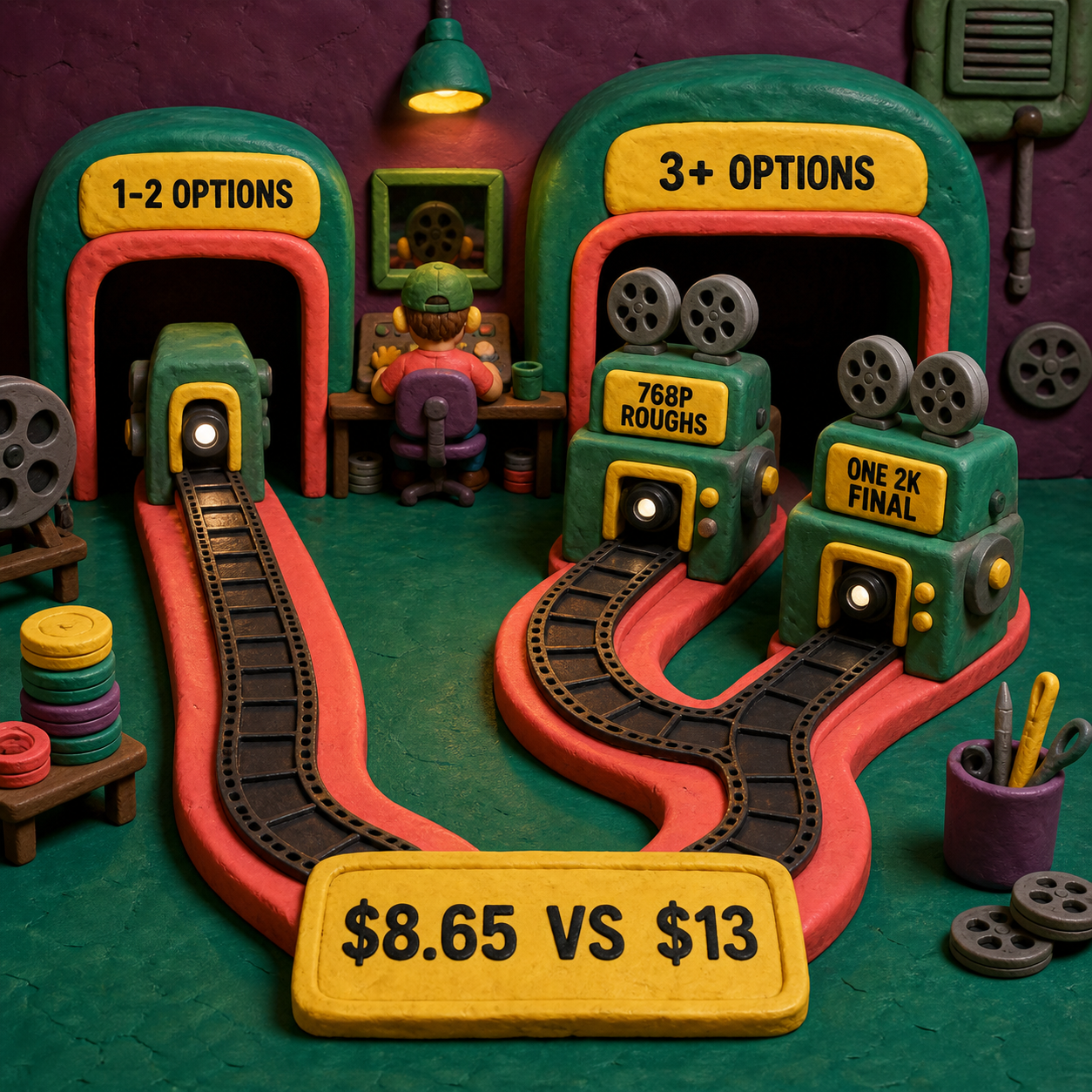
The limitation matters as much as the saving: the 2K result is a new generation, not a lossless upgrade of the accepted H3 Max file. Camera timing, product geometry, typography, and small details can drift when the endpoint changes.
MiniMax separately lists a 768P-to-2K regeneration price of $0.05 per second for output and another $0.05 per second for the original 768P task input. Its page does not say that a fal H3 Max output qualifies as that original MiniMax task. Do not build a budget that assumes cross-provider eligibility until MiniMax documents it or confirms it for the account.
Speed Winner: fal MiniMax H3 Max
fal MiniMax H3 Max wins speed because its live text-to-video page shows a five-second 768p example with 2.53 seconds in timings.inference. That is a vendor example, not a guarantee for every prompt, queue, region, or network path.
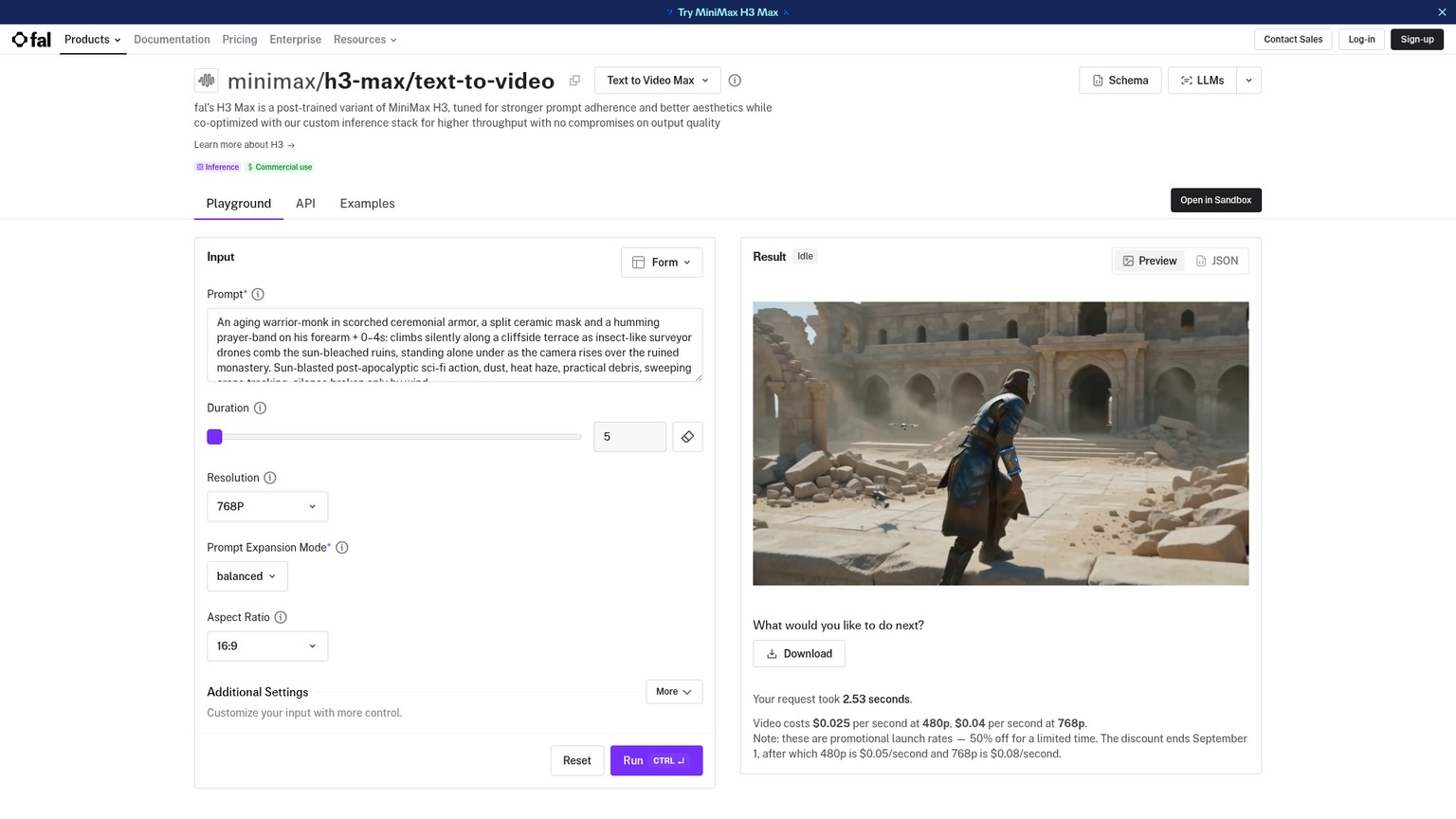
Inference is only the backend frame-generation stage. A user's click-to-video wait also includes prompt expansion, queueing, input upload, response delivery, and file download. fal says a 15-second clip takes around 15 seconds, so the faster-than-playback advantage is strongest on the shortest five-second job.
Prompt settings can erase the gain too. fal recommends balanced expansion for the low-latency path, says fast expansion takes about one second, and says quality expansion can spend up to 30 seconds rewriting the prompt. A product that silently selects quality mode should not promise a three-second experience.
The available package is deliberately narrower: 480p or 768p, five to 15 seconds, native synchronized audio, and text-to-video or image-to-video. The image endpoint can also take an optional ending frame. For a creative review tool, that is enough to make motion, pacing, and sound discussable. For a 2K master or reference-driven identity job, it is not.
The deeper explanation of what the timing does and does not measure is in Can AI Video Render Faster Than Playback 2026.
Winner: H3 Max for a five-second 768p feedback loop.
Skip it when: 768p is below the delivery bar, quality prompt expansion is mandatory, or the workflow depends on reference video and editing.
Control and Delivery Winner: MiniMax H3
MiniMax H3 wins control and delivery because it treats text, images, video, and audio as one context, then exposes 2K output, reference-to-video, first-and-last-frame generation, and editing.
The direct list price is $0.08 per second at 768P and $0.13 at 2K. The output runs for five to 15 seconds at 24 FPS on fal's current H3 product page, with native stereo audio. Its reference endpoint accepts as many as nine images, three video clips, and three audio clips, capped at 12 files total.
That reference surface is the reason to pay more. An art director can identify a character with images, take motion from a video, and guide voice or ambience with audio instead of asking a text prompt to describe all three. Editing keeps the same model family available when one element needs to change without intentionally rebuilding the entire shot.
The wall is cost complexity. Audio inputs are free, the first five images are free, extra images cost $0.04 each, and video input is billed by its own duration at the selected output-resolution rate. The output-second headline is only the base of a reference-heavy bill.
For brand work, H3 is closer to a finishing model, but 2K still does not make an output automatically ship-ready. Product geometry, approved marks, generated lettering, identity, continuity, dialogue, sound effects, and usage rights all need review. A raster video can look crisp and still be wrong in a way that matters to the brand.
Winner: MiniMax H3 for 2K, multimodal reference control, and editing.
Skip it when: the job is a disposable 768p rough and the reviewer benefits more from response time than from extra controls.
What the Independent Quality Data Says
Artificial Analysis gives H3 Max a small observed lead, not a decisive quality win. Its live text-to-video leaderboard with audio lists fal MiniMax H3 Max at 1,235 Elo with a 95% confidence interval of -10/+10 over 5,350 samples. MiniMax H3 is at 1,227 Elo with -7/+7 over 8,909 samples.
Those intervals overlap. The eight-point gap is too small to support a blanket claim that H3 Max is visibly better. The benchmark is based on blind user preferences, which is useful evidence for overall appeal, but it does not replace a brand's checks for exact product shape, lettering, identity, editability, or end-to-end latency.
Wan 3.0 currently leads that board at 1,242 Elo. That result is relevant to a buyer chasing general preference quality, but it does not erase H3 Max's price and latency advantage for the specific rapid-review job.
Winner: H3 Max on the observed benchmark score, with no decisive separation from H3.
A Cost-Aware Before-to-After Recipe
The best H3 Max workflow changes the brief before it changes the model. Start with the same product job throughout: a five-second 16:9 motion test for a matte-black bottle using an approved opening image.
An under-specified prompt is:
Make a premium dramatic video of this bottle with cool movement and sound.
That sentence leaves the camera path, product invariants, ending, background, and audio open. A cheap result can still be expensive to review because nobody can identify which choice failed.
A production-shaped direction is:
Five-second 16:9 product shot. Use the supplied image as the opening frame. Keep the bottle silhouette, cap, label position, and matte-black color unchanged. Make one slow clockwise camera orbit while condensation forms, then stop on the front label. Use a quiet refrigeration hum with no speech and no music.
This is a prompt design example, not a claimed generation result. Its advantage is a clearer rejection note: silhouette drift, changed cap, label movement, incomplete orbit, or unwanted audio.
Lock the opening frame and invariants
Use the approved product image. Name the shape, label placement, color, camera path, ending frame, and sound conditions that cannot change.
Generate three H3 Max directions
Keep duration at five seconds, resolution at 768p, and prompt expansion on balanced. Change only one creative variable per attempt. Three list-price attempts cost $1.20, or $0.60 during the launch window.
Reject with a named reason
Record the request, cost, keep-or-reject decision, and one craft failure. Do not promote a direction that only looks impressive at thumbnail size.
Make one MiniMax H3 2K final
Transfer the approved direction and source references, then generate it again at 2K for $0.65 before extra reference inputs. Treat it as a new result that needs another review.
Run the ship-ready check
Approve product geometry, marks and type, identity, continuity, dialogue, sound, disclosure, rights, and export specifications. If any structural detail fails, the clip remains a mood board.
H3 Max can be ship-ready when 768p meets the channel specification and the clip passes that craft check. It is mood-board-only when the job needs 2K, stable brand details across several shots, or a controlled edit of an existing clip. For more context on the finishing model and its wider ecosystem, see the MiniMax AI review.
Switching Costs and Who Should Not Switch
Switching between fal H3 Max and MiniMax direct is a small integration project, not an endpoint-string edit. fal's client handles submission and status updates on its surface. MiniMax documents an asynchronous flow that creates a task, polls a task_id, then retrieves the completed file using a file_id.
A production switch has five concrete jobs:
- Map authentication, endpoint names, duration, resolution, prompt expansion, and reference fields.
- Rewrite queue and failure handling around the provider's task lifecycle.
- Store output media in infrastructure you control instead of treating provider URLs as an archive.
- Revalidate prompts, seeds, safety behavior, audio, and every brand invariant on the new model.
- Rebuild cost monitoring around output seconds plus MiniMax reference-input charges.
Prompt libraries and review history are the durable assets. Provider-specific task IDs, output URLs, and undocumented assumptions are lock-in.
Do not switch from MiniMax H3 to H3 Max if the current product depends on 2K, reference video, direct editing, or MiniMax's original-task regeneration path. Do not switch from H3 Max to H3 solely for matching 768p list price when fast response is the product's value. And do not run both models if the team produces only one approved clip at a time: below three candidates, the mixed 2K workflow has no list-price saving.
What is the best AI tool for creating videos in 2026?
For speed-sensitive five-second 768p iterations, fal MiniMax H3 Max is the better fit. For 2K output, multimodal references, and editing, MiniMax H3 is the stronger production choice. A broader cinematic shortlist belongs in the full AI video generator comparison, not a real-time cost decision.
How much does AI API cost?
For the two video APIs compared here, durable list pricing is $0.08 per output second at 768p and $0.13 per second for MiniMax H3 at 2K. Inputs, storage, retries, delivery, editing, and review can raise the cost per approved result.
Which AI video generator is most cost effective?
H3 Max is most cost-effective when faster 768p results shorten a paid creative-review loop. MiniMax H3 is more cost-effective when 2K, references, or editing prevent a separate finishing system. After 1 September, their bare 768p output price is tied.
What is the current most realistic AI video generator?
No single score proves realism for every subject. Artificial Analysis currently places Wan 3.0 first on its blind text-to-video leaderboard with audio at 1,242 Elo, with H3 Max third at 1,235 and H3 fourth at 1,227. Brand-specific realism still needs a brief-specific review.
Can ChatGPT make AI videos?
ChatGPT can help shape a script or prompt, but OpenAI documents video generation through a separate Videos API using Sora models. The official OpenAI API page marks that API deprecated and scheduled to shut down on 24 September 2026, so it is not a sensible new production dependency.
Are AI videos monetized on YouTube?
They can be. YouTube says that an AI disclosure label alone does not change whether a video can earn money, while realistic synthetic content still requires disclosure. Its separate monetization policies still apply, so generated footage is not an automatic shortcut into the YouTube Partner Program.
Why can't ChatGPT make videos?
Conversational text and video generation are separate model and product surfaces with different compute, job lifecycles, media delivery, and safety controls. An assistant can plan a shot without the chat response itself being a video-rendering endpoint.
Is VideoGPT free?
"VideoGPT" is not one unambiguous product or price. Several services use similar names, so verify the exact vendor, included credits, watermark, commercial rights, and API rate before treating it as free. It does not change the published fal or MiniMax rates above.
The Monday Move
Take one approved product image and one five-second brief next week. Generate three 768p H3 Max directions with a single variable changed in each, record the rejection reason, and move only the winner to one MiniMax H3 2K pass if the delivery spec requires it. Measure cost per approved direction and total review minutes. If the faster endpoint does not shorten either number, keep the simpler single-model workflow.
Use the AI Business Workflow Audit Checklist to map the generation, review, and finishing steps before choosing an API.
- Published
- Category
- Design
- Language

Claude Design Is Now Free: Pricing and Business Uses
Claude Design is included on Free. See current plan prices, shared usage limits, exports, setup steps and where prototypes need engineering.Oct 10, 2026Design
Beautiful AI Review
Beautiful.ai review: Smart Slide guardrails, current pricing, Team seat ambiguity, AI features, export limits and when Gamma is the better fit.Oct 10, 2026Design
Nano Banana 2.1 Explained: Pricing, Changes, and When to Switch
Nano Banana 2.1 cuts 1K and 2K image costs about in half. Compare monthly budgets, verify the migration, and decide when Pro earns its premium.Oct 8, 2026Design
ElevenLabs Alternatives: Murf, MAI-Voice-2, OpenAI TTS and Cartesia (Verified October 2026)
Compare ElevenLabs, Murf, MAI-Voice-2, OpenAI, Cartesia, Google and Speechify by studio or API job, with verified prices and switching costs.Oct 4, 2026Design
Higgsfield API Pricing
Price Higgsfield API video and image jobs, separate API dollars from app credits, and check top-ups, expiry and cashback before scaling.Sep 27, 2026Design
Is Gemini Live Avatar Free
Check Gemini Live Avatar access, Enterprise API charges and custom-avatar limits before budgeting a customer-facing video agent.Sep 27, 2026Design
Gemini 3.8 Flash TTS Pricing
Price Gemini 3.8 Flash TTS by audio minute, compare Flash-Lite and service tiers, and budget the January 2027 increase.Sep 24, 2026Design