Can AI Video Render Faster Than Playback 2026
Yes. fal H3 Max renders a five-second 768p AI video in under three seconds. See what that speed changes, costs, and still cannot do.
Published
 By Omid Saffari


Yes. A five-second 768p video from fal's H3 Max can finish rendering in under three seconds, so the clip is ready before five seconds of playback would end. That changes AI video from a coffee-break task into a review loop. At list price, each five-second 768p draft costs $0.40; fal's launch promotion cuts that to $0.20 through August 31, 2026. Fifty attempts therefore cost $20 at list price, or $10 during the promotion, before storage, orchestration, editing, and human review.
The short answer: faster than playback is now real
H3 Max crosses the faster-than-playback line for its shortest clips. fal reports that five seconds of video renders in under three seconds, with its example response showing roughly 2.5 seconds of GPU inference. In plain terms, the machine can make the whole shot faster than a viewer can watch it once.
That is faster-than-real-time generation, not live streaming. The completed file still arrives after the generation finishes. Uploads, queue position, prompt rewriting, and download time can all make the click-to-video experience longer than the raw render number.
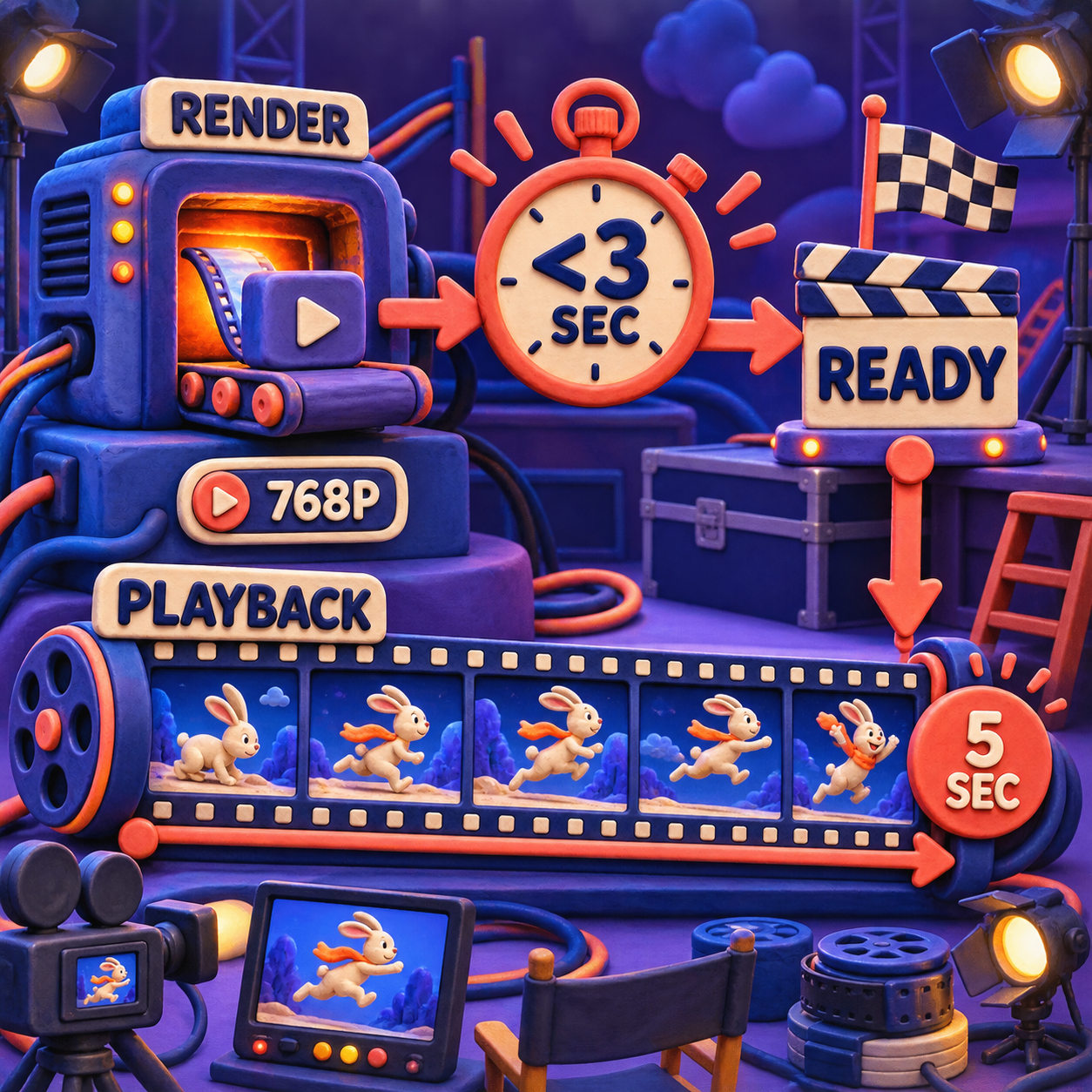
The speed also changes with duration. fal says a 15-second clip takes around 15 seconds, so the headline advantage is strongest at five seconds. The honest answer to the title is therefore yes, for short H3 Max clips at 768p, not every AI video job at every length or resolution.
What H3 Max actually is
H3 Max is fal's performance-tuned version of MiniMax H3. "Post-trained" means fal took the existing open-weight model and trained it further with new data and preference feedback, focusing on prompt adherence and aesthetics. The inference team then shaped the serving system around that model.
Think of it as tuning both a race car and the track. A faster engine helps, but the larger gain comes when the engine, tires, surface, and pit process are designed together. fal says it discarded shortcuts that made the benchmark faster when those shortcuts hurt output quality.
The practical package is specific:
- It makes five to 15 seconds of video at 480p or 768p. The default is 768p, which is 1344 by 768 at 24 frames per second in 16:9.
- Text-to-video supports 21:9, 16:9, 4:3, 1:1, 3:4, and 9:16.
- Image-to-video can use one image as the opening frame and an optional second image as the ending frame. The output follows the opening image's shape.
- Each generation includes synchronized sound in the same pass. You can describe dialogue, ambience, music, and effects alongside the shot.
- The public API returns the video, the expanded prompt when available, and backend timing data.
fal's human-preference study placed H3 Max first for overall quality, prompt understanding, and aesthetics against 12 leading models. Its H3 Max page also reports first place on two outside image-to-video boards: 1,341 Elo on Design Arena and 1,201 Elo on Artificial Analysis with audio. Those rankings are useful evidence, but they are snapshots, not a permanent crown.
How the workflow feels without the API jargon
You give H3 Max a shot brief, not a timeline. The brief can name the subject, action, camera move, look, and sound. For image-to-video, you can also supply the first frame and optionally the last frame.
Then four things happen:
- Choose the frame. Set a duration from five to 15 seconds, choose 480p or 768p, and select an aspect ratio for text-to-video. Image-to-video inherits the opening image's ratio.
- Expand the instruction. Balanced mode spends about a second improving the prompt. Quality mode can spend up to about 30 seconds, which is useful when detail matters more than response time.
- Generate the shot. For a five-second 768p request, fal reports under three seconds of render time. The API's
timings.inferencefield is the GPU denoising time, meaning the stage that turns noise into the final sequence. - Review and finish. A person still decides whether the motion, identity, text, audio, and brand details are usable, then cuts, captions, grades, or rejects the result elsewhere.
Builders also get practical controls around that flow. A prompt can be up to 50,000 characters. A seed is a number that anchors the model's randomness, and fal chooses one when you omit it. The safety checker is on by default. Normal responses return a hosted video URL, while sync mode can return the file as base64 data inside the response.
That last step matters. H3 Max is a very fast shot generator. It is not a complete editor, approval system, rights checker, or campaign manager.
The business math changes before the creative work does
The durable shift is from paying mainly for access to paying directly for attempts. H3 Max lists at $0.08 per output second at 768p, or $0.40 for a five-second shot. The launch rate is half that until September 1. There is no subscription minimum for API use.
You can test the model before paying. fal offers five free five-second 768p generations per rolling 24 hours without sign-up, then five more per day for signed-in users at durations up to 15 seconds. fal also permits commercial use of API output, subject to its terms.
For context, Adobe Firefly plans currently span $9.99 to $199.99 per month, while Runway plans start at $12 per month when billed annually. Those products include interfaces, editing features, storage, and access to multiple models, so the prices are not a clean like-for-like comparison. The point is the budget shape: a product team can treat H3 Max as metered infrastructure inside its own workflow instead of buying another seat for every person who needs an output.

The cheaper loop does not make every output valuable. It makes rejection affordable. That is the real production change. A team can ask for several camera moves or art directions, discard weak takes, and spend senior attention on the small set that survives.
Seven use cases, ranked by who gains most
1. Paid-social teams testing motion concepts
A performance marketer with 20 key images could ask for three five-second motion treatments per image, then route the 60 clips into a review queue. At H3 Max list price, the raw generation spend is $24, or $12 during the launch promotion. The payoff is not automatic ad performance. It is a much shorter path from hypothesis to something the team can judge.
2. Ecommerce teams animating a product catalog
A retailer with 300 approved product stills could turn each one into a short detail shot, rotation, or lifestyle motion test. The opening image anchors the product, while the prompt directs movement and sound. One five-second draft per SKU costs $120 at list price. The workflow pays when the catalog already exists and the expensive part is creating enough motion candidates for merchandising and social placements.
3. Creative directors running live review sessions
An agency team could upload a keyframe during a review, try a different camera move, and inspect a short result while the conversation is still active. Balanced prompt expansion adds about a second and the request still has network overhead, but raw five-second inference no longer forces the meeting to stop. That makes the model useful for deciding direction, even when the generated clip never ships.
4. Social teams producing vertical cutaway shots
A small media team could prompt five to 15 seconds of 9:16 footage with ambience already attached, then use it as a candidate cutaway in a larger edit. Native audio removes a separate sound-generation step. The team still needs disclosure, fact checking, and editorial review, especially when realistic footage could be mistaken for a recorded event.
5. Game teams testing motion from concept art
A game art team could use a character or environment painting as the first frame, define an ending pose with a second frame, and test how the imagined motion reads. This pays as previsualization: it helps people discuss timing and camera intent before committing animation resources. It does not produce controllable game animation or a reusable rig.
6. Pitch teams turning boards into moving proof
A production company could animate the opening and closing frames of a proposed shot for a treatment. The result gives a client something closer to timing than a static storyboard without pretending it is the final footage. The faster loop is valuable because feedback can change the next attempt immediately.
7. Product teams adding responsive video generation
An app builder could place H3 Max behind a prompt box or image uploader, return the finished clip, and expose the measured inference time. Faster short clips make waiting states less awkward and make experimentation feel interactive. The product still needs a secure server-side API layer, moderation, retries, storage, cost controls, and a clear fallback when a generation fails.
If you need to compare the broader field before choosing a model, the existing guides to real-time AI video APIs and image-to-video generators cover the surrounding options.
Three products worth building
1. A catalog motion desk, the strongest opportunity
Build a workflow that takes approved product stills, applies brand-safe motion recipes, generates several five-second candidates, and sends only approved clips to export. Retailers, marketplaces, and commerce agencies would pay for throughput, review control, and repeatability rather than raw generation alone.
The demand is already visible: "image to video AI" gets about 40,500 U.S. searches a month, and "AI image to video generator" gets another 8,100. The smallest sellable version needs a bulk uploader, a handful of motion templates, per-SKU prompt fields, a review queue, and export naming that matches the catalog. At list price, 300 five-second drafts carry $120 of H3 Max generation spend before application costs.
This is the best opportunity because the customer already owns the inputs, has a repeatable job, and can measure the output in approved assets per catalog. The catch is consistency. Product shape, labels, and colors can drift, so the approval layer is the product. A thin upload form with H3 Max behind it has no moat.
2. An instant ad-variant review room
Build a shared room where a marketer uploads key art, requests several camera and audio treatments, and compares the returned clips side by side with comments and approvals. Agencies and in-house growth teams would pay to compress the gap between a creative idea and a decision.
"AI video generator" receives about 246,000 U.S. searches a month, carries transactional intent, and has a $4.56 average cost per click. The MVP is a prompt grid, image upload, five-second generation, side-by-side playback, voting, and an export handoff. Fifty five-second H3 Max drafts cost $20 at list price, leaving room for the workflow layer to carry the value.
The catch is provider substitution. A faster model will arrive. The durable part must be the team's briefs, review history, permissions, and learning about which treatments get approved, not a permanent attachment to H3 Max.
3. A vertical image-to-video preview funnel
Put a narrowly tailored motion preview inside an existing vertical product: a listing platform, menu system, event tool, or creator storefront. The business customer pays for qualified leads or upgraded publishing, while the end user gets a fast first result from one image.
The demand is large but price-sensitive. "Image to video AI free" gets about 12,100 U.S. searches a month, and "free image to video AI" gets about 6,600. A workable MVP offers one controlled template family, a short preview, an approval step, and a paid clean export or batch workflow.
The catch is severe: fal itself offers five free five-second 768p generations per day without sign-up, and generic free tools already fill the search results. This only works when the vertical context saves the user more work than the generation itself. A generic wrapper is a dead end.
Where H3 Max stops being the right answer
Use H3 Max when fast iteration matters more than maximum resolution or deep edit control. Do not choose it just because the speed number is impressive.
- It tops out at 768p. Standard MiniMax H3 is the fal option for 2K output.
- It makes short shots. Duration is limited to five through 15 seconds.
- The sub-three-second claim is narrow. It applies to a five-second 768p render. fal says a 15-second clip takes around 15 seconds, and full request latency includes more than GPU inference.
- Quality prompt expansion can erase the latency advantage. It may spend up to about 30 seconds rewriting the brief.
- It is not the full H3 toolset. fal's H3 Max pages expose text-to-video and image-to-video with first-and-last-frame control. Standard H3 remains the option for 2K reference-to-video and editing.
- It is not a finished production workflow. Selection, continuity, captions, legal review, provenance, and final editing still sit outside the model. For a different approach centered on editing, see Gemini Omni Flash video editing.
My take is simple: faster-than-playback generation matters most as an operations capability. It lets software put video creation inside a working session, but the valuable product is still the system around the model.
Can AI video render faster than playback in 2026?
Yes. fal reports that H3 Max can render a five-second 768p clip in under three seconds. That is faster than the clip's playback duration, although complete request time also includes prompt expansion, queueing, upload, and delivery.
Why are AI-generated videos so slow?
Video models must create many related frames while keeping motion, subjects, camera behavior, and sound coherent. H3 Max attacks the delay on two fronts: further training the model and designing the inference engine around it. fal describes the reported timing as the GPU denoising stage that turns noise into the sequence.
Can I make an AI video from a picture?
Yes. H3 Max's image-to-video endpoint uses an image as the opening frame and can optionally take a second image as the ending frame. The video follows the opening image's aspect ratio and can run from five to 15 seconds.
What is the best AI video generator in 2026?
For a speed-sensitive five-second 768p workflow, H3 Max has a strong case: fal reports sub-three-second rendering and first-place image-to-video results on two public boards. It is not the right choice when you need 2K, reference-to-video, or video editing, where standard MiniMax H3 offers the broader toolset.
If you want a latency-sensitive video workflow built for your business, turn it into a production system.
- Published
- Category
- Design
- Language
Nano Banana 2.1 Explained: Pricing, Changes, and When to Switch
Nano Banana 2.1 cuts 1K and 2K image costs about in half. Compare monthly budgets, verify the migration, and decide when Pro earns its premium.Oct 8, 2026Design
ElevenLabs Alternatives: Murf, MAI-Voice-2, OpenAI TTS and Cartesia (Verified October 2026)
Compare ElevenLabs, Murf, MAI-Voice-2, OpenAI, Cartesia, Google and Speechify by studio or API job, with verified prices and switching costs.Oct 4, 2026Design
Higgsfield API Pricing
Price Higgsfield API video and image jobs, separate API dollars from app credits, and check top-ups, expiry and cashback before scaling.Sep 27, 2026Design
Is Gemini Live Avatar Free
Check Gemini Live Avatar access, Enterprise API charges and custom-avatar limits before budgeting a customer-facing video agent.Sep 27, 2026Design
Gemini 3.8 Flash TTS Pricing
Price Gemini 3.8 Flash TTS by audio minute, compare Flash-Lite and service tiers, and budget the January 2027 increase.Sep 24, 2026Design
ngram vs Demosmith
Compare ngram and Demosmith for product videos, browser capture, revisions and usable exports, with costs matched to the same job.Sep 19, 2026Design
ArtPatt Pricing
ArtPatt pricing explained: Free limits, Pro exports, saved patterns, AI-image allowances, and when a paid plan earns its place.Sep 15, 2026Design