Klaviyo Pricing (2026): When the Higher Price Pays Back
Klaviyo costs $20 at 500 active profiles and $1,380 at 100,000. See every tier, current mobile rules, hidden costs, and break-even math.
Published Updated
 By Omid Saffari






Klaviyo starts at $20 per month for 500 active profiles, reaches $150 at 10,000, and costs $1,380 at 100,000. Pay that premium only when ecommerce flows recover more contribution than the gap to a $9 to $16 alternative.
Klaviyo pricing at a glance
Klaviyo prices its core Profiles and Email product by active profiles, then gives most paid bands an email allowance equal to roughly 10 sends per profile. The live Klaviyo pricing page is the source of record for the dollar amount, while the billing page in your account is the source of record for your own profile count and mobile rate.
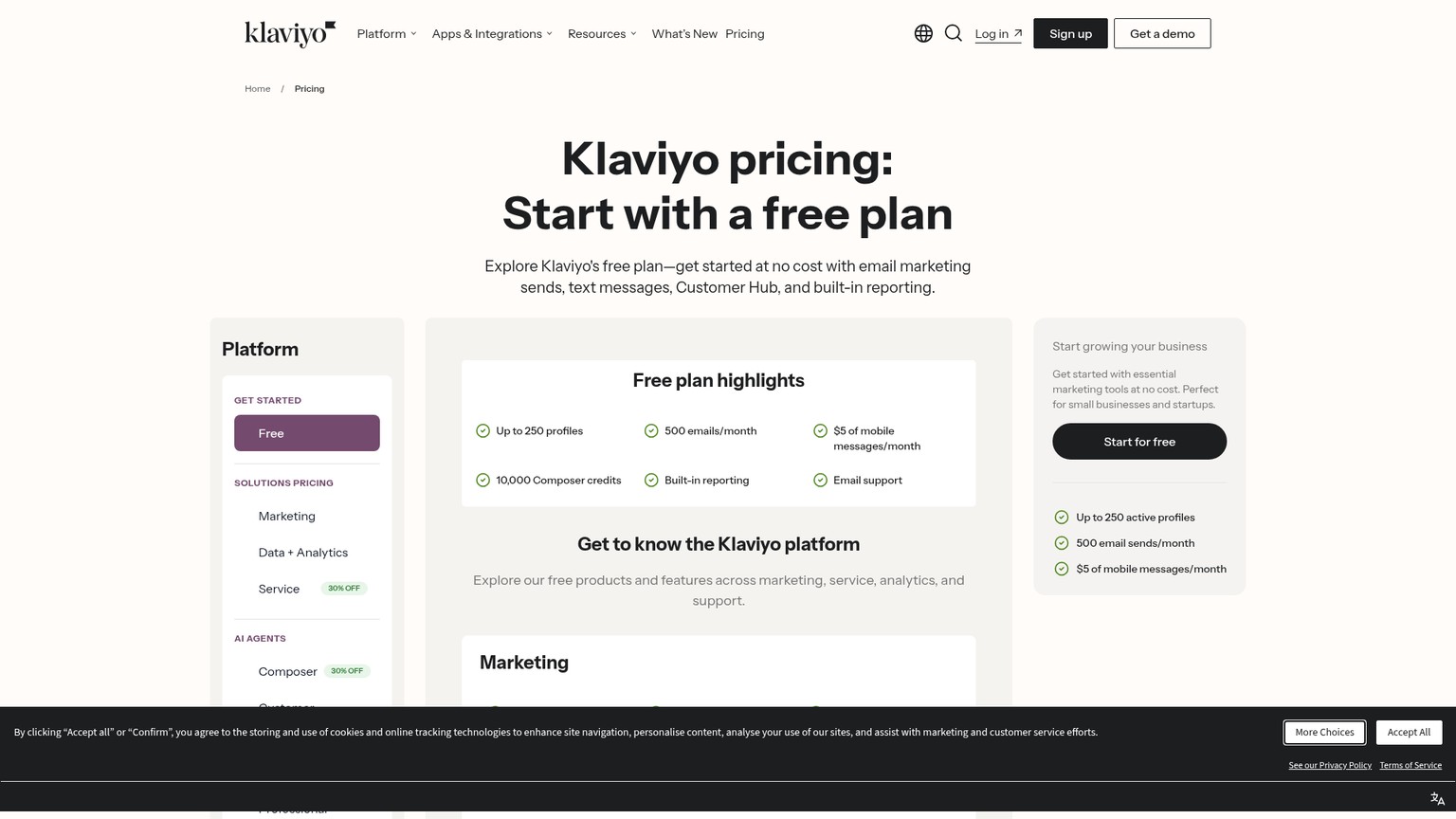
Verified against Klaviyo's live pricing page and current public calculator on August 11, 2026. These are monthly US dollar prices before optional products, mobile spend, taxes, and custom services.
The table shows the cost at full use of the included email allowance. If a 10,000-profile account sends only 20,000 emails, its effective cost is $7.50 per 1,000, not $1.50. Paying for a large allowance does not make it cheap when most of that allowance sits unused.
The verdict: pay for outcomes, not the platform name
Klaviyo's entry paid plan is not wildly expensive in isolation. The issue is how fast profile-based billing compounds. A store at 500 active profiles pays $240 per year. At 10,000, the annual core bill is $1,800. At 50,000 it becomes $8,640, and at 100,000 it is $16,560 before mobile messaging or add-ons.
That progression makes the verdict situational:
- Pay for Klaviyo when your store captures useful product, checkout, and order behavior, and someone will build and maintain flows against it. The premium then has a job: recover carts, repeat purchases, or margin.
- Stay free when you have no more than 250 active profiles and can live within 500 emails per month. The free account can remain free indefinitely while both limits hold.
- Choose a cheaper alternative when your main job is broadcasting a newsletter. At the normalized entry level, Klaviyo costs $4.00 per 1,000 included sends, versus $2.67 for Omnisend Standard at its regular price, $2.60 for Mailchimp Essentials, and $1.80 for Brevo Starter.
- Clean the list before upgrading when inactive but billable profiles are pushing you over a threshold. One profile can add $25 per month at several cliffs.
The cleanest break-even test is contribution, not revenue. If Klaviyo costs $11 more per month than Brevo Starter at the entry level, the flows need to create more than $11 of additional monthly contribution. Gross sales can look impressive while discounts, product cost, and fulfillment erase the software payback.
How Klaviyo billing works
The core bill has two meters: active profiles and emails sent. You need a plan that covers the active profiles in the account, and each band carries a monthly send limit.
An active profile is a valid profile that can receive at least one type of marketing and is not suppressed or deleted. Klaviyo's billing explanation says consent status by itself does not decide whether a profile is billable. An address added through checkout or another engagement can count even when that person did not explicitly subscribe to email.
That definition is the first hidden budget variable. A marketing lead may report one subscriber count while Billing sees 10,001 active profiles. The latter number sets the tier.
Email accounting is equally literal. Messages that leave Klaviyo count whether they are delivered or bounce. Skipped emails do not count. API-triggered emails share this plan allowance because they still leave the same Klaviyo system; there is no separate public API subscription that creates another send pool.
All public self-serve plans renew monthly. A paid cycle renews on the date the account began paying, while a free cycle renews on the first of the month. The public pricing page does not show an annual toggle or annual discount. Multiply the monthly tier by 12 for the standing annual budget, but keep the contract itself monthly unless Klaviyo quotes something different directly.
If you exceed a send limit, Klaviyo offers two broad responses:
- Flexible overages buy the next tier's full sending capacity once, priced at the base plan's unit rate. This is designed for an occasional peak.
- Auto-upgrade moves the subscription upward and leaves it there until you change it. This is the safer continuity choice for recurring volume, but it can quietly reset the budget baseline.
Klaviyo says a normal upgrade is generally more economical than repeated flexible sending. A seasonal DTC brand might flex for a single holiday burst. A brand crossing its allowance every cycle should budget the higher tier rather than treating a recurring requirement as an exception.

Every Klaviyo Profiles and Email tier
Klaviyo does not use a neat three-plan ladder. It uses many profile bands, especially after 10,000 profiles. That reduces some jumps, but it also makes the exact threshold more important than a generic starting price.
Here is the complete public self-serve ladder verified in August 2026:
Free through 10,000 active profiles
- 0 to 250: $0 per month with 500 emails.
- 251 to 500: $20 per month with 5,000 emails.
- 501 to 1,000: $30 per month with 10,000 emails.
- 1,001 to 1,500: $45 per month with 15,000 emails.
- 1,501 to 2,500: $60 per month with 25,000 emails.
- 2,501 to 3,000: $70 per month with 30,000 emails.
- 3,001 to 3,500: $80 per month with 35,000 emails.
- 3,501 to 5,000: $100 per month with 50,000 emails.
- 5,001 to 5,500: $110 per month with 55,000 emails.
- 5,501 to 6,000: $130 per month with 60,000 emails.
- 6,001 to 6,500: $140 per month with 65,000 emails.
- 6,501 to 10,000: $150 per month with 100,000 emails.
The unusual band here is 6,501 to 10,000. It gives the full 100,000-send allowance at $150. A brand near 6,500 profiles therefore gains much more headroom when it crosses into that band than it did at the smaller steps.
10,001 through 30,000 active profiles
- 10,001 to 10,500: $175 per month with 105,000 emails.
- 10,501 to 11,000: $200 per month with 110,000 emails.
- 11,001 to 11,500: $225 per month with 115,000 emails.
- 11,501 to 12,000: $250 per month with 120,000 emails.
- 12,001 to 12,500: $275 per month with 125,000 emails.
- 12,501 to 13,000: $300 per month with 130,000 emails.
- 13,001 to 13,500: $325 per month with 135,000 emails.
- 13,501 to 15,000: $350 per month with 150,000 emails.
- 15,001 to 20,000: $375 per month with 200,000 emails.
- 20,001 to 25,000: $400 per month with 250,000 emails.
- 25,001 to 26,000: $425 per month with 260,000 emails.
- 26,001 to 27,000: $450 per month with 270,000 emails.
- 27,001 to 28,000: $475 per month with 280,000 emails.
- 28,001 to 30,000: $500 per month with 300,000 emails.
From 10,001 through 13,500 profiles, each extra 500-profile band adds $25 per month. At 13,501, the band widens to 1,500 profiles. The practical lesson is to price from your exact live count, not from a rounded claim that you have “about 10,000 contacts.”
30,001 through 100,000 active profiles
- 30,001 to 35,000: $550 per month with 350,000 emails.
- 35,001 to 40,000: $600 per month with 400,000 emails.
- 40,001 to 45,000: $650 per month with 450,000 emails.
- 45,001 to 50,000: $720 per month with 500,000 emails.
- 50,001 to 55,000: $790 per month with 550,000 emails.
- 55,001 to 60,000: $860 per month with 600,000 emails.
- 60,001 to 65,000: $930 per month with 650,000 emails.
- 65,001 to 70,000: $1,000 per month with 700,000 emails.
- 70,001 to 75,000: $1,070 per month with 750,000 emails.
- 75,001 to 80,000: $1,140 per month with 800,000 emails.
- 80,001 to 85,000: $1,205 per month with 850,000 emails.
- 85,001 to 90,000: $1,265 per month with 900,000 emails.
- 90,001 to 95,000: $1,325 per month with 950,000 emails.
- 95,001 to 100,000: $1,380 per month with 1,000,000 emails.
At this scale, the band size is mostly 5,000 profiles and the monthly jump ranges from $50 to $70. The cost per maximum active profile generally improves, but the actual invoice becomes material enough to manage as a budget line rather than a card expense.
100,001 through 150,000 active profiles
- 100,001 to 105,000: $1,440 per month with 1,050,000 emails.
- 105,001 to 110,000: $1,495 per month with 1,100,000 emails.
- 110,001 to 115,000: $1,555 per month with 1,150,000 emails.
- 115,001 to 120,000: $1,610 per month with 1,200,000 emails.
- 120,001 to 125,000: $1,670 per month with 1,250,000 emails.
- 125,001 to 130,000: $1,725 per month with 1,300,000 emails.
- 130,001 to 135,000: $1,785 per month with 1,350,000 emails.
- 135,001 to 140,000: $1,840 per month with 1,400,000 emails.
- 140,001 to 145,000: $1,900 per month with 1,450,000 emails.
- 145,001 to 150,000: $1,955 per month with 1,500,000 emails.
Above 150,000 active profiles, the public calculator hands the account to sales for a custom quote. At that point, ask for the profile band, included email volume, mobile commitment, support, and any dedicated infrastructure as separate line items. A single blended monthly total makes later renewal math harder.
Is Klaviyo free?
Yes. Klaviyo Free costs $0 and supports up to 250 active profiles and 500 emails per month. The current Free plan also includes $5 of mobile messages per month, 10,000 Composer credits, built-in reporting, basic Customer Hub, basic Helpdesk, templates, the editor, automations, segmentation, and reports.
The account does not expire merely because time passes. You can remain free indefinitely while both the 250-profile and 500-email limits hold. Email support lasts for the first 60 days; community and self-service resources remain after that.
Where Free stops is more important than the feature list:
- Go over the active-profile limit and Klaviyo can stop email sending and prevent flow emails from going live until the count is compliant or the account upgrades.
- Use all 500 monthly emails and sending pauses until the cycle resets or the plan changes.
- Use the $5 mobile allowance and further mobile sending needs paid capacity.
- Grow to 251 active profiles and the first paid Profiles and Email band is $20 per month.
Who never needs to pay: a very small store validating its first flows, a prelaunch list with infrequent sends, or a side business that can keep fewer than 251 marketable profiles and send no more than 500 emails monthly. If the account sends a weekly message to the full 250-profile list, the allowance is already too small. Free is a useful sandbox and a genuine tiny-list plan, not a long-term weekly newsletter plan at the limit.
Klaviyo SMS and mobile pricing changed in 2026
Klaviyo replaced mobile-message credits with dollar-denominated per-message rates on July 13, 2026 for new customers and free mobile plans. Existing paid mobile subscriptions transition on their next billing cycle after August 13, 2026. That date matters because a credit-based estimate is no longer the right way to forecast a new account.
Under the new mobile pricing model, you still buy an upfront monthly dollar commitment. Each message draws down that commitment at a rate based on channel, country or region, number type, and carrier or provider costs. Carrier fees are already included, so they do not arrive as a separate line item.
Klaviyo introduced more than 70 narrower mobile tiers. It does not publish one universal per-message rate that can safely stand in for every account. The exact rate lives in Billing Overview because a US toll-free SMS, a Canadian short-code message, and a WhatsApp message can have different economics.
The current free allowance is $5 of mobile messages per month. Paid examples in Klaviyo's billing guidance include $15 and $25 monthly commitments, but the right commitment depends on destination and channel mix. Larger commitments can carry volume economics, while a poor geography estimate can still make the plan undersized.
Three mobile costs deserve a calendar reminder:
- Unused dollars do not roll over. Overbuying is waste, not a banked balance for next month.
- Short codes are separate. A US or Canada short-code subscription is billed apart from the mobile plan.
- Overage behavior depends on settings. Auto-upgrade changes the ongoing tier. Flex temporarily bills additional spend, and current mobile Flex availability begins on plans of $490 or more.
Add-ons that can change the Klaviyo bill
Profiles and Email is only the core line. Klaviyo's plan builder can add Reviews, Marketing Analytics, Advanced KDP, Customer Hub, Helpdesk, Customer Agent, Composer, Social Marketing, and paid support. Each product uses its own meter, so “Klaviyo costs $150” may describe only one piece of a 10,000-profile account.
Reviews
Reviews is metered by monthly orders eligible for review requests. The complete public ladder is 50 orders free; 250 for $25; 1,000 for $90; 2,000 for $175; 3,500 for $300; 10,000 for $500; 15,000 for $750; 25,000 for $1,000; 50,000 for $1,500; 100,000 for $2,000; 150,000 for $3,000; 200,000 for $4,000; 400,000 for $8,000; 600,000 for $12,000; 800,000 for $16,000; and 1,000,000 for $20,000 per month.
This meter can produce a very different bill from profile count. A high-order-frequency brand with a modest list can outgrow Reviews sooner than Profiles and Email.
Analytics and data
Marketing Analytics starts at $100 per month and stays at that price through 13,500 active profiles, then scales with the profile ladder. Advanced KDP uses total profiles rather than active profiles. Its public points include $500 per month at 100,000 total profiles, $1,250 at 250,000, $2,500 at 500,000, $3,750 at 750,000, and $4,765 at 1,000,000.
That different denominator matters. Suppressing a profile may reduce the active-profile bill but does not make historical customer data disappear from a product metered on total profiles.
Service and content products
The live page currently shows promotional and full prices side by side for several products. Budget from the full price unless the checkout states a durable term:
- Customer Hub: $20 promotional, $30 full per month through 10,000 active profiles.
- Helpdesk: $10 promotional, $15 full per month for 50 tickets.
- Customer Agent: $50 promotional, $75 full per month for 75 conversations.
- Composer: $14 promotional, $20 full per month for 2,000 credits.
- Social Marketing: $38 promotional and $50 full through 10,000 active profiles; $94 and $125 through 25,000; $150 and $200 through 50,000; $225 and $300 through 150,000.
Professional Support is $500 per month. Enterprise Support is $1,800 per month. A dedicated IP has no public price and is available only to qualifying accounts through an account manager. Klaviyo recommends a 30 to 40 day warming period, which creates an operational cost even before a custom infrastructure charge is known.
The decision rule for add-ons is simple: give each one its own owner, usage meter, and outcome. If Customer Agent is supposed to deflect tickets, measure contribution against conversations. If Reviews is supposed to increase conversion, measure it against eligible orders. Do not let a promising feature disappear into the core platform total.
Hidden Klaviyo costs and billing traps
The visible tier is only the opening number. These are the conditions most likely to move the actual bill.
Active-profile drift
Imported contacts, checkout addresses, and other eligible profiles can make Billing larger than the marketing list you normally report. Suppressing, deleting, or bulk-removing profiles can take up to 72 hours to refresh. Klaviyo also says to reduce the count or make a downgrade more than 24 hours before renewal.
The practical move is to begin cleanup several days before the cycle closes, not on renewal morning. A brand at 10,001 active profiles pays $175 instead of $150. Waiting for one profile to clear after the deadline can cost $25 for the next month.
Flexible overages can cost more than the planned tier
Flex buys all of the next tier's send capacity at the current base unit rate without permanently changing the subscription. That convenience suits one peak. If it happens repeatedly, Klaviyo's own guidance is that an upgrade is generally more economical.
Auto-upgrade solves continuity but changes the standing plan. It can occur during the cycle, and the account stays on that higher plan until someone changes it. Put an owner on the billing preference; “the platform upgraded itself” is still a budget decision.
Mobile dollars expire
An unused mobile commitment does not roll over. The rate also varies by route, and a short-code subscription is separate. Forecasting one blended message cost can hide both underuse and expensive destinations.
API and app usage are not separate bargains
There is no public API-versus-app price split for core email. The billing rule counts messages that leave Klaviyo. Moving a flow from a visual campaign to an API trigger does not create free sends.
Downgrades do not refund the current cycle
Klaviyo does not refund a mid-cycle downgrade. A cancellation or downgrade controls future billing, not the value left in the current cycle. Make the decision before renewal rather than after the invoice lands.
The annual-lock trap is an assumption
Klaviyo's public self-serve plans are monthly and the pricing page shows no public annual discount. The trap is budgeting an annualized price as if prepayment will reduce it. Use 12 times the monthly amount unless a written quote says otherwise.
Promotions are not the operating baseline
Customer Hub, Helpdesk, Customer Agent, Composer, and Social Marketing currently display lower promotional prices next to full prices. A durable P&L should carry the full number. Treat the promotion as temporary savings, not the price that must remain available.
The Klaviyo cost math
The core plan becomes more efficient with scale only when you use its send allowance. At maximum included volume, the cost per 1,000 emails falls from $4.00 at 500 profiles to $3.00 at 1,000, $2.00 at 5,000, $1.50 at 10,000, $1.44 at 50,000, and $1.38 at 100,000. The 25,000-profile tier briefly rises to $1.60 per 1,000 because of the ladder shape.
Cost per maximum active profile follows a similar pattern: $0.040 at 500, $0.030 at 1,000, $0.020 at 5,000, $0.015 at 10,000, $0.016 at 25,000, $0.0144 at 50,000, and $0.0138 at 100,000.
Those unit rates answer efficiency. They do not answer affordability. The annual core budget at the same checkpoints is $240, $360, $1,200, $1,800, $4,800, $8,640, and $16,560.
One profile can carry a large marginal price
Profile bands turn some individual contacts into expensive threshold crossings:
- 10,000 to 10,001 profiles changes the bill from $150 to $175, a $25 monthly or $300 annual jump.
- 13,500 to 13,501 changes $325 to $350, also $25 monthly or $300 annually.
- 25,000 to 25,001 changes $400 to $425, again $25 monthly or $300 annually.
- 100,000 to 100,001 changes $1,380 to $1,440, a $60 monthly or $720 annual jump.

This is not an argument for suppressing engaged people to save pennies. It is an argument for removing profiles that should not be marketable before they trigger a whole band.
Break-even in orders, not features
Take a small DTC brand comparing Klaviyo's $20 entry plan with Brevo Starter at $9 monthly. The gap is $11. Assume an $80 average order value and a 60 percent contribution margin, leaving $48 contribution per incremental order. These are illustrative assumptions, not a vendor result.
One additional order would cover 4.36 months of that $11 monthly gap. Under those assumptions, Klaviyo does not need a dramatic lift to justify the entry premium. But the order must be incremental, attributable enough to trust, and created by a flow or segmentation advantage the cheaper setup would not have delivered.
At 10,000 profiles, use the same method with your actual alternative quote. Subtract alternative cost from Klaviyo's $150, then divide the difference by contribution per order. That result is the minimum extra orders Klaviyo must create every month. If nobody can name the flows expected to create them, choose the cheaper tool.
Klaviyo vs the alternatives on price
The fair comparison uses ongoing monthly prices, similar contact counts, and similar send allowances. Introductory promotions can make a checkout look cheap without improving the next year's P&L.
Omnisend: the closest lower-cost entry
Omnisend Standard currently covers 500 contacts and 6,000 emails for $11.20 per month during the first three months, then $16 regular. At the regular price and full allowance, that is $2.67 per 1,000 emails.
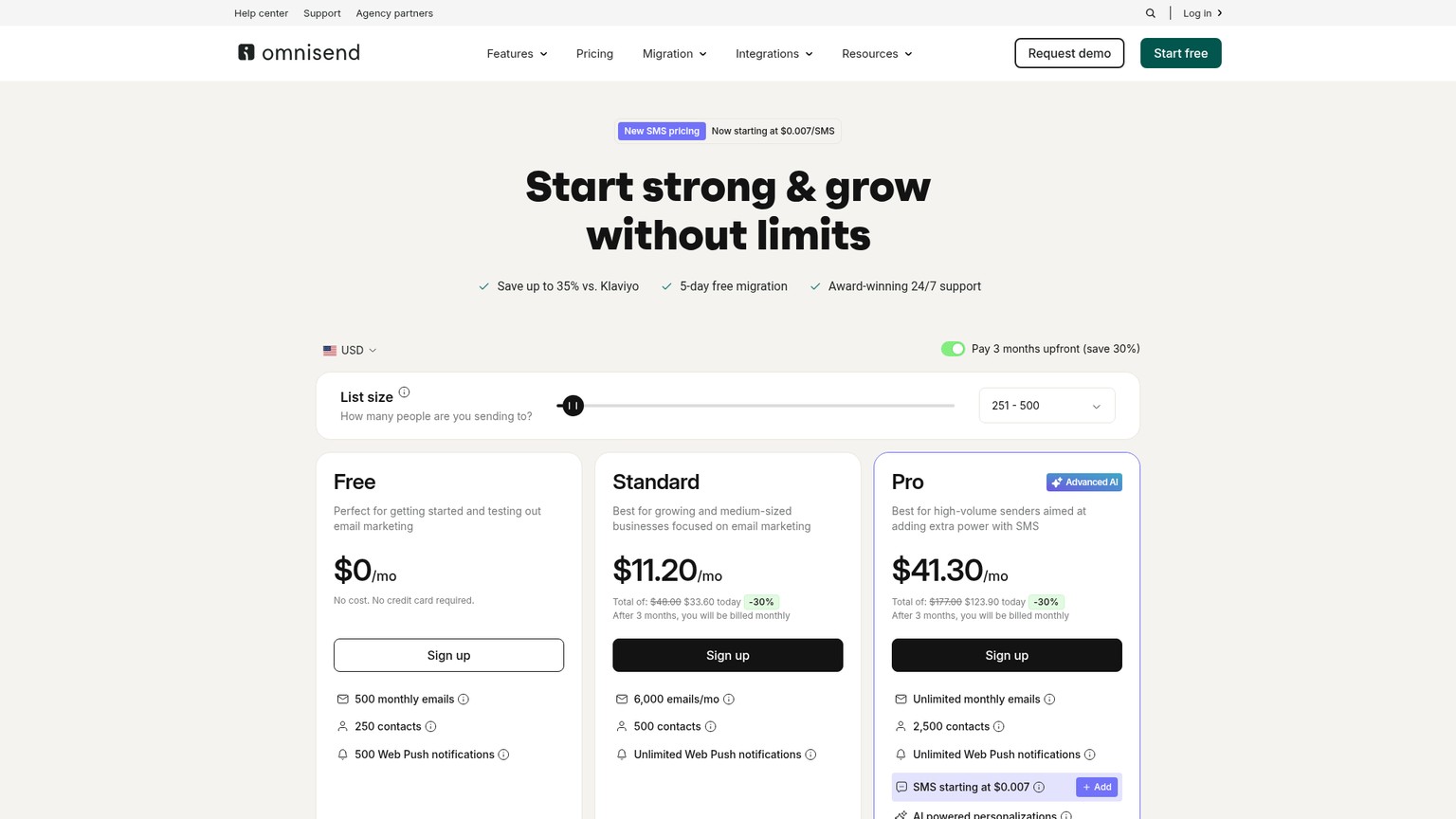
Klaviyo's comparable 500-profile band is $20 with 5,000 emails, or $4.00 per 1,000. Klaviyo therefore costs 25 percent more per month while including fewer sends at this checkpoint.
Choose Omnisend when the lower recurring entry price matters more than the specific Klaviyo workflow you have identified. Choose Klaviyo only when that workflow has a measurable payback. The deeper Omnisend versus Klaviyo comparison covers the broader product decision.
Mailchimp: cheaper Essentials, equal Standard price
Mailchimp Essentials starts at $13 per month for 500 contacts and 5,000 monthly sends. Mailchimp Standard starts at $20 for 500 contacts and 6,000 sends.
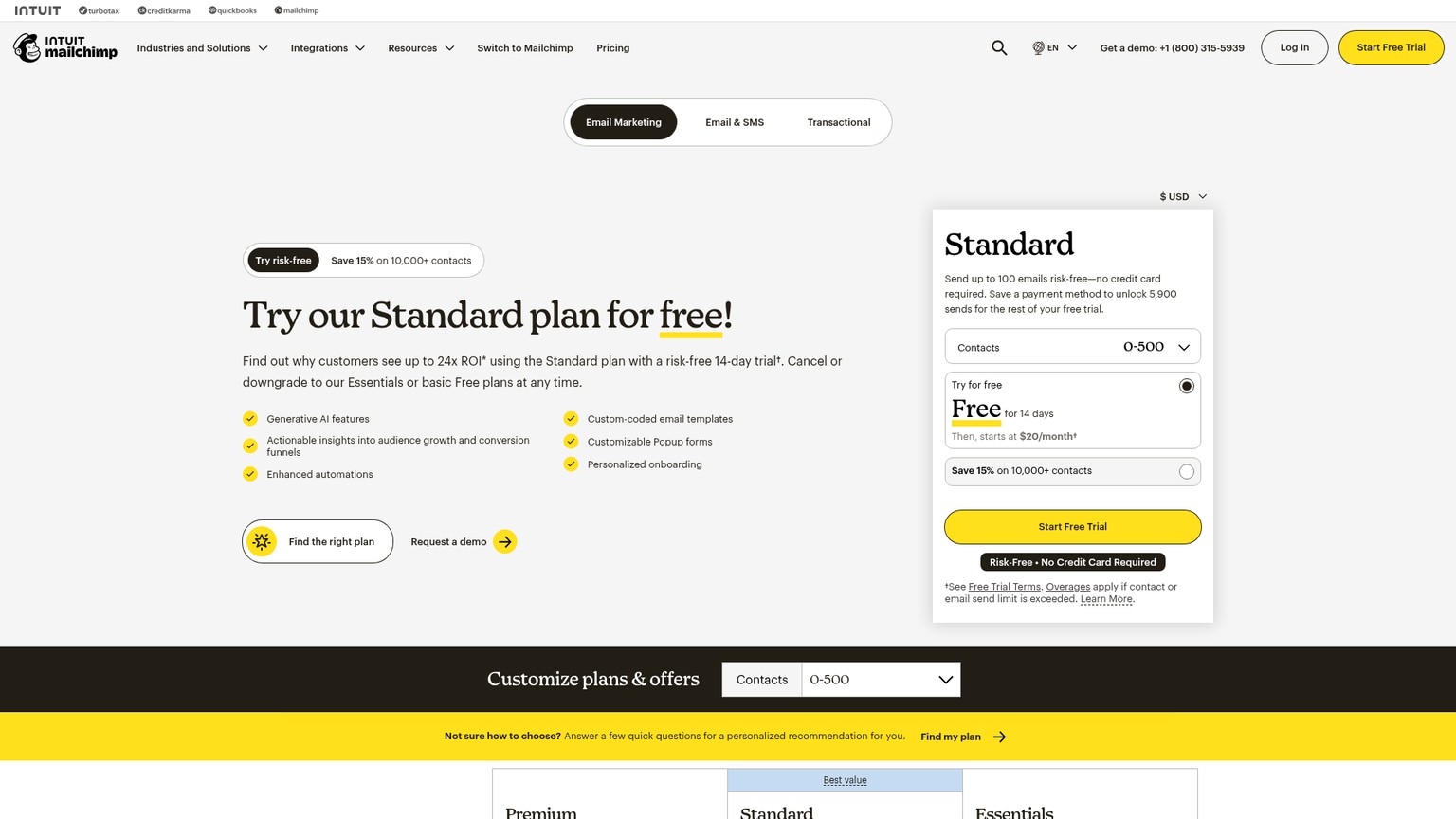
Against Essentials, Klaviyo costs 53.8 percent more for the same 5,000-send allowance. Against Standard, the entry dollar price is equal, but the included allowance differs by 1,000 sends. At 10,000 contacts, Mailchimp's displayed regular prices after its 12-month introductory period are $110 for Essentials and $135 for Standard, versus Klaviyo's $150 through 10,000 active profiles.
Mailchimp is the simpler price choice when a buyer mainly needs email and the Klaviyo-specific revenue case is absent. Klaviyo is the operator's choice only when its use of store behavior can recover the gap. See the full Klaviyo versus Mailchimp ecommerce pricing analysis before migrating a mature account.
Brevo: the lowest normalized send cost
Brevo Starter costs $9 with monthly billing and includes 5,000 emails per month. Its annual option is shown as an $8.08 monthly equivalent. Brevo Free allows 300 emails per day.
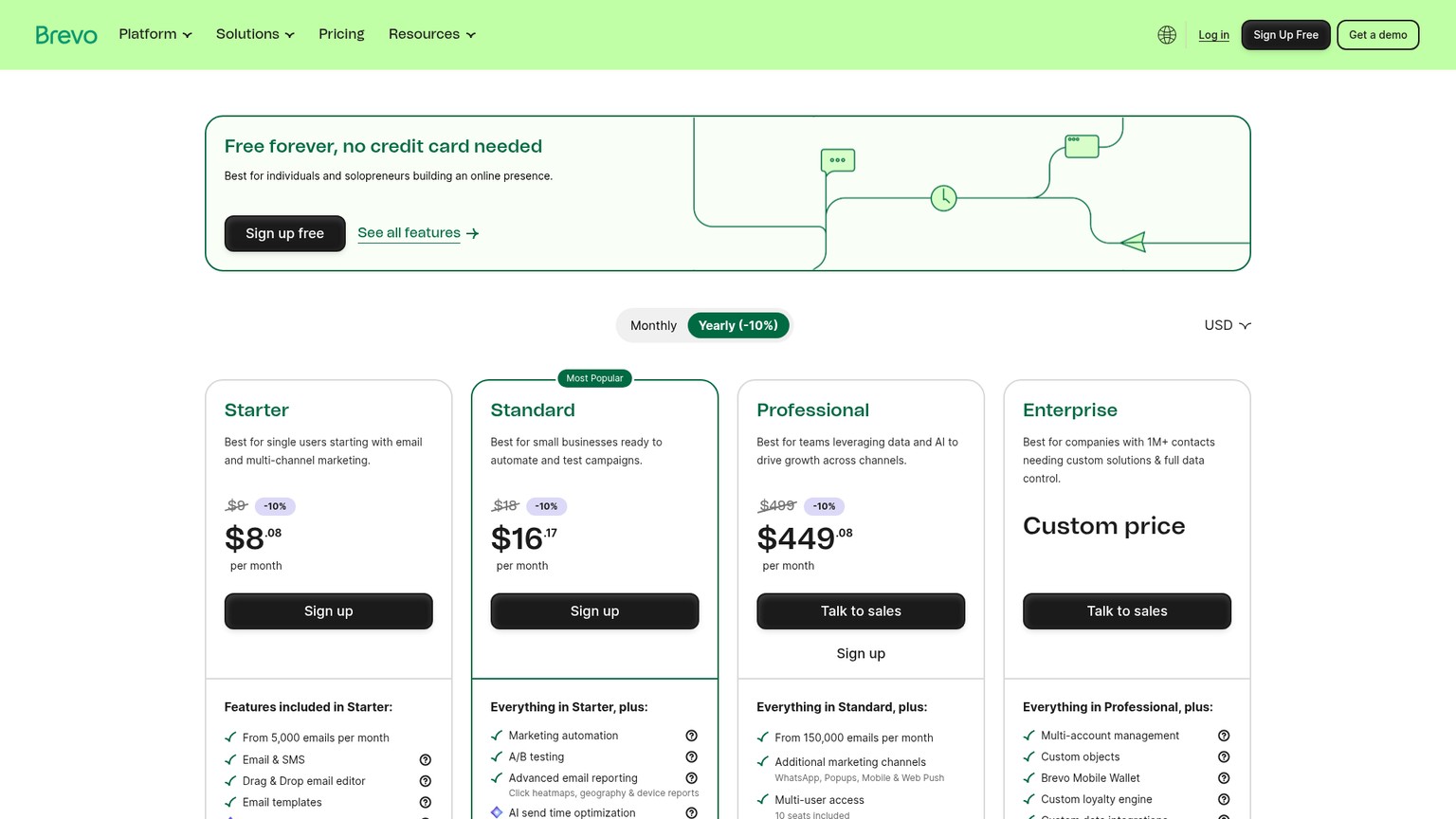
At the monthly Starter price, Brevo works out to $1.80 per 1,000 included sends. Klaviyo's $20 entry band is 122.2 percent more expensive and carries the same 5,000-email allowance, though Klaviyo's meter is explicitly capped at 500 active profiles at that price.
Brevo is the clean budget choice when send volume matters and the buyer has not identified a Klaviyo-only revenue case. The $11 monthly gap is small at entry, but percentage differences become less useful as lists grow because each vendor's ladder changes. Reprice the exact account instead of extrapolating the starting rate.
For a wider shortlist beyond these three, the AI email marketing tools pricing guide puts the plans into a broader buying context.
The Monday move: price your actual account
Do this before a renewal, migration, or peak campaign. The output should be one monthly number and one reason to accept it.
Record the billable count
Open Billing Overview and write down active profiles, not newsletter subscribers. If cleanup is needed, begin early enough for the possible 72-hour refresh and finish more than 24 hours before renewal.
Forecast the peak email month
Count campaigns and automated sends separately, then add them. Delivered and bounced messages count; skipped messages do not. Compare the peak with the tier allowance, not the average month.
Price mobile by route
For each country, channel, and number type, multiply the in-account per-message rate by expected volume. Add the results, choose the closest commitment, and remember that unused dollars do not roll over.
Expose the cliff
Write down the next profile threshold and its monthly jump. If the account is just over it, identify inactive billable profiles before accepting a higher baseline.
Set the overage owner
Use Flex for a genuine one-time spike and Upgrade for a repeated pattern. Assign one person to review auto-upgrades and add-on promotions before every renewal.
The final line should read like this: “Klaviyo costs us X per month, and it must create Y additional contribution through these named flows.” If the second half is blank, the buying decision is not ready.
Frequently asked questions
Is Klaviyo free?
Yes. Klaviyo Free costs $0 and allows up to 250 active profiles, 500 emails per month, $5 of mobile messages per month, and 10,000 Composer credits. You can remain on it indefinitely while the profile and email limits hold.
Why is Klaviyo so expensive?
Klaviyo becomes expensive because it charges in active-profile bands and most paid tiers bundle about 10 emails per maximum profile. The price is defensible when ecommerce data and flows generate more contribution than the gap to a cheaper sender; it is difficult to defend for a light newsletter.
Is Klaviyo or Mailchimp cheaper?
Mailchimp Essentials is cheaper at the normalized 500-contact level: $13 per month with 5,000 sends versus Klaviyo at $20 with 5,000 sends. Mailchimp Standard and Klaviyo both start at $20 around this level, but Standard includes 6,000 sends while Klaviyo includes 5,000.
How much does it cost to send 1,000 emails with Klaviyo?
Klaviyo does not sell core email in isolated 1,000-email blocks. At full use of the allowance, the effective core cost is $4.00 per 1,000 on the 500-profile plan, $1.50 at 10,000 profiles, and $1.38 at 100,000 profiles. Sending less than the allowance raises the effective unit cost.
Does Klaviyo offer a student discount?
Klaviyo does not advertise a student discount on its public pricing page as of August 11, 2026. A student or very small project can use the $0 plan while staying within 250 active profiles and 500 monthly emails.
What is Klaviyo's refund policy?
Klaviyo says it does not refund a mid-cycle downgrade. Make a downgrade more than 24 hours before renewal, and allow for the possible 72-hour delay after cleaning active profiles.
Did Klaviyo pricing change in 2026?
Yes, for mobile messaging. Klaviyo moved new customers and free mobile plans from credits to dollar-denominated per-message rates on July 13, 2026. Existing paid mobile subscriptions transition on the next billing cycle after August 13, 2026.
Does Klaviyo offer an annual discount?
The public self-serve pricing page shows monthly billing and no annual discount toggle. For planning, multiply the monthly tier by 12 unless a written custom quote says otherwise.
Does Klaviyo charge separately for API email?
Klaviyo does not publish a separate core API subscription. Its billing rule counts messages that leave the system, so API-triggered emails use the same plan allowance rather than creating a free parallel pool.
Use the AI Business Workflow Audit Checklist to decide which automation deserves a paid line item.
- Last Updated
- Category
- Growth
- Language

Beehiiv Review
Beehiiv reviewed for business newsletters: current pricing, growth, monetization, AI, MCP, analytics and the costs that change the buying decision.Oct 10, 2026Growth
Trainual Review
Trainual review for SOPs and onboarding: AI drafting, knowledge search, read-only MCP, quote-only plans, implementation and who should skip it.Oct 10, 2026Growth
SocialBee Review
SocialBee review of evergreen scheduling, AI Copilot and client workspaces, with all six plans, add-on costs, and Buffer and Later comparisons.Oct 10, 2026Growth
SurveyMonkey Pricing: Plans, Response Caps and Annual Bills
SurveyMonkey prices, response caps and AI limits, with annual bills for one person and three-seat teams. See when overages change the best plan.Oct 10, 2026Growth
ActiveCampaign Alternatives: GetResponse, Kit and More
Compare ActiveCampaign alternatives at 2,500, 10,000 and 25,000 contacts, with vendor prices, workflow trade-offs and a migration checklist.Oct 9, 2026Growth
CallRail Alternatives: WhatConverts and More Compared
Compare six CallRail alternatives by vendor pricing, usage fees, AI and reporting. Includes WhatConverts cost math and a pre-switch checklist.Oct 9, 2026Growth
Monday.com Pricing: Seat Buckets and the Yearly Bill
Calculate monday.com Work Management costs for 5, 12 and 40 people, including seat buckets, annual vs monthly billing and AI credit charges.Oct 9, 2026Growth