Monday.com Pricing: Seat Buckets and the Yearly Bill
Calculate monday.com Work Management costs for 5, 12 and 40 people, including seat buckets, annual vs monthly billing and AI credit charges.
Published
 By Omid Saffari


monday.com pricing starts at $9 per seat per month on annual Basic, but a 12-person team needs 15 paid seats. That makes Standard $2,160 a year for seats, or $2,400 including the minimum AI bundle before discounts and tax. Choose Standard for light coordination; choose Pro when you need private boards, time tracking or regular automation.
Verified against monday.com's live pricing page, October 2026, checked October 9. All dollar amounts below are USD. Annual rates are monthly equivalents paid upfront for the year. The calculations use published Work Management seat prices and credit charges, not negotiated quotes. Source: monday.com pricing.
monday.com Work Management, also called the monday AI work platform in current support documentation, organizes tasks, projects and operational workflows. monday CRM is a separate product with its own prices. If you are buying a sales pipeline system, use our monday CRM pricing breakdown; its rates do not belong in the Work Management budget.
Partner disclosure: monday.com is a partner. Qualifying purchases through our links may earn a commission.
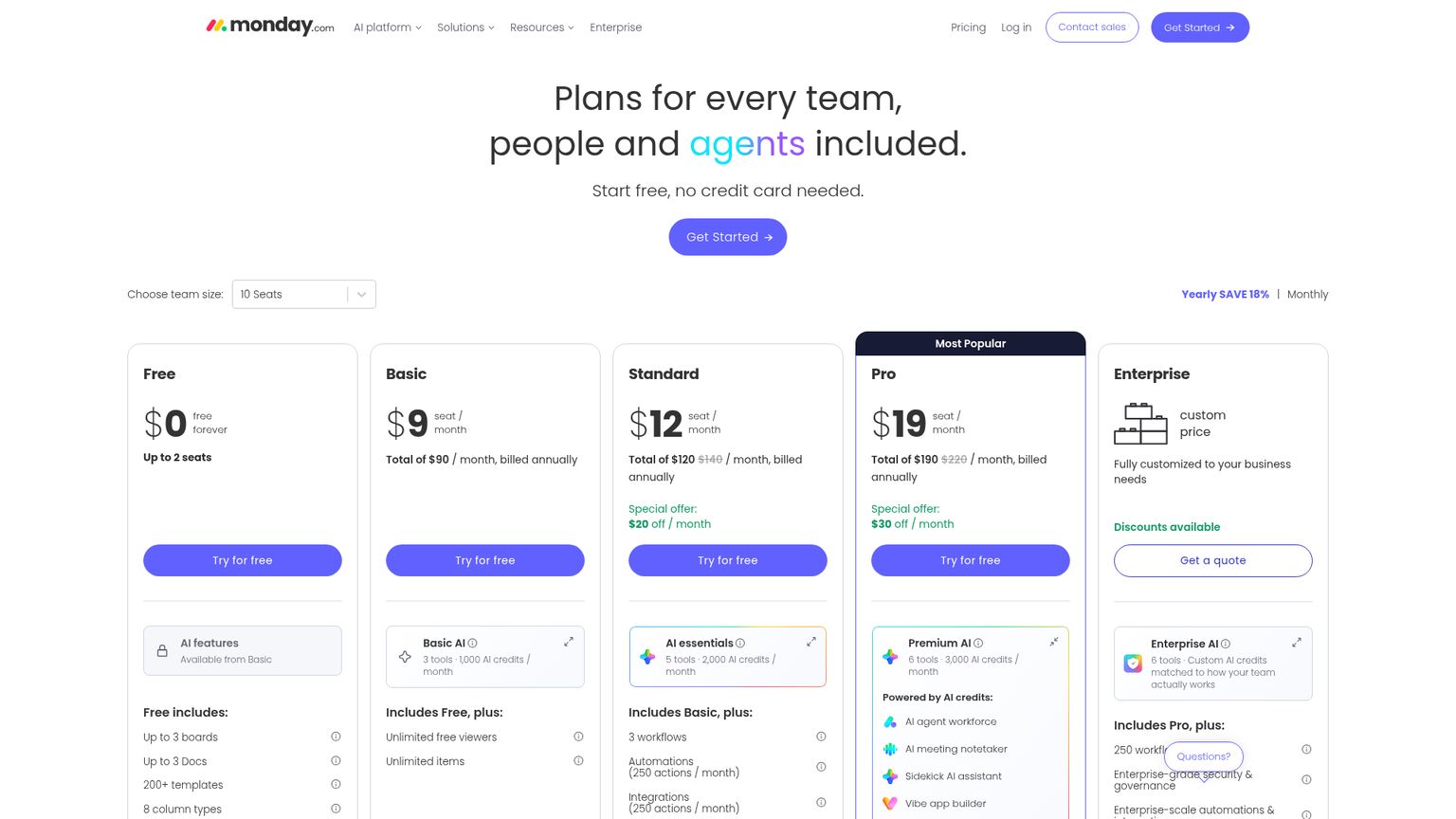
monday.com pricing plans at a glance
The paid seat rates are $9, $12 and $19 on annual billing, versus $12, $14 and $24 on monthly billing. The table covers the seat component only; the required AI credit purchase and the current discount are explained immediately below it.
Sources: live plan prices and features, seat rules and Enterprise term, and action allowances.
At the three-seat minimum, the annual seat-only bills are $324 Basic, $432 Standard and $684 Pro. On monthly billing, those same three seats cost $36, $42 or $72 a month, before any AI credit charge and tax.
The AI line changes the total. The annual pricing view currently lists minimum monthly credit bundles costing $10 for Basic, $20 for Standard and $30 for Pro, alongside special monthly discounts that offset those amounts. Where that offer applies, the displayed total returns to the seat subtotal. Without the discount, budget another $120, $240 or $360 a year, respectively. Do not treat a promotional credit discount as a permanent free allowance. Current purchase breakdown.
Basic fits a shared tracker; Standard fits light coordination
Basic is enough when your operations assistant and colleagues mainly update a shared task list manually. It includes unlimited items, the rows that represent tasks or records, and unlimited free viewers who can read without editing. But automations and integrations start at Standard. Paying for Basic and then discovering that your handoff needs an automatic notification is an avoidable upgrade. Plan features, automation availability.
Standard adds timeline, Gantt and calendar views, plus guest access. A Gantt view shows when project tasks happen and how their schedules relate. That is useful for a small marketing team coordinating launches; it does not remove Standard's modest action allowances or give you Pro's private boards.
Seat buckets: why headcount is not the billable seat count
You buy the smallest available group of seats that accommodates your billable users. The paid minimum is 3 seats. Through a 50-person team, the pricing selector uses 3, 5, 10, 15, 20, 25, 30, 40 and 50. A four-person team buys five; a six-person team buys ten; a twelve-person team buys fifteen. Seat-bucket explanation, live pricing selector.
The larger gaps matter. There is no 35-seat or 45-seat option in that selector. A team between 31 and 40 maps to 40; a team between 41 and 50 maps to 50. The pricing FAQ directs teams above 40 users to request an exact quote, so a 50-seat selection should lead to a confirmed proposal before you approve the budget.
For a twelve-person agency, buying fifteen seats means paying for 25% more seats than your headcount. Three unused seats are 20% of the purchased capacity. On annual Standard, the advertised $12 seat rate becomes $15 per actual person per month before AI: $2,160 ÷ 12 people ÷ 12 months.
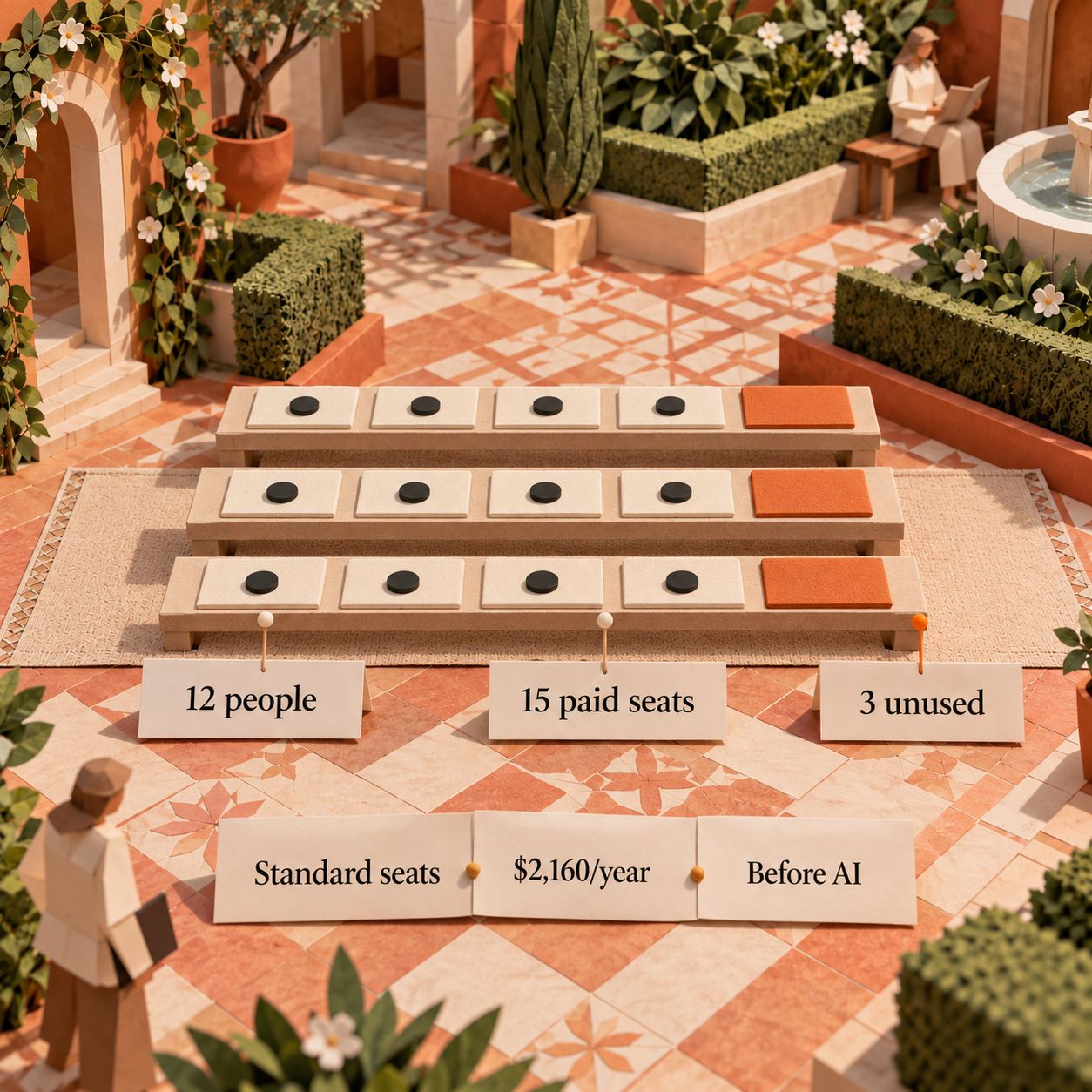
That spare capacity is useful if you are hiring into it. It is wasted spend if those seats will stay empty. Forecast likely headcount across the subscription period before calling the annual plan cheaper.
Three worked yearly bills: 5, 12 and 40 people
Annual seat subtotal = purchased seat bucket × annual-billing seat rate × 12. The examples assume every person is a paid member, no extra guest seats, no negotiated discount, and no taxes, optional apps or AI usage beyond the minimum bundle. The minimum-credit totals below assume that the displayed monthly credit charge applies throughout the year without a promotional offset. These are calculated budgets, not checkout quotes. Price inputs.
Five people: five paid seats
A five-person local-services office exactly fills its bucket:
- Basic: 5 × $9 × 12 = $540/year for seats; $660 with minimum AI before discounts.
- Standard: 5 × $12 × 12 = $720/year for seats; $960 with minimum AI before discounts.
- Pro: 5 × $19 × 12 = $1,140/year for seats; $1,500 with minimum AI before discounts.
For the same five seats, monthly billing costs $60 Basic, $70 Standard or $120 Pro before AI. Keeping those monthly plans for a full year produces seat totals of $720, $840 or $1,440. Annual billing therefore saves $180, $120 or $300 on seats.
Standard is a sensible starting point for appointment preparation, task ownership and occasional handoffs. Pro needs a specific job, such as private internal boards or recording task time, to earn its higher bill.
Twelve people: fifteen paid seats
A twelve-person agency buys three more seats than it can immediately use:
- Basic: 15 × $9 × 12 = $1,620/year for seats; $1,740 with minimum AI before discounts.
- Standard: 15 × $12 × 12 = $2,160/year for seats; $2,400 with minimum AI before discounts.
- Pro: 15 × $19 × 12 = $3,420/year for seats; $3,780 with minimum AI before discounts.
Multiplying Standard by twelve people would produce $1,728. The correct bucket adds $432 a year to that estimate, before AI.
Monthly billing for fifteen seats is $180 Basic, $210 Standard or $360 Pro. Over twelve payments, the seat totals become $2,160, $2,520 or $4,320. Annual billing saves $540, $360 or $900.
For this agency, Pro costs $1,260 more per year than Standard on seats, equivalent to $105 a month. Including both plans' undiscounted minimum AI bundles increases that gap to $1,380 a year, or $115 a month. That is the amount your time-tracking process, private boards or automation capacity must justify.
Forty people: forty paid seats
A forty-person operator fills its bucket, so the effective seat price equals the headline rate:
- Basic: 40 × $9 × 12 = $4,320/year for seats; $4,440 with minimum AI before discounts.
- Standard: 40 × $12 × 12 = $5,760/year for seats; $6,000 with minimum AI before discounts.
- Pro: 40 × $19 × 12 = $9,120/year for seats; $9,480 with minimum AI before discounts.
Monthly billing is $480 Basic, $560 Standard or $960 Pro before AI. Twelve monthly payments total $5,760, $6,720 or $11,520 for seats, making the annual seat savings $1,440, $960 or $2,400.
The operational issue at this size is Standard's action limit. Buying forty seats does not multiply the account's 250 monthly automation actions. If several departments automate daily work, budget for the workflow volume as well as the people.
Annual versus monthly: calculate the commitment, not just the discount
Annual billing wins on seat cost only if you use enough of the year. At the published USD rates, the savings against twelve monthly payments are 25% on Basic, about 14.3% on Standard and about 20.8% on Pro. Those are calculated tier-specific discounts; they differ from the page's general savings banner.
Ignoring AI promotions, taxes and refunds, the annual seat purchase costs the same as 9 months of monthly Basic, about 10.3 months of monthly Standard, or 9.5 months of monthly Pro. For a temporary project, monthly billing can still be the smaller total commitment even with its higher rate.
A twelve-person agency committing to Standard pays the $2,160 seat subtotal upfront; $180 is only its monthly equivalent. The monthly-payment alternative is $210 for its fifteen seats. Confirm cash timing and AI charges in the purchase summary before comparing those amounts.
Standard versus Pro: the features that decide the purchase
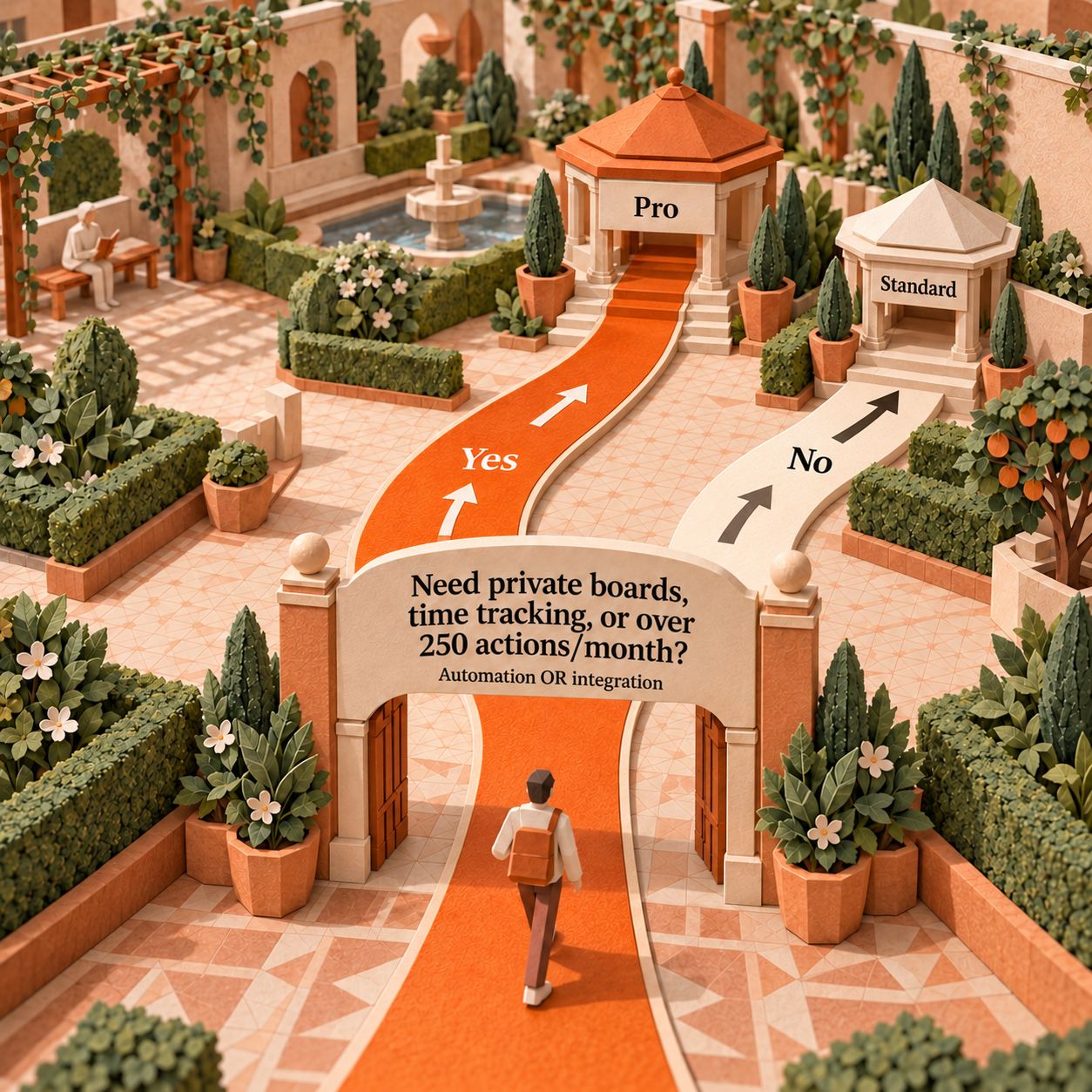
Choose Pro as soon as private boards or native time tracking are required. Choose it for action capacity when your measured workload exceeds Standard. Standard suits occasional, simple coordination; Pro is the more credible budget for an agency whose daily delivery depends on automations. Current features.
Standard supplies 250 automation actions and 250 integration actions per month. Pro supplies 25,000 of each, a hundredfold increase. These are separate account-wide allowances, not a combined pool and not an allowance per paid user. An automation action is work performed by an automation; an integration action involves a connected service. A single recipe can perform several chargeable actions. monday's action-pricing explanation.
For an illustrative intake workflow, assume each new request consumes three automation actions. 100 requests × 3 actions = 300, already above Standard's allowance. At that consumption rate, 83 complete requests use 249 actions. Count the actual actions in your intended recipe before choosing the plan; a hundred requests do not necessarily mean a hundred actions.
Pro's private boards and docs restrict visibility to invited people, which matters when your agency mixes client delivery with sensitive staffing or margin discussions. Its time tracking records time spent on tasks. Standard's schedule views do not substitute for recording billable hours.
There are also distinct workflow and AI limits. The current cards list 3 workflows on Standard and 20 on Pro. Extra AI credits do not raise your ordinary automation or integration allowance. If an action quota is exhausted, monday documents upgrading as the route to more capacity; it does not publish a simple pay-per-extra-action rate on this pricing page. Workflow and action limits.
Guest billing can make Pro cheaper than Standard
A five-member agency with four external clients illustrates the reversal. Standard counts each complete group of four guests as one billed seat, while Pro and Enterprise allow unlimited guests. Basic does not include guests. Guest pricing rules.
Those five members plus four Standard guests count as six billable seats, requiring the ten-seat bucket. Standard's annual seat subtotal becomes $1,440. Pro can keep five paid member seats and the guests for $1,140, saving $300 on seats despite its higher per-seat rate. Including undiscounted minimum AI bundles gives $1,680 Standard versus $1,500 Pro, a $180 difference.
Treat clients as guests only when they qualify for that external role. Free read-only viewers serve a different purpose from people who need to edit work.
monday.com AI costs: credits, minimum bundles and extra usage
For customers offered the current Work Platform purchase model, AI credits are a required component alongside seats. monday says this model applies to customers joining on or after May 6, 2026 who were offered seats plus AI credits. Existing accounts can have different arrangements. It explicitly separates this model from monday CRM, monday dev and monday service. AI purchase policy.
On the annual pricing view, the minimum bundles are 1,000 credits/month for Basic at $10, 2,000 for Standard at $20, and 3,000 for Pro at $30. Enterprise is custom. Credits are a shared account pool, not those amounts multiplied by your paid seats. The pricing page's current special discount offsets the minimum bundle charge, but monday describes such offers as introductory and customer-dependent. The public pages checked do not establish a universal end date for that offer. Published credit charges, purchase conditions.
For a twelve-person Standard account, the annual budget is therefore:
$2,160 seats + $240 minimum credits − the discount your order actually grants + additional usage and applicable tax.
That is $2,400 before discounts, and $2,160 if a full-year discount offsets the entire minimum credit charge. Confirm the discount's duration on your order; the visible monthly discount alone is not proof of a full-year entitlement.
What those AI credits buy
monday AI Notetaker, which produces meeting notes, uses 120 credits per meeting hour. AI blocks, actions such as transforming content in board items, use 8 credits per action, with actions on the same item counted once within a 24-hour period and subitems treated separately. Other capabilities, including Sidekick and agents, vary with task complexity. Current AI consumption rules.
For a Standard account using AI Notetaker for 10 meeting hours, the allocation is 1,200 credits. That leaves 800 of the minimum 2,000 credits, enough for 100 billable item-level AI block actions under the documented counting rule. This is an illustrative allocation, not a promise that every workflow consumes the same amount.
The minimum Standard bundle works out to $0.01 per credit, or $1.20 of bundle cost per meeting hour, before discounts. Do not apply that unit rate to every larger purchase: the live price of the credit bucket you select controls the bill.
Top-ups, expiry and the limits of the published price
Standard offers 2,000, 4,000 or 8,000 credits/month; Pro offers 3,000, 4,000, 8,000 or 20,000. You can change the credit bucket without changing seat count. monday sends usage alerts at 80% and 100%; some AI capabilities may continue briefly after the limit before usage pauses. Credit-bucket and limit guidance.
Buy more through Administration → AI governance → Credits Usage. Check the offered charge before purchasing. The current public pages checked do not provide a blanket rollover or expiry guarantee, or a universal automatic overage tariff, so do not budget on banking unused credits. monday also says publishing a live Vibe app requires a paid app bucket; AI credits alone are not proof that every app-related charge is covered. AI credit guidance.
monday free plan: who never needs to pay?
A solo operator or two-person partnership may never need a paid plan if a small manual tracker does the job. A team of three to fifty cannot put all its members into the ordinary Free plan: its ceiling is two seats.
monday.com free plan features
The pricing page includes up to 3 boards, up to 3 docs, 200+ templates, 8 column types, and iOS and Android apps. Support adds the limits that determine whether you can keep using it: 200 items across the account, 500 MB storage, no guests or viewers, no automations or integrations, and one board connected per dashboard. Free also lacks the time-tracking and formula columns, and AI features start on paid plans. Free plan details, pricing-page feature list.
A two-person consultant business could track active projects without paying if it stays within those limits and updates work manually. Archived or deleted items do not count toward the item limit. Successful referrals can increase the allowance by 100 items each, up to 1,000 items total, but do not expand the two-person team limit.
The 14-day Pro trial is a different offer. It lets you evaluate paid capabilities before deciding whether to subscribe or move to Free; it does not turn Pro into a permanently free plan. Trial and plan rules.
monday.com enterprise pricing: buy it for a requirement
Enterprise needs a sales quote; there is no defensible public per-seat dollar amount to insert into your budget. The public support page specifies a minimum twelve-month term. It does not establish a universal Enterprise minimum seat count, so have sales confirm that separately. Plan terms.
The reasons to investigate it are enterprise governance, multi-level permissions, portfolio and resource management, or action demand beyond Pro. Support lists 250,000 automation actions and 250,000 integration actions per month. A forty-person company does not automatically need Enterprise because it has forty people; a smaller company may need it because a required control is unavailable below that tier. Enterprise features, action allowances.
Ask for seats, credit quantity, extra usage, contract term and any introduction-to-renewal price difference as separate lines in the proposal.
monday.com nonprofit pricing
An eligible nonprofit should check the program before using the ordinary commercial calculation. monday's nonprofit page advertises 10 free seats, 70% off additional seats and 33% off AI capabilities. Eligibility and the actual package must be confirmed through the program; those benefits are not a general discount for every small business. monday for nonprofits.
monday.com free alternatives: when a cheaper tool fits
A cheaper tool fits when your job is task visibility and accountability, without monday's more expensive workflow requirements. Compare the same people, guest access, privacy needs and automation workload. Do not compare a bare task-board plan with a monday configuration chosen for private client delivery and tracked time.
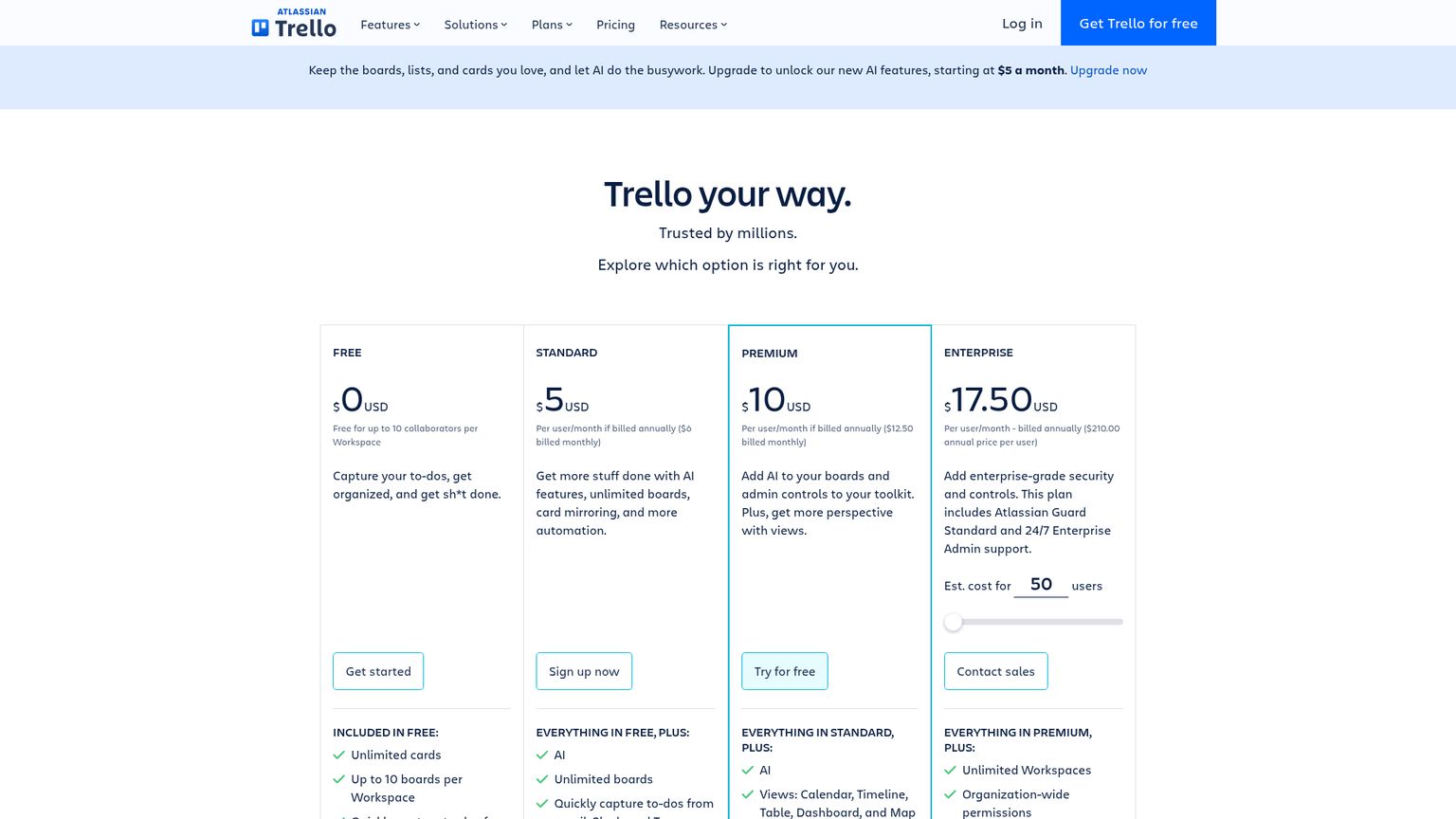
Trello, a board-and-card task organizer, is worth considering for a small office with a simple task queue. Its Free plan supports up to 10 collaborators and 10 boards per Workspace, with unlimited cards. That accommodates a five-person office that cannot fit into monday's two-seat Free plan. The tradeoff is that broader views and administration features sit on higher Trello plans. Trello plan details.
ClickUp, a task and document workspace, is another candidate when you need more people on a free plan. Its pricing page lists unlimited free members and tasks, collaborative docs and Kanban boards. Storage and feature limits still matter, and its paid permissions need checking before replacing a private monday workflow. For a twelve-person team needing a shared task list, it is worth checking before paying for fifteen monday seats. ClickUp plan details.
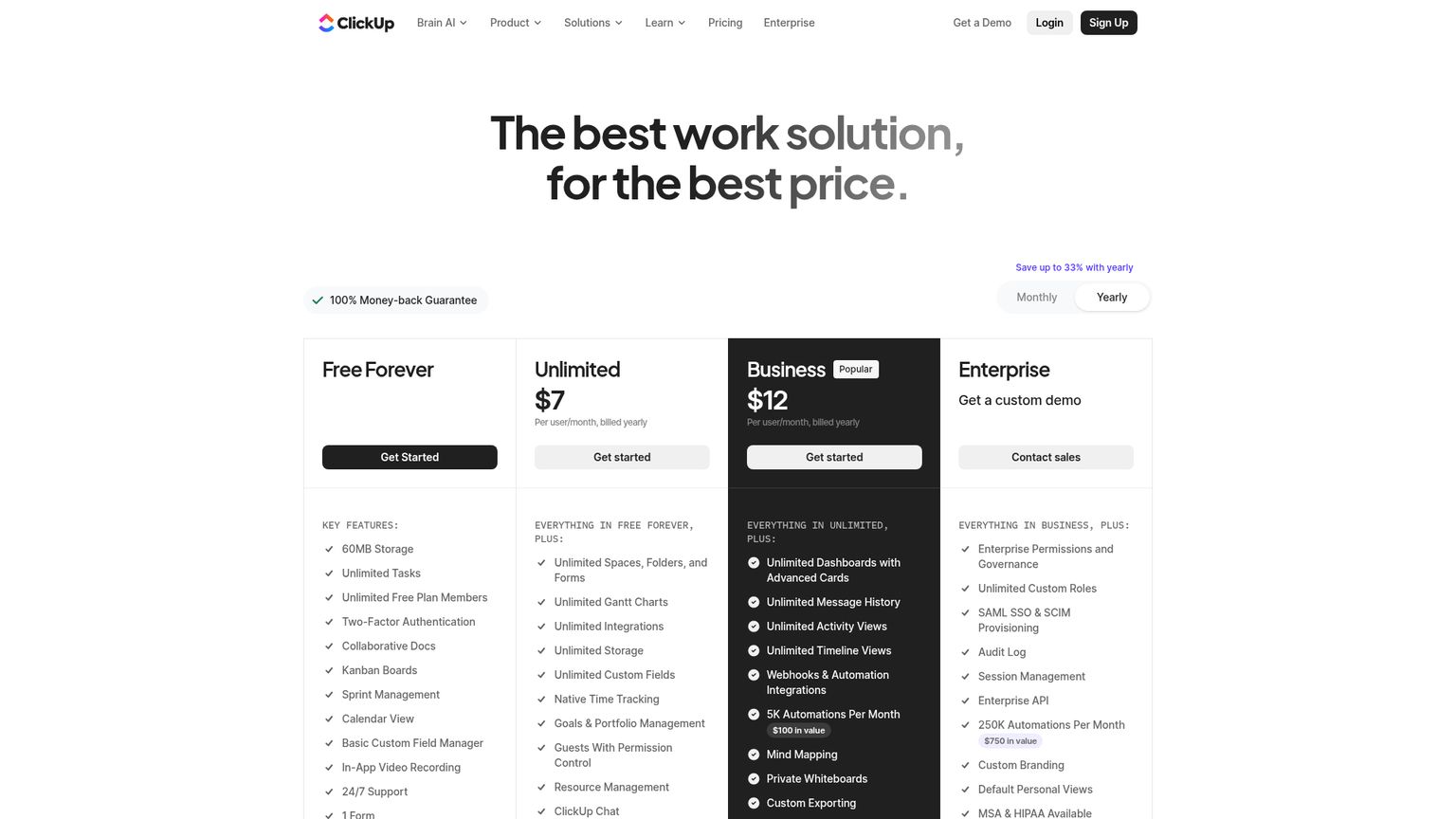
The decision rule is practical: keep monday if the required workflow justifies the full bucket plus AI bill. If people mostly change a status and a due date, start with the cheaper configuration that everyone can use.
Before you approve the subscription
Price the workflow you intend to run next week. A plan that omits a necessary feature produces a second purchase decision immediately after the first.
Count billable people and guests
Separate editing members, read-only viewers and eligible external guests. Round the resulting billable count to an available seat bucket.
Find the feature that decides the tier
Check private boards and time tracking first. Then count expected monthly automation and integration actions separately using the intended recipes.
Read the full purchase summary
Confirm Work Management, USD, billing cycle, seat bucket, AI credit quantity, discount duration and tax. Save the quoted annual total, including the AI line, before paying.
Assign usage ownership
Have an administrator monitor action usage and AI governance. Review the required bucket before renewal instead of assuming headcount and usage will stay unchanged.
Frequently asked questions
How much does Monday project management cost?
Work Management's annual-billing seat rates are $9 Basic, $12 Standard and $19 Pro per month. Paid plans start at three seats, making the annual seat minimums $324, $432 and $684. Add the AI credit charge applicable to your account, subtract only confirmed discounts, and include tax.
How much is Monday.com pricing?
For five paid members, annual seat subtotals are $540 Basic, $720 Standard and $1,140 Pro. Twelve members need fifteen seats, making those totals $1,620, $2,160 and $3,420. Enterprise is quote-only; the ordinary Free plan supports up to two people.
Is Monday.com free now?
Yes, Work Management has a Free plan with up to two seats, three boards and a starting allowance of 200 items. It is separate from the fourteen-day Pro trial and does not provide free access for a three-person team.
Does Monday.com charge for guest users?
On Standard, up to three guests are free and each complete group of four counts as one billed seat. That count can trigger a larger seat bucket. Pro and Enterprise allow unlimited guests; Basic does not include guest access. Guest rules.
Is Monday.com worth buying?
It can be worth buying when the chosen tier supports a specific recurring workflow and its annual bucket cost is justified. For a twelve-person agency, Pro's seat premium over Standard is $1,260 a year. If private boards, time tracking and the larger action allowance have no use in your process, paying that premium is hard to defend.
Who is Monday.com's biggest competitor?
There is no single useful winner without defining the job. For the task-management budget considered here, Trello and ClickUp are sensible alternatives to evaluate. Their free configurations suit different team sizes and feature needs, so compare the workflow rather than assuming the same plan name means equivalent coverage.
Which CRM is better, HubSpot or Monday?
That is a separate CRM buying decision, not a choice between the Work Management plans above. Use the monday CRM pricing comparison to compare the sales product and its alternatives; do not reuse this page's Work Management seat rates for either CRM.
Is Monday an Israeli company?
Yes. monday.com's company history describes its origins and launch in Tel Aviv. Its location does not change the USD Work Management calculations above. Company history.
Why is Monday.com falling?
If you mean the share price, that requires a dated market question and separate financial evidence. Subscription prices do not establish why a stock moved, so no stock-performance explanation is inferred here.
monday.com student pricing
The current student support guide recommends the Free plan and invites active students to contact support if it does not meet their needs. It does not promise every student a particular paid-plan discount. Student guidance.
Can I change my mind?
The pricing FAQ says a yearly subscription paid within the last 30 days may be cancelled for a partial refund of the remaining balance. After the refund period, downgrades do not receive refunds. Confirm the terms attached to your order before committing. monday's pricing FAQ.
Get the AI Business Workflow Audit Checklist
Check the workflow, billable people and annual budget before your next software purchase, then get new operator comparisons by email.
- Published
- Category
- Growth
- Language

Beehiiv Pricing: Annual Costs by List Size
Beehiiv pricing verified October 2026: annual bills at 1k, 10k, 50k and 100k subscribers, plan features, October changes and paid newsletter fees.Oct 9, 2026Growth
Pipedrive Pricing: Plans, Add-ons and Team Costs
Current Pipedrive seat and add-on prices, annual vs monthly budgets for 3 and 10 users, AI features, and when Premium costs less.Oct 8, 2026Growth
Lemlist Pricing: Seats, Credits and Sending Costs
Lemlist pricing by month, quarter and year, including credits, mailboxes and add-ons. See founder, sales team and agency bills plus alternatives.Oct 8, 2026Growth
Tidio Alternatives
Compare seven Tidio alternatives by support job, current pricing and billing unit. See who should switch, what migration costs and when Tidio wins.Oct 7, 2026Growth
Vista Social Pricing: What Your Profiles and Team Cost
Vista Social starts at $99/month. Compare annual prices, profile and user limits, AI features, add-ons, three bills and cheaper options.Oct 7, 2026Growth
Unbounce Pricing 2026: Plans, Visitor Limits and Testing
Unbounce starts at $29/month. Compare all six plans, annual rates, visitor and domain limits, A/B testing, Smart Traffic and the cheapest fit.Oct 7, 2026Growth
Best AI Ad Generator in 2026: AdCreative.ai, Atria, Creatify & Arcads (Compared)
Choose AI ad tools by job: static ads, UGC-style video or creative research. Compare current maker pricing, credit units and free entry.Oct 6, 2026Growth