Perplexity vs Exa vs Tavily Search API Cost 2026
Perplexity vs Exa vs Tavily pricing, task cost, free-tier crossovers, limits, and the decision rule for agent search in 2026.
Published Updated
 By Omid Saffari




Pick Perplexity for most paid agent-search workloads: its $5 per 1,000-request rate undercuts Exa at $7 and Tavily Basic pay-as-you-go at $8, while Perplexity Medium now leads the Artificial Analysis Search Index at 80. Exa still wins specialist people, company, and scholarly discovery; Tavily wins the simplest free prototype when one credit wallet for search, extract, crawl, map, and research matters more than the lowest unit cost.
Which one should you pick?
Perplexity is the default choice for a paid general-web search layer, Exa is the specialist, and Tavily is the prototype-friendly web toolkit. That verdict turns on four things: the billing unit, the evidence returned, the workload's specialist needs, and what happens after a search result enters the agent loop.
Prices, billing units, and capability claims were verified against all three vendors' live pages on August 29, 2026. The benchmark numbers are attributed to Artificial Analysis; the crossovers and normalized workloads below are calculations from those current inputs.
For a funded founder building a research agent, choose Perplexity Medium first. It has the strongest exposed provider-swap score, the lowest raw rate of these three, and a five-query batching rule that can collapse a burst of related searches into one billing unit.
For a mid-market CTO building company, people, or scholarly discovery, choose Exa when its specialist indexes remove custom source discovery from the product. The $2 per 1,000-request premium over Perplexity is only $20 across 10,000 searches. That is cheap if Exa's category-aware retrieval removes repeated searches or manual source hunting.
For a solo technical builder proving a feature, start with Tavily when the free 1,000-credit allowance and adjacent Search, Extract, Map, Crawl, and Research endpoints shorten the path to a useful prototype. Move only after the request mix stabilizes. A one-credit Basic request is reasonable during discovery; paying twice for Advanced on every call is not.
For a backend workload with independent queries arriving in groups, Perplexity has the clearest economic edge. Its API accepts as many as five related queries in one successful request, processes them independently, and bills the request once. That is not a small discount. It changes the unit you should put in the budget.
Price winner: Perplexity, unless free credits decide the month
Winner: Perplexity. On gross public list price, before free credits, 10,000 single-query searches cost $50 on Perplexity, $70 on Exa, $80 on Tavily Basic pay-as-you-go, and $160 on Tavily Advanced.
Those figures normalize one request to one logical query. That is the fairest baseline for an interactive agent whose searches arrive one at a time. It is not the best case for Perplexity.

Perplexity's five-query billing advantage
Perplexity charges $5 per 1,000 successful Search API requests, not per query inside the request. Its multi-query documentation allows as many as five related queries in an array, processes each independently, and counts the whole successful request as one billing unit. Rate limiting still counts the five queries separately.
If 10,000 logical queries pack cleanly into 2,000 five-query requests, the Search API charge falls from $50 to $10. Exa remains $70 for 10,000 standard Search requests, and Tavily Basic remains $80 at pay-as-you-go rates.
That makes Perplexity seven times cheaper than Exa and eight times cheaper than Tavily Basic for this specific batchable workload. The condition matters. A user waiting on one fresh query cannot manufacture four useful companions just to save money. A nightly market-monitoring job, a product-catalog refresh, or a research system exploring five known angles often can.
Free credits reverse the low-volume cash decision
Exa's Starter tier includes $20 at signup and $10 in recurring monthly credits without a payment method. Excluding the one-time signup credit, the recurring allowance makes Exa cheaper out of pocket until 5,000 single-query requests per month. At that crossover, Perplexity costs $25 and Exa's $35 gross charge becomes $25 after the monthly credit. Above 5,000, Perplexity's lower unit rate wins.
Tavily provides 1,000 free credits each month. If pay-as-you-go is enabled after that allowance, Tavily Basic stays cheaper in cash terms until roughly 2,667 monthly searches. At the crossover, each is about $13.33. Beyond it, Perplexity's $0.005 request rate pulls away from Tavily's $0.008 credit rate.
These are cash crossovers, not product verdicts. Exa may still win below or above 5,000 because a specialist index does work that general search cannot. Tavily may still win because its adjacent endpoints remove integration work. The crossover only tells you when “free” stops deciding the invoice.
Tavily ties Perplexity only at a fully used Growth allowance
At 100,000 single-query Basic searches, Perplexity costs $500, Exa costs $700, and Tavily's Growth plan costs $500 for 100,000 credits. Tavily reaches Perplexity's $0.005 unit rate only at that plan level and only when the allowance is fully used.
The lower Tavily plans remain more expensive per Basic search: Project is $30 for 4,000 credits, Bootstrap $100 for 15,000, and Startup $220 for 38,000. An allowance left idle raises the effective unit cost. Advanced also consumes two credits, so a workload that needs Advanced cannot use the Basic-search comparison unchanged.
The budget rule is blunt: use free credits while they cover the month, then price the stable request mix. Once a Tavily workload is mostly Basic Search and no longer depends on its broader surface, Perplexity deserves a shadow test.
Quality winner: Perplexity, with two benchmark limits
Winner: Perplexity among the products with exposed current rows. Artificial Analysis measures Perplexity Medium at 80 on its Search Index and Exa Auto at 74 under the same answer model and agent loop. The current public table does not expose a Tavily row, so the result does not prove that Perplexity beats Tavily on every workload.
The Artificial Analysis methodology is a provider-swap test. It holds GPT-5.6 Luna at medium reasoning constant, gives the agent a 25-turn budget with up to 10 results per search, and changes the Search API provider behind the web-search tool. Its 1,700 tasks combine 900 DeepSearchQA questions, 600 held-out AA-Omniscience questions, and 200 hard BrowseComp questions. The index is a blended score, not a claim that 80 percent of every production query is correct.
Completed benchmark-task cost favors Perplexity
Artificial Analysis reports search and answer-model spend separately. Adding those components produces the business comparison:
- Perplexity Medium: $62.30 search plus $29.09 model per 1,000 tasks, or $91.39 total.
- Exa Auto: $65.57 search plus $61.58 model per 1,000 tasks, or $127.15 total.
That is $0.09139 per benchmark task on Perplexity versus $0.12715 on Exa, making Perplexity's observed total 28.1 percent lower. It also completed the measured task in 28.6 seconds versus 33.0 seconds for Exa Auto, a 4.4-second or 13.3 percent difference.
If a production workload reproduced those observed averages across 100,000 tasks, the budget would scale to roughly $9,139 on Perplexity Medium and $12,715 on Exa Auto, a $3,576 difference. That is a scenario, not a forecast. Your query distribution, answer model, caching, acceptance rules, and source mix can move every component.
This is why per-request price is incomplete. A provider can cost more per search and still reduce the task bill if the agent needs fewer searches or receives a tighter payload. It can also look cheap per call while forcing more model tokens, fetches, or retries. Retrieval belongs beside the model-inference budget covered in the cheapest AI API comparison, not on a separate spreadsheet tab.
Medium is the Perplexity setting to buy first
Perplexity's three context variants occupy the current top three rows, but Medium is the operating default. Medium scores 80 at $91.39 total per 1,000 benchmark tasks and 28.6 seconds. High scores 79 at $91.37 and 29.5 seconds. Low scores 77 at $104.78 and 37.0 seconds.
More extracted context did not improve the top score, and the smallest payload did not produce the lowest total. Low caused enough extra search spend to outweigh its lower model cost. High lowered search spend but raised model cost. Medium delivered the best quality at effectively the same total as High.
That consequence is useful on Monday morning: do not set High merely because the workload is important. Start at Medium, then promote a query class only when your own evaluation shows the extra content fixes a measurable failure.
The benchmark does not settle reliability or Tavily quality
Two limits prevent a leaderboard-only migration.
First, Artificial Analysis retries fatal provider errors such as 429s, 5xx responses, and timeouts until success. Recoverable tool and fetch failures remain, but fatal provider reliability does not. A production buyer still needs p95 latency, rate-limit behavior, error rate, and recovery cost from a shadow run.
Second, the methodology names a Tavily Basic configuration, but the current visible public leaderboard contains no Tavily score, task-cost, or latency row. That omission does not make Tavily weak. It makes a current three-way quality ranking unsupported. Compare Tavily with the same replay workload instead of borrowing an older, differently configured result.
Perplexity's edge is extracted context, not just cheaper links
Perplexity Search API is the best general default because it now combines low unit price, billable batching, extracted page context, and the strongest exposed benchmark result. It is a raw retrieval API, separate from Perplexity's Sonar and Agent APIs, so your application still owns synthesis, citation policy, and final validation.
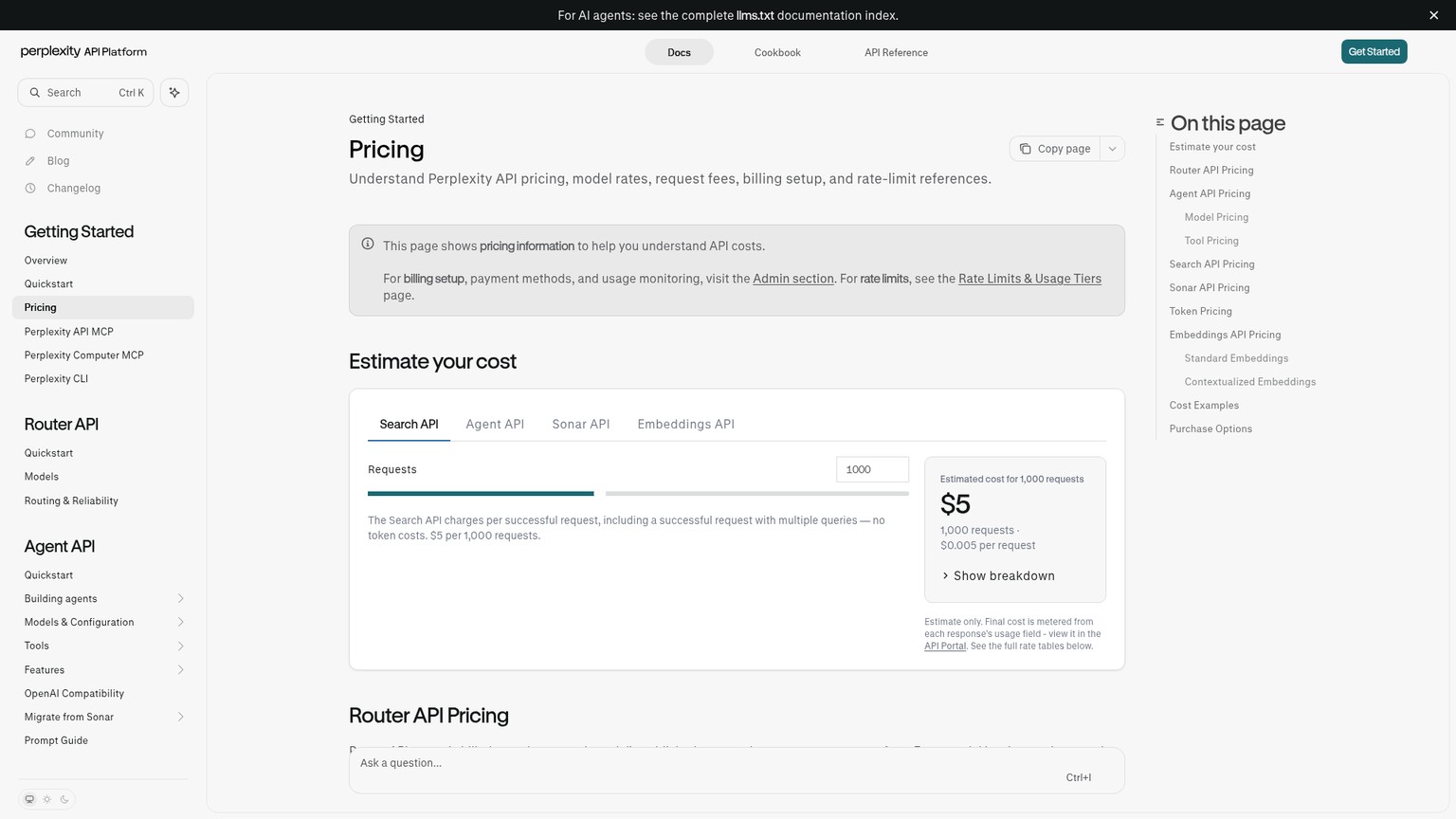
The live pricing page lists $5 per 1,000 successful requests, with no additional token charge. Invalid requests, rate-limited requests, and upstream failures are not billed. A successful response with no results is billed, which means weak query construction can still spend money without returning evidence.
Perplexity's Search API can return 1 to 20 ranked results and lets you choose Low, Medium, or High extracted context. Low returns short query-relevant passages, Medium a balanced amount per document, and High detailed relevant content. Manual max_tokens and max_tokens_per_page controls let an evaluation or context-constrained agent set explicit extraction budgets.
Filtering is also broad: region, language, domains and paths, publication dates, and last-updated dates. Domain controls support an allowlist or a denylist, but not both in the same request. That is enough for monitoring, current-policy research, source-bound retrieval, and regional discovery without buying an answer model from the same vendor.
The wall is what Perplexity does not bundle. Search API gives your system retrieval payloads, not a finished answer workflow. If you need extraction, reranking, citation formatting, and synthesis as one managed feature, Tavily's wider surface may reduce build work. If you need people, company, or publication semantics, Exa's category indexes are the cleaner fit.
Perplexity also lists no recurring free Search API allowance on its public pricing page. A solo builder can learn more cheaply on Exa's recurring credit or Tavily's monthly free tier. The switch becomes attractive when the product has a paid, stable request stream or when five-query batches make the effective price impossible to ignore.
For a full separation of Perplexity's app subscriptions, Sonar, Agent API, and Search API, use the Perplexity pricing guide. Consumer Pro or Max does not fund this Search API bill.
Specialist retrieval winner: Exa
Winner: Exa for people, company, scholarly, and similarity-driven discovery. Exa is a search and content system with a general web index plus specialist categories, not merely a more expensive general SERP.
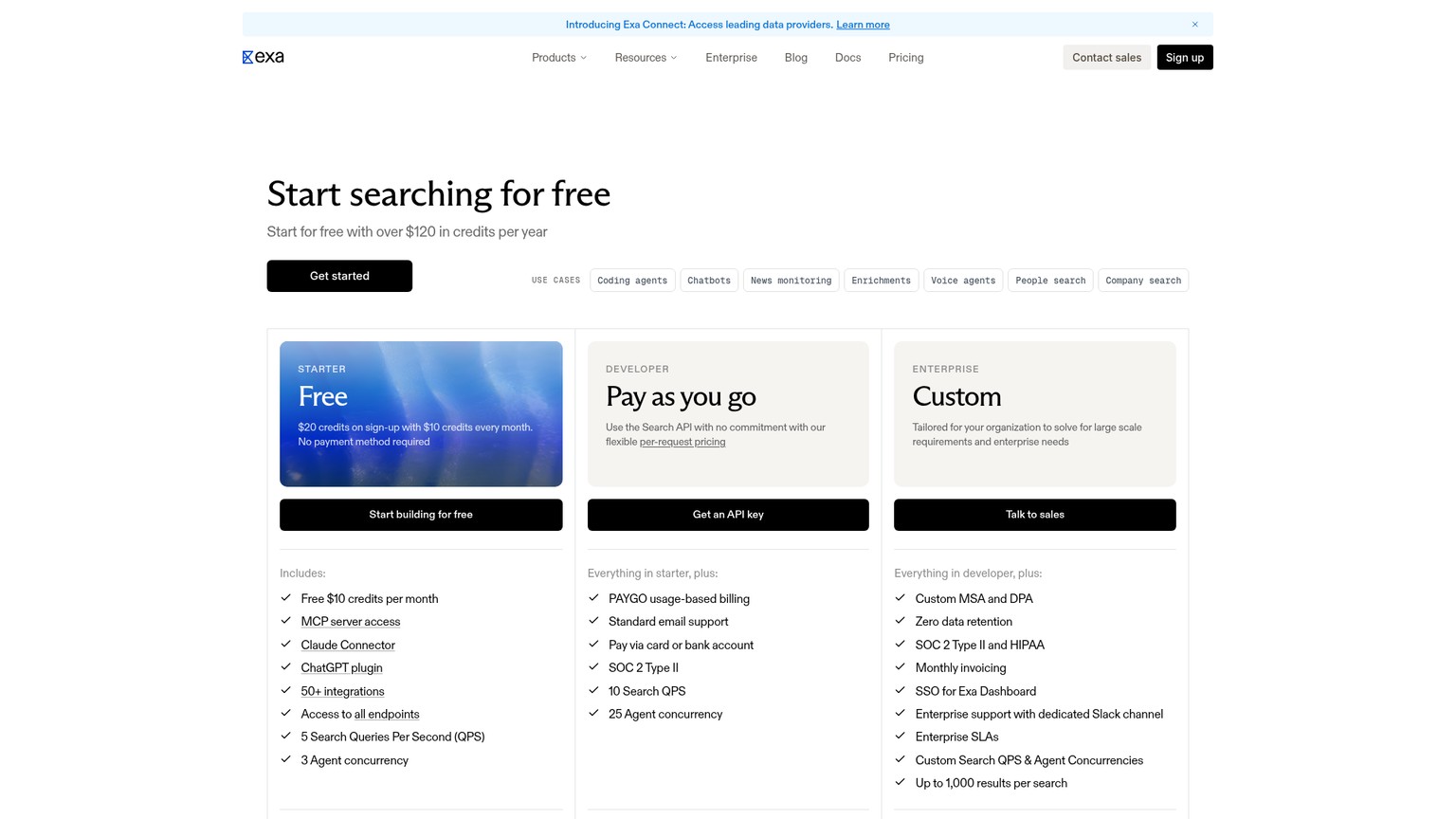
Exa's current price card sets standard Search at $7 per 1,000 requests with up to 10 results. Search can return webpage text and highlights. Contents costs $1 per 1,000 pages per content type, while Deep Search and Deep-Reasoning Search cost $12 and $15 per 1,000 requests.
The standard endpoint offers instant, fast, and auto modes, plus deeper research variants. Auto is the balanced default. Categories include company, publication, news, personal site, financial report, and people. Publication can surface scholarly metadata such as authors, venue, and citations. The Starter account exposes web, people, company, and scholarly-works indexes.
That coverage can repay the $2 per 1,000-request premium quickly. Across 10,000 searches, Exa costs $20 more than Perplexity before credits. A due-diligence agent that otherwise issues multiple generic searches to identify a company, its people, and primary publications can spend that difference without touching a human-review budget.
Exa is also the low-volume cash winner. Its $10 recurring monthly credit covers roughly 1,428 standard Search requests, and its one-time $20 signup credit extends the first-month runway. A small research feature can remain on Exa while its workload is too young to justify an optimization project.
The named limitation sits inside the specialist surface. Exa's company and people categories do not support startPublishedDate, endPublishedDate, or excludeDomains; sending those combinations returns a 400. A compliance or recruiting workflow that needs both specialist entity retrieval and strict date or source exclusion must split the query, filter after retrieval, or choose another provider for that leg.
Exa should be skipped as the default for high-volume, ordinary web lookups when the specialist modes are rarely used. Paying $70 instead of $50 for 10,000 generic searches is only sensible when the output removes downstream work. Instrument category use before standardizing on it.
Workflow breadth winner: Tavily
Winner: Tavily for a free prototype and a managed web-access workflow. Tavily puts Search, Extract, Map, Crawl, and Research behind one account and one credit system, which keeps a small builder from assembling several vendors before the product has earned that complexity.
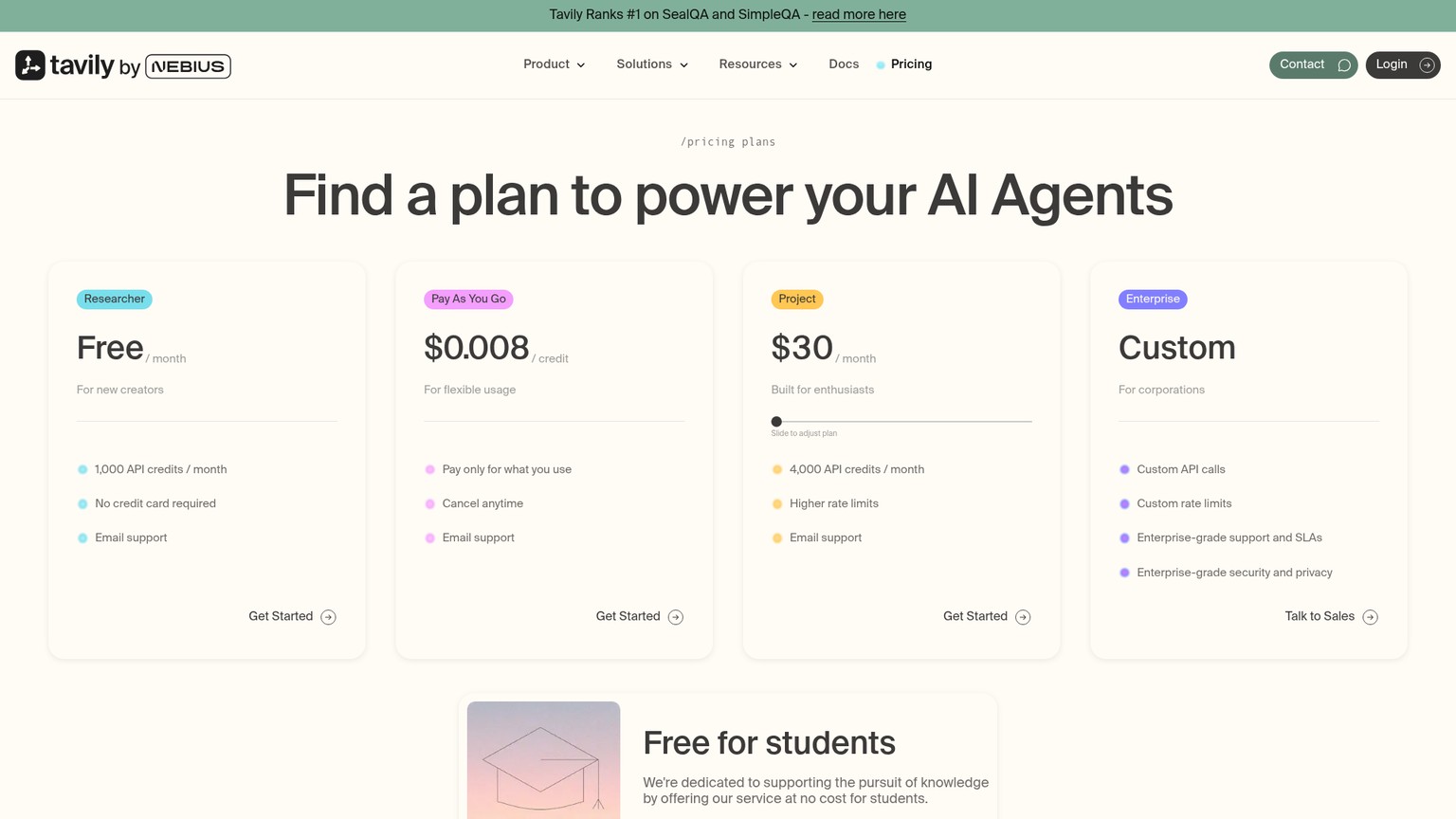
Tavily's credits page gives Researcher 1,000 credits every month for free. Pay as you go is $0.008 per credit. Monthly plans reduce that unit rate from $0.0075 on Project to $0.005 on Growth.
For Search, Basic, Fast, and Ultra-fast cost one credit. Advanced costs two. Search can return reranked chunks, an optional generated answer, and optional cleaned raw content, with domain, date, topic, country, and language controls. Extract, Map, Crawl, and Research draw from the same account but have their own meters.
This breadth matters for a founder building a citation-backed feature. The first version may need a web result, clean page text, a domain map, and a research fallback. Tavily provides those pieces without forcing an early provider architecture. The premium buys a coherent starting surface.
The budget wall is depth drift. Tavily's auto_parameters may choose Advanced when the system predicts it will improve the query, and Advanced spends two credits. If 10,000 requests silently move from Basic to Advanced, the pay-as-you-go search line moves from $80 to $160.
Set search_depth explicitly for any class with a budget target. Use Basic for routine lookups, Fast or Ultra-fast when latency is the priority, and Advanced only for query classes whose accepted result rate improves enough to repay the second credit. Track usage.credits in the response rather than estimating spend from request count.
Tavily is the wrong default once a stable high-volume workload uses little beyond Basic Search. At 100,000 Basic calls, Growth ties Perplexity at $500 only with full allowance use. Perplexity remains cheaper on partial volume and may gain more through batching. Keep Tavily when its adjacent endpoints remove operational work; switch the plain-search lane when they do not.
The broader AI search API comparison covers providers beyond these three and the escalation pattern from lookup to fetch to deep research.
What switching actually costs
Do not switch on list price or one leaderboard row; switch after a provider adapter survives your own replay set. There is little data migration in a Search API change, but there is substantial behavior migration.
The request schemas differ. Perplexity accepts one query or an array and returns ranked snippets with extracted context. Exa adds modes, category semantics, and optional contents. Tavily expresses retrieval quality through search depth and can attach answers or raw content. A shared search(query, policy) wrapper still needs vendor-specific translation underneath.
The response semantics differ too. Relevance scores are not calibrated across vendors. Snippet length changes the answer model's token use. Date fields can mean publication or last update. Domain filters have different limits and unsupported combinations. A threshold tuned to Exa highlights should not be copied onto Perplexity snippets or Tavily chunks.
Cache keys need the provider, mode, filters, context depth, and extraction policy. Otherwise a Medium Perplexity response can satisfy a cached High request, or a Basic Tavily result can masquerade as Advanced. Retry behavior also belongs in the adapter because Perplexity does not bill rate-limited or upstream failures, while your surrounding queue still pays in latency.
The commercial lock-in is lighter than a database migration but not zero. Tavily monthly allowances can strand value if traffic moves mid-cycle. Exa's free credits can hide the gross unit rate during a pilot. Perplexity's batching can shape job scheduling. Keep business logic independent of those billing conveniences.

Who should not switch
Do not move the whole workload if:
- The current provider already meets an accepted-evidence cost target and nobody has priced the adapter work.
- Exa's people, company, or publication categories are embedded in the product.
- Tavily's Extract, Crawl, Map, or Research endpoints share the workflow and would need replacement.
- The workload is latency-sensitive and the only evidence is a benchmark that retries fatal provider errors.
- Private-domain, local, commerce, coding, or regulated-source queries dominate and are underrepresented in the public benchmark.
- Your team cannot run the old and new provider side by side long enough to catch source-coverage regressions.
The safer move is routing. Keep Exa for specialist discovery, Tavily for managed crawl and extract work, and move repeatable general search or batchable monitoring to Perplexity. Consolidate only if the replay data shows the specialist lanes are not earning their complexity.
The Monday move
Replay last week's accepted queries through Perplexity Medium, Exa Auto, and the Tavily depth you use today. Do it before changing a production default.
Freeze the workload
Export the actual queries, filters, expected source types, accepted answers, and failure examples. Keep the difficult tail and repeated queries because those determine retries, caching, and batching potential.
Hold the answer layer constant
Use the same answer model, prompt, fetch policy, token budget, and acceptance check for all three providers. Change only the search adapter.
Measure the budget line that matters
Log search spend, answer-model spend, p95 task latency, accepted-answer rate, source coverage, retries, and human-review rate. Also record how many Perplexity queries could pack into valid five-query billing units and how often Tavily selects Advanced.
Route one workload class
Move the repeatable class with the clearest gain, not the entire search layer. General research and batched monitoring are the first Perplexity candidates; people and scholarly discovery stay on Exa; crawl-heavy prototypes stay on Tavily.
That is the budget consequence of Perplexity's new leaderboard position. The Monday decision is not “replace every search provider.” It is “make Medium the challenger for the expensive general-search lane, then require the accepted-answer budget to justify each remaining premium.”
How much does Tavily charge for search?
Basic, Fast, and Ultra-fast Search cost one credit per request; Advanced costs two. Tavily lists pay-as-you-go at $0.008 per credit, monthly plans from $0.0075 to $0.005 per credit, and 1,000 free credits each month.
Is Tavily search better than Exa search?
Tavily is better when one managed account for search, extract, map, crawl, and research reduces build work. Exa is better for people, company, publication, and semantic discovery. The current public Artificial Analysis table exposes Exa results but no Tavily row, so it cannot support a universal quality winner between them.
How much is the Perplexity Search API?
Perplexity charges $5 per 1,000 successful Search API requests with no additional token fee. A successful request may contain as many as five queries and still count as one billing unit, though each query counts against rate limits.
Is Exa free to use?
Exa's Starter tier lists $20 in signup credit plus $10 in recurring monthly credit, with no payment method required. Standard Search is $7 per 1,000 requests after credits.
Get the AI Tools Map for Business Owners
The AI Tools Map for Business Owners turns comparisons like this into a practical adoption stack, with cost, fit, and the point where each tool earns its place. Subscribe to get the next edition free.
- Last Updated
- Category
- AI
- Language

Marblism Review
Marblism's seven AI employees, current plans, shared-hour costs, dated public reviews and the jobs that still need human approval.Oct 9, 2026AI
Claude Haiku vs Sonnet
Haiku 5.5 vs Sonnet 5.5 for ticket classification, long summaries and coding subagents, with current API rates and three monthly budgets.Oct 8, 2026AI
Claude Haiku 5.5: Pricing and When to Switch
Claude Haiku 5.5 pricing, the 100K prompt threshold, and a monthly bill versus Haiku 4.5 and Sonnet 5.5. Which work should you move?Oct 8, 2026AI
Otter AI Alternatives: Granola, Krisp, MeetGeek, Circleback and Claap
Choose Granola, Krisp, MeetGeek, Circleback or Claap by the job. Compare live prices, free limits, bot-free capture and CRM handoffs.Oct 8, 2026AI
Mistral Large 4: Pricing, Open Weights, and When to Use It
Mistral Large 4: verified API prices, the launch offer, claimed benchmarks, and when to test the preview or wait for self-hosting.Oct 7, 2026AI
Lindy AI Review (Verified October 2026)
Lindy AI review: current plans, credit costs, email and meeting setup, integration limits, and when Gumloop, n8n or Marblism fits better.Oct 7, 2026AI
Mistral Pricing (2026): API Costs and Vibe Seats
Mistral API rates, Le Chat and Vibe plans, free limits, EU hosting costs and a worked monthly bill. Verified October 2026.Oct 6, 2026AI