Pipedrive Pricing: Plans, Add-ons and Team Costs
Current Pipedrive seat and add-on prices, annual vs monthly budgets for 3 and 10 users, AI features, and when Premium costs less.
Published
 By Omid Saffari



Pipedrive pricing starts at $14 per seat per month with annual billing, or $24 billed monthly. Growth is the sensible starting plan when your salespeople need email sync and automated follow-ups: three seats cost $1,404 upfront for a year, before add-ons and tax. Premium can cost less than Growth plus the tools you need, but that calculation changes with your seat count and billing cycle.
Verified against Pipedrive's live pricing page and billing documentation on 8 October 2026. Prices are US dollars as supplied by Pipedrive, before applicable tax. Regional prices can differ.
Pipedrive is an affiliate partner. This site may earn a commission through the plan-selection link below. Recommendations turn on your required workflow, paid seats, add-on scope and usage limits.
Pipedrive Pricing at a Glance
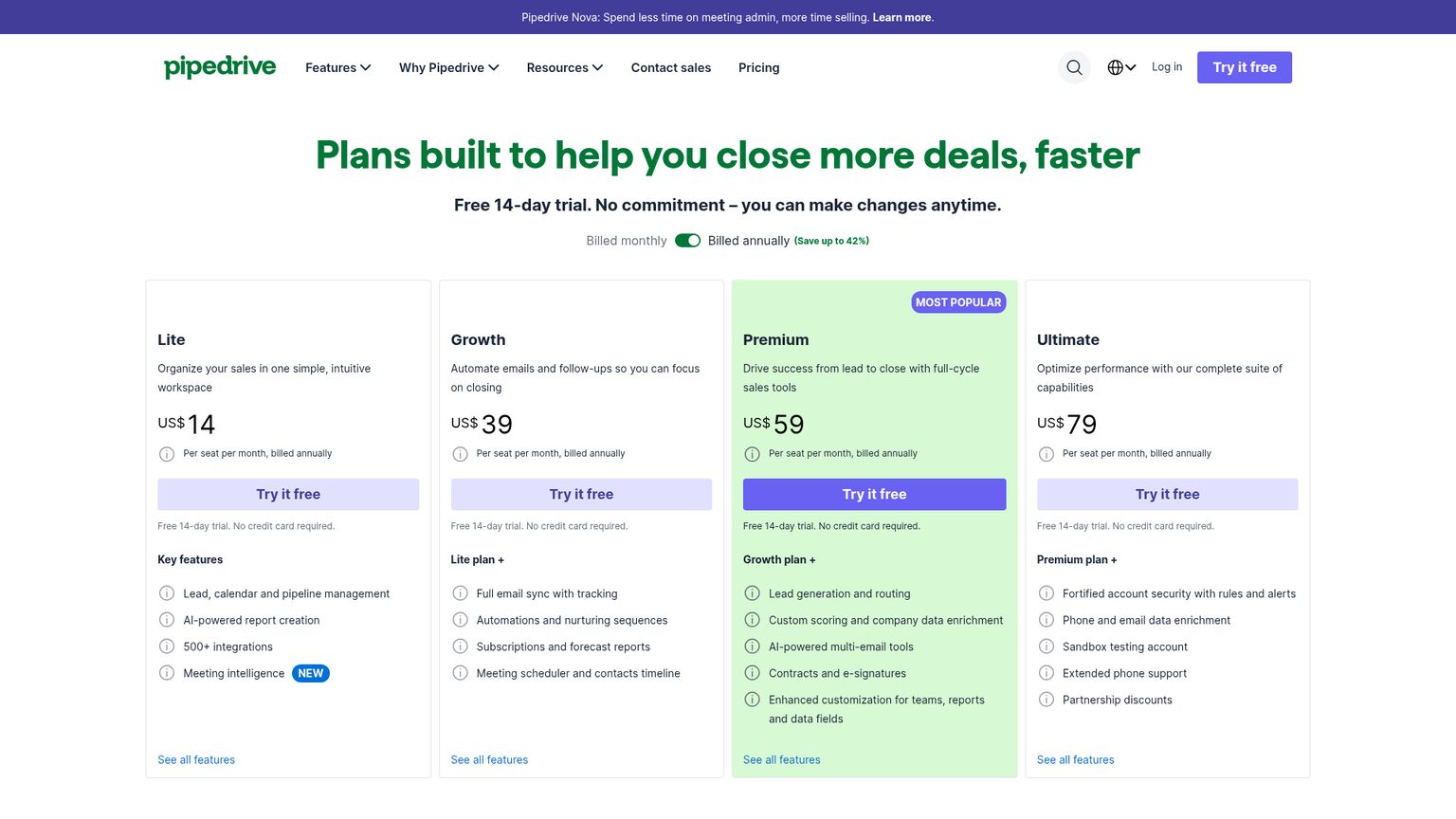
Pipedrive, a sales CRM for organizing customer relationships and deals, currently sells Lite, Growth, Premium and Ultimate. The annual column is a monthly equivalent; you pay the annual amount upfront. These are the current US prices from Pipedrive's pricing page, verified in October 2026.
For a founder hiring salespeople, headcount and billable seats are different things. Pipedrive charges for seats even when they are unassigned. Review the paid seat count before a renewal, especially after a rep leaves. Add-ons and top-ups, purchases that increase a usage allowance, follow your plan's billing cycle. Pipedrive billing rules.
Pipedrive Pricing Plans: Which One Should You Buy?
Start with Growth if the CRM must manage email follow-up as well as the pipeline. Lite is sufficient when someone will manually maintain the deal record. Premium earns a place when its included packages or collaboration features replace costs you would otherwise pay separately. Ultimate needs a specific security or capacity requirement.
Lite: A Manual Sales Pipeline
Lite costs $14 per seat per month billed annually or $24 monthly. It includes lead, calendar and pipeline management and AI-powered report creation. Full email synchronization and workflow automations begin on Growth. Current pricing and plan features.
For a founder and an assistant keeping a small set of active opportunities current, Lite can be enough: assign a next activity, move the deal when a prospect responds and review the pipeline. Its wall appears when keeping emails and follow-ups current becomes another administrative job. Buy Growth when that workflow needs to run inside the CRM.
Growth: The Practical Starting Point for Reps
Growth costs $39 per seat per month billed annually or $49 monthly. It adds email sync and tracking, automations, nurturing sequences, subscription and forecast reports, a meeting scheduler and a contacts timeline. LeadBooster, Smart Docs and Projects remain paid extras. Growth features and package inclusion.
A sales lead managing reps who regularly follow up after demos has a clear reason to choose it: the conversation and the next action can sit alongside the deal. However, an automation plan is useful only after you have decided what should trigger the follow-up and who owns the reply. Growth cannot supply that sales process for you.
Premium: Bundle the Tools Your Workflow Uses
Premium costs $59 per seat per month billed annually or $79 monthly. LeadBooster, Projects and Smart Docs are included. It also adds lead routing, custom scoring, company enrichment, AI email tools, shared team inbox functionality and more customization. Premium pricing, included add-ons.
For an agency that captures a lead, sends a proposal and hands the won deal to delivery, the bundle can cover several stages of the sale. The limitation is its seat multiplier: upgrading everyone can cost more than buying company-wide add-ons on Growth. Campaigns and Web Visitors still cost extra on Premium.
Ultimate: Name the Requirement Before Upgrading
Ultimate costs $79 per seat per month billed annually or $99 monthly. It adds security rules and alerts, phone and email enrichment, a sandbox testing account and extended phone support. It also increases several usage limits. Ultimate features.
Choose it when a sales lead needs enforced access restrictions or a separate environment for testing changes. At ten seats, the step from Premium adds $200 per month equivalent, or $2,400 a year, with annual billing. The same seat-price difference applies monthly. A small sales operation needs a concrete reason to absorb that expense.
Once you have matched the workflow to a tier, compare Pipedrive plans and start the free trial. Keep the billing choice and any required extras beside the plan you select.

Pipedrive CRM Pricing for 3 Seats and 10 Seats
Multiply the seat price first, then add the packages using their own billing units. The following calculations cover the core CRM only. Add-ons, top-ups, third-party services and tax are excluded. All inputs come from Pipedrive's current USD pricing.
Three Seats: Annual and Monthly Costs
- Lite: 3 × $14 = $42 per month equivalent; $42 × 12 = $504 paid annually. Monthly billing is 3 × $24 = $72 per month, or $72 × 12 = $864 across a year.
- Growth: 3 × $39 = $117 per month equivalent; $117 × 12 = $1,404 paid annually. Monthly billing is 3 × $49 = $147 per month, or $147 × 12 = $1,764 across a year.
- Premium: 3 × $59 = $177 per month equivalent; $177 × 12 = $2,124 paid annually. Monthly billing is 3 × $79 = $237 per month, or $237 × 12 = $2,844 across a year.
- Ultimate: 3 × $79 = $237 per month equivalent; $237 × 12 = $2,844 paid annually. Monthly billing is 3 × $99 = $297 per month, or $297 × 12 = $3,564 across a year.
For a founder and sales reps who need Growth's email tools, $1,404 is the annual seat payment to approve. The $117 figure helps compare monthly budgets; it is not an option to pay the annual subscription in monthly installments.
Ten Seats: Annual and Monthly Costs
- Lite: 10 × $14 = $140 per month equivalent; $140 × 12 = $1,680 paid annually. Monthly billing is 10 × $24 = $240 per month, or $240 × 12 = $2,880 across a year.
- Growth: 10 × $39 = $390 per month equivalent; $390 × 12 = $4,680 paid annually. Monthly billing is 10 × $49 = $490 per month, or $490 × 12 = $5,880 across a year.
- Premium: 10 × $59 = $590 per month equivalent; $590 × 12 = $7,080 paid annually. Monthly billing is 10 × $79 = $790 per month, or $790 × 12 = $9,480 across a year.
- Ultimate: 10 × $79 = $790 per month equivalent; $790 × 12 = $9,480 paid annually. Monthly billing is 10 × $99 = $990 per month, or $990 × 12 = $11,880 across a year.
Annual billing saves $1,200 on ten Lite or Growth seats and $2,400 on ten Premium or Ultimate seats versus making monthly payments throughout a year. Those savings are calculated from the seat rates alone.
CRM Cost per Month: Use the Correct Billing Units
A company-wide package is added once. A seat-based package is multiplied by the users who need it. This is why an agency owner's bill can change even when the CRM plan stays the same.
For three Growth seats plus LeadBooster, annual billing is $1,404 + $390 = $1,794 a year. Its monthly equivalent is $117 + $32.50 = $149.50. Monthly billing is $147 + $39 = $186 per month. Pipedrive pricing.
For ten Growth seats plus LeadBooster, annual billing is $4,680 + $390 = $5,070 a year, or $422.50 per month equivalent. Monthly billing is $490 + $39 = $529 per month. The package stays company-wide; it does not become ten LeadBooster charges.
That normalizes to about $49.83 per seat-month for the three-seat annual setup, versus $42.25 for the ten-seat annual setup. With monthly billing, the corresponding costs are $62 and $52.90 per seat-month. These are calculated allocations of a shared package, not additional Pipedrive tiers.

Add-on Prices: What Goes on Top of the Seat Bill?
LeadBooster, Projects and Smart Docs are included in Premium and Ultimate; Campaigns and Web Visitors are extra on every CRM tier. On Lite and Growth, each required package adds to the bill. Pipedrive's inclusion matrix.
The public cards advertise starting prices. Subscriber volumes, signature packages, selected project seats and extra prospecting credits can change the amount you pay. The dollar inputs below are from the live pricing page and its own USD package data, checked against the relevant product and billing pages.
LeadBooster: From $32.50 per Company per Month Equivalent
LeadBooster starts at $390 per company annually, equivalent to $32.50 per month, or $39 per company per month with monthly billing. It includes Chatbot, Live Chat, Web Forms and Prospector, the outbound prospect-finding tool. Web Visitors is a separate purchase. LeadBooster contents, monthly billing price.
For a small B2B business that needs website forms and chat, this is a company-wide fee worth comparing with the form and chat tools already in its stack. Prospecting is a separate capacity question: LeadBooster includes 10 Prospector credits each month, each revealing a lead. Unused credits expire at the end of the monthly allowance period, including on annual subscriptions. Extra credits appear separately on the invoice. Prospector billing and expiry.
Projects: From $16 per Project Seat per Month Equivalent
The current pricing card starts Projects at $16. The corresponding current offer in Pipedrive's page data is $192 per project seat annually, or $20 per project seat per month on monthly billing. Use the current card when budgeting a new purchase. Pipedrive pricing.
Projects manages the work after a deal is won. On Lite and Growth, you select and pay for the project seats needed to create and manage that work. They are additional to the core CRM seats. On Premium and Ultimate, Projects is included for all users. A sales lead who hands every sale to a delivery manager may need fewer project seats than CRM seats. Projects billing and access.
Smart Docs: From $32.50 per Company per Month Equivalent
Smart Docs starts at $390 per company annually, equivalent to $32.50 per month, or $39 per company per month billed monthly. It supports the document workflow for quotes, proposals and contracts; check that the selected package's signing allowance covers your volume. Premium and Ultimate include it. Starting price, plan entitlement.
For an agency sending proposals from the same deal records it uses to manage sales, this can reduce the need for a separate document tool. If an existing proposal system already covers that workflow, do not add Smart Docs to the budget merely because it appears on the pricing page.
Campaigns: From $13.33 per Company per Month Equivalent
The starting Standard Campaigns package for 1,000 subscribers costs $160 annually, shown as $13.33 per month, or $16 monthly. The starting Premium Campaigns package for the same subscriber count is $240 annually, equivalent to $20 per month, or $24 monthly. Premium Campaigns is an email-marketing add-on tier, distinct from the Premium CRM plan. Pipedrive pricing and USD package inputs.
Campaigns bills by add-on tier and subscribed marketing contacts. Its current billing guide allows 1,000 to 100,000 subscribers, in 1,000-subscriber increments. Increases take effect immediately with a prorated charge; reductions take effect next cycle, and you cannot reduce the allowance below your current subscribed contact count. Campaigns subscription rules.
For the same setup at ten seats, $4,680 + $390 + $160 = $5,230 annually, about $435.83 per month equivalent. Monthly billing is $490 + $39 + $16 = $545, or $6,540 across a year. The annual difference is $1,310. These examples use the starting Standard Campaigns subscriber package.
Web Visitors: From $41, With Visitor-volume Pricing
Pipedrive's main pricing page advertises Web Visitors from $41. Its product page lists monthly tiers of $49 for up to 200 identified organizations, $99 for up to 500, and $299 for up to 2,000. The precise quote depends on the organizations identified visiting your website, with irrelevant traffic excluded. Starting price, visitor tiers and monthly prices.
For a B2B sales lead, this answers which companies are visiting, rather than identifying every individual visitor. Use the quote for your visitor tier and billing cycle. The worked invoices above exclude Web Visitors: the public starting card does not establish an exact annual invoice for your traffic level. It is also extra on Premium and Ultimate.
When Premium Costs Less Than Growth Plus Add-ons
Premium can be cheaper for a small annual subscription, while Growth plus company-wide packages becomes more attractive as seats increase. The annual Growth-to-Premium difference is $20 per seat-month equivalent. Monthly billing makes that difference $30. LeadBooster plus starting Smart Docs adds $65 per company-month equivalent annually, or $78 monthly. Inputs from Pipedrive.
For three seats billed annually, Growth plus both packages costs $1,404 + $390 + $390 = $2,184 a year. Premium costs $2,124, saving $60 annually, with Projects and the other Premium features also included.
For three seats billed monthly, Growth plus both packages costs $147 + $39 + $39 = $225 per month. Premium costs $237. Growth is $12 cheaper each month if those packages cover the workflow and Premium's additional features are unnecessary.
On these starting package prices alone, Premium is cheaper up to three seats with annual billing, but only up to two seats with monthly billing. That boundary comes from the per-seat upgrade cost overtaking the company-wide package fees. It excludes Projects and assumes the starting document package meets your needs.
For ten seats, Growth plus LeadBooster and Smart Docs is $4,680 + $390 + $390 = $5,460 annually, versus $7,080 for Premium. The difference is $1,620 a year. Monthly, $490 + $39 + $39 = $568, versus $790, a $222 monthly difference.
Projects can change that result. If all ten users also need Projects, Growth's annual total becomes $5,460 + (10 × $192) = $7,380. Premium's $7,080 is then $300 cheaper annually. Monthly, Growth becomes $568 + (10 × $20) = $768, still $22 below Premium's $790.
For an agency owner, the decision is therefore specific: count the users who manage delivery, then compare the completed Growth quote with Premium. A company-wide document fee and a project-seat fee have different effects on that comparison.
Which AI Features Are Included on Each Pipedrive Plan?
Every current plan includes some AI; Premium and Ultimate add the email-writing features. Paying for Premium solely to get AI-generated reports is unnecessary because Lite already includes that capability. Pipedrive's AI availability guide.
Lite, Growth, Premium and Ultimate all include: the AI import assistant, AI-assisted report creation, AI-powered Marketplace search, smart-app recommendations and the mobile business card scanner. Sales Assistant, which answers questions about CRM data and can help create notes, is listed for every plan as a beta feature.
Premium and Ultimate add: AI email creation and AI-powered notifications, plus beta email summarization and suggested replies. For a sales lead choosing Growth to run follow-ups, automated email sequences and AI-written email text are different entitlements. Growth includes the sequences; the email-creation feature requires Premium or Ultimate.
Beta eligibility is not a guarantee of availability in your account. Pipedrive says some beta features are limited to selected users. Released features are managed under Tools and apps > Pipedrive AI; beta features sit under Personal preferences > Beta program. Check that the feature you intend to use is present and enabled. AI access and setup.
Pipedrive Nova is included in all plans at no additional cost. Its current product page describes pre-meeting briefs, call transcription and draft CRM updates that you review and approve. The free inclusion is explicit, so meeting intelligence alone does not justify a higher plan. Nova.
The Projects page separately advertises AI-assisted project briefs, beta project-health summaries and beta external reporting. Access follows Projects: a paid project seat on Lite or Growth, or inclusion on Premium and Ultimate. Projects features, access rules.
The Limits That Can Change Your Plan or Bill
Seat count increases some allowances; it does not multiply every company limit. A sales lead should look at the constraint that will stop the workflow, rather than assume a larger subscription removes all caps. The figures here are from Pipedrive's current usage-limit documentation.
Leads and deals: Lite allows 2,500 × seats, Growth 5,000 × seats, Premium 15,000 × seats and Ultimate 20,000 × seats, with a company ceiling of 300,000. Ten Growth seats therefore allow 50,000 combined leads and deals. Active leads and unarchived open, won and lost deals count. Contacts have no Pipedrive usage cap. Archiving old deal records can matter more than upgrading for an expanding sales history.
Fields and reporting: in Lite/Growth/Premium/Ultimate order, custom fields are 30/100/300/500 per company. Insights reports are 15/50/250/500 per user. A founder with ten reps does not get ten times the company's custom-field allowance.
Automation: Lite has none. Growth/Premium/Ultimate provide 50/150/250 automations per company, 3/10/20 if/else conditions per automation, and 5/25/50 sequences per company. Each automation path can have 10 actions. Delay steps are limited to 3 on Growth or 10 on the higher plans; paths have a 90-day total time limit, and a wait-for-condition step can last at most 7 days.
Email and collaboration: Growth supports 1 synchronized email account per user, Premium 3 and Ultimate 5; Lite has no full email sync. Shared team inboxes are unavailable on Lite and Growth, limited to 1 on Premium and 5 on Ultimate. Teams, custom visibility groups and custom permission sets are each limited to 15 on Premium and 25 on Ultimate; Lite and Growth do not include those custom group/set features.
Scoring and enrichment: Premium has 5 custom scores and 100 company-enrichment credits; Ultimate has 10 scores and 500 credits. Lite and Growth do not include these allowances. These credits are separate from Prospector credits.
API capacity: the API, which lets software exchange data with the CRM, has a token budget of 30,000/60,000/150,000/210,000 × seats across Lite/Growth/Premium/Ultimate, capped at 100 million per company. An integration's consumption belongs in the budget review alongside the human workflow. Full limits and consequences.
When a cap is reached, Pipedrive can block additional manual creation. Automatically created or imported deals may go to a waitlist or skip file; automatically created leads can be discarded. Existing data is not deleted simply for being above a limit. Check this before letting a website form feed a nearly full account.
Top-ups: Get the Quote for the Constraint
Growth and higher plans can buy increments of 250,000 API tokens, 25,000 leads and deals, 50 reports or 50 automations. Premium and higher can also add 100 enrichment credits, 10 Prospector credits, and a bundled increase of 10 each for teams, visibility groups and permission sets. Available top-ups.
Pipedrive shows the price in Billing, and it varies with the billing cycle. There is no universal public dollar quote to add to these examples. Compare the actual top-up quote with the upgrade difference; buying capacity is useful when that single constraint is the reason you would otherwise move tiers. Top-up billing.
Annual Billing: The Discount Comes With a Commitment
Choose annual billing when the users and workflow are settled. For three seats, annual billing saves $360 on Lite or Growth and $720 on Premium or Ultimate over a full year of monthly payments. For ten seats, the corresponding savings are $1,200 and $2,400. Seat-price inputs.
Pipedrive's terms make annual fees payable in advance. They state that fees are non-refundable and that ordinary cancellation takes effect at the end of the current term. Upgrades take effect immediately with a charge for the remaining-term price difference; downgrades wait until renewal without a mid-term refund. Pipedrive's subscription and payment terms.
For a founder still deciding who will use the CRM, monthly billing buys flexibility at a known higher seat price. Once adoption is established, the annual saving becomes easier to judge. Review paid seats and extras before the renewal, rather than expecting unused seats or an abandoned package to produce a refund.
Pipedrive Free Trial: What You Can Check Before Paying
Pipedrive has a 14-day core CRM trial with no credit card required, and no permanent free CRM plan. Invite the people who will use it and check whether the proposed plan covers the workflow. Trial details, free-plan disclosure.
The core trial does not provide Prospector credits; those require a paying subscription. Projects has its own 14-day add-on trial that converts to paid unless canceled. Campaigns has a separate 21-day trial for up to 500 subscribers, and an account review is required to buy it afterward. Prospector trial restriction, Projects trial, Campaigns trial.
If your operation only needs a contact list and occasional manual reminders, you may never need to buy a paid CRM. Keep that simpler workflow or evaluate a permanent free CRM. Pipedrive is worth paying for when its paid sales workflow replaces work you otherwise need to do.
Pipedrive Alternatives: When Close or HubSpot Fits Better
Choose an alternative when its workflow better matches how you acquire and serve customers. A cheaper seat that needs additional communication or marketing tools can create a more expensive complete setup.
Close CRM Pricing: Compare the Calling Workflow
Close, a CRM built around sales communication, fits better when reps spend their day in outbound email, calls and SMS. Its pricing page lists built-in communication tools, automated outreach and higher-tier dialers. Calling and SMS have usage costs, so include those in the quote. Close's current plan and usage matrix.
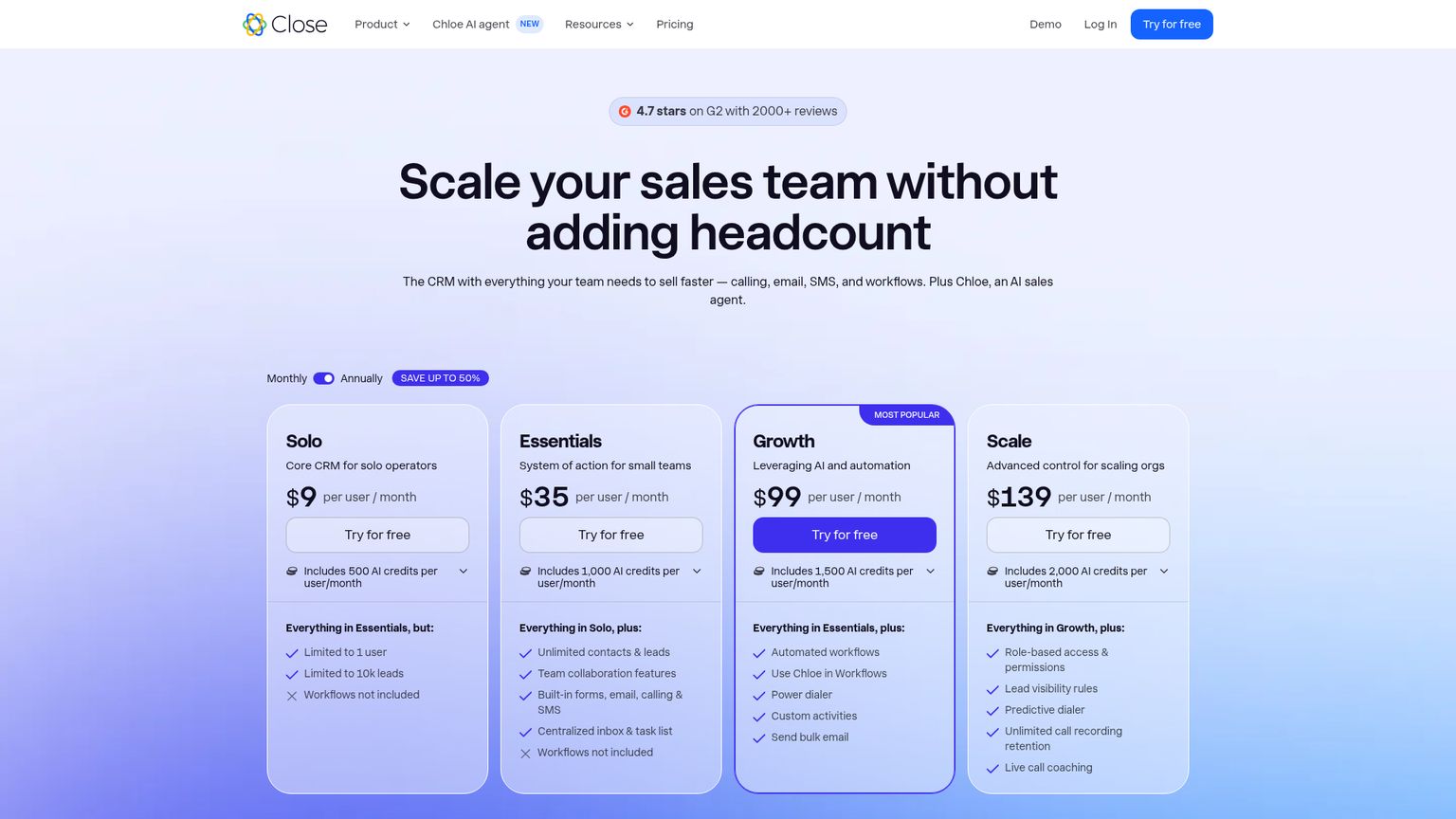
A sales lead choosing Pipedrive Growth plus a separate telephone system should compare that completed bill with Close's required plan and usage. A business primarily managing inbound deals and delivery has less reason to pay for a calling-focused stack. The Close CRM pricing breakdown walks through its separate communication and AI charges.
Pipedrive vs HubSpot: Compare Sales With the Wider System
HubSpot, a CRM platform with sales and marketing products, fits better when shared customer records must support a broader marketing, sales and service operation, or when its permanent free CRM covers your basic needs. Its free offering should be evaluated against the features you require before considering paid upgrades. HubSpot's free CRM.
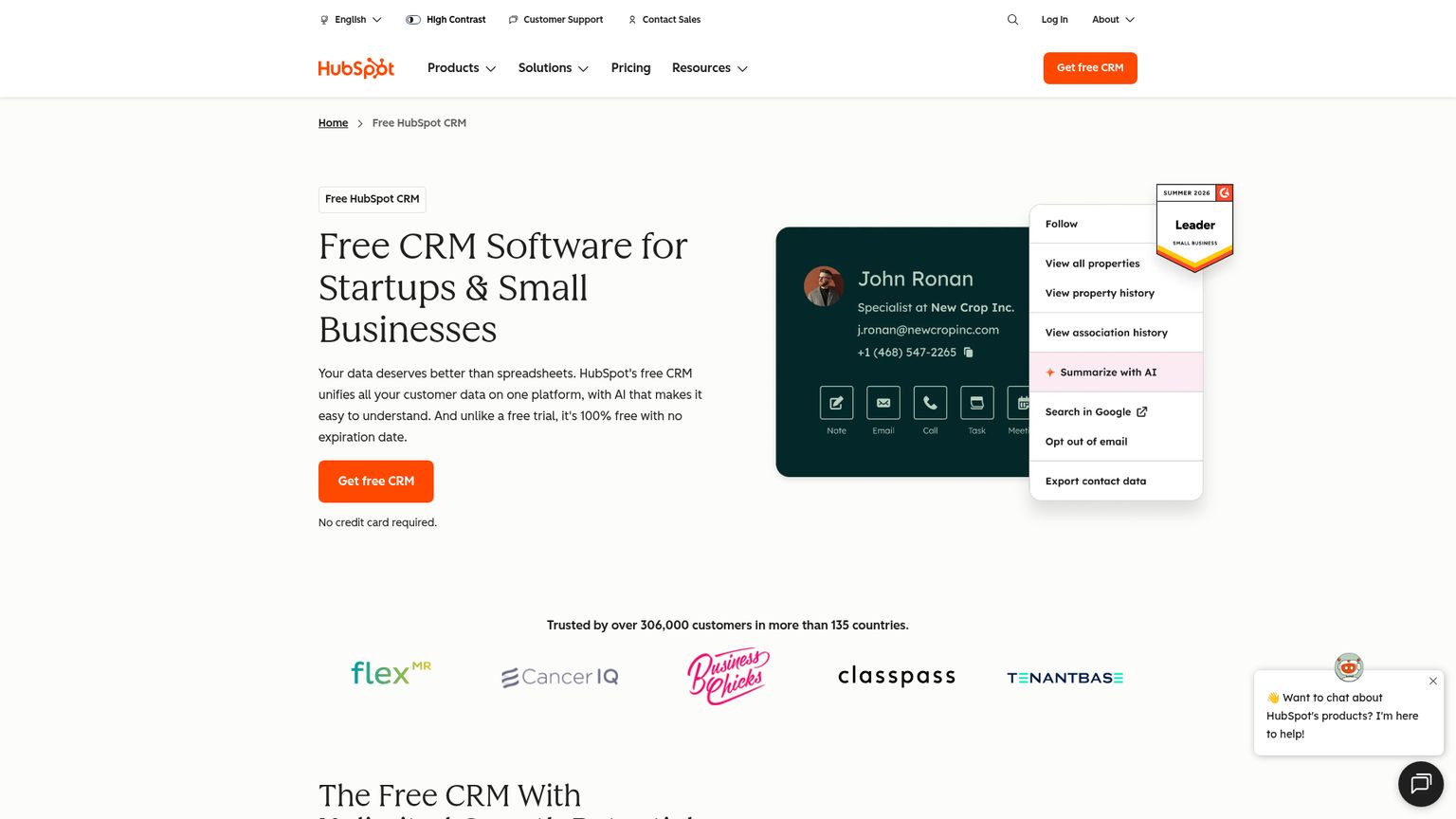
Pipedrive is the cleaner shortlist when the immediate problem is tracking deals, following up and handing won business to delivery. Choose HubSpot when the wider system matters enough to justify the applicable paid product, contact and usage costs. The Pipedrive vs HubSpot comparison examines that trade-off.
Normalize the quotes to the same billable users, billing term, email workflow, calling needs, marketing subscribers and required add-ons. A headline CRM seat price alone does not establish which system is cheaper for your business.
Choose Your Plan From a Completed Workflow
Before buying, have a rep walk through a typical opportunity from first contact to handover. Record where the chosen plan stops covering the job.
List the work that must happen
Include pipeline updates, email follow-up, website lead capture, proposals, signing and delivery. Mark existing tools you intend to keep so you do not price replacements you will not use.
Count each kind of seat
Count paid CRM seats and, on Lite or Growth, the selected project seats. Add company-wide packages once. Identify subscriber, visitor and credit requirements separately.
Compare completed quotes
Write down the monthly charge and the annual payment for Growth plus the needed extras, then Premium. In Billing, use Manage subscription and Manage add-ons to review the actual combination and any top-ups.
Check access before committing
Confirm the required AI feature is available and enabled, especially if it is in beta. Review the trial terms for each add-on and put the renewal decision on your calendar.
Pipedrive Cost Questions
How expensive is Pipedrive?
The current core plans run from $14 to $79 per seat per month equivalent with annual billing, or $24 to $99 monthly. Three Growth seats cost $1,404 annually or $147 monthly, before extras and tax. Required company packages and project seats determine the completed bill. Pipedrive pricing.
Is Pipedrive free?
There is no permanent free plan. The standard core CRM trial lasts 14 days and requires no credit card. A founder who only needs a basic contact list may be better served by an existing simple system or a permanent free CRM. Pipedrive's free-plan disclosure.
What are the disadvantages of using Pipedrive?
Full email sync and automation require Growth or higher. Premium's seat multiplier can cost more than buying company-wide packages separately, Campaigns and Web Visitors remain extra on every plan, and usage caps still apply. Annual payment also commits the budget upfront. Plan inclusions and billing.
Which CRM is the cheapest?
For basic needs, a permanent free CRM such as HubSpot can cost less than a paid Pipedrive subscription. For a working sales operation, compare the quote that includes the required users, communications and add-ons. No single starting seat price settles that comparison. HubSpot's free offering.
Is Pipedrive a good CRM?
It is a strong shortlist for a founder or sales lead who wants a defined deal pipeline, follow-up activities and a clear route to automation. Lite suits manual management; Growth is the practical starting point for email-based selling. Choose another system when calling or an integrated marketing operation is the dominant requirement.
What is better, HubSpot or Pipedrive?
Pipedrive fits a focused sales pipeline and follow-up workflow. HubSpot fits better when its free CRM is enough or its broader sales, marketing and service products match the business. Compare complete required packages before deciding from price alone.
Which companies use Pipedrive?
Pipedrive's current pricing page carries customer testimonials from 4-advice GmbH, Picked Group Ltd and Candybox Marketing Inc. These are vendor-published examples, not evidence that every company needs the same plan. Pipedrive customer testimonials.
Who owns Pipedrive?
Pipedrive's company newsroom identifies Vista Equity Partners as its majority holder and also names Bessemer Venture Partners, Insight Partners, Atomico and DTCP as investors. Pipedrive's company statement.
Is Pipedrive a CRM or ERP?
Pipedrive describes itself as a sales CRM. The plans discussed here cover customer relationships, leads, deals and sales workflows. Choose it for that job; assess the other systems your business needs for accounting and operations separately. Pipedrive's product description.
What is the best CRM for a service business?
For a service business that sells an engagement and then manages delivery, Pipedrive with Projects is a relevant shortlist. Compare Growth plus the project seats needed with Premium, where Projects is included. For a business whose main activity is high-volume outbound calling, include Close in the evaluation. The best fit follows the work and its completed cost.
Does Pipedrive offer a student discount?
The public pricing page does not list a general student discount. Budget using the published tier and billing-cycle prices unless Pipedrive confirms a specific offer for your account. Current public pricing.
What is Pipedrive's refund policy?
The current terms state that subscription fees are non-refundable and ordinary cancellation takes effect at the end of the current term. Do not treat an annual subscription as a refundable monthly commitment. Paid-account access continues until the billing cycle ends after cancellation. Payment terms, cancellation guidance.
Has Pipedrive pricing changed?
Pipedrive now uses Lite, Growth, Premium and Ultimate. Its transition guide maps Essential to Lite, Advanced to Growth, Professional and Power to Premium, and Enterprise to Ultimate. Switching applies current list pricing; an old plan name or legacy package price does not establish the price of a new subscription. Plan transition guide.
AI Business Workflow Audit Checklist
Use the workflow and budget checklist above for your CRM decision, then receive new operator guides by email.
- Published
- Category
- Growth
- Language

Lemlist Pricing: Seats, Credits and Sending Costs
Lemlist pricing by month, quarter and year, including credits, mailboxes and add-ons. See founder, sales team and agency bills plus alternatives.Oct 8, 2026Growth
Tidio Alternatives
Compare seven Tidio alternatives by support job, current pricing and billing unit. See who should switch, what migration costs and when Tidio wins.Oct 7, 2026Growth
Vista Social Pricing: What Your Profiles and Team Cost
Vista Social starts at $99/month. Compare annual prices, profile and user limits, AI features, add-ons, three bills and cheaper options.Oct 7, 2026Growth
Unbounce Pricing 2026: Plans, Visitor Limits and Testing
Unbounce starts at $29/month. Compare all six plans, annual rates, visitor and domain limits, A/B testing, Smart Traffic and the cheapest fit.Oct 7, 2026Growth
Best AI Ad Generator in 2026: AdCreative.ai, Atria, Creatify & Arcads (Compared)
Choose AI ad tools by job: static ads, UGC-style video or creative research. Compare current maker pricing, credit units and free entry.Oct 6, 2026Growth
Surfer SEO Alternatives: SE Ranking, Frase, Clearscope, NeuronWriter and MarketMuse (Verified October 2026)
Compare five Surfer SEO alternatives by content scoring, SEO suite fit and AI tracking, with current prices and workload costs.Oct 6, 2026Growth
CallRail Pricing (2026): Plans, Usage and AI Costs
CallRail's monthly and annual prices, AI features and usage fees, with worked bills for one location, multiple locations and agencies.Oct 6, 2026Growth