Beautiful AI Review
Beautiful.ai review: Smart Slide guardrails, current pricing, Team seat ambiguity, AI features, export limits and when Gamma is the better fit.
Published
 By Omid Saffari


Beautiful.ai is worth paying for when repeatable, on-brand decks save more work than unrestricted slide design. This Beautiful AI review puts that trade at $14.50 a month on annual Pro billing, while treating the Team page's conflicting seat wording as a budget question you must resolve before buying.
Pricing and public product documentation verified on 10 October 2026. This is a public-source evaluation, with no signed-in tests. The workflow examples are proposed ways to use documented features, not decks generated during this review.
Disclosure: Beautiful.ai plan links use our affiliate redirect. Gamma is also a partner. These relationships do not change the recommendations or the limitations below.
Beautiful AI Review: What You Are Buying
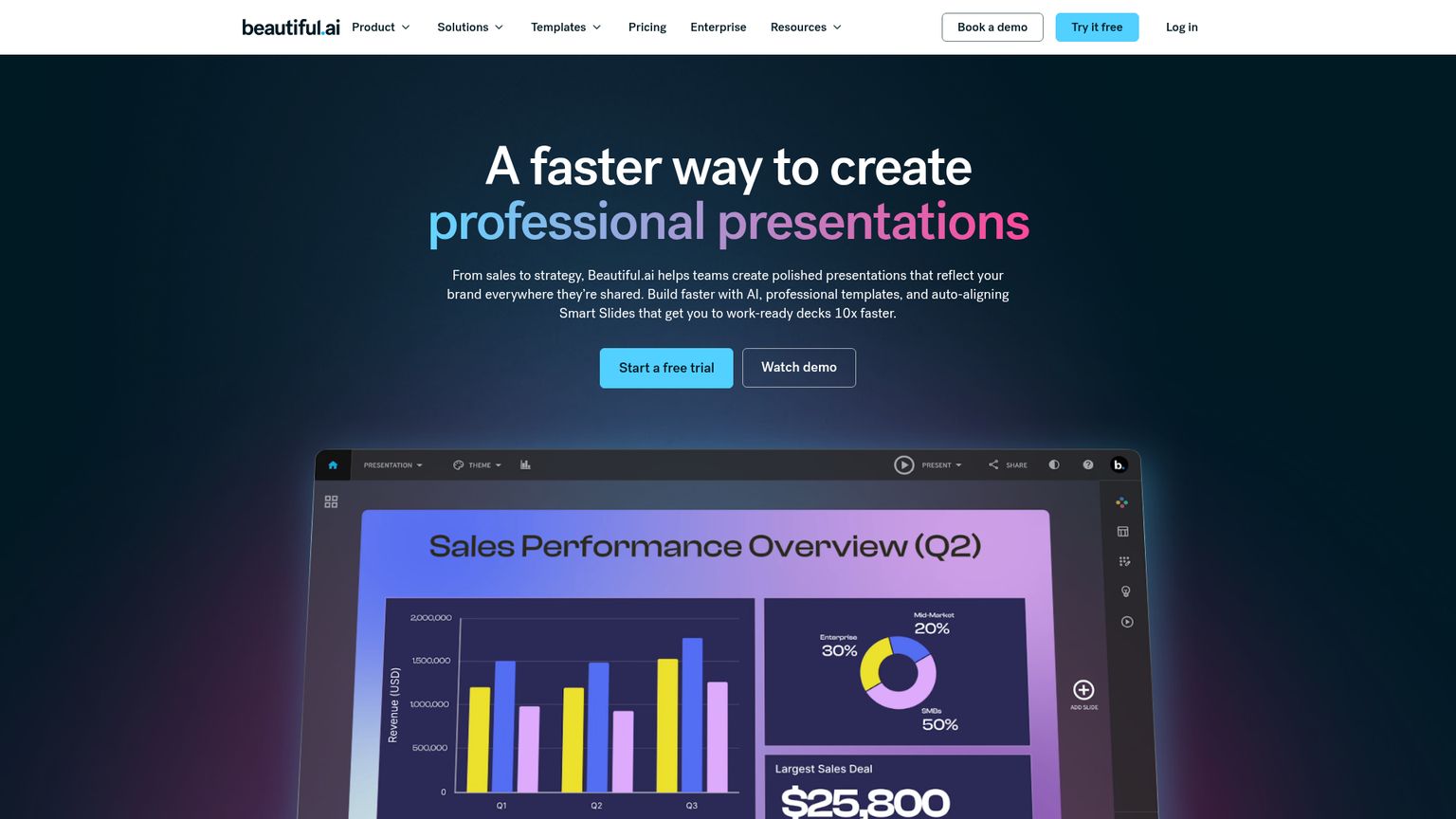
Beautiful.ai is a presentation editor built around layouts that adjust as you change their contents. Its Smart Slides handle spacing, alignment and resizing; its AI can draft the outline, copy and images; its themes and shared resources help repeat a visual standard across decks. You still own the argument, the accuracy of the numbers and the decision about what deserves a slide. The useful distinction is between automating layout and doing your thinking for you: only the former is the dependable buying premise supported by the public feature set.
How to Read Beautiful AI Reviews
Judge Beautiful.ai on four criteria: whether routine slides remain consistent after edits, whether colleagues can reuse approved material, whether the final delivery format preserves what matters, and whether the subscription removes enough work to justify its cost. Those criteria explain both the recommendation and its limits.
Who Should Use It, and Who Should Skip It?
Beautiful.ai fits a founder updating an investor deck, a consultant producing recurring client reports, or a sales lead trying to stop every rep rebuilding the company story. Its value rises when the same visual system must survive repeated edits by different people.
The shortlist below compares starting prices, not equivalent governance packages. Prices are in US dollars; annual rates mean an annual commitment.
Sources: Beautiful.ai pricing, Gamma pricing, Plus AI pricing.
Buy for repeated work, not one impressive opening slide. A consultant who ships the same report structure every month can reuse its visual decisions. A founder making an unusual product narrative may spend more time negotiating the layout rules than benefiting from them. That founder should compare the hardest slide before choosing a subscription.
Beautiful AI vs Gamma
Gamma, an AI workspace for presentations, documents and websites, is the cheaper starting point for exploring a story across formats. Its free plan includes 400 starter credits that do not refill and allows up to 10 slides per prompt. Plus costs $9 per seat per month billed annually, or $108 a year, with 1,000 monthly credits and removal of Gamma branding. Pro costs $18 per seat per month annually, or $216 a year, and adds custom branding, detailed analytics and 4,000 monthly credits. These are the annual prices shown on Gamma’s live pricing page.
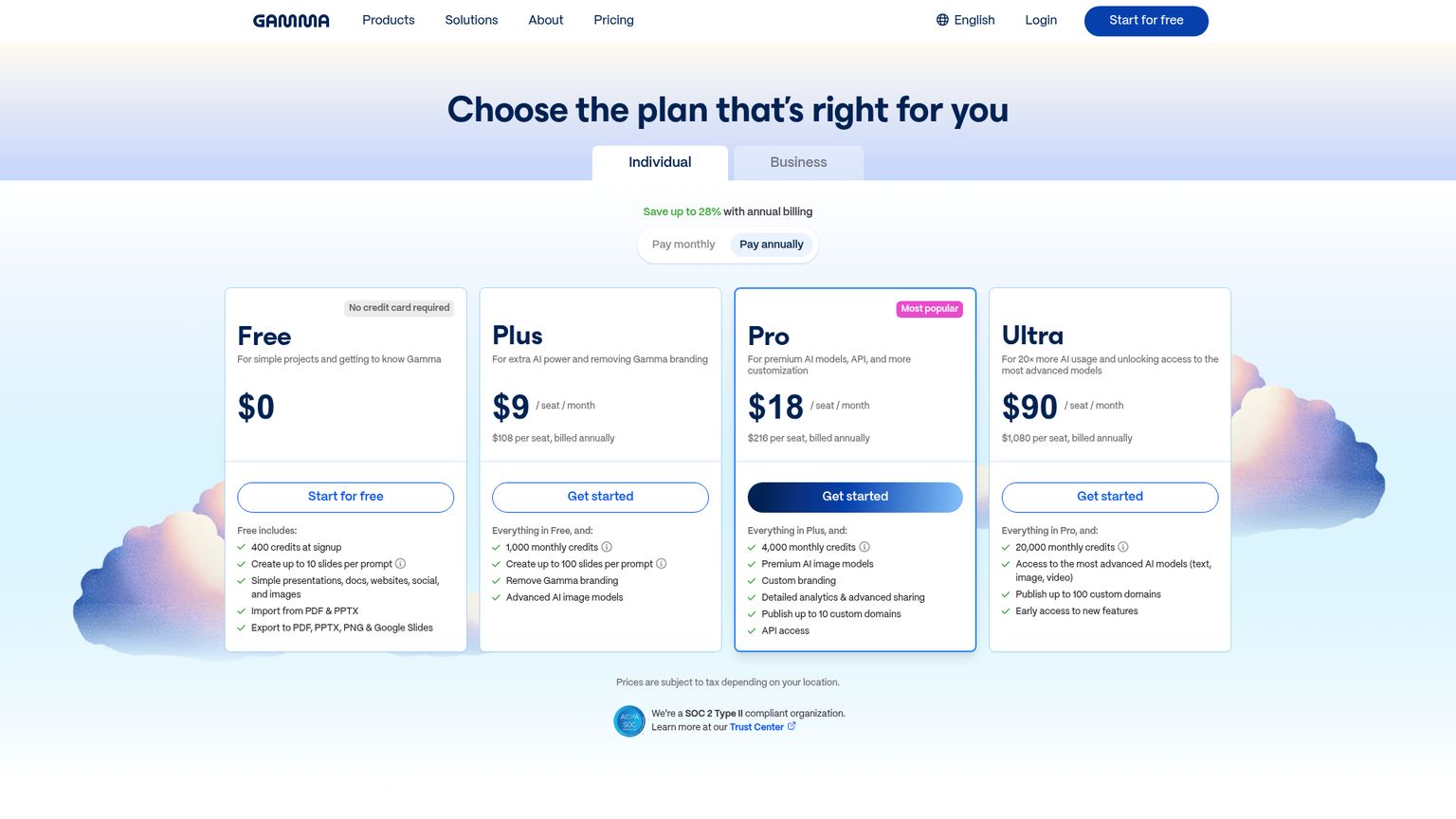
The decision is not whether either product has AI. Both do. Choose Gamma when a presentation is one version of material you also want to share as a document or website. Favor Beautiful.ai when a reusable slide layout system is the central requirement. Gamma’s paid credits can run out, and credit consumption varies by action, model and complexity, so a monthly allowance is not a guaranteed number of finished decks. Our Gamma pricing breakdown covers that separate budget decision.
Beautiful AI Alternatives for Native Client Handoffs
Plus AI is an add-on that creates and edits presentations inside Microsoft PowerPoint and Google Slides. It deserves a place on a consultant’s shortlist when the client expects to keep editing in one of those applications. Basic is $10 per user per month annually or $15 monthly; document uploads arrive on Pro at $20 per user per month billed annually or $25 billed monthly, while custom branding is listed on Team at $30 per user per month billed annually or $40 billed monthly. Plus AI’s pricing page specifies those boundaries.
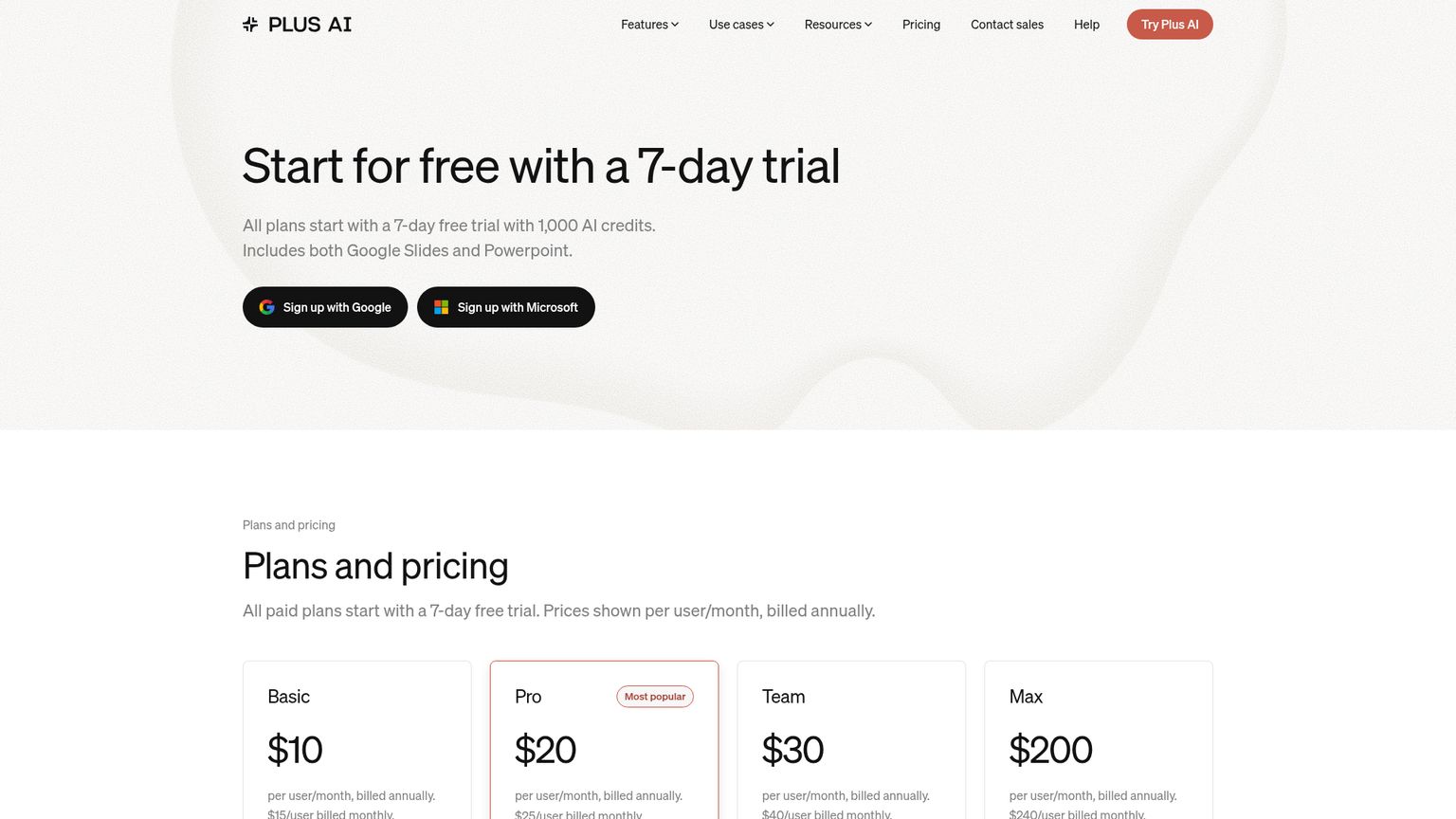
Skip Beautiful.ai if most of the work will immediately move into a client’s native editor and its adaptive layouts will no longer drive revisions. Skip entry-level Plus AI if uploading source documents or applying a shared brand is the reason you are buying: its cheapest plan is not the full feature set. For a wider shortlist, see the AI presentation tools comparison; use the live prices here for this purchase.
Smart Slides: Keep the Grid, Give Up Some Freedom
Beautiful.ai’s Smart Slides are most useful when the content changes but the visual pattern should stay stable. Its public Smart Slides page describes automatic alignment, resizing and spacing across more than 300 layouts, including comparisons, timelines and data slides.
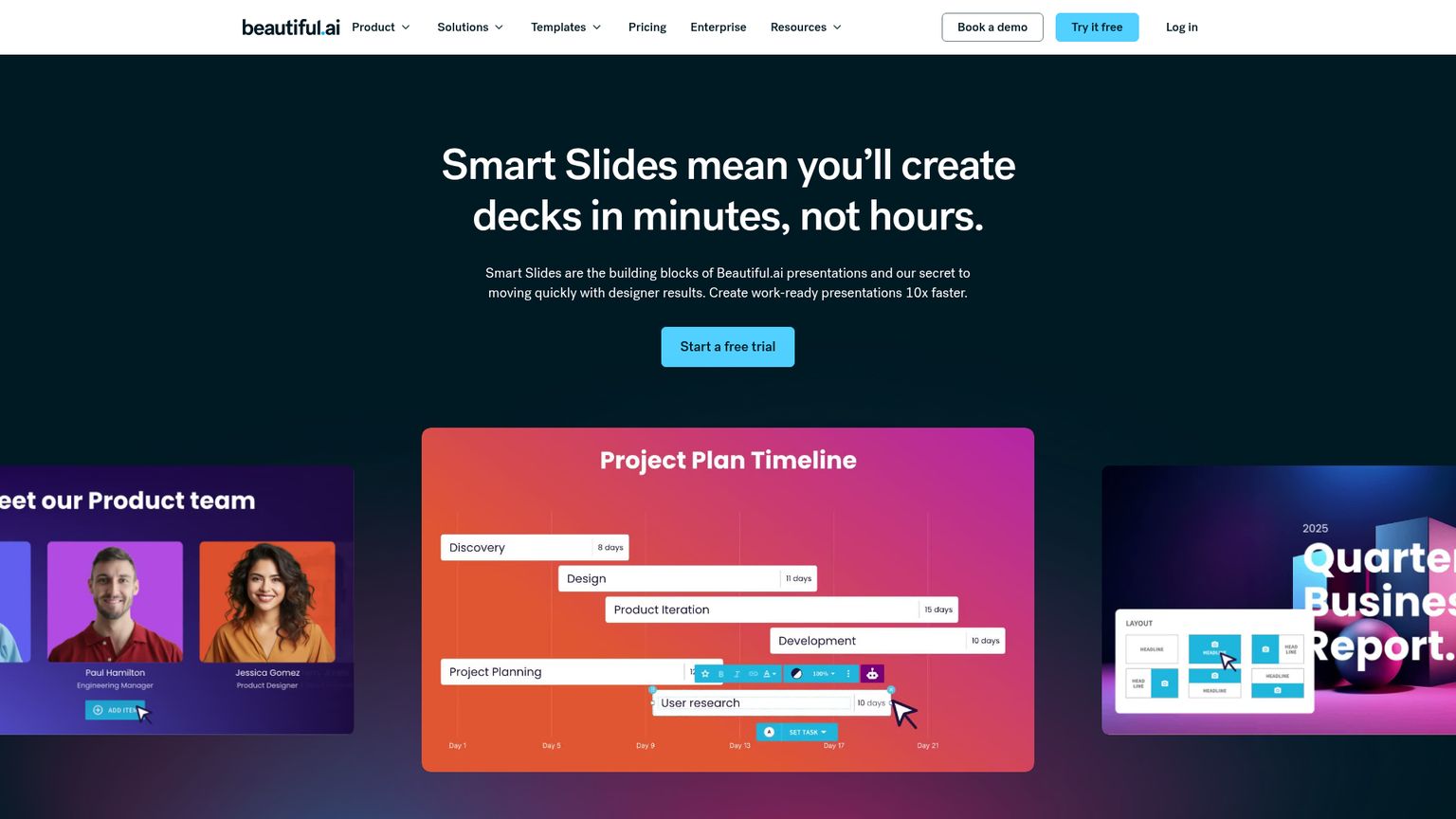
Consider a sales proposal comparing service packages. When the scope changes, a rep should update the package descriptions and check the hierarchy, rather than manually move every neighboring box. That is an appropriate job for a constrained layout. A bespoke diagram whose positioning carries the argument is a different job: the arrangement itself is content, and automatic layout may be the wrong starting point.
The practical sequence is to try another Smart Slide layout, shorten the message, or split overloaded content. If none preserves the meaning, Beautiful.ai provides a freeform escape: its help center documents Ideas → Convert to Classic Slide → Ok. A Classic Slide removes the normal Smart Slide design constraints. You gain manual control and take responsibility for the layout again. Conversion instructions.
Importing a Deck Does Not Make It Smart
Beautiful.ai’s team-template documentation states that imported PowerPoint slides arrive as Classic Slides. They do not automatically adapt like native Smart Slides. The documented recommendation is to rebuild the important slides as Smart Slides when creating a reusable template.

That boundary changes a migration budget. If a sales lead imports an existing master deck, the upload is the beginning of the work. Identify the slides repeatedly edited by reps, rebuild those first, and leave genuinely exceptional layouts under manual control. A library with fewer useful adaptive slides is more valuable than a large imported library mistaken for an automated one.
A Beautiful AI Presentation Starts With the Outline
Beautiful.ai’s documented AI workflow lets you shape the story before generating the design. Start with a prompt, pasted outline, URL or uploaded file; refine a slide-by-slide outline; then choose the theme, language, image source and image style. The presentation-maker page also describes trying alternative slide layouts while preserving the copy and numbers.
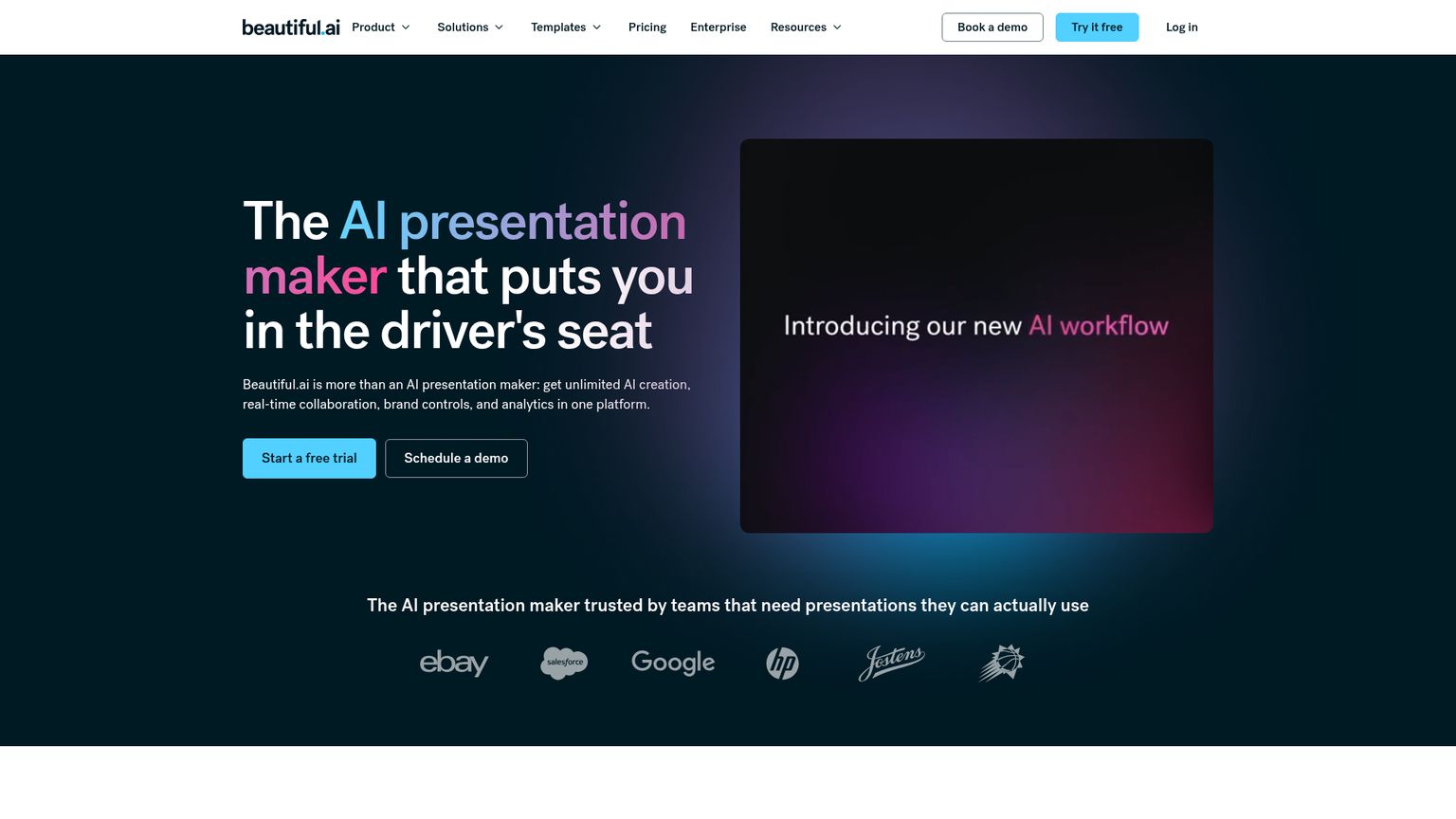
The implication for a founder is straightforward: settle what the investor needs to believe before decorating it. A good-looking slide does not repair an unsupported market claim. For a consultant, the equivalent rule is to decide what the client needs to approve before turning a report into a deck.
Beautiful AI Examples: The Same Client Brief, Before and After
Use this hypothetical brief: a consultant must explain a client’s quarterly results, identify the main constraint and request approval for the next action. Beautiful.ai’s public page includes a quarterly business report example, but the restructuring below is an editorial illustration, not a generated result.
Before: an outline organized as executive summary, financial overview, sales performance, marketing performance, achievements and outlook. It contains the report’s subjects, but the client still has to infer the decision.
After: open with the decision requested, show the evidence that makes it necessary, explain the constraint, propose the action, then state its owner and next review point. Move background material behind the main narrative. The facts have not changed; their order now helps someone act.
The first correction belongs in the outline. The second belongs in the slide: replace a paragraph mixing results and recommendations with a chart of the result and a short statement of its consequence. The third is an accuracy check: verify that units, dates and qualifiers survived any AI rewrite. Layout automation supports these choices; it does not make them.
A Reproducible Trial Recipe
Beautiful.ai’s public workflow supports the following evaluation. Bring material you are permitted to upload and treat the steps as a proposed trial, not a claim that this review executed them.
Give the AI a decision and a source
Supply the report or approved notes. A useful prompt is: “Create a client review for the decision-maker approving our next action. Use only the supplied facts. Separate results, interpretation and recommendation. Flag missing evidence instead of inventing it. Finish with the decision required and the responsible owner.”
Fix the outline before generating
Review the slide-by-slide narrative. Remove repeated sections, move evidence next to the claim it supports, and identify where a chart will communicate more clearly than a paragraph. This is the cheapest place to change the argument.
Set the visual rules
Select the approved theme, language and image source. Define a consistent image style if using generated illustrations. Use supplied product imagery for anything that must accurately depict the business. A thematic AI picture is not evidence of a product feature.
Stress the recurring layouts
Try alternative Smart Slide layouts while keeping the approved copy and figures. Lengthen a heading, add a comparison item, and revise chart labels. Count the slides that need manual layout work; those exceptions determine whether the system fits your workload.
Inspect the final handoff
For an editable PowerPoint, the documented path is Presentation → Export Presentation → Editable PowerPoint → Export. Open the exported file in the destination environment and check fonts, chart labels and notes. Inspect a static PDF separately if that is what the client will receive.
The creation stages come from Beautiful.ai’s AI workflow; the export path comes from its export documentation. Public pages do not establish how often your particular deck will need repairs, which is why the difficult slide belongs in the evaluation.
Brand Controls: Styling Is Only the First Layer
Beautiful.ai’s brand system is useful only if you distinguish defaults, shared resources and permissions. A saved theme sets the look. A shared library gives colleagues approved material. Permissions determine what they can change. Buying one does not prove you have bought all three.
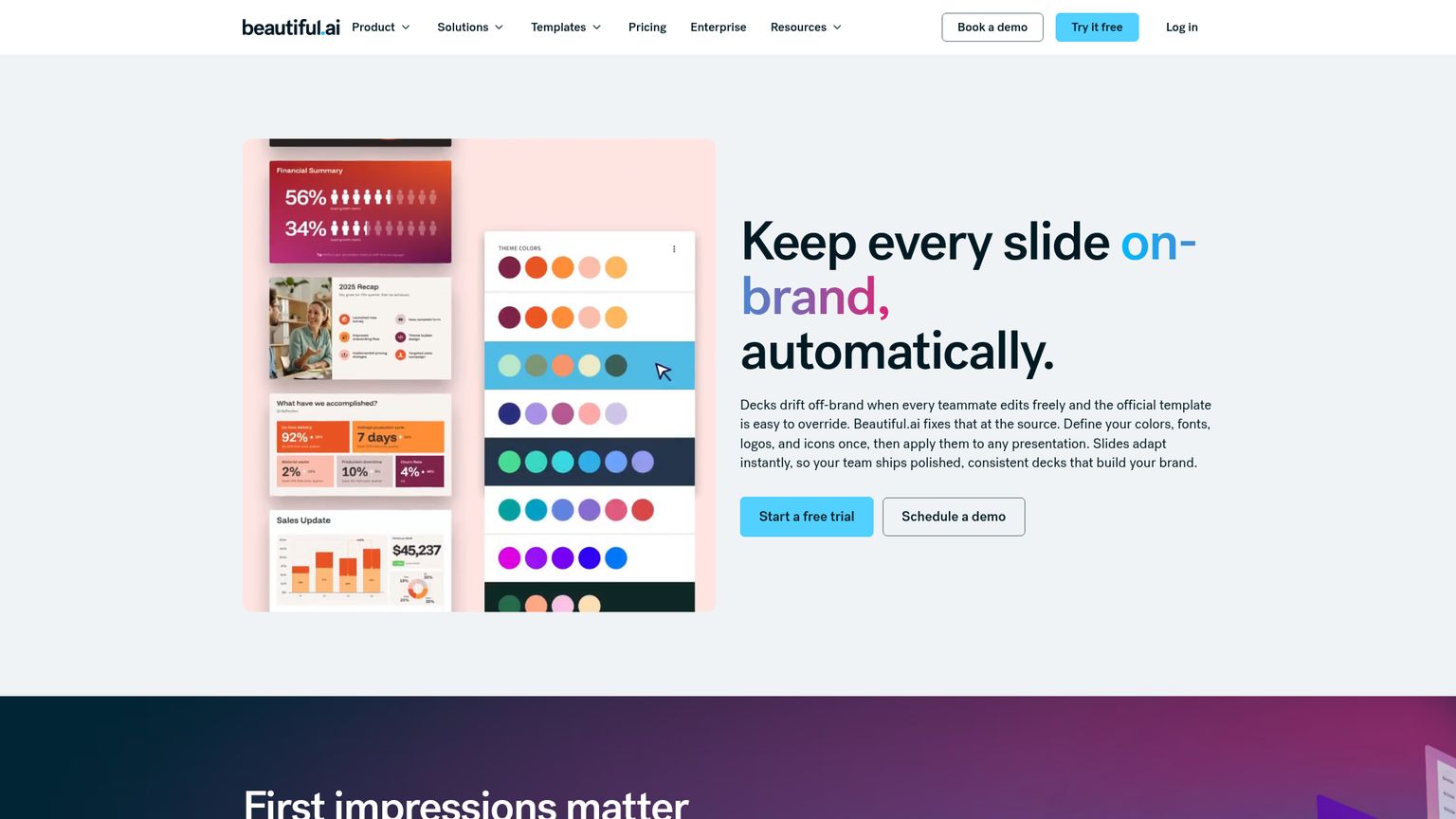
The brand page documents colors, fonts, logos, icons and footers, together with shared assets and locked reusable slides. Pro’s pricing card includes a custom theme builder. Team adds shared libraries, collaboration and locked slides. Enterprise explicitly lists configurable brand guardrails and advanced permissions. Do not translate “custom branding” into a promise that every user on the cheapest plan is prevented from changing every design setting.
For a sales lead, start with an approved company story, a current product overview and a customer-proof slide whose wording has been checked. Reuse those assets rather than asking each rep to generate the company’s claims again. For an agency, decide whether a client-specific theme is enough or whether different editors need restrictions on which resources they can use.
Shared Slides Need an Owner
Beautiful.ai’s presentation-workflows page describes a shared workspace, assignments, comments, live editing and viewer tracking. Those features support a repeatable proposal process, but someone still has to retire the old offer and approve the new one.
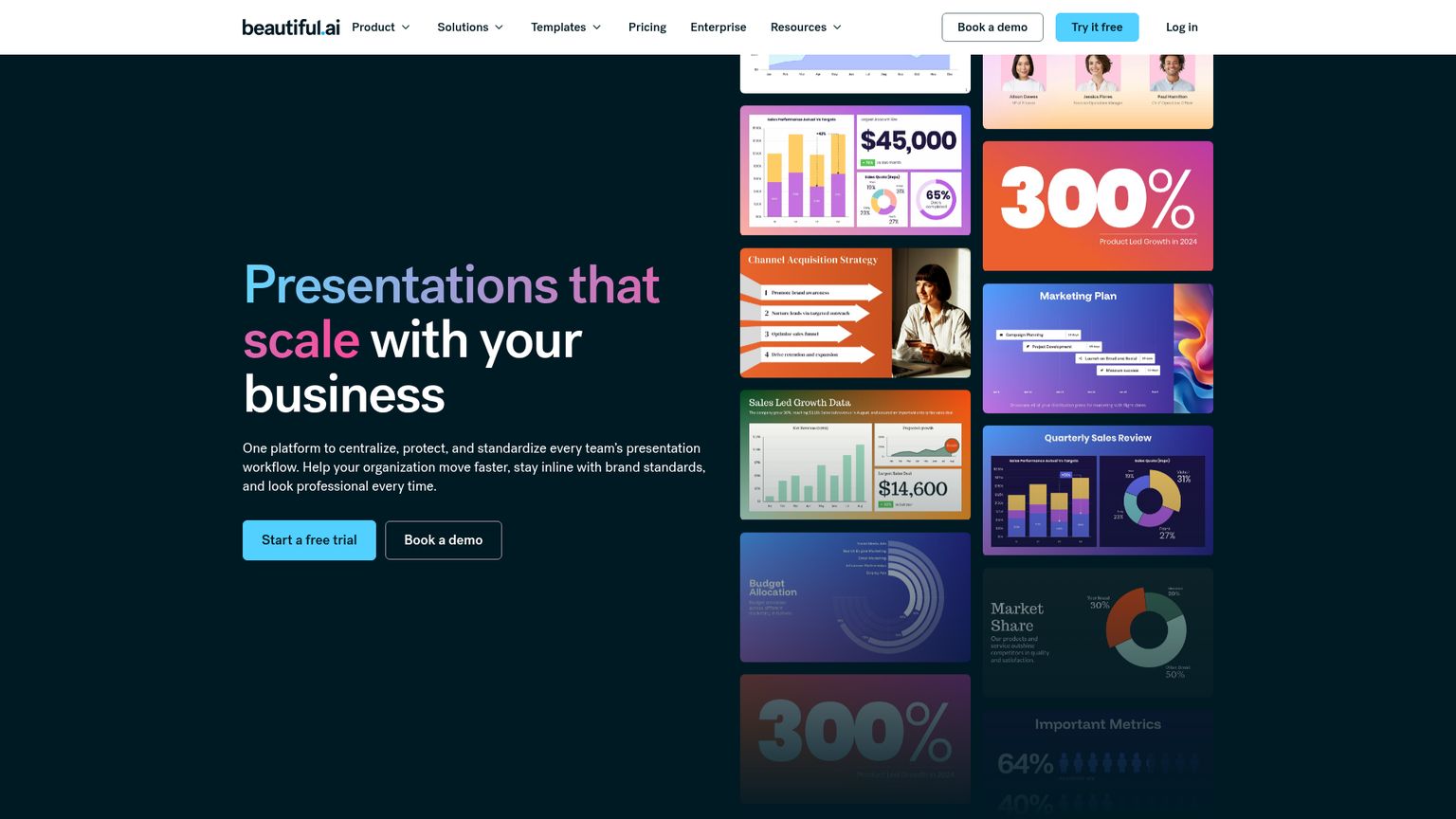
Assign an owner to reusable claims and slides. Treat viewer activity as a follow-up signal, not proof that a buyer agrees with the proposal. And specify whether the buyer receives a link, a PDF or an editable deck: the handoff determines where your control ends.
Charts and Client Reports Need a Data Owner
Beautiful.ai can format a chart; it cannot take responsibility for what the chart means. Its data-visualization page describes spreadsheet connections and chart layouts, including line, bar, column and waterfall charts. The pricing page places live data linking to charts and tables on Team.

For a recurring client report, keep the approved data in its source spreadsheet, update the relevant chart, then check the reporting period and the definition of each metric. Revenue booked, revenue collected and pipeline value can all make attractive graphs; they answer different questions. Consistent colors cannot correct an inconsistent definition.
Use a trend chart when the question is change over time, and a comparison chart when the question is which category differs. Put the consequence in the heading. “Qualified pipeline fell” helps the reader more than “Sales overview,” provided the source supports it.
The craft bar for a deliverable is that the chart stays legible in the delivered format, its units and period are clear, and its interpretation matches the data. If the slide only looks convincing at full screen in the editor, it is a draft. Review the exported or shared version before calling it client-ready.
Beautiful.ai Pricing: What Each Plan Costs
Beautiful.ai’s live pricing page lists Pro, Team and Enterprise, plus a monthly Pro option and a link to SMB plans. The current Pro annual rate is $14.50 per month. Use that maker-published figure for budgeting.
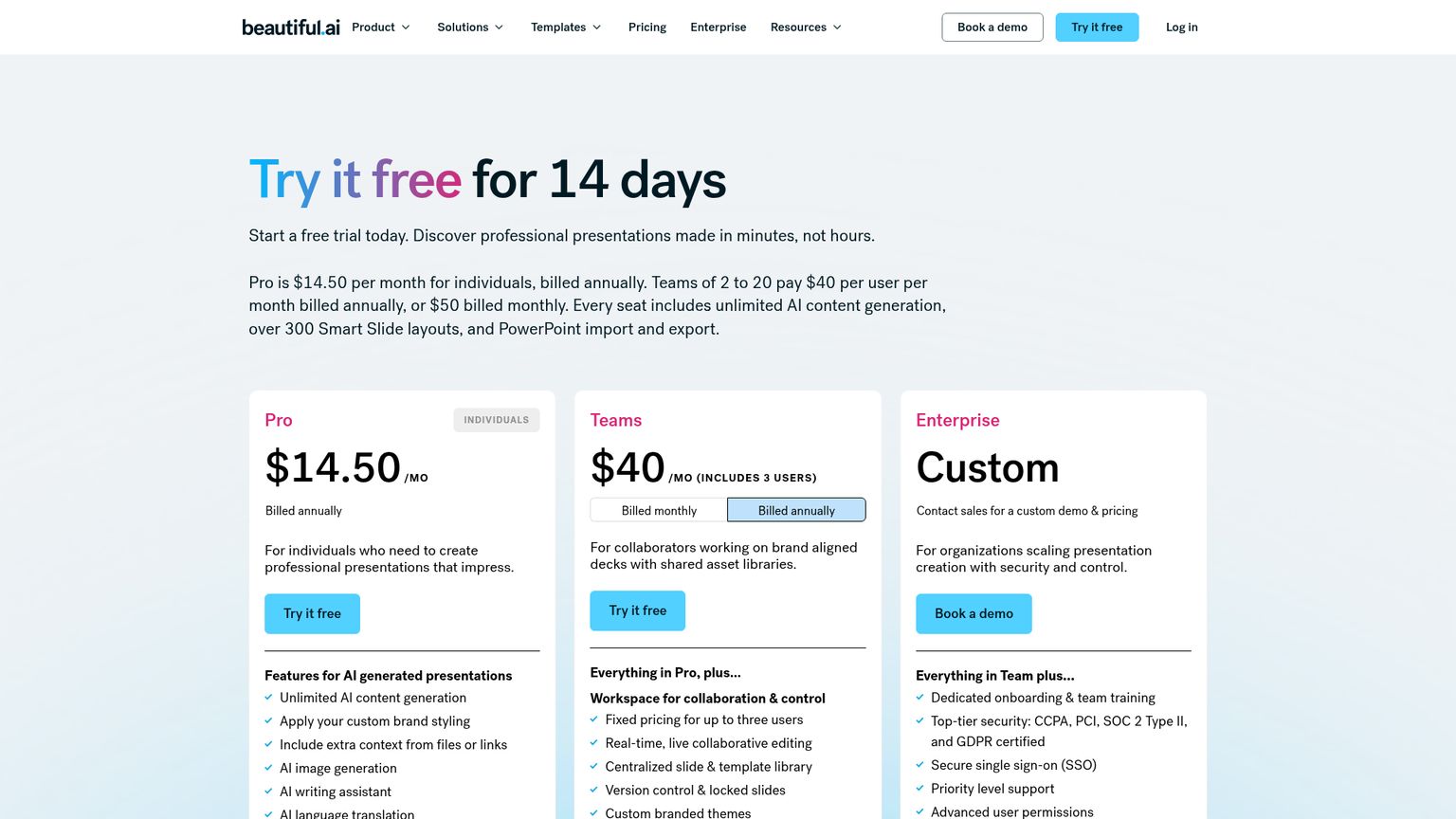
Primary-tier figures come from pricing; SMB figures and eligibility come from the small-business page. Monthly equivalents are not a monthly payment offer.
Which AI Features Are Included in Each Plan?
Pro lists unlimited AI content generation, AI image generation, an AI writing assistant, AI language translation, and extra context from files or links. It also lists applying your custom brand styling. AI drafting is therefore part of the individual plan, rather than a reason by itself to buy Team.
Team includes everything in Pro, so it inherits all those AI features. Its card additionally describes presentations in 100+ languages and on-demand slide translation. The upgrade’s practical purpose is shared creation and control: live collaboration, centralized slide and template resources, shared assets, locked slides, live data linking and engagement analytics.
Enterprise includes everything in Team. The published additions center on administration: single sign-on, user provisioning, advanced permissions, audit logs, onboarding and configurable brand guardrails. Its card does not publish a separate numerical AI allowance. All three descriptions follow the maker’s plan cards.
The SMB page lists the Create with AI workflow among its included B2B features. It does not separately enumerate the entire AI feature list in the same way as the Pro card; specify the required features in the demo and order terms.
The Team Card Has a Pricing Conflict
The Team pricing prose and FAQ say $40 per user per month annually, or $50 per user monthly, for 2 to 20 seats. The card simultaneously says “INCLUDES 3 USERS” and describes fixed pricing for up to three users.
Those statements do not produce a reliable checkout total on their own. This review does not assume that $40 buys three seats, or that a three-seat minimum applies. Ask for the total covering your paid creators, billing term and renewal conditions before starting a Team subscription.
Also separate creators from invited collaborators. Beautiful.ai’s guest-workspace documentation says guests without a paid workspace seat can edit presentations they are invited to, collaborate and export, but cannot create, import or duplicate presentations. A client reviewing a specific deck may have a different role from an employee originating decks. Guest access is not a substitute for a creator seat.
What a Consultant or Sales Team Pays Per Deck
For a solo consultant, annual Pro costs $174, calculated as $14.50 × 12. Paying $45 monthly for a full year totals $540, a $366 difference. For an isolated engagement, three paid months cost $135; four cost $180. Annual billing becomes cheaper at the fourth paid month, provided you will use that commitment. Price inputs.
Suppose the consultant finishes four usable decks each month. At 48 decks per year, annual Pro costs approximately $3.63 per deck. Monthly Pro works out to $11.25 per deck at the same monthly output. These are subscription allocations; they exclude research, writing, revision and time spent fixing exports. Unused or abandoned decks do not make the business case better.
For a five-creator sales team, the per-user interpretation would mean $2,400 annually, equivalent to $200 per month, or $250 with monthly billing. At a hypothetical 20 finished decks per month, that is $10 or $12.50 per deck respectively. The Team wording conflict still applies. The more useful performance measure is the time from approved source material to an accepted deliverable, including every revision.
SMB Pricing Depends on Company Size
Beautiful.ai’s SMB page publishes a $6,000 annual flat rate for SMB 50 and $12,000 for SMB 100, with full access for all users, dedicated onboarding and priority support. Eligibility is stated in employees in the company, not merely the number who build slides.
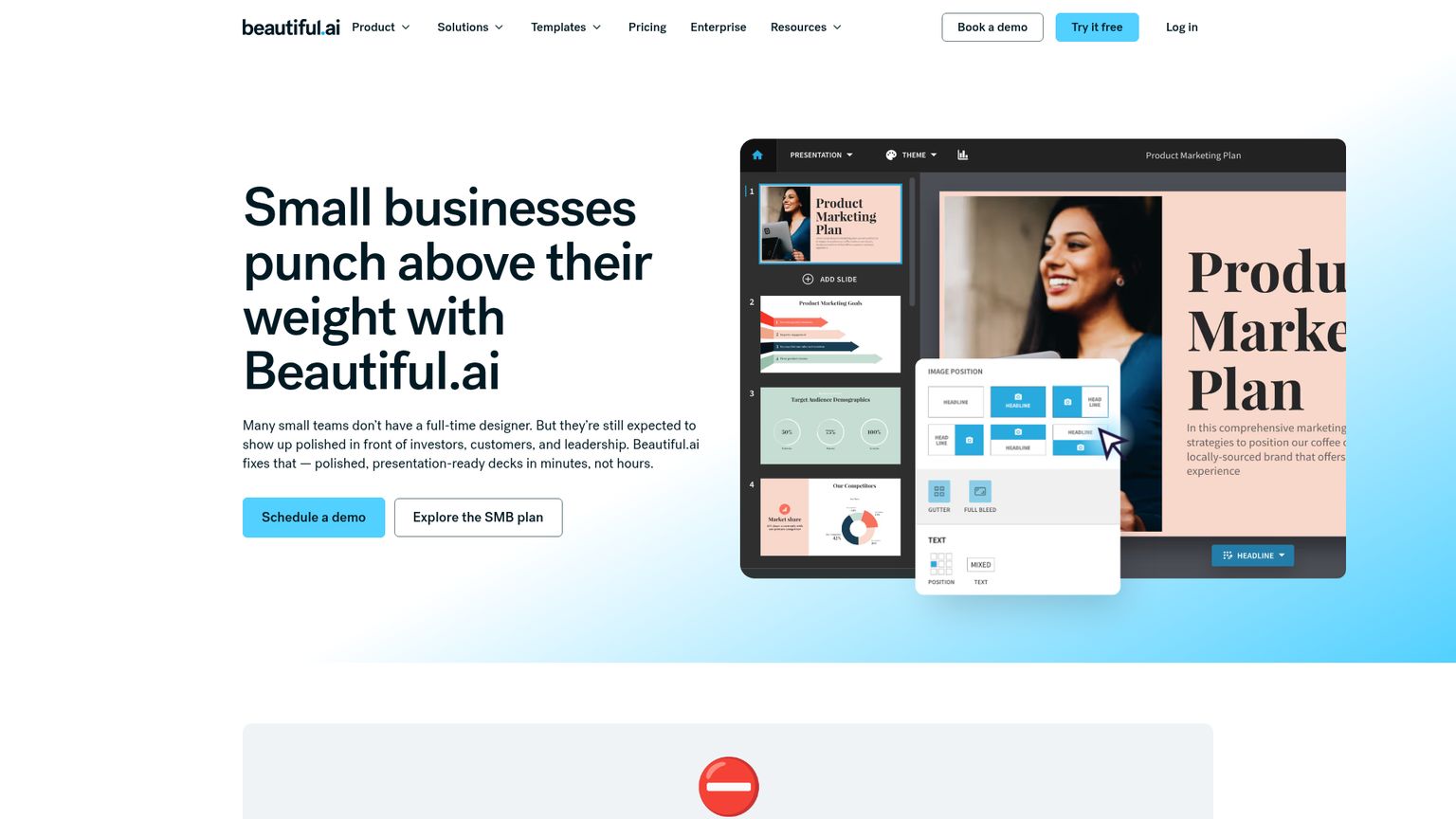
The monthly equivalents are $500 and $1,000. At each plan’s full employee capacity, both work out to $10 per employee per month equivalent, but that is not a separately sold $10 seat. A company paying for broad access while only a few people create decks will see a different cost per active creator.
Using the conditional Team annual rate, 12 creators cost $5,760 a year and 13 cost $6,240. SMB 50’s $6,000 is lower than that latter calculation by $240, if the company qualifies and the quoted terms match. This is a reason to compare written offers at that scale, not a claim that every organization should switch at 13 users.
Beautiful AI Free Access and the Trial Charge
Beautiful.ai lists a 14-day trial requiring a credit card, with a full charge unless you cancel before it ends. Both Pro and Team are described as trial options. There is no permanent general-purpose free plan listed for the business reader of this review; the separate education offer is a year free for students with a valid .edu address. Trial and education terms.
The pricing FAQ directs cancellation to the Billing section of your Profile. It also says monthly subscriptions are non-refundable. Start a trial when you have the source material and time to evaluate the final handoff, and record the cancellation deadline immediately. An annual price displayed as a monthly equivalent should not be mistaken for a single month’s charge at trial expiry.
Limitations That Can Change the Purchase
Beautiful.ai’s constraints matter most when the deck leaves its ideal workflow. These are specific reasons to choose a different tool, a different plan or a narrower rollout.
The layout rules can oppose the story. Smart Slides work best when your content fits a useful repeatable pattern. Switching an exception to Classic restores freedom, but the more slides you manage manually, the less of the core automation you are buying. If bespoke spatial composition dominates your work, keep the project in the native editor or use Plus AI there.
Imported templates carry rebuilding work. Importing PowerPoint does not turn the old master into an adaptive system. The documented Classic Slide import behavior means a sales-library migration needs time to reconstruct key layouts. Include that work in the purchase decision, particularly if maintaining the existing master exactly is mandatory.
Editable export is not complete fidelity. Beautiful.ai’s export guide says external platforms lose its transitions and animations. Google Slides export also loses embedded video and audio. PowerPoint formatting can differ if the destination device lacks the fonts; the guide recommends downloading and installing them. A PDF is static. These are documented limitations, not export failures observed in this review.
Brand feature names do not settle permissions. The presence of themes on Pro is not evidence of Enterprise-level enforcement. If the business requirement is that a rep cannot alter a protected brand element, make that exact action part of the plan demonstration. The public cards do not justify a blanket claim that every Beautiful.ai deck is impossible to take off-brand.
AI drafting still needs evidence and editing. Files and links give the system context, but supplying a source is not a guarantee that every resulting claim is correct. Check copy after shortening or translation, verify figures against the approved report, and reject illustrations that imply an unverified product capability. This is the editorial work your subscription does not remove.
The trial creates a billing deadline. A card-required trial is useful only if you finish the evaluation before the charge. Combine that deadline with the unresolved Team wording and the case for obtaining a written total becomes stronger.
Verdict: Buy the Rules Only When You Need Them
Beautiful.ai earns its place when recurring deck creation is slowed by inconsistent layouts, repeated brand corrections and rebuilding approved material. Choose Pro for an individual whose standard decks fit Smart Slides. Consider Team for shared creation and reuse, after the vendor resolves the price. Consider Enterprise when specific permissions and administrative controls are purchase requirements.

The decision rule is net time saved after source checking, manual exceptions and handoff repairs. For example, three Gamma Pro seats at the verified annual rate equal $54 per month. Conditional Beautiful.ai Team pricing for three creators equals $120, a $66 difference. At an assumed labor cost of $75 an hour, roughly 53 minutes of additional net savings per month would cover that premium. This is a budgeting illustration, not a measured saving or a claim that the plans have identical features.
Choose Gamma if flexible content and a lower-cost start matter more than a reusable slide system. Choose Plus AI if native client editing defines the job. On Monday, take a recurring deck with a troublesome comparison, a chart and an editable handoff requirement. Evaluate those parts and the final file before committing your library or your annual budget.
Frequently Asked Questions
Is Beautiful.ai worth it?
Yes when repeatable Smart Slide layouts and shared brand resources remove enough revision work. It is less compelling when most slides require bespoke positioning or must immediately be rebuilt in another editor. Compare total preparation and handoff effort, not the appearance of the first draft.
Does Beautiful.ai have a free plan?
The current pricing page lists a card-required 14-day trial rather than a permanent general-purpose free plan. It charges unless cancelled before the trial ends. A separate education offer provides a year free for eligible students with valid .edu email addresses.
How does Beautiful.ai compare to Gamma?
Beautiful.ai centers adaptive slide layouts and repeatable deck production. Gamma spans presentations, documents and websites, with a free entry plan and paid AI credit allowances. Gamma Plus is $9 per seat per month annually; Beautiful.ai Pro is $14.50 per month annually. Compare branding and collaboration requirements separately from those entry prices.
Can Beautiful.ai import PowerPoint slides?
Yes. Its team-template documentation says imported slides become Classic Slides, which do not automatically adapt like Smart Slides. Rebuilding key layouts is part of turning an imported deck into a reusable adaptive template.
Can I export Beautiful.ai presentations to PowerPoint?
Yes, editable PowerPoint export is documented for Pro, Team and Enterprise. Check destination fonts, and do not expect Beautiful.ai’s transitions and animations to survive external export. Open the final file in the environment where it will be used.
Who needs the Beautiful.ai Team plan?
People who need a shared workspace, collaborative editing and centralized slides, templates and assets. Pro is the individual option; invited guests have more limited creation rights than paid workspace members. Obtain a confirmed Team total because the pricing prose and three-user card wording conflict.
Use the AI business workflow audit checklist to identify where presentation work costs you time before adding another subscription.
- Published
- Category
- Design
- Language

Nano Banana 2.1 Explained: Pricing, Changes, and When to Switch
Nano Banana 2.1 cuts 1K and 2K image costs about in half. Compare monthly budgets, verify the migration, and decide when Pro earns its premium.Oct 8, 2026Design
ElevenLabs Alternatives: Murf, MAI-Voice-2, OpenAI TTS and Cartesia (Verified October 2026)
Compare ElevenLabs, Murf, MAI-Voice-2, OpenAI, Cartesia, Google and Speechify by studio or API job, with verified prices and switching costs.Oct 4, 2026Design
Higgsfield API Pricing
Price Higgsfield API video and image jobs, separate API dollars from app credits, and check top-ups, expiry and cashback before scaling.Sep 27, 2026Design
Is Gemini Live Avatar Free
Check Gemini Live Avatar access, Enterprise API charges and custom-avatar limits before budgeting a customer-facing video agent.Sep 27, 2026Design
Gemini 3.8 Flash TTS Pricing
Price Gemini 3.8 Flash TTS by audio minute, compare Flash-Lite and service tiers, and budget the January 2027 increase.Sep 24, 2026Design
ngram vs Demosmith
Compare ngram and Demosmith for product videos, browser capture, revisions and usable exports, with costs matched to the same job.Sep 19, 2026Design
ArtPatt Pricing
ArtPatt pricing explained: Free limits, Pro exports, saved patterns, AI-image allowances, and when a paid plan earns its place.Sep 15, 2026Design