GetResponse Pricing: Plans, List Sizes and Upgrade Costs
GetResponse prices from 1,000 to 100,000 contacts, feature upgrade triggers, annual bills, and comparisons with Kit, ActiveCampaign and Mailchimp.
Published
 By Omid Saffari





GetResponse pricing starts at $19 per month for 1,000 contacts, but a 2,500-contact newsletter costs $29 on Starter and a 10,000-contact course business costs $134 on Creator. Choose the plan for the work you need, then price the contact bracket: automation depth, ecommerce, courses and webinar capacity can matter more than list size.
Verified against GetResponse's live pricing page on 11 October 2026. All GetResponse amounts below are USD, before applicable taxes. Annual figures are monthly equivalents of a full-year prepayment. The calculations use the page's own list-size selector, including its 5,000, 10,000 and 25,000-contact positions. Source: GetResponse pricing.
GetResponse is an email marketing platform that combines newsletters, automated follow-ups and, on higher plans, selling tools and course hosting. Starter is the sensible newsletter plan; Marketer is the ecommerce and automation plan; Creator is the course and webinar plan. A bigger audience raises the price inside each plan. It does not automatically mean you need a more expensive feature package.
Partner disclosure: GetResponse is a featured partner. The GetResponse link may earn a commission. Prices and features were verified from vendor documentation.
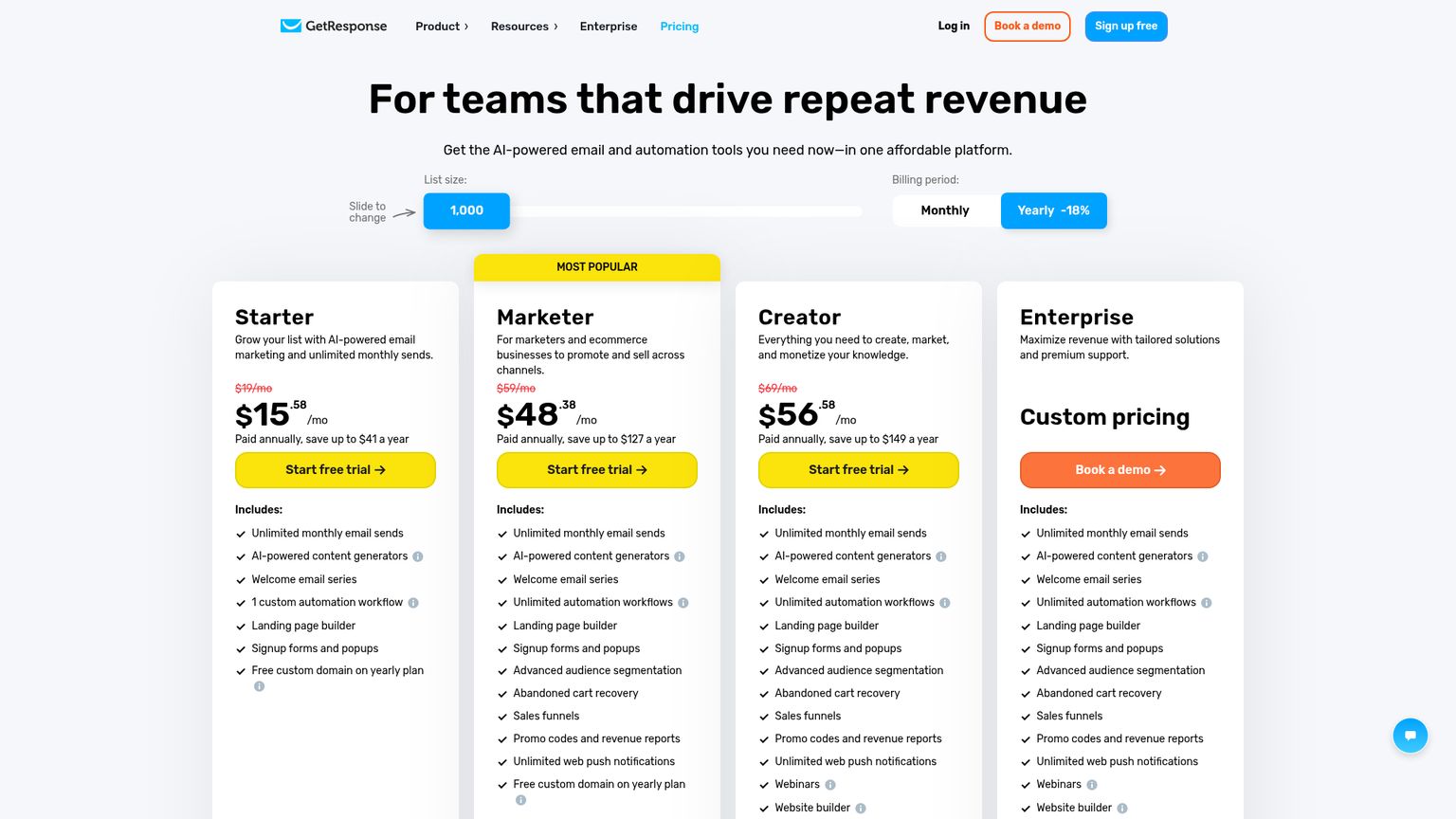
GetResponse Pricing at a Glance
At 1,000 contacts, the paid choice is $19, $59 or $69 per month, with Enterprise priced individually. The annual discount is 18% on the standard plans. The lower advertised monthly equivalent requires paying the year in advance.
Prices and feature boundaries come from the current pricing cards and comparison matrix. Starter, Marketer and Creator include unlimited monthly email sends. This makes the bill primarily a contact-and-feature calculation, rather than a charge for each broadcast.
For a local business sending a weekly newsletter, paying for Marketer solely because it sounds more professional wastes money. For a shop that needs abandoned-cart recovery, Starter's lower price is irrelevant because that feature sits on Marketer and above.
Enterprise has a 30-day pilot arranged through a demo. That is separate from the standard 14-day free trial. Its custom quote should be compared on the exact support, sending and feature requirements your business needs, rather than assigned an invented starting price.
What GetResponse Costs as Your List Grows
Contact growth can raise the bill sharply even when your feature needs stay the same. These are the USD prices shown by the live selector. Each pair below means monthly billing / monthly equivalent with annual prepayment, in that order.
- 5,000 contacts: Starter $54 / $44.28; Marketer $95 / $77.90; Creator $109 / $89.38. Creator includes up to 2,000 students. 5,000-contact pricing.
- 10,000 contacts: Starter $79 / $64.78; Marketer $114 / $93.48; Creator $134 / $109.88. Creator includes up to 5,000 students. 10,000-contact pricing.
- 25,000 contacts: Starter $174 / $142.68; Marketer $215 / $176.30; Creator $249 / $204.18. Creator includes up to 10,000 students. 25,000-contact pricing.
- 50,000 contacts: Starter $299 / $245.18; Marketer $359 / $294.38; Creator $414 / $339.48. Creator includes up to 20,000 students. 50,000-contact pricing.
- 100,000 contacts: Starter $539 / $441.98; Marketer $599 / $491.18; Creator $690 / $565.80. Creator includes up to 40,000 students. 100,000-contact pricing.
The smaller 2,500-contact bracket costs Starter $29 / $23.78, Marketer $69 / $56.58, or Creator $79 / $64.78. Creator's student allowance there is 1,000. The newsletter bill below uses that exact bracket. 2,500-contact pricing.
The step from 10,000 to 25,000 contacts adds $95 a month on Starter, $101 on Marketer or $115 on Creator with monthly billing. A business approaching that boundary should budget the next bracket before running a large lead-generation campaign.
The unit price improves while the total bill rises. Starter goes from $19 per 1,000 contacts at the smallest bracket to $6.96 per 1,000 at 25,000. That is useful capacity economics, but it does not make inactive or duplicated records free. Paying less per contact still means spending more cash overall.
Which Features Require a More Expensive Plan?
The upgrade triggers are workflow count, ecommerce functions and content delivery. Start with the task you need to perform. A plan that cannot do that task is not a bargain, and a bundle of unused features is not a saving.
GetResponse Email Marketing: When Starter Is Enough
Starter already includes an automation builder and one custom workflow. The live matrix marks building from scratch and automation templates as available. An automation workflow is a set of rules that sends or changes something after a subscriber takes an action, such as signing up or clicking a link.
Starter also includes welcome email series, newsletters, signup forms and popups, unlimited landing pages and monthly email sends. It permits 3 account users, while AI tools are limited to 3 uses. For a consultant with a newsletter and a single welcome journey, that can cover the job. Starter features.
The limitation is meaningful: one custom workflow does not give you an unlimited library of separate journeys. Starter also lacks features such as contact tagging, scoring and abandoned-cart recovery in the current matrix. A business that wants separate onboarding, sales and re-engagement workflows should price Marketer before designing those campaigns.
Marketer: Unlimited Workflows and Ecommerce
Marketer is the first standard plan with unlimited automation workflows and the fuller ecommerce toolset. Its pricing page lists advanced audience segmentation, abandoned-cart recovery, sales funnels, promo codes, revenue reports and unlimited web push notifications. Segmentation means grouping contacts by relevant characteristics or behavior so you can send different messages to different people.
The detailed matrix also places payment gateway integration, e-product delivery, revenue tracking and order-confirmation automation on Marketer and above. It includes 5 account users. Starter's general ecommerce integrations should not be confused with having this entire selling toolkit. Marketer features.
For a small online shop, the useful question is whether those workflows can produce enough additional contribution to cover the upgrade. At 10,000 contacts, Marketer costs $35 more per month than Starter. If an additional order contributes $50 after variable costs, one incremental order would cover that difference. That is an illustrative break-even calculation, not a claim that automation will produce the order.
Creator: Courses and Webinars Have Separate Limits
Creator is the first standard plan that includes the course creator, webinars, website builder and premium newsletter subscriptions. It also includes the Marketer features, unlimited courses and 5 account users. Creator features.
Its course capacity follows the contact bracket: the starting plan includes 500 students, while the 10,000-contact bracket includes 5,000 students. The comparison matrix's headline maximum of 40,000 students is not the allowance at every price.
Webinar capacity is a different constraint. The live pricing page includes 100 attendees and 3 hours of recording storage on Creator. A course business with thousands of email contacts cannot assume its webinar room holds that entire audience. If a launch depends on a larger live session, get the capacity and price confirmed before paying annually.
The page lists 0% platform transaction fees for content monetization. That is not evidence that payment processing is free. Budget any payment-provider charges separately, using the processor and country you will actually use.
Enterprise: Buy a Defined Requirement
Enterprise earns consideration when you need features or service beyond the standard packages. The page lists dedicated support, single sign-on, SMS, mobile push notifications, AI product recommendations and transactional email capabilities. Transactional email means operational messages triggered by events, distinct from a newsletter broadcast.
Do not buy Enterprise merely because your list reaches 25,000 contacts: the standard plans have published prices for that size and beyond. Ask for a quote when a specific capacity, support arrangement or technical requirement makes the standard packages unsuitable. Enterprise features and pilot.

Worked Bill: A 2,500-Contact Newsletter
A newsletter with exactly 2,500 counted contacts costs $29 per month on Starter, or $285.36 prepaid for the year. Assume a consultant sends four full-list broadcasts each month and uses only the included automation capacity. That produces 10,000 email deliveries before any welcome or follow-up messages.
The bill is:
- Monthly commitment: $29, or $348 over twelve unchanged monthly payments.
- Annual commitment: $23.78 × 12 = $285.36 paid upfront.
- Annual saving: $348 − $285.36 = $62.64.
- Cost per 1,000 deliveries in this example: $2.90 with monthly billing, or about $2.38 using the annual monthly equivalent.
These are calculations from the 2,500-contact Starter price, not a per-message tariff. Sending another broadcast does not add a broadcast charge under the plan's unlimited-send allowance. Adding enough counted contacts to enter the next bracket changes the bill.
Marketer at this size costs $69 per month, an extra $40. Choose it when the consultant needs additional workflows or a specific gated feature. Keeping one uncomplicated welcome journey and a regular newsletter is a good reason to stay on Starter.
Worked Bill: A 10,000-Contact Course Business
A course creator with 10,000 contacts pays $134 per month for Creator, or $1,318.56 upfront for the year. Assume the business has 500 enrolled students, wants course delivery and email automation in GetResponse, and keeps each live webinar within the included 100-attendee capacity.
The bill is:
- Monthly commitment: $134, or $1,608 over twelve unchanged monthly payments.
- Annual commitment: $109.88 × 12 = $1,318.56 paid upfront.
- Annual saving: $1,608 − $1,318.56 = $289.44.
- Cost per 1,000 email contacts: $13.40 a month, or about $10.99 on the annual equivalent.
The 10,000-contact Creator bracket provides up to 5,000 students, so the example's 500 students fit comfortably. The student allowance is capacity for course use, not a claim that every email subscriber has purchased a course.
At the same contact size, Marketer is $114 monthly or $93.48 on the annual equivalent. Creator therefore adds $20 monthly, or $16.40 per month on annual billing. The annual difference is $196.80.
That is the useful bundle comparison for an educator. If Creator can replace an external course or webinar service costing more than that increment, it may reduce the combined software bill. If you are keeping your existing course platform and only need marketing automation, Marketer may remain sufficient. Count only subscriptions you can actually cancel.

The bundle stops being an easy choice when the webinar room is too small or the course workflow does not fit your teaching model. Use the trial to check enrollment, lesson access, payment flow and follow-up behavior before moving a live course business.
Is GetResponse Free?
GetResponse offers a free account with a 14-day premium trial, and its pricing FAQ says a free version remains afterward. Premium features become unavailable if you do not upgrade. The current pricing page does not state a permanent free contact or monthly-send allowance, so there is no numeric free-plan limit asserted here. Trial and free-account terms.
The trial is a chance to evaluate paid workflows, not evidence that they remain free. Its pricing FAQ says you can create courses during the trial, but selling them requires a paid plan. It also says paid premium-newsletter subscriptions require a paid plan.
Who may never need to pay? Someone whose ongoing needs fit the free version after the trial can keep using that account. Confirm the current limits and retained features inside the account before depending on it. A business relying on paid course sales or the premium workflows demonstrated during the trial should budget the relevant paid plan.
For the newsletter owner, this means checking what remains available after the trial before treating the initial experience as a permanent free service. For the course creator, the paid selling requirement already settles the decision.
Extra Costs and Billing Rules to Check
The biggest billing surprises come from how contacts are counted and how long you commit. Unlimited emails do not mean unlimited audience records, and an annual discount does not cap list-growth charges.
Duplicated Contacts Can Raise the Bracket
GetResponse counts the same email address more than once when it appears on multiple lists. Its billing documentation also considers the month's peak active subscriber count and the total contacts added during that billing month. Deleting records later does not necessarily erase the higher usage already incurred. Contact-counting rules.
For a course business, copying every buyer onto a separate course list can inflate the bill even though the number of people has not changed. Review list structure before importing. Where the selected plan supports the segmentation you need, organizing an existing audience can be more economical than duplicating it across lists.
List-Extension Fees Can Repeat Monthly
When growth exceeds your purchased allowance, GetResponse's help page describes a list-extension fee based on the difference between your bracket and the one that accommodates your list. The charge can recur monthly, including on an annual subscription. Imports may instead present an upgrade choice. List-extension policy.
Using current monthly prices, moving from 5,000 to 10,000 contacts on Marketer creates a $19 difference, from $95 to $114. On Starter, the 2,500-to-5,000 jump is $25, from $29 to $54. Ask billing support how an existing annual payment or discount affects your particular extension charge; the monthly examples are not a personalized annual invoice.
Above the standard 100,000-contact limit, the same help page states $4 per started block of 1,000 additional contacts each month. At that scale, compare an Enterprise quote and the required service level rather than assuming the extension fee answers every capacity question.
Annual Prepayment Is Not a Refundable Trial
The pricing page says upgrades take effect immediately and restart the billing cycle. Downgrades, including changing from annual to monthly billing, require support. Its refund policy says amounts already charged are not refunded, even if you cancel immediately after renewal. Refund policy.
An annual plan is attractive for a stable newsletter you expect to run all year. It is less attractive while testing a migration, proving a new course or deciding whether the workflows fit. Use the free trial to answer those questions before buying the discount.
Budget Taxes, Add-Ons and Separate Sending Services
Published GetResponse prices are net of applicable taxes. Payment processing, optional services and any external software you retain belong in the total budget. The pricing page includes general API access on the standard plans, but places the transactional email API and SMTP service under Enterprise. Do not read unlimited marketing sends as a quote for every type of application email. Plan matrix.
The billing help page also warns that North American accounts may not have access to purchase or enable add-ons. A US buyer should not choose a lower plan on the assumption that an older webinar add-on offer will be available. Use the current plan inclusions, and obtain a specific quote for anything extra. Regional add-on note.
GetResponse vs Kit, ActiveCampaign and Mailchimp at 10,000 Contacts
At the same audience size, GetResponse Starter is $79 monthly, Marketer $114 and Creator $134. Their annual prepaid totals are $777.36, $1,121.76 and $1,318.56, respectively. The alternatives below use 10,000 contacts or subscribers, with billing commitments stated explicitly. This compares budget choices, not identical feature bundles.
Kit and ConvertKit Pricing
Kit, the creator email platform formerly called ConvertKit, has a $0 Free plan through 10,000 subscribers. Its pricing page includes unlimited broadcasts, landing pages, forms, tagging and segmentation, and digital product or subscription selling. That makes it the strongest price baseline for a newsletter owner who can work within the Free feature set. Kit pricing.
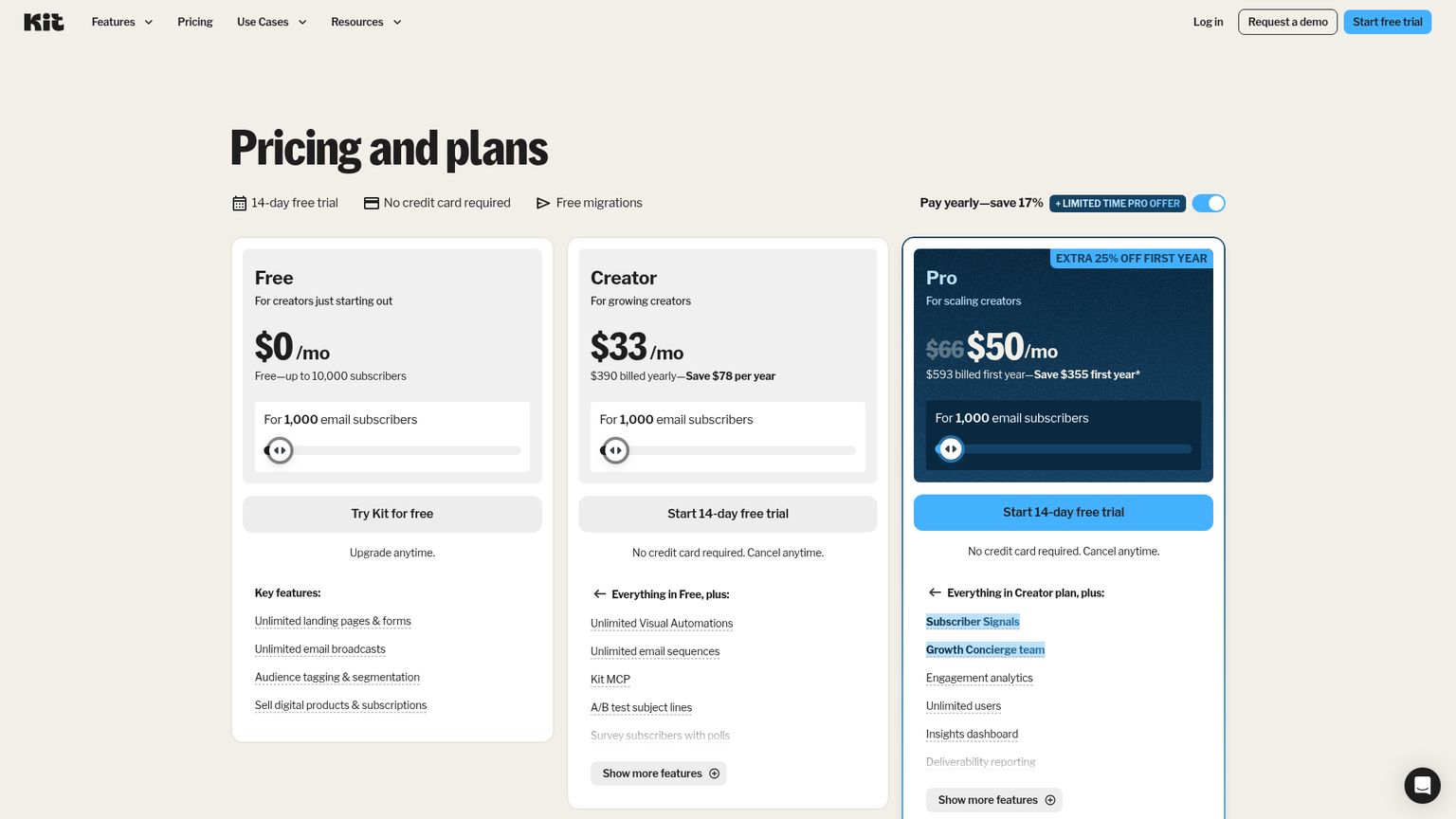
The limitation is automation: Kit places unlimited Visual Automations and email sequences on Creator, while its Free comparison column lacks the visual automation builder. Use $0 as the simple-newsletter comparison, not as a quote for a paid automation setup. A paid 10,000-subscriber Kit rate could not be verified from its live selector in this check, so it is not substituted with the page's 1,000-subscriber starting price. The separate Kit pricing guide covers that product's plan structure.
ActiveCampaign: Price the Automation You Need
ActiveCampaign, an email and marketing automation platform, lists Starter at $149 and Plus at $189 per month, billed annually, at 10,000 contacts. Those annual commitments are $1,788 and $2,268. Its page places unlimited automation actions on Plus and above; Starter limits actions within an automation. ActiveCampaign pricing.
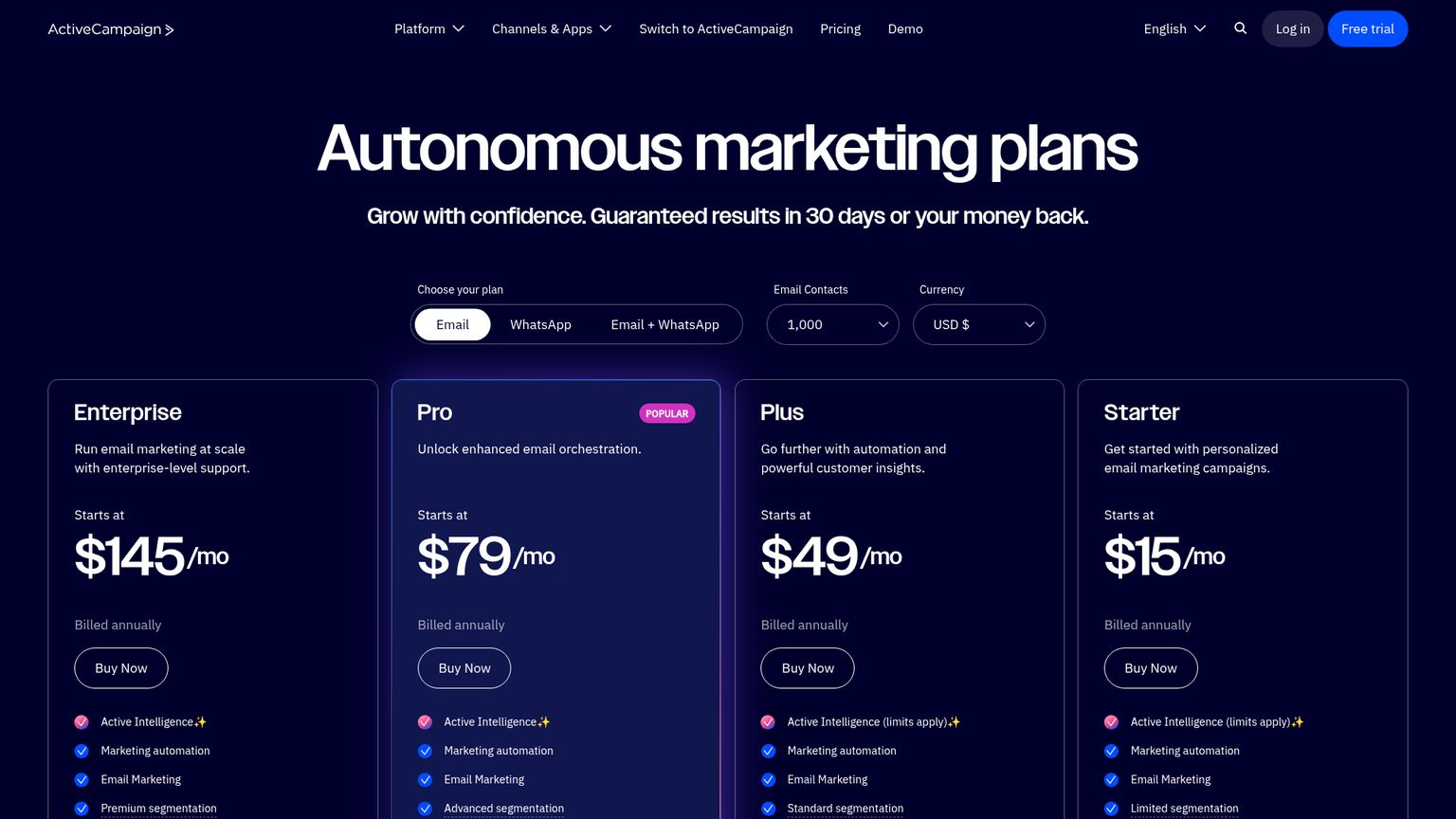
For a small business comparing fuller automation, GetResponse Marketer's $1,121.76 annual bill is the closer budget reference than its newsletter-only recommendation. ActiveCampaign Plus costs more in this comparison, so choose it when its documented workflow or integration fit earns that difference. Paying extra for capacity you will not use is not a migration strategy. The ActiveCampaign alternatives guide helps frame that decision.
Mailchimp Pricing
Mailchimp, an email marketing platform, shows Essentials at $110 and Standard at $135 per month for 10,000 contacts at regular USD rates. The monthly send allowances are 100,000 and 120,000, respectively. Twelve payments at those regular rates total $1,320 and $1,620; these are annualized monthly costs, not quotes for an annual prepaid contract. Mailchimp pricing.
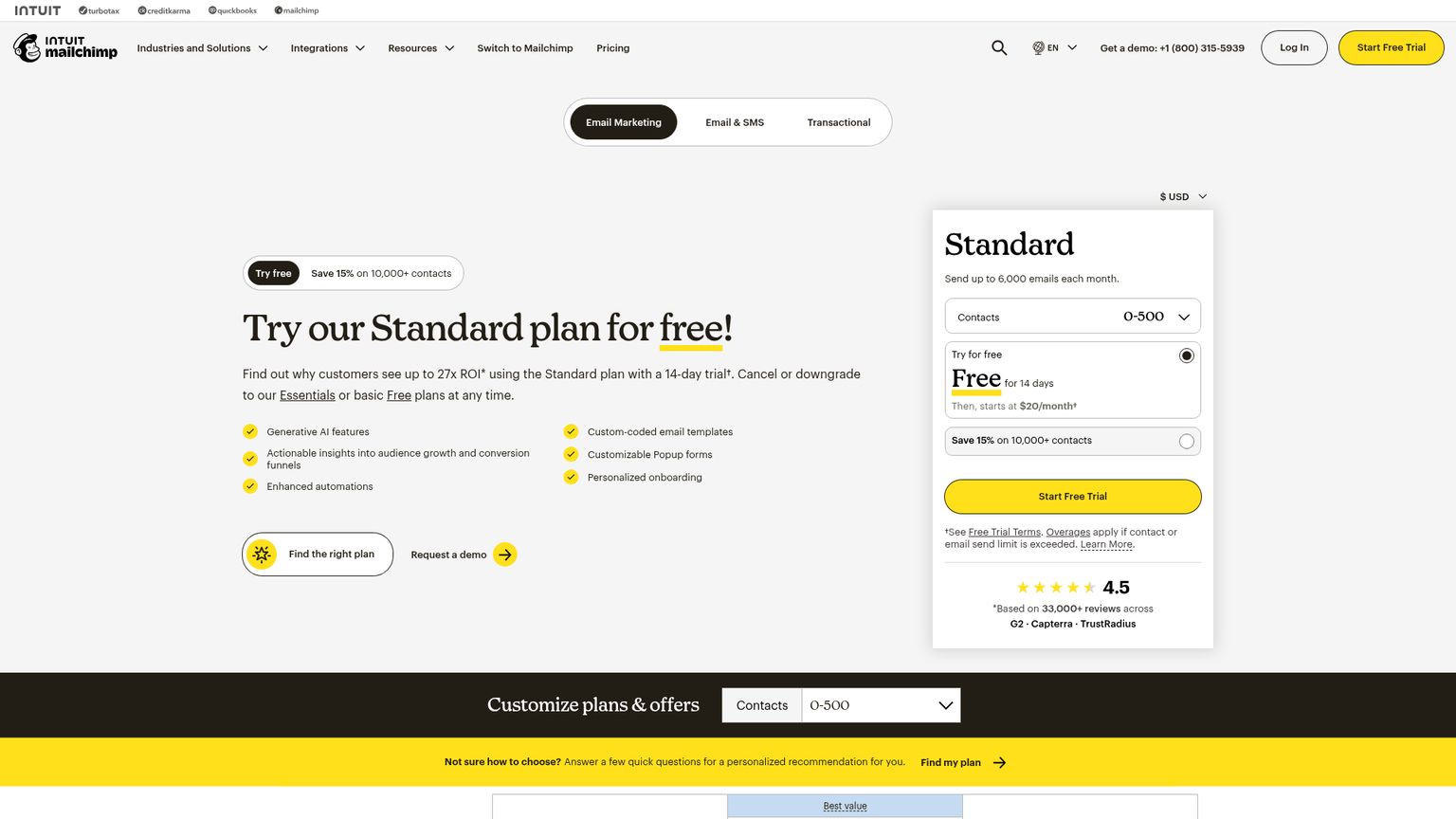
Mailchimp's introductory discounts can reduce the first year's bill, but the regular rate is the useful renewal comparison. Its pricing page also states that contact or send overages can incur charges. GetResponse's unlimited monthly marketing sends remove that particular send allowance from the calculation, while its contact brackets still apply. Read the Mailchimp pricing breakdown if that is your current bill.
The price decision: Kit Free deserves the first look for a straightforward 10,000-subscriber newsletter. GetResponse Marketer has the lower annual automation budget against the ActiveCampaign Plus quote above. GetResponse Creator deserves attention when courses and webinars would replace paid tools. Mailchimp buyers should compare renewal cost and sending volume, alongside the work required to migrate.
Which GetResponse Plan Should You Choose?
Choose the least expensive plan that covers a workflow you will use now. For a consultant's newsletter, that is often Starter. For an online shop running cart recovery and multiple journeys, price Marketer. For an educator delivering courses and hosting modest live sessions inside the same platform, price Creator.
Count the audience that will be billed
Count records across lists and check for duplicated email addresses. For a course business, record the required student allowance and largest expected webinar audience separately.
Name the feature that changes the plan
Decide whether one custom workflow is sufficient, whether you need ecommerce automation, and whether courses or webinars must live in GetResponse. Use that requirement to choose Starter, Marketer or Creator.
Test the work before prepaying
During the 14-day trial, check the actual signup, follow-up and selling journey you intend to run. Compare the next contact bracket as well as today's price, then choose monthly flexibility or the annual commitment.
If your requirements still span several platforms, the best email marketing software guide provides the broader shortlist. A cheaper monthly fee helps only when the software can perform the job and the migration cost is justified.
GetResponse Pricing FAQ
How much does it cost to send 10,000 emails?
With GetResponse Starter, four broadcasts to 2,500 counted contacts cost $29 per month. One broadcast to 10,000 contacts needs the $79 monthly bracket. Both produce 10,000 deliveries; the contact count creates the price difference because the paid plans include unlimited monthly sends.
What is GetResponse used for?
GetResponse manages marketing email, audience growth and automated follow-ups. Higher plans add ecommerce functions, and Creator includes course creation, webinars and premium newsletter subscriptions. The right plan depends on which of those tasks your business needs.
What are some reliable alternatives to GetResponse?
Kit, ActiveCampaign and Mailchimp are alternatives worth comparing for creator newsletters, automated marketing and email campaigns. The prices above establish budget differences; they are not an independent uptime or delivery-reliability ranking.
Who owns GetResponse?
GetResponse's company history identifies Simon Grabowski as its founder. That establishes who started the company, not its complete current shareholding, which the pricing materials do not establish. Company history.
Is GetResponse legit?
GetResponse is an established operating software company whose official history dates its founding to 1998. That does not guarantee campaign revenue or delivery results for a particular account. Evaluate its current features and billing terms against your own requirements. About GetResponse.
What are the best email marketing platforms?
For the needs covered here, compare Kit for a simple creator newsletter, GetResponse for combined email and course tools, ActiveCampaign for an automation-led shortlist, and Mailchimp against an existing campaign workflow. There is no universal best choice independent of list size and required features.
What is the most hacked email provider?
No comparable, verified security ranking is established by these pricing sources. That question also concerns mailbox security, which is different from choosing software to send marketing campaigns. Do not use an unsupported superlative to select a plan.
Is email marketing still worth it in 2026?
It can be when incremental contribution exceeds the software, content and operating costs. In the newsletter example, one additional sale contributing an assumed $50 covers the $29 monthly software fee. It does not necessarily cover all the work, and no additional sales are guaranteed.
What is replacing Gmail?
The GetResponse, Kit, ActiveCampaign and Mailchimp plans compared here are for marketing campaigns. They should not be evaluated as direct replacements for a personal or business inbox. Choose the campaign budget separately from your mailbox workflow.
Does GetResponse offer a student discount?
The live pricing page checked for this guide does not advertise a student discount. Do not budget around an unverified coupon. A course plan's student allowance describes learners you can serve, not a discount for the account owner.
What is the GetResponse refund policy?
GetResponse says paid monthly and annual charges are not refundable, even when cancellation follows a renewal immediately. Canceling prevents subsequent charges; it does not turn a prepaid year into a refundable monthly plan. Official refund policy.
Use the AI Business Workflow Audit Checklist to decide which paid features deserve a place in your monthly budget.
- Published
- Category
- Growth
- Language

Calendly Alternatives in 2026: Cal.com, TidyCal, Acuity & More
Compare Calendly alternatives by need: Cal.com, TidyCal, Acuity, Bookings and more. Verified prices, routing, branding and reasons to stay.Oct 11, 2026Growth
Mailchimp Alternatives in 2026: Kit, beehiiv, ActiveCampaign and GetResponse Compared
Compare Mailchimp alternatives for newsletters, automation and ecommerce, with verified prices at 1,000 and 10,000 contacts and reasons to stay.Oct 11, 2026Growth
Zendesk Alternatives 2026: Tidio, Chatbase, CloudTalk and Helpdesks
Compare Zendesk alternatives by support model: Tidio, Chatbase, CloudTalk and leading helpdesks, with current prices, AI charges and switching advice.Oct 10, 2026Growth
Best CRM for Small Business in 2026: Pipedrive, Close, folk, Keap and More (Compared)
Compare nine small-business CRMs by how you sell, verified prices for five users, free-plan limits, setup effort and the upgrades that matter.Oct 10, 2026Growth
Later Pricing: Plans, Add-Ons and the Five-Client Bill
Later plans, social sets, users and add-ons priced for a solo brand and five-client agency. Compare annual and monthly bills with three alternatives.Oct 10, 2026Growth
Apollo Alternatives in 2026: Lusha, FullEnrich and Amplemarket Compared
Compare Apollo alternatives for contact data, sequencing or both, with current prices, credit costs and reasons to stay on Apollo.Oct 10, 2026Growth
9 Semrush Alternatives in 2026: SE Ranking, Ahrefs and DataForSEO
Compare nine Semrush alternatives by job, price and limits, including SE Ranking and DataForSEO. Know what you save and what you give up.Oct 10, 2026Growth