ActiveCampaign Alternatives: GetResponse, Kit and More
Compare ActiveCampaign alternatives at 2,500, 10,000 and 25,000 contacts, with vendor prices, workflow trade-offs and a migration checklist.
Published
 By Omid Saffari





At 10,000 contacts, ActiveCampaign Plus costs $239 a month; MailerLite Comfort costs $89, a $150 monthly saving if your workflows fit. The best ActiveCampaign alternatives depend on what must survive the move: GetResponse for webinar funnels, Kit for creator businesses, and ecommerce or CRM specialists when those systems drive revenue.
ActiveCampaign alternatives: who should pick what?
MailerLite wins for a smaller bill with straightforward automation. GetResponse wins for webinar funnels. Kit wins for a creator-led business, provided you budget for a paid plan when sequences matter. Ecommerce stores should shortlist Omnisend and Klaviyo; a B2B business consolidating customer records should consider HubSpot despite its higher cost.
The choice turns on four things: recurring cost at your actual audience size, the workflow steps you need, the systems feeding those steps, and the cost of moving. An automation is a saved sequence of actions triggered by something a contact does. Preserving it means preserving its entry rules, timing, branches and exits, not simply finding another visual editor.
Pricing and plan details below were checked against the makers' live pages on 9 October 2026. This is a pricing and documentation comparison, not a claim of hands-on migration testing. GetResponse's verified tiers are in euros; Kit's paid prices at the requested sizes could not be verified, so no paid Kit savings are claimed. Those limitations matter more than a tidy ranking.
For a wider first-time buying shortlist, see our best email marketing software comparison. Here the priority is replacing a working ActiveCampaign account without losing the behavior that earns revenue.
Prices at 2,500, 10,000 and 25,000 contacts
Compare the same reachable audience and the same sending workload before comparing discounts. The model below assumes four broadcasts to every marketable contact each month: 10,000, 40,000 and 100,000 emails respectively. Extra automated messages need additional allowance. Taxes, SMS, optional add-ons and temporary promotions are excluded.
Prices are normal monthly USD subscriptions unless marked EUR or catalog. HubSpot's catalog amount is a recurring monthly equivalent, not a promise of monthly cancellation. A free broadcast plan is shown separately from a paid automation replacement.
The audience sizes are identical; the billing units are not. Brevo's rows buy 15,000, 40,000 and 100,000 sends with enough storage for the audience. HubSpot sells additional marketing contacts in packs, so the quoted capacities are 7,000, 12,000 and 27,000. Kit Free fits the first two sizes but cannot preserve an automated welcome sequence.
Do not convert the GetResponse row into a dollar saving by subtracting it from a dollar price. The section below uses ActiveCampaign's separate euro catalog for a same-currency comparison. A US buyer needs GetResponse's USD checkout quote before approving a budget.
Annual billing changes the baseline
ActiveCampaign's annual monthly equivalents at 2,500 / 10,000 / 25,000 contacts are:
- Starter: $39 / $149 / $391.
- Plus: $95 / $189 / $389.
- Pro: $149 / $375 / $629.
- Enterprise: $255 / $589 / $879.
These are annual commitments divided by the year, not monthly subscriptions. The current calculator puts Plus below Starter by $2 a month equivalent at 25,000 contacts. That is the displayed pricing, not a reason to silently substitute a different figure.
MailerLite Comfort's annual monthly equivalents are $29.70 / $80.10 / $161.10; Power's are $44.10 / $116.10 / $215.10. GetResponse Creator's verified euro annual equivalents are EUR 64.78 / 93.48 / 179.58. Compare the term you can actually buy, especially if your ActiveCampaign renewal is still months away. MailerLite pricing, GetResponse pricing.
What leaving ActiveCampaign gives up
ActiveCampaign is worth retaining when its automation depth is doing work the cheaper plan cannot reproduce. Its current tiers are Starter, Plus, Pro and Enterprise, and the important distinction is what happens inside a workflow.
Starter allows five actions per automation and tops out at 25,000 contacts. Plus removes the action limit and includes one user. Pro includes three users, advanced segmentation, conditional content, predictive sending and attribution. Enterprise includes five users, custom objects and single sign-on. Monthly send allowances are 10 times the contact tier for Starter and Plus, 12 times for Pro and 15 times for Enterprise. ActiveCampaign plan comparison.
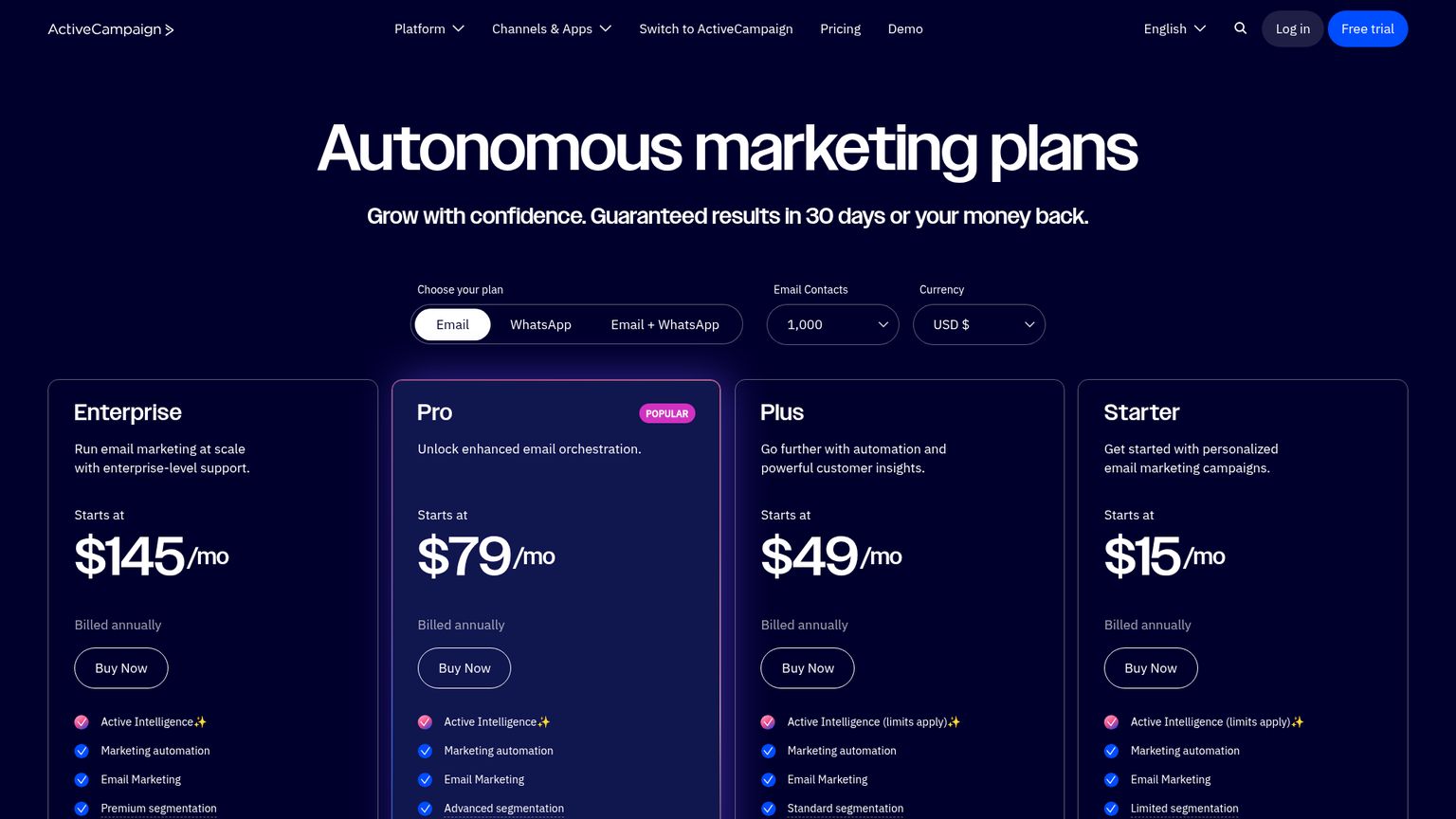
For a service business, the deciding feature might be a branch that treats an existing customer differently from a new lead. For an agency, it might be a client's access requirements or several events feeding the same nurture program. Document those dependencies before assuming a cheaper visual builder is interchangeable.
The CRM bill needs separate attention. ActiveCampaign's Enhanced CRM Pipelines and Sales Engagement are add-ons; the base email plan is not the full sales-system quote. Our ActiveCampaign review goes deeper on the platform. Compare your invoice and required features with today's tiers before deciding whether to switch, change plans or simply remove unused add-ons.
Alternatives to ActiveCampaign, by the work you need to keep
GetResponse: the winner for webinar funnels
GetResponse, an email and funnel platform, is the strongest fit here when webinars are part of the sales process. Choose Creator for that job. Marketer has automation, but the current plan comparison places webinars in Creator and Enterprise. A business buying Marketer for webinar hosting would need another plan.
At 2,500, 10,000 and 25,000 contacts, Marketer is EUR 69 / 99 / 189 monthly and Creator is EUR 79 / 114 / 219. Both include unlimited automation workflows and email sends, tagging and scoring, event-based triggers, landing pages and forms, with five users. Creator's webinar allowance is 100 attendees, three presenters and three hours of recording storage. GetResponse's current plan matrix.
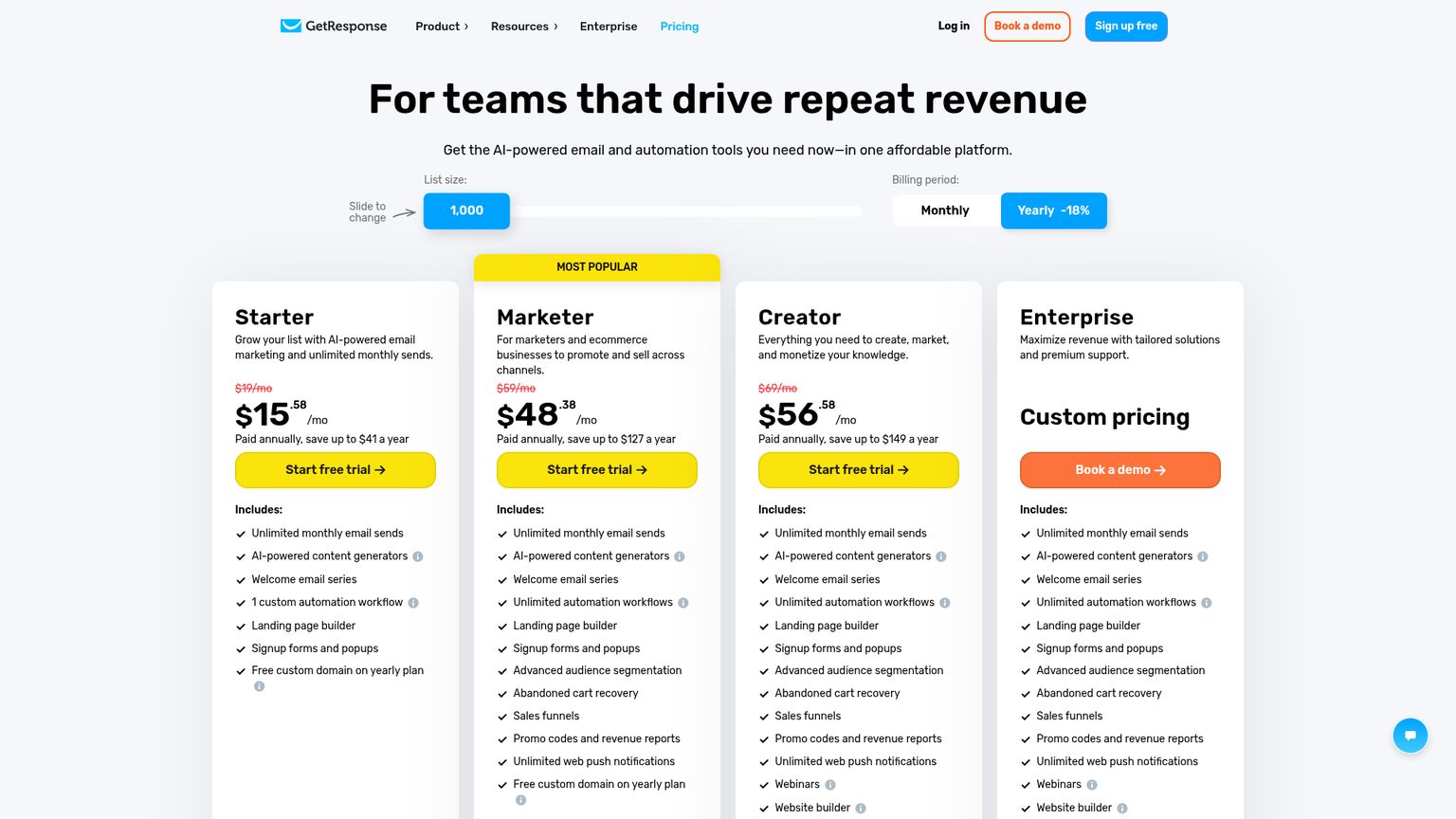
For a consultant selling through a live workshop, that combination can replace several handoffs: a signup form feeds a reminder sequence, the session produces a follow-up segment, and the sales emails remain with the same audience. Confirm that the attendance data and conditions your existing funnel uses are available before rebuilding it.
Best for: A service or education business whose webinar audience fits Creator's allowance.
Standout: Automation and webinars in one subscription.
Pricing: Creator EUR 79 / 114 / 219 monthly at the three requested list sizes.
- Creator includes the webinar capability this use case needs.
- Tagging, scoring and unlimited workflows support a structured follow-up program.
- Five users can suit a small team working on the same account.
- Marketer is not the webinar tier; Starter has only one custom workflow and lacks tagging and scoring.
- A session exceeding the attendee allowance changes the buying decision.
- The verified full pricing grid is in euros, so it cannot establish a US dollar saving.
For a euro-billed business, ActiveCampaign's EUR catalog lists Plus at EUR 119 / 239 / 489 monthly. Creator therefore saves EUR 40 / 125 / 270 monthly, or EUR 480 / 1,500 / 3,240 in yearly run rate. That is same-currency arithmetic, not an exchange-rate estimate.
Kit: the winner when the business is the audience
Kit, a creator-focused email platform, fits newsletters, courses and digital products better than a sales-team replacement project. Its paid Creator plan combines visual automations, email sequences, tagging and integrations around a subscriber relationship. A writer selling a paid product has a different operating model from an agency routing leads between salespeople.
Kit's current Free plan supports 10,000 subscribers, unlimited broadcasts, forms and landing pages, audience tagging and digital products. Its current help page explicitly puts visual automations, sequences, rules and RSS campaigns on paid plans. Do not migrate an ActiveCampaign welcome series to Free expecting it to keep running. Kit Free plan documentation.
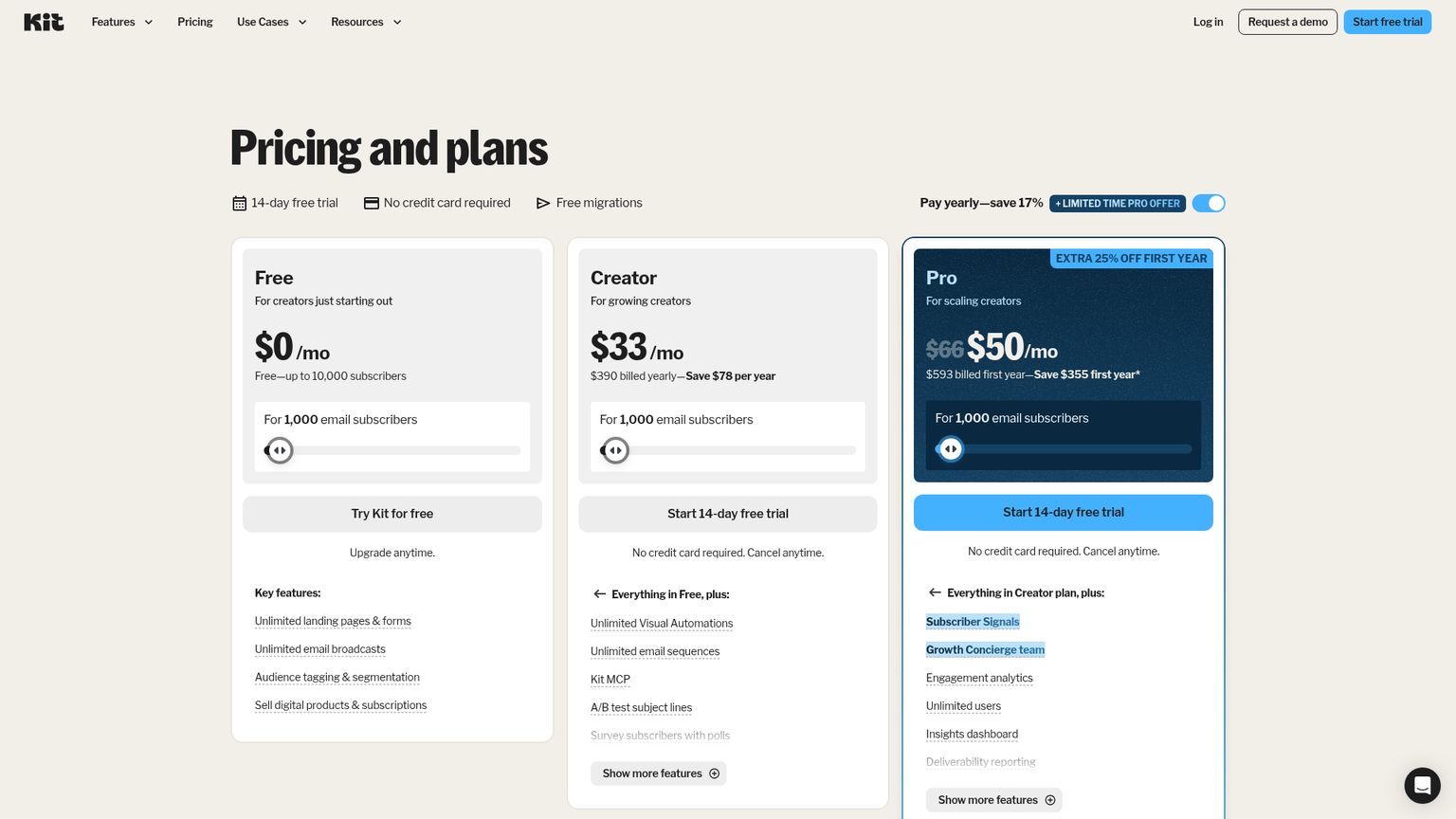
Best for: A creator or newsletter publisher selling to their own audience.
Standout: Subscriber sequences alongside audience growth and digital-product tools.
Pricing: Free is $0 at 2,500 and 10,000 subscribers; unavailable at 25,000. Paid Creator tier prices at those sizes were not verifiable from the live calculator in this check.
Free trial: Creator has a 14-day trial; Kit also offers assisted migration. Kit pricing, migration service.
- Creator provides unlimited visual automations and sequences.
- Free can support a substantial broadcast-only newsletter.
- Assisted migration gives an eligible creator help with the move.
- Free does not preserve automation-dependent workflows.
- Creator includes two users; an agency needs to check access and account structure.
- No verified paid-tier quote here means no defensible Creator savings figure.
Choose Kit for the business model, then confirm the economics in its contact selector. Our Kit pricing guide provides more context, but a previously published price is not a substitute for the current quote. GetResponse wins over Kit for the verified webinar use case; Kit is the more focused shortlist when the newsletter itself drives the business.
MailerLite: the winner for simpler automation on a smaller bill
MailerLite, an email marketing platform with forms and automation, is the best first check for a business that has outgrown its need for ActiveCampaign's depth. The current paid plans are Comfort and Power. At 10,000 subscribers, Comfort costs $89 monthly against ActiveCampaign Plus at $239, leaving $150 a month before migration costs.
Comfort is $33 / $89 / $179 monthly at the three audience sizes. It includes three seats, 50 automations, ten forms, ten websites or landing pages, and monthly sends equal to ten times the subscriber limit. Power is $49 / $129 / $239, with multiple automation triggers and unlimited seats, forms and automations; unlimited email remains subject to fair use. MailerLite pricing and limits.
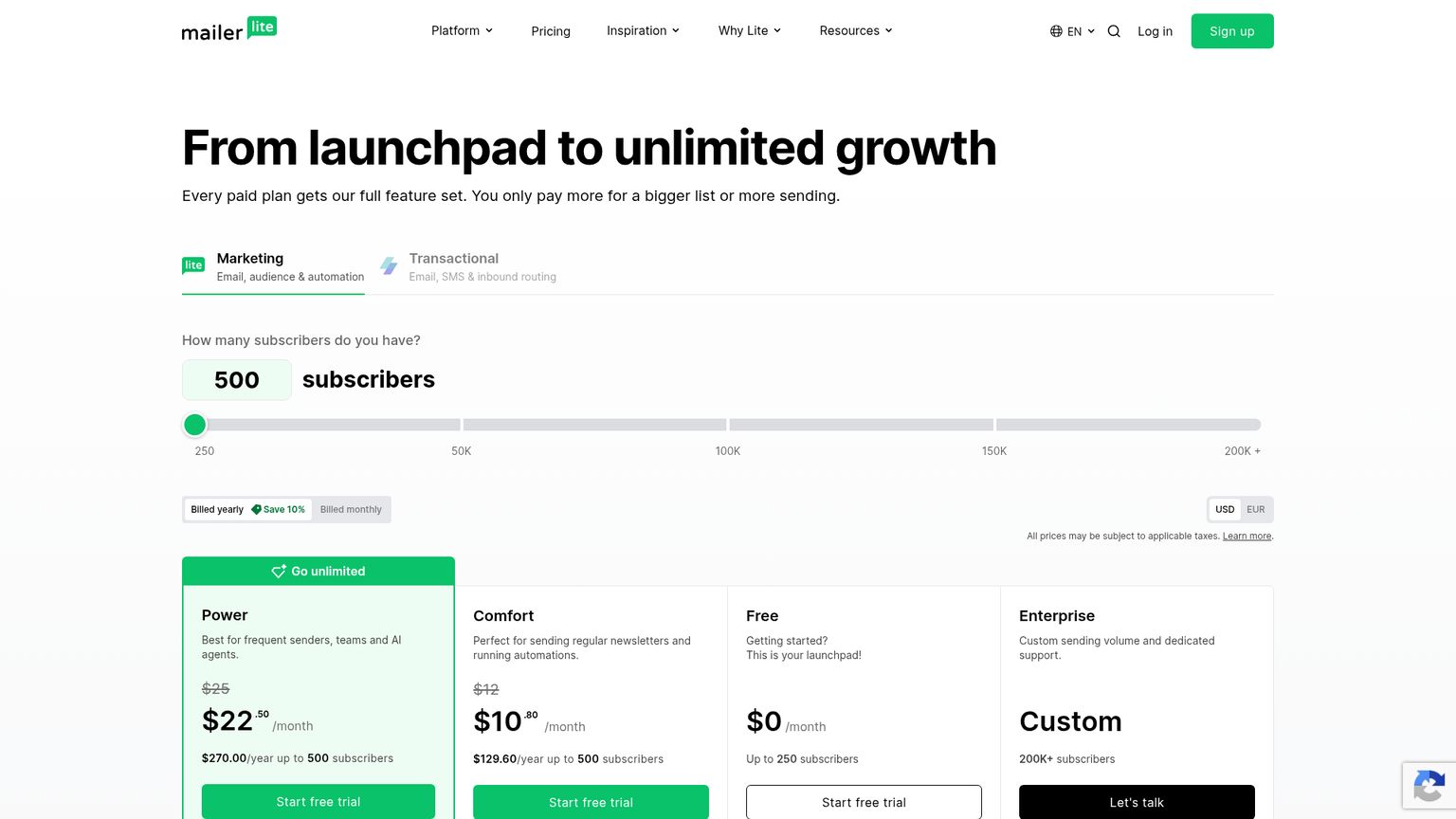
For a local services business sending a newsletter and a few follow-ups, Comfort's boundaries may be ample. For an agency with separate lead magnets for many campaigns, the form count can force Power before subscriber count does. That makes a form inventory part of the price comparison.
Best for: Small businesses with a manageable set of straightforward workflows.
Standout: Lower contact-tier pricing with a clear capacity upgrade.
Pricing: Comfort $33 / $89 / $179; Power $49 / $129 / $239 monthly.
Free trial: 14 days. MailerLite plan details.
- Comfort is cheaper than ActiveCampaign Plus at every requested monthly tier.
- Its three seats can cover a small working team.
- Power gives a defined upgrade path for multiple triggers and more forms.
- Comfort's form and automation ceilings require an inventory before moving.
- Active subscribers count cumulatively within the billing cycle; deleting them does not instantly erase the charge.
- Agency client accounts need separate paid subscriptions, without a multi-account discount.
A useful trial is one complete business journey, not an empty builder tour:
Choose the journey that would hurt to lose
Use a form signup that enters a welcome sequence and exits when the contact buys. Record the existing entry condition, delays, exclusions and purchase exit before recreating it.
Rebuild with test contacts first
Map a test tag and custom field, then check each branch with addresses you control. Make sure the purchase exit works before scheduling a live message.
Price the completed configuration
Count the forms, automations, seats and expected messages the account will actually use. Choose Comfort only if the working configuration fits; otherwise compare Power with your current invoice.
Brevo reviews: the sending allowance decides the value
Brevo, a marketing platform priced partly around email volume and contact storage, wins when a large database does not receive frequent broadcasts. It breaks the assumption that every stored contact must carry the same monthly cost, but cheap sends alone do not guarantee the right plan.
For the modeled workload, Standard costs $49 / $89 / $139 monthly. At 2,500 contacts, its $35 plan's 10,000 sends look sufficient, but that tier stores only 1,500 contacts. The correct choice is the $49 tier with 15,000 sends and 2,500 contacts. The selected larger tiers allow 500,000 stored contacts and provide 40,000 or 100,000 sends. Brevo's USD pricing selector.
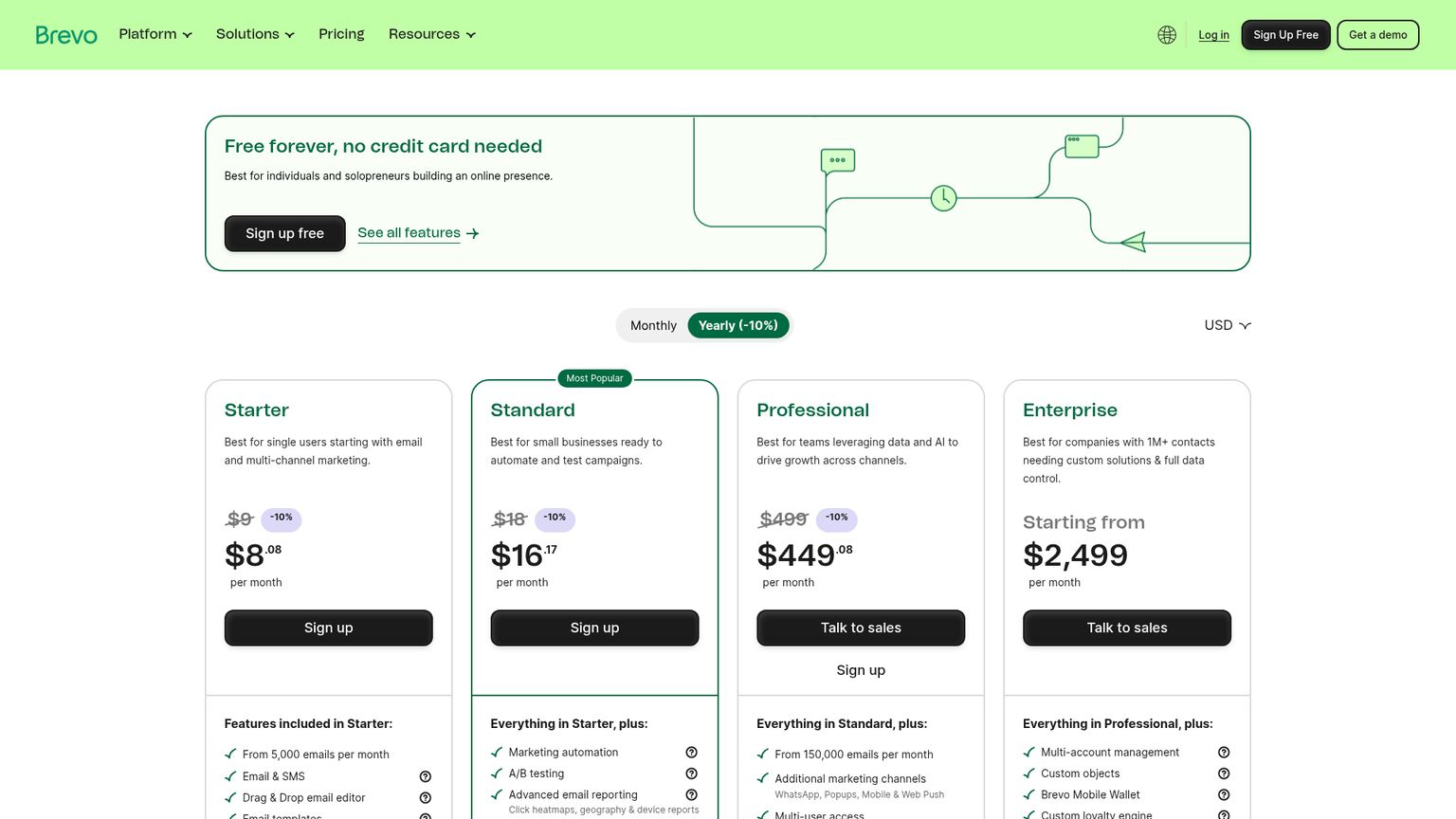
For a service firm with a seasonal audience, storage capacity can be useful. For a retailer sending frequent campaigns plus abandoned-cart and post-purchase messages, send volume may erase the apparent advantage. At 10,000 and 25,000 contacts, the modeled allowance is fully consumed by the four broadcasts, so automated messages require a larger allowance.
Best for: A large audience contacted selectively.
Standout: Standard includes unlimited multi-step workflows, A/B testing, web and event tracking, advanced reporting and send-time optimization.
Pricing: $49 / $89 / $139 monthly at the modeled workload, before extra automated sends. Brevo Standard features.
- Storage and sending can be matched to a less frequent campaign schedule.
- Standard supports multi-step automation without buying the highest tier.
- The modeled 25,000-contact workload saves $350 monthly against Plus.
- Lower send tiers can have insufficient contact storage.
- Workflow emails consume the same allowance used in the broadcast calculation.
- One marketing seat and one landing page are included; team access, extra needs and SMS can add cost.
Klaviyo email marketing: the winner for an integration-led store
Klaviyo, an ecommerce-oriented marketing platform, deserves the shortlist when purchase events and connected store data drive the email program. Email includes automation flows, signup forms, A/B testing, audience and conversion dashboards, reputation tools and more than 350 integrations. The current pricing page places predictive analytics in the Marketing bundle, not the Email plan quoted here. Klaviyo plan comparison.
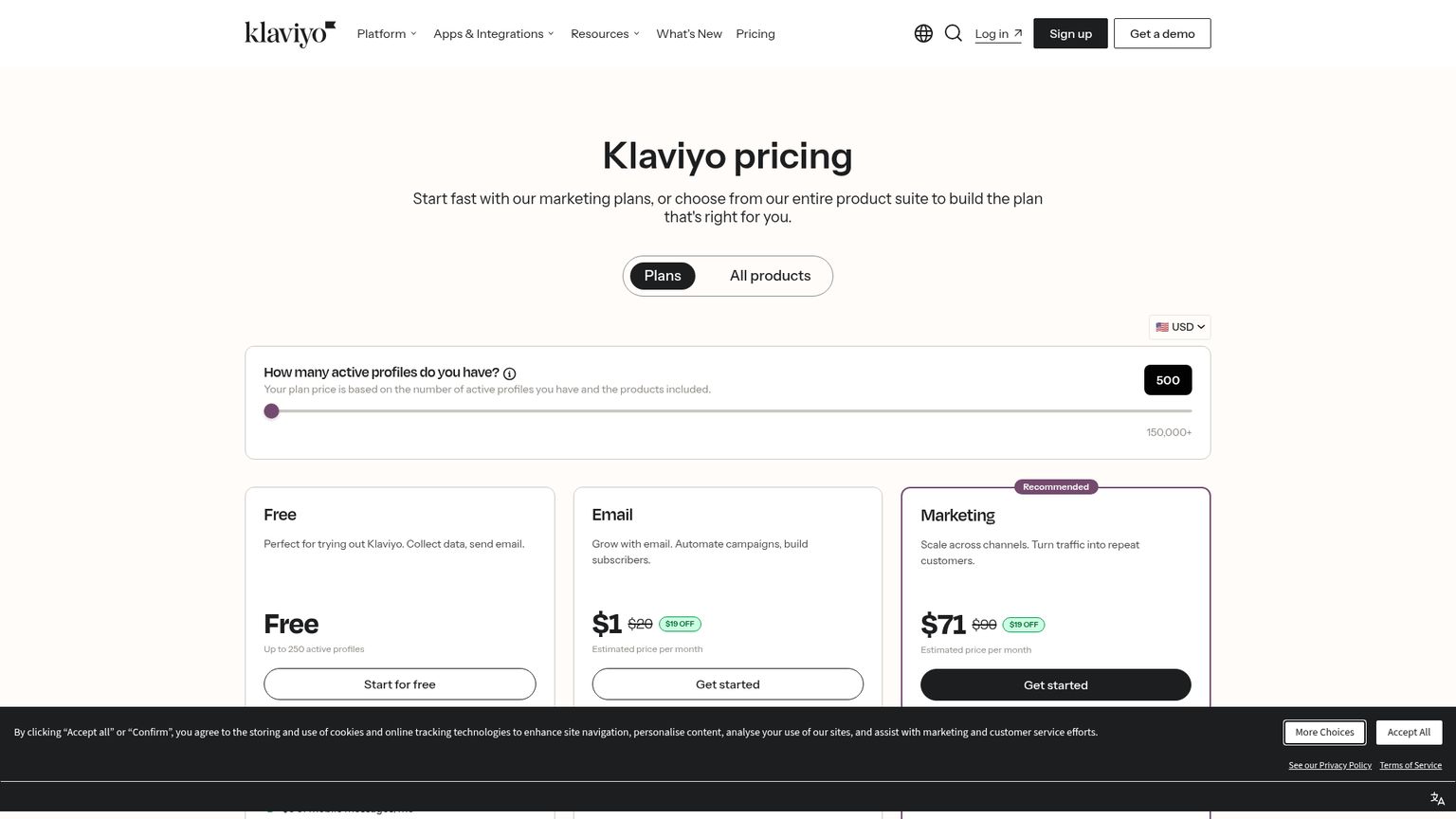
For a store with several systems contributing customer events, the relevant question is whether each integration carries the exact event and property your branches use. An integration logo is not proof that a particular field, refund state or subscription event will arrive as expected.
Klaviyo pricing: the savings narrow as the list grows
Klaviyo Email costs $60 / $150 / $400 monthly, with 25,000 / 100,000 / 250,000 email sends at the requested tiers. These figures come from the official pricing page and its US calculator data.
Best for: A store choosing around its integration and event requirements.
Standout: Connected ecommerce data feeding automation flows.
Pricing: $60 / $150 / $400 monthly for Email.
- The integration catalog supports a broad store shortlist.
- Flow automation and conversion dashboards suit purchase-led journeys.
- The quoted send allowances exceed the four-broadcast workload.
- Predictive analytics requires a different bundle from the price shown.
- Features in the Marketing bundle require a separate price comparison.
- At 25,000 contacts, Email costs more than annually committed ActiveCampaign Plus.
Klaviyo wins the integration-led shortlist, not the cheapest-email contest. Prove the particular store connection first; if both platforms handle it, Omnisend Standard has the lower monthly price at all three sizes here.
Omnisend: the winner for ecommerce cost control
Omnisend, an ecommerce email and messaging platform, is the stronger price-led choice when its workflows cover your store. Standard combines email, SMS and web-push automation with segmentation, forms and sales reporting. Its normal recurring price is $44 / $132 / $282 monthly, with 30,000 / 120,000 / 300,000 emails respectively. Omnisend pricing.
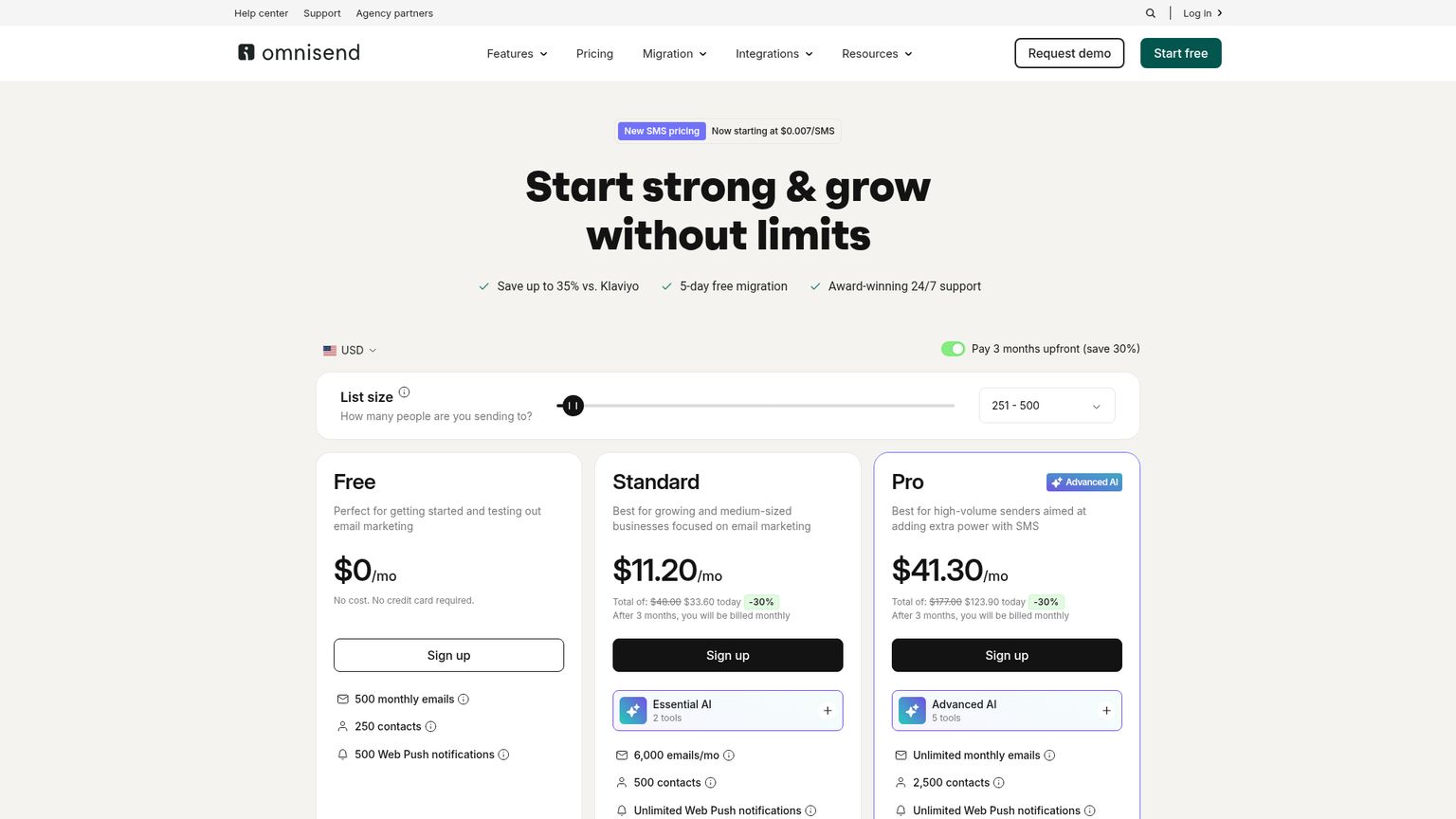
A store rebuilding abandoned-cart and post-purchase journeys should compare the full event sequence and message allowance. Omnisend's headline discount is temporary; the ongoing numbers above exclude it. SMS use can add cost, and the contact definition includes subscribers plus non-subscribers who receive automated messages, while unsubscribed contacts are excluded. A store's “newsletter subscribers” count may therefore understate its billable audience.
Best for: A store seeking ecommerce workflows at a lower recurring cost.
Standout: Email, SMS and web-push automation in the same platform.
Pricing: Standard $44 / $132 / $282 monthly; Pro $59 / $150 / $400. Current recurring rates.
- Standard undercuts Klaviyo Email at each requested audience size.
- Its included email allowance leaves room above the modeled broadcasts.
- The maker offers migration assistance.
- Automated messages to non-subscribers can affect the billable count.
- SMS is not an unlimited inclusion in the email price.
- Promotional savings should not be carried into a yearly run-rate forecast.
HubSpot: the winner for CRM consolidation, not lower email spend
HubSpot Marketing Hub Professional, a CRM-connected marketing system, makes sense when the move consolidates customer records and team processes. It does not make sense as a simple response to an expensive email bill. Its catalog starts at $890 monthly, includes 2,000 marketing contacts and three Core Seats, and requires $3,000 onboarding. HubSpot's product and services catalog.
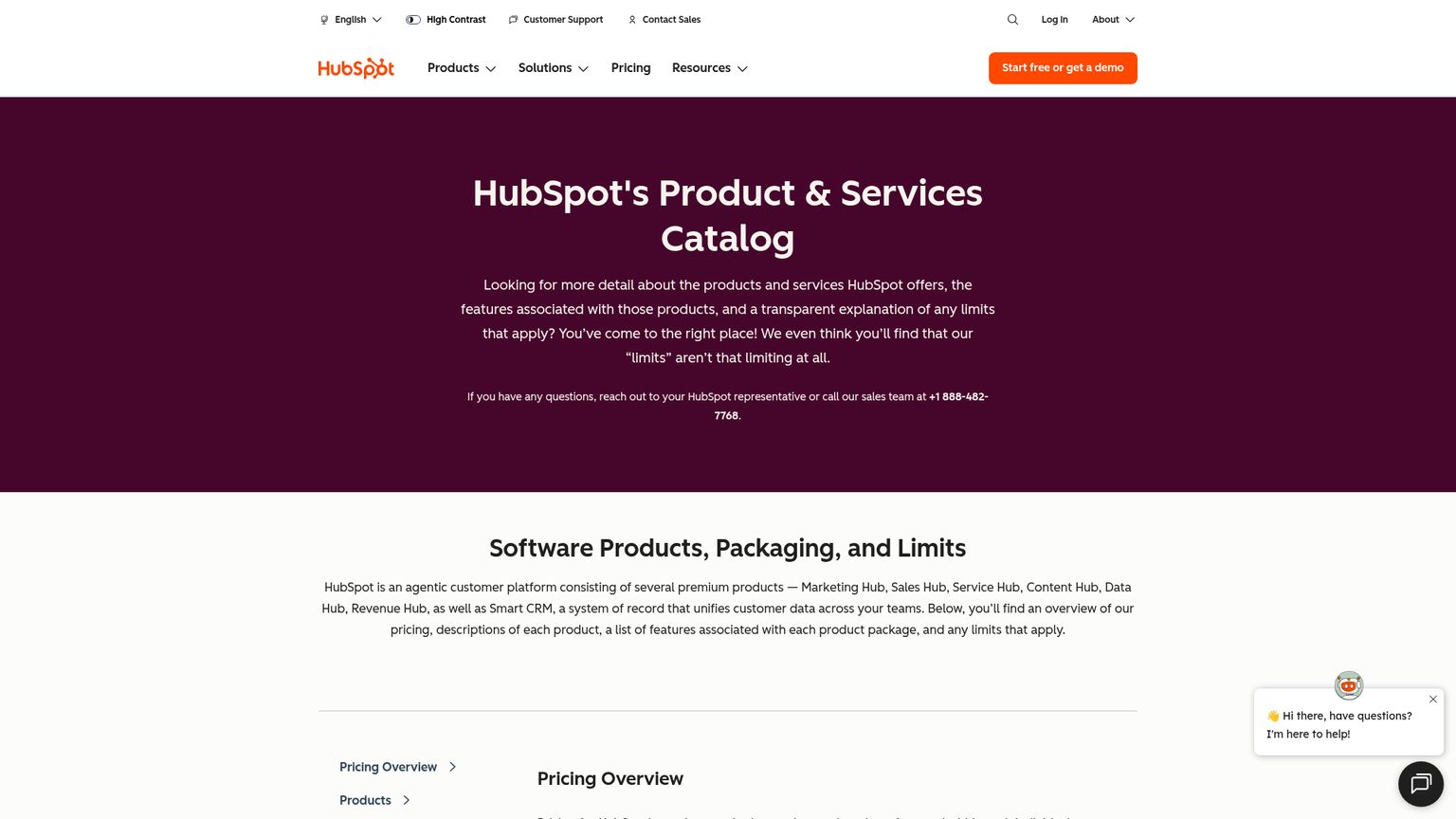
The contact-pack calculation is the important part. Additional marketing contacts come in blocks of 5,000: $250 per block through a total of 22,000, then $225 per block through 42,000. Thus 2,500 requested contacts need one block, 10,000 need two, and 25,000 need four at $250 plus one at $225.
Best for: A B2B team funding a broader CRM and marketing consolidation.
Standout: Professional marketing automation attached to customer records.
Pricing: Calculated recurring catalog totals of $1,140 / $1,390 / $2,115; first year including onboarding is $16,680 / $19,680 / $28,380.
- CRM context can justify a wider operational consolidation.
- Non-marketing records can remain unbilled within database limits.
- The catalog gives a calculable basis for contact expansion.
- Pack sizes charge for more capacity than the requested audience needs.
- Mandatory onboarding materially increases first-year cost.
- Marketing-contact tier reductions take effect at renewal; get a term-specific quote before signing.
At 10,000 contacts, the calculated recurring premium over ActiveCampaign Plus monthly is $1,151 a month, or $13,812 a year, before onboarding. A B2B team needs that much value from consolidation, avoided tools or recovered staff time before this becomes an economic argument.
What you save, and when switching pays back
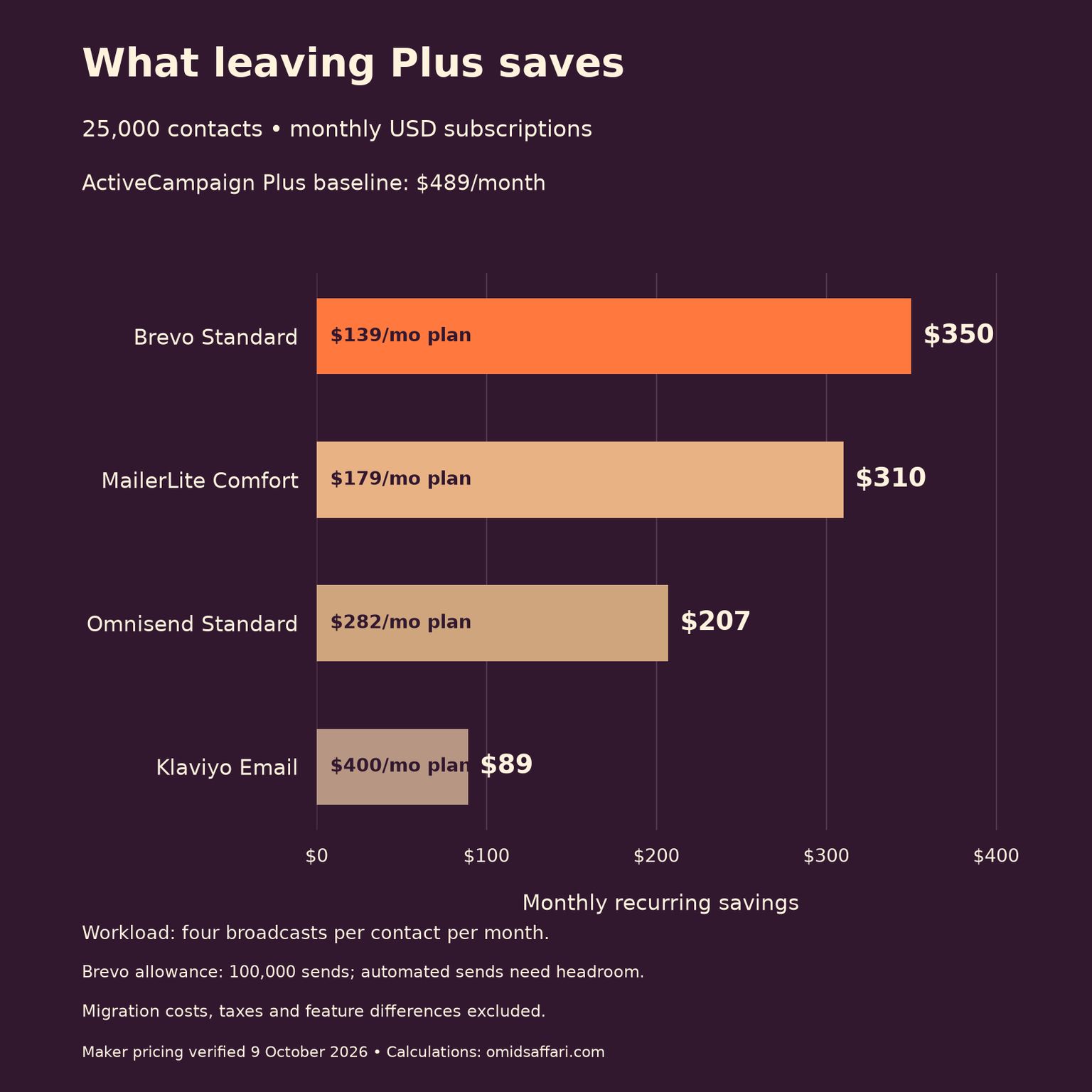
The best saving is the one left after recreating your workflow. Against ActiveCampaign Plus on monthly USD subscriptions, the recurring differences at 2,500 / 10,000 / 25,000 contacts are:
- MailerLite Comfort: save $86 / $150 / $310 monthly.
- Brevo Standard: save $70 / $150 / $350 at the defined broadcast volume, before extra automation sends.
- Omnisend Standard: save $75 / $107 / $207 monthly.
- Klaviyo Email: save $59 / $89 / $89 monthly.
These are calculations from the makers' prices above, not claims that the feature sets are identical. At 10,000 contacts, the yearly run-rate savings are $1,800 for Comfort or the modeled Brevo plan, $1,284 for Omnisend, and $1,068 for Klaviyo.
Annual billing can reverse a recommendation. At 10,000 contacts, Klaviyo Email at $150 remains $39 below annually committed ActiveCampaign Plus at $189 a month equivalent. At 25,000, Klaviyo's $400 is $11 above Plus at $389. Among the requested tiers, the cheaper option flips at 25,000; this does not establish the exact crossover at every intermediate list size.
Keep AI upgrade promises separate from the replacement decision. Our AI email marketing pricing analysis helps compare that additional spend. First verify that the ordinary forms, events and follow-ups work; then decide whether an AI feature earns its premium.
Migration checklist: preserve the workflow, not just the list
Move the contact data, consent and workflow state as separate jobs. A CSV can carry a person's address and tags. It does not, by itself, prove that someone halfway through a nurture sequence will resume at the right step in a new platform.
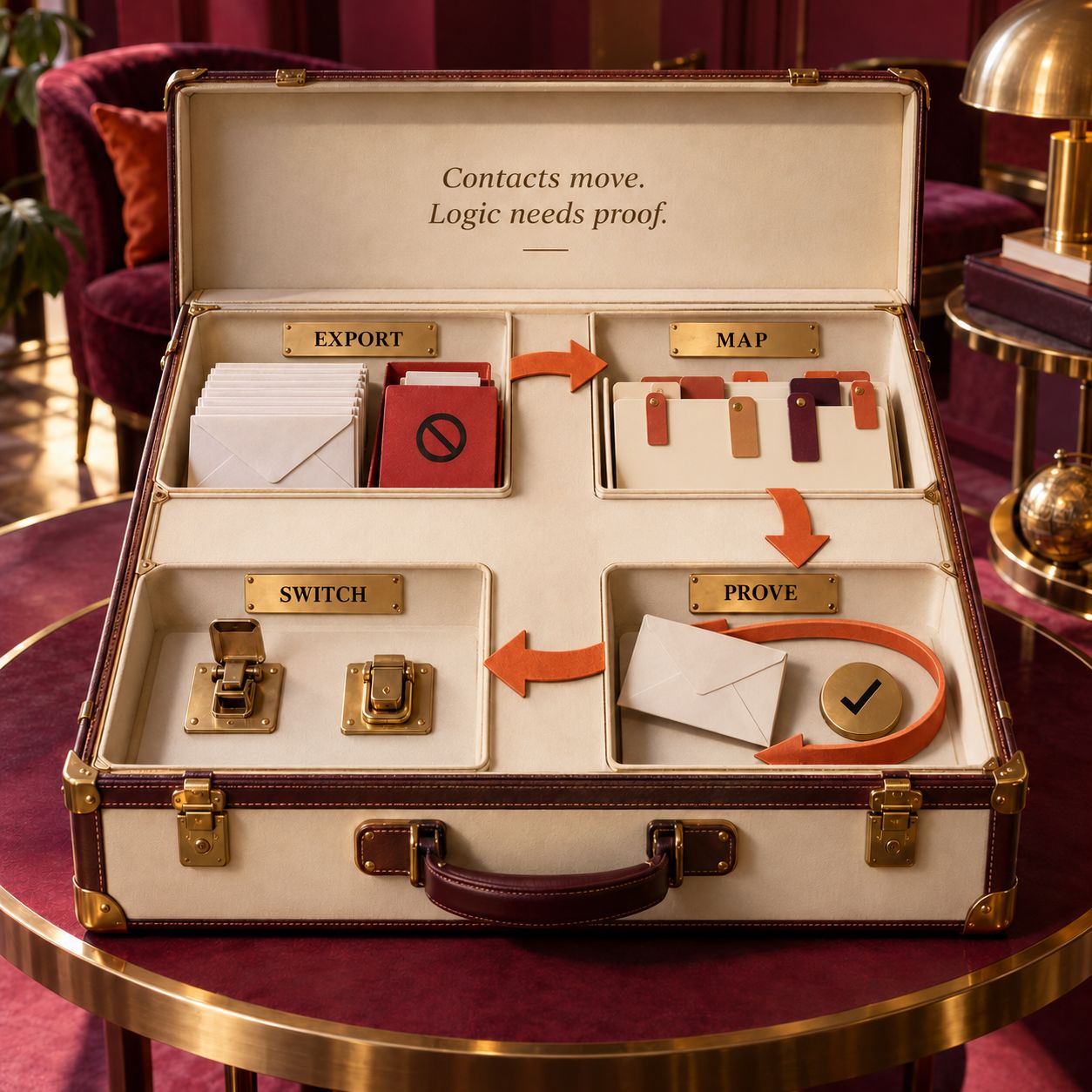
Use this as the acceptance checklist for the person responsible for the move:
-
Inventory active automations before exporting. Record each entry trigger, delay, condition, action, goal, exit and connected system. Include webhooks, CRM actions and store events. Decide which workflows to retire, which to rebuild, and how contacts already waiting inside them will finish. Keeping an old sequence running for existing entrants can be safer than restarting everyone in the destination.
-
Export contacts and preserve exclusions. Save the active audience, unsubscribed and suppressed records, consent evidence, lists, tags and required custom fields. Keep an untouched export as a reference. ActiveCampaign's contact export supports selected fields and places tags in one column, but contact notes cannot be exported through it. Archive required notes separately before closing the account. ActiveCampaign export documentation.
-
Map tags and custom fields by meaning. Tags label membership or state; fields store a value such as renewal date, product or owner. Write down the destination name and type for each. Check date formats, empty values, multi-select fields and duplicate addresses. A field called “Customer” is not enough unless everyone agrees which event sets it and which workflows depend on it.
-
Import into a controlled state. Keep new workflows paused or exclude the migration batch until tested. Imports, tag additions or list membership can otherwise look like new behavior. ActiveCampaign's own importer, for example, has a Trigger Automations control because importing can start active workflows. Check the equivalent behavior in the destination instead of assuming import is silent. ActiveCampaign import behavior.
-
Authenticate and warm the sending setup. Configure the destination's required sending-domain authentication and check reply handling. Start with recently engaged, permissioned recipients, then expand gradually while monitoring bounces, complaints and engagement. Klaviyo's warming guidance specifically prioritizes engagement history and holds back winback and sunset flows during warming. The appropriate ramp depends on history and volume; there is no universal safe number of days. Klaviyo's warming guidance.
-
Replace forms and every other entry point. Inventory embedded forms, popups, landing pages, checkout opt-ins, lead-ad connections and external integrations. Check field mapping, consent text, confirmation steps, thank-you pages and the first email. A successful import does not stop an old form from sending tomorrow's leads to ActiveCampaign.
-
Test outcomes, including exits. Use controlled contacts representing a new lead, an existing customer, an unsubscribed person and a purchase during a sequence. Check that the expected message arrives, the wrong branch stays silent, and a purchase prevents an obsolete sales email. Inspect timestamps and destination fields, not just the visual diagram.
-
Cut over with an owner and a rollback plan. Switch the live entry points, reconcile new contacts between systems, and monitor the first complete business journey. Retain the exports and required history. Cancel or downgrade the old account only when the owner has confirmed that the agreed acceptance checks pass and understood the billing term.
For an agency, repeat the permission, sender and form checks per client. A pooled spreadsheet is not a substitute for each client's suppression list or approval to receive email. Treat deliverability, the ability to reach inboxes reliably, as a condition of the move rather than a feature guaranteed by a lower price.
Who should not switch yet
Stay on ActiveCampaign until the replacement passes the workflow that matters most. That is especially true if a custom integration supplies a critical field, salespeople rely on deal history, a live launch is underway, or no one owns the cutover. A recurring discount is weak compensation for a broken purchase exit or missing lead source.
Avoid Kit Free as an automation replacement, GetResponse Marketer as a webinar plan, and HubSpot Professional as a cheap-email tactic. Avoid choosing Brevo from send volume without checking storage, or Omnisend from a temporary discount without its ongoing price. These are plan-fit mistakes, not blanket judgments about the products.
The next working-day move is concrete: export an automation inventory, pick the hardest revenue-producing journey, and request or build that same journey in the shortlisted plan. If the cheaper tier supports it and the payback period suits the business, migrate. If it requires fragile workarounds, keep the working system while narrowing the brief.
Frequently asked questions
Activecampaign alternatives free
Kit Free supports broadcasts to up to 10,000 subscribers, but visual automations and sequences require a paid plan. MailerLite Free currently allows 250 subscribers and 2,500 monthly sends; Klaviyo Free allows 250 profiles and 500 monthly emails; Brevo Free permits 300 sends a day. A free tier can be useful for a small newsletter without being a replacement for an ActiveCampaign automation account. MailerLite, Klaviyo, Brevo.
Best activecampaign alternatives
Start with MailerLite for simpler automation at lower contact-tier prices, Brevo for selective sending to a large list, GetResponse Creator for webinar funnels, Kit for creator businesses, Omnisend or Klaviyo for ecommerce, and HubSpot for a broader CRM consolidation. The winning plan must preserve the workflow and fit the complete bill.
Activecampaign alternatives reddit
Use user discussions to find migration problems worth investigating, then check each recommendation against your contact count, sending frequency and required plan. Ask whether the person moved only a newsletter or also rebuilt purchase events, exclusions and sequence state. A recommendation without that context does not establish your likely saving.
Use the business workflow audit checklist to identify what your replacement must preserve
- Published
- Category
- Growth
- Language
CallRail Alternatives: WhatConverts and More Compared
Compare six CallRail alternatives by vendor pricing, usage fees, AI and reporting. Includes WhatConverts cost math and a pre-switch checklist.Oct 9, 2026Growth
Monday.com Pricing: Seat Buckets and the Yearly Bill
Calculate monday.com Work Management costs for 5, 12 and 40 people, including seat buckets, annual vs monthly billing and AI credit charges.Oct 9, 2026Growth
Beehiiv Pricing: Annual Costs by List Size
Beehiiv pricing verified October 2026: annual bills at 1k, 10k, 50k and 100k subscribers, plan features, October changes and paid newsletter fees.Oct 9, 2026Growth
Pipedrive Pricing: Plans, Add-ons and Team Costs
Current Pipedrive seat and add-on prices, annual vs monthly budgets for 3 and 10 users, AI features, and when Premium costs less.Oct 8, 2026Growth
Lemlist Pricing: Seats, Credits and Sending Costs
Lemlist pricing by month, quarter and year, including credits, mailboxes and add-ons. See founder, sales team and agency bills plus alternatives.Oct 8, 2026Growth
Tidio Alternatives
Compare seven Tidio alternatives by support job, current pricing and billing unit. See who should switch, what migration costs and when Tidio wins.Oct 7, 2026Growth
Vista Social Pricing: What Your Profiles and Team Cost
Vista Social starts at $99/month. Compare annual prices, profile and user limits, AI features, add-ons, three bills and cheaper options.Oct 7, 2026Growth