CallRail Alternatives: WhatConverts and More Compared
Compare six CallRail alternatives by vendor pricing, usage fees, AI and reporting. Includes WhatConverts cost math and a pre-switch checklist.
Published
 By Omid Saffari



CallRail alternatives are worth moving to when they lower your full bill or fix a reporting gap. CallRail starts at $55 per month on monthly billing; WhatConverts starts at $30, but its $60 Plus plan is the relevant comparison when calls, forms, and chats need to sit in one report.
Prices and plan details verified against the vendors' live pages on 9 October 2026. All prices below are US dollars. Monthly billing is the default unless an annual commitment is stated. Cost examples are calculated scenarios, not product trials or customer invoices.
Which CallRail Alternatives Should You Pick?
Pick WhatConverts for mixed-channel lead reporting, CallTrackingMetrics (CTM) for agency account structure or inexpensive basic AI summaries, and Ringba for a business that sells calls. Stay with CallRail when repricing your existing account solves the problem. Call tracking connects an incoming phone call to the campaign, keyword, or other source that generated it; changing providers should improve that decision, not simply produce another dashboard.
Those are job-specific recommendations. WhatConverts is a partner, and links may earn a commission. Its placement here rests on combined lead reporting and the calculated costs, not the partnership.
The six alternatives were selected for attribution, published pricing transparency, client reporting, conversation analysis, and a concrete reason to migrate. A phone system that answers calls is a different purchase from software that proves which ads generated them. No hands-on trial or call-quality benchmark is claimed.
CallRail Pricing: The Baseline You Must Beat
CallRail's entry price is $55 per month, or $50 per month equivalent with annual billing. The annual setting is selected when its pricing page opens. Lead Tracking includes five local numbers and 250 local minutes; additional local numbers cost $3 per month and local minutes cost $0.06, including transcription. Toll-free numbers are $5 per month and toll-free minutes are $0.08. CallRail's own pricing page.
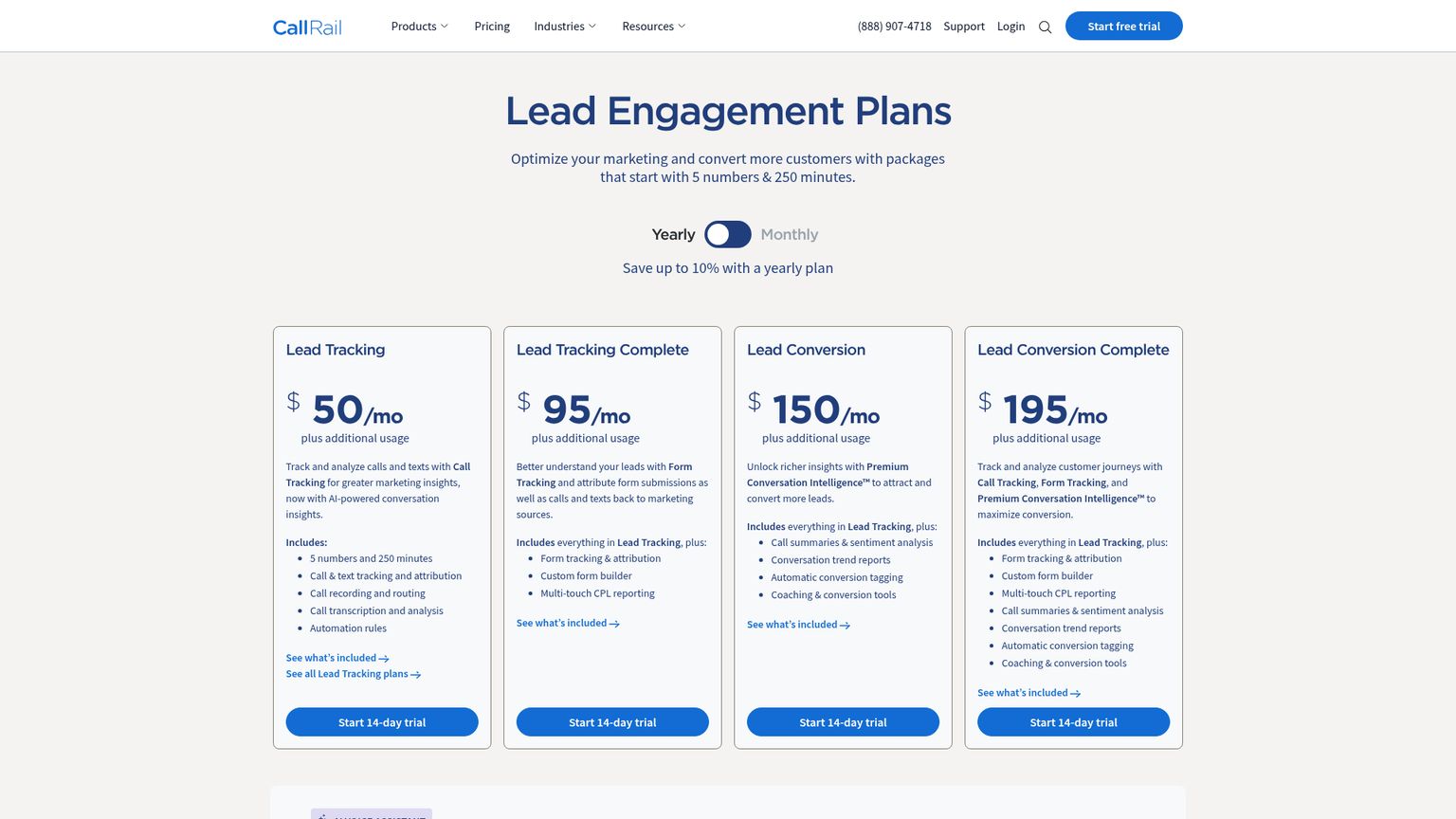
Forms and premium summaries are different upgrades. Lead Tracking Complete costs $105 monthly and includes 1,000 form submissions. Lead Conversion costs $165 monthly and adds premium summaries, sentiment, conversation trends, conversion tagging, and coaching. Lead Conversion Complete combines the two at $215 monthly. Basic transcription is already included in the main tracking bundle; do not describe every AI feature as a paid extra. Current bundle features.
For a roofer whose calls already reach the right office, the question is whether a new report helps identify qualified jobs or reduces the bill enough to pay for migration. For the complete tier breakdown, use our CallRail pricing guide. Our broader AI call-tracking tools comparison provides additional context on conversation analysis; use this article's dated prices for the current budget.
Six Alternatives, Priced for the Job They Do Better
Compare subscription, number rental, and usage together. A tracking number is the rented phone number assigned to a marketing source or visitor session. Dynamic number insertion, or DNI, swaps the number displayed on your website so the provider can connect a call to that visitor's source.
These are US local rates from the makers' pricing pages. The Nimbata country selector was checked against its own page's US rate data. Included credits and allowances are explained in the product sections.
1. WhatConverts Call Tracking: Best for Calls, Forms and Chats Together
WhatConverts is a lead-tracking platform whose strongest fit is a marketing report that includes phone calls, forms, and chats. If an agency's client receives valuable website inquiries as well as calls, Plus puts those lead types alongside their marketing sources. The decision is about seeing the full intake picture: a campaign with fewer calls may still produce the better mix of inquiries.
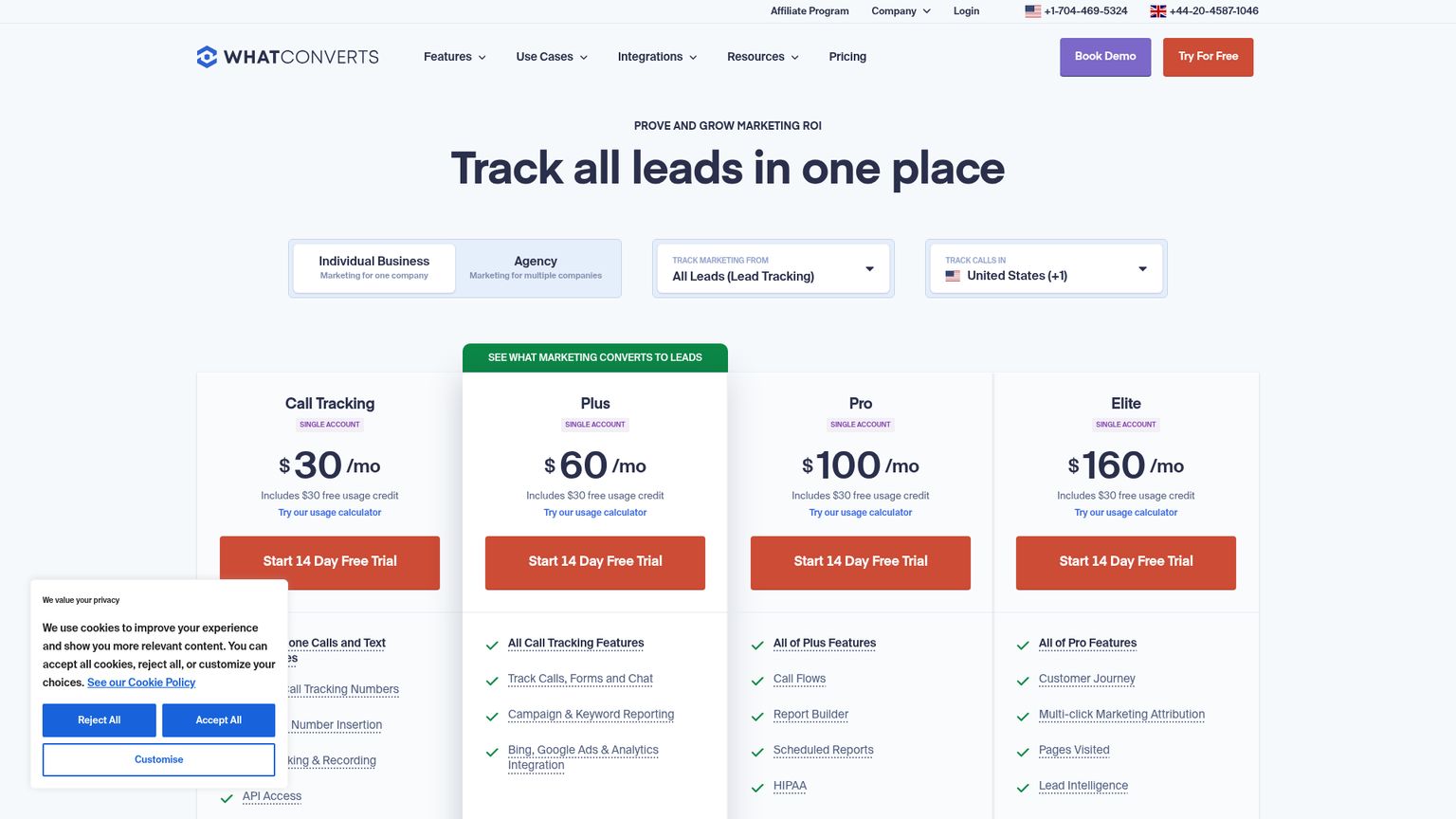
The important tier boundary is Plus versus Pro. Plus provides combined tracking and campaign reporting; Pro adds the custom report builder, scheduled reports, and call flows. An agency promising a tailored recurring report should budget Pro, not sell the $30 headline as that package. WhatConverts plans and features.
Best for: A local-services business or agency connecting calls, forms, and chats to marketing.
Standout: Multiple inquiry types in the same lead-reporting workflow.
Pricing: $30 Call Tracking, $60 Plus, $100 Pro, or $160 Elite monthly; each individual plan includes a $30 usage credit. US local numbers are $2.50/month, calls $0.045/minute, transcription $0.02/minute, and tracked forms/chats/transactions $0.10 each. Toll-free numbers are $3.50/month and minutes $0.065.
Free trial: 14 days. Published rates.
The credit is one spending allowance shared across eligible usage, not a separate free allowance for every channel. Also, transcription and AI analysis are not interchangeable: WhatConverts describes call analysis as requiring transcription and AI analysis as separately metered. Get the AI price for your proposed setup before claiming cheaper summaries. How its billing works.
- Plus includes calls, forms, and chat tracking.
- The usage credit offsets eligible metered charges.
- Pro supplies custom and scheduled reports.
- The $30 tier does not deliver the combined-channel use case.
- Higher form volume can erase its price advantage over CallRail.
- AI analysis needs its own cost check.
Verdict: WhatConverts wins the combined-lead-reporting shortlist, provided you buy the reporting tier you actually need. For a first evaluation, use one client and one website before moving the rest:
Price the reporting promise
Choose Plus for combined lead tracking, or Pro when the deliverable requires custom and scheduled reports. Enter numbers, minutes and non-call leads separately in the vendor calculator.
Pilot the whole inquiry path
Install the new tracking setup on a controlled page, connect the required lead sources, then place a test call, submit a form and send a chat. Confirm each reaches the intended report with its marketing source.
Approve the evidence before porting
Check a known paid campaign and a known organic visit. Confirm that qualified inquiries are distinguishable from spam and that the client can read the report. Then approve the number move.
2. CallTrackingMetrics: Best for Agency Structure and Basic AI Summaries
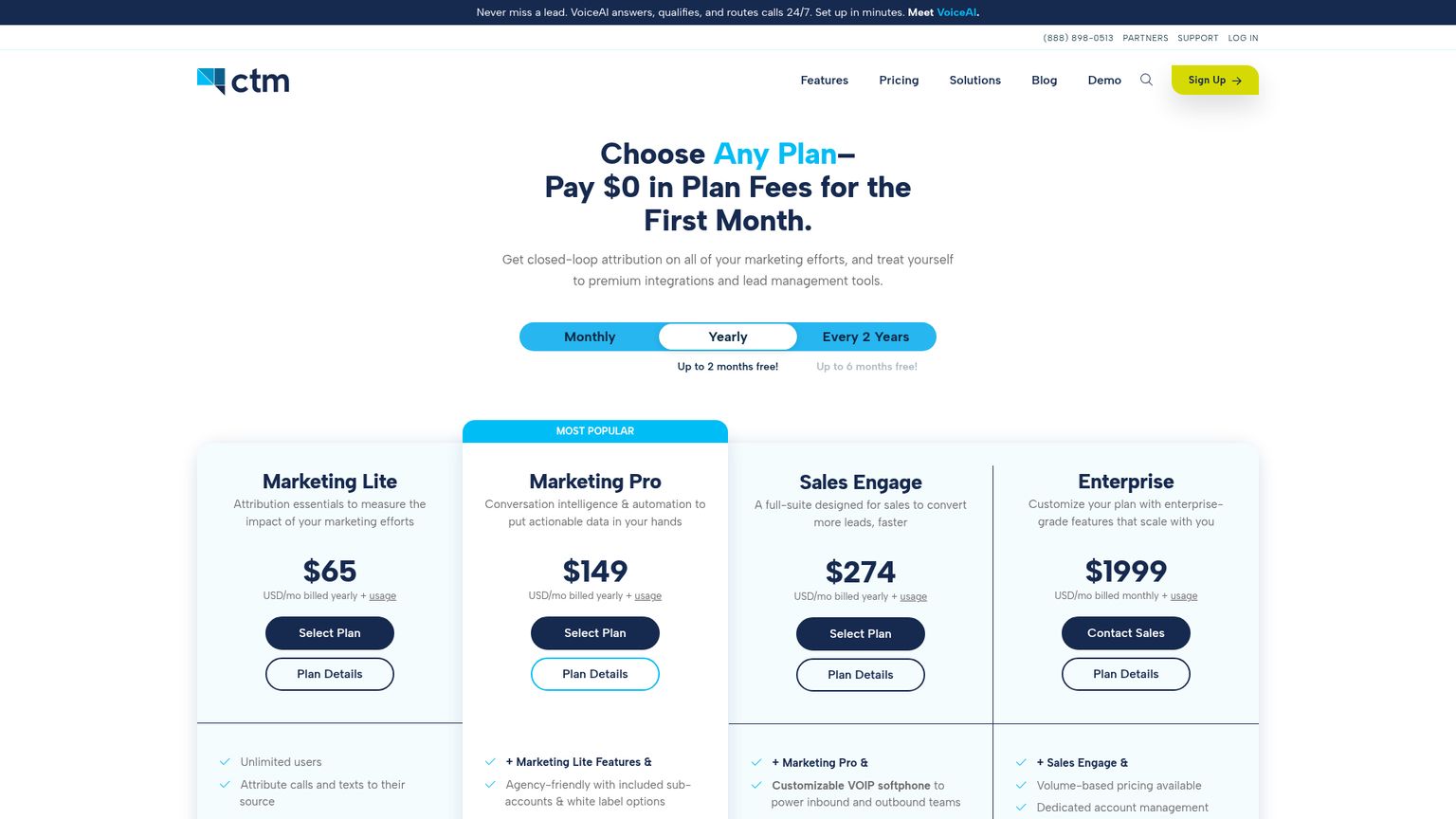
CallTrackingMetrics, now branded CTM, combines attribution with call handling and automation. Marketing Lite is worth considering when a business wants transcripts and short summaries without buying CallRail's premium summary bundle. Marketing Pro becomes more relevant for an agency: it includes 25 subaccounts, keeping client workspaces separate under its plan structure. CTM pricing.
Best for: An agency managing distinct client accounts, or an operator who needs basic summaries.
Standout: Lite's transcription plus basic AI summary costs $0.02/minute; Pro adds AskAI custom questions from $0.01/question.
Pricing: Marketing Lite is $79 monthly or $65/month annual equivalent. Marketing Pro is $179 monthly or $149/month annual equivalent. US local numbers cost $2/month and forwarded local calls $0.04/minute; toll-free numbers cost $3/month and forwarded minutes $0.055.
Free trial: The pricing page promotes no platform plan fee for the first month; usage remains separate. Plan and usage schedule.
The hidden budgeting distinction is a starting allowance versus a monthly allowance. Pro's 3,000 transcription minutes per subaccount do not renew every month. After that allowance, transcription is $0.02/minute. An agency should quote recurring costs with that charge included, not amortize a temporary allowance as permanent free AI. Pro also includes 5,000 form submissions monthly, then $0.02 each; additional packs of 25 subaccounts cost $50/month. Allowance terms.
- Lite includes Google Ads and Google Analytics 4 (GA4) integrations.
- A basic AI summary accompanies metered transcription.
- Pro includes 25 client subaccounts.
- Numbers and calling minutes are additional to the platform fee.
- The initial transcription allowance is not replenished monthly.
- Advanced AI questions add a separate usage charge.
Verdict: CTM wins for basic summaries and an explicit agency subaccount package. A summary that explains a call is useful; it is not proof that an AI model correctly identified revenue or a qualified lead. Validate that judgment against your own calls before feeding it into bidding.
3. Nimbata: Best for Per-Answered-Call Budgeting
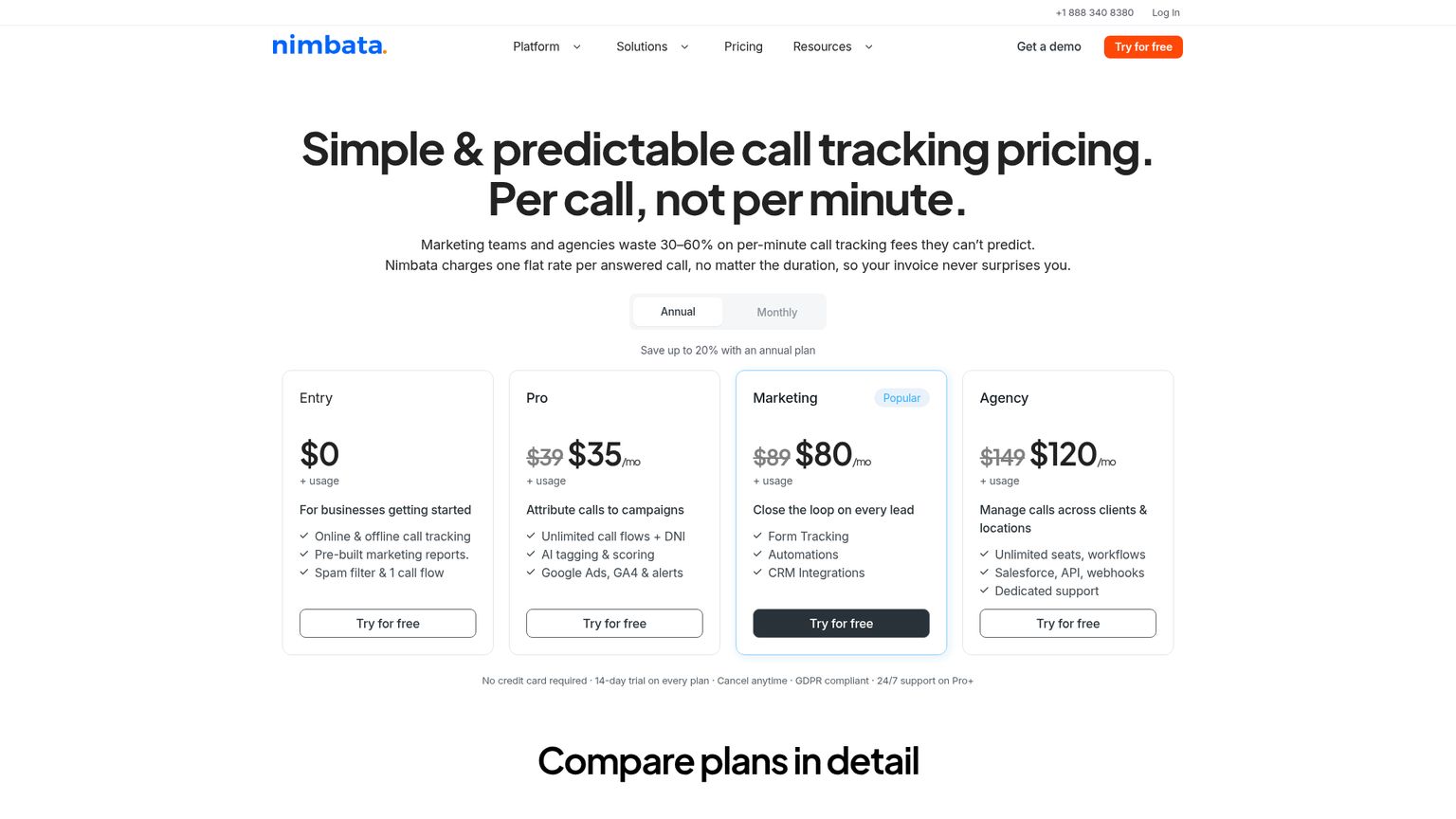
Nimbata is a call-attribution platform that bills calling usage by answered call instead of minute. That makes the usage unit easier to relate to inquiries, but its fair-use clause limits the long-call advantage. A legal practice handling lengthy consultations should read that clause before moving on a promise of duration-independent bills.
Best for: A marketer who wants answered-call billing and knows the duration pattern of those calls.
Standout: Pro includes DNI, Google Ads and GA4; Marketing adds forms and CRM integrations.
Pricing: Entry is $0 plus usage; Pro $39 monthly or $35/month annual equivalent; Marketing $89/$80; Agency $149/$120. US local rates on Entry are $4.60/number/month and $0.10/answered call. Pro rates are $3.20 and $0.06; Marketing $2.30 and $0.04; Agency $1.60 and $0.03. Transcription is $0.02/minute on paid plans.
Free trial: 14 days, capped at two tracking numbers and 50 answered calls. Nimbata's pricing and country rate selector.
- Calling usage is priced around answered calls.
- Pro includes the main paid-search attribution integrations.
- Agency provides unlimited seats and projects.
- Entry lacks the DNI and integrations most advertisers need.
- Long average calls can trigger fair-use overages.
- Transcription remains a per-minute charge.
Verdict: Nimbata wins on the answered-call billing model, not on an unconditional promise that long calls cost the same.
Free Call Tracking Still Has Usage Costs
Nimbata Entry has no subscription fee, but it is not a zero-cost CallRail replacement. Numbers and answered calls are charged, and the entry tier omits DNI and Google Ads/GA4 integration. Use the free trial to evaluate the attribution setup you intend to buy; use the paid plan and usage rates for your ongoing budget.
4. CallScaler: Best When Number Rental Is the Bottleneck
CallScaler is a call-tracking and lead-generation platform with unusually low published local-number rental. An agency holding many numbers across campaigns should notice the $0.50 monthly rate. It should also notice the $95 monthly subscription and the separate recording and AI charges: cheap numbers do not automatically make a cheap complete workflow.
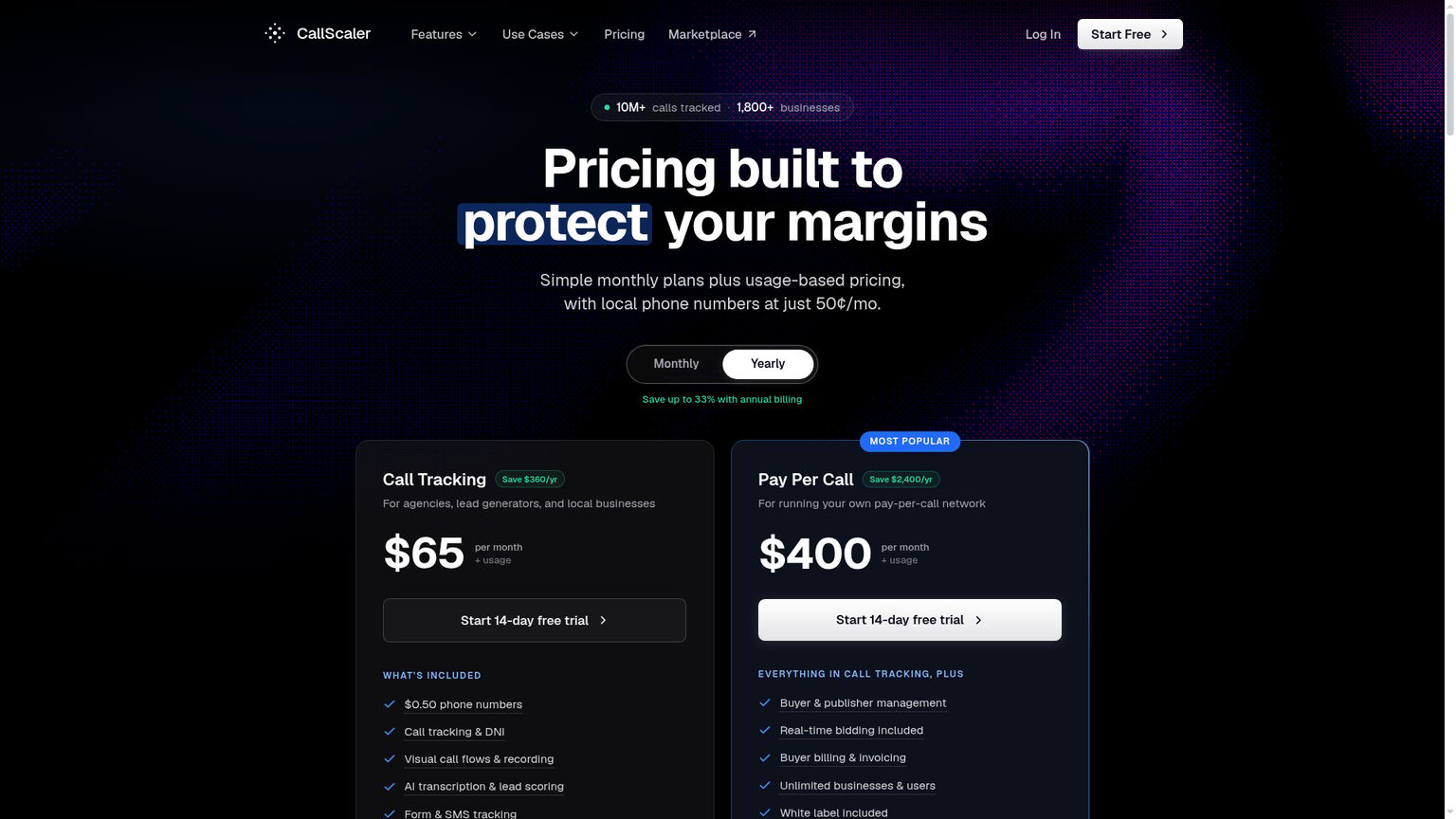
Best for: A lead-generation business with a large number inventory.
Standout: DNI, call flows, form tracking and a client portal alongside inexpensive numbers.
Pricing: Call Tracking is $95 monthly, or $65/month equivalent billed annually. Local numbers are $0.50/month and minutes $0.045; toll-free numbers $2/month and minutes $0.055. Advanced recording is $0.005/minute; AI transcription and intelligence is $0.006 per 15 seconds.
Free trial: 14 days. CallScaler pricing.
The entry plan permits three businesses and five users per business. Unlimited users and businesses add $95/month. A future exit also has a published cost: CallScaler charges $10 per number to port out, although it offers free port-in assistance. Moving a large inventory cheaply today should not obscure its exit cost. Account limits and porting terms.
- Local numbers cost $0.50/month.
- Form tracking and client access are listed features.
- Port-in assistance is offered without a port-in charge.
- Monthly billing is $95, not the advertised $65 annual equivalent.
- Recording and AI add usage charges.
- More than three businesses requires an upgrade or add-on.
Verdict: CallScaler wins on local-number rental, but the full bill must beat your existing plan. Its monthly base is higher than CallRail's entry fee.
5. Ringba: Best for Selling Calls to Buyers
Ringba is an inbound-call platform built around operating a call business. It fits a lead generator that routes inquiries to buyers and cares about call revenue. A home-services owner who simply wants to connect ads to appointments is paying for a different kind of operation.
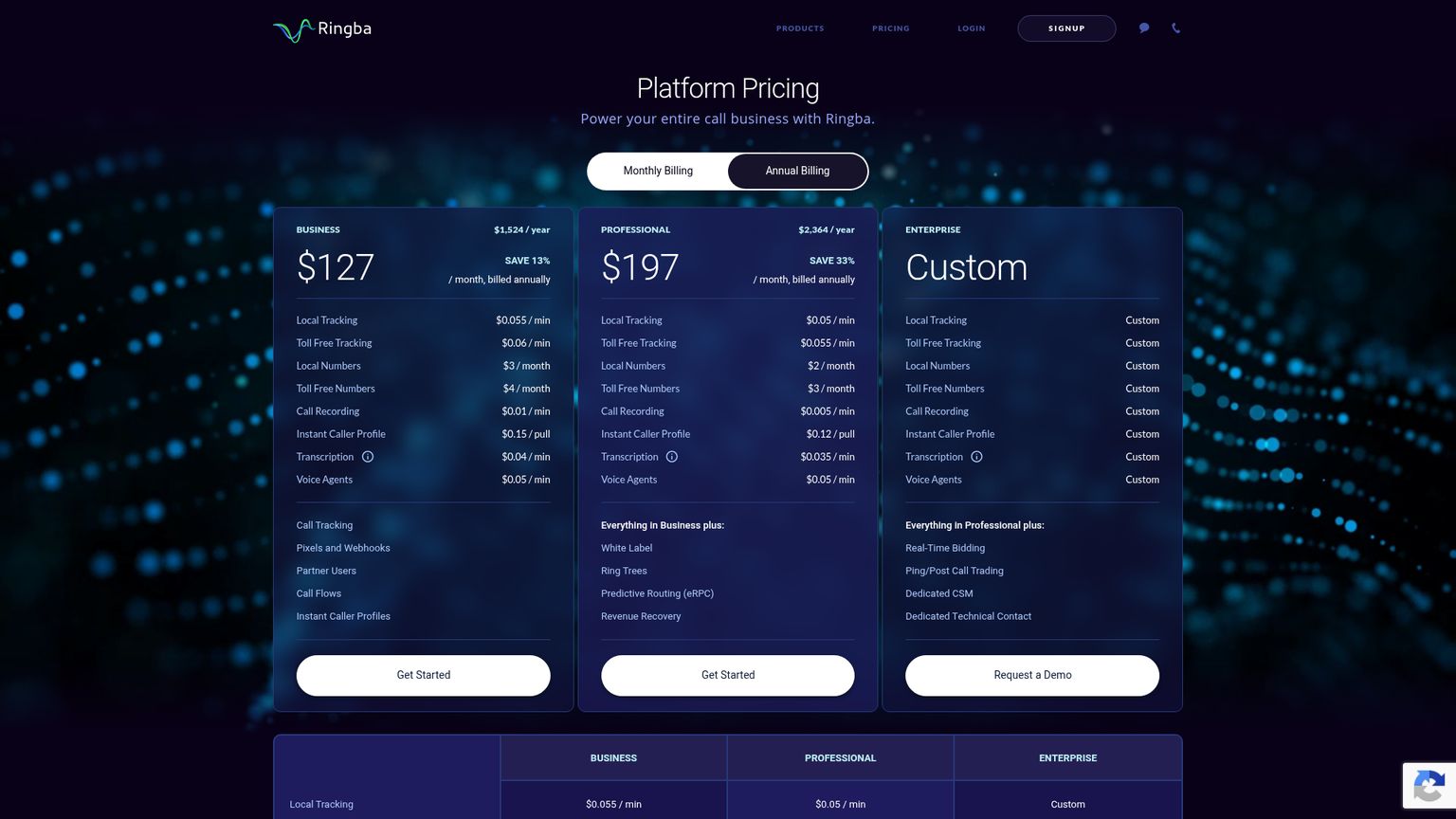
Best for: Pay-per-call lead generators, where buyers pay for qualifying incoming calls.
Standout: Professional adds Ring Trees, predictive routing, and revenue recovery; Enterprise adds real-time bidding and ping/post call trading.
Pricing: Business is $147 monthly or $127/month annual equivalent. Its local numbers cost $3/month, local tracking $0.055/minute, toll-free numbers $4/month, toll-free tracking $0.06/minute, recording $0.01/minute and transcription $0.04/minute. Professional is $297 monthly or $197/month annual equivalent.
Free trial: No standard free trial allowance is stated on the pricing page; a demo is offered. Ringba pricing.
- Business includes call flows and partner users.
- Higher plans address buyer routing and call monetization.
- Number, minute, recording and transcription rates are published.
- Its entry subscription exceeds CallRail's.
- Recording and transcription are additional charges.
- Real-time bidding requires a custom Enterprise plan.
Verdict: Ringba wins when the product you sell is the call. Avoid it as a routine cost-cutting replacement for a local business's attribution report.
6. CallRail vs Invoca: Best for an Enterprise Analysis Project
Invoca is a revenue-execution and conversation-analysis platform to evaluate when the requirement outgrows a simple attribution report. Its pricing page covers dynamic tracking numbers, offline conversion and revenue imports, Google Ads and GA4 integrations, and Signal AI conversation analysis. The relevant buying question is whether those capabilities support a specific revenue or quality-management workflow.
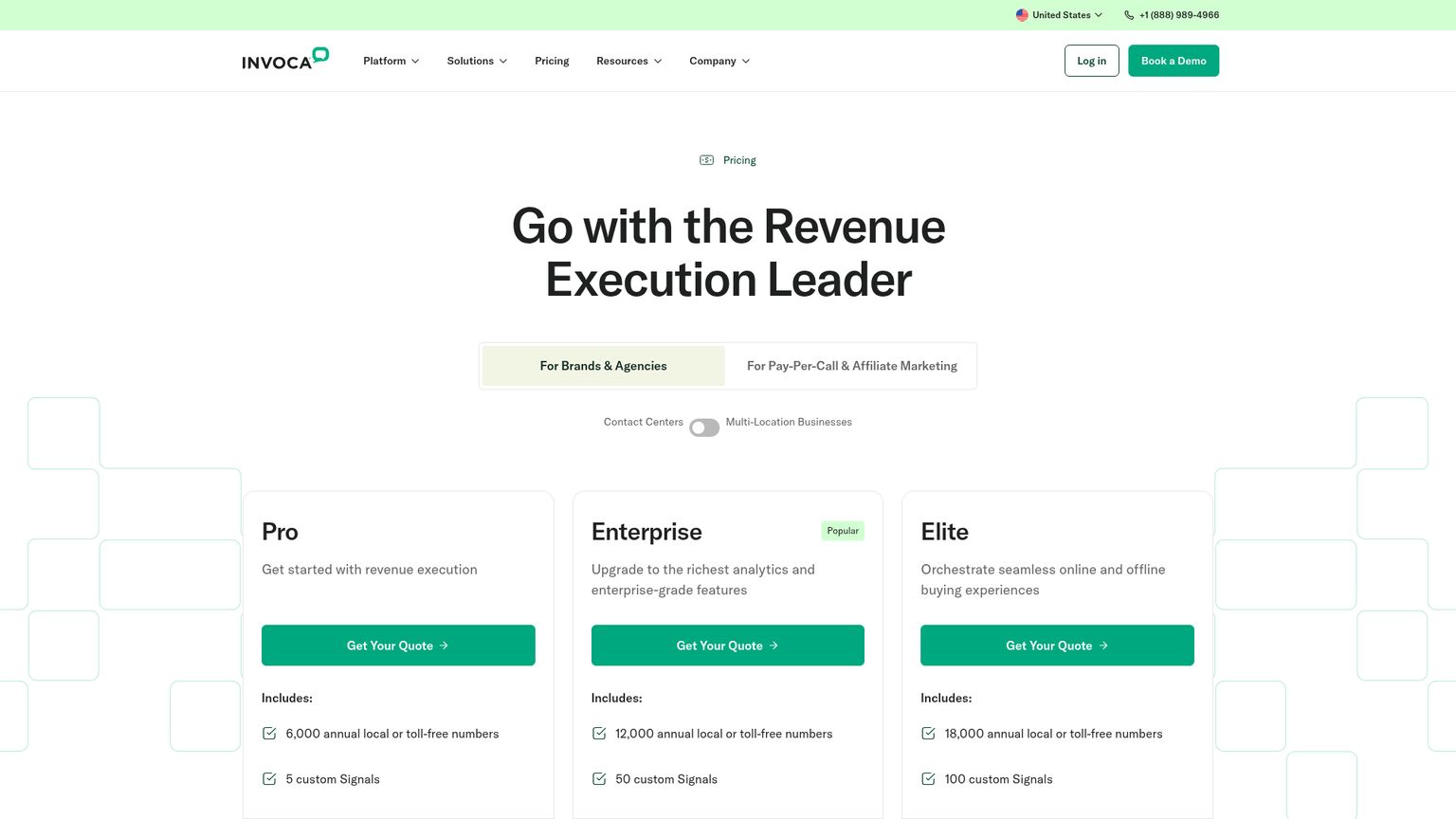
Best for: A multi-location organization or contact center with a defined analysis project.
Standout: Signal AI and AI-powered quality management appear as optional add-ons on the published plan cards; scope both explicitly in the quote.
Pricing: Custom quote. Invoca's own pricing page does not publish a dollar starting subscription or per-number/per-minute rates. Request all three in writing.
Free trial: No standard public trial allowance is stated; quote and demo routes are offered. Invoca plan scope.
- Connects calls with offline conversion and revenue data.
- Offers a dedicated conversation-analysis suite.
- Publishes plan boundaries for enterprise capabilities.
- There is no public rate card to validate savings.
- The desired AI features may be add-ons on the quoted tier.
- Evaluation and migration need a project owner.
Verdict: Invoca wins a place on the enterprise analysis shortlist, not a cheapest-alternative ranking. Ask it to price your actual data, numbers, minutes, retention and integrations before comparing the quote with CallRail.
CallRail vs WhatConverts: Equal Workload, Different Bill
WhatConverts Plus saves $35 per month in this matched example, but CallRail becomes cheaper once form volume rises far enough. Assume a single US business with 10 local tracking numbers, 1,000 billable local minutes, 100 form submissions, and transcription on every minute. Both plans are billed monthly. Premium AI summaries, SMS, international usage, taxes and surcharges are excluded.
- CallRail Lead Tracking Complete: $165. $105 base + five extra numbers × $3 + 750 extra minutes × $0.06. The 100 forms fit inside the 1,000-form allowance; transcription is included in the local-minute rate.
- WhatConverts Plus: $130. $60 base + $25 numbers + $45 calling + $10 forms + $20 transcription, less the $30 included credit.
These are calculated subscription-plus-usage subtotals using CallRail's rate card and WhatConverts' rate card. They are not guaranteed invoice totals. CallRail rounds each call up to a whole minute; use each provider's billable units when estimating your own traffic.
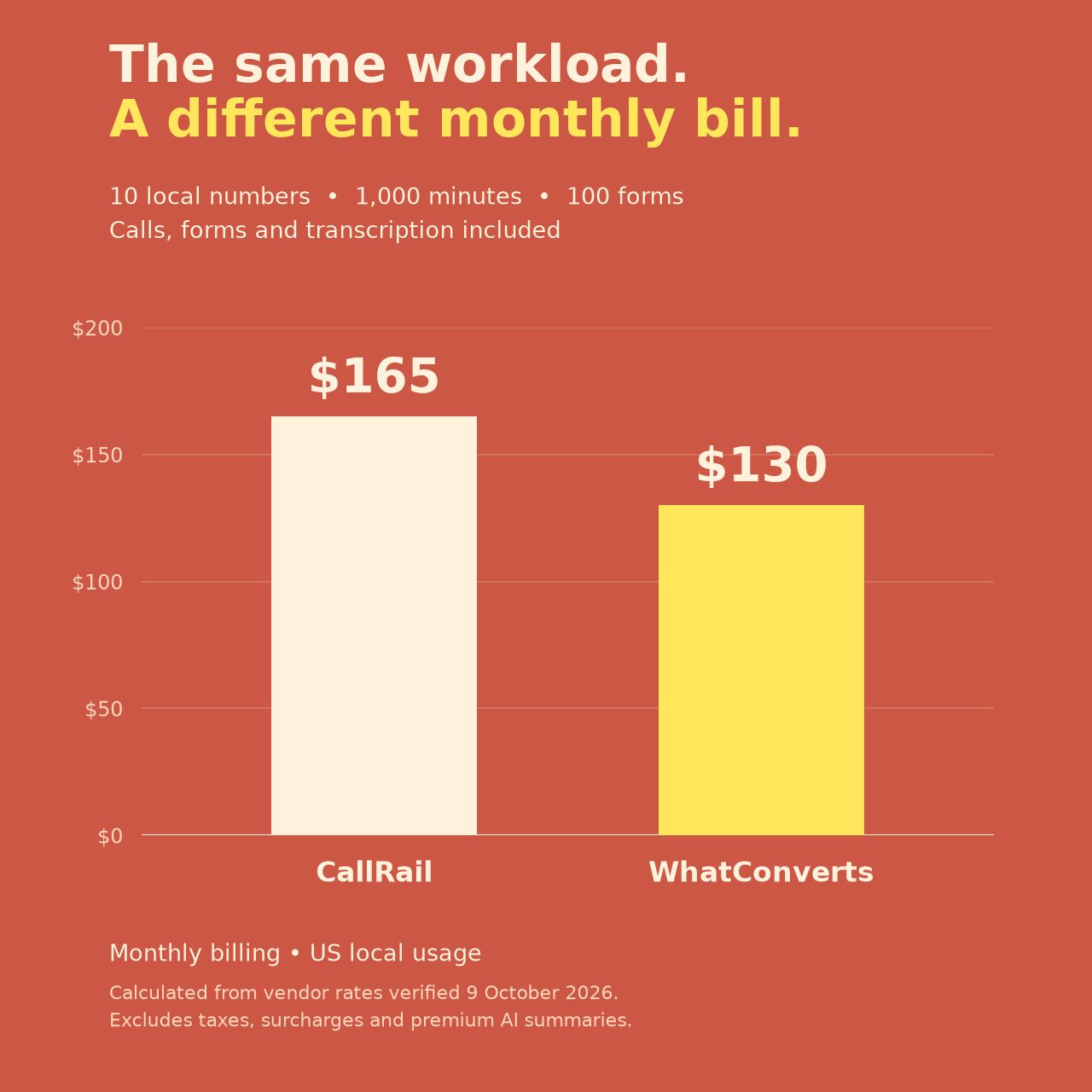
Transcription is the difference between a fair comparison and an inflated savings claim. Disable it in WhatConverts and its subtotal falls to $110, but that no longer matches the transcription included with CallRail's main bundle. With it enabled, the saving is $420 over an unchanged year.
The Price Crossover Is 450 Forms
At 450 forms, these two configurations both cost $165. Holding numbers and transcribed minutes fixed, WhatConverts costs $120 plus $0.10 per form. CallRail remains $165 through its included 1,000 forms. Above 450 forms and through that allowance, CallRail wins on price. A form-heavy appointment business should therefore resist a recommendation based only on the $60 versus $105 subscription comparison.
That rule is specific to this workload and these tiers. It does not price chat parity, custom scheduled reports, or premium AI analysis. If one of those is the reason to move, compare the plan that supplies it.
Agency Accounts Change the Credit Calculation
WhatConverts Agency Plus becomes cheaper at six clients in this particular workload. Each client still uses 10 numbers, 1,000 transcribed minutes and 100 forms. Agency rates reduce the per-client usage to $87.50: $17.50 numbers, $40 calling, $10 forms and $20 transcription.
Agency Plus costs $500 plus aggregate usage beyond its $250 credit. Five individual Plus accounts cost $650; the agency plan costs $687.50. At six clients, individual accounts cost $780 and Agency Plus costs $775. That crossover is calculated, not a universal agency threshold. Individual and agency rates.
For scheduled custom reports, rerun the calculation on Pro. Also, CallRail allows unlimited companies and users inside a standard account; do not assume every client must buy a separate subscription. Account ownership and client billing arrangements must match before comparing an agency total. CallRail account billing.
At High Volume, Compare the Right CallRail Tier
For 20 local numbers and 5,000 local minutes, WhatConverts' voice-only subtotal is $275, CallRail's lowest published monthly volume option is $320, and CallScaler is $330. These calculations exclude optional transcription and AI charges rather than claiming equivalent analysis features:
- WhatConverts Call Tracking: $30 + $50 numbers + $225 minutes minus $30 credit = $275.
- CallRail's 1,000-minute/10-number option: $95 + 10 extra numbers × $2.50 + 4,000 extra minutes × $0.05 = $320. Its 4,000-minute option would cost $340 at this workload.
- CallScaler: $95 + 20 numbers × $0.50 + 5,000 minutes × $0.045 = $330.
CallRail volume menu, WhatConverts rates, CallScaler rates.
On WhatConverts, transcribing those minutes adds $100. On CallScaler, advanced recording adds $25 and AI processing adds $120 if every minute is billed as four 15-second units. Confirm the analysis allowance attached to the specific CallRail volume quote. The practical lesson is simple: price the complete workflow, then choose the subscription.
Pre-Switch Checklist: Protect Numbers, Integrations and History
Move one proven workflow first, and keep the old account active until the number and its reporting path work. Porting preserves the phone number. It does not, by itself, transfer attribution history, recordings, client permissions, or your definitions of a qualified lead.
Keep Each Call Tracking Number Accounted For
Inventory every number before requesting a port. Mark where it appears: website pools, Google Ads call assets, business listings, landing pages, printed materials, and repeat customers' address books. Identify which numbers must survive and which temporary test numbers can be replaced.
CallRail says porting away typically takes 4-6 weeks. Its US and Canadian numbers are free to port out. An administrator authorizes the move, obtains the Customer Service Record, and gives it to the receiving provider, which initiates the port. Keep CallRail active until completion. CallRail port-away instructions.
A new tracking number can let you pilot sooner, but it creates a different migration job: update every placement and plan for people who still call the old number. A destination vendor's shorter typical port-in estimate is not a guarantee for your CallRail transfer.

Export the evidence
Save the reports, recordings and lead records you need while you still have access. Keep number-to-source mappings, campaign names, qualification rules, dates and time zones. Confirm export and import capabilities with both providers; do not assume old visitor histories can be reconstructed in the new dashboard.
Validate Google Ads and GA4 separately
Confirm the integration is included in the exact plan. In Google Ads, map the intended conversion action, its value and qualification rule. In Google Analytics 4, check the destination property, event names and key-event settings. Send known test inquiries through both paths and verify receipt before using the new feed for decisions. During parallel running, choose one production conversion feed so the same lead is not counted twice.
Check forms, chat and number swapping
Test each important form and chat provider, not just the homepage phone link. Verify DNI on your main landing pages, source attribution, routing, voicemail and client access. Avoid two competing number-swap scripts on the same production page. Preserve the old configuration for rollback.
Rebuild recording consent and access controls
Have the person responsible for compliance approve the recording notice and consent workflow for the jurisdictions involved. Test the greeting on the new route before enabling recording or analysis. Review retention, recording access, and any healthcare agreement separately. A port does not carry these settings over, and a generic recording announcement is not proof of legal compliance. CallRail itself notes that requirements differ and offers configurable greetings. Recording guidance.
Cut over, reconcile, then cancel
After the scheduled port, place test calls from an unrelated phone and confirm routing. Reconcile provider logs against the lead report, Google Ads and GA4. Mark the cutover date in client reporting: the before and after periods may have different attribution rules. Deactivate or cancel the old setup only after successful verification and the required exports.
Put a Price on the Reporting Gap
The migration bill includes labor and overlap, even when porting is free. As an illustration, four hours at an internal cost of $75/hour is $300. Add an assumed $105 of subscription overlap and the move costs $405 before other expenses. At the earlier $35 monthly saving, payback takes about 12 months.
Those are planning assumptions, not vendor charges. Replace them with your own migration hours, overlap period and contract terms. A report that saves hours each month may justify moving sooner; a small base-fee reduction on its own may not.
Who Should Stay With CallRail?
Stay when the current attribution works, the relevant volume plan is competitive, and the migration has a weak payback. Keep it when the alternative would remove a required integration, disrupt client reporting, or replace included transcription with a new metered charge that cancels the saving.
Avoid Invoca if your only brief is “make the small-business bill cheaper”: its public page cannot substantiate that case. Avoid Ringba when you are not operating a call-selling business. Avoid Nimbata Entry for a Google Ads attribution replacement that requires DNI and GA4. Avoid WhatConverts Call Tracking if the promised deliverable includes forms and chats. Those are wrong-plan or wrong-job choices, not judgments that the products are bad.
The Monday move is to export one recent month of usage, price it on the exact replacement tier, and pilot one lead path. Port only after the reporting improvement or savings survives that check.
FAQ
Is CallRail worth it?
Yes, when its attribution supports budget decisions and the complete bill is competitive. In the worked calls/forms/transcription example, WhatConverts saves $35 monthly, but an assumed $405 migration takes about 12 months to repay. A small saving is not automatically a good switch.
What converts vs CallRail?
WhatConverts Plus is the stronger shortlist choice when calls, forms and chats need to share a lead report. CallRail remains competitive for form-heavy workloads: the matched example ties at 450 forms. Compare Pro if custom scheduled reporting is required, and price AI summaries separately.
What is the best call tracking software?
For combined lead reporting, start with WhatConverts. For agency subaccounts and basic AI summaries, consider CTM. For a business selling calls, consider Ringba. If your current CallRail setup works, reprice its volume tiers before migrating.
How much does CallRail cost per month?
Lead Tracking starts at $55 on monthly billing or $50/month equivalent with annual billing. The main monthly bundles are $55, $105, $165 and $215, plus applicable usage. CallRail pricing.
Is CallRail HIPAA compliant?
CallRail offers HIPAA-supported Healthcare plans with a Business Associate Agreement. Do not assume the standard entry plan or merely disabling recordings satisfies a healthcare organization's obligations. Confirm the plan, agreement and workflow. CallRail Healthcare.
Is CallRail a VoIP?
CallRail is primarily bought for call attribution and lead engagement, with recording and routing among its features. If you need to replace office phones, evaluate that requirement separately rather than assuming a tracking subscription replaces your phone system. CallRail's product scope.
Can police trace VoIP calls?
Some provider records can be obtained through legal process; that does not mean every internet call is identifiable. This is a separate legal question from marketing call attribution. The US Department of Justice describes legal access to telephone-provider records in its discussion of electronic communications privacy law.
What are the top 5 VoIP providers?
There is no universal top five for every buyer. A business-phone shortlist needs to address calling, extensions and emergency-service requirements; this shortlist addresses marketing attribution. Do not substitute one buying decision for the other.
What is the main disadvantage of VoIP?
For an internet-based calling endpoint, continuity depends on internet connectivity and power. Plan backup connectivity and power for that setup. This is different from a tracking number forwarding calls to an existing phone service. FCC discussion of service continuity.
Use the AI Business Workflow Audit Checklist to map the reporting steps you want to improve before buying another tool. Get it through the newsletter.
- Published
- Category
- Growth
- Language

Monday.com Pricing: Seat Buckets and the Yearly Bill
Calculate monday.com Work Management costs for 5, 12 and 40 people, including seat buckets, annual vs monthly billing and AI credit charges.Oct 9, 2026Growth
Beehiiv Pricing: Annual Costs by List Size
Beehiiv pricing verified October 2026: annual bills at 1k, 10k, 50k and 100k subscribers, plan features, October changes and paid newsletter fees.Oct 9, 2026Growth
Pipedrive Pricing: Plans, Add-ons and Team Costs
Current Pipedrive seat and add-on prices, annual vs monthly budgets for 3 and 10 users, AI features, and when Premium costs less.Oct 8, 2026Growth
Lemlist Pricing: Seats, Credits and Sending Costs
Lemlist pricing by month, quarter and year, including credits, mailboxes and add-ons. See founder, sales team and agency bills plus alternatives.Oct 8, 2026Growth
Tidio Alternatives
Compare seven Tidio alternatives by support job, current pricing and billing unit. See who should switch, what migration costs and when Tidio wins.Oct 7, 2026Growth
Vista Social Pricing: What Your Profiles and Team Cost
Vista Social starts at $99/month. Compare annual prices, profile and user limits, AI features, add-ons, three bills and cheaper options.Oct 7, 2026Growth
Unbounce Pricing 2026: Plans, Visitor Limits and Testing
Unbounce starts at $29/month. Compare all six plans, annual rates, visitor and domain limits, A/B testing, Smart Traffic and the cheapest fit.Oct 7, 2026Growth