GLM-5.2 Review (2026): The Open-Weight Model That Runs Claude Code at Half the Cost of Opus
GLM-5.2 is a 753B open-weight model that matches Claude Opus on coding at under half the cost. Real pricing, benchmarks, and when to actually use it.
Published Updated
 By Omid Saffari


GLM-5.2 is still a 753-billion-parameter, MIT-licensed open-weight coding model, but it is no longer the value leader in its own family. GLM-5.3 Flash now lists at $0.15 per million input tokens and $0.50 per million output tokens, versus $1.40 and $4.40 for Cloudflare's GLM-5.2 endpoint, while adding native vision and a 1,048,576-token Cloudflare context window.
The verdict
Do not start a new hosted workload on GLM-5.2 unless you need compatibility with an existing deployment or exact reproduction of an older evaluation. GLM-5.3 Flash is the better default for cost-sensitive agents and multimodal work. Full GLM-5.3 is the stronger choice when maximum coding performance matters more than token cost. GLM-5.2 now makes the most sense as a stable, self-hostable baseline.
That is a sharper recommendation than this review originally made. GLM-5.2 still combines permissive weights, long context, and credible coding performance, but Z.ai has now shipped two successors. The choice is no longer GLM-5.2 versus an expensive closed model. It is usually Flash versus full GLM-5.3, with GLM-5.2 kept only where migration risk is worth more than the savings.
Since August 30, 2026, Cloudflare AI Search supports GLM-5.3 Flash as its native Workers AI generation model, using the alias @cf/zai-org/glm-5.3-flash and a 1,048,576-token context window. That makes Flash available inside a managed retrieval-and-generation stack, not only through Z.ai or a coding plan. The setup and cost consequences are covered in Cloudflare AI Search with GLM-5.3 Flash, explained.
For an existing self-hosted GLM-5.2 deployment, there is no need to move simply because a new version exists. For a new hosted deployment, the price gap is too large to ignore: Flash's list output rate is 88.6% lower, and it handles images, video, and files that GLM-5.2 does not accept natively.
What GLM-5.2 actually is
Z.ai released GLM-5.2 on June 16, 2026 as a long-horizon engineering model. Its official model card lists 753 billion parameters, text input and output, open weights, and local deployment paths including SGLang, vLLM, KTransformers, xLLM, and Transformers. Z.ai's direct model supports a 1-million-token context and 128K maximum output tokens. Cloudflare's hosted GLM-5.2 endpoint is a different envelope, capped at 262,144 context tokens.
The architecture feature that made the original release noteworthy is IndexShare. Z.ai's GLM-5.2 launch page says one lightweight indexer is reused across every four sparse-attention layers, cutting per-token computation by 2.9 times at a 1-million-token context. In plain language, the model avoids repeating part of the expensive search over a huge prompt in every layer. That helps long repository sessions cost less to serve.
GLM-5.3 is the direct coding successor. Z.ai says it uses the same base model as GLM-5.2 and gets its gains from additional post-training. GLM-5.3 Flash is a different branch built from a new base: 320 billion total parameters, 18 billion active parameters, hybrid sparse and linear attention, and a 30-trillion-token multimodal training corpus. Its current documentation lists video, image, text, and file inputs, text output, a 1-million-token context, and 128K maximum output tokens.
The smaller active footprint is the business-relevant change. Z.ai reports 3.0 times less attention computation and a 4.4 times smaller key-value cache than full GLM-5.3. Less compute and memory per request are what make the much lower token price possible. Flash is not just GLM-5.2 with a new label; it changes the serving economics and adds native visual feedback to the coding loop.
Both GLM-5.2 and GLM-5.3 Flash remain available under the MIT license. You can use them commercially, modify them, and self-host them. That keeps them in the open-weight conversation, even though hosted access and the hardware required to run models of this size still cost money.
The benchmarks, read honestly
GLM-5.2's original benchmark case is now a dated baseline, not a current rank. In its June launch material, Z.ai reported that GLM-5.2 trailed Claude Opus 4.8 by about one point on FrontierSWE, ranked behind Opus 4.8 on PostTrainBench, and trailed it by 13 points on SWE-Marathon. Those were strong results for an open-weight release, but they describe the June model lineup and the tasks Z.ai chose to present.
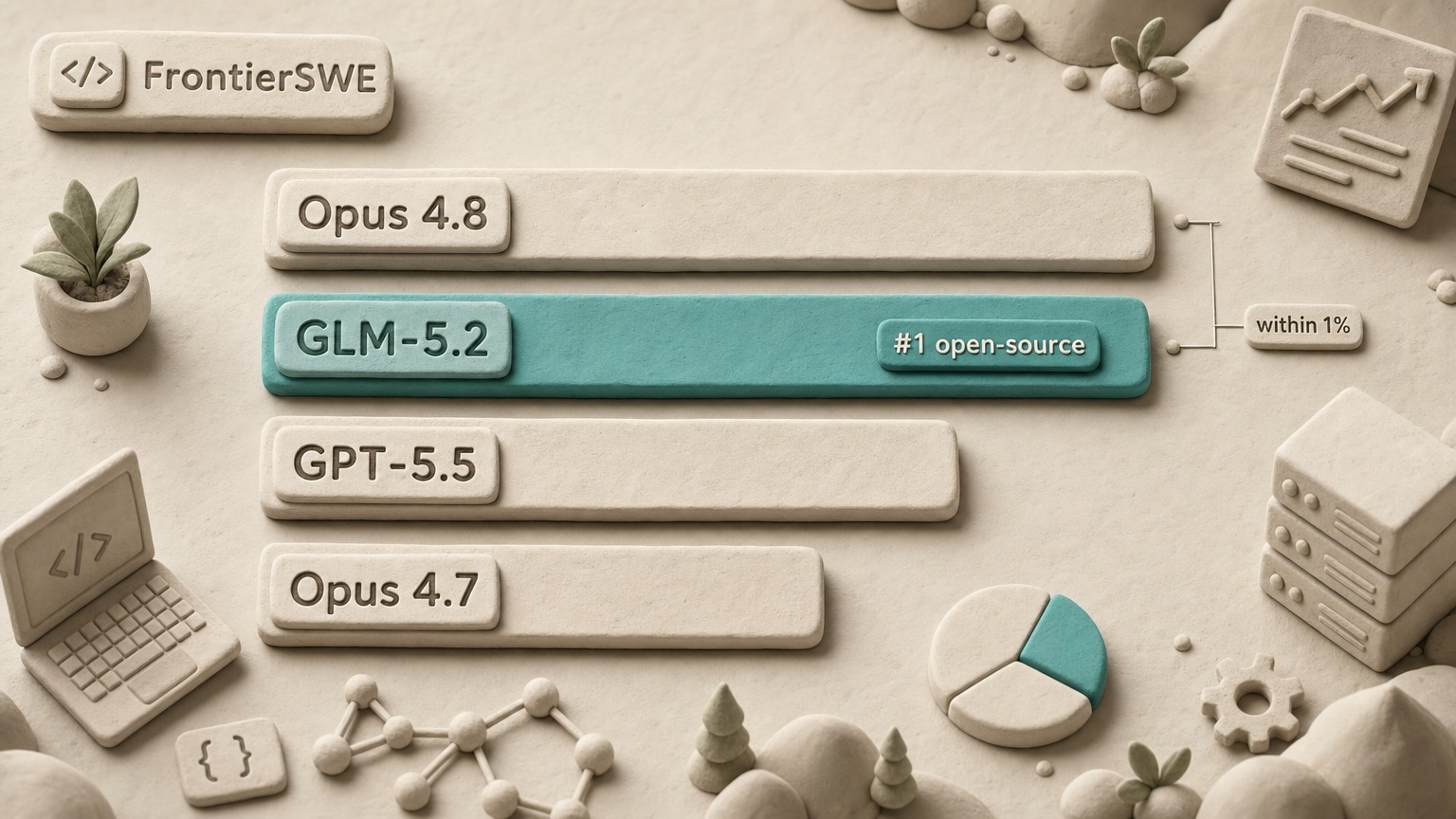
The newer comparison moves the recommendation. In Z.ai's published GLM-5.3 Flash evaluation, Flash scores 84.3 versus GLM-5.2's 81.0 on Terminal Bench 2.1, 63.4 versus 46.2 on DeepSWE v1.1, and 48.8 versus 26.2 on AutomationBench v1.0.6. On Z.ai Code Bench v1.0 at maximum effort, run with Claude Code 2.1.207, Flash scores 29.0 against Opus 4.8's 29.5.
Those figures are useful and still vendor-published. The public benchmarks point in the same direction across coding and agent work, while the private Code Bench is controlled by Z.ai. The defensible conclusion is that Flash beats GLM-5.2 on the workloads Z.ai reports and gets close to Opus 4.8 on Z.ai's own coding evaluation. It does not prove that Flash matches Opus across writing, analysis, instruction following, or every production repository.
What it really costs
The live price pages make GLM-5.2 hard to justify for a new hosted workload. These rates were verified against Z.ai's current pricing page and Cloudflare's current Workers AI pricing on August 30, 2026.
The Flash promotion is specific to Z.ai's API and ends at 24:00 on September 9, 2026 in UTC+8 Singapore time. Cloudflare lists the standard $0.15 input, $0.03 cached input, and $0.50 output rates. Do not budget a Cloudflare deployment around Z.ai's temporary discount.
For a simple workload using 1 million input tokens and 1 million output tokens, GLM-5.2 or full GLM-5.3 costs $5.80. Flash costs $0.65 at list price, 88.8% less. During Z.ai's promotion it costs $0.325, 94.4% less. The input-output split will vary in real work, but the decision does not: GLM-5.2 and GLM-5.3 share one price tier, while Flash sits far below it.
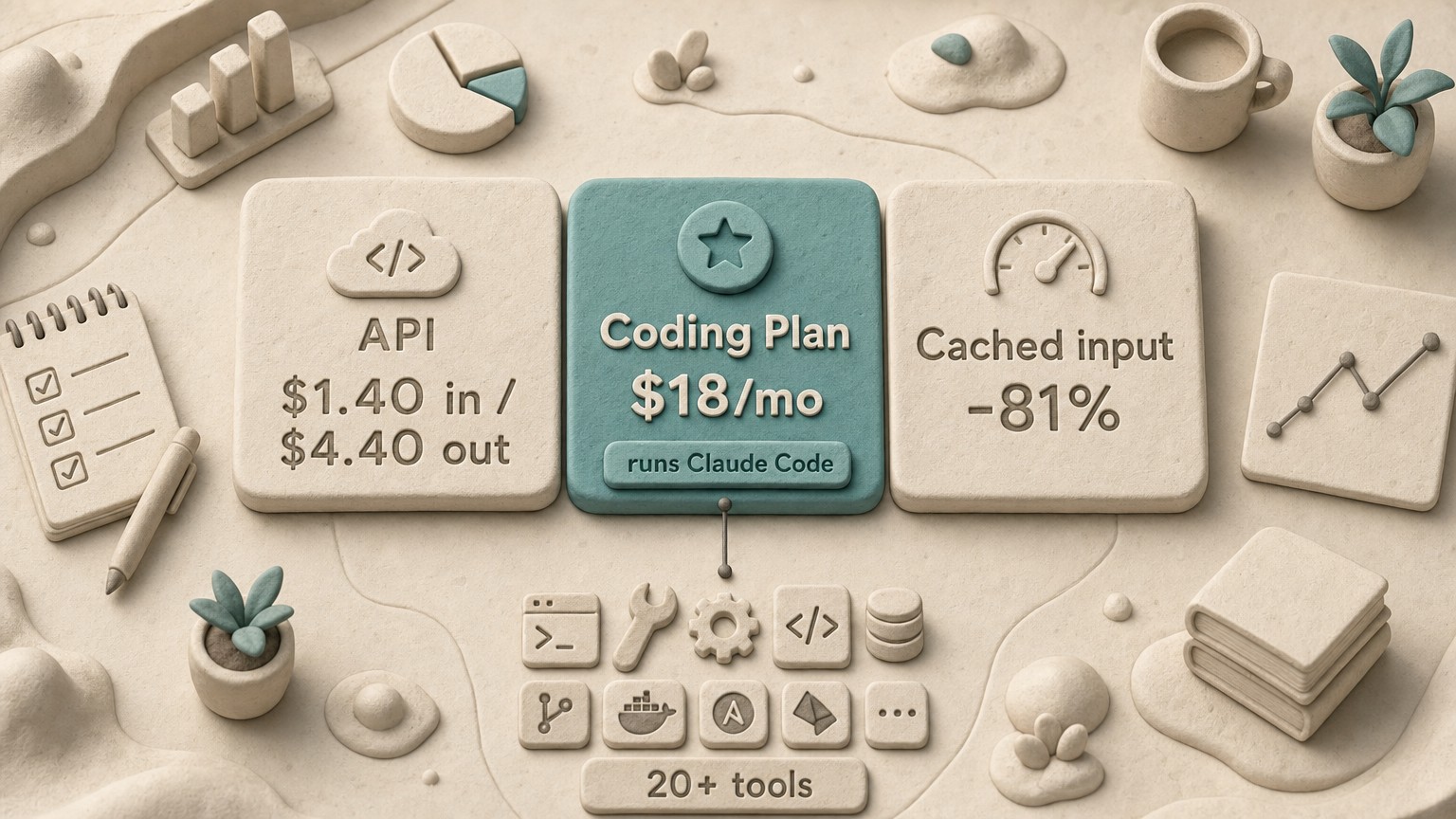
The GLM Coding Plan has also changed. Lite remains $18 monthly or $12.60 per month billed yearly and now publishes 10,000 credits per week. Pro is $80 monthly or $56 per month billed yearly with 6 times Lite usage. Max is $168 monthly or $117.60 per month billed yearly with 14 times Lite usage. The page lists more than 20 agent tools, including Claude Code and ZCode, and still provides the npx @z_ai/coding-helper setup command.
GLM-5.3 Flash is available to all Coding Plan users and gets 3 times the usable quota of full GLM-5.3. That makes the plan decision clearer: start on Lite if your weekly work fits 10,000 credits, then move up for capacity. The Claude Code pricing guide is the useful comparison if you are weighing this plan against a frontier subscription. Pick full GLM-5.3 inside the plan only when its stronger coding profile earns the higher quota burn.
Is GLM-5.2 free?
The weights are free to download and use under MIT. Hugging Face hosts the GLM-5.2 weights, and Z.ai lists supported local inference frameworks. The same is true for GLM-5.3 Flash.
Compute is not free. GLM-5.2 contains 753 billion parameters and Flash contains 320 billion total parameters, so self-hosting either model is infrastructure work, not a laptop shortcut. Hosted GLM-5.2 costs $1.40 per million input tokens and $4.40 per million output tokens. Flash costs $0.15 and $0.50 at list price, with the temporary Z.ai discount described above.
Cloudflare AI Search adds another distinction. AI Search is free during its open beta within published limits, including 20,000 queries per month and 500 crawled pages per day on Workers Free, but Workers AI generation and AI Gateway usage are billed separately. A free search layer does not make the generation tokens free.
GLM-5.2 vs GPT and Claude for coding
The useful comparison is no longer whether GLM-5.2 can occasionally approach GPT or Claude. It is whether you value an open model, predictable token economics, and native multimodal inputs enough to accept a younger ecosystem. GLM-5.3 Flash strengthens all three parts of that case.
Against GPT and Claude, the GLM family's clearest wins are control and cost. You can self-host the weights, and Flash makes sustained output much cheaper. The closed frontier still has the simpler case for someone who wants one polished assistant for mixed writing, analysis, and coding rather than a model selected for a particular workload.
For pure coding, do not turn the June FrontierSWE result into a universal claim. GLM-5.2 being about one point behind Opus 4.8 on one historical benchmark never meant it was equally capable everywhere. Flash improves the cost and capability case, while full GLM-5.3 targets the hardest coding work at the same API price as GLM-5.2. If you want a broader comparison before changing a production workflow, the frontier coding model guide remains the better starting point. The Kimi K3 review covers another open-weight alternative built around a different cost-performance tradeoff.
Who should run it, who should skip it
Keep GLM-5.2 if an existing self-hosted stack is stable, an evaluation must remain reproducible, or a dependency is pinned to its behavior. A working deployment does not become wrong on release day.
Choose GLM-5.3 Flash for new high-volume agents, visual coding, document work, or Cloudflare AI Search generation. Its list token rates are nearly one ninth of GLM-5.2's, it accepts visual and file inputs, and it has the larger Cloudflare context window. Choose full GLM-5.3 when complex coding performance matters more than throughput; its API price is unchanged from GLM-5.2, so there is little reason to start a new paid GLM-5.2 coding workload at the same rate.
Skip a migration if your workload is light enough that model cost is negligible, or if changing the model creates more validation work than the monthly saving. Vendor benchmarks do not replace a representative task from your own repository.
The Monday move is concrete: run one real repository task through GLM-5.3 Flash, track output tokens, elapsed time, and the edits you must correct, then repeat it with full GLM-5.3. If Flash clears your quality bar, make it the routine default and reserve the full model for escalations. If you use Cloudflare AI Search, select @cf/zai-org/glm-5.3-flash as the generation model and leave retrieval unchanged for the first comparison.
Is GLM-5.2 Chinese?
Yes. Z.ai's company history says ZhipuAI was founded in 2019 from Tsinghua University technology. Both GLM-5.2 and GLM-5.3 Flash have MIT-licensed weights, so teams with strict data-location requirements can evaluate self-hosting instead of sending prompts to a hosted endpoint.
Is GLM-5.2 free?
The MIT-licensed weights are free to download and use. Hosted inference is paid: current pricing lists GLM-5.2 at $1.40 input and $4.40 output per million tokens. Hardware and operations still make self-hosting a real cost.
Is GLM-5.2 better than GPT for coding?
Not as a general claim. Z.ai's June launch data put GLM-5.2 close to top closed models on selected long-horizon coding benchmarks, but GLM-5.3 and GLM-5.3 Flash have since surpassed it in Z.ai's published coding evaluations. GLM-5.2's strongest current reasons are open weights and compatibility, not being the newest performance leader.
Can I use GLM-5.2 with Claude Code?
Yes. The GLM Coding Plan supports Claude Code and more than 20 agent tools. GLM-5.3 Flash is now available to all plan users with 3 times the usable quota of full GLM-5.3, so it is the better first model to try for routine work.
Deciding whether GLM-5.2 belongs in your setup usually comes down to how your coding agent is wired. I put the steps for pointing an agent at a cheaper model without breaking your workflow into a free Claude Code and Codex setup checklist. Subscribe to the newsletter to get it, plus the weekly read on which models are worth switching to.
- Last Updated
- Category
- AI
- Language

Otter AI Alternatives: Granola, Krisp, MeetGeek, Circleback and Claap
Choose Granola, Krisp, MeetGeek, Circleback or Claap by the job. Compare live prices, free limits, bot-free capture and CRM handoffs.Oct 8, 2026AI
Mistral Large 4: Pricing, Open Weights, and When to Use It
Mistral Large 4: verified API prices, the launch offer, claimed benchmarks, and when to test the preview or wait for self-hosting.Oct 7, 2026AI
Lindy AI Review (Verified October 2026)
Lindy AI review: current plans, credit costs, email and meeting setup, integration limits, and when Gumloop, n8n or Marblism fits better.Oct 7, 2026AI
Mistral Pricing (2026): API Costs and Vibe Seats
Mistral API rates, Le Chat and Vibe plans, free limits, EU hosting costs and a worked monthly bill. Verified October 2026.Oct 6, 2026AI
Claude Skills
Use Claude Skills across the apps, Claude Code and API. Build a weekly client-report skill file by file, then install and share it.Oct 6, 2026AI
AI Employee: What It Does, Costs, and How to Start
What AI employees can do, current prices for six tools, and how to pick one role, keep human review and measure a 30-day pilot.Oct 6, 2026AI
Wispr Flow Alternatives (2026): VoiceOS, Superwhisper, Aqua Voice, Willow and Monologue
Compare VoiceOS, Superwhisper, Aqua Voice, Willow and Monologue by work task, current price, offline privacy, team controls and coding-agent input.Oct 5, 2026AI