OpenClaw Review (Verified August 2026)
OpenClaw is free, flexible, and risky by default. See current costs, workflows, security limits, alternatives, and who should skip it.
Published Updated
 By Omid Saffari




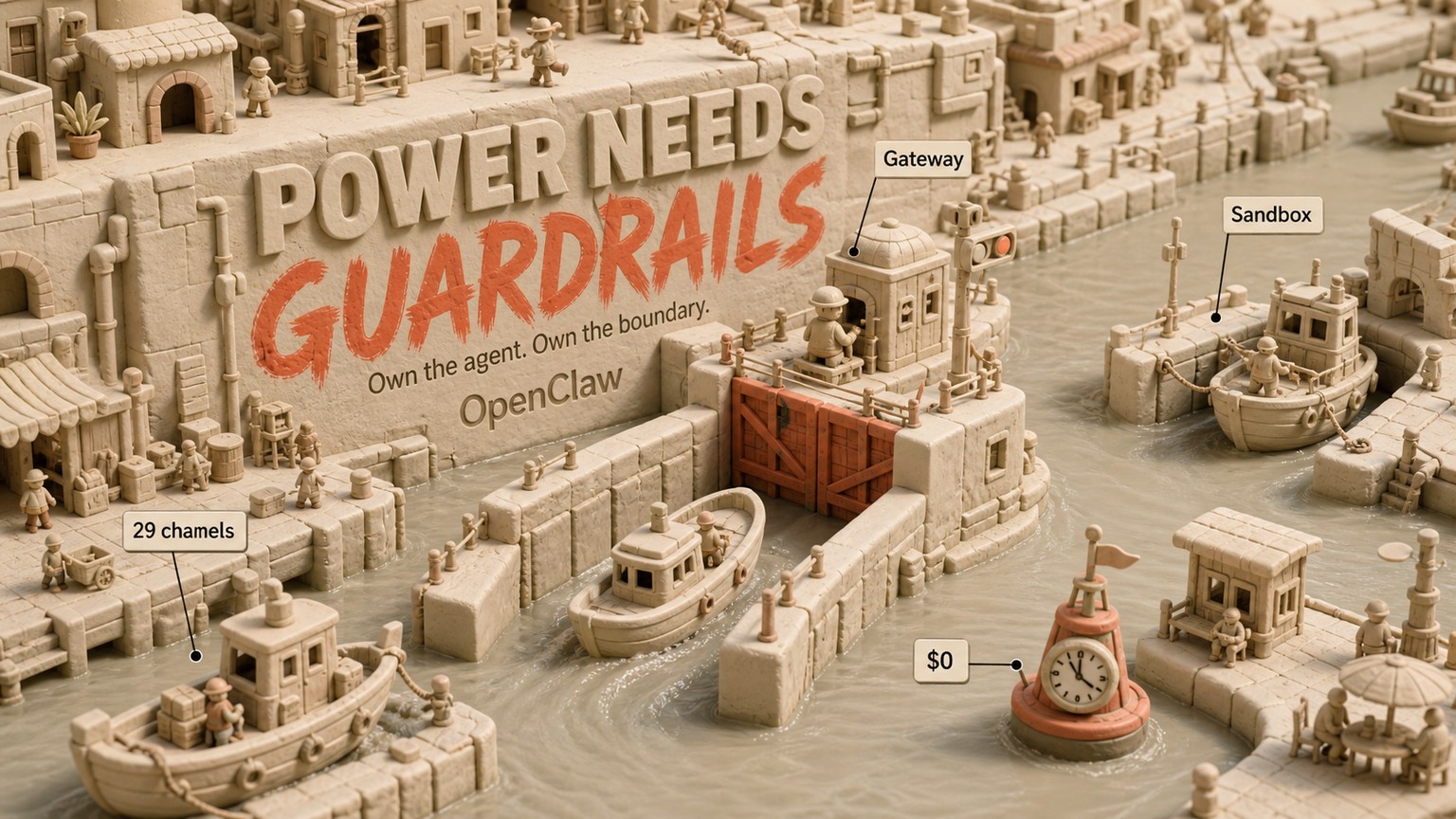
OpenClaw is worth using only if you want an always-on agent badly enough to operate its security boundary. The software costs $0, but sandboxing is off by default, the Gateway stays outside the sandbox, and the latest stable release changed on August 4, 2026.
What OpenClaw actually is
OpenClaw is an MIT-licensed agent runtime you install on a computer or server. Its Gateway joins an AI model to local state, tools, chat channels, browser control, and scheduled work, so the agent can keep context and take actions after a conversation ends. It is not an AI model and it is not a managed assistant subscription. It is the control layer that lets a model act through infrastructure you own, with permissions you must design and maintain. The current stable release is v2026.7.1-2, published August 4, 2026.
OpenClaw puts that control layer on macOS, Linux, or Windows and keeps its state on the machine running it. The product specifications, release state, and security defaults in this review were checked against OpenClaw's live pages on August 8, 2026.
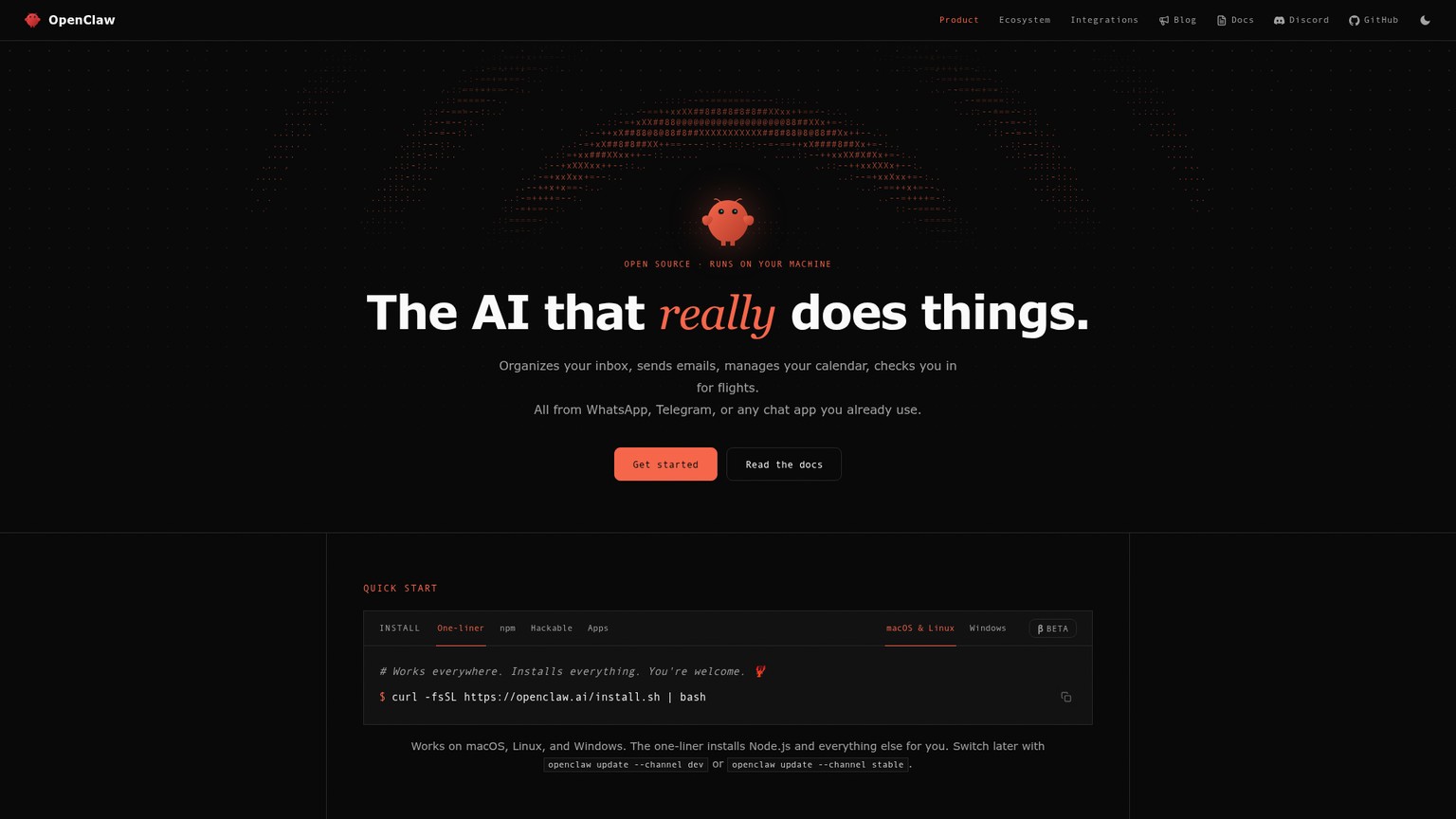
That ownership is the point and the liability. A managed assistant hides the gateway, model connection, storage, permissions, and updates behind one account. OpenClaw exposes those pieces so you can shape them. You gain reach and portability. You also become the product's administrator, security owner, and incident responder.
OpenClaw vs the alternatives at a glance
The table is not a feature contest. It separates three different operating models. ChatGPT sells a managed assistant. n8n sells workflow execution. OpenClaw gives an agent broad connective tissue and asks you to own the runtime around it.
That distinction prevents the most expensive buying mistake: choosing an agent because it can perform a demo, then discovering that the organization needed a governed workflow or a managed assistant instead.
Who OpenClaw is for and who should skip it
OpenClaw is for a technical owner who wants one persistent agent to live across a machine, multiple chat surfaces, and recurring work. It fits a solo technical builder especially well because one person can define the trust boundary, inspect the configuration, constrain permissions, and decide when an action needs approval. It can also fit a funded founder or senior operator when a technical owner remains accountable for the runtime.
The strongest fit has four traits:
- You want the agent available outside a single browser tab.
- You need it to remember durable context and act through tools you select.
- You can isolate it from sensitive systems and grant permissions gradually.
- You will maintain releases, credentials, logs, and provider costs as operational work.
The product becomes harder to justify as any of those traits disappear. If the work is mostly asking questions, drafting, analyzing files, or doing bounded research, a managed assistant removes a large amount of administration. If the work is a fixed sequence such as moving a qualified lead from a form into a CRM and notifying sales, a deterministic automation platform makes the path easier to inspect and reproduce.
The dashboard is an admin surface, not just a chat window
OpenClaw exposes its local Control UI on port 18789 by default, and that interface carries administrative authority for chat, configuration, and execution approvals.
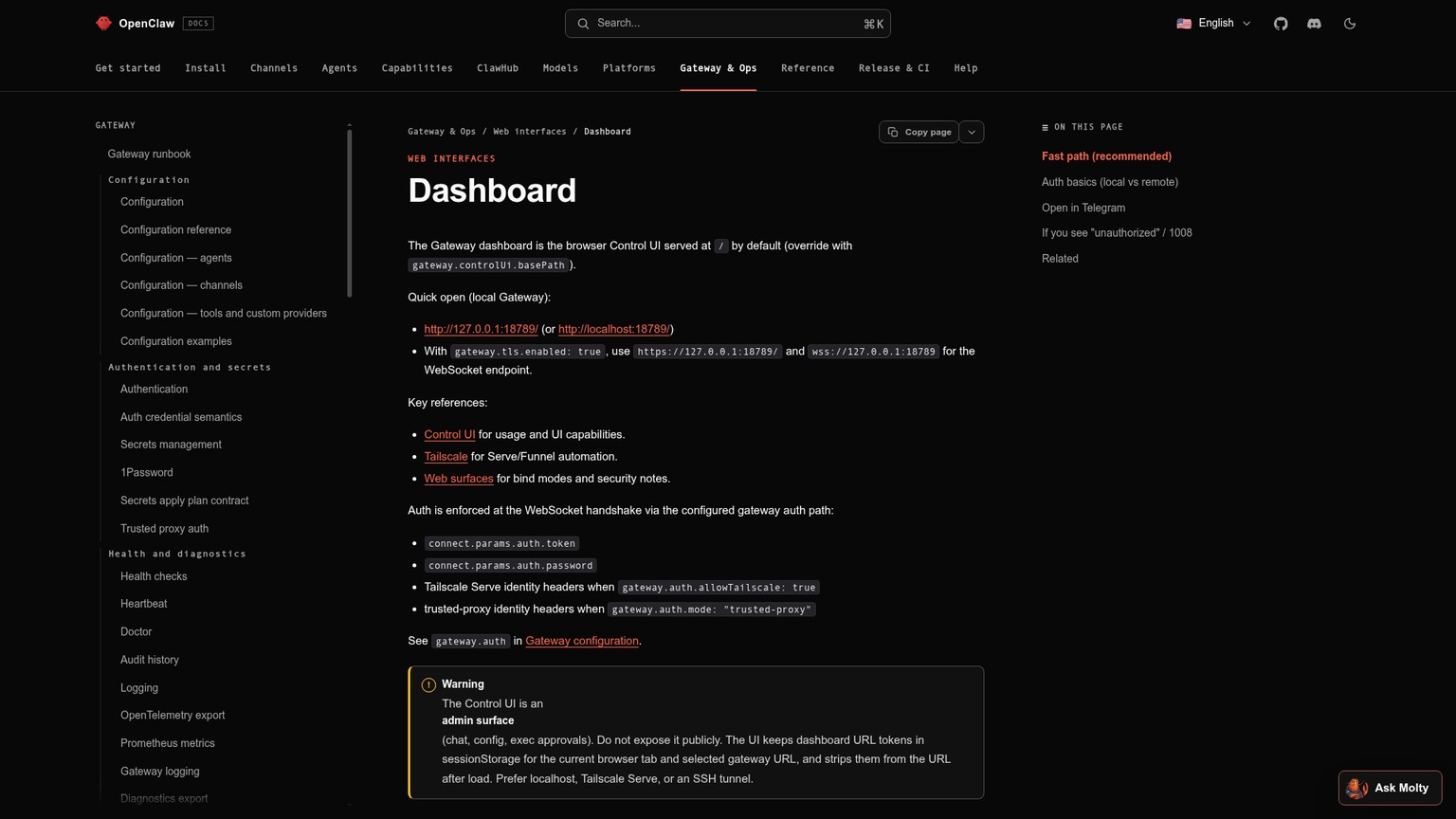
That changes who can responsibly run it. A technical solo operator can treat the dashboard like an admin console: keep it on loopback, use the supported authentication path, and open remote access only through a deliberate boundary such as a private tunnel or trusted identity layer. A casual user may see a friendly chat surface and miss the fact that access to the Control UI can become access to configuration and action.
For a mid-market CTO, OpenClaw is a pilot candidate rather than a drop-in enterprise assistant. The pilot should have one named owner, one isolated Gateway, one narrow workflow, one dedicated identity, and one rollback path. A broad launch to several departments through one shared Gateway conflicts with the project's own trust model. OpenClaw treats authenticated operator access inside a Gateway as trusted control-plane access, not as independent tenant access.
For a funded founder, the business case is strongest when the agent removes a recurring coordination loop. Examples include collecting a daily source brief, preparing a project status summary, or watching a known set of pages and returning changes to a private channel. The value is not that the agent can talk. The value is that it can stay present, retain the agreed context, and continue a bounded job without rebuilding the setup each time.
For a senior operator, the product makes sense when the operator can name both the action path and the review path. "Monitor these five vendors, capture their pricing pages, and draft a change report for approval" is a viable agent job. "Run growth" is not. A narrow outcome gives you an audit target, a cost denominator, and a place to require approval.
Skip OpenClaw for ChatGPT when management is the feature
ChatGPT is the better choice for someone who wants a broad managed assistant without operating a Gateway, browser service, skill supply chain, or sandbox.
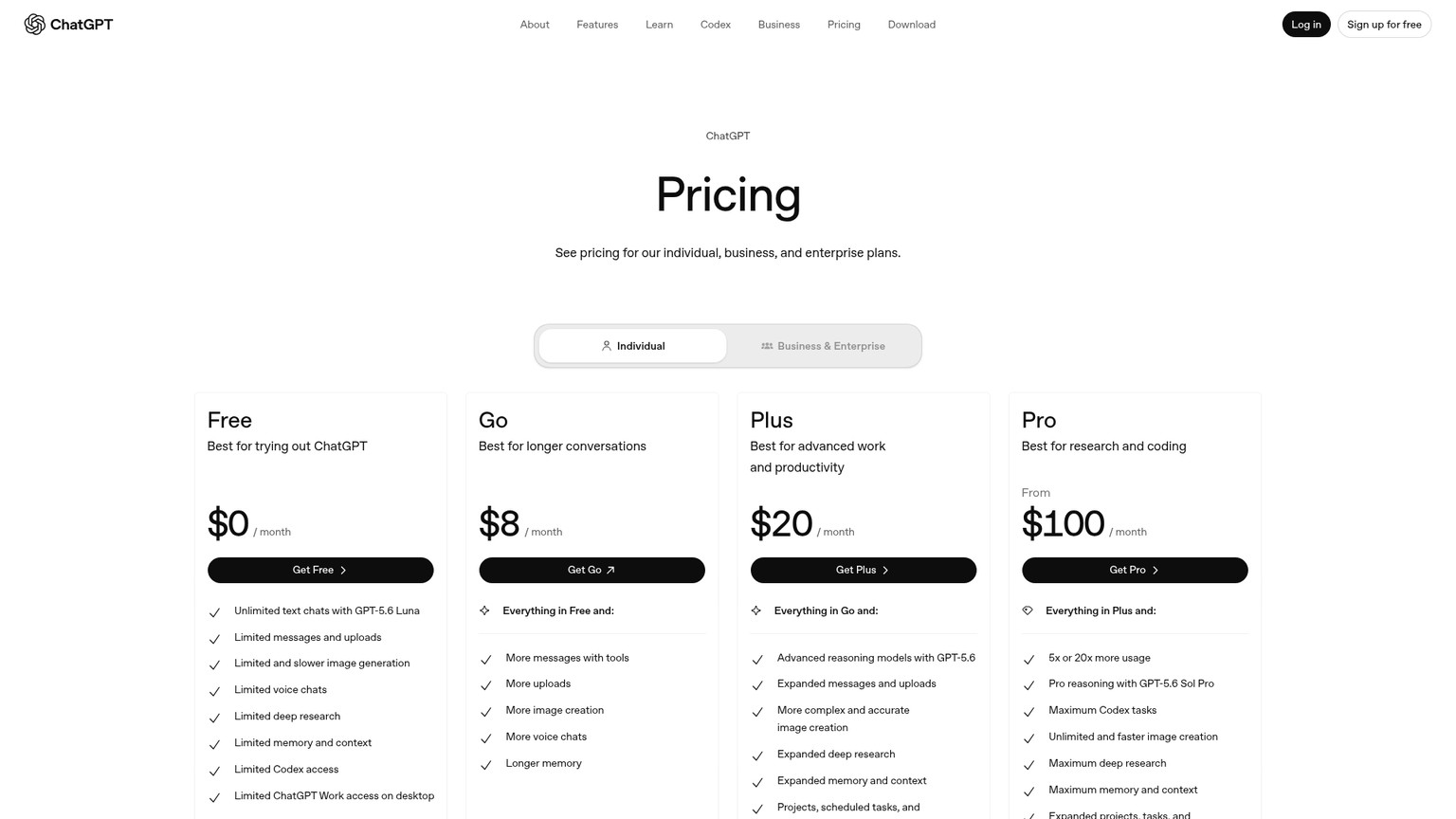
ChatGPT Free costs $0 and Plus costs $20 per month as of August 8, 2026. That price buys a managed environment rather than host ownership. The detailed ChatGPT review explains when its paid tiers earn their cost, but the OpenClaw decision is simpler: choose ChatGPT when you need reasoning, writing, research, files, and supported managed tools more than you need an agent living on your machine.
This is the correct skip for a nontechnical founder, an executive assistant use case with no infrastructure owner, or a professional who cannot safely separate work credentials from the agent runtime. A managed product can still make mistakes and still needs data controls. It removes a different category of failure: you are not maintaining the host process, network exposure, browser control service, plugin code, or release channel.
Skip OpenClaw for n8n when the path should be deterministic
n8n is the better choice when a workflow can be drawn as triggers, conditions, transforms, approvals, and destinations.
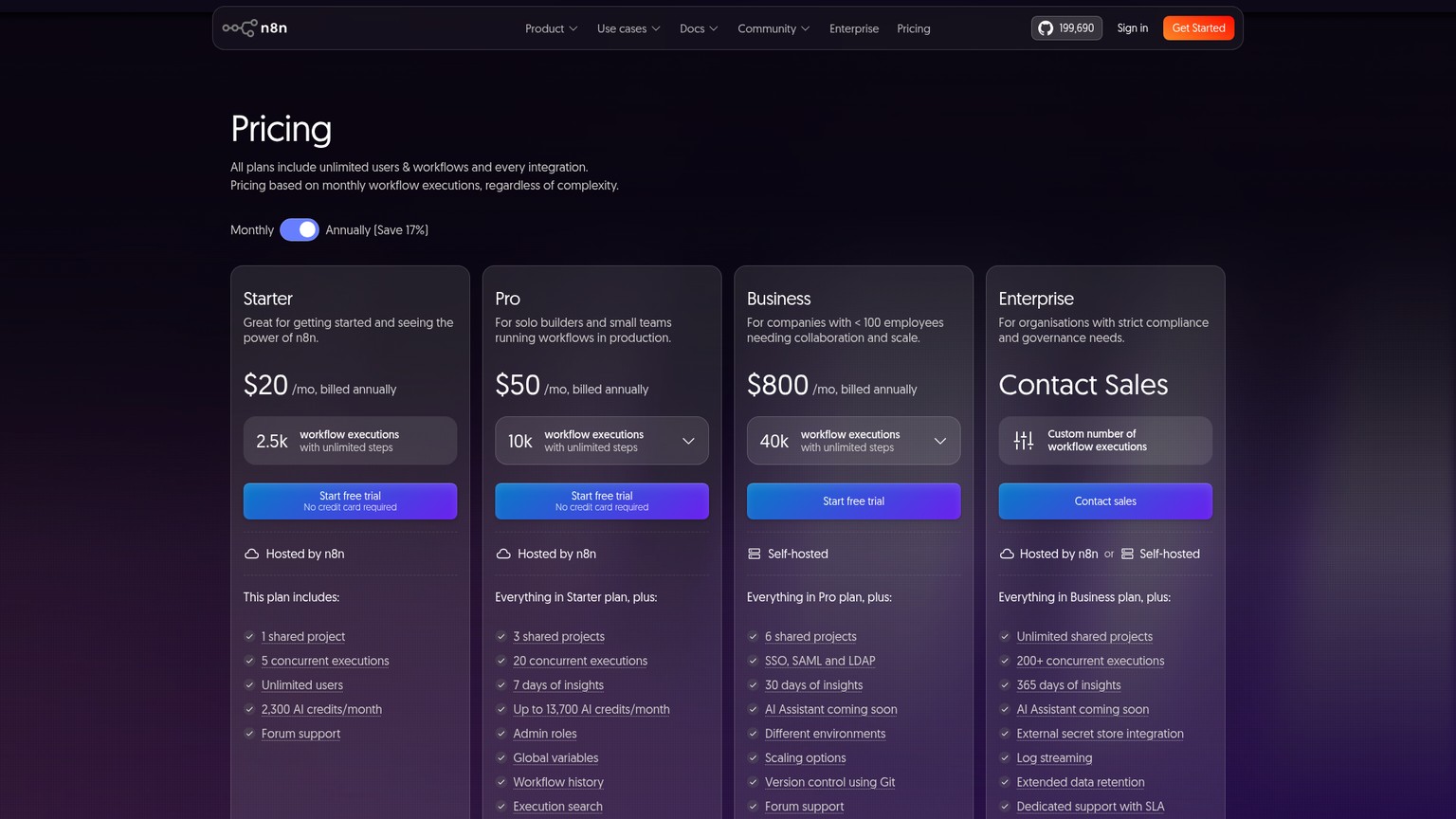
n8n offers a self-hosted Community Edition, while its cloud Starter plan costs $20 per month billed annually for 2,500 workflow executions. Pro costs $50 for 10,000 executions, Business costs $800 for 40,000, and Enterprise is custom. Those prices buy a workflow model where the path is visible before a run starts.
Choose n8n for lead routing, scheduled data sync, invoice handoff, webhook processing, or a compliance-sensitive process whose steps should not change because a model interpreted the context differently. You can still put a model inside one node. The model then performs a bounded part of the workflow instead of deciding the entire control flow.
The distinction is especially important for teams. An OpenClaw agent can choose tools dynamically and respond to new context, which is useful for ambiguous knowledge work. The same flexibility is a problem when finance, security, or operations needs every run to follow the same approved route.
The decision rule
Pick OpenClaw when all three answers are yes: Is a technical owner accountable for the runtime? Does the job need persistent agency across tools or channels? Can the first deployment stay inside one operator's trust boundary?
Pick ChatGPT if the first answer is no. Pick n8n if the second answer is no because the path can be defined in advance. Do not deploy one shared OpenClaw Gateway to unrelated or mutually untrusted users just because session names look separate. A session key routes context; it is not a tenant authorization boundary.
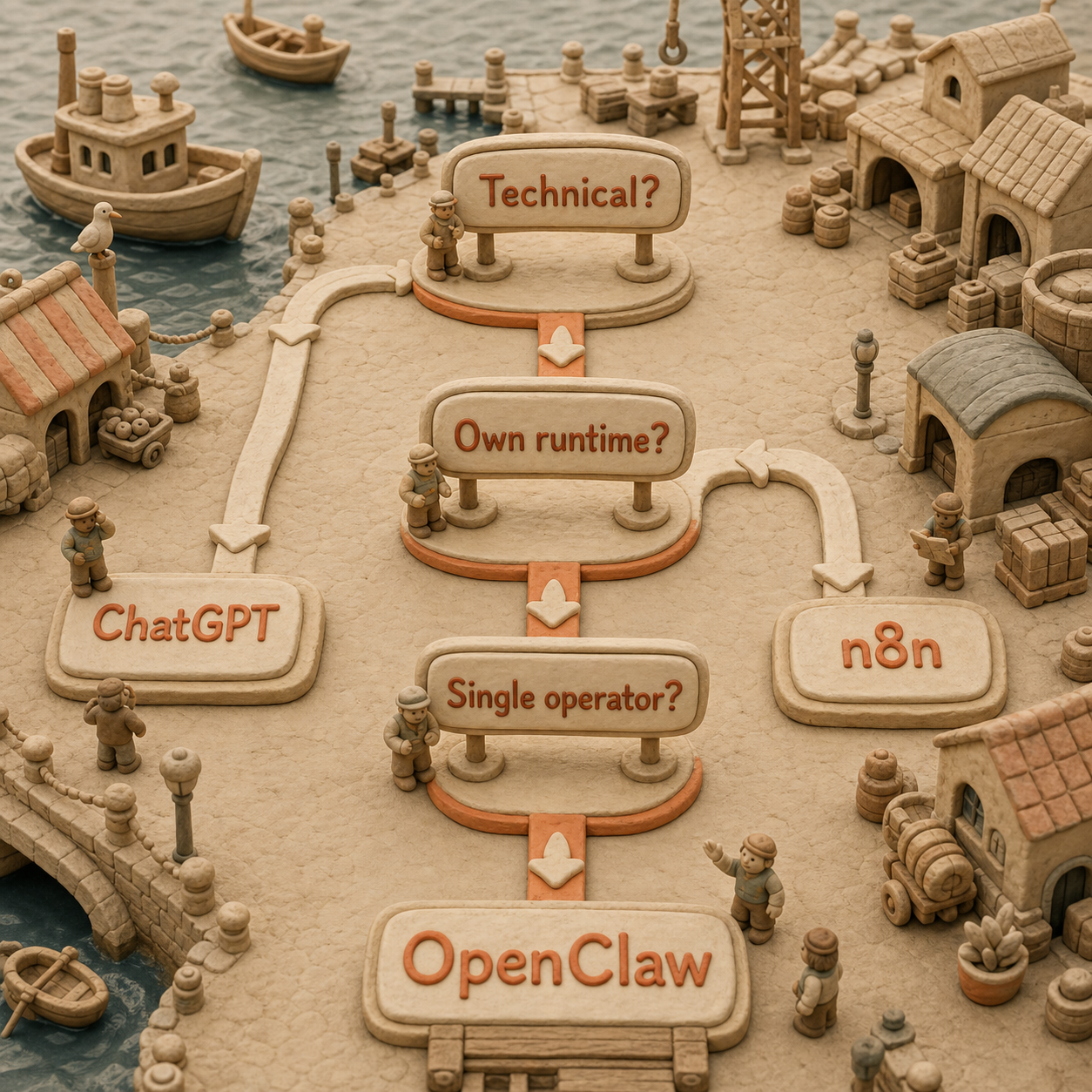
That rule is deliberately strict. OpenClaw can be enjoyable for experimentation with fewer controls, but a review should judge the product by the system it creates after the novelty passes. The ongoing system includes the agent, host, model provider, messages, browser state, credentials, installed skills, schedules, and every external service it can reach.
Capability 1: one persistent assistant across 29 channels
OpenClaw's most useful capability is not any single integration. It is the combination of one Gateway, persistent state, and 29 supported chat channels, which lets an agent remain reachable from the surfaces where work already arrives.
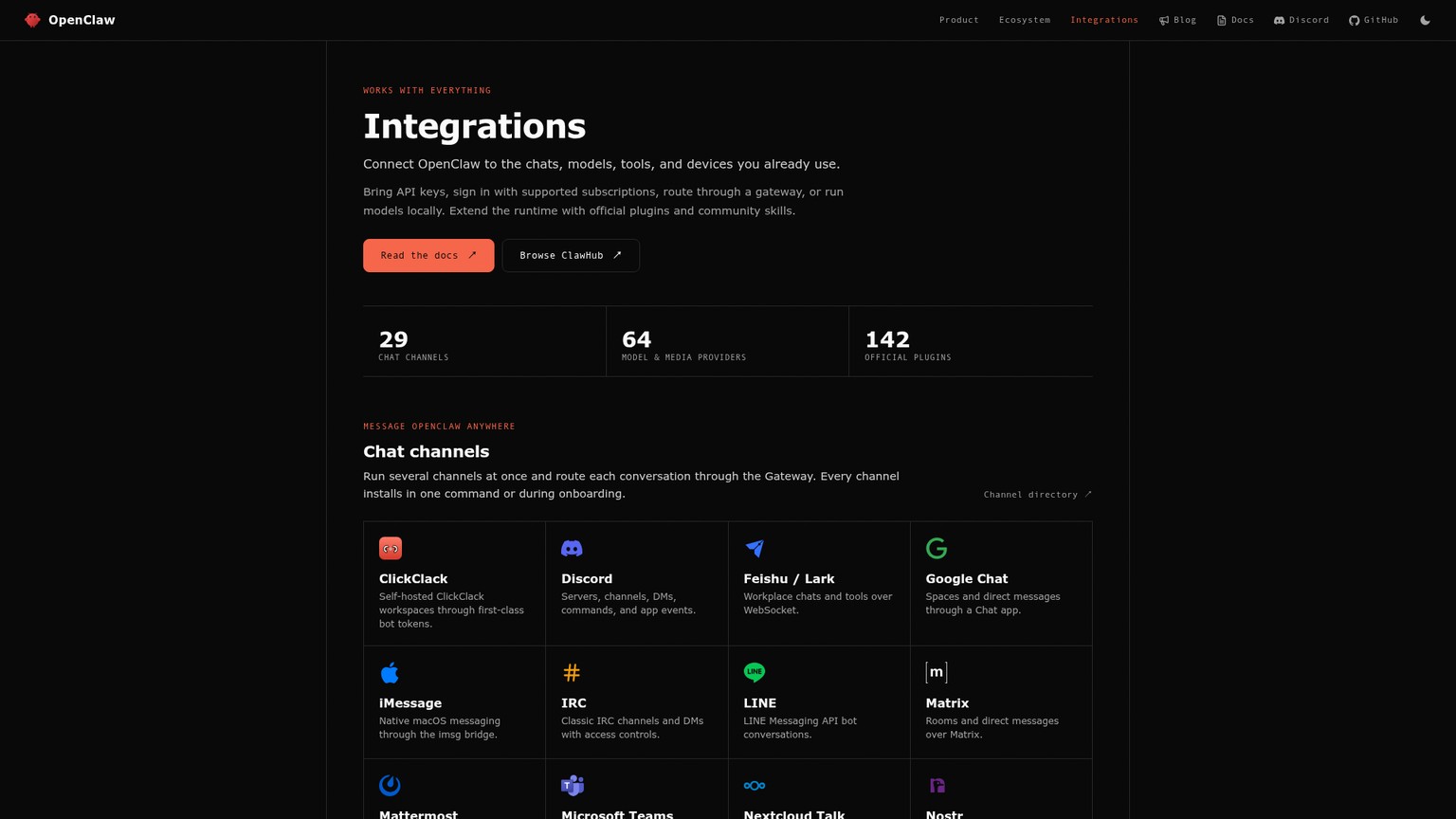
The official channel directory includes Slack, Telegram, Discord, Signal, WhatsApp, Microsoft Teams, iMessage, WebChat, and many others. Several channels can run at once and route conversations through the Gateway. That makes a useful pattern possible: start a request from a work channel, continue it from a phone, and let the agent use the same durable operating context instead of treating each surface as an unrelated chatbot.
The plain-language advantage is continuity. A normal chatbot session starts when you open it and stops when you leave. A persistent agent can keep an agreed identity, workspace, procedures, and schedule available between messages. The model still reasons one turn at a time, but the runtime supplies the state and tools that make the service feel continuous.
A founder workflow: one morning brief, two channels, one context
A funded founder could use the channel layer for a daily operating brief without giving the agent authority to send mail, spend money, or change production systems.
Define the source boundary
Give the agent a dedicated workspace containing the project notes it may read and a short list of public pages it may inspect. Keep payroll, customer exports, credentials, and personal files outside that workspace. The first useful boundary is what the agent cannot see.
Choose one command channel and one delivery channel
Use a private Slack channel for work requests and Telegram for the finished brief. Pair both identities and keep public or open messaging policies disabled. Cross-channel convenience should not become an invitation for unknown senders to trigger tools.
Make the output reversible
Ask for a morning summary with source links and a list of proposed follow-ups. Do not let the first version send external messages or edit a system of record. The founder approves the next action after reading the evidence.
Measure the recurring outcome
Track whether the brief arrives, whether each source was read, whether changes are cited correctly, and how much model usage the run consumed. A brief that needs ten minutes of repair every morning is not autonomous value; it is another inbox.
This workflow uses OpenClaw's strength without pretending continuity is the same as correctness. Persistent memory can carry a stale preference as easily as a useful one. Cross-channel access can spread a mistaken action more widely. The safe design makes the agent persistent while keeping its authority narrow.
Session continuity needs an identity policy
OpenClaw routes direct messages into the main session by default for personal cross-device continuity. That is sensible for one person using several channels. It is unsafe as an unexamined default when several people can reach the same bot because their context can land in the same rolling session.
The fix depends on the use case. Keep one owner if the agent is personal. If a shared inbox is intentional, isolate direct-message sessions per channel and sender. If users are mutually untrusted, split the host-level trust boundary with separate Gateways and ideally separate OS users or hosts. Context isolation reduces accidental mixing. It does not turn one Gateway into a hostile multi-tenant platform.
The payoff is significant for the right operator. One agent can accept a thought from Telegram, use a procedure stored in its workspace, and return a structured result to Slack without rebuilding context. The price is that identity, context, and tool permission become architecture rather than settings to click through once.
Capability 2: browser work with a separate agent profile
OpenClaw makes browser automation practical by giving the agent a dedicated Chromium-family profile that is separate from a person's daily browser by default.
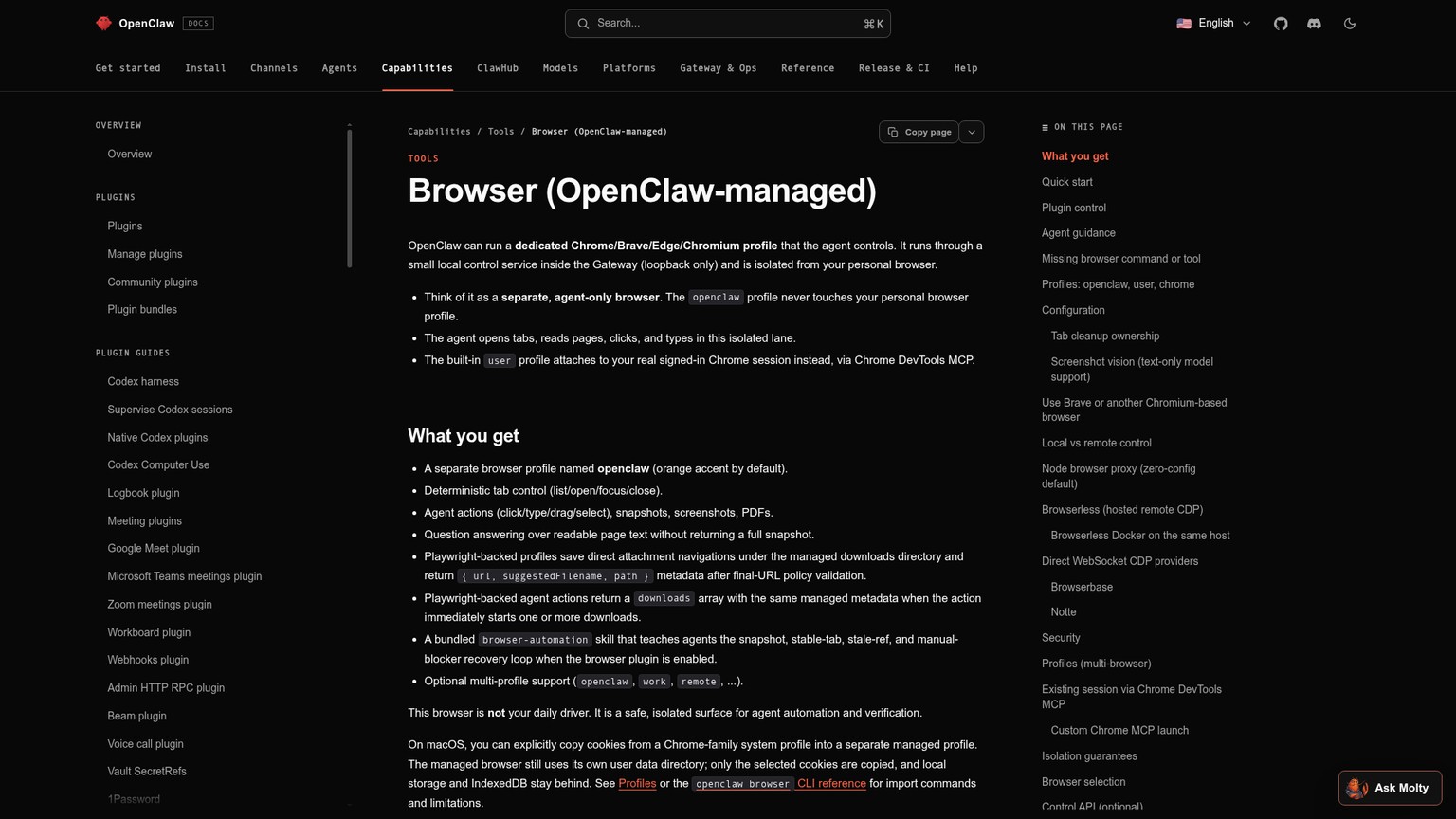
The managed profile can open and focus tabs, read pages, click, type, drag, select, capture snapshots, take screenshots, create PDFs, and handle downloads. That is enough for useful work such as checking vendor pages, collecting evidence, filling a bounded form, or verifying a deployment screen. It is also enough to make a costly mistake if the profile is logged into sensitive systems and the agent follows hostile instructions from a page.
The separate profile is therefore more than a convenience. It is a permission container. The agent should receive only the cookies, accounts, downloads, and browser history needed for its job. The personal browser remains outside the lane.
A senior-operator workflow: verify a vendor price change
Consider a senior operator who needs a weekly report on three vendors. The outcome is not "browse the web." The outcome is a dated, source-linked change report with screenshots and no external action.
Create a clean browser identity
Use the managed OpenClaw profile, not an attached personal Chrome session. Sign in only where the job requires it. Disable password sync and avoid loading personal accounts into the profile.
Constrain the destination set
Give the agent the exact official pricing and release URLs. Require it to stop when a login, CAPTCHA, purchase, download, or unknown domain appears. A source allowlist turns an open browsing job into a reviewable route.
Capture evidence before interpretation
Have the agent record the visible plan name, price, billing period, timestamp, source URL, and screenshot before it summarizes the change. Evidence first makes a later review possible when a page changes again.
Return a proposal, not an action
Deliver the report to a private channel and ask the operator to approve any downstream update. The browser may observe the pricing page; it should not edit public copy, notify customers, or change a purchase without a second boundary.
The workflow demonstrates where OpenClaw beats a chat-only assistant. The browser profile, scheduled runtime, local evidence, and channel delivery form one system. A managed assistant may offer browser-like tools, but OpenClaw lets the operator shape the profile and host boundary directly.
The attached-browser shortcut changes the risk
OpenClaw can attach to a real signed-in Chrome session through its user or chrome profiles. That can remove login friction, especially when a person is away from the computer. It also gives the agent the authority of that signed-in profile. If the browser can open payroll, customer records, cloud consoles, or personal mail, so can an agent action operating through it.
Use the managed profile as the default. Treat an attached profile as temporary elevated access with a named reason, a person present when possible, and a short task. The product documentation describes browser control over a remote logged-in profile as equivalent to operator access for whatever that profile can reach.
There is another underappreciated limit: OpenClaw's browser SSRF checks are defense in depth, not a network firewall. They do not intercept every redirect hop, popup first request, Service Worker path, or background request. A policy-enforcing proxy or network-isolated environment is still required when egress must be guaranteed.
Browser control is ship-ready for bounded, observable work. It is not a reason to grant the agent a person's entire signed-in digital life.
Capability 3: scheduled and background work
OpenClaw becomes more than a chat interface when Automations, Heartbeat, tasks, hooks, and standing orders keep work moving between conversations.
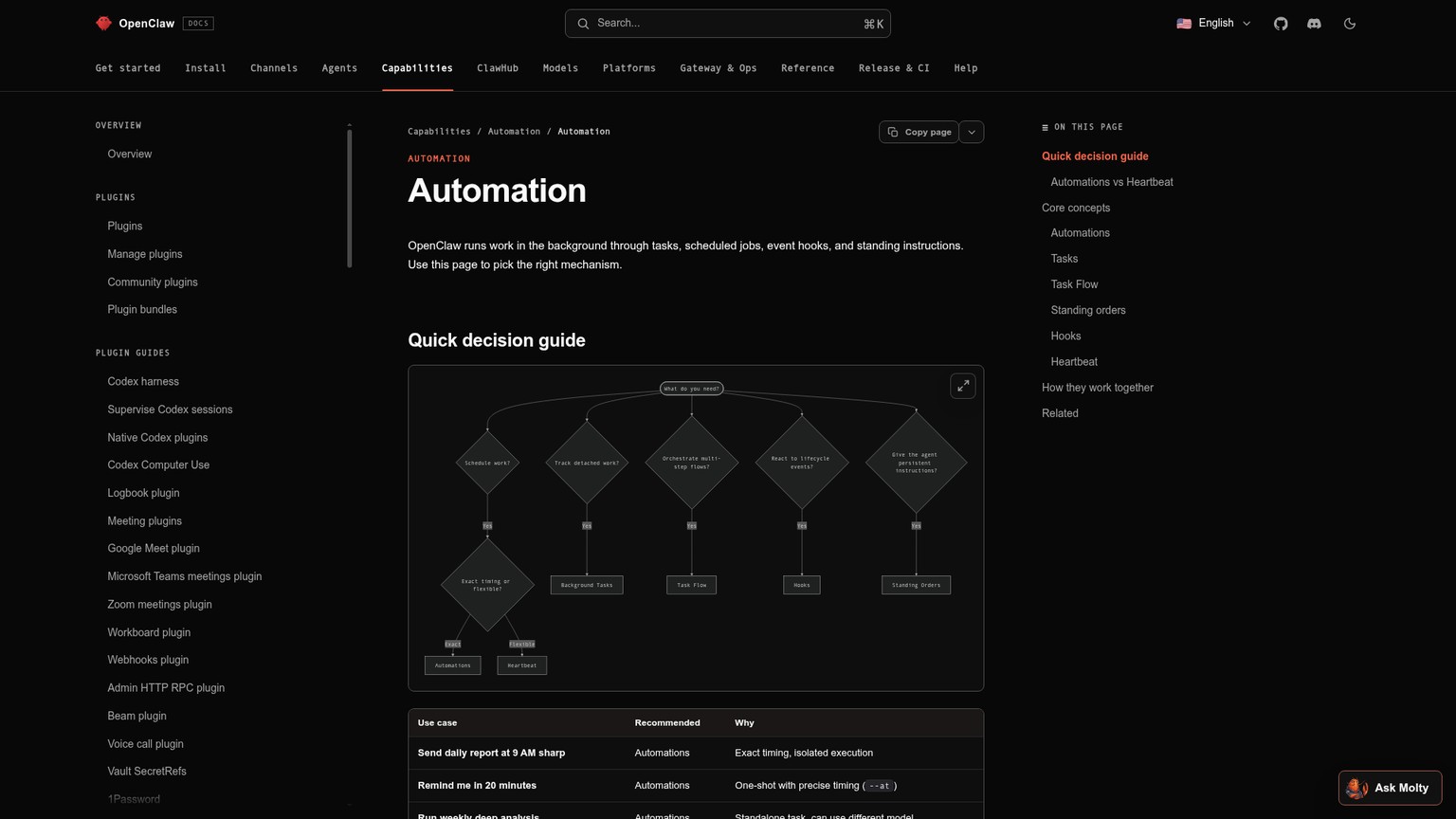
Automations handle exact schedules, one-time reminders, recurring expressions, and webhook-triggered jobs. They can run with isolated or shared context and can deliver results to a channel or webhook. Every Automation run creates a task record. Heartbeat is different: it is an approximate periodic turn, every 30 minutes by default, using the main-session context, and it does not create a task record.
That distinction matters because scheduling, context, and auditability are separate needs. A 9:00 AM executive brief needs an exact Automation. A periodic "anything important?" check can use Heartbeat. A detached research job needs a task record so the operator can inspect its state. A persistent policy such as "check compliance before replying" belongs in standing instructions rather than a schedule.
A daily monitoring workflow with an audit trail
A senior operator could configure a daily market monitor that reads a bounded source list, compares it with the previous record, and sends only meaningful changes.
Schedule an isolated run
Create one Automation for the required local time and run it in an isolated session. Give it a clear source list, output schema, time limit, and maximum number of browser actions.
Separate observation from judgment
First collect page title, changed text, URL, and capture time. Then ask the model to classify the change. This makes it possible to inspect whether the source changed even when the classification is wrong.
Record the task state
Use the task record to distinguish queued, running, succeeded, failed, timed out, cancelled, or lost work. A channel message alone is not an execution log.
Deliver only the reviewable result
Send the operator a concise change list with source links and a proposed response. Keep publishing, purchasing, deleting, or messaging third parties behind explicit approval.
This design gives each run a durable shape. A vague autonomous loop can burn tokens while making no progress. A bounded Automation has a schedule, inputs, allowed tools, time limit, output, and reviewer.
Heartbeat is awareness, not precision scheduling
Heartbeat is useful for context-aware checks that can be delayed. It can batch an inbox check, calendar awareness, and notification review into one main-session turn. It defers when the relevant session or execution lane is busy. That makes it a poor choice for a report that must arrive at an exact time and a good choice for "surface anything that now needs attention."
The default 30-minute cadence is not free. Every model-backed check can consume quota or tokens, even when little changed. Start with a longer interval or an event trigger, then shorten it only when the missed-information cost justifies more frequent runs.
A task record is not an outcome
OpenClaw's task ledger tells you that work ran and how it ended. It does not prove the result was correct, useful, or economically valuable. A successful task can still produce a wrong price, omit a source, or recommend an unsafe action. A failed task can still consume most of its budget before timing out.
The outcome metric must live one level above runtime status. For a market monitor, count correctly identified changes that a person accepts. For a daily brief, count briefs delivered on time with all required sources. For code work, count reviewed changes that pass the defined tests. That denominator is what turns token spend into cost per outcome later in this review.
This is one of OpenClaw's strongest areas because the primitives cover more than cron. It is also where careless autonomy becomes expensive. Background work needs tighter budgets and clearer stops than interactive chat because nobody is watching each intermediate decision.
Capability 4: skills and provider portability
OpenClaw turns repeatable procedures into skills, which are directories built around a SKILL.md instruction file and any resources the workflow needs.
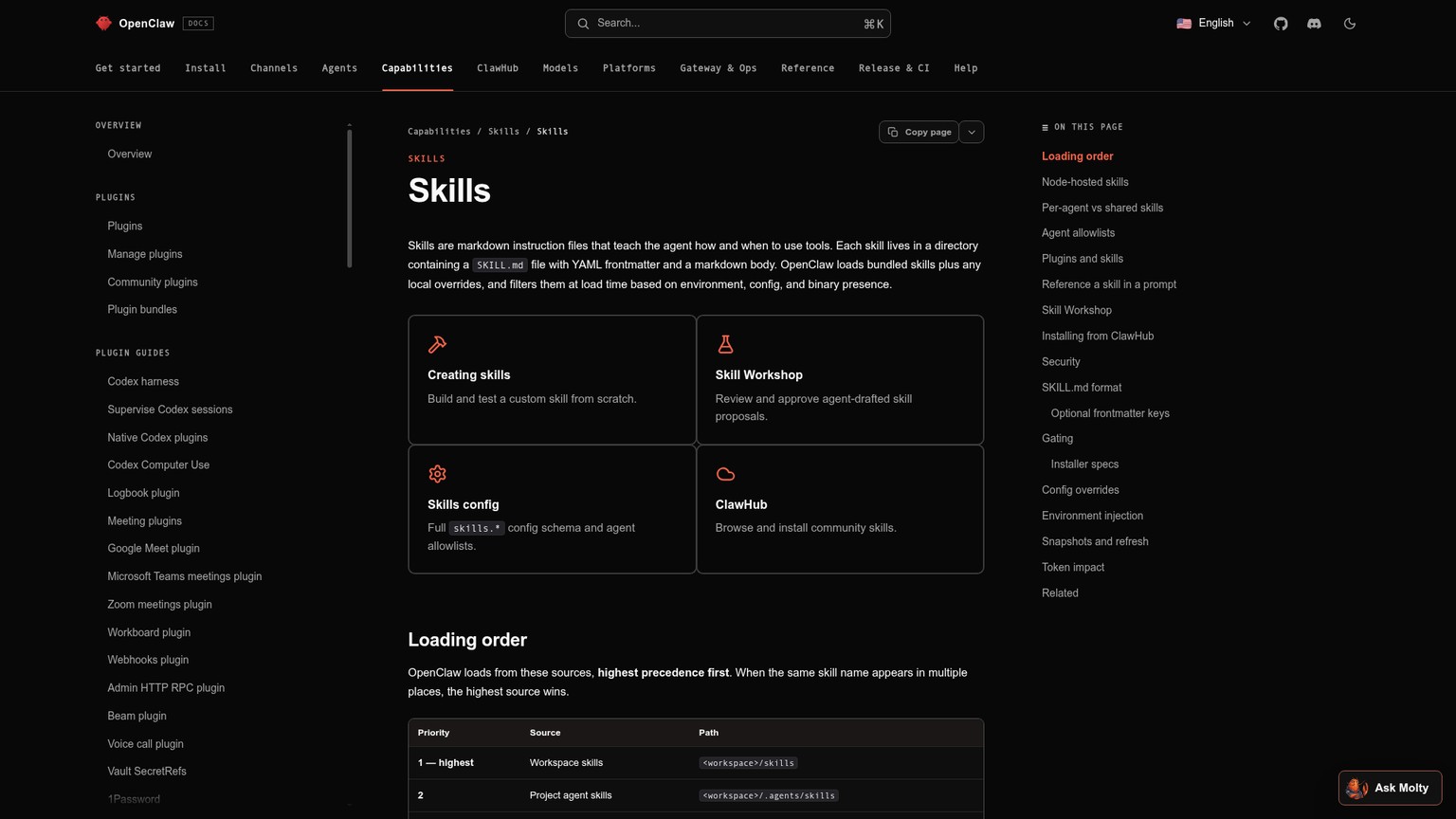
Skills can live in a workspace, project, personal directory, managed store, bundled install, plugin, extra directory, or connected node. The load order lets a local procedure override a lower-precedence one with the same name. The practical result is that a solo builder can preserve a reliable process instead of rewriting the full instruction in every chat.
OpenClaw also supports many model providers, including hosted APIs, subscription-backed coding providers, gateways, and local models. The runtime can therefore keep the same workflow while the operator changes the model behind it. That portability is valuable when cost, quality, privacy, or provider availability changes.
A builder workflow: make release review repeatable
A solo technical builder could turn a repeated release-review process into a local skill without giving the skill permission to publish anything.
Write the contract before the automation
Define the trigger, allowed official sources, required facts, comparison method, output structure, and stop conditions in
SKILL.md. State that the skill returns a draft and may not publish, merge, or notify customers.Keep evidence beside the result
Require the skill to save release URLs, version labels, dates, and extracted changes in a workspace the reviewer can inspect. A summary without its source trail is hard to correct.
Gate every install source
Use an explicit skill allowlist and a trusted
security.installPolicycommand for ClawHub, Git, local, update, and dependency installs. The policy fails closed when it cannot return a valid decision.Switch models against one evaluation
Run the same fixed release sample through the low-cost and high-capability models you are considering. Compare missed facts, unsupported claims, total tokens, latency, and reviewer corrections. Portability matters only when a repeatable evaluation decides the switch.
The first benefit is procedural memory. A good skill stores how the job should be done, not just facts from the last job. The second is model choice. A stable procedure makes it easier to use a cheaper model for routine extraction and reserve a stronger one for ambiguous judgment.
ClawHub scanning is a signal, not permission
OpenClaw can install skills from ClawHub, Git repositories, local directories, and uploaded archives. ClawHub exposes VirusTotal, ClawScan, and static-analysis signals, and openclaw skills verify can fail when registry verification fails. Those controls improve the supply-chain story. They do not prove that a skill is suitable for your credentials, files, tools, and threat model.
Review the instructions and bundled code before enabling a third-party skill. Pin the source where possible. Deny broad shell and filesystem access until the workflow needs it. Treat an update like a new permission review because the code and instructions may change even when the skill name stays the same.
One boundary deserves explicit attention: skill environment variables and API keys are injected into the host process for the agent turn, not into the sandbox. A reader can easily assume "the agent is sandboxed" means every secret used by a skill exists only inside that sandbox. The official documentation says otherwise.
Provider portability has a similar caveat. Changing models does not preserve behavior automatically. Models differ in tool use, instruction following, prompt-injection resistance, cost, and supported context. The workflow contract and evaluation set must stay stable while you compare them.
OpenClaw pricing and the real monthly cost
OpenClaw costs $0 for the software, and that is the entire first-party price list. There is no official Free, Pro, Team, Enterprise, or OpenClaw Cloud ladder on the vendor's live pages as of August 8, 2026. The repository uses the MIT license. Everything you pay sits around the software: the model, compute, search, media, messaging, storage, and operations.
OpenClaw documents those external meters on its API usage and costs page rather than a SaaS pricing page.
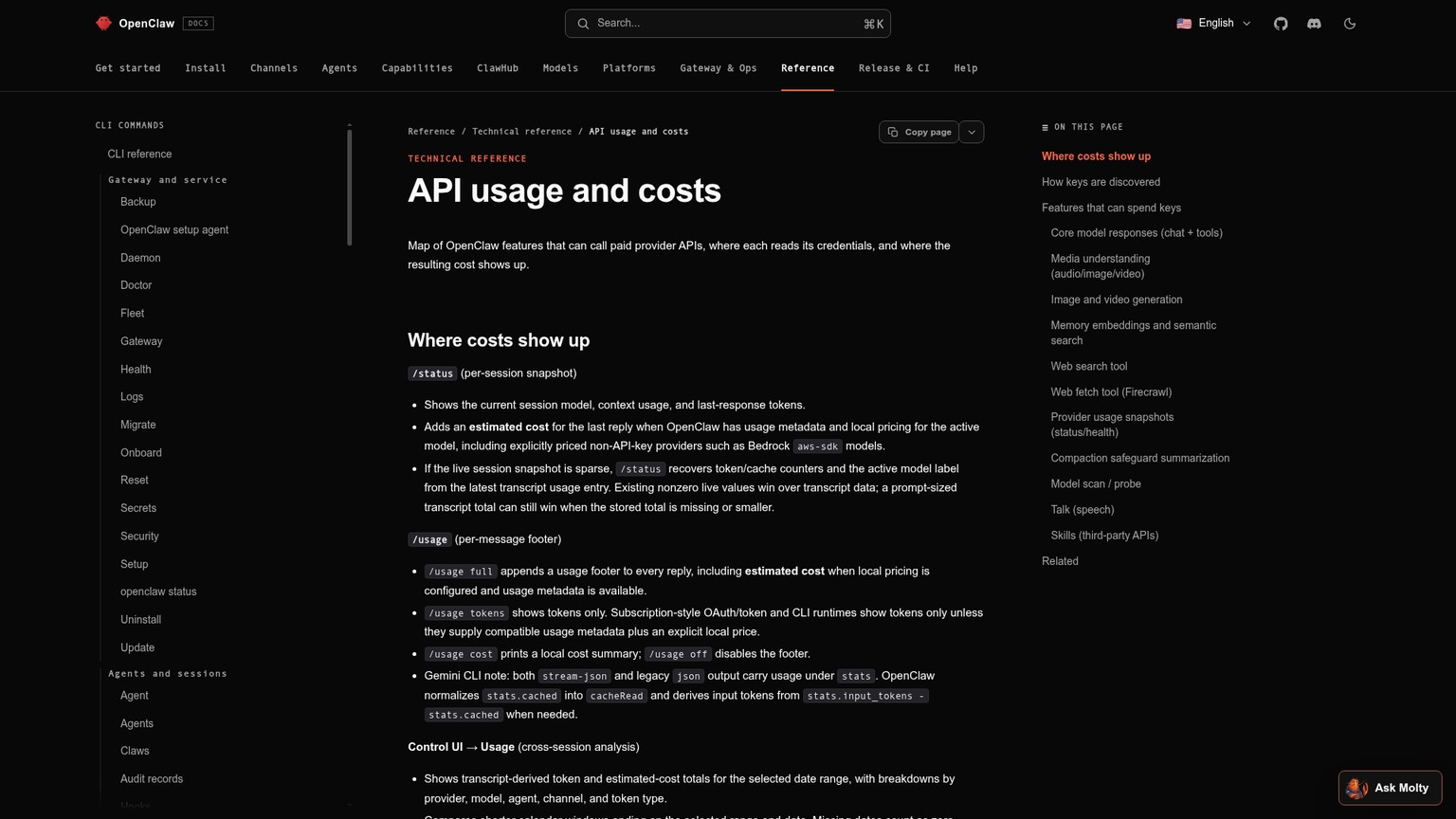
The live vendor pages and prices in this section were verified on August 8, 2026. That date matters because model prices and supported authentication paths change faster than the MIT license.
The model-only cost of a useful agent task
Token pricing becomes understandable only when it is attached to a workload. Use one explicit scenario: a scheduled research task consumes 20,000 input tokens and 2,000 output tokens per attempt. That is an analysis assumption, not an OpenClaw benchmark. A real run may use far more or less depending on history, tool results, retries, reasoning, and output length.
OpenAI's live model page currently prices GPT-5.6 Luna at $0.20 per million input tokens and $1.20 per million output tokens, Terra at $2 and $12, and Sol at $5 and $30. OpenClaw can use other providers, but these three tiers create a normalized comparison with one vendor and one token budget.
The model-only attempt costs are:
- Luna: 20,000 input tokens cost $0.004 and 2,000 output tokens cost $0.0024, for $0.0064 per attempt.
- Terra: 20,000 input tokens cost $0.04 and 2,000 output tokens cost $0.024, for $0.064 per attempt.
- Sol: 20,000 input tokens cost $0.10 and 2,000 output tokens cost $0.06, for $0.16 per attempt.
At 100 attempts per month, the same job costs $0.64 on Luna, $6.40 on Terra, or $16 on Sol before hosting, search, media, channel, and other external API charges. The model choice creates a 25-fold spread between Luna and Sol for the same token volume.
Attempt cost still overstates value because not every attempt produces an accepted result. Assume an 80% successful completion rate, again as an explicit scenario. Divide each attempt cost by 0.8:
- Luna: $0.008 per successful outcome.
- Terra: $0.08 per successful outcome.
- Sol: $0.20 per successful outcome.
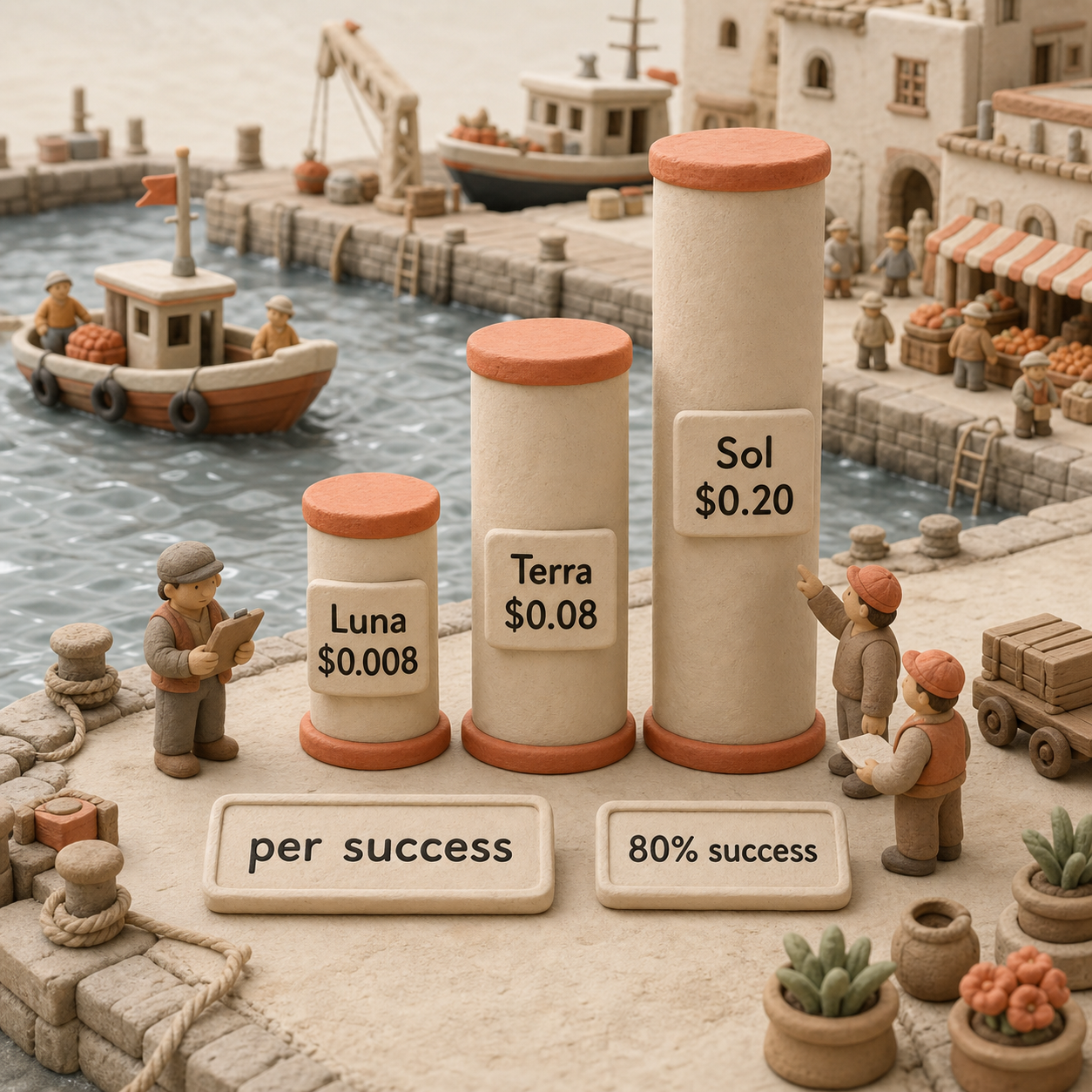
That calculation is useful because it changes the model question. The cheapest model is not automatically the cheapest outcome. If Luna completes only half the jobs that Sol completes correctly, its token advantage narrows. If the task is simple extraction with strict sources, Sol may be unnecessary. The right tier is the cheapest one that meets the task's acceptance criteria after reviewer corrections are counted.
Subscription access can be cheaper and less measurable
OpenClaw supports subscription-style provider paths as well as API keys. A flat subscription can make the marginal token cost appear to be zero until quota or extra-usage rules intervene. It also makes exact local cost attribution weaker because subscription runtimes may report tokens without a compatible dollar estimate.
Treat the subscription as a capacity pool, not a free model. Assign it a recurring job, record how often the job completes, and note when quota or provider policy interrupts it. A $20 plan that produces 100 accepted outcomes has a simple subscription allocation of $0.20 each before the host and tools. A plan shared across unrelated work needs a more honest allocation than assigning its entire cost to the most convenient success story.
OpenClaw's own usage views are useful for local analysis but are not the provider invoice or a lifetime billing ledger. Missing model prices can leave gaps. Reconcile high-spend workflows against the provider's bill before calling a cost report complete.
The smaller meters can dominate a background loop
Search, web fetching, image understanding, image generation, speech, embeddings, and third-party skills can each spend a separate key. A single interactive request may call several of them. A scheduled loop may call them again every hour.
OpenClaw's current documentation gives one concrete search example: Brave Search includes $5 per month in renewing credit, and the Search plan costs $5 per 1,000 requests, so the credit covers 1,000 searches. That sounds generous until an agent performs ten searches per check, four checks per day, across several agents. The correct control is a per-workflow request cap, not a hope that the free credit lasts.
The same principle applies to media and embeddings. A memory feature that invokes remote embeddings has a different cost and data path from local embeddings. A screenshot workflow may add image-understanding calls. A voice channel may add transcription and speech generation. Price the full action graph, not only the model that writes the final sentence.
OpenClaw vs n8n cost per run
n8n Starter costs $20 per month billed annually and includes 2,500 executions. At full utilization, that is $0.008 per included execution. The number matches the worked Luna cost per successful outcome by coincidence, but the units are different. An n8n execution is one workflow run. An OpenClaw outcome depends on model quality, tool behavior, and acceptance criteria.
n8n wins economically when the task follows the same route every time and uses little or no model judgment. OpenClaw can win when the task is ambiguous enough that a person would otherwise inspect sources, choose tools, and adapt the plan. The value must come from that judgment. Using an agent to imitate a deterministic webhook chain adds cost and failure modes without adding useful intelligence.
The price decision
Start with the smallest meaningful workload, not the cheapest model. Define one accepted outcome, set a model and tool budget, and record human correction time. Upgrade the model when correction cost exceeds token savings. Move deterministic steps out of the agent when they do not need judgment. Keep OpenClaw only when the remaining adaptive work is valuable enough to justify the runtime you operate around it.
The limitations that decide the verdict
OpenClaw's limitations are not minor polish issues. They sit at the same layers that make the product useful: host access, persistent context, browser authority, background execution, third-party skills, and a fast release stream.
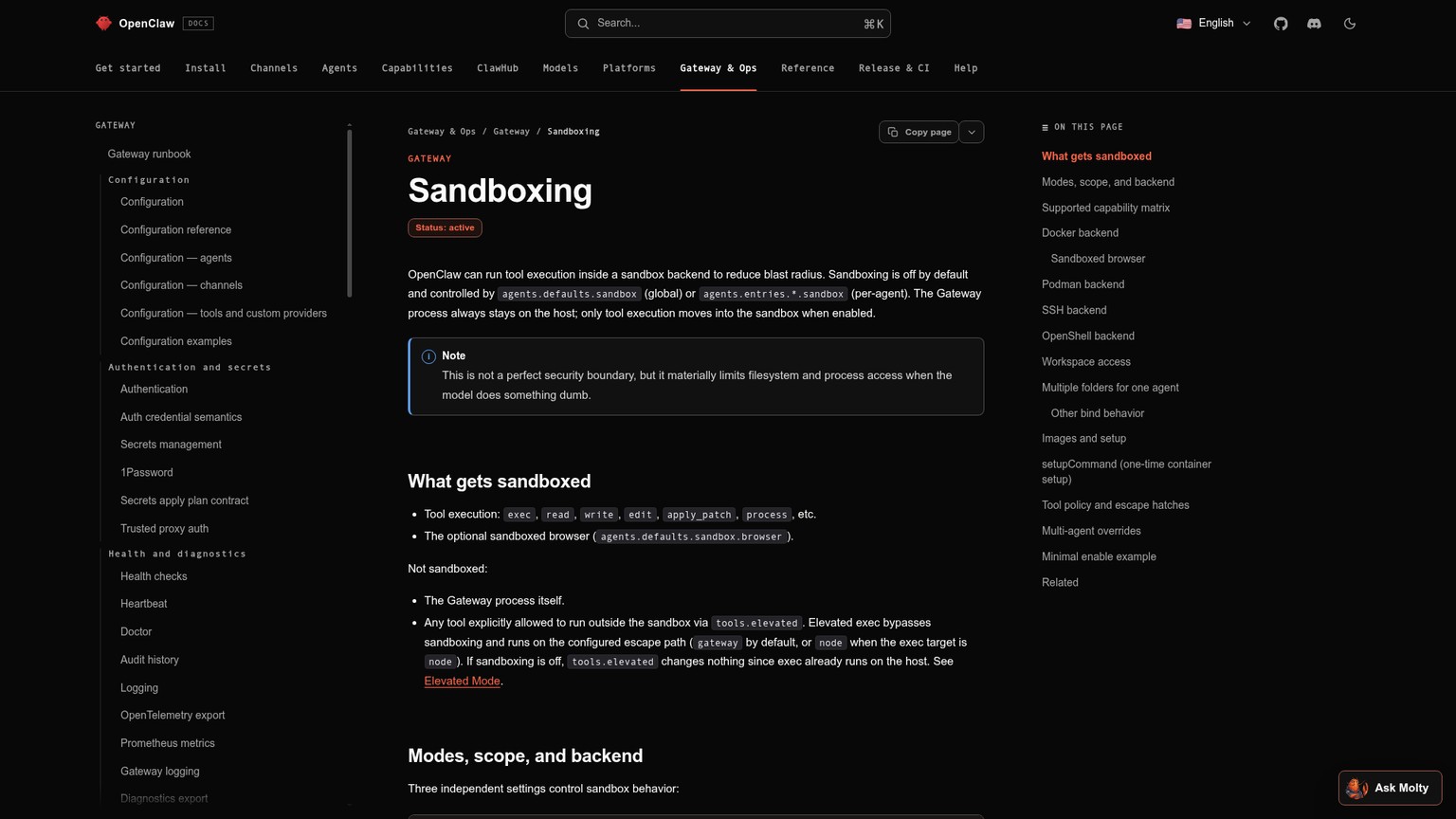
The most important boundary appears on the official sandboxing page.
1. Sandboxing is off by default
OpenClaw sets agents.defaults.sandbox.mode to off by default. If you install the product and never change that posture, tool execution runs against the host according to the active tool and exec policies. A configuration that mentions a sandbox image or workspace setting does not help when sandbox mode remains off.
This is not a reason to dismiss the product. It is a reason to reject the phrase "safe because self-hosted." Self-hosting gives you control over the environment. It does not choose a safe environment for you.
For a production-minded pilot, enable sandboxing deliberately and decide whether all sessions or only non-main sessions belong inside it. Keep workspace access at none or read-only until writes are required. Deny network access when the task does not need it. Avoid elevated tools unless a named action cannot work without them.
2. The Gateway and native plugins remain outside the sandbox
Even with sandboxing enabled, the Gateway process stays on the host. Native plugins and control-plane RPC also remain outside and share the Gateway trust boundary. Tools explicitly allowed through elevated execution bypass the sandbox.
This is the limitation a container diagram can hide. The agent's shell and file tools may run inside Docker while the process coordinating sessions, credentials, plugins, browser services, and control-plane calls remains on the host. The sandbox reduces blast radius for selected tools. It does not wrap the entire OpenClaw system.
The practical response is host isolation. Run the Gateway under a dedicated OS user or on a dedicated machine or VM. Keep personal credentials and unrelated company secrets off that host. Treat native plugin installation as host code installation. If the Gateway is compromised, a tool container is not a complete recovery boundary.
3. One Gateway is a trusted operator boundary, not multi-tenant isolation
OpenClaw treats an authenticated operator inside one Gateway as trusted at Gateway scope. Session keys route conversations; they do not authorize tenants. Direct-message isolation can keep one person's conversation from mixing with another's, but it does not protect mutually adversarial users sharing a host and control plane.
The official security guidance is explicit: run one isolated Gateway cell per tenant or organization. For a company pilot, that means one team should not casually become one Gateway for the whole company. Separate trust boundaries with separate Gateways, OS users, hosts, credentials, and workspaces where the risk warrants it.
This makes OpenClaw a poor choice for a SaaS founder looking for a ready-made multi-tenant agent backend. The architecture can be deployed in isolated cells, but you must build the tenancy, provisioning, policy, billing, monitoring, and lifecycle around those cells.
4. Prompt injection arrives through the work itself
Pairing and allowlists control who can trigger the agent. They do not sanitize the content the agent reads. A web page, email, document, attachment, pasted log, or tool result can contain instructions intended to redirect the model.
OpenClaw's security documentation says system-prompt guardrails do not solve prompt injection. Harder controls come from tool policy, approvals, sandboxing, allowlists, filesystem isolation, and network limits. The useful assumption is that the model can be manipulated and the system must keep that manipulation from reaching a consequential action.
A strong pattern separates reading from acting. Use a read-only agent or session to summarize untrusted material. Pass a bounded result to an action-capable agent. Require human review for sending, publishing, buying, deleting, changing access, or moving sensitive data. This adds friction exactly where friction prevents irreversible mistakes.
5. Browser control can inherit a person's authority
The managed OpenClaw browser profile is isolated from the personal profile, but the product also supports attaching to a real signed-in Chrome session. That shortcut can expose every application and account reachable through the session. Browser downloads and page content are also untrusted inputs.
The safest useful posture is a dedicated profile with dedicated accounts, disabled password sync, a separate downloads directory, and no access to systems outside the job. Use an attached personal or work profile only for a short, supervised task whose target cannot be reached another way.
Network policy needs the same realism. Browser URL checks reduce SSRF risk, but the browser documentation says they are not a network firewall. Complete egress isolation needs a policy-enforcing proxy or owner-controlled network boundary.
6. Skills expand the supply chain and secret surface
A community skill can change instructions, run installers, call tools, read files, and use provider keys according to the permissions available to it. ClawHub scanning and skills verify improve visibility, but different scanners cover different failure modes. A clean status is not an authorization decision for your environment.
The host-process secret boundary is particularly important. Skill keys and environment variables are injected into the host process for the turn, not the sandbox. A skill that needs one API key should not run inside an agent that can also read an unrelated credential directory or invoke broad host tools.
Use exact source references, review updates, set agent skill allowlists, and run a trusted install policy for every install path. Keep the first version of a skill read-only. Add one permission at a time and record why the outcome needs it.
7. Release velocity is not long-term support
The current stable release, v2026.7.1-2, landed on August 4, 2026. OpenClaw introduced an extended-stable channel on July 30. The first line is 2026.6.33, based on 2026.6.11, with later security and reliability fixes backported.
Extended-stable is not yet LTS. A line is supported until the next monthly extended-stable release, for a minimum of one month. The project describes the channel as a step toward future LTS. That is progress for critical deployments, but it does not satisfy an organization that requires a year of security support, a slow deprecation policy, or a fixed enterprise maintenance window.
The maturity scorecard also relies on issue counts, comparisons, and human judgment, with a goal of more than 90% end-to-end test coverage for stable features. A scorecard helps buyers see which surfaces are maturing. It is not a service-level agreement.
For a serious deployment, choose the release channel intentionally, stage updates, keep a rollback artifact, subscribe to advisories, and verify the task after every change. "Latest" maximizes access to fixes and features. "Extended-stable" reduces churn. Neither removes the operator's maintenance job.
8. Security history makes patching non-optional
OpenClaw's historical advisory GHSA-g8p2-7wf7-98mq shows why release discipline matters. The high-severity issue affected versions through v2026.1.28 and was patched in v2026.1.29. A crafted Gateway URL could exfiltrate the stored token and give an attacker operator-level Gateway control, even when the Gateway listened only on loopback. The advisory carried a CVSS 3.1 score of 8.8.
The current release is far beyond the affected versions. The lesson is not that the old bug remains. The lesson is that a local administrative surface can still be reached through the browser and that a Gateway token can become host-level authority. Staying patched, separating the browser profile, and limiting Gateway exposure are part of normal operation.
9. Cost observability is useful but incomplete
OpenClaw can show token and estimated-cost information in session status, usage footers, the Control UI, and provider quota windows. Those views depend on usage metadata and configured local prices. Subscription-backed runtimes may expose quota or tokens without a dollar figure. Some provider or tool charges may sit outside the model record.
The Control UI totals describe available local history, not the provider invoice or lifetime spend. Reconcile provider bills, host costs, search/media keys, and human review time for the workflows that matter. A local chart can show a downward token trend while an external tool bill grows.
A contained pilot posture
No checklist can guarantee that an autonomous agent is safe, but a pilot can remove avoidable exposure.
Isolate the host
Use a dedicated machine, VM, or OS user. Keep personal browser data, password stores, broad cloud credentials, and unrelated company files off the runtime.
Isolate the trust boundary
Run one Gateway for one operator or one mutually trusted team. Use separate Gateways for separate tenants or adversarial users.
Turn the sandbox on
Use sandbox mode for all pilot sessions, session scope, and no or read-only workspace access. Keep network disabled until a defined source or API needs it. Remember that the Gateway and native plugins remain outside.
Lock inbound access
Keep direct messages on pairing or a narrow allowlist. Avoid open group policies. Use a dedicated channel and separate session context where several approved senders are involved.
Separate reading from action
Let the first workflow collect and propose. Keep external messages, purchases, deployments, deletes, and permission changes behind manual approval.
Audit and rehearse recovery
Run
openclaw security auditafter configuration changes and before exposure. Test update, rollback, credential rotation, task cancellation, and host recovery before the agent handles valuable data.
This posture makes the first pilot slower. That is useful. The pilot should reveal the product's operational cost before broad permissions make the agent appear more capable than the organization can safely support.
- MIT-licensed software with no OpenClaw subscription fee
- Persistent local state and reach across 29 chat channels
- Strong browser, automation, task, skill, and provider composition
- Operator control over the host, model, permissions, release channel, and data path
- A dedicated browser profile and configurable sandbox can reduce blast radius when deliberately enabled
- Sandboxing is off by default, and the Gateway plus native plugins remain outside it
- One Gateway assumes trusted operators rather than hostile multi-tenant isolation
- Prompt injection can arrive through the content the agent is supposed to read
- Browser and skill integrations can inherit powerful accounts, secrets, and host permissions
- Release support is still fast-moving; extended-stable offers a monthly minimum window, not LTS
- Total cost spans model, hosting, external APIs, and human review rather than one predictable bill
Verdict: adopt only when ownership is the feature
OpenClaw earns a recommendation for technical solo operators and builders who want a persistent agent they can shape, isolate, and maintain. It does not earn a general recommendation for nontechnical users, shared hostile users, or teams looking for a managed enterprise control plane.
The explicit decision rule is:
- Choose OpenClaw when one technical owner wants a persistent agent across channels and tools, can dedicate a runtime, can keep the first job reversible, and accepts updates and security policy as part of the product.
- Choose ChatGPT when the recurring job is conversation, research, files, drafting, or supported managed tools and nobody should own the host stack.
- Choose n8n when the workflow should execute the same approved graph every time and model judgment belongs in one bounded step, if anywhere.
- Pilot OpenClaw, do not approve it broadly, when a mid-market team has a promising adaptive workflow but has not yet proven host isolation, identity policy, provider cost, monitoring, update, and recovery.
- Skip OpenClaw when the use case needs hostile multi-tenant isolation inside one service, long contractual support, guaranteed deterministic action, or access to sensitive systems without a human approval layer.
For a funded founder, the economic test is one recurring outcome. If a bounded agent saves more operator time than its review, maintenance, and incident risk consume, keep it. If the founder mainly enjoys sending messages to an agent from Telegram, a managed assistant is cheaper in attention.
For a mid-market CTO, ownership must have a business reason. Data location, provider choice, local tools, specialized channels, or an unusual workflow can justify the runtime. "We want an AI agent" does not. Approve one isolated cell for one job, then expand only after the logs, costs, failure modes, and recovery process are boring.
For a senior operator, OpenClaw is strongest as a proposal engine with hands. Let it observe, collect, compare, and prepare. Add external action only where the destination, permission, and rollback are visible. The product's broad authority is most credible when the operator refuses to use all of it at once.
Frequently asked questions
Is OpenClaw free?
Yes. OpenClaw is MIT-licensed and the software costs $0. The official site has no paid OpenClaw pricing tiers as of August 8, 2026. You still pay for the model or subscription quota, the computer or server, search and media APIs, messaging providers where applicable, third-party services, and the time required to maintain the system.
Is OpenClaw safe?
OpenClaw is not safe by default in the way a managed consumer app suggests. Sandboxing is off by default, the Gateway stays on the host even when tool execution is sandboxed, and prompt injection can arrive through pages, messages, documents, and attachments. A dedicated host, one Gateway per trust boundary, pairing or allowlists, sandbox mode, narrow tools, a dedicated browser profile, updates, audits, and human approval can reduce risk without eliminating it.
What does OpenClaw cost per month?
There is no fixed vendor price. In the worked scenario of 100 monthly attempts at 20,000 input and 2,000 output tokens each, model-only cost is $0.64 on GPT-5.6 Luna, $6.40 on Terra, or $16 on Sol. Hosting, search, media, channel APIs, other tools, and human review are extra. Subscription-backed providers can replace token billing with quota and extra-usage rules.
Is OpenClaw worth it?
OpenClaw is worth it for a technical owner who needs a persistent, self-hosted agent across tools and channels and can keep the first workflow bounded. It is not worth it for occasional chat, nontechnical users without an infrastructure owner, deterministic workflows that n8n can express clearly, or teams expecting hostile multi-tenant isolation from one Gateway.
Where is OpenClaw on GitHub?
The official repository is github.com/openclaw/openclaw. It carries the source, MIT license, releases, issues, and security advisories. Check the latest release and advisories before installing or updating rather than relying on an old setup guide.
Do you need a VPS for OpenClaw?
No. OpenClaw can run on macOS, Linux, or Windows, including an existing machine. A VPS can keep the Gateway available while your laptop sleeps, but it adds hosting cost, remote administration, and a different network-exposure problem. A dedicated local machine or VM may be the better first pilot when the workflow touches sensitive data.
What are the best OpenClaw alternatives?
ChatGPT is the best alternative when you want a managed general assistant and do not need host ownership. n8n is the better alternative when the workflow should follow a deterministic, inspectable graph with known triggers and destinations. The correct alternative depends on whether the job needs adaptive agency, managed assistance, or repeatable workflow execution.
What are good OpenClaw use cases?
Good use cases are bounded, reversible, and evidence-producing: a daily source brief, vendor-page monitoring, project-status assembly, a private cross-channel assistant, release-note review, or research that returns a proposal for approval. Poor first use cases include unrestricted email action, production deployment, purchases, deletion, broad browser access, or a shared bot for unrelated users.
What are the main OpenClaw risks?
The main risks are host-level authority, sandboxing that must be enabled, Gateway and plugin code outside the sandbox, prompt injection through untrusted content, attached-browser access to logged-in accounts, community skill supply-chain exposure, fast update requirements, model mistakes, and costs spread across several providers. Most of those risks come from the same integrations that make OpenClaw useful.
Want a faster way to match each AI tool to a recurring business outcome? Get the AI Tools Map for Business Owners.
- Last Updated
- Category
- AI
- Language

Mistral Large 4: Pricing, Open Weights, and When to Use It
Mistral Large 4: verified API prices, the launch offer, claimed benchmarks, and when to test the preview or wait for self-hosting.Oct 7, 2026AI
Lindy AI Review (Verified October 2026)
Lindy AI review: current plans, credit costs, email and meeting setup, integration limits, and when Gumloop, n8n or Marblism fits better.Oct 7, 2026AI
Mistral Pricing (2026): API Costs and Vibe Seats
Mistral API rates, Le Chat and Vibe plans, free limits, EU hosting costs and a worked monthly bill. Verified October 2026.Oct 6, 2026AI
Claude Skills
Use Claude Skills across the apps, Claude Code and API. Build a weekly client-report skill file by file, then install and share it.Oct 6, 2026AI
AI Employee: What It Does, Costs, and How to Start
What AI employees can do, current prices for six tools, and how to pick one role, keep human review and measure a 30-day pilot.Oct 6, 2026AI
Wispr Flow Alternatives (2026): VoiceOS, Superwhisper, Aqua Voice, Willow and Monologue
Compare VoiceOS, Superwhisper, Aqua Voice, Willow and Monologue by work task, current price, offline privacy, team controls and coding-agent input.Oct 5, 2026AI
AI Agent Examples: 13 Small Business Jobs and What They Cost
13 AI agent examples for small businesses: what runs the job, what a person checks, and current prices from Tidio, Vida, MindStudio and more.Oct 5, 2026AI