Grok 4.7 vs Grok 4.6
Grok 4.7 starts at the same token price as 4.6. Compare access, coding evidence and task costs before moving your workflow.
Published
 By Omid Saffari

Grok 4.7 vs Grok 4.6 is an evaluation decision, not a price decision: both start at $2 per million input tokens and $6 per million output tokens. Put new difficult coding and knowledge work on Grok 4.7; keep proven Grok 4.6 flows until 4.7 wins on completed work, elapsed time, and the final bill.
Grok 4.7 vs Grok 4.6: Which One Should You Pick?
Pick Grok 4.7 for the jobs where Grok 4.6 stops early, misses a cross-file dependency, or needs repeated correction. Keep Grok 4.6 on a production path that already passes its checks within budget. A newer model is a candidate for traffic, not a reason to move every workload.
That gives each reader a different first move:
- A funded founder with a blocked product feature should trial Grok 4.7 on that feature, because xAI's strongest gains are on difficult, sustained work.
- A mid-market CTO should leave passing Grok 4.6 automations alone and route failed task classes into a controlled 4.7 evaluation.
- A senior operator producing research, documents, or presentations should compare accepted deliverables, not prose polish.
- A solo technical builder should use 4.7 to attack the issue that 4.6 could not finish, then promote it only if the result survives the same tests.
This is a workload-level decision. A company can reasonably run 4.7 for repository work and retain 4.6 for a stable extraction or classification flow. The extra routing is justified only when the measured benefit exceeds the operational complexity.
Is Grok 4.7 Better?
Yes for the difficult coding and professional-work evidence xAI published on September 21, 2026. No as an automatic replacement for every Grok 4.6 deployment. The evidence favors an evaluation, while the unequal reasoning settings stop it from proving a universal upgrade.
Grok 4.7 Coding
Winner: Grok 4.7, with a provider-benchmark caveat. In xAI's same-release comparison, Grok 4.7 at xHigh scored 46.3% on CursorBench 4.0 against 40.4% for Grok 4.6 at High, a 5.9 percentage-point lead. On Terminal-Bench 4.0, the pair scored 38.0% and 20.3%, a 17.7-point gap. EEBench was 64.0% against 53.0%, an 11-point lead.
Those are meaningful differences on the tasks the launch emphasizes: sustained repository work, terminal operation, and engineering. They are still vendor-reported results, and xAI gave 4.7 the deeper xHigh setting while 4.6 ran at High. More reasoning can improve quality while adding reasoning tokens and latency. Treat the chart as a reason to test 4.7, not as a controlled estimate of your production gain.
The knowledge-work direction is similar. xAI reports 1,657 for Grok 4.7 versus 1,546 for Grok 4.6 on AA Briefcase v1.1, and 1,695 versus 1,605 on GDPval. Its legal-agent result is 19.6% versus 15.8%, while HealthBench Professional is 56.7% versus 48.5%. All of those figures come from the September 21 comparison, so they do not mix an older benchmark version into a false head-to-head.
Do not turn the launch headline into a speed promise. The page calls Grok 4.7 twice as fast as comparable models, but its body says standard Grok 4.7 is served at the same speed as Grok 4.6. The specific 2× output-speed option is a separate Fast service tier with a higher price.
The blunt conclusion is that 4.7 has earned the hard-task trial. It has not earned a blind fleet-wide migration.
What Stays the Same: Access, Context, Tools, and Reasoning
Grok 4.7 and Grok 4.6 expose nearly the same integration surface, so most migration risk sits in behavior rather than basic API shape. Both accept text and images, return text, support function calling and structured outputs, and carry a 500,000-token context window.
Grok 4.7: The Current Flagship
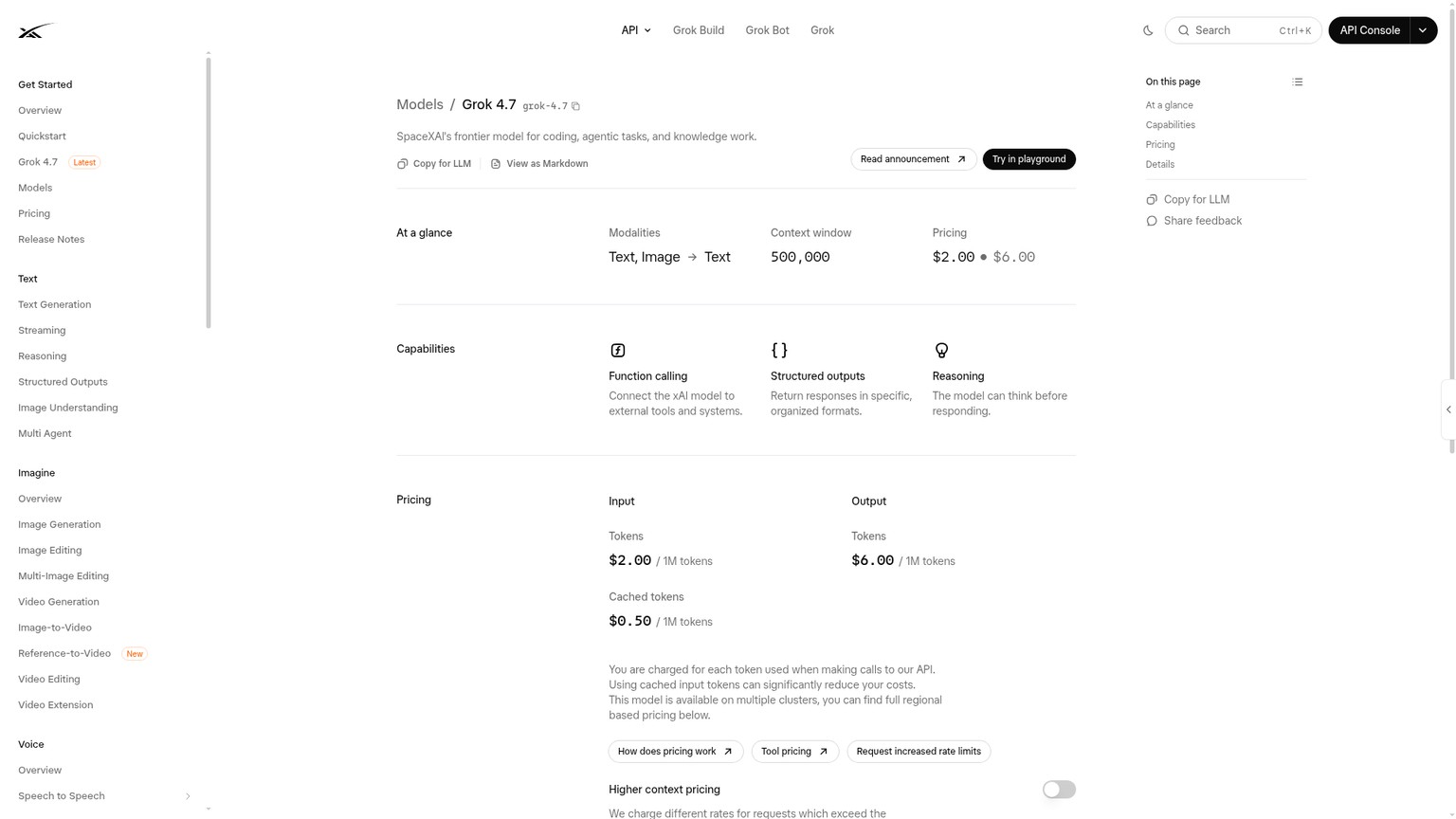
Grok 4.7 uses the documented model ID grok-4.7. xAI's live model page positions it for coding, agentic tasks, and knowledge work, and the launch says it is available through the public API, Cursor, Grok Build, third-party coding tools, model routers, and cloud platforms.
Best for: difficult coding and knowledge work that 4.6 does not complete.
Pricing: $2 fresh input, $0.50 cached input, and $6 output per million tokens below 200K.
Named limit: no Batch support, and the Fast variant is not available through the public xAI API.
Skip when: a passing 4.6 workflow has no expensive failure to fix.
Its Responses API behavior has one integration detail worth checking: Grok 4.7 always returns encrypted reasoning content, including encrypted outputs from server-side tools. A client can ignore that field, but a client that manually carries conversation state should preserve the reasoning items unchanged when continuity matters.
Grok 4.6: The Documented Baseline
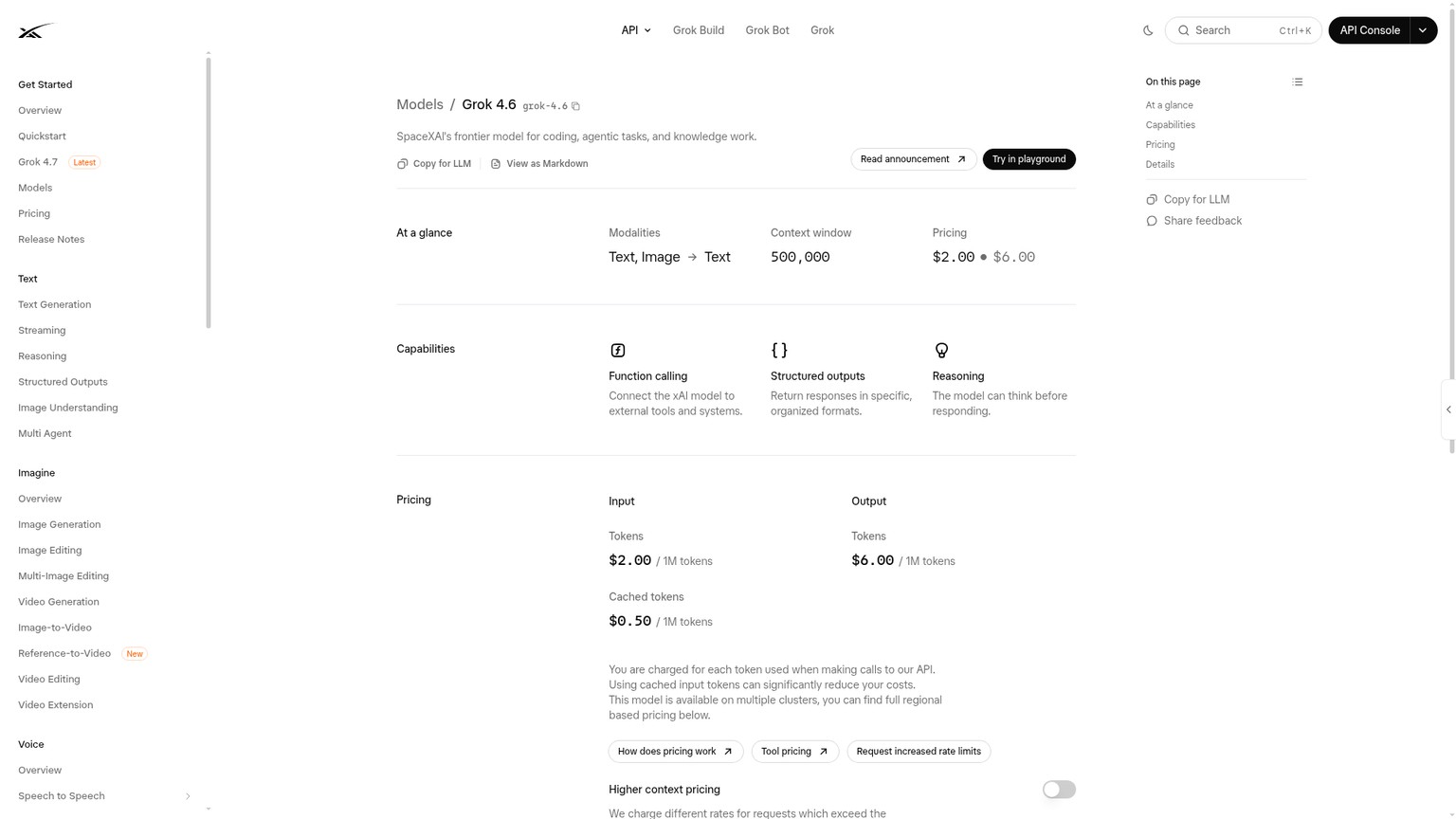
Grok 4.6 remains available under grok-4.6. Its current model page still documents the same 500,000-token window, the same input and output modalities, and the same core function-calling, structured-output, and reasoning capabilities.
Best for: stable workflows that already pass a defined acceptance gate.
Pricing: $2 fresh input, $0.50 cached input, and $6 output per million tokens below 200K.
Named limit: lower xAI-reported scores on the current hard-task comparison, with no token-rate discount for staying back.
Skip when: repeated unfinished work already costs more than a controlled migration.
Both models support low, medium, high, and xhigh reasoning effort. xAI's reasoning documentation sets high as the default and says reasoning cannot be disabled. That shared high setting is the fair starting point for a paired evaluation. A 4.7 xHigh run belongs in a separate lane because it changes the quality, token, and latency budget at the same time.
Winner: tie on interface compatibility, Grok 4.7 on current vendor recommendation. The familiar surface lowers migration effort, but compatible parameters do not guarantee compatible tool choices, output schemas, stopping behavior, or retry patterns.
Grok 4.7 API Cost: Identical Rates, Different Task Bills
Grok 4.7 and Grok 4.6 have identical public API token rates, verified against xAI's live pricing page on September 21, 2026. Below 200,000 prompt tokens, each costs $0.002 per 1K fresh input tokens, $0.0005 per 1K cached input tokens, and $0.006 per 1K output tokens.
At 200,000 prompt tokens or more, every token in the request moves to the long-context schedule: $0.004 per 1K fresh input, $0.001 per 1K cached input, and $0.012 per 1K output. A 500,000-token window is capacity, not permission to carry an unbounded agent history cheaply.
The rows are exact token arithmetic, not observed model runs. They isolate the pricing meter so behavior can decide the comparison.
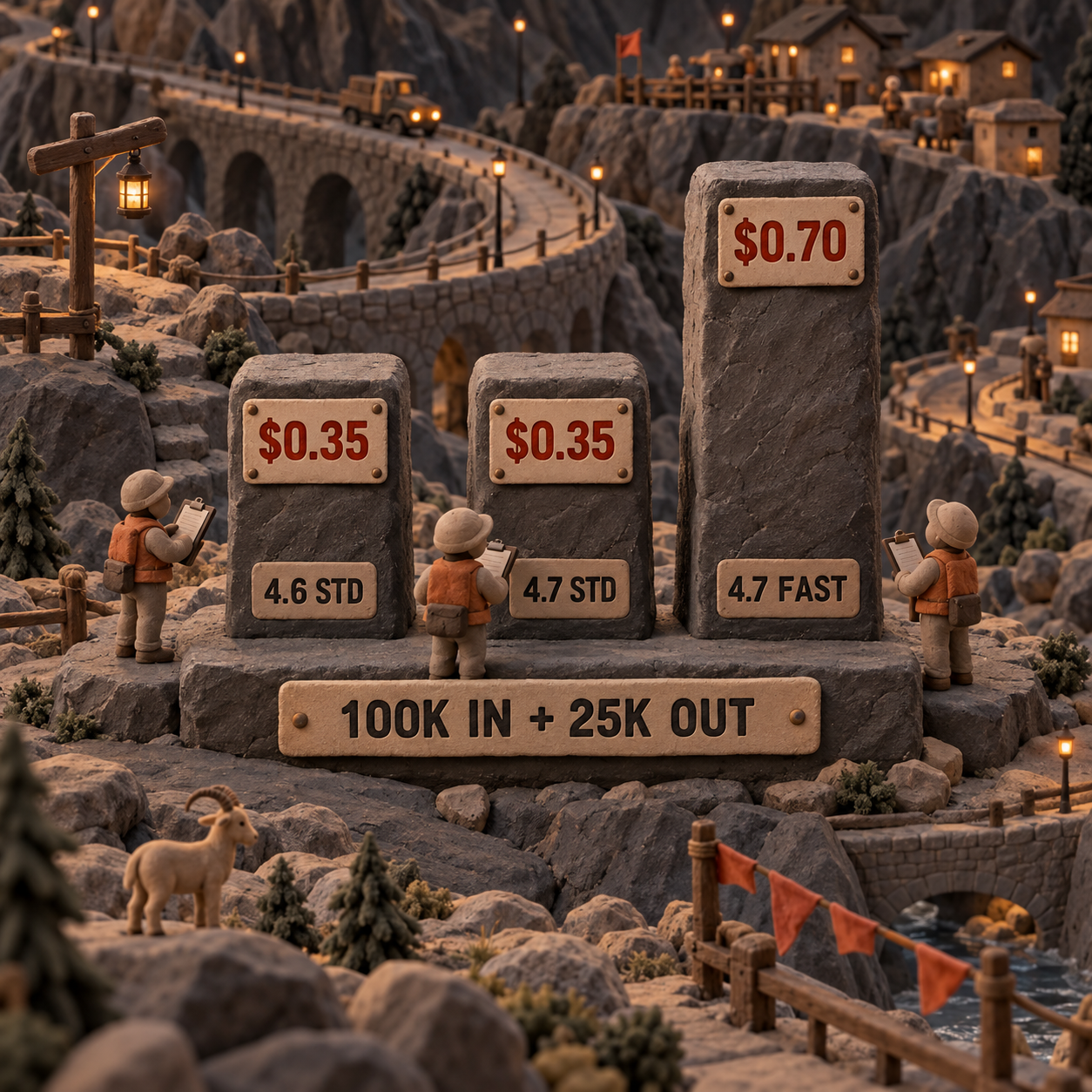
There is no token-rate crossover between these models. The crossover is completed work:
cost per accepted task = total billed cost across all attempts / accepted tasks
If both models consume the same billed tokens per attempt, any increase in accepted-task rate makes 4.7 cheaper per completed job. If 4.7 spends more because it reasons longer, it must improve the accepted-task rate by a larger proportion than its spend increase. Equal sticker prices do not protect you from extra reasoning, retries, tool loops, or verbose output.
The Fast and priority options need separate budgets:
- Grok 4.7 Fast below 200,000 prompt tokens costs $4 input, $1 cached input, and $12 output per million tokens. The 100K-input, 25K-output example therefore costs $0.70.
- Grok 4.7 Fast is available only through Cursor and Grok Build, not through the public xAI API, and the Grok Build free tier does not include it.
- Above 200,000 prompt tokens, xAI's detailed Fast table lists $6 input, $1.50 cached input, and $18 output per million. Use that posted schedule instead of applying a blanket multiplier.
- Public API Priority Processing charges a 2× premium when the response confirms the priority service tier.
Both models currently lack Batch API support. Reasoning tokens count toward consumption, and public API tools add another meter. Web Search and Code Execution each cost $5 per 1,000 calls. That is why the evaluation log needs usage and tool charges from the response, not an estimate from prompt length alone.
The earlier Grok 4.5 review explains why this 200K threshold matters in long agent loops. The same lesson applies here: compact stale history before it silently doubles the request's token rates.
Winner: Grok 4.7 only when its completed-work yield improves. If both models pass at the same rate, Grok 4.6 wins by avoiding migration work. If 4.7 clears failures that force retries or human repair, its equal token rates become an economic advantage.
The Switching Cost Is Operational, Not Contractual
Grok 4.6 wins the stability category because staying put costs nothing to configure. Grok 4.7 must repay the work of validating behavior, updating observability, and keeping a safe rollback path.
Preserve these controls before changing the model ID:
- The exact prompt, system policy, tool schemas, repository snapshot, timeout, and retry policy.
- Schema validators, tests, lint, build commands, and any human acceptance checklist.
- Separate fresh-input, cached-input, reasoning, output, tool-call, and elapsed-time records for every attempt.
- A record of side effects already completed before a retry or rollback. Replaying a partially completed task can duplicate an action.
- The old model ID in configuration, not buried in code, so one workload can return to 4.6 without reverting unrelated changes.
Prompt compatibility is not behavior compatibility. A structured-output schema may still parse while losing a required field. A coding agent may call the same tools but stop before tests. A research agent may finish faster by skipping verification. Those are regressions even when the HTTP request succeeds.
Grok 4.7's main limitation is evidence transfer: xAI's chart and one browser rebuild do not tell you how it behaves in your repository. Grok 4.6's limitation is the opposite: its known stability does not fix a class of tasks it repeatedly fails. The right split keeps the known baseline and gives the harder queue to the candidate.
Upgrade Grok 4.6 Only After This Three-Task Check
The upgrade should pass three small tasks in clean copies of one repository before it receives production traffic. This is a small workflow check, not a general benchmark. Use high reasoning for both models, keep every other control identical, and treat any 4.7 xHigh run as a separate experiment.
Freeze three acceptance tests
Use a previously fixed bug, a small cross-file feature, and a dependency migration from the same repository. Define success before either model sees the task: the targeted regression passes, the full test suite remains green, lint and build complete, the requested files change, and unrelated behavior does not.
Make clean copies for every attempt
Start each model-task pair from the same commit in a clean working copy. Give both models the same prompt, files, tools, permissions, timeout, and retry allowance. Do not let one model inherit another model's patch or explanation.
Run the common setting first
Call
grok-4.7andgrok-4.6athigh. Record the returned model ID, pass or fail, elapsed time, fresh and cached input, reasoning and output usage, tool charges, and the billed amount. Keep every failure in the results. Run 4.7 atxhighonly as a separately labeled trial.Promote by task class
Compare accepted work, elapsed time, and total bill. Move only the class that 4.7 wins, keep 4.6 as the rollback value, and repeat the check after prompt, tool, or model changes. A mixed deployment is valid when its monitoring cost is lower than the measured benefit.

The Monday move is concrete: restore one known bug, choose one cross-file feature, and pick one dependency update from last month's work. Run those three tasks next week at High on clean copies, publish every failure in the internal result sheet, and move only the task class whose completed work, elapsed time, and actual bill justify the change.
Frequently Asked Questions
What is the best version of Grok to use?
Grok 4.7 is xAI's current recommendation for code and general work. Grok 4.6 remains the better operational choice for a flow it already completes reliably until 4.7 wins a paired workload check.
Is Grok 4.6 good?
Yes. It has the same documented 500,000-token context window, core tool capabilities, reasoning settings, and standard API rates as 4.7. Its weakness is lower xAI-reported performance on the hardest coding and knowledge-work comparisons.
What is the current best Grok model?
xAI calls Grok 4.7 its most capable model for code and everything else. That makes it the candidate to evaluate first, not proof that it beats 4.6 on every deployed workflow.
What are the different versions of Grok?
xAI maintains general-purpose Grok models plus specialized image, video, and voice models. For this coding and knowledge-work decision, the relevant documented IDs are grok-4.7 and grok-4.6; use the live model catalogue for the changing full list.
Is anything better than Grok?
No model is best across every repository, tool setup, latency target, and quality gate. Compare providers on accepted work per dollar with the same tasks and controls rather than treating a vendor benchmark as a universal ranking.
What are the different levels of Grok?
For Grok 4.7 and Grok 4.6, the reasoning-effort levels are low, medium, high, and xhigh. The default is high, and reasoning cannot be disabled.
Does Grok have an 18+?
That is a consumer-product and safety-mode question, not a capability difference between these two API model IDs. It should not decide a Grok 4.7 versus Grok 4.6 coding migration.
How much does Grok cost per month?
For the API use compared here, cost is metered by tokens and optional tool calls rather than one fixed per-model monthly fee. Consumer subscriptions, free access, and Grok Build plans are kept current in Is Grok Free?.
What are all the Grok models?
The complete list changes as xAI adds and retires model variants, so its live catalogue is the source of record. For coding and general knowledge work, xAI currently points users to Grok 4.7.
Want a ready-made coding-agent evaluation setup? Get the Claude Code + Codex setup checklist with the newsletter.
- Published
- Category
- AI
- Language

Gamma Alternatives in 2026: Beautiful.ai, Prezi and More
Compare Gamma alternatives for brand control, editable PowerPoint and Google Slides, pitch decks and live talks. Current plans and clear tradeoffs.Oct 11, 2026AI
Reflection AI Beam: What It Means for Coding and Agents
Reflection AI Beam explained: October release plans, vendor benchmark claims, beta access and whether builders should wait before switching models.Oct 10, 2026AI
Claude for Google Workspace
How to install and deploy Claude in Docs, Sheets and Slides, control edits, and test the paid-plan beta with three practical team workflows.Oct 10, 2026AI
Claude Dashboards
Set up Claude Dashboards beta, inspect SQL and refresh timestamps, check a sales metric, and decide when to keep your BI tool.Oct 10, 2026AI
Granola AI Review
Granola reviewed for business meetings: bot-free notes, current pricing, templates, recipes, consent, platform limits and who should choose an alternative.Oct 10, 2026AI
Fyxer Review
Fyxer reviewed through current pricing, help docs and public feedback: inbox sorting, drafts, meetings, privacy and who should pay for Pro or Team.Oct 9, 2026AI
GPT 6 Explained: Models, Release Dates, Access, and Prices
GPT-6 Astra, Sol, 6.1 Sol and Luna explained: release dates, ChatGPT plan access, Work and Codex availability, and verified API costs.Oct 9, 2026AI