Mailchimp Alternatives in 2026: Kit, beehiiv, ActiveCampaign and GetResponse Compared
Compare Mailchimp alternatives for newsletters, automation and ecommerce, with verified prices at 1,000 and 10,000 contacts and reasons to stay.
Published
 By Omid Saffari







Kit is the strongest starting point among Mailchimp alternatives for a creator newsletter: its Free plan covers up to 10,000 subscribers. For a small business leaving because automation is too limited, start with ActiveCampaign Plus; for an online store, compare Omnisend with Klaviyo before choosing a cheaper newsletter sender.
Prices and plan limits verified against the makers’ live pages on 11 October 2026. This comparison covers eight alternatives, with Mailchimp as the baseline. The recommendations come from pricing, documented capabilities and workflow analysis, not hands-on product trials.
A larger contact list is only one reason an email bill grows. The plan you need also depends on how many messages you send, which automated decisions you make and whether a second person needs access. A newsletter, a consultant’s follow-up sequence and a store’s abandoned-cart flow can have the same audience size and need different software.
Mailchimp alternatives at 1,000 and 10,000 contacts
Compare the plan that handles your work, then compare its bill. ActiveCampaign Starter is cheaper than Plus at both list sizes, but it permits only five actions per automation. Brevo’s price depends on sending volume as well as the contact allowance attached to that volume. Those differences matter more than the lowest advertised starting price.
All amounts below are USD per month, with the billing commitment stated in the last column. Annual equivalents require an annual commitment. Monthly prices exclude temporary introductory discounts. Taxes, SMS, optional modules and implementation work are additional where applicable.
Read the Brevo row as a sending scenario, not a universal contact-price quote. The 1,000-contact example uses its 10,000-send band, which includes 1,500 contacts. The 10,000-contact example assumes four full-list broadcasts, so it uses the 40,000-send band, which includes 500,000 contacts. Add automation sends before choosing your volume.
A blank price is intentional. Kit’s live page confirmed the Free limit and its paid 1,000-subscriber rates, but a paid 10,000-subscriber quote could not be verified. GetResponse’s selector rendered euro prices at 10,000 contacts in the verification browser; those are not substituted for a US dollar quote.
Custom Enterprise plans from beehiiv and MailerLite, Omnisend’s Custom option, and Brevo’s larger Professional and Enterprise tiers are discussed where relevant below. They are not substitutes for a small-business contact-band quote.
Best Mailchimp alternatives by what you send
Kit is the newsletter starting point; ActiveCampaign Plus is the automation starting point; Omnisend is the ecommerce starting point. The ordering below follows those jobs. A specialist can be the best choice for its business model without being the cheapest or broadest product in the list.
1. Kit: creator newsletters with room to grow
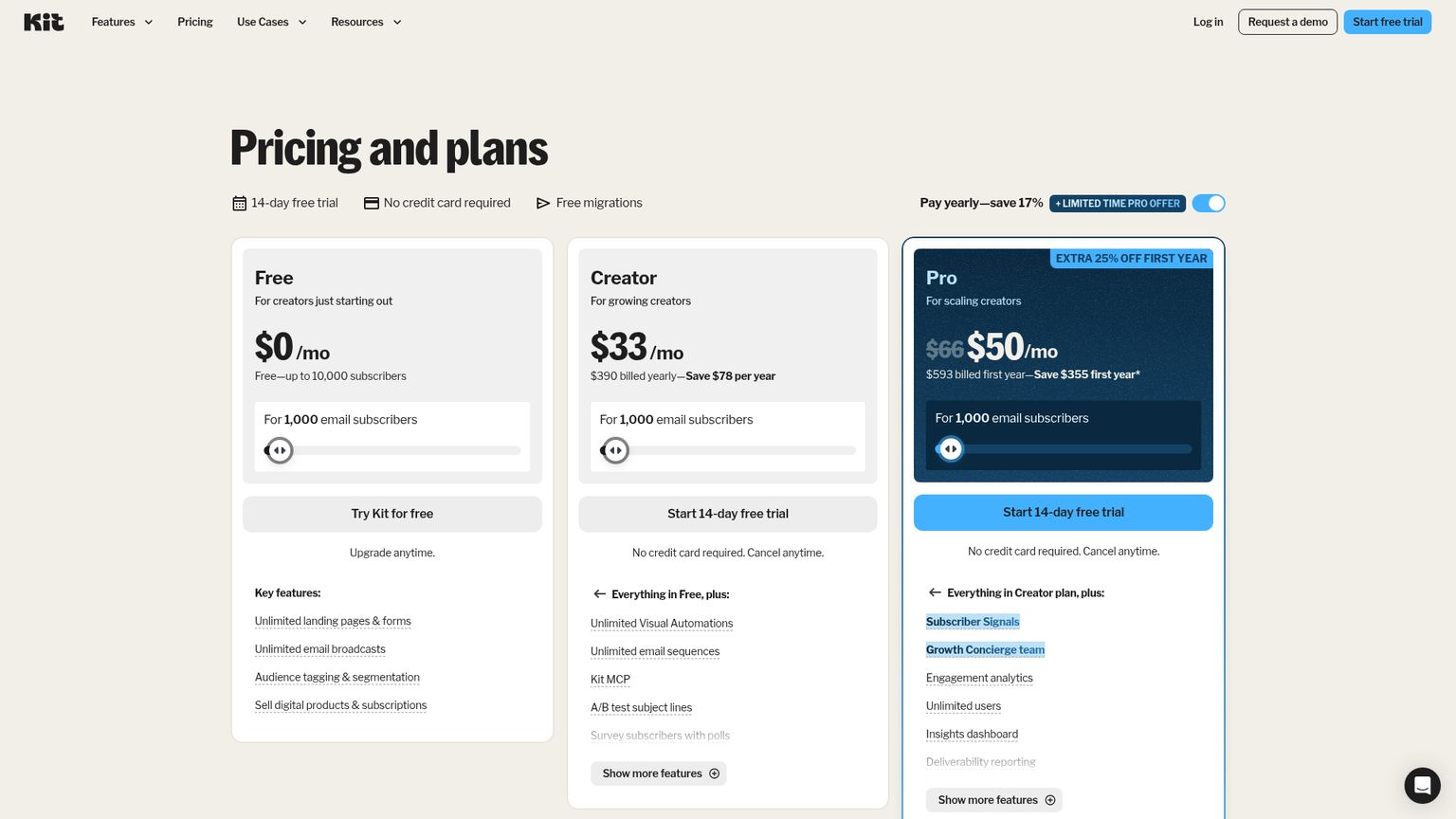
Kit, an email platform for creators selling knowledge, content or services, is the strongest first look when Mailchimp mainly delivers your newsletter. Its Free plan supports up to 10,000 subscribers, unlimited broadcasts, landing pages and forms, tagging and segmentation, and selling digital products or subscriptions. For a consultant whose newsletter starts sales conversations, that can remove the software bill while preserving the core publishing job. The paid decision begins when the business needs Creator’s unlimited Visual Automations and email sequences. Source: Kit pricing.
Best for: Authors, educators, coaches and service businesses whose audience follows a person or a body of expertise.
Standout: A large Free subscriber allowance, with paid automation built around subscriber interests and sequences.
Pricing: Free $0 through 10,000 subscribers. At 1,000, Creator displays $33 per month with $390 billed yearly; Pro’s standard annual-equivalent display is $66 per month.
Free trial: A 14-day paid-plan trial, with no credit card required.
The important distinction is between broadcasting and running a sales sequence. A broadcast sends an edition to an audience you choose. A sequence sends a series of messages after a person does something, such as subscribing to a course-interest form. If the business sends an essay each Friday, start with the broadcast requirement. If it needs different follow-ups for different interests, evaluate the paid automation requirement before migrating.
Consider a solo training consultant with one newsletter and two subjects: leadership and hiring. Tags, which are labels attached to subscriber records, help distinguish those interests. The useful design question is whether the next message depends on an interest, an action or a purchase. Draw that decision before deciding how many automations you need. A larger library of messages is not automatically a better funnel.
Creator is the sensible paid default here. Pro adds capabilities such as engagement scoring, collaboration, a newsletter referral system and deeper reporting. Those are reasons to upgrade when someone owns the process they support. A solo writer who cannot explain how a referral program or additional reporting will change next week’s work should be cautious about paying for it.
Name the welcome journey’s outcome
For the training consultant, choose one outcome such as booking a consultation. Draft a short welcome series that delivers the promised resource, explains the relevant problem, demonstrates the approach and invites the next step. Treat this as a proposed workflow, not a claim that every subscriber will convert.
Map interests before importing
Decide which existing Mailchimp fields should become subscriber tags or segments. Keep permission and unsubscribe records alongside that map. Test the mapping on a small set of records before moving the whole audience.
Choose Free or Creator from the workflow
Use Free when scheduled broadcasts and audience segmentation cover the job. Evaluate Creator when the written plan requires automated sequences or branching in the visual automation builder. Do not assume a large free subscriber allowance includes every paid automation feature.
Check the subscriber paths before switching forms
Walk through a new subscriber, someone already on the list and someone who has bought. Confirm who enters the sequence, which message follows and when promotional follow-up should stop. Only then replace the signup form that feeds the live audience.
- Free covers a substantial creator newsletter without a subscriber-based bill through 10,000.
- Tags and segments support a newsletter organized around reader interests.
- Creator combines unlimited sequences and visual automations with the publishing workflow.
- Unlimited automation is a paid-plan reason, so Free is not an equivalent replacement for every Mailchimp journey.
- The annual display and temporary Pro offer need careful reading.
- A store choosing chiefly on order events should compare the ecommerce specialists first.
The decision rule: choose Kit when content builds the relationship and sequences sell your expertise. For a hypothetical consultant earning $150 contribution per additional booking, three incremental bookings would cover the $390 annual Creator bill. That is a break-even requirement, not a promised result. For plan mechanics beyond this comparison, use the Kit pricing guide.
2. beehiiv: when the newsletter is the business
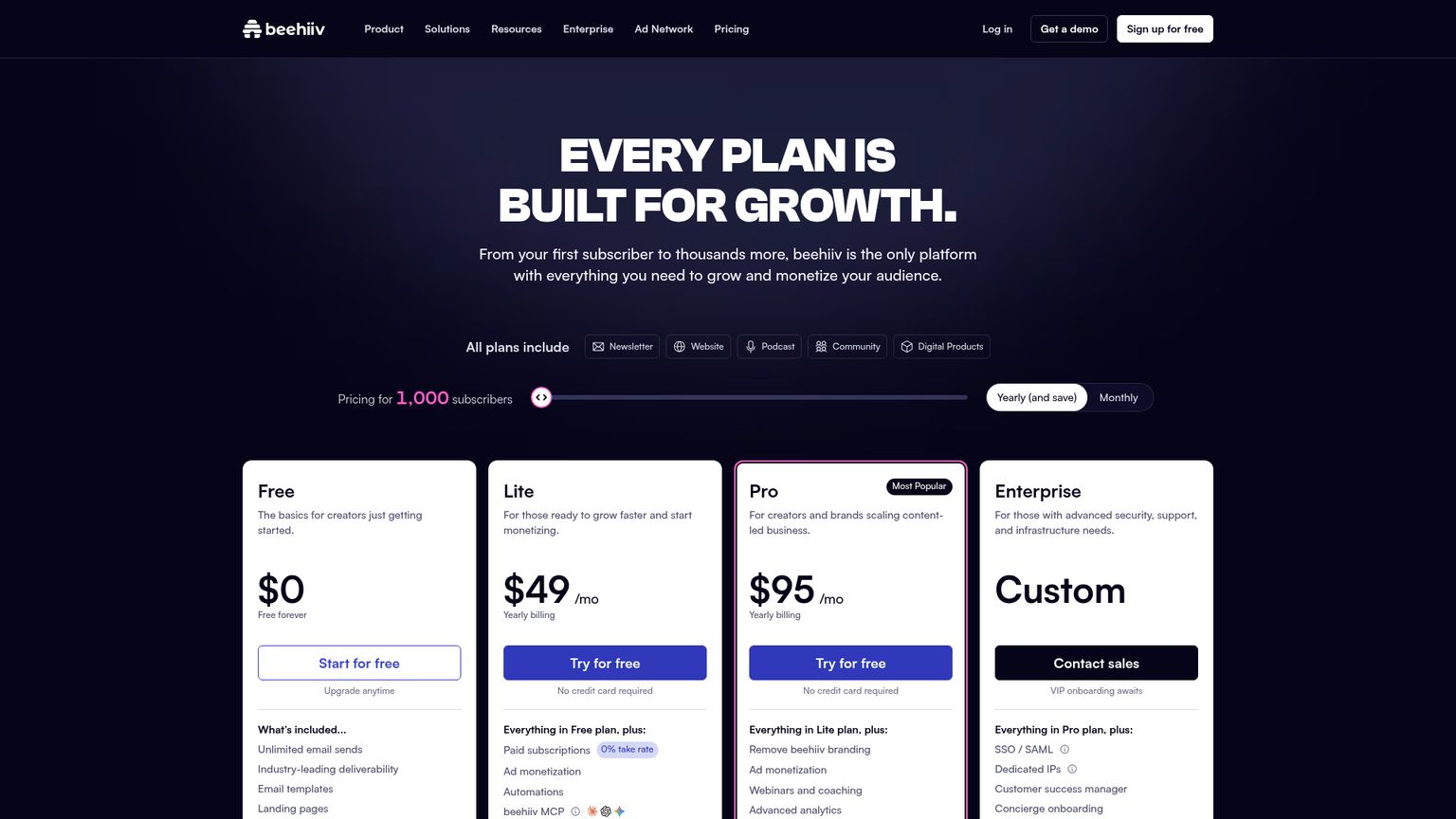
beehiiv is a publishing platform for businesses that want the newsletter itself to earn money through subscriptions, advertising or related products. Its current tiers are Free, Lite, Pro and Enterprise. Lite adds automations, paid subscriptions, ad monetization, polls and A/B testing; Pro adds capabilities including brand removal, advanced analytics, webhooks and dynamic content. Choose it when growing and monetizing a publication matters more than coordinating a complicated sales process. Source: beehiiv pricing.
Best for: A local publication, specialist industry newsletter or creator building a media business.
Standout: Publication growth and monetization in the same product as newsletter publishing.
Pricing: Free through 2,500 subscribers. Lite is $49/$119 per month billed yearly at 1,000/10,000; Pro is $95/$199. Monthly billing is higher, as the table shows. Enterprise is custom.
Free trial: Lite and Pro trials are advertised without a card; the page read did not specify a duration.
A neighborhood business newsletter and a plumber’s customer newsletter can look similar in an inbox. Their economics are different. The publisher wants a larger engaged audience that can support advertisers or paid subscriptions. The plumber wants booked jobs and repeat customers. beehiiv’s publishing model fits the first case much more directly; the second should begin with the follow-up it needs after an inquiry.
That distinction prevents an expensive mistake: buying monetization infrastructure before knowing what the audience will buy. Access to advertising features is not an advertising-income guarantee. A newsletter owner still needs a clear audience, useful editions and someone responsible for evaluating offers. Treat any expected ad income as uncertain until your own publication earns it.
The Free plan includes unlimited email sends, but its 2,500-subscriber ceiling makes it a different free option from Kit. At 10,000 subscribers, the decision is between paid tiers. Lite is the reasonable starting point if its features cover the publication. Pro needs a specific justification, such as required brand removal, dynamic content or the larger team allowance. Lite includes two seats; Pro includes ten.
Both paid publishing tiers advertise a 0% platform take on subscription and digital-product revenue; payment processing remains separate. That means the choice between Lite and Pro is not a choice between different platform revenue shares. It is about capabilities, limits and operating needs. A publisher should model subscription receipts after processing and other costs before assigning a software budget.
Before importing a Mailchimp audience, also decide where future editions will live and how readers will discover the signup page. A platform change does not supply an editorial promise. Write the one-sentence reason a reader should subscribe, then check that your website, forms and first edition express the same promise. This is especially useful when a general business mailing list is being turned into a distinct publication.
- Newsletter publishing, growth and monetization have a coherent business purpose.
- Unlimited sends avoid a separate email-volume calculation for the publication.
- Lite includes monetization and automation without requiring Pro.
- Free ends at 2,500 subscribers, below Kit’s published allowance.
- Paid costs increase with the audience; the plan’s maximum capacity is not a flat-rate price.
- Ad access and growth features cannot substitute for demand from readers or advertisers.
The decision rule: pick beehiiv when the publication is the product. Pick Kit when the publication primarily supports a creator’s services or products and its workflow fits better. The beehiiv pricing guide covers the broader billing detail without repeating it here.
3. ActiveCampaign: automation that needs more than a short chain
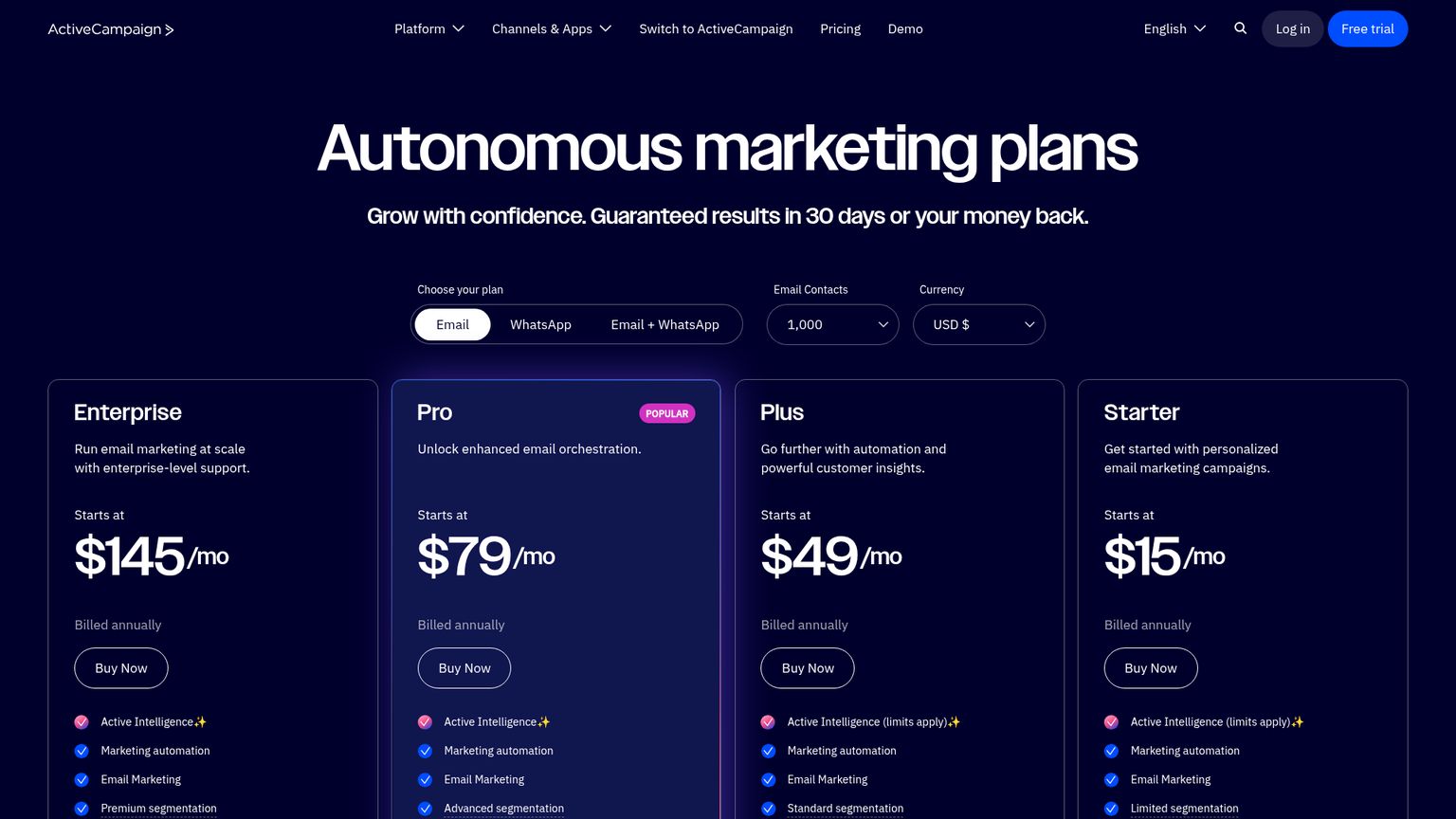
ActiveCampaign, a marketing automation platform, is the clearest upgrade when the reason for leaving Mailchimp is a more demanding follow-up process. Start the evaluation at Plus, not at the $15 Starter badge. Starter limits each automation to five actions; Plus permits unlimited automation actions. A business that needs a longer sequence should evaluate the tier that can carry it from the beginning. Source: ActiveCampaign pricing.
Best for: A service business or B2B marketer with distinct inquiry, nurture and customer follow-up paths.
Standout: Automation depth, with a clear difference between Starter and Plus.
Pricing: At 1,000 contacts, Starter $15, Plus $49, Pro $79 and Enterprise $145 per month billed annually. At 10,000: $149, $189, $375 and $589 respectively.
Free trial: 14 days, with no credit card required.
An automation action is a step the system performs in the workflow. Before comparing plans, write the follow-up as a sequence of actual decisions and tasks: when a person enters, what information matters, which message follows and what ends the process. A workflow that already needs a sixth action has answered the Starter-versus-Plus question. Splitting a coherent process into awkward fragments just to stay on a cheaper tier creates maintenance work.
For a consultancy, the meaningful distinction might be between someone downloading a general resource and someone asking for a proposal. Those people should not automatically receive the same follow-up. The consultant also needs a way to recognize that a prospect has become a customer, so promotional nurture does not continue blindly. The business rule is the specification; the visual automation is its implementation.
Plus also includes landing pages and standard segmentation, which means defining audiences from their attributes or behavior. Pro adds advanced segmentation, predictive and conditional content, and attribution and conversion tracking. Conditional content changes parts of a message for different recipients. Attribution connects a measured result to marketing activity. Those features earn their cost only if someone will use the additional information to change a decision.
There is a staffing limit to price, too. Starter and Plus include one user, Pro three and Enterprise five. A founder selecting Plus for the automation may discover that a marketer and an outside operator also need access. Put the access requirement into the quote rather than assuming the automation tier solves the team requirement.
For an illustrative consultancy with $150 contribution from an additional booking, four extra bookings across the year would cover the $588 Plus subscription. That calculation does not establish that automation will produce them. It gives the business a measurable threshold: the process needs to recover opportunities or save enough operating time to justify its cost.
Do not treat the email-plan quote as a complete sales-system quote. The pricing page lists Pipelines and Sales Engagement as CRM add-ons, and SMS separately. A CRM, the system that tracks customer relationships and sales activity, may be part of the eventual setup, but its add-ons should be priced explicitly. The more systems involved, the more valuable a small end-to-end trial becomes.
- Plus removes Starter’s five-action ceiling.
- Higher tiers have identifiable segmentation, content and reporting reasons to upgrade.
- Published contact bands make the annual commitment visible at both list sizes.
- Starter is a poor fit when the migration is specifically for longer automations.
- Plus includes one user, which may not match the people who must operate it.
- CRM add-ons and SMS can increase the cost beyond the email quote.
The decision rule: choose ActiveCampaign Plus when you can describe a valuable follow-up process that requires its automation depth. If the only scheduled work is sending the same newsletter to everyone, this is an unnecessarily elaborate starting point.
4. GetResponse: replace several related marketing jobs
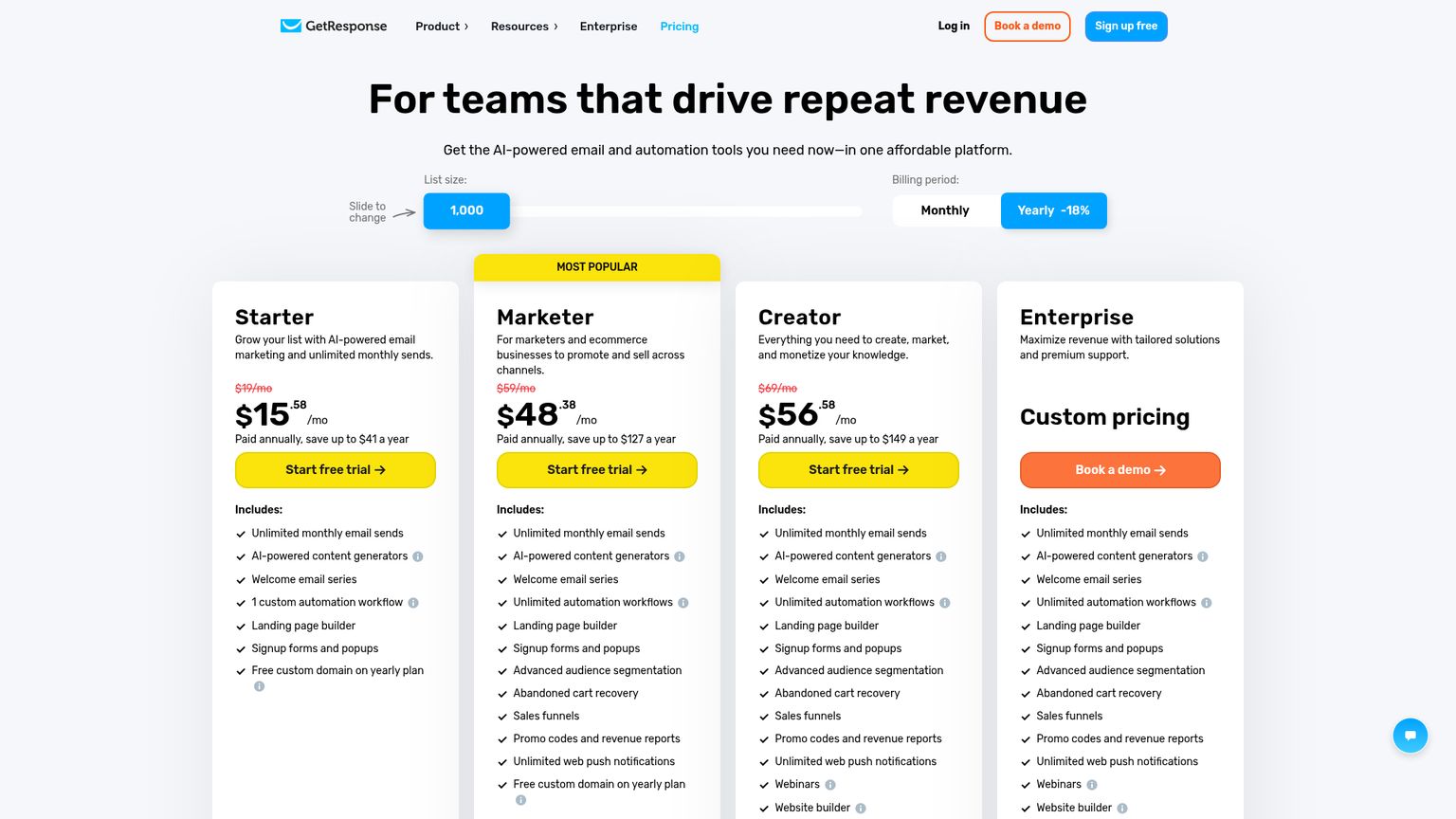
GetResponse is an email and marketing platform that makes sense when the business wants campaigns, landing pages and sales funnels together. At 1,000 contacts, Starter is $19 monthly, Marketer $59 and Creator $69. Starter includes a welcome series and one custom automation workflow; Marketer includes unlimited workflows, advanced audience segmentation, abandoned-cart recovery and sales funnels. Source: GetResponse pricing.
Best for: A small business combining email, lead capture and sales activity, or an educator adding a knowledge product.
Standout: Related marketing functions that can be evaluated as one operating system.
Pricing: Monthly Starter $19, Marketer $59, Creator $69 at 1,000. Annual equivalents are $15.58, $48.38 and $56.58. Enterprise is custom; no unverified 10,000-contact USD price is quoted here.
Free trial: 14 days, with limits on trial features.
The best reason to consider an all-in-one platform is the work it can remove between tools. Suppose a training business collects registrations on a landing page, sends preparation emails and sells a follow-up course. The owner should assess the whole path, including the records passed from one stage to the next. A lower email bill matters less if the replacement still requires repetitive copying between separate systems.
Starter can be sufficient when there is one defined welcome process and regular campaigns. Its unlimited monthly sends do not remove the one-custom-workflow limit. Those are separate dimensions: how many messages go out and how many distinct automated processes the product supports. If the business needs independent lead, customer and reactivation workflows, Marketer is the relevant quote to examine.
Creator adds webinars, a website builder, course creation and premium newsletter subscriptions. The displayed 1,000-contact tier supports up to 500 students. A student allowance is not a contact allowance; confirm both when planning a course. A business can have a large mailing list and a much smaller enrolled audience, or the reverse depending on how it organizes its records.
The monthly difference between Marketer and Creator at 1,000 contacts is $10, or $120 across a year. That is worth evaluating when a webinar or course function replaces something you already pay for and satisfies its requirements. It is wasted money when it merely creates another unused feature area. List the exact outside subscription or recurring task the upgrade would remove before assigning value to it.
For ecommerce, Marketer’s cart recovery and revenue reports make it a legitimate candidate. Omnisend and Klaviyo still deserve comparison when most decisions depend on store events. The better choice is the one that handles your actual customer path with the least manual correction, not the product with the longest feature menu.
- Starter combines email, forms and landing pages with a defined welcome workflow.
- Marketer adds unlimited workflows and specific sales and ecommerce capabilities.
- Creator can consolidate relevant webinar and course work for an education business.
- Starter’s one custom workflow can be too restrictive for a migration driven by automation needs.
- Additional functions only reduce costs if the business uses them and can retire existing work or subscriptions.
- A fresh 10,000-contact USD quote is needed before making the larger-list decision.
The decision rule: choose GetResponse when the combined registration-to-sale process is the advantage. Choose a narrower newsletter tool when publishing is the only job, or a specialist store platform when order-driven marketing dominates.
5. MailerLite vs Mailchimp: simpler campaign economics
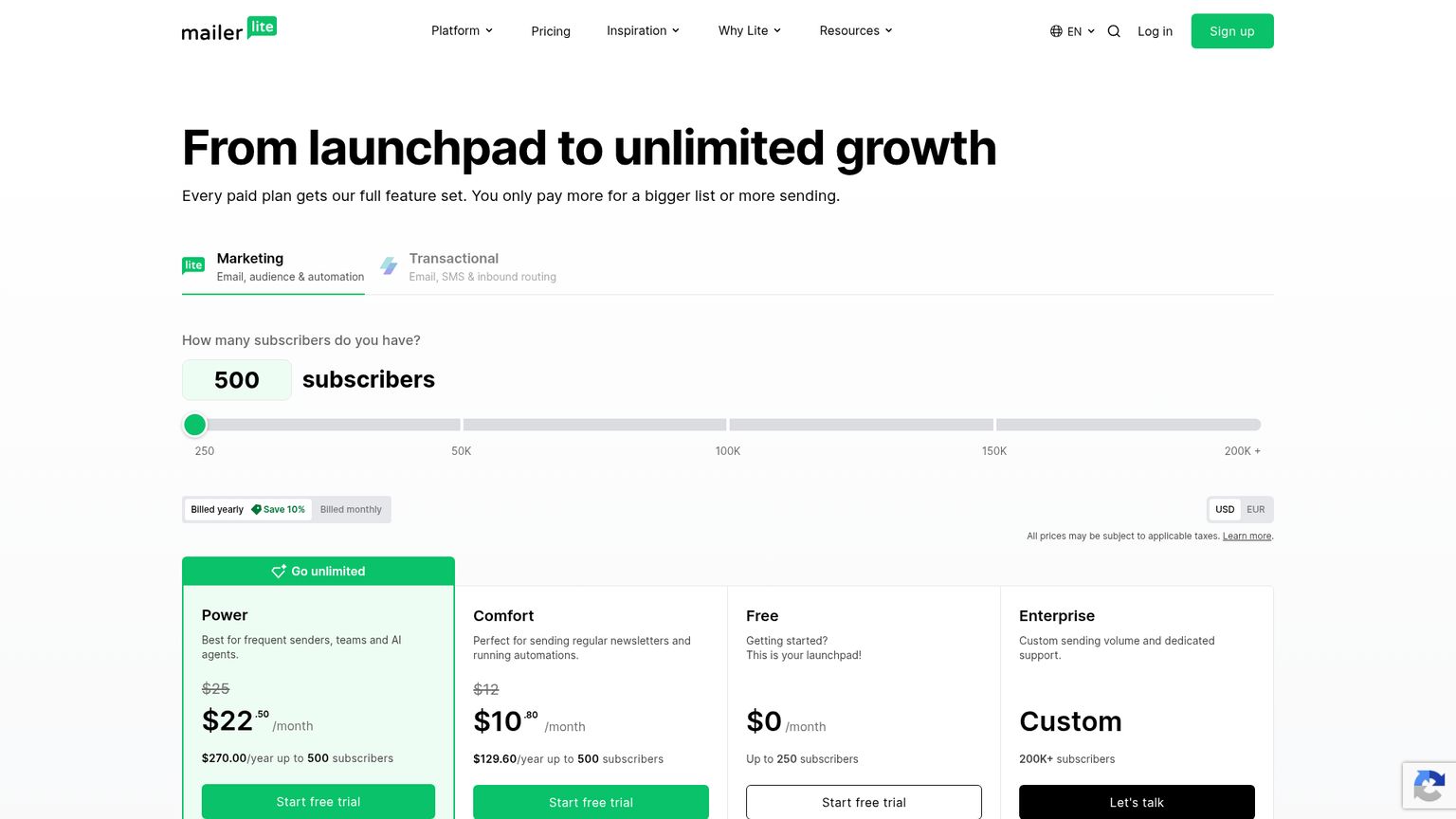
MailerLite is the clearest paid shortlist option for a small business that wants regular campaigns and automations without changing its whole marketing model. Its current paid tiers are Comfort and Power. At 1,000 subscribers they cost $19 and $39 monthly; at 10,000, $89 and $129. Free now covers 250 subscribers and 2,500 monthly emails, so an older free-plan claim should not decide this purchase. Source: MailerLite pricing.
Best for: A local business, small agency or service firm sending regular campaigns with manageable automation needs.
Standout: A clear choice between bounded sending on Comfort and unlimited sending on Power.
Pricing: Comfort $19/$89 and Power $39/$129 monthly at 1,000/10,000 subscribers. Free $0; Enterprise custom.
Free trial: 14 days, no credit card required.
Comfort includes 50 automations, three user seats, ten websites and landing pages, and ten signup forms. Power includes unlimited automations, users, landing pages and forms, plus multiple automation triggers. A trigger is the event that starts a workflow. Start by counting the distinct ways people should enter a process, rather than assuming every automation feature is interchangeable.
For a local services company, a newsletter, a seasonal reminder and an inquiry follow-up may be the complete brief. The owner needs to inspect how each process starts, which audience it uses and who maintains it. If Comfort supports the required setup, Power should earn its upgrade through sending volume, staffing or another named limit. A higher tier is not a substitute for writing the process clearly.
The sending allowance is a useful discriminator. Comfort includes 10,000 monthly emails at 1,000 subscribers and 100,000 at 10,000. Four full-list broadcasts use 4,000 or 40,000 respectively, leaving room for other messages. Ten full-list broadcasts use the entire allowance before automated messages. A business planning a busy promotional period should include that peak, not just an average quiet month.
At 10,000 contacts, MailerLite Comfort is $46 per month below Mailchimp Standard’s regular $135 rate, or $552 across a year. Against Mailchimp Essentials at $110, the difference is only $21 monthly, or $252 annually. Those are different switching cases. Compare against the Mailchimp tier you would actually keep after a cleanup, not an inflated baseline chosen to make the move look attractive.
A small agency should also price access honestly. Comfort’s three included seats may fit an owner, marketer and assistant. Power’s unlimited users may matter when more people need access, but the account’s permission requirements still need checking. An included seat count tells you how many users the plan admits; it does not prove that every approval or client-access arrangement works as you expect.
- Comfort provides a straightforward campaign and automation package with published limits.
- The monthly price can be compared without an annual commitment.
- Power’s unlimited sends and users give specific reasons to upgrade.
- Free does not cover either of the article’s target list sizes.
- Comfort’s sending allowance must cover automations as well as broadcasts.
- The savings against Mailchimp Essentials can be modest after migration labor.
The decision rule: choose MailerLite when the work is familiar campaign marketing and its current limits fit. Keep a working Mailchimp setup if the annual saving is too small to repay the move, or choose ActiveCampaign when the decisive requirement is a more demanding automation process.
6. Brevo: price the messages as well as the audience
Brevo is an email and multichannel marketing platform worth examining when the business needs marketing and transactional messages, or has a large audience it emails selectively. Transactional messages respond to a specific event, such as an order or account action. Brevo makes these available across its plans, but its pricing calculator also attaches contact allowances to sending bands. Do not assume the smallest advertised price includes any size of contact database. Source: Brevo pricing.
Best for: Businesses that can forecast sending volume and need marketing plus transactional communication.
Standout: The ability to assess a sending-volume budget alongside contact capacity.
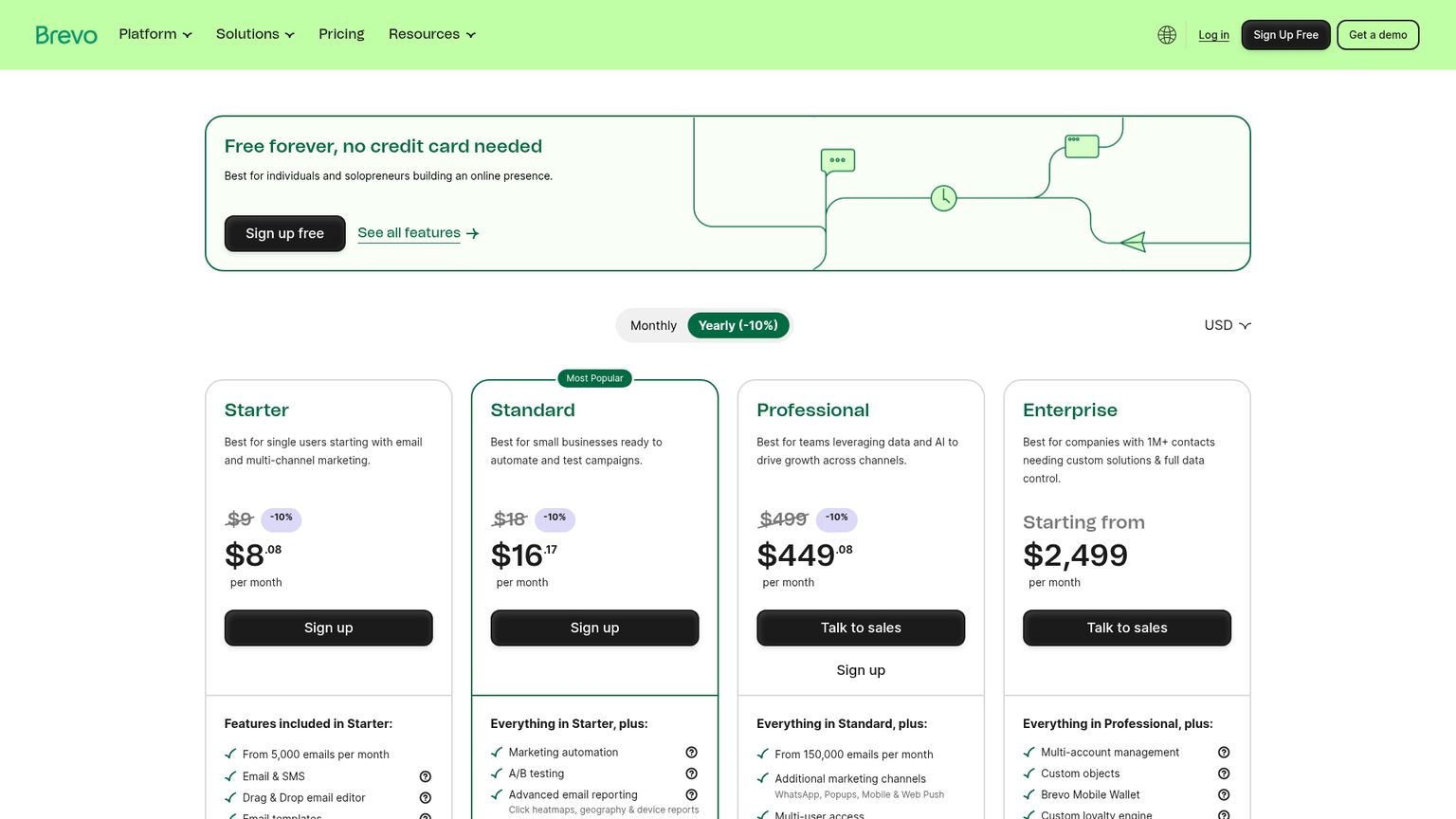
Pricing: For the modeled 1,000-contact workload, Starter $17 or Standard $35 monthly with 10,000 sends. For 10,000 contacts and 40,000 sends, Starter $46 or Standard $89 monthly.
Free trial: A Free plan is available, with up to 300 emails per day after sending approval; this is a daily limit, not a full-list allowance.
The base advertisements are lower: Starter begins at $9 monthly and Standard at $18 for the default 5,000-send band. The default calculator includes 500 contacts. That is why those numbers are not inserted into the 1,000-contact column. Selecting 10,000 sends lifts the contact allowance to 1,500. At the verified 40,000-send selection, the included allowance is 500,000 contacts.
For a service company with 10,000 contacts sending four broadcasts in a month, 40,000 messages is the broadcast budget before follow-up and transactional activity. Starter’s $46 quote is attractive if its functions are sufficient. Standard’s $89 quote adds the documented automation and testing package: unlimited multi-step workflows, A/B testing, web and event tracking, and removal of the Brevo logo. SMS credits remain separate.
The difference between those plans in that scenario is $43 a month. The owner should name the workflow that earns it. If the only task is a monthly update, avoid paying for unused automation. If different customer actions should trigger different follow-ups, price Standard and test those events. A cheap sender and a useful automation system are different purchases even when they share a brand.
Sending volume can also be a forecasting problem. A seasonal retailer may email a smaller engaged segment frequently, while keeping a larger database. Another business may send every edition to everyone. Both can have the same stored audience and different email consumption. Build the estimate from recipients multiplied by messages, with a separate allowance for triggered communication.
Brevo also lists Professional from $499 monthly, or a $449.08 annual-equivalent display, with a starting volume of 150,000 emails. Enterprise starts at $2,499 monthly on the US page. Those are different operating tiers, not the natural next purchase for a small business seeking to lower a Mailchimp bill. The annual-equivalent displays for the modeled Standard quotes are $31.50 and $80.08, respectively; the table uses monthly billing consistently for this row.
- Sending-volume quotes can fit a business that does not email its whole database frequently.
- Marketing and transactional messaging can be evaluated together.
- Standard has identifiable automation, testing and tracking additions.
- Entry-level contact allowances prevent treating the base price as an unlimited-list offer.
- Free’s daily cap does not suit a prompt broadcast to a large audience.
- Logo removal on Starter and SMS can add cost; a volume quote needs its options checked.
The decision rule: choose Brevo when its sending-volume economics and workflow fit your actual message pattern. Choose a subscriber-based unlimited-send newsletter plan when frequent full-list publishing makes that simpler.
7. Omnisend: the practical ecommerce starting point
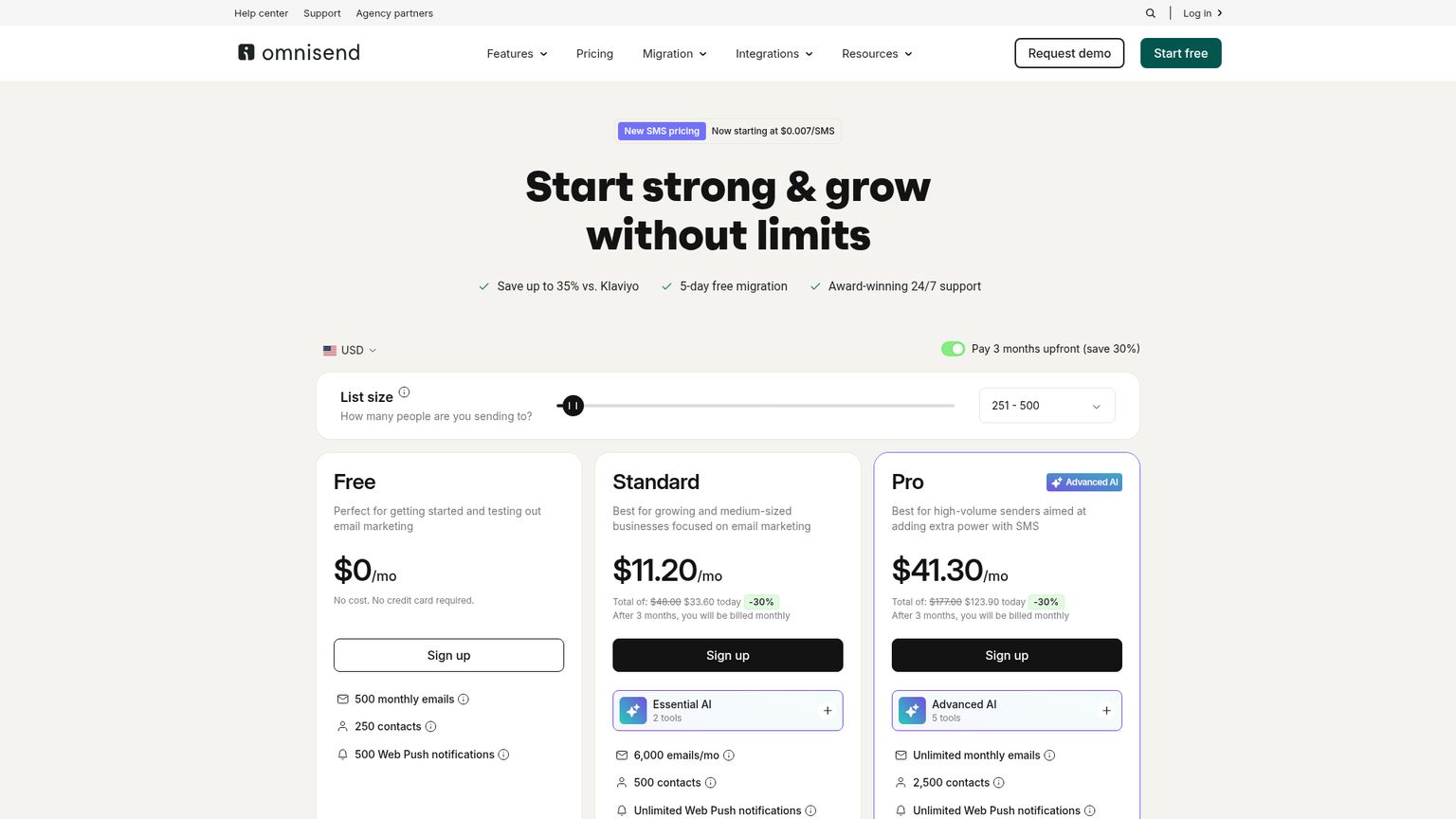
Omnisend is an ecommerce email and SMS platform with prebuilt welcome, cart-recovery and post-purchase automations. For a store moving beyond general newsletters, that is a useful starting shape: the marketing responds to shopping activity. At 1,000 billable contacts, Standard is $20 monthly and Pro $59; at 10,000, they are $132 and $150. These are the regular monthly rates, with the three-month prepayment promotion switched off. Pricing and automation capabilities.
Best for: An online store that wants customer-event-driven email without beginning from a blank workflow design.
Standout: Store-oriented automation templates and a relatively small Pro premium at the larger comparison size.
Pricing: Standard $20/$132 and Pro $59/$150 monthly at 1,000/10,000 contacts. Free $0; Custom quoted separately.
Free trial: Free is the evaluation route: up to 250 contacts and 500 monthly emails.
A store doing a hypothetical 50 orders a day has a different follow-up problem from a weekly publication. It needs to distinguish someone browsing from someone abandoning a cart, and both from someone who has completed a purchase. A template helps start that process, but the store still needs correct event data and an explicit rule for when a message becomes inappropriate.
Begin with the event that the customer would recognize. A welcome message should follow the relevant signup; a cart reminder should correspond to the cart event; a post-purchase message should make sense after the order. Then decide which other messages should be suppressed. Copy and timing matter, but a perfectly written reminder sent after the customer has already bought is a workflow defect.
Standard includes 12,000 monthly emails at the 1,000-contact selection and 120,000 at 10,000. Pro includes unlimited monthly emails; at the smaller selection its price covers a displayed minimum of 2,500 contacts. This explains why the Pro price does not shrink to match a 1,000-contact audience.
Billable contacts need attention during migration. Omnisend says the list includes subscribers and non-subscribers who receive automated messages; unsubscribed contacts are not billed. That is not the same definition as a simple count of newsletter subscribers. Ask the quote to reflect the store records and automation recipients you will actually carry over.
SMS should have its own business case. The page prices it separately by volume and destination, so the email comparison does not pretend to include a store’s text-message program. Decide which messages deserve that additional channel, how permission is recorded and what the total cost will be. Adding a channel just because the product supports it creates more messages without establishing more value.
- Prebuilt store workflows match welcome, cart-recovery and post-purchase jobs.
- Standard’s send allowances are visible at both comparison sizes.
- Pro’s unlimited-email upgrade is a small price step at 10,000 contacts.
- Chat and email support are available around the clock on all plans.
- Billable automation recipients can differ from the newsletter subscriber count.
- A temporary prepayment discount can obscure the continuing monthly price.
- SMS is an additional budget, and templates still require store-specific checks.
The decision rule: start with Omnisend when an ordinary store’s welcome, recovery and post-purchase flows are the work to improve. Put Klaviyo beside it when customer data and more detailed segmentation will drive a substantially different marketing program.
8. Klaviyo: ecommerce where customer data changes the message
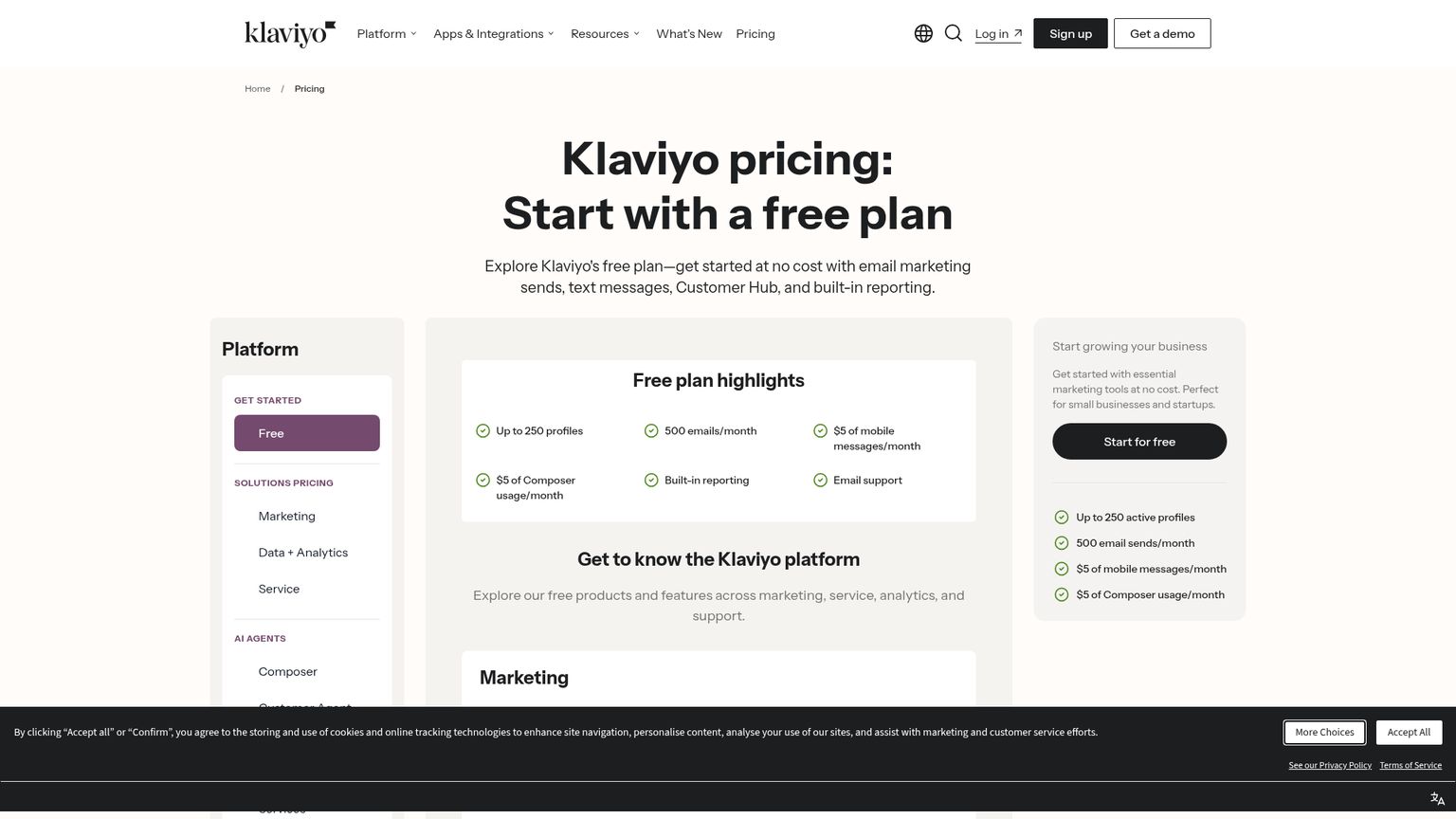
Klaviyo is a customer-data-centered marketing platform for businesses that want purchase history and browsing behavior to shape campaigns and automated flows. Its email product documents welcome, abandoned-cart and post-purchase automation, segmentation and product recommendations. The email-only quote is $30 monthly for 1,000 active profiles and $150 for 10,000, with 10,000 and 100,000 monthly sends respectively. Pricing and email capabilities.
Best for: An ecommerce business with useful customer data and someone responsible for segmentation and lifecycle marketing.
Standout: Personalization informed by shopping and purchase behavior.
Pricing: Email-only Marketing $30/$150 monthly at 1,000/10,000 active profiles. Other products and messaging are selected separately.
Free trial: The Free plan supports up to 250 active profiles and 500 emails monthly for evaluation.
An active profile is a contact eligible to receive marketing email. It is a billing unit, not proof that the person opens messages or buys regularly. A store migrating a large audience should work from the platform’s definition and the statuses it will import, rather than the most flattering count in an old newsletter report.
The strongest use case is a store whose next useful message depends on what a customer has done. A first-time buyer may need product guidance. A repeat buyer may need a different recommendation. Someone browsing a specific category may be relevant to a campaign that would be noise for the rest of the audience. Klaviyo’s value grows when those distinctions change what the marketer sends.
Data is the dependency. If product categories are inconsistent, purchase records are incomplete or nobody owns the segment definitions, the platform has less useful information to act on. Before moving, choose a small set of customer situations that matter commercially and identify the record that proves each one. “High-value customer” is not a working segment definition until the business decides what makes someone high value.
At 10,000 profiles, Klaviyo’s email quote is $18 above Omnisend Standard. However, Klaviyo’s quoted allowance is 100,000 sends versus Omnisend Standard’s 120,000. At the same $150 monthly amount, Omnisend Pro includes unlimited emails. That does not decide the product choice by itself, but it prevents “same price” from being mistaken for “same capacity.”
The sensible evaluation compares the same proposed workflow in both products. Use the same customer event, the same audience definition and the same intended outcome. Then inspect what information arrives, what a marketer must configure and how the business will check the result. A broader data model is valuable when it helps make a better decision; otherwise it can become another layer to maintain.
Klaviyo’s pricing interface also offers separate products such as mobile messaging, Composer, Customer Hub and Reviews. The table is deliberately an email-only quote. Do not compare a configured multi-product Klaviyo bill with a competitor’s bare email subscription and conclude that the whole difference is the email sender.
- Documented personalization uses purchase history and browsing behavior.
- Segmentation and lifecycle flows support a differentiated ecommerce program.
- The active-profile and send allowances make the email-only budget explicit.
- Better data and clear segment ownership are prerequisites for getting value from the sophistication.
- The quoted email allowance is lower than Omnisend Standard’s at 10,000.
- Additional products and messaging can widen the bill beyond this comparison.
The decision rule: choose Klaviyo when richer customer distinctions will change campaigns and someone can maintain them. For a store needing the standard lifecycle flows first, compare Omnisend’s simpler operating brief before paying for a more ambitious program.
Alternatives to Mailchimp: choose the workflow before the brand
Choose the product family from the activity that earns revenue. A newsletter audience, a services pipeline and a store customer base can all contain email addresses, but the next useful message is determined differently.
If your revenue follows publishing, start with Kit or beehiiv. Kit is the creator-newsletter starting point, especially when its large Free allowance covers the work. beehiiv belongs near the top when the publication itself is being monetized. MailerLite also deserves a quote when the requirement is straightforward business campaigns rather than a distinct publication business.
If revenue follows a sequence of decisions after an inquiry, compare ActiveCampaign Plus and GetResponse Marketer. Ask what should happen after each meaningful event and where a human takes over. ActiveCampaign is the automation-first evaluation; GetResponse becomes more compelling when landing pages and related sales functions belong in the same system.
If revenue follows shopping and repeat purchases, compare Omnisend and Klaviyo. Begin with the customer events your store can supply reliably. A platform cannot act on an event that the connected setup does not provide correctly.

Brevo is the cross-cutting option when sending volume, transactional messages and marketing need to be budgeted together. The full best email marketing software comparison covers the broader category; this shortlist is specifically about replacing an existing Mailchimp job.
Cheap Mailchimp alternatives: count sends and migration work
The cheapest viable alternative is the one that performs the required work at the lowest total operating cost. Subscription savings alone can be too small to justify rebuilding a functioning system.
Start with a sending budget. Four broadcasts to 1,000 contacts use 4,000 emails; four to 10,000 use 40,000. Ten broadcasts use 10,000 or 100,000. Then add welcome messages, purchase follow-ups, reactivation and any other triggered sends. These are planning calculations, not predictions of how many messages your business should send.
Next, price the actual people and capabilities. A single-user automation plan can be a poor quote for a business needing several operators. A free newsletter allowance can be irrelevant to a store that needs order-driven workflows. A volume-priced sender can be economical for occasional campaigns and less attractive for frequent full-list publishing.
Finally, put a value on migration work. Include mapping records, rebuilding templates and automations, checking integrations, replacing forms, training the operator and running the transition. Include any period when both subscriptions remain active. Leaving that work out is equivalent to treating your own time as free.
That calculation favors staying when the existing system works and the price difference is small. It favors moving sooner when the existing workflow repeatedly creates manual work or blocks a valuable process. Name that work separately from the subscription saving so the business can assess both.
Annual billing also changes the decision. An annual equivalent is useful for comparing ongoing cost, but the bill and commitment arrive on a different schedule. Verify the replacement’s complete workflow before choosing a long commitment solely for the discount. A small reduction in subscription cost does not compensate for buying the wrong operating model.
Free Mailchimp alternatives: check who can receive a full send
Kit has the strongest verified free audience allowance in this shortlist, but free capacity is not the same as free automation. Its Free plan covers up to 10,000 subscribers with unlimited broadcasts. beehiiv Free covers 2,500 subscribers with unlimited sends. Those are practical publishing options when their included features fit. Kit, beehiiv.
MailerLite Free is now a small-list starting point: 250 subscribers and 2,500 emails a month. Klaviyo and Omnisend Free each support 250 contacts or active profiles and 500 monthly emails. They can help evaluate the product with a small audience, but they do not make a 1,000- or 10,000-contact migration free. MailerLite, Klaviyo, Omnisend.
Brevo’s Free limit is 300 sends a day after approval. Even ignoring all other constraints, a broadcast to 1,000 people would require at least four days at that cap; a broadcast to 10,000 would require at least thirty-four. That is arithmetic illustrating the limit, not a recommended way to schedule a campaign. It is a poor match for a time-sensitive offer that everyone needs to receive together. Brevo.
For a local business, ask whether “free” still works on the day the campaign matters. The relevant limit could be the audience, the send allowance, the workflow or the brand presentation. Write down that requirement before being attracted by a zero in the pricing card.
Stay on Mailchimp if the existing system earns its keep
Mailchimp is worth keeping when the current forms, campaigns, integrations and automations already support the business, and a replacement’s savings do not repay the move. Familiarity has an economic value when it reduces recurring work. It also needs to be weighed against any repeated limitation that is forcing the business to work around the product.
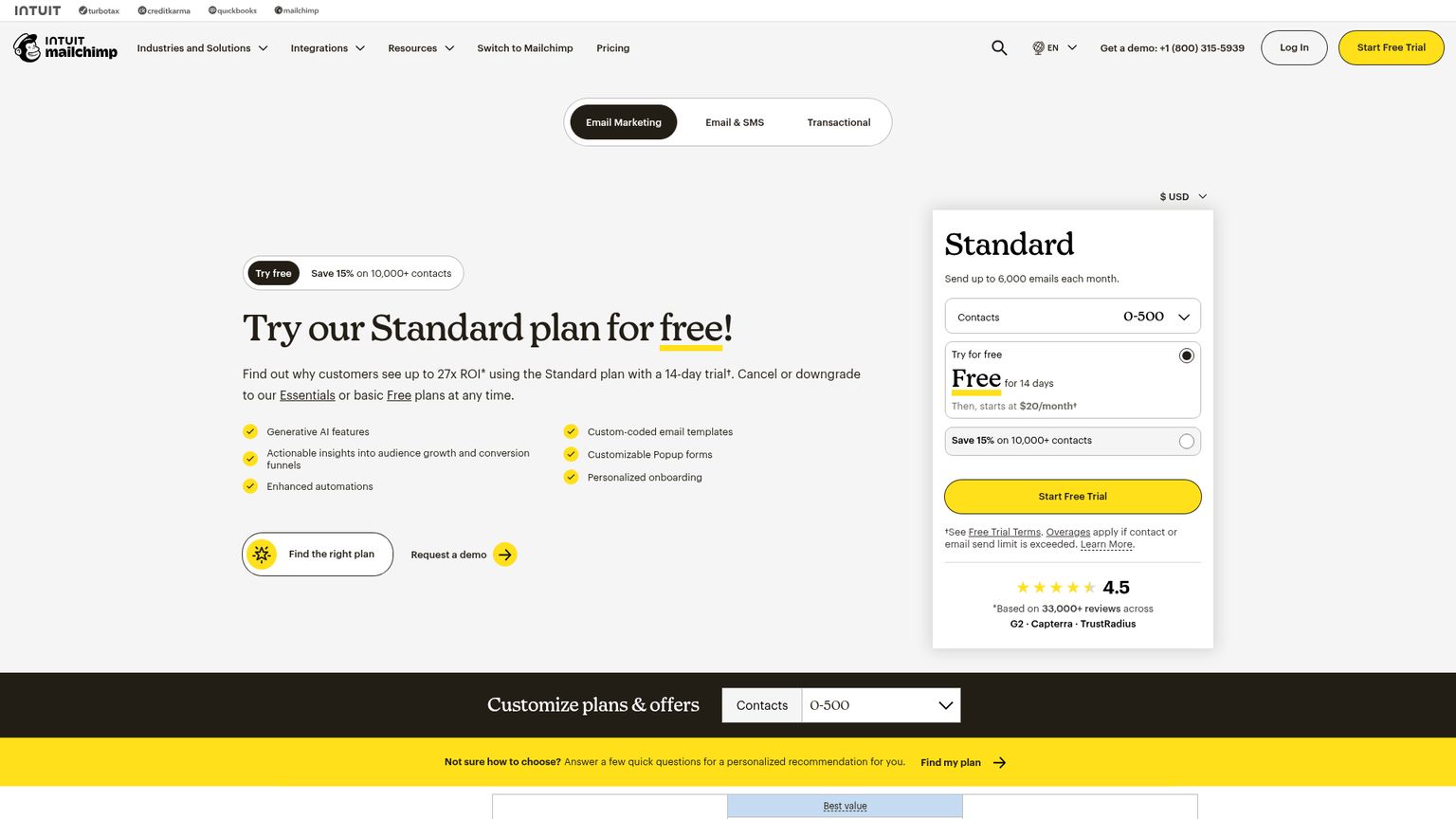
The verified regular monthly baseline is Essentials at $26.50 and Standard at $45 for a 1,000-contact requirement, which maps to the 501 to 1,500 band. At 10,000 contacts, Essentials is $110 and Standard $135. Premium starts at $350. Free supports 250 contacts and 500 monthly sends. Introductory discounts are excluded from those comparisons. Mailchimp’s own pricing page.
Stay if a cleanup addresses the bill without disrupting the work. Mailchimp counts subscribed, unsubscribed and non-subscribed contacts toward the plan limit. Archived and cleaned contacts do not count. Review those statuses before assuming every record in the account needs to remain billable. Archiving retains the record while preventing marketing sends; permanent deletion is a different action. Mailchimp’s contact definitions.
Stay if the required workflow already works and the proposed replacement has only a modest price advantage. The migration-payback example above is especially relevant to a small business moving from Essentials. A new interface is not a business outcome. A lower bill is an outcome, but it needs to be large enough relative to the time and disruption required.
Stay if the operating dependencies are valuable. An existing signup process, approved campaign template or connected customer workflow needs to be rebuilt and checked somewhere else. List those dependencies in plain language. Then test whether the alternative preserves them, improves them or forces the business to accept a compromise.
Move when the opposite is true: the bill remains unnecessarily high after a sensible cleanup, the required automation does not fit, or the customer workflow needs a specialist. Use the Mailchimp pricing breakdown for the deeper billing mechanics instead of treating this comparison as a complete account audit.
Mailchimp alternatives for nonprofits
GetResponse deserves a nonprofit quote when its features fit, but the discount has conditions. Its program describes a 50% discount subject to eligibility and approval. The organization must place the GetResponse logo on its website within four weeks; the discount cannot be combined with annual or other discounts and is valid for twenty-four months. Verify eligibility and renewal cost before budgeting it as permanent. GetResponse’s nonprofit program.
For a small organization, the workflow may be a donor newsletter, an event-registration sequence or a recurring supporter update. Those are different requirements. A discounted plan with more functions is not automatically easier for a volunteer to maintain. Choose the simplest plan that the organization can operate reliably, then assess whether the discount changes the decision.
If the work is mainly a publication, Kit or beehiiv’s ordinary free offering may be relevant without a nonprofit-specific deal. If the work needs several automated journeys, price those capabilities directly. Also identify who will own the account when staff or volunteers change; continuity of access and documented processes can matter more than a small monthly saving.
How these were picked
The recommendations turn on workflow fit, usable capacity and the total cost of operating the replacement. Prices and capabilities were checked against each maker’s live site on 11 October 2026, including interactive contact and send selectors where accessible. This was a documented comparison, not an inbox-placement benchmark or a hands-on trial of every product.
The first criterion is what starts the message: a publication schedule, a subscriber action, an inquiry or a store event. The second is whether the needed workflow fits the selected tier. The third is the combined bill for contact capacity, sends, users and relevant extras. The fourth is how much work the business must perform to move and maintain it.
No deliverability winner is declared. A published feature list does not establish where a particular business’s emails will land. Likewise, vendor averages for advertising income or attributed revenue are not treated as forecasts for the reader. The original contribution here is the dated price verification, the comparable sending scenarios and the migration-payback calculations.
The field is limited to eight alternatives with distinct roles. Adding more names would not improve a decision already narrowed to newsletters, automated sequences or ecommerce. Bouncer appears separately below because it checks addresses during migration; it does not replace an email platform.
Some product links are partner links and may earn a commission. Commercial relationships do not change the fit criteria or the reasons to skip a product. Kit, beehiiv, ActiveCampaign and GetResponse are featured in the jobs where their documented capabilities make sense.
The ones to avoid
Avoid a mismatch between the work and the tier, even when the brand is good. These are specific poor fits, not a blacklist of products.
Avoid ActiveCampaign Starter for a process that already requires more than five actions per automation. If automation depth is the reason for leaving, selecting the constrained tier recreates the problem. Price Plus, simplify the proposed process for a business reason, or choose another suitable platform.
Avoid beehiiv as the default replacement for a store’s order-driven marketing program. Its strongest case here is the publication business. A merchant should first evaluate the store workflows, event data and sending economics of Omnisend or Klaviyo. Choose beehiiv when the store is also running a publication with a distinct purpose.
Avoid Klaviyo for a broadcast-only requirement with no plan to use customer distinctions. The richer ecommerce evaluation has little value if every person will receive the same occasional update and nobody will maintain segments. Kit, MailerLite or an appropriate Brevo quote may fit that simpler brief better.
Avoid MailerLite Free for a 1,000-contact migration and Brevo Free for a same-day 10,000-recipient campaign. The current caps do not support those plans as described. Old pricing screenshots and generous-sounding free labels do not change the published limits.
Avoid GetResponse Creator when there is no course, webinar or other Creator-specific job to do. Start with the tier required by the email and automation process. Pay for the broader package when it replaces work the business has decided to perform.
Finally, avoid switching solely because a tool advertises a lower entry price. Ask for the contact band, sending volume, billing term and feature tier together. The table shows how quickly an attractive starting number becomes the wrong comparison.
Move the audience without losing the workflow
A successful migration preserves who may receive messages, what you know about them and what should happen next. Moving email addresses alone does not preserve the operating system around the audience.
Before opening an import screen, identify the live sources of new contacts and the messages that already run automatically. A small business may remember its main signup form and overlook another form on an old landing page. An online store may have several triggered processes. The inventory should describe each source, destination, owner and intended outcome in plain language.

Export the meaning of the records
Preserve subscription status, the source of permission, useful audience fields and the tags or groups that affect your messages. Keep unsubscribe and suppression records available. Do not turn every exported row into a new subscriber simply because the destination accepts an email address.
Translate the audiences and processes
Write down how each important segment is defined and how each automation starts and stops. Match those rules in the new platform, then compare sample records. Similar labels in two products do not prove that the underlying audience contains the same people.
Rebuild the smallest valuable workflow
Begin with the process that motivated the move: the creator’s welcome sequence, the consultant’s inquiry follow-up or the store’s cart recovery. Check the entry event, messages, stopping condition and handoff. Establish that it works before rebuilding every historical campaign.
Check customer situations and sending setup
Use records representing a new subscriber, a returning buyer and an unsubscribed person. Verify the expected behavior for each, including who receives nothing. Follow the new provider’s domain-authentication instructions and check links, forms and sender details before a live campaign.
Switch the sources, then reconcile
Move signup forms and integrations deliberately, with an owner for each. Confirm that new records arrive in the intended place and that overlapping automations do not both send. Keep exports and the old account accessible until the transition has been reconciled, then decide what to retire.
Bouncer: an optional check for stale addresses
Bouncer is an email-verification service that belongs beside a migration when an old list has a specific address-quality problem. Its verification app and API assess addresses, while its Deliverability Kit provides inbox-placement, authentication and blocklist checks. It is an optional supporting tool, not a ninth Mailchimp alternative. Source: Bouncer.
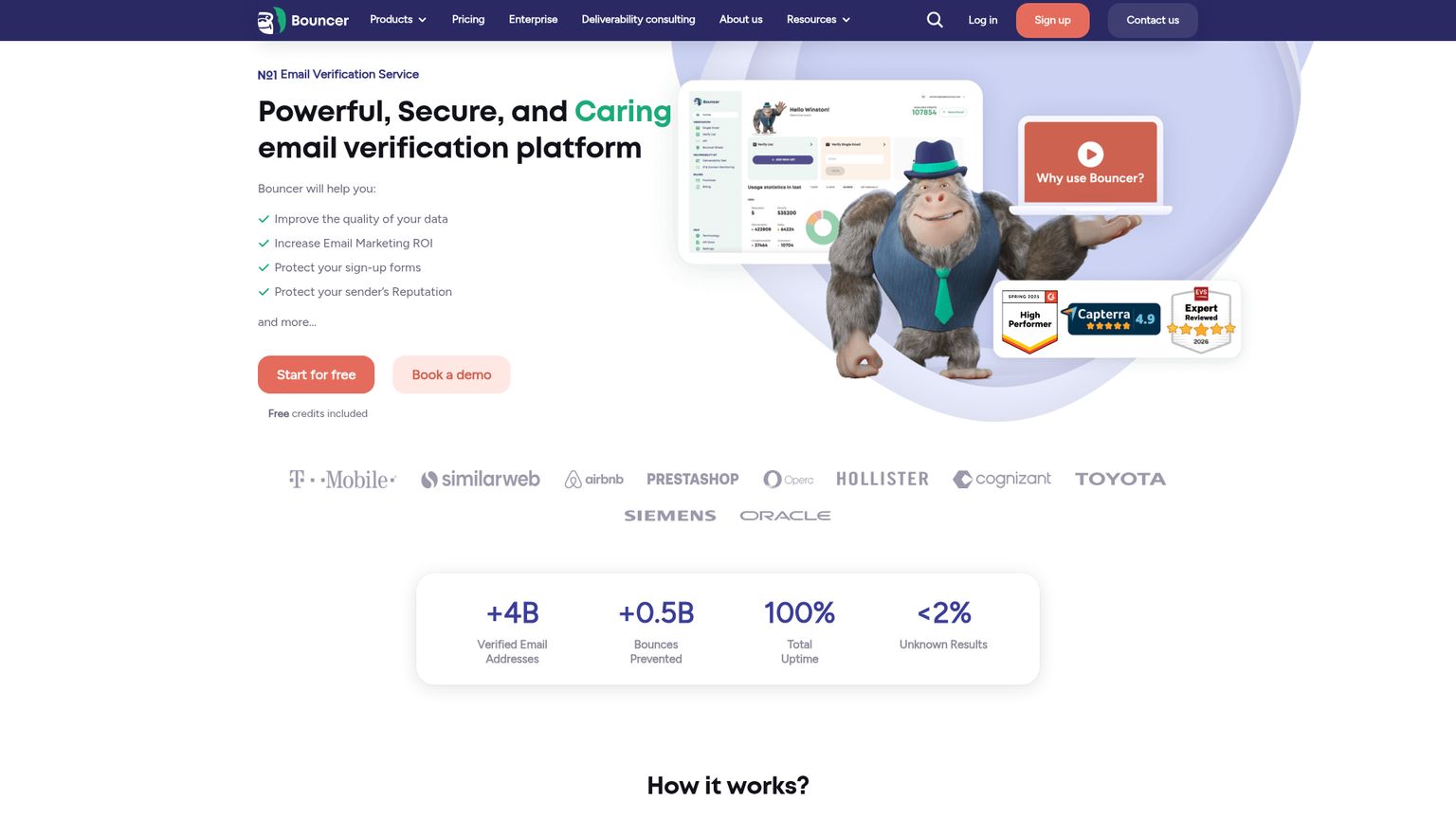
A business importing a neglected audience should first ask whether the records still belong in the marketing process. Address verification can help assess whether an address is usable; it does not establish permission, explain the person’s interests or justify restarting promotional messages. Preserve those distinctions in the migration plan.
Use Bouncer when the address check answers a concrete question that the current data cannot resolve. Skip a separate verification purchase when the list is recent, well-maintained and there is no identified address-quality issue. The value is reducing a particular uncertainty, not adding another subscription to every migration.
For Monday’s move, choose the relevant platform family, obtain a quote at your current list and realistic sending volume, and write the acceptance cases for the workflow that matters most. A small, representative evaluation gives you a better purchase decision than importing the whole database and discovering the feature limit afterward.
Frequently asked questions
What is the best free Mailchimp alternative?
Kit is the strongest free starting point for a creator newsletter in this shortlist: it supports up to 10,000 subscribers and unlimited broadcasts. beehiiv Free covers up to 2,500 subscribers with unlimited sends. Choose from the included workflow features as well as audience size; neither allowance means every paid automation feature is free. Kit, beehiiv.
Is MailerLite as good as Mailchimp?
MailerLite is a strong replacement for regular campaigns when its automation, sending and access limits fit the business. At 10,000 subscribers, Comfort costs $89 monthly versus Mailchimp Essentials at $110 or Standard at $135. Keep Mailchimp when existing dependencies and migration work outweigh that saving. MailerLite, Mailchimp.
Can I migrate my Mailchimp list to a competitor?
Yes, but confirm the destination’s import requirements before moving records. Preserve subscription and suppression statuses, useful audience fields and the rules behind segments and automations. Check representative customer paths before switching live forms or integrations. An imported email address alone does not preserve the workflow or establish permission to send.
Use the AI Business Workflow Audit Checklist to map the email processes worth moving before committing to a replacement.
- Published
- Category
- Growth
- Language

Zendesk Alternatives 2026: Tidio, Chatbase, CloudTalk and Helpdesks
Compare Zendesk alternatives by support model: Tidio, Chatbase, CloudTalk and leading helpdesks, with current prices, AI charges and switching advice.Oct 10, 2026Growth
Best CRM for Small Business in 2026: Pipedrive, Close, folk, Keap and More (Compared)
Compare nine small-business CRMs by how you sell, verified prices for five users, free-plan limits, setup effort and the upgrades that matter.Oct 10, 2026Growth
Later Pricing: Plans, Add-Ons and the Five-Client Bill
Later plans, social sets, users and add-ons priced for a solo brand and five-client agency. Compare annual and monthly bills with three alternatives.Oct 10, 2026Growth
Apollo Alternatives in 2026: Lusha, FullEnrich and Amplemarket Compared
Compare Apollo alternatives for contact data, sequencing or both, with current prices, credit costs and reasons to stay on Apollo.Oct 10, 2026Growth
9 Semrush Alternatives in 2026: SE Ranking, Ahrefs and DataForSEO
Compare nine Semrush alternatives by job, price and limits, including SE Ranking and DataForSEO. Know what you save and what you give up.Oct 10, 2026Growth
WhatConverts Pricing: Plans, Usage and Agency Bills
WhatConverts plans, usage credits and fees explained, with bills for one business and 20 clients, plus a fair CallRail cost comparison.Oct 10, 2026Growth
Beehiiv Review
Beehiiv reviewed for business newsletters: current pricing, growth, monetization, AI, MCP, analytics and the costs that change the buying decision.Oct 10, 2026Growth