9 Semrush Alternatives in 2026: SE Ranking, Ahrefs and DataForSEO
Compare nine Semrush alternatives by job, price and limits, including SE Ranking and DataForSEO. Know what you save and what you give up.
Published
 By Omid Saffari


SE Ranking is the first of these Semrush alternatives to consider when you want rank tracking, keyword research, site audits and AI visibility in one subscription: Core costs $129 monthly, $70 less than Semrush Starter. DataForSEO fits a different buyer: someone who can build a workflow around metered data instead of buying another seat. Keep Semrush when the replacement would cost more in missing features and extra work than it saves.
Pricing and published plan limits verified on 10 October 2026. Prices below are USD. Monthly subscriptions, annual monthly equivalents and prepaid API balances are labelled separately. The recommendations come from current vendor pages and the calculations shown here, not hands-on product testing.
SE Ranking and DataForSEO are partners. This site may earn a commission through their links. Recommendations still depend on the work, price and limitations described below.
Semrush alternatives at a glance
Choose the job first. A founder who needs a weekly keyword check can spend much less than a marketing lead who needs daily monitoring, technical audits and AI answers across several markets. An API can lower the data bill while increasing the work required to produce a usable report.
The annual offers above require annual billing. Ubersuggest's displayed offer is promotional, not a promise about renewal or a cancellable $16 monthly subscription. Similarweb is included because it can replace an important job, not because its current page proves a saving.
Semrush pricing: identify the bill you are replacing
Semrush has two different entry comparisons. Its SEO plan is $139 monthly, while Starter is $199 monthly for the explicitly quantified SEO and AI Search bundle. Switching to SE Ranking Core therefore saves $10 or $70 per month, depending on your starting point. Those differences are calculated from Semrush's own pricing and SE Ranking's subscription page.
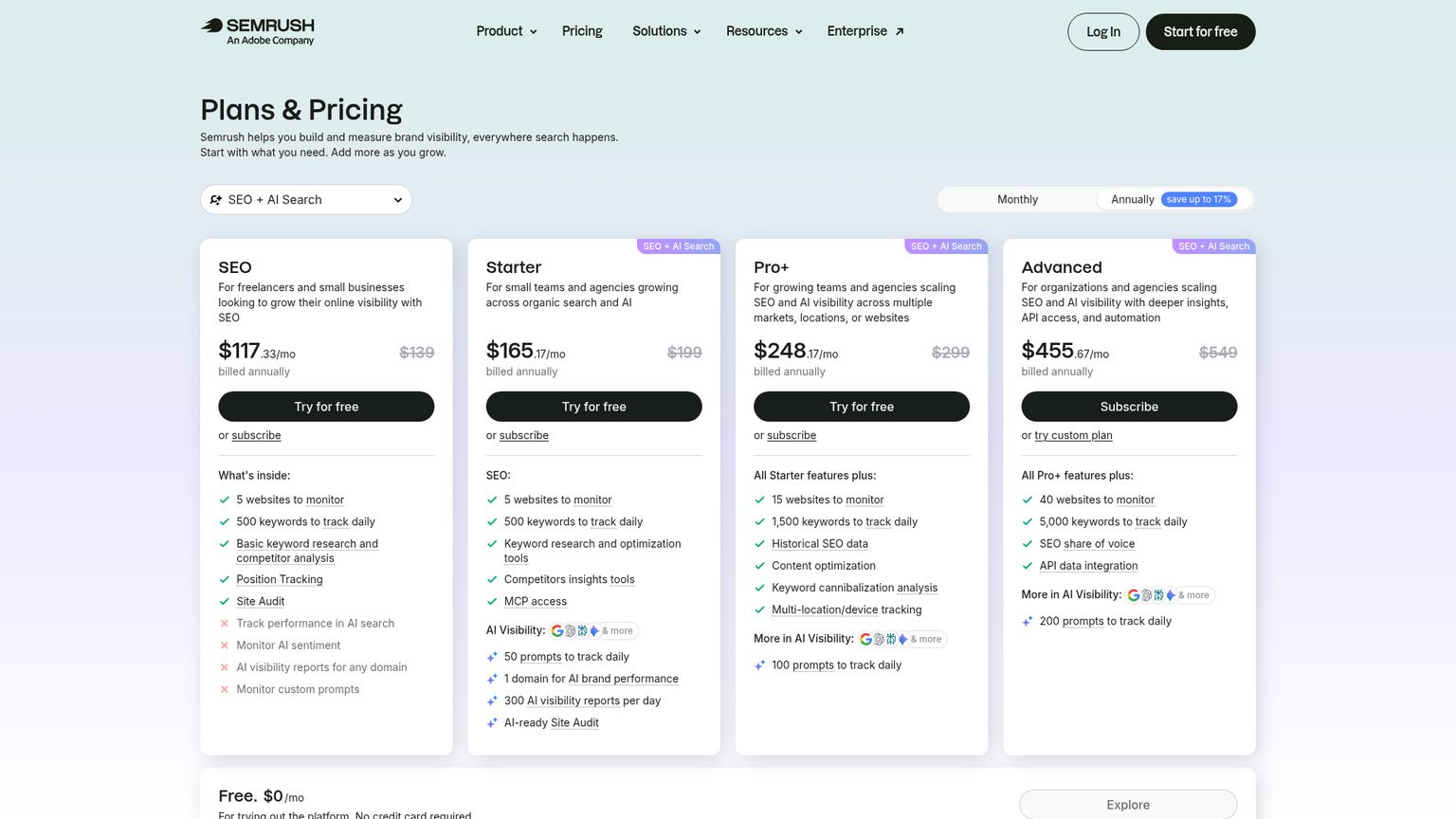
The current Semrush lineup is SEO $139, Starter $199, Pro+ $299 and Advanced $549 per month. The displayed annual monthly equivalents are $117.33, $165.17, $248.17 and $455.67, respectively; Enterprise is custom and a limited free account exists. Starter includes 500 daily keywords and 50 daily AI prompts. Pro+ adds historical SEO data, content optimization, keyword cannibalization analysis and multi-location/device tracking. Cannibalization means your own pages compete for the same query. Current plans.
For a founder checking one site's visibility, several alternatives are enough. For a growth lead coordinating content, markets and client reporting, removing one integrated workflow may create several subscriptions and a recurring reconciliation task. The Semrush pricing breakdown covers the wider bill; the Semrush review covers the product decision.
How these were picked
The strongest replacement preserves the work you act on. These nine picks cover the requested field, with different winners for an operating suite, link research, paid-search intelligence, market research and API data. Their order reflects usefulness to a small team leaving Semrush, not a universal ranking of data quality.
The comparison uses four buying criteria:
- Job coverage: can the quoted plan research keywords, track rankings, diagnose site problems and measure the AI visibility you need?
- Useful capacity: are its projects, seats, crawl allowance and refresh schedule enough for the actual workload?
- Completed cost: what happens after annual commitments, upgrades, AI allowances and implementation time?
- Decision quality: does the output tell someone what to investigate or change, rather than merely adding another score?
Prices and published limits were checked against vendor pages on 10 October 2026. The evaluation combines those specifications with the workload calculations shown below; it does not claim hands-on trials, measured accuracy or client results. No database-size ranking is used: a published index total would not, by itself, establish coverage of your market or the accuracy of your decisions.
For a local-services owner, the acceptance question is whether the replacement finds the relevant queries and exposes problems on the pages that generate enquiries. For a business-to-business (B2B) software company, it is whether research, technical checks and visibility reports support the next content or product-marketing decision. A longer feature list cannot settle either question.
The nine alternatives, by the work you need
1. SE Ranking: the first suite to compare
SE Ranking is an SEO platform for teams that want research, monitoring and audits in one account. It is the first shortlist choice for a founder replacing Semrush's recurring SEO work, particularly when AI visibility also matters. Core combines keyword, competitor and backlink research with website and on-page audits; its published capacity is 10 projects, one manager seat, 2,000 daily keywords and 250,000 audit pages per month. Included features and limits.
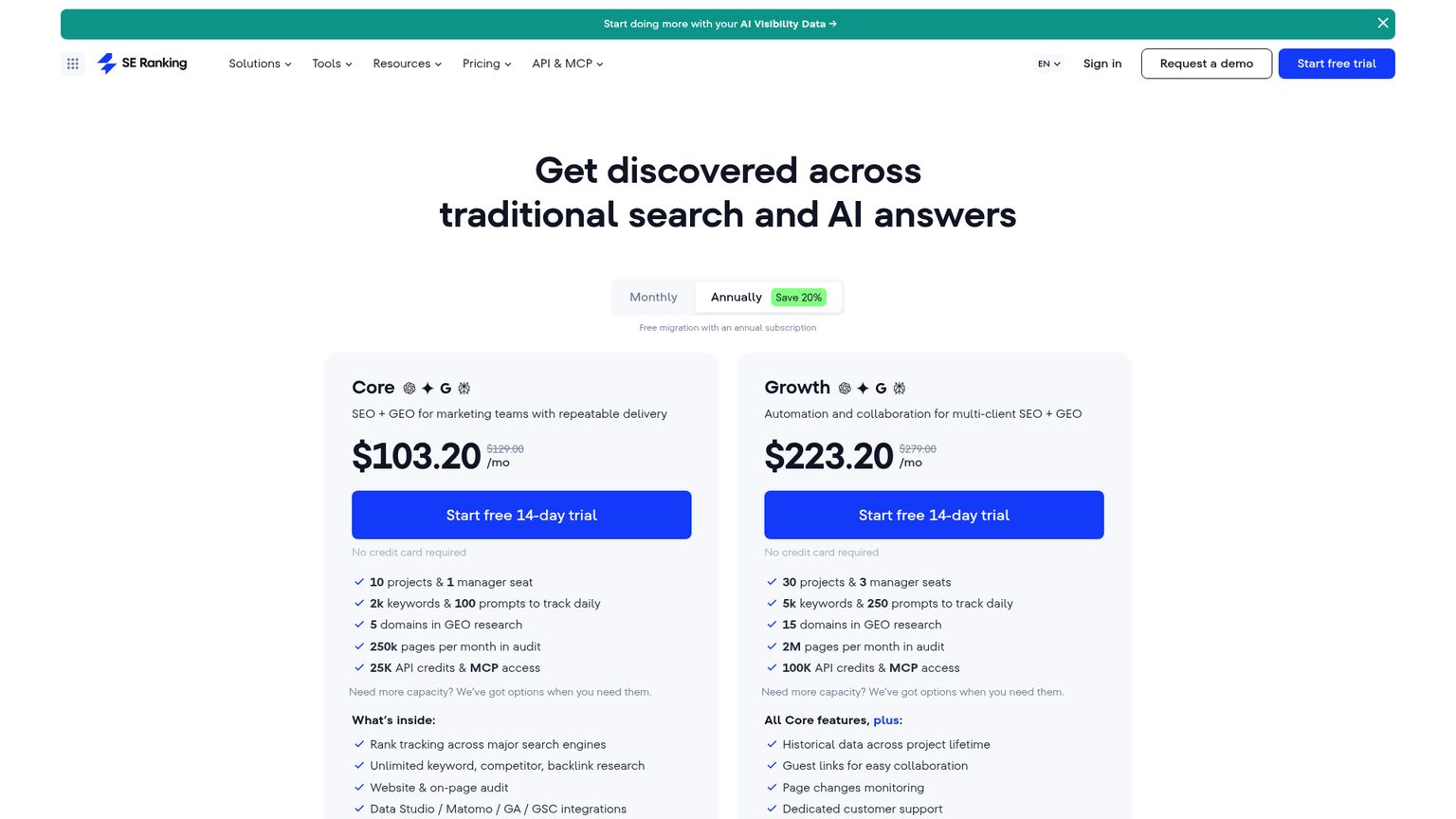
A founder and an external SEO consultant should decide who needs to operate the account. One manager seat is a practical constraint when both people expect simultaneous access. Growth includes three manager seats and 30 projects, plus guest links and page-change monitoring, but a higher tier can consume the saving that prompted the move. Do not buy more project capacity when the problem is simply another person needing access; obtain the seat-specific total first. Plan differences.
Best for: A small marketing operation that needs an integrated alternative rather than a collection of specialist tools.
Standout: Daily keyword tracking alongside core research, audits and AI monitoring.
Pricing: Core $129/month or $103.20/month annually; Growth $279/$223.20; Enterprise custom. The entry AI Search add-on is $89 monthly or $71.20/month annually. Optional Agency Pack starts at $69/month, API add-on at $45/month, both annual-only; standalone API starts at $179/month, annual-only. Live pricing.
Free trial: 14 days, no credit card required. Its published allowances differ from the paid plan.
SE Ranking vs Semrush
SE Ranking Core is the better budget candidate when its included workflow and capacity meet your needs. The monthly saving against Starter is $70, or $840 over a year of monthly payments. Against Semrush SEO, it is just $10 monthly, or $120 over a year. These are subscription differences before extra seats, add-ons and tax, not estimates of business return.
AI visibility needs a closer read. Core's price card advertises 100 prompts to track daily, but SE Ranking's help documentation separately describes account-wide prompt slots and monthly checks. A check is one prompt on one AI engine. Its tracker covers Google AI Overviews, Google AI Mode, Gemini, ChatGPT and Perplexity. Confirm the included check allowance for your intended engine mix before treating the headline prompt count as an all-engine daily entitlement. The usage definition comes from SE Ranking’s AI Results Tracker FAQ, checked on 10 October 2026.
For a software founder, a useful AI report identifies customer questions where the brand is absent and the sources worth investigating. It should not become a celebration of mentions without any link to a commercial page or follow-up action. The SE Ranking review goes deeper into the distinction between prompt slots, checks, mentions and citations.
- Core covers the principal research, tracking and audit jobs in one subscription.
- Its published daily keyword allowance suits a substantial small-team watchlist.
- AI monitoring is part of the buying comparison, rather than automatically another full platform.
- Core includes only one manager seat.
- Prompt slots and monthly checks must be reconciled for your workload.
- Adding AI capacity can make the bill higher than Semrush Starter.
Use the trial to reproduce a weekly decision, not to browse every report. The following is an evaluation workflow based on the documented ranking settings and import support, not a claim that these steps were exercised here. Rank Tracker capabilities.
Bring the working keyword list
Create the website project and import the keywords you already use to decide what to improve. Preserve your intended landing pages and commercial groups. SE Ranking publishes project and keyword-history import support, but verify the specific history you need before cancelling the old account.
Match the measurement settings
Set the same search engine, location and device used in the existing report. Use groups or tags to separate product, service and informational queries. A changed location can make a dashboard look different without telling you whether the underlying work improved.
Reproduce an actionable audit
Inspect a revenue-producing page and a page with a known issue. Check whether the report exposes the problem clearly enough to assign a fix. The acceptance criterion is an owner and an action, not a higher health score.
Price the AI workload before renewal
List the customer prompts, engines and checking frequency you intend to keep. Confirm their monthly consumption and the completed seat bill. Export a usable report and verify that someone can act on it before committing to annual billing.
2. Ahrefs: choose it for the research you need
Ahrefs is an SEO research and monitoring platform whose strongest buying case here is a link and content workflow. Site Explorer helps investigate a site's search and link presence; Keywords Explorer supports keyword research. A B2B content lead considering competitor topics, missing links and pages worth improving should compare the specific reports needed, because several of the most relevant tools start above the entry tier. Ahrefs features by plan.
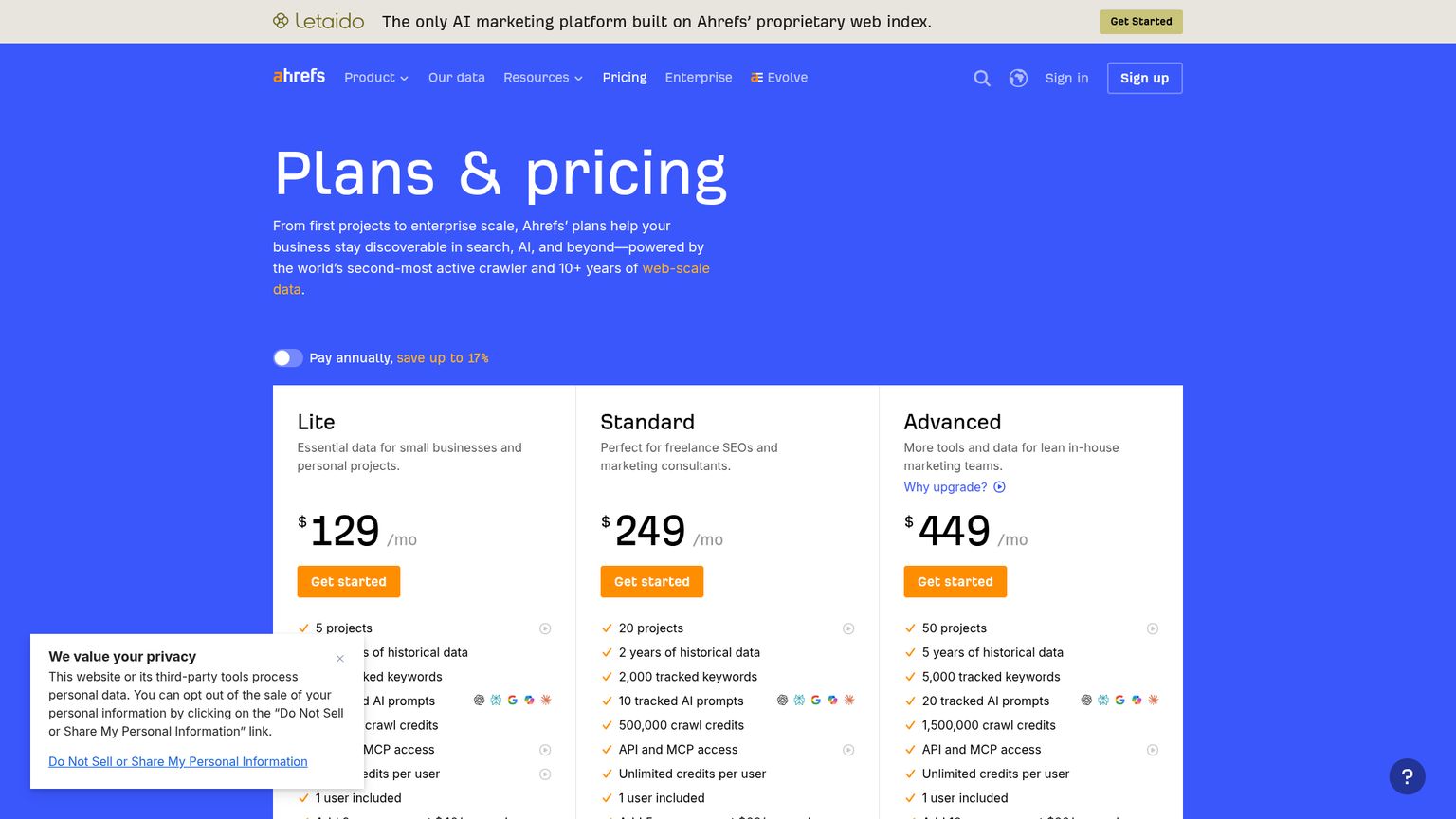
Standard includes Content Explorer, Batch Analysis and broken-link and broken-backlink reports. It costs $249 monthly, compared with $129 for Lite. If those reports drive your weekly work, the relevant decision is a $249 research subscription, not whether the $29 Starter badge looks cheaper than Semrush. That avoids switching cheaply and immediately discovering the report that justified the move requires an upgrade.
Best for: A content or SEO lead who can name the link and content reports they will use regularly.
Standout: The Standard research toolset, including Content Explorer and broken-link investigation.
Pricing: Starter $29/month, Lite $129, Standard $249, Advanced $449, Enterprise from $1,499/month with an annual commitment. Brand Radar AI starts at $199/month. Separate custom prompt packages cost $50, $100 or $250 monthly for 2,500, 7,000 or 25,000 checks, with overages. Current pricing.
Free trial: The pricing page offers Ahrefs Free, limited Site Explorer and Site Audit access for website owners, as the free route; do not treat it as the paid suite.
Semrush vs Ahrefs
Choose Ahrefs when its particular research reports improve decisions you already make. Keep Semrush when its current monitoring, content and multi-market workflow matters more than gaining those reports. This comparison does not establish that one vendor's traffic estimate is more accurate in your niche.
The monitoring tradeoff is concrete. Ahrefs' main plan comparison lists weekly base rank updates. Lite includes 750 tracked keywords, 1,000 credits per user per month, and only five tracked AI prompts with 150 monthly checks. A marketing lead who needs daily ranking reactions or a broad AI-question panel must price that workload separately. Published limits.
- Research, site audit and rank monitoring are available within the platform.
- Standard supplies named reports for link and content investigations.
- The free owner-site option gives a narrower way to inspect your own site.
- Standard's research tools add $120/month over Lite.
- Weekly base tracking is a different service level from Semrush's daily entry allowance.
- Included Lite AI monitoring is a small allowance, not a broad visibility programme.
For the pairwise decision, use Ahrefs vs Semrush. If neither research subscription fits the work, the Ahrefs alternatives guide covers the wider choice.
3. Moz Pro: a practical conventional SEO shortlist
Moz Pro is an SEO suite for keyword research, rank tracking, site crawling and link research. It belongs on the shortlist for a small business that needs to maintain an owned site and review progress on a regular schedule. Its current plans also advertise AI visibility, so dismissing it as an SEO-only option would miss the current offer. Moz Pro's product scope.
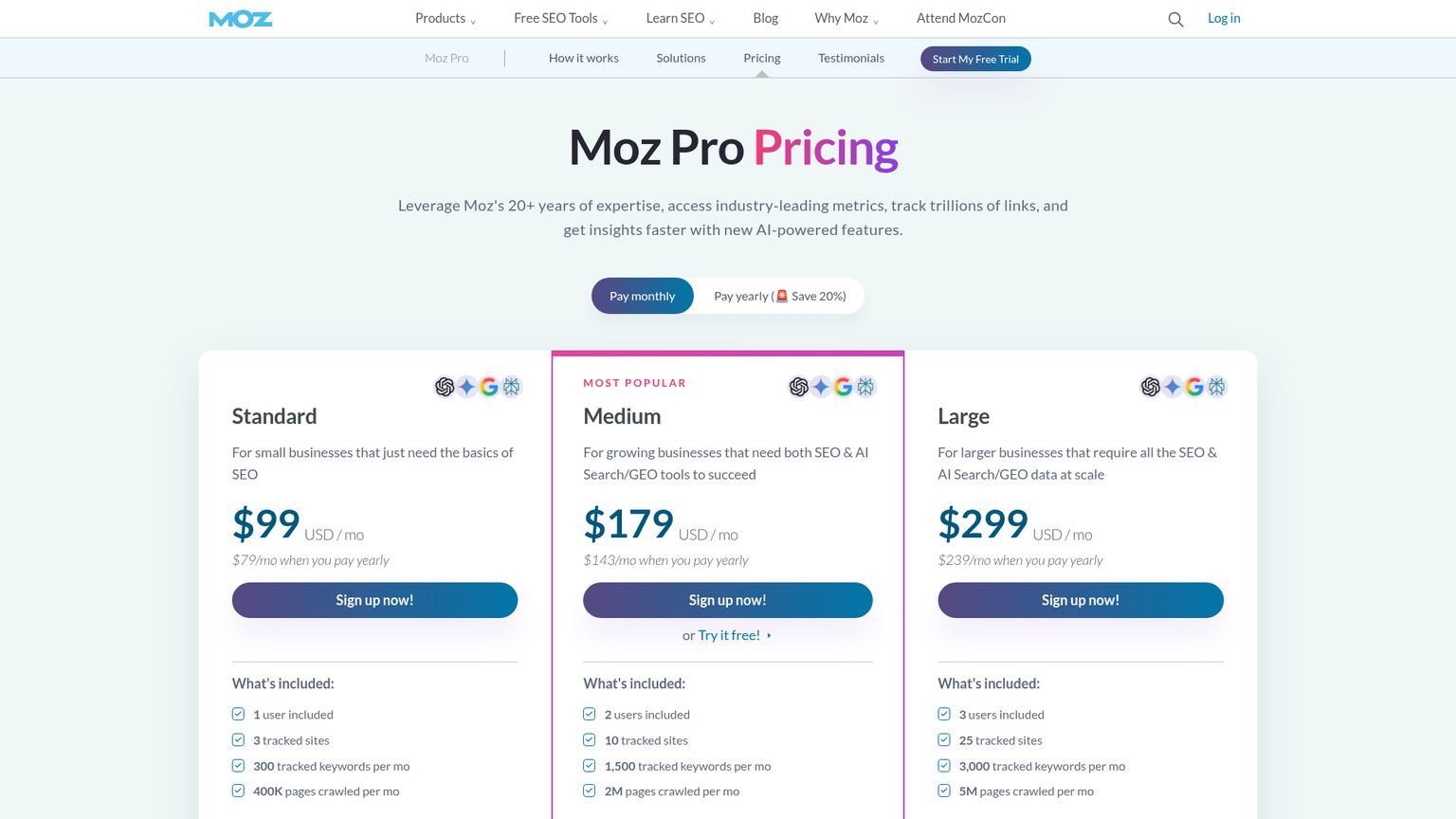
The entry distinction is easy to overlook. Moz's $49 Starter is described as a solution for an individual managing a single website. The more detailed Standard card is $99 monthly, with three tracked sites, 300 tracked keywords and 400,000 crawl pages per month. Its AI allowance lists 150 prompts across four models with weekly prompt tracking. Do not silently attach Standard's published AI limits to Starter's lower price. Tier details.
Best for: A small business maintaining a modest site portfolio with scheduled SEO reviews.
Standout: A conventional SEO workflow with explicitly weekly AI monitoring on Standard.
Pricing: Starter $49/month; Standard $99 monthly or $79/month yearly; Medium $179/$143; Large $299/$239; Enterprise custom. The annual cards specify first-year bills of $950, $1,719 and $2,868 for Standard, Medium and Large. Use those invoice amounts rather than multiplying rounded monthly labels. Live plans.
Free trial: A Medium trial is offered on the pricing page; review its checkout terms.
Ahrefs vs Semrush vs Moz
For a local business publishing and maintaining service pages, Moz belongs in the evaluation because the work is repetitive and bounded. Ahrefs Standard is the stronger shortlist candidate when the decision specifically depends on its advanced link/content reports. Semrush remains the candidate when the existing workflow needs its daily monitoring and higher-tier multi-market functions.
This is a choice of work and cadence, not brand prestige. If the owner can only commission changes after a weekly review, paying for a faster stream of observations may add little. If a campaign requires daily intervention, weekly AI monitoring is a material limit even when the prompt count looks generous.
- Keyword, link, rank and crawl work are covered in the suite.
- Standard publishes a clear AI prompt count and weekly cadence.
- Medium includes two users, making collaboration an explicit plan choice.
- Starter and Standard should not be treated as the same feature package.
- Standard's AI refresh is weekly.
- Rounded annual monthly equivalents do not exactly reproduce every published annual bill.
4. SpyFu: strongest when competitor ads matter
SpyFu is a competitor keyword research tool for SEO and Google Ads, the search advertising platform. It fits a founder or paid-search marketer asking what competitors target and how to improve campaign research. A local-services business using Semrush chiefly to investigate rival ads has a more focused alternative here than someone replacing a full technical and content workflow. SpyFu's product offering.
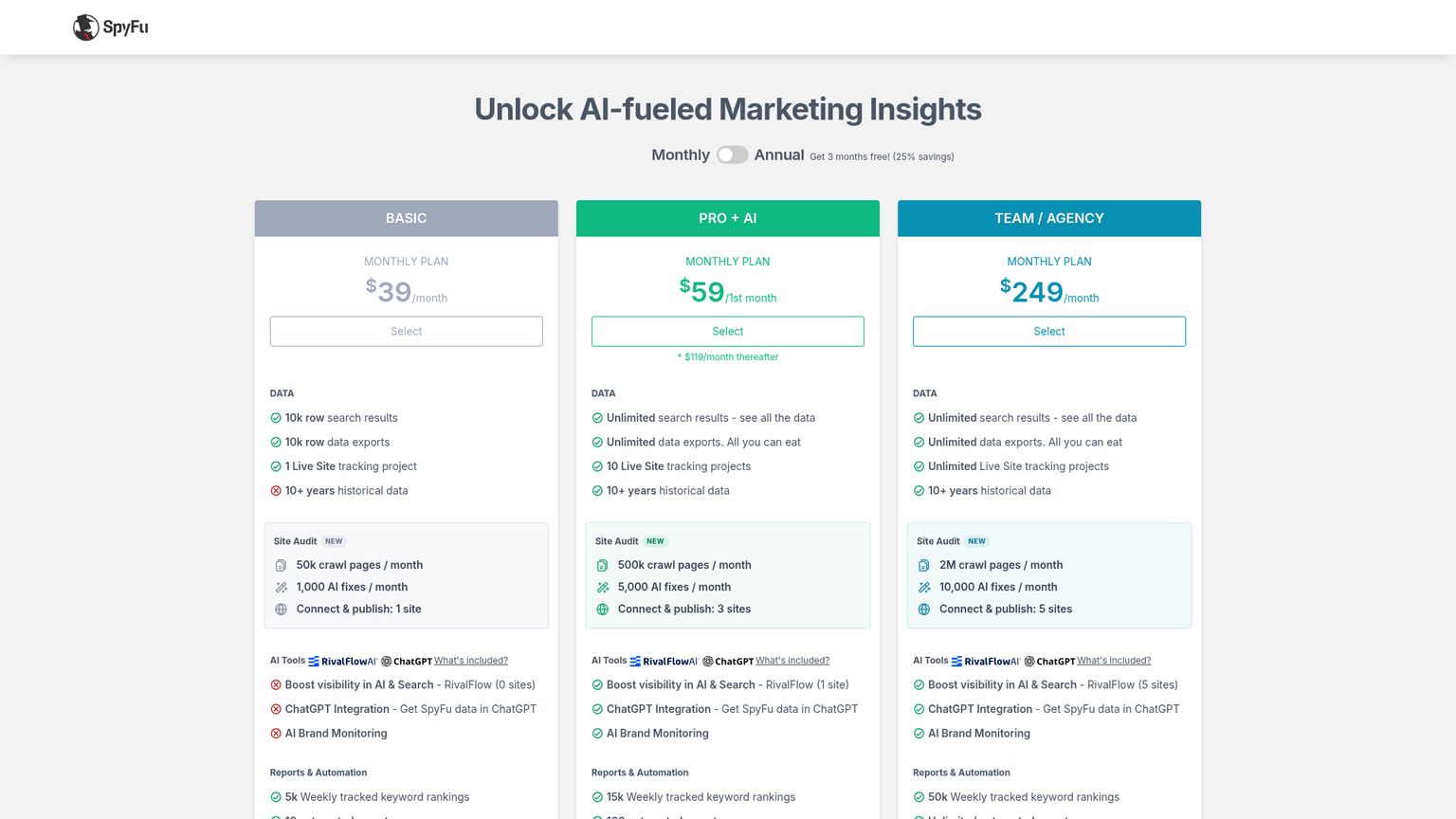
Basic now lists 50,000 site-audit crawl pages per month, so the limitation is not simply that auditing is absent. The actual buying walls include weekly tracked rankings, 10,000-row search/export limits, and no AI Brand Monitoring on Basic. Pro + AI adds that AI feature and unlimited search results and exports. Current inclusions.
Best for: A marketer whose recurring task is competitor keyword and advertising research.
Standout: A focused buying case around competitor search activity.
Pricing: Basic $39/month or $29/month annually. Pro + AI advertises $59 for the first month, then $119/month, or $89/month annually. Team / Agency is $249/month or $187/month annually. Current plans.
Free trial: No free-trial entitlement is assumed in this comparison; the Pro + AI first-month promotion is paid.
For a business owner briefing an ads contractor, use the research to produce a shortlist of terms and messages to investigate. Competitor activity does not tell you that an ad is profitable. Your own lead quality and acquisition economics still decide what to run. That analytical work remains necessary whichever vendor supplies the data.
The renewal bill can change the recommendation. If the required job includes AI Brand Monitoring, evaluate Pro + AI at its ongoing $119 price. Basic's $39 is relevant only if its actual inclusions cover the job. Also verify the historical period you need: the pricing grid excludes the full advertised long-history feature from Basic.
- The product's focus matches competitor SEO and Google Ads research.
- Basic publishes site-audit capacity rather than requiring an assumed separate crawler.
- Pro + AI removes search-result and export row limits listed on Basic.
- Basic excludes AI Brand Monitoring.
- Rank tracking is weekly.
- The attractive Pro + AI first-month price is not the renewal price.
5. Mangools: focused keyword work with a cadence tradeoff
Mangools is a bundle for keyword research, search-results analysis, backlink investigation, site metrics and rank tracking. It is a sensible shortlist choice for a solo marketer who wants a bounded research session to produce a content brief and a watchlist. The current bundle also includes AI Search Watcher PRO; the case for it is broader than the older description of a basic keyword tool. Current package.
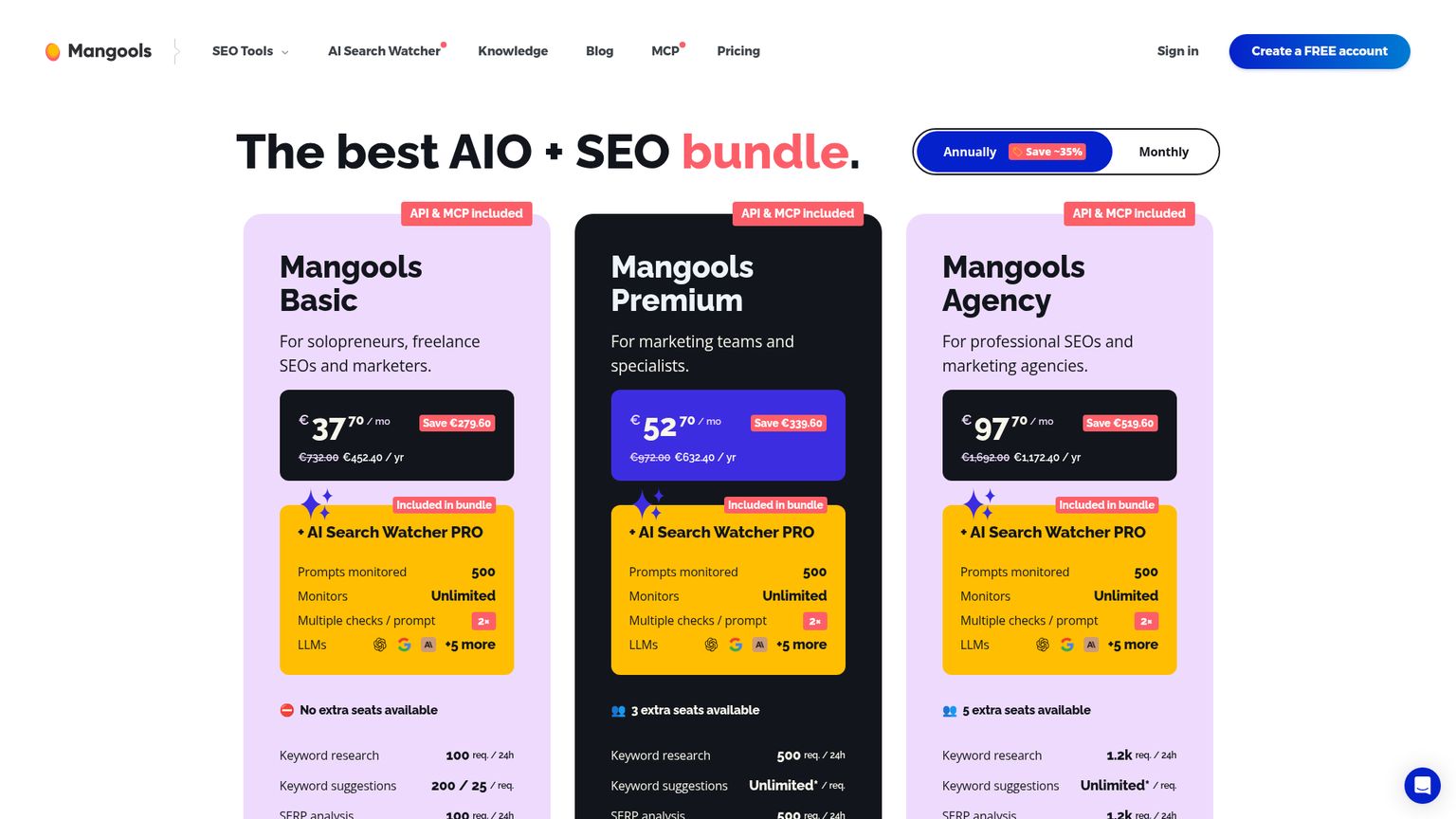
Basic publishes 100 keyword research requests per day and 200 tracked keywords. That can suit a small site's deliberate content programme. Its rank updates are weekly, however, and Basic offers no extra seats. A founder sharing work with a contractor should resolve both issues before buying a year, because a low price does not fix a mismatched reporting schedule or access arrangement.
Best for: A solo site owner or marketer doing focused keyword research and periodic rank review.
Standout: A compact research bundle with an advertised AI monitoring inclusion.
Pricing: The annual bundle cards show Basic $37.70/month, $452.40/year; Premium $52.70/month, $632.40/year; Agency $97.70/month, $1,172.40/year. These are annual monthly equivalents. Vendor pricing.
Free trial: No full paid-plan trial is assumed here. The pricing FAQ instead states a 48-hour refund policy, which is a different arrangement.
Premium raises the tracked keyword allowance to 700, but still lists weekly rank updates. Agency lists 1,500 keywords with daily updates. If daily tracking is why you subscribe, the relevant comparison is Agency's bill, not Basic's.
Treat the AI bundle with the same discipline. Its page advertises 500 monitored prompts and two checks per prompt, but that headline does not justify promising daily checks across every engine. Establish the schedule you need and confirm it. Likewise, SiteProfiler's site metrics are not evidence of a Semrush-equivalent full technical crawl allowance. A store owner who must diagnose template or indexing problems needs to verify a crawler separately.
- The bundle addresses keyword research, ranking, backlinks and search-results analysis.
- Basic publishes a usable small-site keyword allowance.
- AI Search Watcher PRO is explicitly included in the displayed bundle.
- Basic and Premium rank updates are weekly.
- Basic has no extra seats.
- A comparable full technical site-crawl entitlement is not listed in the package reviewed.
6. Serpstat: a lower-cost suite if the limits fit
Serpstat is an SEO suite combining keyword research, site analysis, rank tracking, audits and backlink analysis. It suits a solo consultant or small business that wants those core jobs together without paying for a larger operating bundle. Its Individual plan is a credible shortlist option, but the tracking allowance is measured in position checks, not simply a permanent keyword count. Serpstat plans.
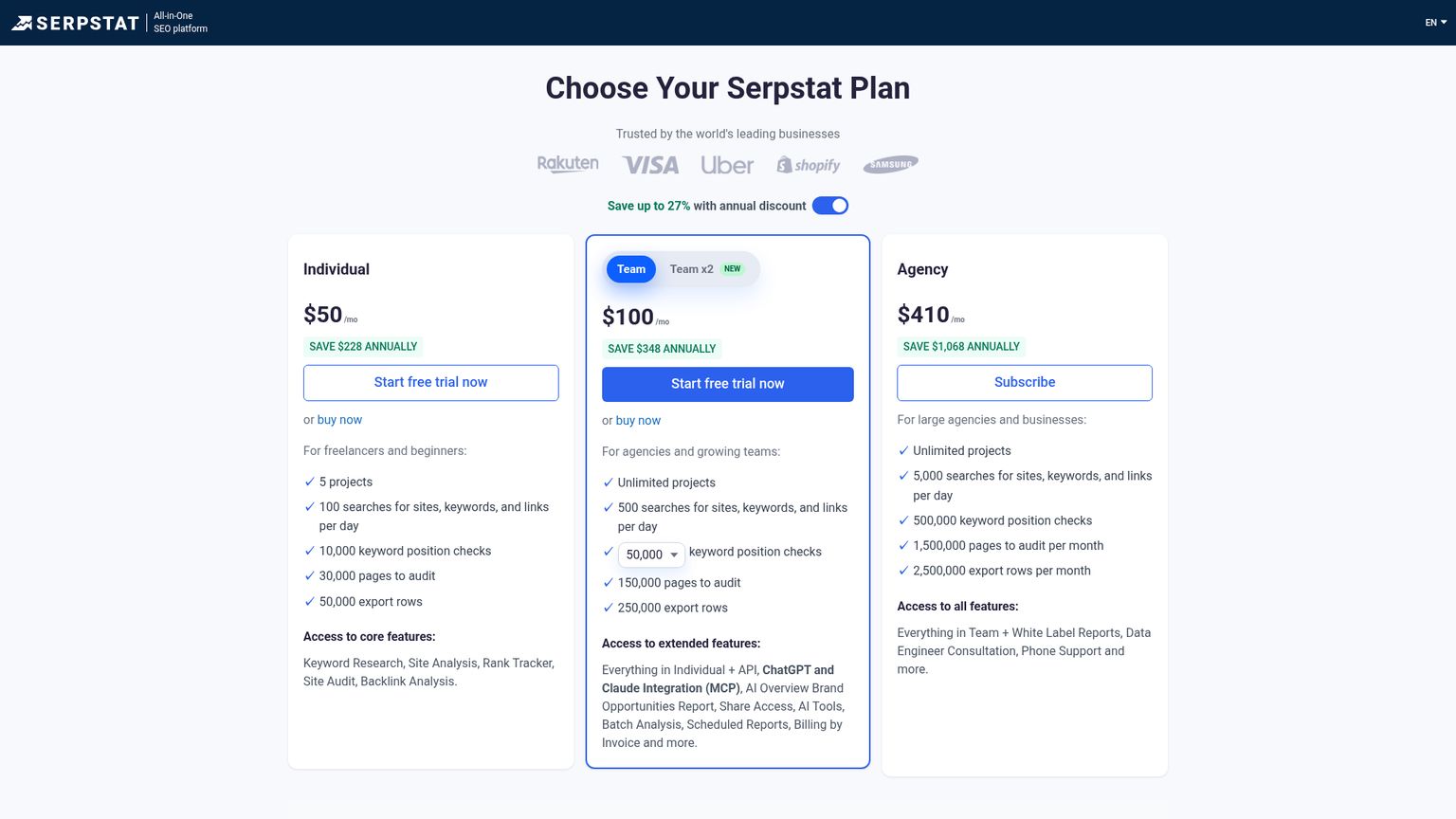
Individual includes five projects, 100 research searches per day and 10,000 position checks per month. For an illustrative list of 200 keywords checked daily over 30 days, the starting workload is 6,000 checks before separately counted location or device variants. Doubling that workload would require 12,000. Confirm the vendor's exact consumption rules before comparing its allowance with a tool advertising tracked keywords.
Best for: A solo operator seeking research, tracking and audit features in one lower-cost subscription.
Standout: The core suite is present on Individual, with explicit usage ceilings.
Pricing: Individual $69/month or $50/month annually; Team $129/$100; Team x2 $209/$169; Agency $499/$410. The first value is monthly billing, the second the annual monthly equivalent. Current plan page.
Free trial: Seven days for Individual or Team, with payment-card verification and automatic renewal described in the FAQ.
The technical-audit wall is more consequential for some sites than the price. Individual lists 30,000 audit pages, but a 5,000-page maximum scan and no JavaScript rendering. Rendering means executing a page's scripts to inspect the content they produce. A site dependent on that content should evaluate Team or another crawler, rather than assume a larger monthly page allowance solves the problem.
Team also introduces API access, shared operation and the AI Overview Brand Opportunities Report. The page links a separate LLM Brand Monitor product; do not assume that means Individual includes a complete multi-engine AI visibility programme. A consultant asked to deliver that service must establish the actual package before quoting the client.
- Individual includes the main SEO research, tracking and audit tools.
- The monthly entry price is below Semrush's SEO plan.
- Team offers API access and three users for a growing workflow.
- Individual excludes JavaScript rendering and API access.
- Check-based tracking needs workload arithmetic.
- A monthly audit allowance is not the same as the maximum size of one scan.
7. Ubersuggest: a small-site budget candidate
Ubersuggest is an SEO tool for keyword ideas, competitor and backlink research, rank tracking and site audits. It fits an owner improving one business website on a regular but limited schedule. Its current plans also include AI search visibility, although the entry refresh rate makes it a periodic review tool rather than a daily AI-monitoring substitute. Current features and prices.
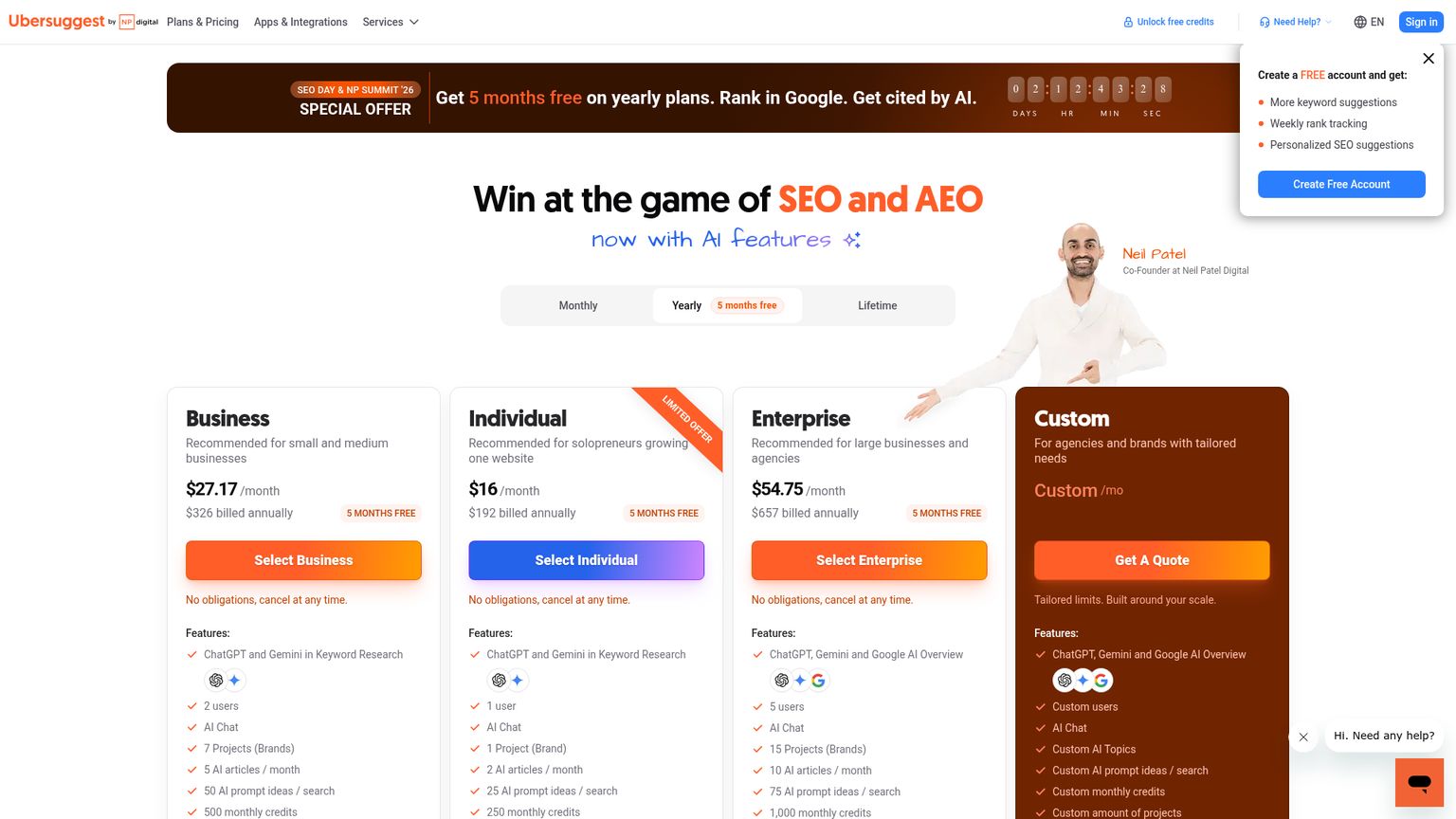
Individual publishes one project, one user, 125 weekly tracked keywords and 1,000 page scans per project. It includes 10 AI prompts per project refreshed monthly. A local-services owner updating service pages and reviewing progress periodically may find that sufficient. A marketer reporting daily visibility changes would be buying the wrong cadence, regardless of how low the annual offer looks.
Best for: An owner with a small website and a short, recurring SEO task list.
Standout: A low displayed annual commitment for bounded site work.
Pricing: The limited annual offer checked today shows Individual $16/month equivalent, $192/year; Business $27.17/month, $326/year; Enterprise $54.75/month, $657/year; Custom by quote. Monthly and lifetime selectors exist, but their tier-specific prices were not exposed in the rendered cards captured, so no amount is quoted for them. Live pricing.
Free trial: A free account is available, and the FAQ offers a one-time seven-day trial for monthly subscriptions. These are separate options.
Business raises the project allowance to seven, includes two users, and changes AI checking to 15 prompts per project biweekly. Enterprise lists 15 projects, five users and 20 AI prompts per project weekly. Those changes matter more than the plan names. Buying Business for collaboration should be justified by who needs access and which sites they manage, not by a vague expectation that every monitoring job becomes daily.
The API limitation is explicit: the pricing FAQ says no API access plans are available. A founder planning automated reports should factor that into the shortlist immediately. A product that works well for a manual weekly review can still be the wrong source for a data workflow.
- The entry plan has a concrete small-site scope.
- Research, audits and tracking can support one recurring review.
- The plan table exposes AI cadence instead of only advertising an AI feature.
- Entry AI monitoring refreshes monthly.
- Rank tracking is weekly.
- No API plan is offered, and the displayed annual promotion should not be treated as a permanent monthly price.
8. Similarweb: replace market research, not automatically the whole suite
Similarweb is a digital intelligence platform for examining markets, competitors and traffic patterns. It fits a founder deciding which market, channel or competitor deserves attention. That is a different purchasing problem from checking whether a particular service page has a technical issue, so Similarweb should enter the shortlist when market intelligence is a substantial part of the current Semrush workload. Published packages.
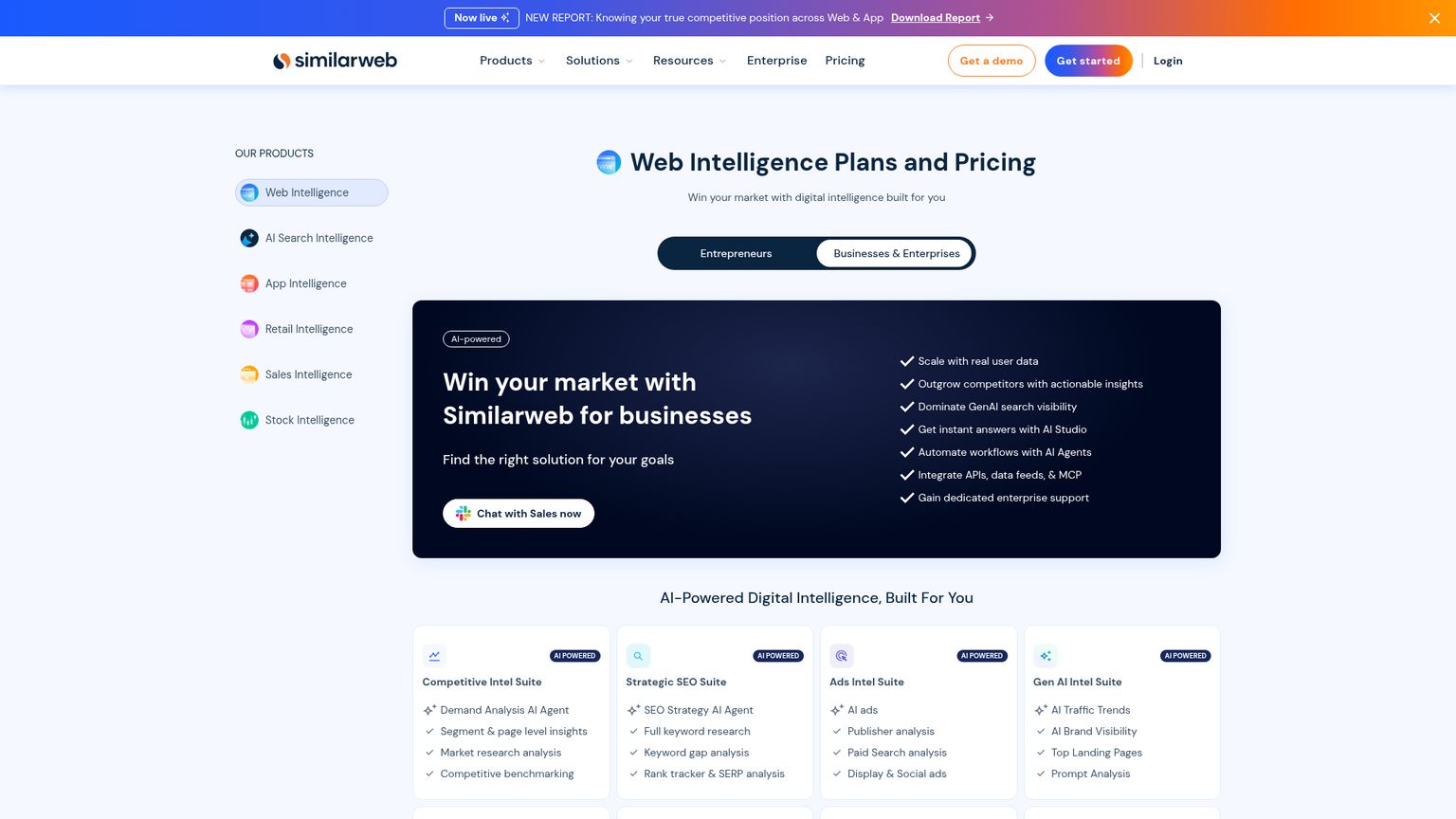
The pricing page separates Competitive Intel, Strategic SEO and Gen AI Intel suites. Strategic SEO lists keyword research, keyword-gap analysis, rank tracking and search-results analysis. Gen AI Intel lists AI traffic trends, brand visibility and prompt analysis. Their presence on one sales page is not evidence that one entry purchase includes them all.
Best for: A growth lead evaluating market position and competitor traffic before allocating resources.
Standout: A buying scope built around competitive and market intelligence.
Pricing: No numeric entry price is quoted because the live Web Intelligence pricing view checked did not expose one. Business requirements are handled through a custom package. Current pricing page.
Free trial: The page offers a free trial and high-level free data samples; premium features may require a custom package.
For a retailer considering a new category, the useful deliverable is a decision about demand and competitive position. For a small software company, it may be a market or channel hypothesis to validate. Neither task becomes valuable just because a dashboard contains more estimated traffic. Tie the purchase to a decision large enough to justify the quote.
Ask for the precise geography, historical period, SEO functions and AI features required in writing. If the resulting package needs a separate crawler and another reporting tool, include them in the replacement cost. Similarweb is a specialist fit here, not a verified cheap substitute.
- Its market and competitor focus addresses a distinct decision-making job.
- SEO and AI intelligence are explicit package options.
- Free samples can help scope the research question before a purchase.
- The pricing view reviewed does not establish a numeric entry cost.
- Package boundaries must be confirmed rather than inferred.
- A market-research purchase may leave day-to-day SEO operations to another tool.
9. DataForSEO: buy the data when you can own the workflow
DataForSEO provides SEO data through APIs, interfaces that let your software request structured results. It fits a technical founder or marketing team with someone responsible for a custom reporting or research workflow. Its appeal is metered data consumption rather than another user seat; the tradeoff is responsibility for turning those responses into a reliable decision process. Pricing model.
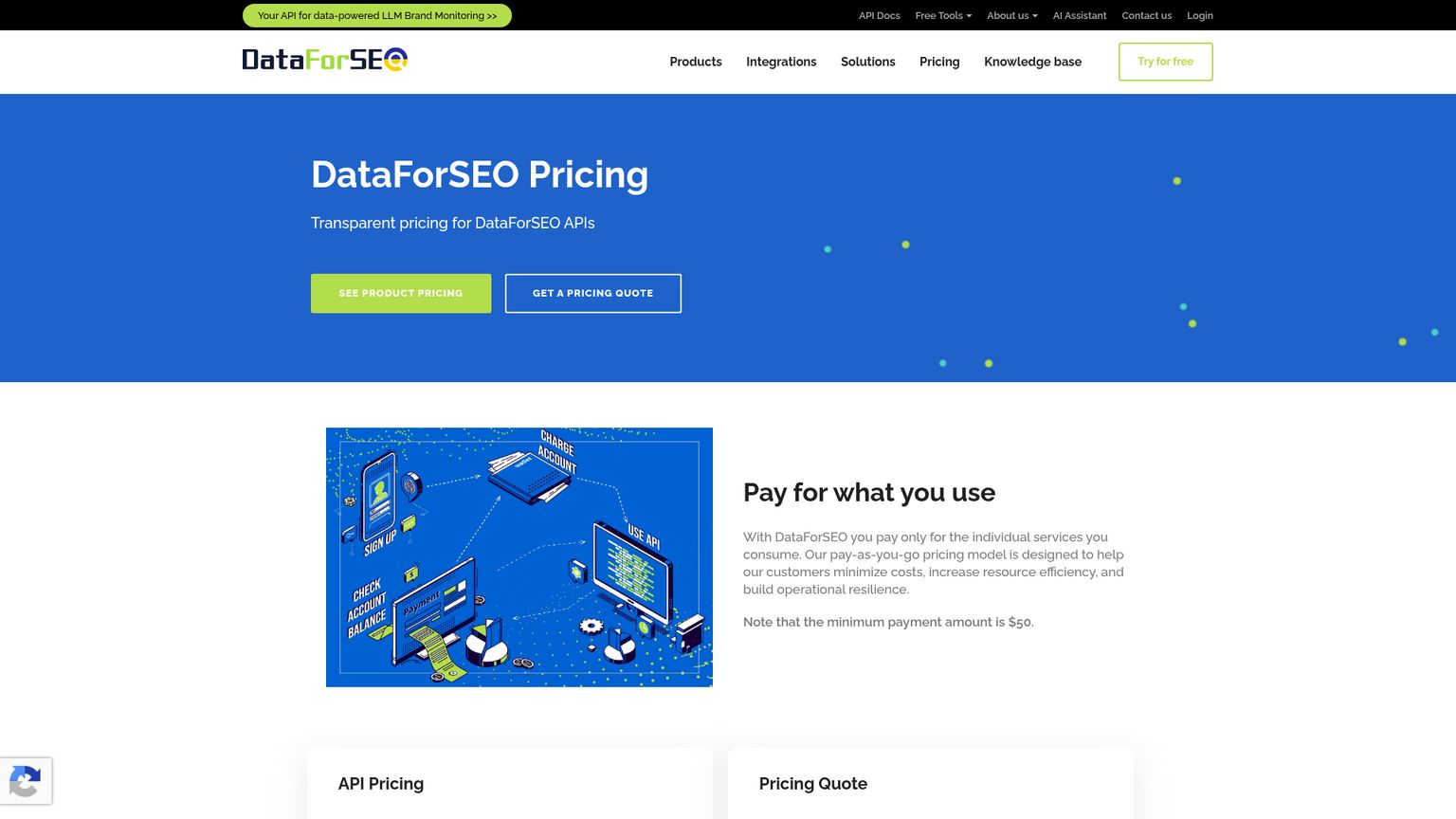
The vendor's minimum payment is $50. That is a payment into usage, not a claim that every month costs $50 or that the balance buys the equivalent of a Semrush subscription. SERP, keyword, backlink, on-page and AI Optimization data have separate product pricing. A SERP is a search engine results page; requesting one supplies observations that your workflow still has to interpret.
Best for: A team able to maintain a repeatable data workflow and its reporting.
Standout: A consumption model that can suit small, precisely scoped requests or automated collection.
Pricing: $50 minimum payment, then service-specific usage. Google Organic SERP API charges $0.0006 per first page of 10 results in Standard Queue, $0.0012 in Priority Queue, or $0.002 in Live Mode, before applicable extras. Published SERP rates.
Free trial: The SERP pricing page offers a try-for-free registration route; no particular credit allowance is assumed here.
Consider an explicitly hypothetical workload: 200 keywords, one location, one device and one first-page check daily for 30 days. That is 6,000 SERPs, costing $3.60 in Standard Queue or $12 in Live Mode at the quoted base rates. It does not include extra result pages, keyword metrics, audits, backlinks, AI-answer collection, storage or development. A first-page request also does not establish a keyword's position if the target ranks deeper.
That last distinction prevents a bad comparison. A cheap first-page observation is useful when the business question is whether important pages appear there. It is insufficient if the stakeholder expects complete position histories throughout a deeper results range. Define the output before estimating usage.
Queue choice is another business decision. Scheduled reporting can often wait for queued results; interactive work may need Live Mode. The vendor lists average turnaround times separately, with a longer target and possible extended processing for the normal queue. A morning report should tolerate late or missing tasks instead of treating every missing response as a ranking loss. Methods and pricing conditions.
For a software founder, a useful first implementation is a single recurring report with a fixed scope and a clear failure signal. Keep the same query, location, device and depth settings between runs. Store enough context to distinguish a changed observation from a changed request. Add other data families only when a decision calls for them.
For a marketing generalist without technical support, SE Ranking or another finished suite is usually the more practical purchase. Paying less for data while losing the ability to produce the weekly report is not a saving.
- Usage can be matched to a narrowly defined recurring workload.
- Separate data families let a team buy the inputs its workflow needs.
- The published Google SERP rates make scoped cost calculations possible.
- Your team owns integration, storage and report reliability.
- Depth and optional request parameters can change the base bill.
- One API's price does not include the other SEO and AI jobs in a suite.
Cheaper alternatives to Semrush: count work, not features
A replacement pays when its completed bill and the work it creates are lower than the subscription it replaces. Start with the current recurring tasks, not a list of everything the old product could do. A solo founder who opens only keyword research and rankings has a different budget problem from an agency delivering audits and AI reports to multiple clients.
For a simple illustration, value additional administrative time at $50/hour. That is an assumption for this calculation, not a claim about a market wage. The $70 monthly saving from Semrush Starter to SE Ranking Core disappears after 1.4 hours, or 84 minutes, of extra monthly work. Against the $139 SEO plan, the starting cash saving is only $10. A small reporting inconvenience can therefore outweigh the lower subscription.

The same discipline applies to API economics. DataForSEO's scoped $3.60 example leaves much more room for implementation cost than a small seat-price difference, but only if the data is enough for the decision. Buying incomplete observations cheaply and then adding manual investigation every week can make the apparent advantage disappear.
Rank tracking: compare the observation schedule
Daily and weekly tracking answer different operational needs. A small business reviewing content once a week may accept weekly updates. A lead responsible for investigating a sudden change on important pages may need daily observations. Choose the response schedule first, then the tool whose quoted tier supports it.
Count locations, devices and projects as part of the workload. Keep the tracked query and destination page consistent during a trial. A different keyword set can make a replacement look better simply because it measures something easier. For check-based plans, calculate monthly requests; for keyword-based plans, confirm what combinations consume the allowance.
Keyword research and audits: test relevance and the page type
For keyword research, use the actual market and language you serve. Ask whether the available suggestions and competitor pages help build a credible brief for something you sell. Search-volume and traffic estimates are planning inputs, not a promise of visits or revenue. A large export is useful only when someone can turn it into a prioritised action.
For an audit, distinguish the total monthly crawl allowance from the size of a single crawl. A store with script-dependent content must also verify rendering. Serpstat's Individual limit shows why: more monthly pages do not add the JavaScript rendering that starts on a higher plan. A metrics lookup and a full crawl are also different jobs.
AI visibility: compare prompts, engines and checks
AI visibility means observing whether a brand or page appears in generated answers. A prompt count alone does not describe the service. You need the engine coverage, the frequency, the definition of a check and the evidence behind a reported mention or citation.
Using SE Ranking's documented unit as an example, 20 prompts across three engines require 60 checks per refresh. At one refresh daily for an assumed 30-day month, that becomes 1,800 checks. This is a workload calculation, not a statement that a particular entry plan includes it. SE Ranking’s AI Results Tracker FAQ defines that check unit.
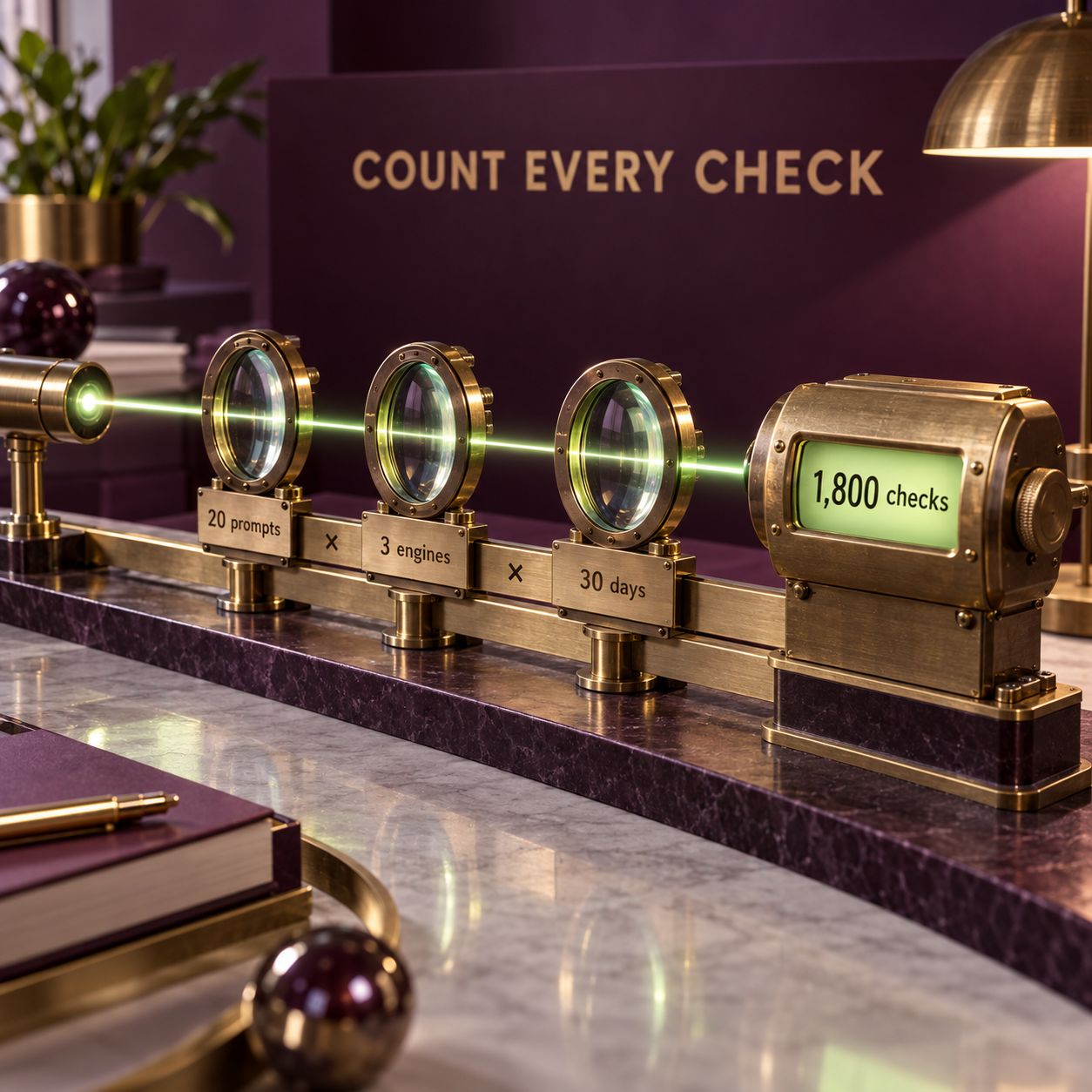
Then compare cadence. Moz Standard advertises weekly prompt tracking; Ubersuggest Individual publishes monthly AI refresh; SE Ranking separates prompt slots from checks; Ahrefs Lite starts with a small included allowance. Those products can all legitimately offer AI visibility while delivering different observations. The correct choice follows how often someone will investigate and act on the evidence.
Keep mentions and citations separate in reports. SE Ranking's documentation, for example, says a link indicator in its Sources report means the source page links to your site; it is not automatically a direct citation of your URL in the AI answer. That distinction matters when a founder expects to see proof of visibility, rather than a related linking opportunity.
Semrush free alternative: what you can stop paying for
Google Search Console is the first free service to use for diagnosing a site you own. It reports Google search performance and queries, and helps investigate indexing and individual URLs. A business owner trying to understand whether existing pages are being found should use that evidence before buying another estimate of their own traffic. Google's product overview.
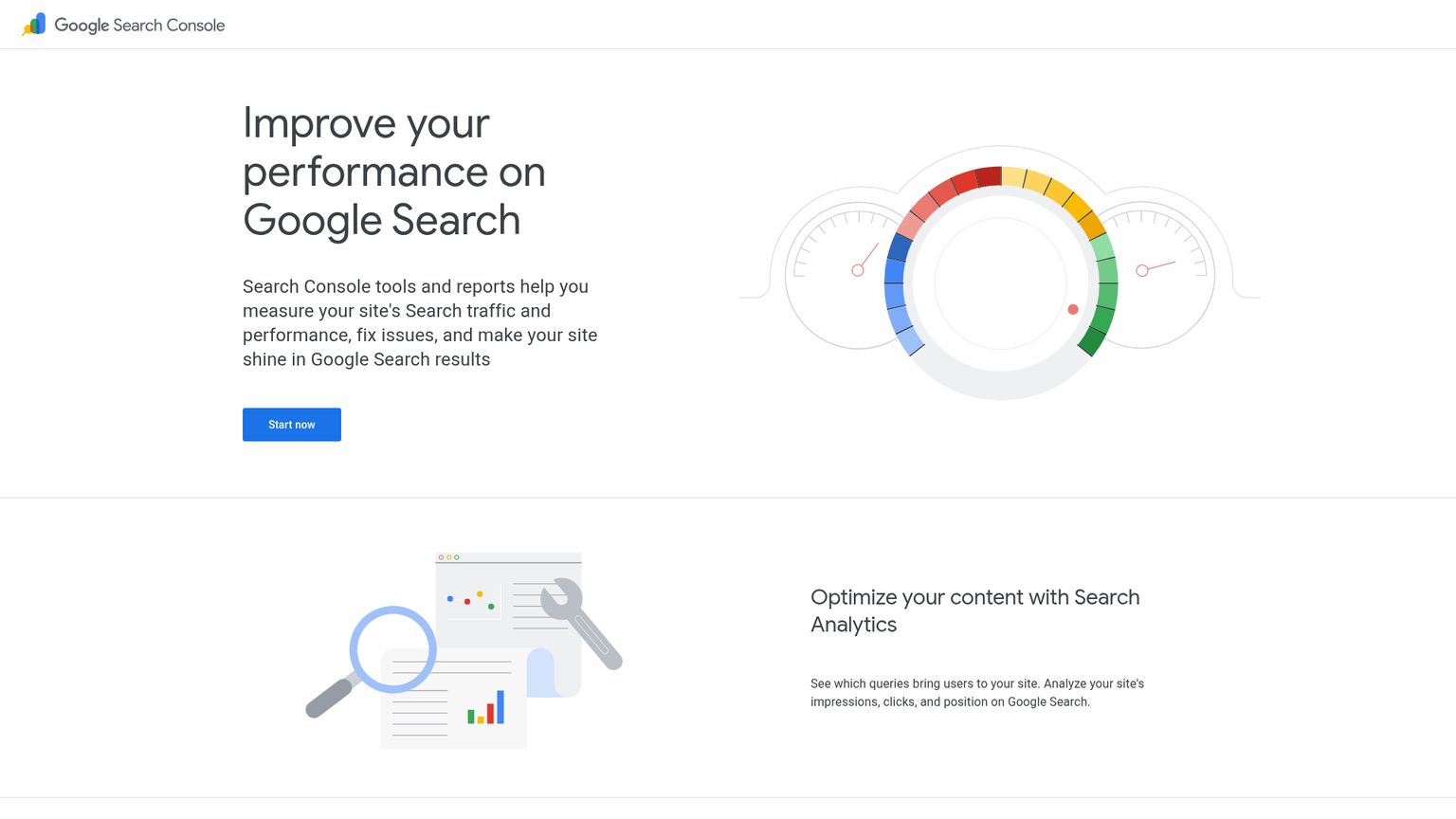
It does not replace a competitor-research subscription or a cross-engine AI visibility programme. Ahrefs Free offers limited owner-site research and audit access; Ubersuggest offers a free account; Semrush's own free account lists 10 reports per day and one demo project. Each has a narrower scope than the paid workflow. Ahrefs free access, Ubersuggest account options, Semrush free limits.
For a founder with no recurring competitor-research task, that narrower scope may be sufficient. Start paying when you can name the question the free tools cannot answer and the action the answer will support.
The ones to avoid
Avoid Ahrefs Starter as an assumed full Semrush replacement. Its low entry price does not buy the Standard research tools discussed above. Choose the report first and price the tier that contains it.
Avoid Mangools Basic or Ubersuggest Individual when daily monitoring is mandatory. Their listed rank cadence is weekly, and Ubersuggest's entry AI refresh is monthly. Those can be good products for a slower workflow and still be wrong for this requirement.
Avoid Serpstat Individual for a crawl that depends on JavaScript rendering. That entitlement starts higher. A cheaper plan is not useful if it cannot inspect the content at issue.
Avoid Similarweb when the sole objective is a proven lower subscription bill. Its public pricing view did not establish that saving. Consider it when market intelligence is the work worth buying.
Avoid DataForSEO without an owner for the integration. A founder should not trade a working report for raw data that nobody maintains. The API route becomes attractive when the necessary technical ownership already exists or has a justified budget.
Who should pick what, and what to do Monday
Pick SE Ranking first for an integrated SEO and AI shortlist, then confirm the seat bill and check allowance. Pick Ahrefs when its specific research tools justify the relevant tier. Consider Moz Pro, Mangools or Ubersuggest for a bounded owned-site workflow whose update schedule fits their limits. Choose SpyFu when competitor search advertising is central, Serpstat when its core suite and crawl rules fit, Similarweb for market intelligence, and DataForSEO for a deliberately owned data workflow.
Keep Semrush when its existing research, historical analysis, content and monitoring workflow would cost more to reconstruct than the alternative saves. No migration earns its keep merely by producing a lower invoice.
The decision flips when a missing feature or recurring task exceeds the cash saving. Make that visible before cancellation:
- Write down the reports used to make a decision during the last working month. Mark the owner and the action each report supported.
- Export the keyword list, project settings and historical reports you must retain. Verify the receiving tool's import scope instead of assuming every chart will transfer.
- Reproduce the same location, device, page and prompt workload in the candidate. Treat differences as questions to investigate, not evidence of one tool's accuracy.
- Obtain the complete bill for seats, AI usage, cadence and any necessary specialist tool. Include time spent preparing the report.
- Switch after the replacement produces a usable result and the retained history is accessible. If that condition fails, keep the current subscription while you resolve the gap.
For a founder, Monday's task is simple: choose the report you would miss most if Semrush disappeared, then evaluate one replacement against that report. Expanding the trial to every feature before proving that job usually creates more choice without a better decision.
Frequently asked questions
Is Semrush a Russian company?
Semrush's own company history says it registered as a US company in 2012 and established its Boston headquarters in 2018. That is the relevant published company history; founder origins alone do not identify the current contracting entity. Check the entity on your agreement for a procurement decision. Semrush company history.
What are the top 3 SEO tools?
For the buyer in this comparison, the first three to shortlist are Semrush, SE Ranking and Ahrefs. Semrush fits the existing integrated workflow, SE Ranking is the first lower-cost suite to compare, and Ahrefs deserves attention for its specific link and content research tools. This is a use-case shortlist, not a measured universal ranking.
What are some affordable alternatives to Semrush?
SpyFu Basic is $39 monthly, Moz Starter is $49 monthly and Serpstat Individual is $69 monthly. Mangools and Ubersuggest show lower annual monthly equivalents, with upfront commitments. SE Ranking Core is $129 monthly for a broader suite. Compare the actual jobs and cadence at those tiers; the lowest price does not establish a complete replacement.
Which is better, Semrush or Ubersuggest?
Ubersuggest is a budget candidate for a small owned site and periodic research, tracking and audits. Semrush is the stronger fit when the needed plan supports daily monitoring and the broader workflow already in use. Ubersuggest Individual's weekly ranks and monthly AI refresh are material constraints for a team expecting daily observations.
Is there anything better than Semrush?
Yes, for a particular job or cost model. SE Ranking can cost less for an integrated workflow, SpyFu is a focused competitor-advertising option, and DataForSEO lets a technical team buy scoped data usage. None is established here as universally more accurate or a cheaper match for every Semrush feature.
Can I use Ubersuggest for free?
Yes. Its current pricing FAQ offers a free account and separately describes a one-time seven-day trial for monthly subscriptions. Free access is not the same as unlimited paid-plan use. Ubersuggest account and trial terms.
How much does Ubersuggest cost per month?
The annual promotional cards verified on 10 October 2026 show Individual at $16/month equivalent, billed $192 annually; Business at $27.17, billed $326; and Enterprise at $54.75, billed $657. Custom pricing is by quote. These are annual offers, not verified month-to-month subscription amounts. Ubersuggest pricing.
What is the best free SEO tool?
Google Search Console is the first choice for investigating Google search performance and indexing on a site you own. It cannot answer every competitor or AI-visibility question, so the best free setup depends on the job. Search Console overview.
What does Ubersuggest do?
Ubersuggest combines keyword and competitor research, backlink information, rank tracking and site audits. Its current plans also advertise AI visibility, with different prompt counts and refresh schedules. Choose the plan using those limits rather than assuming that every AI feature is monitored daily. Published features.
Use the AI business workflow audit checklist to identify which recurring software jobs deserve a paid tool before your next renewal.
- Published
- Category
- Growth
- Language

WhatConverts Pricing: Plans, Usage and Agency Bills
WhatConverts plans, usage credits and fees explained, with bills for one business and 20 clients, plus a fair CallRail cost comparison.Oct 10, 2026Growth
Beehiiv Review
Beehiiv reviewed for business newsletters: current pricing, growth, monetization, AI, MCP, analytics and the costs that change the buying decision.Oct 10, 2026Growth
Trainual Review
Trainual review for SOPs and onboarding: AI drafting, knowledge search, read-only MCP, quote-only plans, implementation and who should skip it.Oct 10, 2026Growth
SocialBee Review
SocialBee review of evergreen scheduling, AI Copilot and client workspaces, with all six plans, add-on costs, and Buffer and Later comparisons.Oct 10, 2026Growth
SurveyMonkey Pricing: Plans, Response Caps and Annual Bills
SurveyMonkey prices, response caps and AI limits, with annual bills for one person and three-seat teams. See when overages change the best plan.Oct 10, 2026Growth
ActiveCampaign Alternatives: GetResponse, Kit and More
Compare ActiveCampaign alternatives at 2,500, 10,000 and 25,000 contacts, with vendor prices, workflow trade-offs and a migration checklist.Oct 9, 2026Growth
CallRail Alternatives: WhatConverts and More Compared
Compare six CallRail alternatives by vendor pricing, usage fees, AI and reporting. Includes WhatConverts cost math and a pre-switch checklist.Oct 9, 2026Growth