SocialBee Review
SocialBee review of evergreen scheduling, AI Copilot and client workspaces, with all six plans, add-on costs, and Buffer and Later comparisons.
Published
 By Omid Saffari




SocialBee earns its $29 monthly starting price when your business has useful posts to reuse, but the five-profile allowance needs counting before you buy. This SocialBee review recommends it for a recurring content library, AI-assisted drafting and separated client workspaces; a light publishing queue may be better served by Buffer, while Later can cost less when its social sets fit.
Verified on 10 October 2026: pricing, limits and features were checked against public vendor pages and documentation. This is a documented-feature and cost analysis, with no signed-in testing or measured claims about publishing reliability, AI quality or time saved.
Partner disclosure: SocialBee and Later are partners of this site. Plan links may earn a commission. Recommendations follow the workflow, account mix and full subscription cost.
What SocialBee is
SocialBee is a social media scheduler that organizes posts into reusable topic categories, helps draft content with AI, and publishes from a shared calendar. A category is a folder of related posts, such as service explanations or customer stories, that can supply recurring calendar slots. Its client workspaces, approval features, analytics and engagement inbox extend that publishing workflow; their availability depends on the plan and social network. The strongest reason to choose it is keeping a useful library in circulation without rebuilding the same calendar every week.
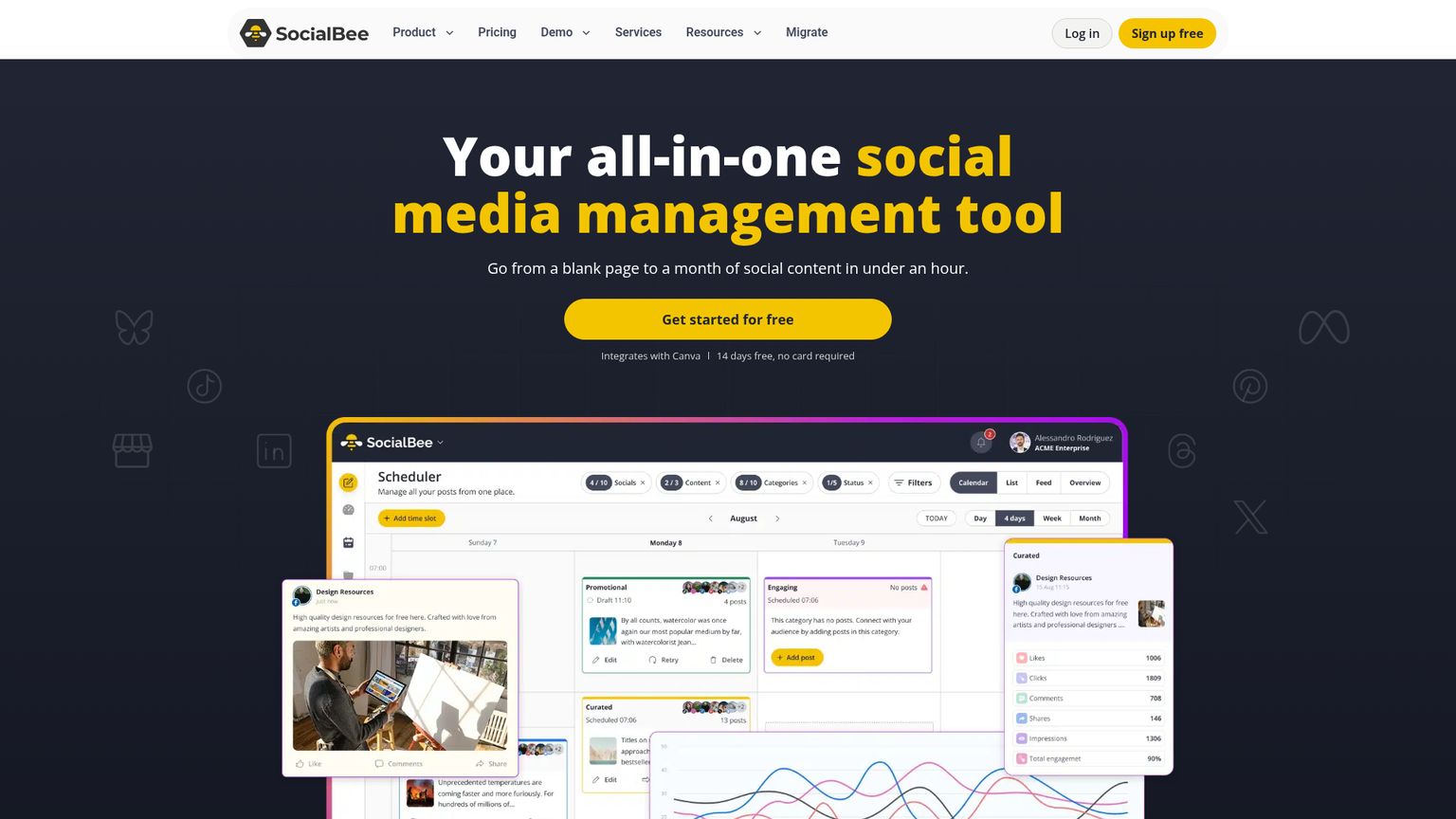
The buying comparison below assumes five active profiles and annual billing, with one operator. A profile means one connected account, such as an Instagram account or a Facebook page. These are subscription costs divided by the accounts you use, rather than by every unused slot a plan includes.
Calculations use SocialBee's pricing, Buffer's pricing and Later's pricing, before tax. Later's set permits one account on each supported network, so its lower figure does not cover five Instagram clients. SocialBee's published Bootstrap invoice is $290, which is $24.17 a month when divided by twelve. Use that invoice for cost comparisons, rather than rounding the rate down to $24.
How to read SocialBee reviews
Judge the purchase on four questions: how much content remains useful after its first publication, which accounts must connect, who must approve drafts, and which reporting outputs clients require. Public pages establish features and commercial limits. They do not establish how reliably a particular account will publish, how quickly support will answer, or how well generated captions will sound like your business. Those are trial acceptance criteria, not claims this review can make.
Who should use SocialBee, and who should skip it
SocialBee fits a local service business, a solo marketer or a small agency whose recurring topics are already clear. A home-services owner can rotate maintenance advice, service explanations and customer stories while keeping seasonal promotions separate. A consultancy can reuse educational material between launches. An agency can keep each client's calendar and reviewers in a dedicated workspace.
The benefit depends on having something worth returning to. A thin library of generic motivational posts does not become a stronger marketing program because it repeats automatically. A daily news account also has less to gain from reuse than a business answering the same customer questions throughout the year.
If you are still choosing the kind of scheduler you need, the broader best social media scheduler for small business comparison explains the shortlist by operating model.
Choose Buffer for a smaller or less repetitive calendar
Buffer, a scheduler priced by connected channel, is the better starting point when you mainly need to draft and queue current posts. Its free plan supports three channels, ten scheduled posts per channel at a time, one user and an unlimited AI Assistant. A solo owner with a light queue can therefore avoid a paid subscription altogether. Buffer's live pricing documents those limits.
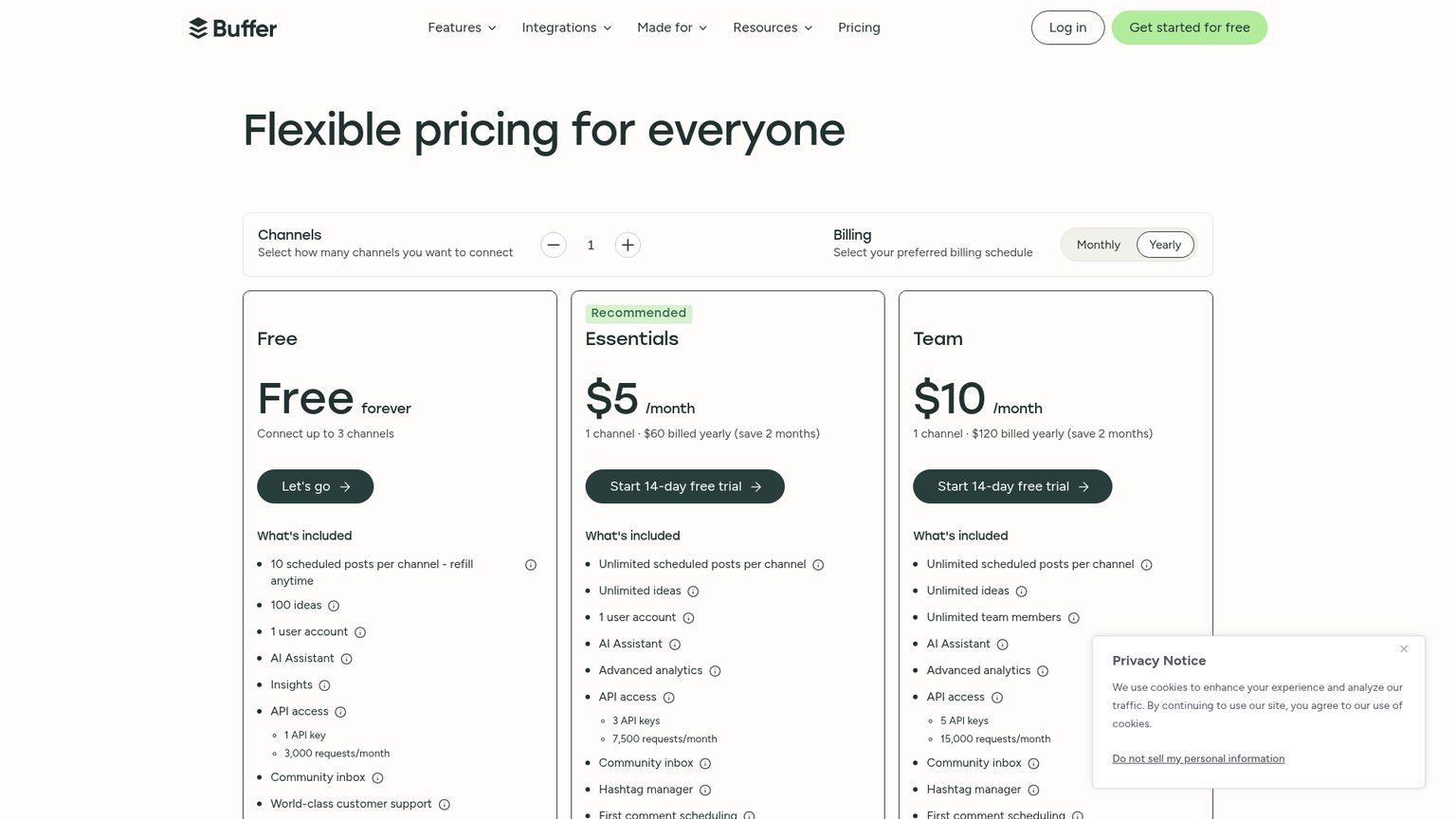
Buffer Essentials costs $6 per channel monthly or $5 on annual billing for the first ten channels. At five channels, that is $30 monthly or $25 a month paid annually. SocialBee Bootstrap's $29 monthly price is close enough that the recurring category workflow should decide the purchase.
Buffer's limitation is also commercial: Essentials includes one user, and formal approval workflows require Team. At five channels, Team costs $60 monthly or $50 a month annually. Its unlimited team members can make it more attractive when many people need access. Volume discounts begin above ten channels, so multiplying the entry rate across a large agency would overstate its cost. Buffer's machine-readable pricing provides the exact examples.
Choose Later when its visual workflow and social sets fit
Later, a social scheduler with an Instagram Grid Planner, fits a brand that organizes publishing around visual content and uses an eligible network mix. Starter costs $18.75 a month billed annually, includes one user and one social set, and allows thirty scheduled posts per profile per month. Its eight possible profiles are one each for Instagram, Facebook, Threads, Pinterest, TikTok, LinkedIn, YouTube and Snapchat. Later's pricing page defines the set.
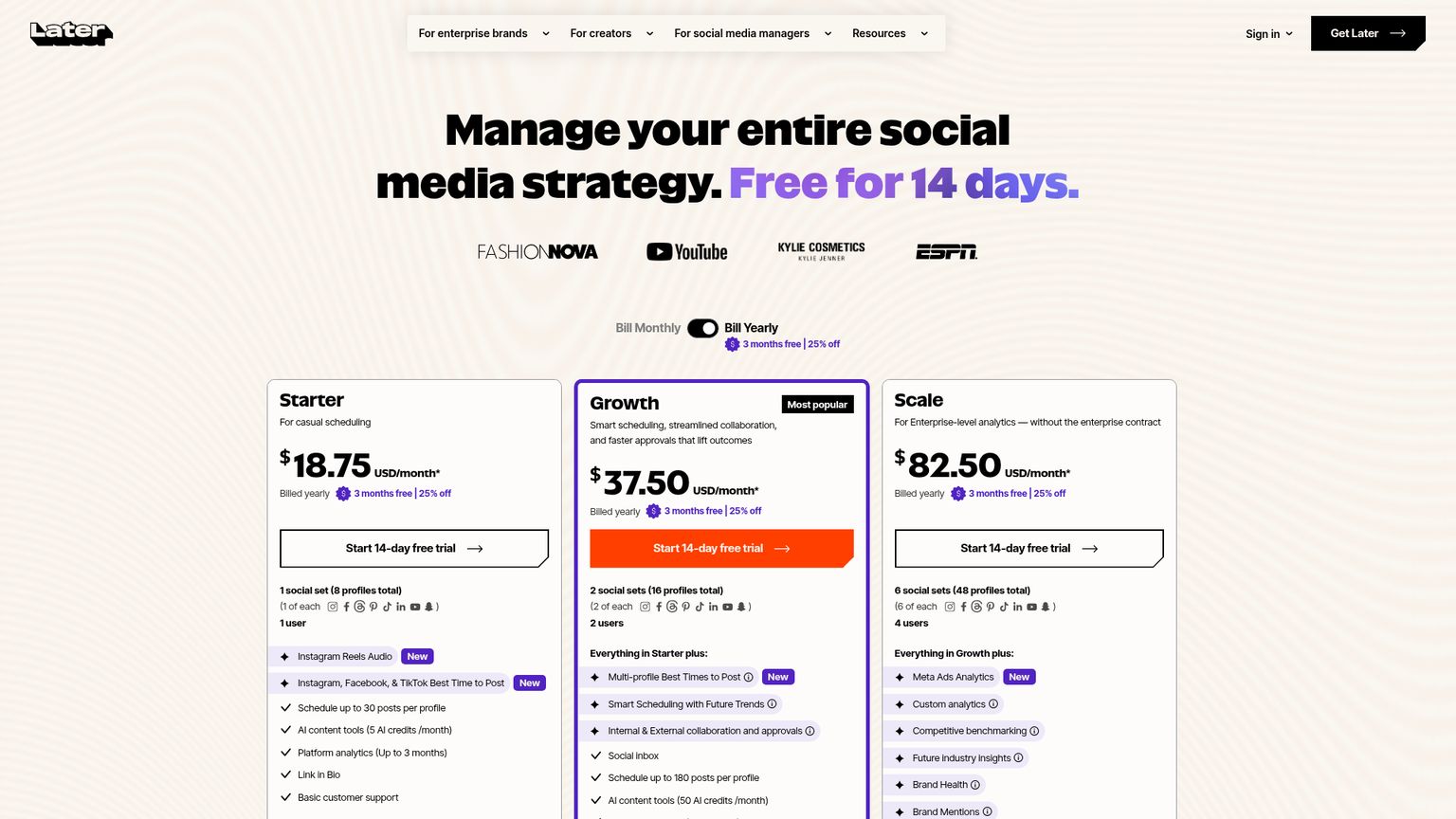
For a boutique using five of those networks, the $3.75 cost per occupied profile is useful. With all eight occupied it falls to $2.34, but empty accounts do not deliver value. A second Instagram account also needs another set; Starter cannot buy additional sets. Growth includes two sets at $37.50 a month annually, with additional sets available on that tier.
Later is a weaker fit for frequent AI drafting on Starter: it includes five AI credits a month, and one caption generation consumes one credit. Starter cannot buy more credits. SocialBee includes unlimited AI content generation on every plan, while Buffer also includes unlimited AI Assistant use. Later's current social-set list also omits X and Bluesky. The partner relationship does not change those constraints.
Category scheduling makes evergreen content reusable
SocialBee's category scheduling is the capability that most clearly earns the subscription for a business with durable advice. Evergreen content means material that remains useful beyond its first posting date. SocialBee can group that material, schedule its category, requeue posts and pause a category. It also supports expiry by date or number of shares for material that should stop circulating. Those controls are documented on its scheduling page.
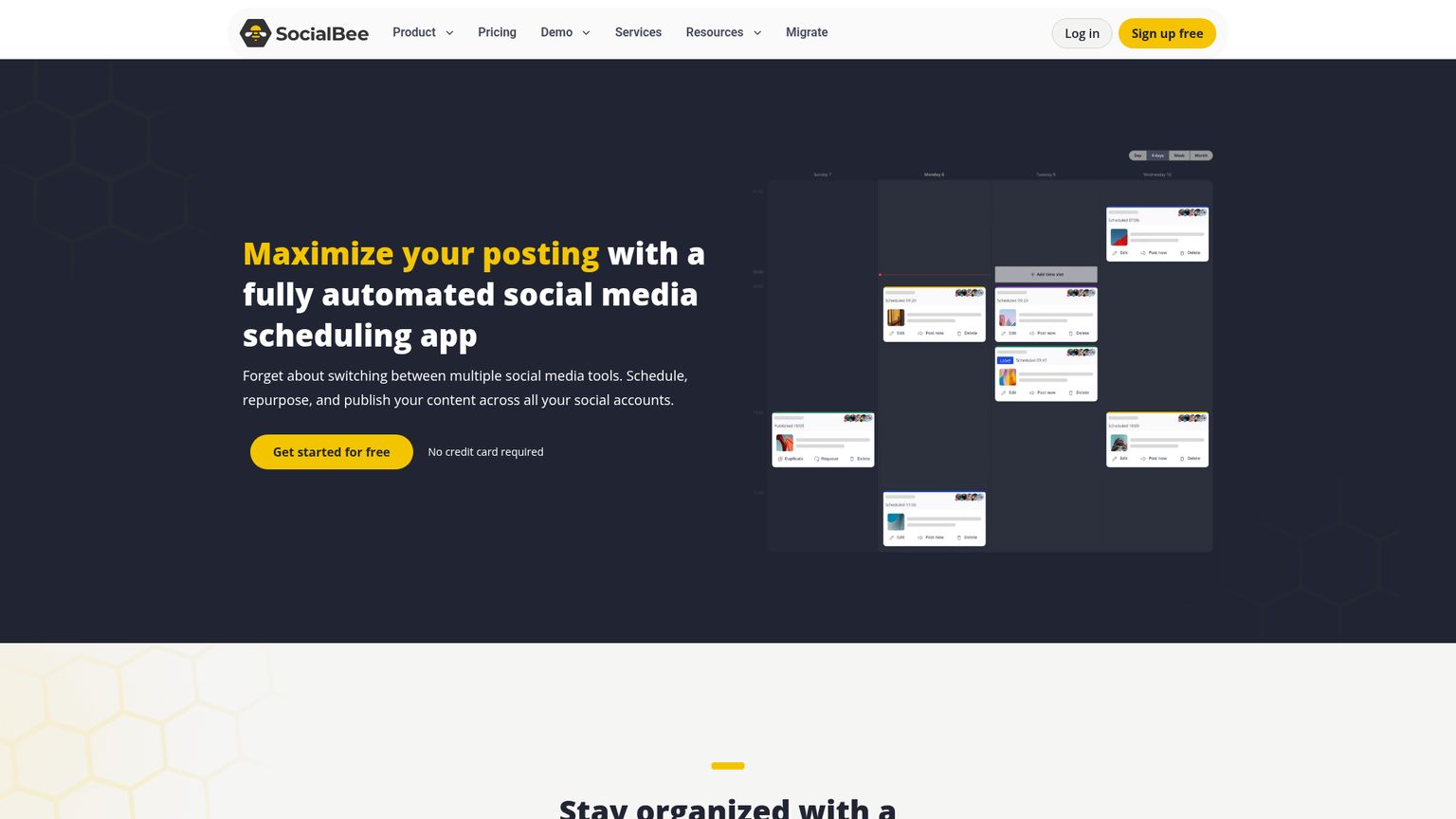
Consider a plumbing business with a library of maintenance advice. It needs a repeatable mix of useful education, evidence of completed work and timely service offers. Category slots let the owner decide the mix once, then maintain the library inside it. That is a different operating task from individually choosing a fresh date for every post.
The owner still needs to decide what is safe to repeat. Advice about locating a shutoff valve may remain useful; a promotion with an end date does not. A customer story may need a fresh image or caption before another appearance. SocialBee supports post variations, but the business must decide when the underlying message has gone stale.
Separate reusable material from dated campaigns
Create categories for maintenance advice, service explanations and customer stories. Put temporary offers into a separate category so pausing or expiring a campaign does not disrupt the useful background calendar.
Assign a modest recurring schedule
Place each category into the calendar at a cadence you can maintain. As an illustration, twelve advice posts used once a week would take twelve weeks to cycle, assuming a fixed order and no additional slots. That is a planning example, not a recommended posting frequency for every business.
Use the correct return rule
Requeue material that can be reused. Give dated offers an expiry date or share limit. Preview the queued posts to check that an old offer has not followed evergreen advice back into circulation.
Review the library as the business changes
When a service, opening hour or offer changes, update the affected material. Use category pausing when a whole topic needs review. Automation reduces calendar work only while the library stays accurate.
The distinction between reuse and expiry is the important control: a durable answer returns to the library, while an ended campaign leaves it.

A blog-led business can also import material through RSS, the feed that exposes newly published website content. SocialBee documents RSS importing and design imports through Canva, along with Unsplash and GIPHY integrations. These reduce content handling, but an imported link still needs a useful explanation for the intended audience. SocialBee's content creation page describes those inputs.
AI Copilot joins the plan to the draft
SocialBee's AI Copilot helps connect platform choices, content categories and a posting schedule to draft posts. Its value is the continuity between planning and publishing. The public Copilot page documents recommendations for platforms, categories and timing, plus generated posts and variations; it does not prove those recommendations will produce leads for your business.

For a solo business-to-business consultant, the useful starting brief is specific: the buyers served, the problem solved, the offer and examples of existing writing. A plan built around procurement questions, delivery mistakes and practical advice gives the consultant material to evaluate. A request to make the brand sound innovative gives the editor much less to work with.
Treat Copilot's categories as proposed editorial choices. Keep a category when it answers a customer question or supports an offer. Remove one that requires expertise you do not have, duplicates another category or implies a result you cannot substantiate. The AI has helped prepare options; the business still owns the position it publishes.
Use the content generator for a particular post
SocialBee's content generator works at the individual-post level: enter a topic or URL, choose a tone, generate variations, edit and schedule. It also supports platform-specific customization and AI images. That makes it useful for turning an existing service page into candidate captions without moving the draft through a separate writing application. The documented generator workflow is the basis for this example.

A consultant could use a service-page URL to draft a practical explanation for LinkedIn and a shorter introduction for another channel. Review the offered outcome, named customer, price and call to action before scheduling. Remove any invented evidence. Platform formatting can be automated more easily than the judgment about what the business is entitled to promise.
Unlimited generation is a useful entitlement when several drafts are needed, but it does not measure usable output. During the trial, record how much editing a typical caption requires. If rewriting the draft takes as long as writing it yourself, the AI allowance contributes little to the purchase decision even though it is unlimited.
Client workspaces separate responsibility
SocialBee's workspaces are useful for an agency that needs each client's posts and reviewers kept together. The collaboration page documents separate workspaces, roles, content approval and feedback on posts. A Contributor can create content and view analytics but cannot approve it; a Publisher can create, edit and approve. Those distinctions let a writer prepare a draft while another person owns publication. SocialBee's collaboration documentation explains the roles.
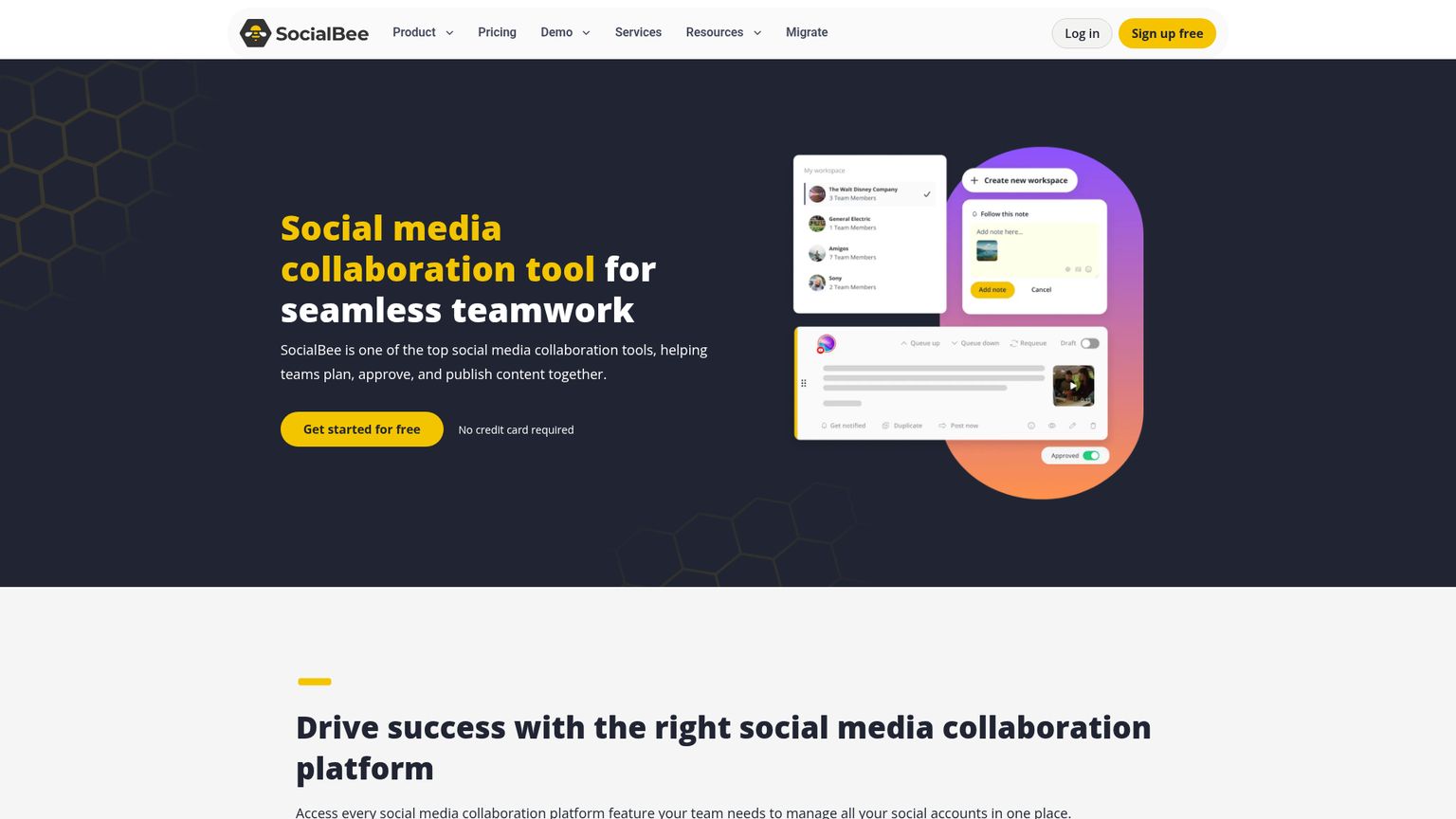
For an agency serving a dental practice, a restaurant and a consultancy, separate workspaces reduce the chance of mixing their content calendars. Assign access around responsibility: who drafts, who checks business facts and who releases a post. The software can support that division, but the agency still has to name the approver and agree a review deadline with the client.
The commercial distinction is easy to miss. Pro includes twenty-five profiles in total, five workspaces and three users per workspace. Five workspaces do not turn the plan into five separate twenty-five-profile subscriptions. Likewise, buying an extra workspace does not by itself buy more profile capacity. The pricing page lists the allowances separately.
The diagram shows how the allowances relate. The profile pool belongs to the plan; workspaces organize it; the included user allowance applies within each workspace.

Formal post approval begins on Accelerate, but internal notes and report exports begin on Pro. Adding another user to Bootstrap therefore does not supply the complete review workflow demonstrated on the collaboration page. For an agency choosing between products around its client process, use the separate Vista Social pricing breakdown to compare the full configuration.
Analytics should change what gets reused
SocialBee's category analytics give a content-library owner a way to decide what deserves another slot. Its public analytics page describes profile and post performance, category metrics, date filters and custom UTM parameters per category. UTM parameters are labels added to links so a separate website analytics system can identify the source of visits. SocialBee's analytics page documents the workflow.
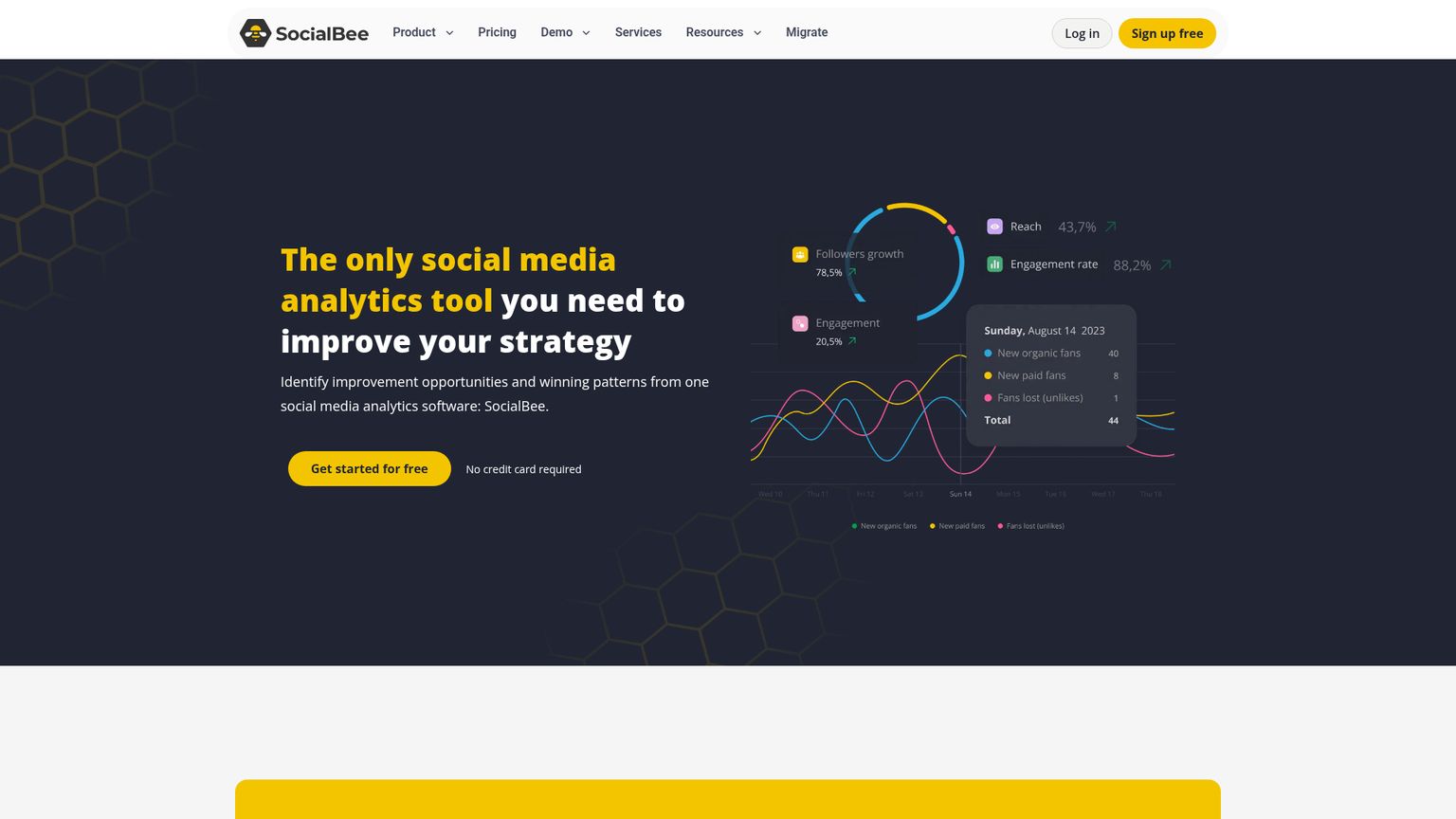
A local business can compare the response to service explanations with the response to general advice, then inspect the posts inside each group. Keep the useful material, revise weak introductions and retire posts that no longer support the offer. A category with strong engagement still needs a connection to enquiries or sales before it deserves more production time.
The plan matters for the deliverable. Bootstrap includes up to three months of analytics data. Accelerate extends the listed history to two years and adds advanced analytics; exporting analytics reports requires Pro. An agency that promises a PDF report should include that requirement in its quote before buying a cheaper plan. The pricing matrix is the entitlement reference, and metrics also vary by network.
Do not treat a scheduler's engagement report as proof of customer acquisition. Use tagged links and your own enquiry or sales records to judge the commercial outcome. The relevant question is whether useful attention reached the business, not whether automated publishing increased the post count.
SocialBee pricing: every plan and the add-ons
SocialBee costs $29 to $449 a month on its six advertised monthly tiers, before applicable taxes. Every tier includes unlimited AI content generation. The standard plans serve individuals and smaller teams; the agency plans increase capacity while keeping Pro's feature set. All amounts below come from the live SocialBee pricing page, checked on 10 October 2026.
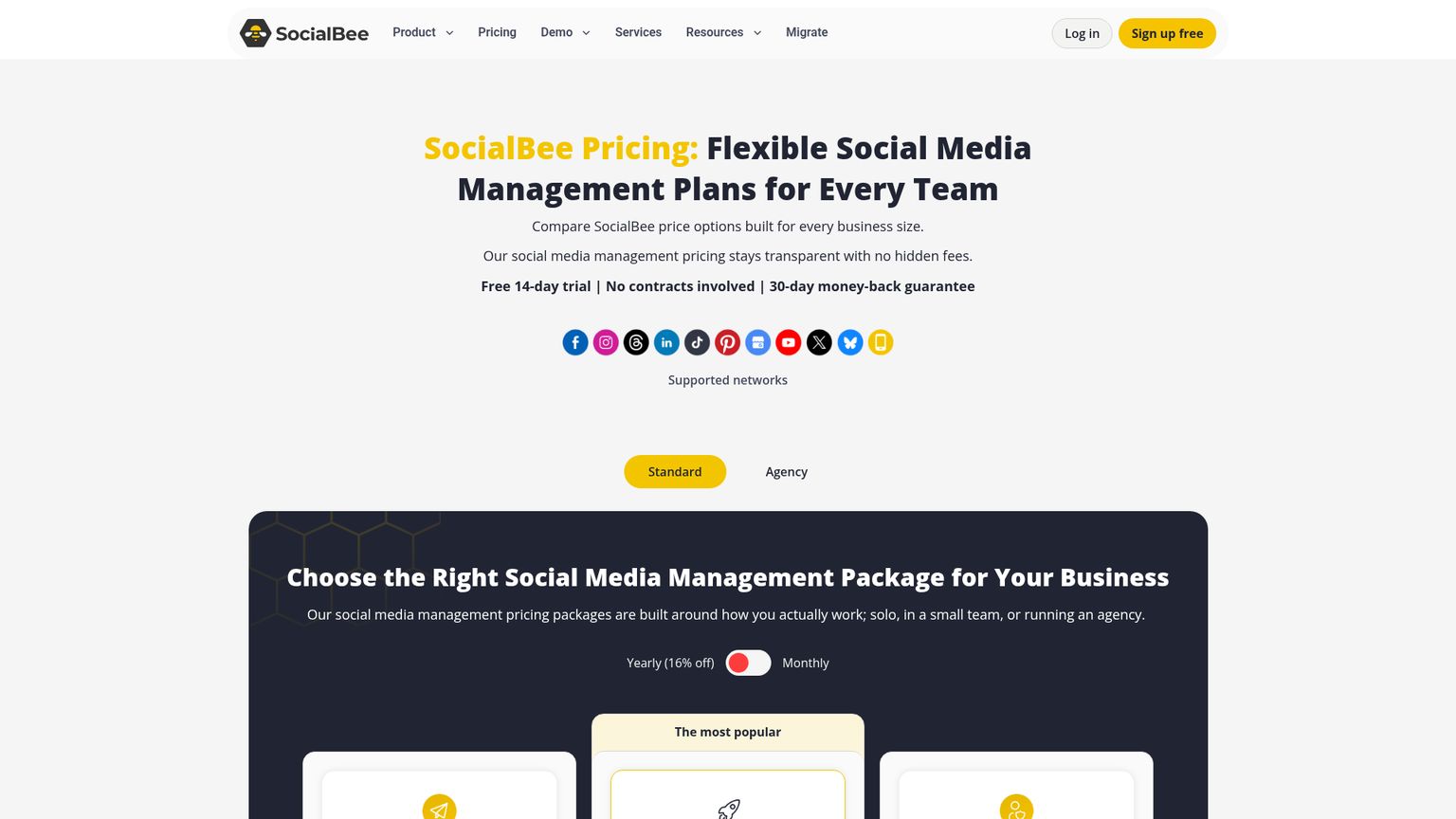
The annual rates are sometimes shortened to $24, $40, $82, $149, $274 and $374. The live cards also carry fractional digits: $24.20, $40.80, $82.50, $149.20, $274.20 and $374.20. For the standard plans, the table uses the separately published annual invoices to calculate precise monthly equivalents. Agency figures are the displayed card rates; confirm the annual invoice at checkout rather than multiplying a rounded display rate. Applicable VAT, GST or other regional taxes are added there based on your location. The page also retains a birthday promotion with a June 10 deadline; those expired promotional rates are excluded here.
What each upgrade buys
Bootstrap is sufficient for a solo publisher who needs recurring content and AI drafting. It includes ten content categories and up to 1,000 posts per category. Its missing formal approvals, internal notes and report exports matter more to most small businesses than the size of that library.
Accelerate increases the category limit to fifty and the posts-per-category limit to 5,000. It adds advanced analytics, CSV importing, bulk post editing, hashtag organization and formal post approval. It still includes one user in one workspace. An approval feature and another reviewer's login are separate budget items.
Pro adds the multi-workspace allocation, three users per workspace, internal notes and analytics report exports. Categories and content sources are unlimited, although the pricing matrix still lists 5,000 posts per category. Choose it when those operating requirements matter, not simply because the trial showed them to you.
Pro50, Pro100 and Pro150 are capacity expansions of Pro. Match the required profile pool, number of client workspaces and users per workspace to the row. An agency with many small clients can exhaust workspaces before profiles; one with a few large clients can reach the opposite constraint.
The sixth profile does not automatically require Accelerate
SocialBee lists these add-ons on its standard plans: an extra user costs $10/month or $100/year; an extra workspace costs $10/month or $100/year; and a pack of five extra profiles costs $15/month or $150/year. These prices are on the same pricing page.
For six profiles, Bootstrap plus one five-profile pack costs $44/month, or $440/year, equivalent to $36.67/month. You pay for ten-profile capacity and leave four slots unused, but it remains cheaper than Accelerate if Bootstrap's feature set is sufficient. The difference is $5 on monthly billing or $50 across an annual subscription.
For eleven profiles, Accelerate plus a five-profile pack costs $64/month, or $640/year, equivalent to $53.33/month. That can avoid Pro's $99 monthly bill when you do not need Pro features. A profile-cap warning that omits these add-ons overstates the upgrade cost.
The same logic applies to collaboration. Two operators who need formal approvals can use Accelerate plus a user for $59/month, or $590/year, equivalent to $49.17/month. Five-channel Buffer Team costs $50 a month on annual billing and includes unlimited team members. The $0.83 monthly-equivalent difference is too small to outweigh workflow fit or the need for more reviewers.
Price the occupied agency, not the maximum capacity
At full capacity on monthly billing, Bootstrap costs $5.80 per profile, Accelerate $4.90 and Pro $3.96. But Pro used for twelve profiles costs $8.25 per occupied profile. The lower calculated per-profile average only becomes useful when the capacity is occupied.
Consider three clients with four profiles each, a separate workspace for each client and one operator per workspace. That is twelve profiles and three workspaces. Accelerate plus a profile pack and two additional workspaces totals $84/month. Pro costs $99/month, a $15 difference that brings internal notes, report exports and more included user capacity. This modeled configuration is a comparison of required allowances, not a claim that either option is cheapest for every agency.
Now consider five clients using five profiles each. They fill Pro's twenty-five profiles and five workspaces. A sixth client of the same size needs another workspace and another profile pack. On the published add-on rates, the plan becomes $124/month, before any additional user costs, versus Pro50's $179. The client count alone does not force Pro50; the complete account and access requirements decide it.
Use the trial against the plan you intend to buy
SocialBee offers a fourteen-day trial with no credit card, and the pricing page describes access to Pro features. Posting stops after the trial if you do not subscribe. There is no reason to assume a Bootstrap purchase retains every capability visible during the trial. SocialBee's trial terms explain the distinction.
Before the trial ends, list the functions you used and map each to the paid plan. If internal notes or PDF exports became part of the client's process, include Pro in the budget. If only category scheduling and AI drafts mattered, the lower configuration may be sufficient.
The limitations that should decide the purchase
SocialBee has useful breadth, but its limits are specific enough to change the buying decision.
Capacity arrives in bundles. The profile allowance is shared across workspaces, and the smallest published profile add-on is a pack of five. A business needing just one extra profile pays for unused capacity. Count actual accounts, including repeated accounts on the same network, before comparing any per-profile headline.
A cheaper plan cannot inherit Pro's workflow by adding seats. Bootstrap lacks formal post approvals; Accelerate includes them but does not include internal notes or report exports. A user add-on changes access capacity, not the feature tier. This is particularly easy to miss after a Pro-feature trial.
The engagement inbox has network-specific coverage. SocialBee does have an inbox, but the public support list covers comments, mentions and direct messages for Facebook Pages and Instagram Business; comments and mentions for Threads, LinkedIn Company and X; and comments for YouTube. Scheduling support for a network is not evidence that its DMs also appear in the inbox. SocialBee's engagement page is explicit about the supported interaction types.

For an agency whose service promise includes answering customer messages, write down the exact network and account type for every inbox it must cover. A missing message channel affects staffing and response commitments even when publishing itself fits the scheduler.
Some destinations require a human publishing step. SocialBee's Universal Posting uses its mobile app and reminders for destinations with platform limitations. Its scheduling page names Facebook Groups, Mastodon, Quora, Telegram and WhatsApp among the examples. Do not sell an unattended publishing service before checking the exact destination and post format in the trial. The scheduling documentation distinguishes these workflows.
Unlimited AI does not remove editorial responsibility. A draft still needs accurate facts, an appropriate offer and a recognizable business voice. Likewise, category reuse creates maintenance work when products, prices or policies change. If your calendar consists mostly of material that expires quickly, there is less reusable work for the subscription to absorb.
SocialBee review verdict: buy the recurring workflow
SocialBee is worth shortlisting when recurring content is an operating asset: a local business answering familiar customer questions, a solo marketer turning existing expertise into posts, or an agency maintaining separate client libraries. Its category scheduling, Copilot and workspaces fit that job. The strongest purchase starts with the smallest plan and add-ons that satisfy the actual workflow.
Choose Bootstrap when one operator needs reusable publishing and AI drafts. Choose Accelerate when formal approval or its additional publishing and analytics features become necessary, budgeting reviewer access separately. Choose Pro when internal notes, exported reports or its included workspace-and-user configuration justify the bill. Above that, compare agency tiers with the required add-ons before moving up.
The decision flips to Buffer when a light or changing queue matters more than a recurring library, especially when the free plan is sufficient or many collaborators need access. It flips toward Later when visual planning matters most, its social sets fit and its AI allowance is adequate. Neither alternative wins purely because a headline price looks smaller.
On Monday, inventory your connected accounts and reviewers, select a representative group of reusable posts and a dated offer, and run that workflow through the trial. Check a required publishing format, an expiry rule and the client's reporting requirement. Buy only after the intended paid configuration supports all of them. That is a more useful acceptance test than filling the calendar with generated drafts.
Frequently asked questions
How much does SocialBee cost?
SocialBee starts at $29/month for Bootstrap, with five profiles and one user in one workspace. Its published annual Bootstrap invoice is $290, equivalent to $24.17/month. Monthly Accelerate and Pro cost $49 and $99; agency plans cost $179, $329 and $449. Add-ons and applicable taxes can increase the bill. See the current pricing page for billing terms.
What are social media reviews?
The phrase can mean an evaluation of social media software or customer feedback shared on a social platform. For a scheduler purchase, useful review evidence includes current commercial terms, documented capabilities and clearly identified hands-on observations. This review provides the first two, plus cost calculations.
Is SocialPilot legit?
SocialPilot is a different product from SocialBee. The SocialBee sources examined here do not establish a verdict about SocialPilot. Evaluate its own product documentation and commercial terms before treating either company's review as evidence about the other.
Is SocialBoom.io a legitimate service?
This review does not verify SocialBoom.io. SocialBee's documented scheduling features and subscription terms should not be used to infer anything about a similarly named service.
Is social boost legit?
The name alone is insufficient to assess a service. Identify the exact provider and promised work before evaluating it. SocialBee's documented product is a scheduler; the evidence here does not verify a separate provider's growth promises.
Is social boosting legit on Reddit?
A forum recommendation is not verification of a provider's identity or promised results. Look for a specific service, dated evidence and clear terms. This public-documentation review did not verify a boosting service through Reddit.
How much does social boosting cost?
A promotion or boosting budget is separate from a scheduler subscription. SocialBee's starting $29 monthly subscription is the software price; it should not be treated as a quote for advertising or purchased audience growth.
Is socialdoper legit?
No verified evidence about that service was collected for this review, so it carries no endorsement here. Similar wording in a product name is not evidence of an association with SocialBee.
What is social boosting?
The phrase generally describes promotion intended to increase the exposure of social content; providers may use it to describe different services. Scheduling determines when posts are published. A recurring calendar does not by itself establish additional reach, followers or sales.
Join the newsletter for practical workflow and pricing updates to help you choose the tools your business needs.
- Published
- Category
- Growth
- Language

SurveyMonkey Pricing: Plans, Response Caps and Annual Bills
SurveyMonkey prices, response caps and AI limits, with annual bills for one person and three-seat teams. See when overages change the best plan.Oct 10, 2026Growth
ActiveCampaign Alternatives: GetResponse, Kit and More
Compare ActiveCampaign alternatives at 2,500, 10,000 and 25,000 contacts, with vendor prices, workflow trade-offs and a migration checklist.Oct 9, 2026Growth
CallRail Alternatives: WhatConverts and More Compared
Compare six CallRail alternatives by vendor pricing, usage fees, AI and reporting. Includes WhatConverts cost math and a pre-switch checklist.Oct 9, 2026Growth
Monday.com Pricing: Seat Buckets and the Yearly Bill
Calculate monday.com Work Management costs for 5, 12 and 40 people, including seat buckets, annual vs monthly billing and AI credit charges.Oct 9, 2026Growth
Beehiiv Pricing: Annual Costs by List Size
Beehiiv pricing verified October 2026: annual bills at 1k, 10k, 50k and 100k subscribers, plan features, October changes and paid newsletter fees.Oct 9, 2026Growth
Pipedrive Pricing: Plans, Add-ons and Team Costs
Current Pipedrive seat and add-on prices, annual vs monthly budgets for 3 and 10 users, AI features, and when Premium costs less.Oct 8, 2026Growth
Lemlist Pricing: Seats, Credits and Sending Costs
Lemlist pricing by month, quarter and year, including credits, mailboxes and add-ons. See founder, sales team and agency bills plus alternatives.Oct 8, 2026Growth