Best CRM for Small Business in 2026: Pipedrive, Close, folk, Keap and More (Compared)
Compare nine small-business CRMs by how you sell, verified prices for five users, free-plan limits, setup effort and the upgrades that matter.
Published
 By Omid Saffari





Pipedrive is the best CRM for small business owners who need a clear deal pipeline; Close wins when calls and email drive the day, folk fits warm relationships, and Keap fits an established automation process. For five users, the starting paid bill ranges from an advertised $35 a month at HubSpot to $416 a month at Keap, with different billing terms and extras. Choose the plan that supports your daily selling work, then check what the next hire or automation will cost.
A customer relationship management system, or CRM, keeps the customer record, conversation history and next sales action together. For a service or B2B business with 2-50 people, its first job is straightforward: make sure a promising inquiry still has an owner when the founder gets busy.
Your company headcount is not your seat count. A firm with a large delivery team might need only the owner and a sales hire in its CRM. The five-seat calculations below assume five people need to participate in selling, rather than merely receive a report.
Pricing verified on 10 October 2026. Prices are US dollars before tax. Annual prices are monthly equivalents of an annual subscription, not promises of monthly payment. Five-seat totals are calculations from the vendors' published rates. Promotions, contact allowances, calling charges and implementation are identified separately.
Best CRM for Small Business: At a Glance
Start with Pipedrive unless a different selling motion gives you a concrete reason to choose another product. It is the default for an owner who wants to see which opportunities are advancing and what needs attention. The alternatives below win on specific jobs, not on an aggregate review score.
These are entry prices. Close Solo cannot serve five users, monday CRM's minimum purchase is larger than one seat, and HubSpot's advertised Starter offer should not be treated as a permanent renewal rate. Each section gives the five-seat bill and the next relevant plan.
For an AI-first purchase, use the separate comparisons of AI CRM for startups and AI CRM tools and their usage costs. The choice here starts with your sales process and the people who must maintain it.
How These Were Picked
The deciding criteria are selling fit, the usable-plan cost, the upgrade boundary and the work needed to get started. A consultancy that wins through referrals needs a different daily workspace from a business whose reps spend the morning calling prospects. Giving both the same universal winner hides the purchasing decision.
This is a comparison of live pricing pages, published capabilities and calculated costs. It is not a hands-on product test. No recommendation uses a review site's numerical score, and no setup time below is presented as a measured trial result.
The shortlist covers nine products suited to these sales jobs. It is not a claim that every CRM on the market was evaluated. Specialist retail, field-service and industry systems need a separate assessment of order, dispatch or regulatory requirements before they can be compared fairly with a general sales CRM.
The practical rubric is:
- Daily work: Can the owner or salesperson maintain the customer record while doing the selling?
- Follow-through: Does the plan include the communication, reminders or automation your process depends on?
- Total purchase: What do five active users cost, and what remains outside that subscription?
- Adoption: Who will clean the import, define the stages, manage permissions and teach the next employee?
Setup estimates are planning allowances. They assume a clean contact spreadsheet, one main sales process, basic email connection and a short team walkthrough. They exclude major migrations, custom integrations, historical data repair and extensive automation. Hours mean focused configuration time; Keap's estimate is elapsed implementation time. Allow a subsequent workweek to see whether people keep records current.
Partner disclosure: Links to Close, Pipedrive, folk and Keap may earn a commission. Each is recommended for a specific fit, with its limitations and alternatives stated alongside it.
Pipedrive: Best for a Visual Deal Pipeline
Pipedrive is a sales CRM built around leads, deals and activities, and it is the strongest starting point for a conventional service-business sales pipeline. A pipeline is simply the sequence an opportunity follows before you win or lose it. An agency owner should be able to distinguish a discovery call from a proposal awaiting a decision without assembling an update from several inboxes.
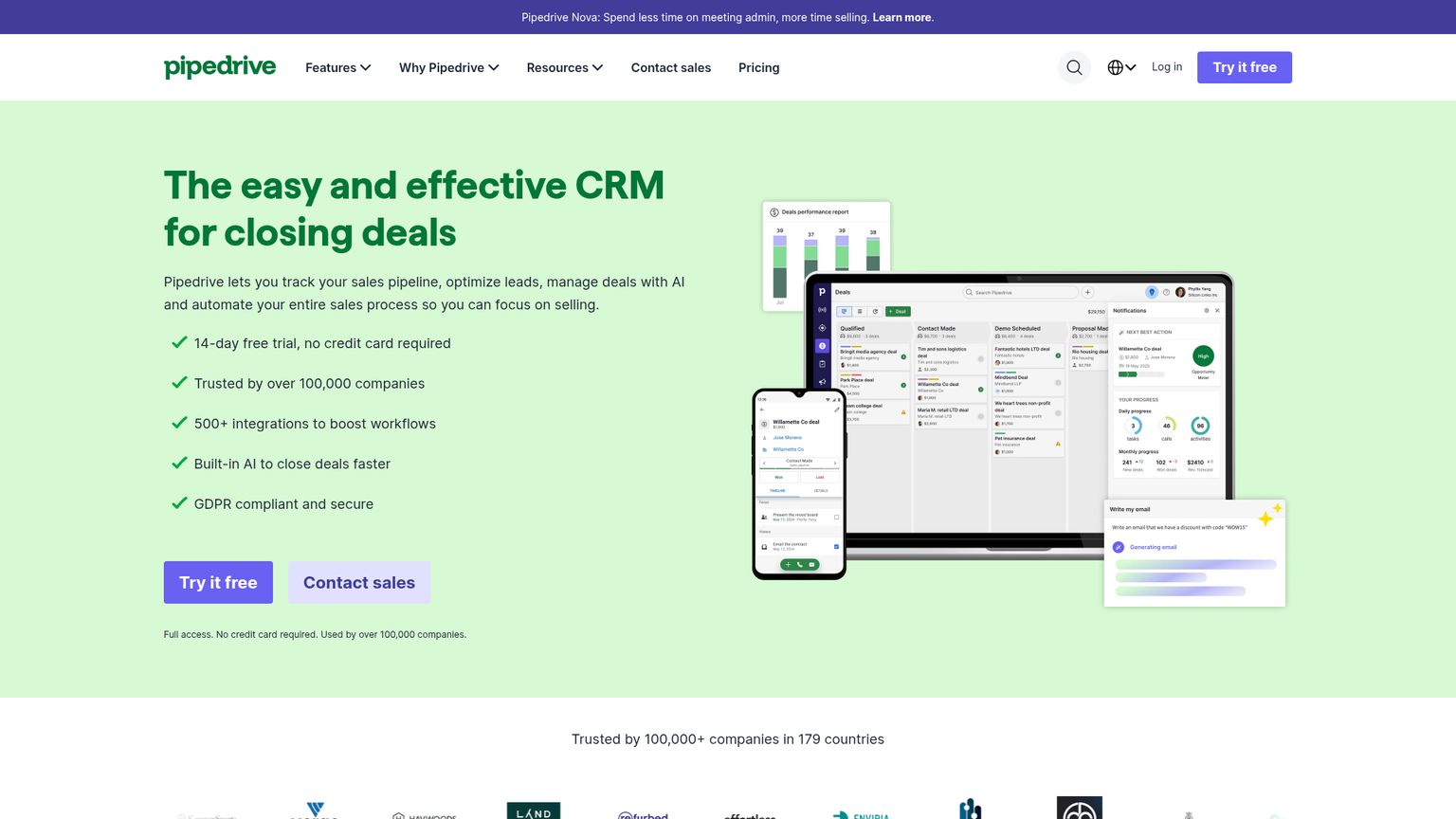
The buying question is whether you need a shared list of deals or a connected follow-up process. Lite covers the basic pipeline job. Growth adds full email synchronization and nurturing sequences, which are scheduled follow-ups around a sales conversation. Those are different purchases, even though both are called Pipedrive.
Best for: Owners and first sales hires managing defined opportunities through repeatable stages.
Standout: A deal-centered workspace with a clear upgrade to email synchronization and follow-up automation.
Pricing: Lite $14, Growth $39, Premium $59 and Ultimate $79 per seat per month, billed annually.
Free trial: 14 days, with no credit card required.
Setup allowance: 3-6 focused hours for the baseline setup described above.
At five seats, those annual plans cost $70, $195, $295 and $395 per month equivalent, respectively. The corresponding annual bills are $840, $2,340, $3,540 and $4,740. These figures come from the current Pipedrive pricing page, verified on 10 October 2026. All four rates above require annual billing.
Premium becomes relevant when you need proposals and contracts with e-signatures, required fields or more detailed team controls. Ultimate adds stronger security controls and a sandbox, a separate place to test changes. Most first-time buyers should justify those requirements before paying for them. Projects and Campaigns are separately listed add-ons, so a CRM subscription alone does not price your entire delivery and marketing stack.
Best Simple CRM for Small Business: Keep the Pipeline Simple
For a small consulting agency, a useful stage describes something the buyer has done: agreed to discovery, received a proposal or approved the work. A stage called “follow up” tells you little, because follow-up may be needed anywhere. Keep the stage and the next activity separate.
That distinction is why Pipedrive is the default recommendation. The business can organize around actual opportunities without first designing an elaborate customer database. The owner still has to define what qualifies a deal to move; software cannot settle that disagreement.
- Lite supplies the central lead, deal, calendar and pipeline functions.
- Growth includes full email sync and nurturing sequences.
- Premium provides a route to contracts, e-signatures and required fields.
- Full email sync and automation require the step above Lite.
- Project delivery and email marketing can add separate subscriptions.
- A clear board still depends on consistent stage definitions and ownership.
Pick Pipedrive when the weekly question is “Which deals will move?” Pick Close instead when the daily question is “Which prospects should I call next?”
Define the buyer milestones
Write the stages of your actual sale before configuring the pipeline. Use customer actions as the boundaries, and agree what evidence lets a deal advance.
Import a small sample
Start with 10 contacts and their active opportunities. Map names, companies, deal owners and values, then inspect the result before importing the rest.
Give every open deal a next activity
Choose the next call, meeting or follow-up and its due date. A deal with no next activity should be an exception you can explain.
Check the paid-plan boundary
If the trial uses email sync or sequences, verify that your chosen paid plan includes them. Have the sales hire continue an opportunity from the record without asking the owner for missing context.
Close: Best for Call-Heavy Outbound
Close is a sales CRM with calling, email and SMS inside the customer workflow, and it earns its premium when communication occupies most of the sales day. Consider a B2B services firm with reps working through prospect lists: the useful question is how quickly they can move from context to a conversation to a recorded next step.
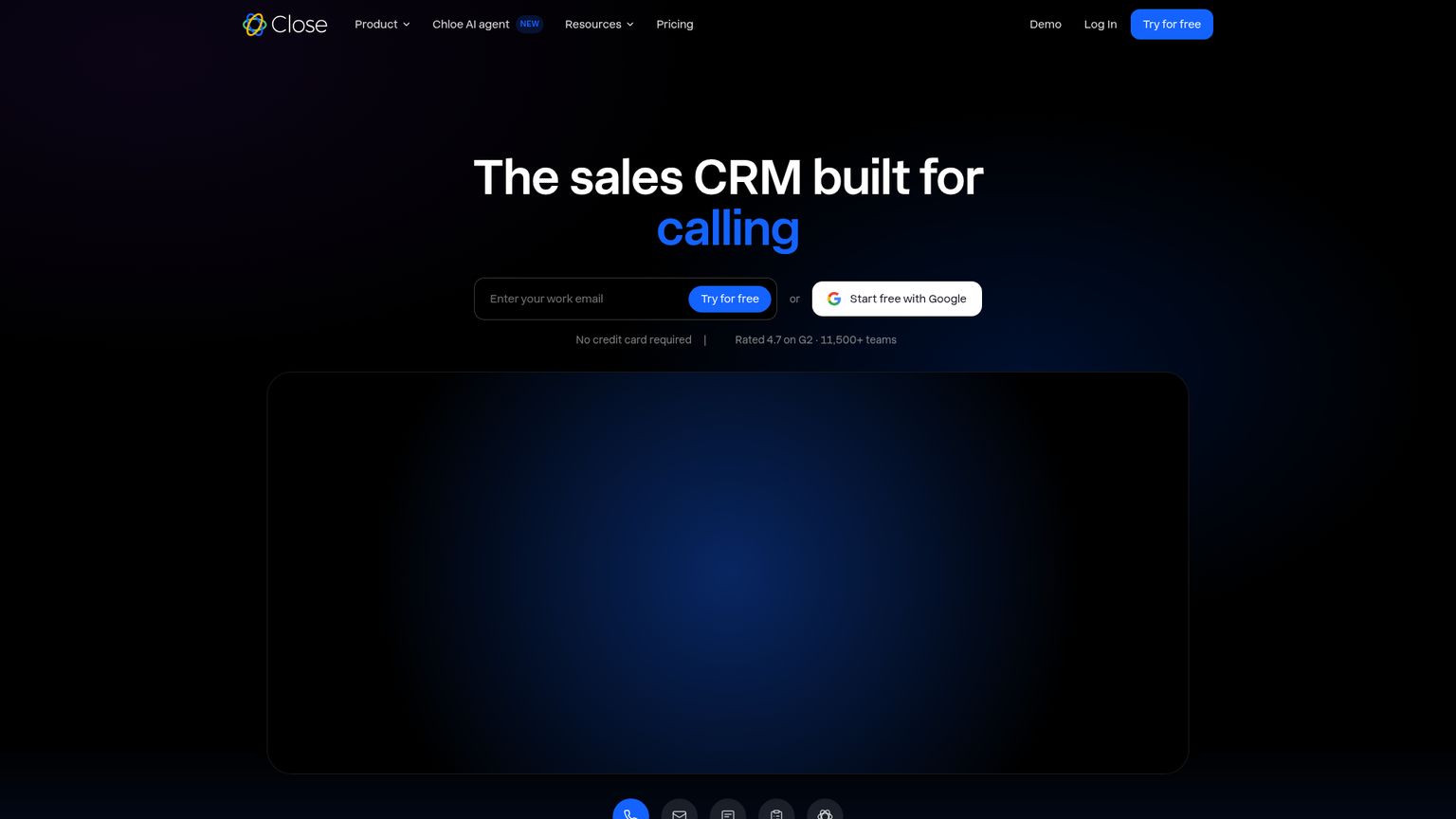
Close's lowest advertised price is a solo subscription. A business with several sellers must start its comparison at Essentials. If the reason for choosing Close is automated outreach or the power dialer, which works through a list of calls, the relevant plan is Growth.
Best for: Service and B2B teams whose selling work is dominated by calls and email.
Standout: Communication and the lead record stay in the same sales workspace.
Pricing: Annual rates are Solo $9, Essentials $35, Growth $99 and Scale $139 per user per month. Monthly rates are $19, $49, $109 and $149.
Free trial: 14 days, no credit card required.
Setup allowance: 4-8 focused hours, including communication setup and a team walkthrough.
Solo permits one user and 10,000 leads. For five users, Essentials is $175/month annually or $245/month on monthly billing; Growth is $495 or $545; Scale is $695 or $745. Annual subscription totals are $2,100, $5,940 and $8,340. Calling is charged by usage in addition to the subscription. Close pricing is the source for these rates and limits.
Essentials includes team collaboration, built-in forms and communications, but it excludes workflows. Growth adds automated workflows, bulk email and the power dialer. Scale adds capabilities such as predictive dialing, lead visibility rules and live call coaching. Buy Scale because those controls solve a current problem, not because it has the longest feature list.
Best Email CRM for Small Business: Price the Calls Too
For an outbound service team, email and calling often form one process. A rep sends an introduction, calls, records the outcome and schedules the next touch. The benefit to evaluate is the reduction in switching and reconstruction between those actions.
Use your own time observations during the trial. If five reps each recover 20 minutes on 20 working days, that is about 33 hours a month. At an assumed labor value of $40 an hour, that time represents roughly $1,333 of capacity. It is an illustration, not a Close performance claim, and it becomes useful only if the time moves into productive selling.
- Essentials includes calling, email, SMS and a centralized task/inbox view.
- Growth connects automated workflows with a power dialer.
- Scale supplies more control for a manager overseeing active callers.
- Solo's headline rate cannot be multiplied into a five-user team plan.
- Workflow automation requires Growth.
- Phone usage is an extra cost, so seat totals are not the complete calling budget.
Choose Close when reps actively work a prospect list; choose a lighter CRM when most sales arrive through existing relationships. Before committing, use the Close CRM pricing guide to model your actual seat count and communication costs.
folk: Best for Relationship-Led Selling
folk is a contact-centered CRM for maintaining relationships, and it fits a consultant or small agency whose next engagement often begins with a referral. The important record may be the person who introduced you, the last conversation and the reason to reconnect, rather than a large queue of identical opportunities.
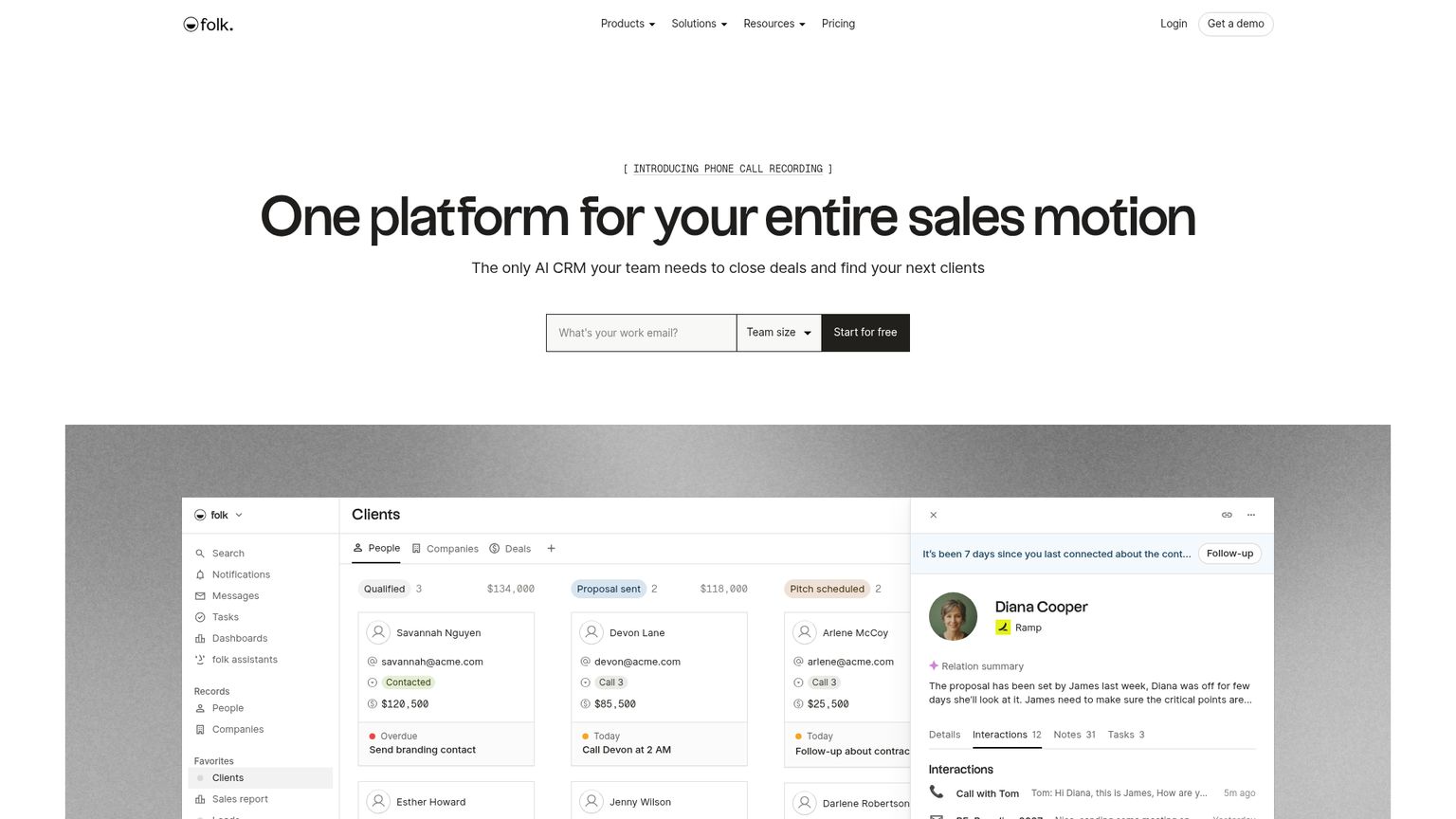
Standard combines pipeline views with contact enrichment and email, calendar and WhatsApp synchronization. That gives a relationship-led seller a place to organize conversations without making every contact look like a near-term deal. Premium is a significant step when the business needs dedicated deal objects, sequences, dashboards or more control over the workspace.
Best for: Consultants, boutique agencies, partnerships and warm outbound built on existing context.
Standout: Relationship organization with communication synchronization and a LinkedIn extension.
Pricing: Standard $24 annually or $30 monthly; Premium $48 or $60; Enterprise from $80 or $100 per member per month.
Free trial: 2 weeks with no credit card required.
Setup allowance: 2-4 focused hours for a clean contact list and a small set of useful views.
Five Standard members cost $120/month equivalent annually or $150/month monthly. Premium costs $240 or $300. Enterprise starts at $400 or $500, with custom limits and scope to confirm. The annual bills at those starting rates are $1,440, $2,880 and $4,800. All rates are from folk's pricing page.
The distinction between pipeline views and dedicated deal objects matters. A view can organize contacts by a status. A deal object is a separate record for an opportunity, useful when the same company or person has several possible engagements. folk explicitly places “Custom objects & Deals” in Premium. Do not choose Standard assuming that every deal-management capability is included.
Best CRM for Small Consulting Business: Preserve the Context
Imagine a consulting owner reconnecting with a former client after an introduction to another department. The useful notes are what changed, who made the introduction and when it makes sense to talk. A generic “lead score” is less helpful than a reliable relationship history and a clear reminder.
Start by separating active opportunities from people worth staying in touch with. Otherwise, the pipeline fills with contacts who have never expressed buying intent, and the owner loses the distinction between a network and revenue expected soon. folk is a good fit when the organization is willing to keep that distinction simple.
- Standard includes contact enrichment and communication synchronization.
- The LinkedIn extension fits research and relationship capture.
- Premium offers a defined route to deal objects, dashboards and sequences.
- Dedicated deal objects and email sequences require Premium.
- Five members moving from annual Standard to Premium add $120 a month.
- A permanent operational free tier is not clearly supported by the trial FAQ.
Choose folk when the relationship is the durable asset. Choose Pipedrive when managing separate opportunities is the main job, or Attio when the relationship structure itself needs more design.
Keap: Best for Small-Business Automation
Keap combines CRM with marketing, appointments and payment-related workflows, and it fits a service business that already knows its repeatable customer journey. Think of a training company moving an inquiry through a consultation, purchase, onboarding and later follow-up. The value is in making that whole sequence dependable.
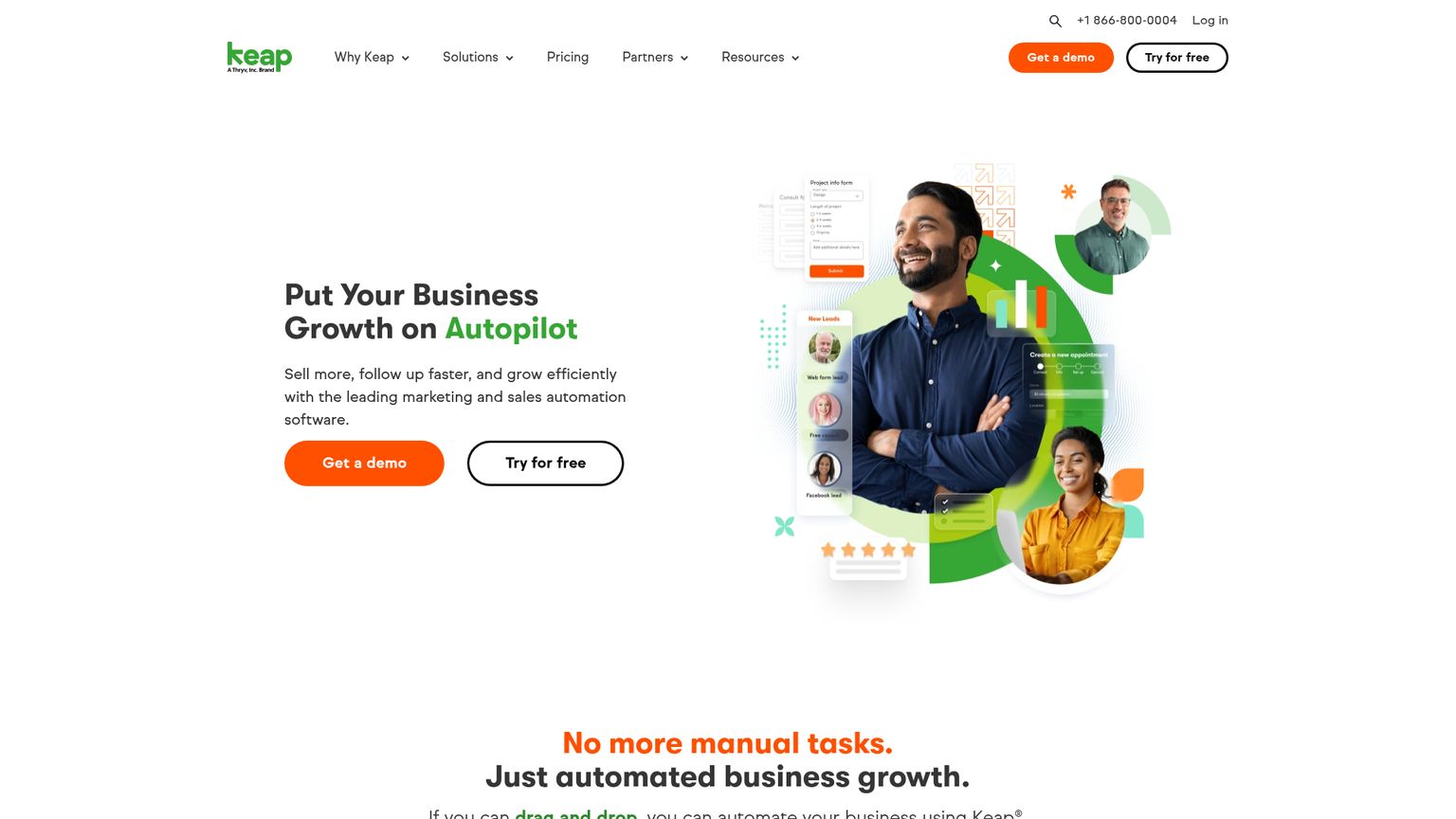
This is a different purchase from a contact manager. Keap's current pricing includes a broad account bundle, plus required implementation services. A business that has not decided how inquiries should be handled can spend money automating inconsistent decisions. Write the process first.
Best for: Established service businesses with repeatable lead nurturing, appointment and billing steps.
Standout: CRM, an automation builder, email/text, landing pages, appointments and payments in one offering.
Pricing: Base account starts at $299/month billed monthly, or $2,988/year, equivalent to $249/month, before required implementation.
Free trial: Advertised with restrictions; no card required.
Setup allowance: Plan for 2-4 weeks elapsed for a useful initial automation, subject to the implementation schedule and scope. This is an editorial allowance, not Keap's promise.
The base configuration starts with two users and 1,500 contacts. The pricing FAQ lists additional users at $39/month each. For five users on monthly billing, the calculation is $299 + three additional users × $39 = $416/month. Contact growth and usage can add costs. The annual base price is not a verified five-user annual quote. Keap pricing supplies the inputs.
The implementation page currently displays a $500 one-time investment, reduced from a crossed-out $1,500. At that displayed implementation price, a five-user monthly subscription begins at $916 including the first month and implementation, or $5,492 across a full year of monthly subscription payments plus implementation, before other extras. Confirm the package scope and current offer before buying.
The bundle includes automatic invoicing and past-due reminders, which can matter more to a service business than another sales dashboard. However, a payment workflow needs explicit rules: when an invoice should be created, when a reminder is appropriate and who handles an exception. A customer who has already paid should not receive another generic collection message because the process was poorly specified.
A useful first implementation is narrow. Pick one repeatable path, such as a consultation request through a booked appointment and the next required action. Check the stop conditions as carefully as the messages: what happens when someone replies, cancels, buys or asks a question? Expand only after the initial path behaves as intended.
- The bundle spans sales, marketing, appointments and payments.
- Automated invoicing and past-due reminders can support the post-sale process.
- Required implementation creates an explicit setup workstream.
- Implementation is mandatory and additional to the subscription.
- The base includes two users, so a five-user team costs more than the headline.
- Contacts and usage remain relevant even after seats are priced.
- Trial restrictions prevent a full live test of payments and texting.
Choose Keap when you can name the repeatable customer process it will run. Skip it when all you need is a shared pipeline and reminders.
HubSpot Free CRM: Best for a Small Inbound Start
HubSpot is a customer platform with a free CRM, and it is the most natural first look for an owner and a sales hire collecting inbound inquiries. Contact records, deal tracking, tasks, email templates and meeting scheduling can establish a shared sales habit before the business commits to a paid subscription.
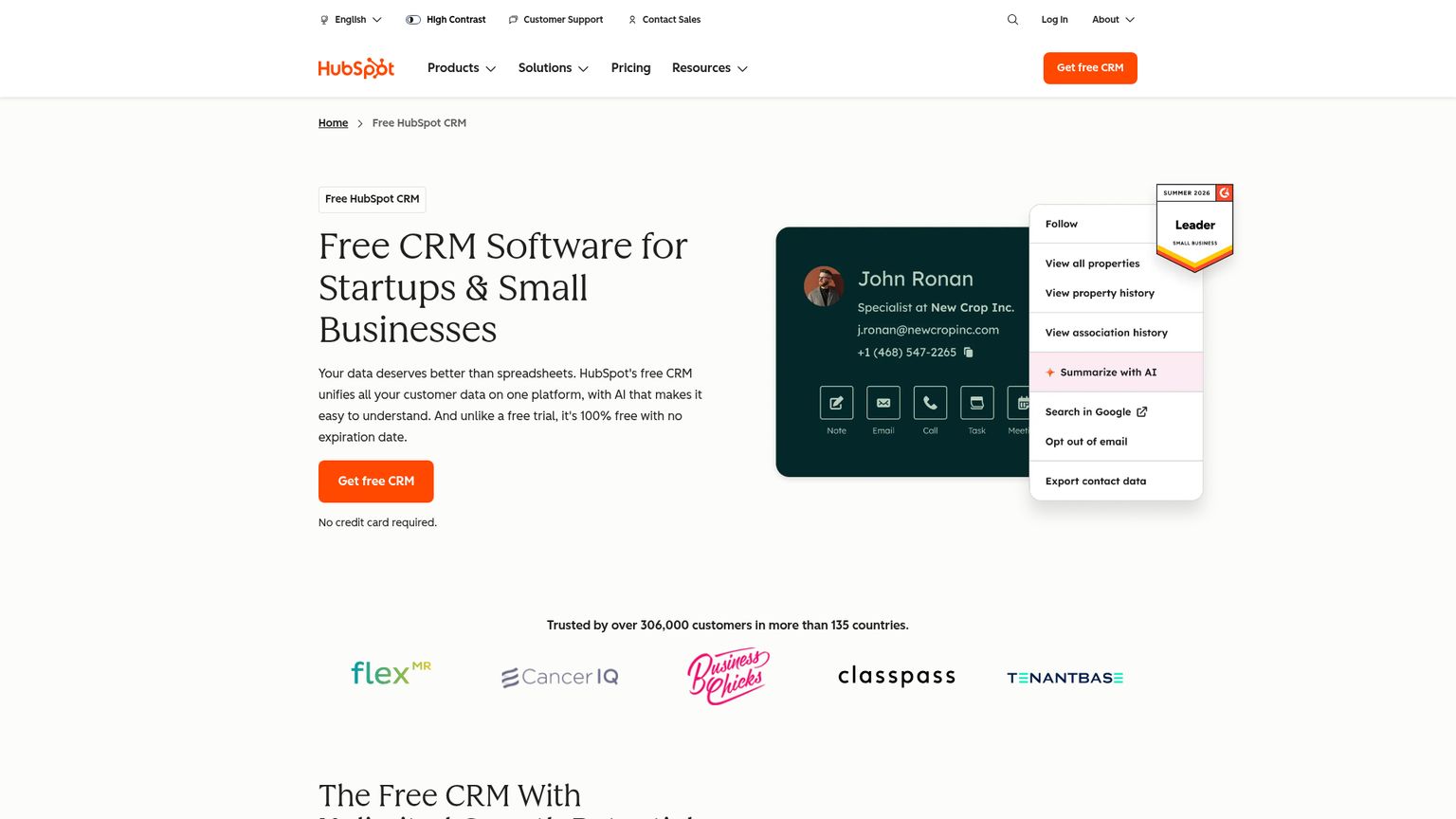
The free offer has a meaningful boundary: up to two users and 1,000 contacts, according to HubSpot's CRM page. It has no expiration date, but it is not an unrestricted five-person sales system. Evaluate the paid path before you depend on free access.
Best for: A very small inbound sales group establishing contact ownership and follow-up.
Standout: A permanent free entry point with a broader paid customer-platform path.
Pricing: Free $0. Starter advertises a starting offer of $7/seat/month; the catalog lists $20/seat/month. Professional displays $90 annually or $100 with monthly payments and an annual commitment; Enterprise starts at $150 with annual billing.
Free trial: The free CRM is an ongoing plan, not a timed trial.
Setup allowance: 3-6 focused hours for basic records, pipeline and email setup.
At five seats, the advertised Starter offer calculates to $35/month if your purchase qualifies. The catalog rate calculates to $100/month. The public pricing display and the catalog establish those two amounts, but they do not justify assuming a permanent $7 renewal price. Confirm the billed term, eligibility and renewal amount in the order. Sources: Sales Hub pricing and the product and services catalog.
Five Professional seats are $450/month equivalent with annual payment, or $500/month with monthly payments under an annual commitment, plus $1,500 required onboarding. Five Enterprise seats start at $750/month equivalent annually, plus $3,500 required onboarding. These are Sales Hub comparisons; they do not price every other HubSpot product a business might add.
For a small services company, the practical upgrade question is whether you are still managing straightforward inbound conversations or need more advanced sales execution and reporting. The current pricing page places sequences and forecasting in Professional. Starter has more restricted workflow triggers and actions than Professional, so do not infer feature parity from the presence of the word “automation.”
A good free-plan evaluation is operational. Can the owner see the original inquiry, the sales hire's response and the next meeting without asking for a summary? If yes, the business has gained something useful. If the buying reason is sophisticated automation from day one, price that requirement at the relevant paid tier before importing the entire database.
- Free access has no expiration date within its limits.
- The entry workflow covers contacts, deals, tasks and scheduling.
- Paid tiers provide a route to sequences, forecasting and more control.
- Two free users do not cover a five-person sales group.
- The advertised Starter offer should not be used as an assumed renewal price.
- Professional and Enterprise add required onboarding fees.
Choose HubSpot for a small inbound start with a known paid path. Choose Pipedrive when the immediate requirement is a focused deal workflow. The Pipedrive versus HubSpot comparison develops that choice in more detail.
Zoho CRM: Best for Lower-Cost Customization
Zoho CRM is a broad sales CRM with a low-cost paid entry point, and it suits an owner willing to assign someone responsibility for configuration. A small B2B supplier may need a pipeline today and more structured process or inventory-related work later. Zoho gives that buyer several defined steps up without starting at an enterprise seat price.
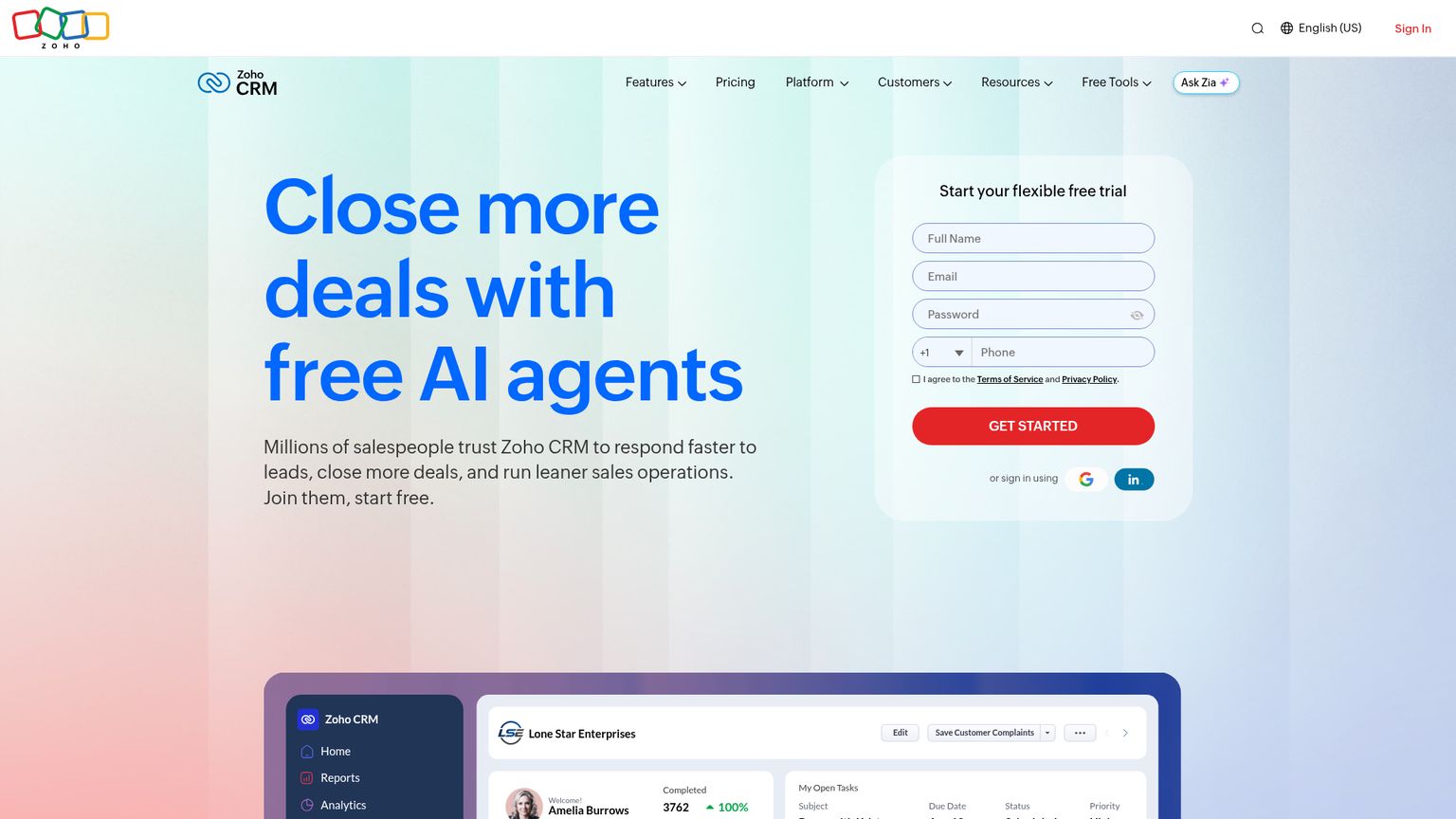
The tradeoff is the setup decision load. A flexible system invites more fields, rules and modules, meaning types of records. Each one should answer a business question or trigger a useful action. If nobody owns the configuration, a cheap subscription can still leave the sales hire working around the system.
Best for: Cost-conscious service or B2B businesses with someone available to configure and maintain their CRM.
Standout: A three-user free tier and several paid levels for broader sales processes.
Pricing: Standard $14 annually or $20 monthly; Professional $23 or $35; Enterprise $40 or $50; Ultimate $52 or $65 per user per month.
Free trial: A permanent free edition for up to three users; paid-plan trials are also offered.
Setup allowance: 1-3 working days for the baseline configuration, with more time for custom processes.
Zoho CRM Pricing at Five Seats
Five Standard users cost $70/month equivalent annually or $100/month monthly. Professional is $115 or $175; Enterprise $200 or $250; Ultimate $260 or $325. Annual bills are $840, $1,380, $2,400 and $3,120 respectively. These are the USD values used by the live Zoho CRM pricing page and its currency price data, checked this run. Select USD when comparing a localized version of the page.
Standard includes email integration, multiple pipelines, forms and forecasting. Professional adds more structured process and inventory management, while Enterprise adds deeper customization and approval-related capabilities. Ultimate is the higher-limit option. For a first CRM, the purchase should start with a specific requirement that Standard cannot satisfy before moving upward.
For a service firm quoting different packages, the first useful configuration might be customer type, service requested, owner and proposal status. Resist creating a separate pipeline for each salesperson merely because you can. Separate pipelines should reflect a different buying process, otherwise reporting becomes harder without improving daily work.
The free edition includes contact management, follow-up reminders, tasks, workflows and reports. Its three-user ceiling still matters: a five-user organization needs a paid plan. “Free plus two more sellers” is not the pricing model used in these calculations.
- Free access accommodates up to three users.
- Standard supplies email integration, multiple pipelines and forecasting.
- Professional provides a route to process and inventory management.
- More configurable choices require a clear internal owner.
- Five active users exceed the free allowance.
- Specialized requirements can move the purchase above Standard.
Choose Zoho when cost matters and configuration has an owner. If nobody can maintain the rules, favor the simpler process you can sustain.
monday CRM: Best for Sales-to-Delivery Coordination
monday CRM is a configurable, board-based sales product, and it is worth evaluating when winning work must lead into an organized delivery handoff. An agency or implementation business needs to carry scope, ownership and promised timing forward after a deal is won; a sales record that stops at “closed” leaves that work unfinished.
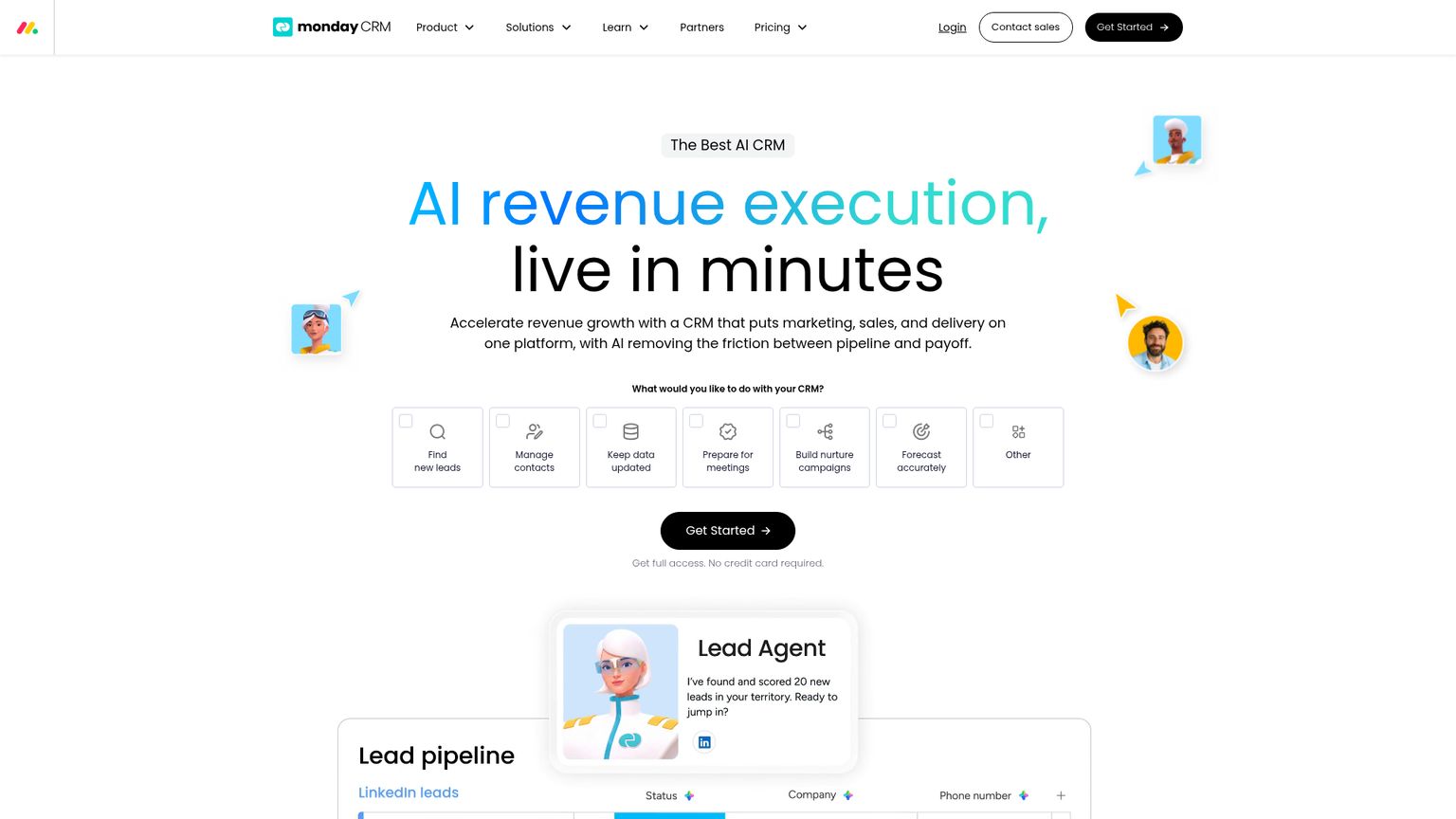
The product is distinct from monday work management. Familiarity with monday's boards can help a buyer understand the approach, but it does not establish that one subscription includes every separate product the company needs. Write down the delivery requirements and price the actual combination.
Best for: Businesses coordinating sales records with a structured operational handoff.
Standout: Configurable boards with a progression into more automation and larger record allowances.
Pricing: Basic $12 annually or $18 monthly; Standard $17 or $25; Pro $28 or $41 per seat per month. Ultimate is a custom quote.
Free trial: 14 days; an ongoing general-purpose free CRM plan is not offered on this pricing page.
Setup allowance: 1-2 working days for the core boards, ownership and handoff conventions.
The minimum is three users. A Basic account therefore starts at $36/month equivalent annually, or $432/year, rather than a $12 total bill. On monthly billing, the minimum is $54/month. For five seats, Basic is $60 annually equivalent or $90 monthly, Standard $85 or $125, and Pro $140 or $205. Five-seat annual bills are $720, $1,020 and $1,680. monday CRM pricing supplies the rates and minimum.
Basic currently allows 1,000 active contacts and deals and five columns per board. That column ceiling deserves attention before you design the record. Standard increases the allowances to 10,000 active contacts and deals, 15 columns per board and 250 custom automations per month. Pro lists 100,000 active contacts and deals and 25,000 custom automations per month. Ultimate is the renamed Enterprise tier.
Best CRM and Project Management for Small Business: Check the Handoff
For a web agency, a won deal should hand over the agreed deliverable, commercial terms, responsible person and first delivery action. The point is to reduce the need for a separate verbal reconstruction. An attractive board alone does not establish that the delivery side has the permissions, information and product access it needs.
During evaluation, walk one opportunity all the way through that transition. Ask the delivery owner to identify what was promised and what happens next from the record. Then verify which actions are manual, which are automated and which need another monday product or integration.
- Configurable boards can reflect the information needed at a sales handoff.
- Standard includes a centralized communications view and custom automations.
- Pro substantially increases the published automation allowance.
- The minimum purchase is three seats.
- Basic's five-column ceiling can constrain a useful record quickly.
- CRM pricing does not automatically include a separate work management subscription.
Choose monday CRM when the sales-to-delivery transition is part of the problem you are buying for. Use the monday CRM pricing guide before choosing seat counts and automation capacity.
Attio: Best for a Flexible Relationship Database
Attio is a configurable CRM built around connected records and relationships, and it fits a business whose information does not fit neatly into a single standard pipeline. A consultancy may need to distinguish client companies, individual buyers, partners and active engagements, then connect those records without forcing them all into one contact list.
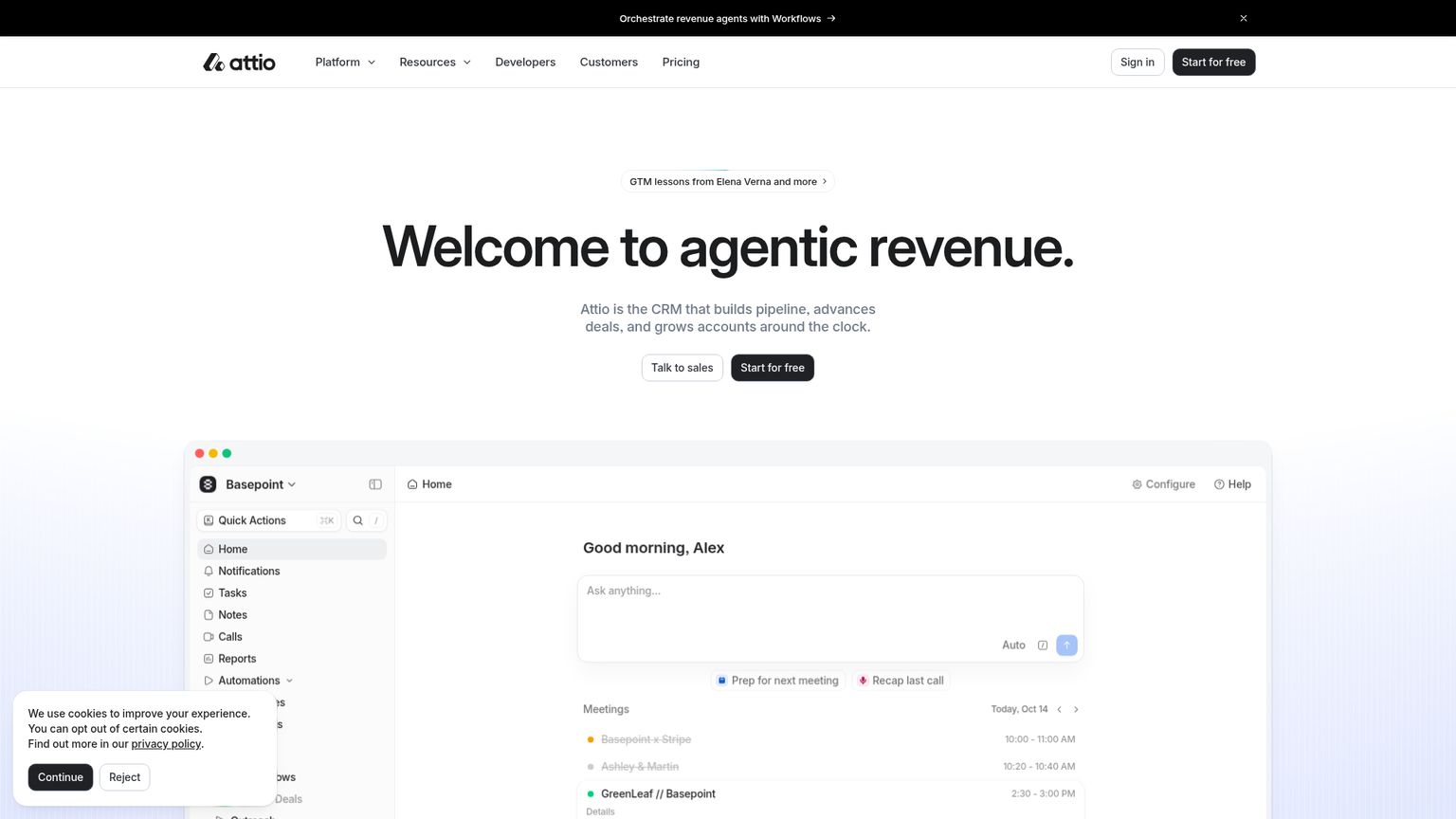
The free plan includes contact synchronization and automatic enrichment, which adds information to the record. Syncing email and calendars can establish a starting contact database. That is useful, but a large imported network is not automatically a useful sales process: someone must decide what should become an opportunity and who maintains it.
Best for: Small teams with a clear reason to model relationships and record types beyond a basic deal board.
Standout: Flexible records, contact synchronization and configurable lists.
Pricing: Free $0; Plus $35 annually or $44 monthly; Pro $79 or $99 per user per month. Enterprise is custom-priced annually.
Free trial: 14 days of Pro.
Setup allowance: 1-2 working days for an intentionally limited initial model.
Free allows up to three seats and 50,000 records. Five users need at least Plus: $175/month equivalent annually or $220/month monthly, an annual bill of $2,100 at the annual rate. Pro costs $395 or $495 for five, with a $4,740 annual bill. Plus has a 10-seat ceiling; a growing sales group must consider the move beyond it. These figures are from Attio's USD pricing page.
Pro adds advanced reporting and permission controls, alongside Call Intelligence and sequences. Attio also uses credits across AI and workflows, so a subscription should not be interpreted as unlimited usage. For this purchase, the central question is whether its record flexibility is useful enough to justify the configuration work.
Begin with the smallest model that explains an actual sale. If a business partner refers several client companies, preserve the distinction between the partner and those buyers. If your sales process is simply a lead progressing to a proposal, a conventional pipeline may be easier to explain to the next employee.
A useful acceptance check is whether a new teammate understands the records without a private tour from the person who built the workspace. Flexible fields are valuable only when their meaning is shared. If “client,” “account” and “company” mean the same thing to different people, settle the vocabulary before adding more automation.
- The free plan includes contact sync and enrichment for up to three seats.
- Plus supports private lists and enhanced email sending.
- Pro offers more advanced reporting and permissions.
- Five users require a paid plan.
- Plus stops at 10 seats.
- Flexible modeling creates design and maintenance work for the business.
Choose Attio when the relationships between records matter. Choose Pipedrive when a standard pipeline already describes the business well.
Salesforce Starter Suite: Best for a Deliberate Salesforce Choice
Salesforce Starter Suite is the small-business entry into Salesforce, and it belongs on the shortlist when choosing that platform is an explicit business decision. It should not win merely because a prospective sales hire recognizes the name. The first question is whether Starter includes the workflow and integrations needed now.
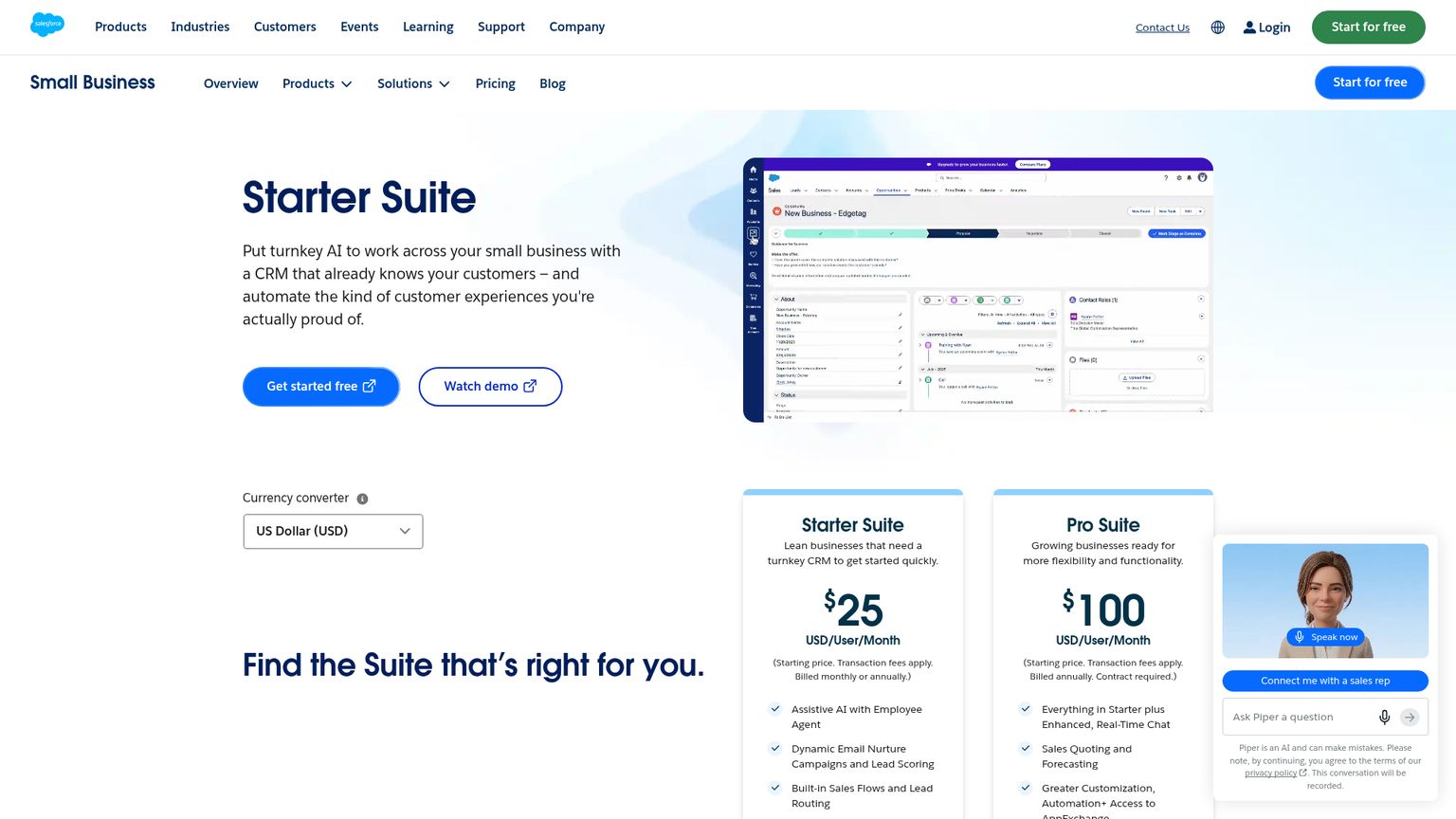
Starter covers account, contact and opportunity management, with lead routing and email nurturing. Pro Suite is the next visible small-business tier, and the upgrade is material. Capabilities such as expanded customization, sales quoting and forecasting, and AppExchange access are advertised at that higher level.
Best for: A small business intentionally adopting Salesforce with a defined Starter-compatible process.
Standout: A packaged entry point into Salesforce's customer-management approach.
Pricing: Starter Suite $25/user/month, billed monthly or annually. Pro Suite $100/user/month, billed annually with a contract.
Free trial: Offered on the vendor's pricing page.
Setup allowance: 1-3 working days for a limited Starter configuration, excluding integrations and a larger migration.
At five users, Starter is $125/month, or $1,500 across a year at that rate. Pro is $500/month equivalent, paid as a $6,000 annual subscription. Transaction fees may apply to payment activity. The Salesforce small-business pricing page is the source.
Salesforce CRM for Small Business: Price the Specific Requirement
A small consultancy might value a common account-and-opportunity vocabulary across its sales hires. That is a reasonable reason to evaluate Starter. It is not evidence that every Salesforce integration or customization a seller remembers from a previous employer will be included.
Ask for the exact workflow to be demonstrated in the edition you will buy. If the proposal depends on AppExchange or the more advanced capabilities listed under Pro, the comparison becomes $500 a month equivalent for five users, not $125. That $375 monthly difference deserves a business requirement, not a vague promise of future growth.
The same discipline applies to setup. Keep the initial process narrow enough that someone in the company can administer it. If the value proposition requires a complex custom system from the outset, cost that implementation separately before comparing it with a simpler subscription.
- Starter has a clearly stated $25 seat price with monthly or annual billing.
- It combines the central account, contact and opportunity records.
- The paid route to broader Salesforce customization is explicit.
- AppExchange and greater customization are advertised under Pro.
- The five-seat Pro subscription is four times the Starter subscription.
- Familiarity with Salesforce does not prove Starter covers a previous employer's setup.
Choose Starter because its current scope fits. Do not buy it on the assumption that it includes the whole Salesforce platform.
Free CRM for Small Business: Where the Free Plan Ends
Free can be enough for the owner and an early sales hire, but the user ceiling must match the people doing the work. HubSpot's free CRM accommodates two users and 1,000 contacts. Zoho CRM and Attio each offer free access for up to three users. A five-person selling group exceeds all three allowances.
Best Free CRM: Count the People Who Need Access
Choose HubSpot's free entry when its inbound workflow and limits fit. Consider Zoho's free edition when a three-user allowance matters and you are comfortable owning configuration. Consider Attio Free when flexible relationship records are part of the requirement.
Do not confuse a trial with an ongoing free plan. Pipedrive, Close, folk, Keap and monday CRM offer evaluation access, but the relevant public pricing pages do not establish an unrestricted permanent free team CRM. Trial access can also include capabilities missing from the paid entry tier.
A good free choice is one whose limits you can live within and whose next paid plan you can afford. A bad free choice requires people to share credentials, keep separate shadow spreadsheets or stop recording customers to stay under a cap.
Best CRM for Small Business Sales: Which One for You?
Choose by the work that most often causes a missed follow-up. When several products qualify, favor the one that the person responsible for sales can maintain without becoming a part-time software administrator.
- Deals stall between meetings: Pipedrive. Move the comparison to Growth when full email sync and sequences are required.
- Reps spend the day calling and emailing: Close. Budget for Growth if the power dialer and automated workflows are the reason to buy.
- Referrals and warm relationships produce the work: folk. Check Premium when you need separate deal objects or sequences.
- A repeatable customer journey needs automation: Keap. Include implementation, contact volume and the restricted trial steps.
- Two people need a free inbound starting point: HubSpot. Price the paid path before adding sellers.
- A lower seat bill matters and configuration has an owner: Zoho CRM.
- Winning a deal must lead into organized delivery: monday CRM, with the needed products and handoff tested together.
- Your customer relationships need a custom structure: Attio, with someone accountable for the model.
- Salesforce is a deliberate platform choice: Starter Suite, after verifying the edition covers the requirement.

The rule that flips the choice is simple: if the distinguishing feature is locked in a higher tier, compare that higher tier against the alternatives. The cheapest entry plan is relevant only when it completes your actual workflow.
The Ones to Avoid
Avoid the wrong plan for a named job, rather than declaring an entire vendor unsuitable for every small business. These are the mismatches most likely to produce an unnecessary upgrade or a second system immediately after purchase.
Avoid Close Solo for a team: its one-user cap is decisive. Avoid Pipedrive Lite for a sales process dependent on full email sync and sequences: those are Growth reasons to buy. Avoid folk Standard when the requirement is dedicated deal objects and sequence automation: its Premium boundary changes the comparison.
Avoid Keap for a business that only wants contact storage and manual reminders. The account bundle and mandatory implementation are difficult to justify without a repeatable automation job. Avoid treating HubSpot Free as a five-user plan or treating its displayed Starter offer as a guaranteed long-term rate.
Avoid monday CRM Basic if the record you need already exceeds five columns per board. Avoid Attio when nobody will own the relationship model, and avoid Salesforce Starter when the purchase depends on AppExchange access advertised in Pro.
Finally, avoid any annual commitment made only because a trial dashboard looked impressive. Ask what happens to the exact working process after the trial ends. The answer should name the paid tier, the included usage and the person responsible for maintaining it.
Set Up the CRM Around the Next Sale
A useful first CRM makes the next action visible to somebody other than the person who took the call. For a service business, that is the operational improvement to establish before building more dashboards or automations.
A stored contact alone is not enough. A colleague should be able to identify who owns the relationship, what happens next and when that action is due. If those answers live only in the founder's memory, importing more rows will not solve the underlying problem.

Use this AI business workflow audit checklist to frame the CRM rollout, even if you do not enable any AI features initially. It tests whether the underlying record and responsibility are ready for automation.
Name the lost work
Choose the failure that costs you attention: missed callbacks, unanswered proposals, forgotten introductions or incomplete delivery handoffs. Define what a successful record would let a colleague do without asking for a recap.
Assign one owner to each active opportunity
A shared record should still have a responsible person. Decide who updates it after a meeting and who covers the next action when that person is unavailable.
Import a sample before the whole history
Check a small group of contacts and active deals for duplicate companies, missing email addresses and incorrect owners. Fix the mapping while the sample is manageable. Keep a copy of the original data.
Connect the essential communication
Choose the email, calendar or calling connection the process needs. Confirm which information colleagues can see. Do not make broader access a default merely because synchronization is convenient.
Prove the handoff
Have someone else continue an opportunity using only the CRM record. If they need the owner to explain the last conversation, add the missing context or revise the operating habit.
Buy after a workweek of use
Check whether the records stayed current, the next actions remained visible and the chosen paid tier preserves the trial workflow. Review the subscription, usage, implementation and next-seat cost together.
On Monday, begin with the active opportunities you are already trying to win. The payoff is a dependable selling routine. Only then automate the repeatable parts; otherwise, the software accelerates a process the business has not agreed on.
Small-Business CRM Questions
Will CRM be replaced by AI?
AI can change how records are updated and how follow-up is prepared, but a business still needs customer history, ownership and a reliable next action. A convincing generated message does not remove the need to know who is responsible for the sale. Choose the record and process first.
Is Zoho CRM still free?
Yes. Zoho CRM's live pricing page lists a free edition for up to three users, including core contact and activity management. A five-user sales group exceeds that limit; Standard starts at $14 per user per month with annual billing, or $70 a month equivalent for five.
What is the best CRM for retail business?
A retail choice should start with the point-of-sale and order systems that hold purchase history, plus the customer follow-up you need. This comparison focuses on service and B2B selling, so it does not establish a universal retail winner. Verify the actual order-data integration before choosing a general sales CRM.
What is the cheapest CRM on the market?
There is no useful whole-market answer without specifying users and required features. In this shortlist, HubSpot, Zoho CRM and Attio have permanent free options within their limits. For five paid users, HubSpot's displayed Starter offer calculates to $35 a month if eligible, but its catalog rate is $100 for five. Compare the available checkout terms and the needed workflow.
Which CRM is best for beginners?
Pipedrive is the default for beginners managing active deals through a clear pipeline. HubSpot is a sensible free start for an owner and one sales hire; folk fits a beginner whose work revolves around warm relationships. Keep the first setup limited to the information needed to continue a sale.
Can I build a CRM in Excel?
Yes, a spreadsheet can hold customers, owners, stages and next actions. The maintenance burden grows when communication history and several people's work must stay aligned. Move when missed updates or duplicated follow-up become a recurring operational problem, rather than because you have reached an arbitrary company size.
What are the top 3 CRM systems?
For the service and B2B audience here, the first three evaluations are Pipedrive for deals, Close for active calling and email, and HubSpot for a small free inbound start. That is a workflow shortlist, not a market-share ranking. Replace one with folk when warm relationships are the main source of work.
Can ChatGPT make a CRM?
Treat a generated CRM prototype as the start of a software project. Someone still has to verify permissions, record correctness, integrations, backups and ongoing maintenance. For a first CRM, custom development makes sense only when a requirement important to the business cannot be served well by an existing product.
Can I build my own CRM for free?
You can begin with tools that have no license charge, but the work of setup, hosting where needed, maintenance and recovery still has a cost. Compare that ownership burden with a managed CRM's subscription. For an owner making the first sales hire, predictable responsibility often matters more than eliminating the license bill.
Keep the AI Business Workflow Audit Checklist Close
Use the rollout checklist above for your CRM decision, then get new workflow comparisons and operator notes by email.
- Published
- Category
- Growth
- Language

Later Pricing: Plans, Add-Ons and the Five-Client Bill
Later plans, social sets, users and add-ons priced for a solo brand and five-client agency. Compare annual and monthly bills with three alternatives.Oct 10, 2026Growth
Apollo Alternatives in 2026: Lusha, FullEnrich and Amplemarket Compared
Compare Apollo alternatives for contact data, sequencing or both, with current prices, credit costs and reasons to stay on Apollo.Oct 10, 2026Growth
9 Semrush Alternatives in 2026: SE Ranking, Ahrefs and DataForSEO
Compare nine Semrush alternatives by job, price and limits, including SE Ranking and DataForSEO. Know what you save and what you give up.Oct 10, 2026Growth
WhatConverts Pricing: Plans, Usage and Agency Bills
WhatConverts plans, usage credits and fees explained, with bills for one business and 20 clients, plus a fair CallRail cost comparison.Oct 10, 2026Growth
Beehiiv Review
Beehiiv reviewed for business newsletters: current pricing, growth, monetization, AI, MCP, analytics and the costs that change the buying decision.Oct 10, 2026Growth
Trainual Review
Trainual review for SOPs and onboarding: AI drafting, knowledge search, read-only MCP, quote-only plans, implementation and who should skip it.Oct 10, 2026Growth
SocialBee Review
SocialBee review of evergreen scheduling, AI Copilot and client workspaces, with all six plans, add-on costs, and Buffer and Later comparisons.Oct 10, 2026Growth