Gamma Alternatives in 2026: Beautiful.ai, Prezi and More
Compare Gamma alternatives for brand control, editable PowerPoint and Google Slides, pitch decks and live talks. Current plans and clear tradeoffs.
Published
 By Omid Saffari


The best Gamma alternatives depend on what happens after the draft: Beautiful.ai for reusable team decks, Plus AI for editable client files, and Prezi for conversations that jump between topics. Gamma Plus still costs $9 per seat per month with annual billing, so switching pays only when another tool solves a specific branding, editing or delivery problem.
Prices and product documentation verified on 11 October 2026. Prices below are in US dollars. Annual monthly equivalents require an annual commitment; they are not month-to-month offers. Recommendations are based on current vendor documentation and cost analysis, not hands-on export testing.
Partner disclosure: This page includes partner links for Beautiful.ai and Prezi. Recommendations follow the job each product fits, with pricing and limitations assessed on the same basis as the other alternatives.
Gamma Alternatives at a Glance
Choose the destination of the deck before choosing the generator. A founder presenting from a browser and a consultant delivering an editable client file have different requirements, even when their first drafts look similar.
These are entry points, not equivalent bundles. Beautiful.ai's individual plan is not its shared team workspace. Free Google Slides does not establish access to Gemini inside Slides. Microsoft consumer AI benefits are not a pool of employee licenses. Full tier prices and source links appear with each tool.
For a broader starting-point comparison, see the AI presentation tools guide. The decision here is narrower: whether replacing an existing Gamma workflow improves the finished deliverable.
What You Are Replacing in Gamma
Gamma, an AI workspace for presentations and other visual content, already supports more handoff formats than a simple browser-deck description suggests. Its current pricing page lists PDF, PPTX, PNG and Google Slides exports, alongside presentations, documents, websites, social content and images. An alternative needs to improve your workflow, not merely advertise an export format Gamma already has.
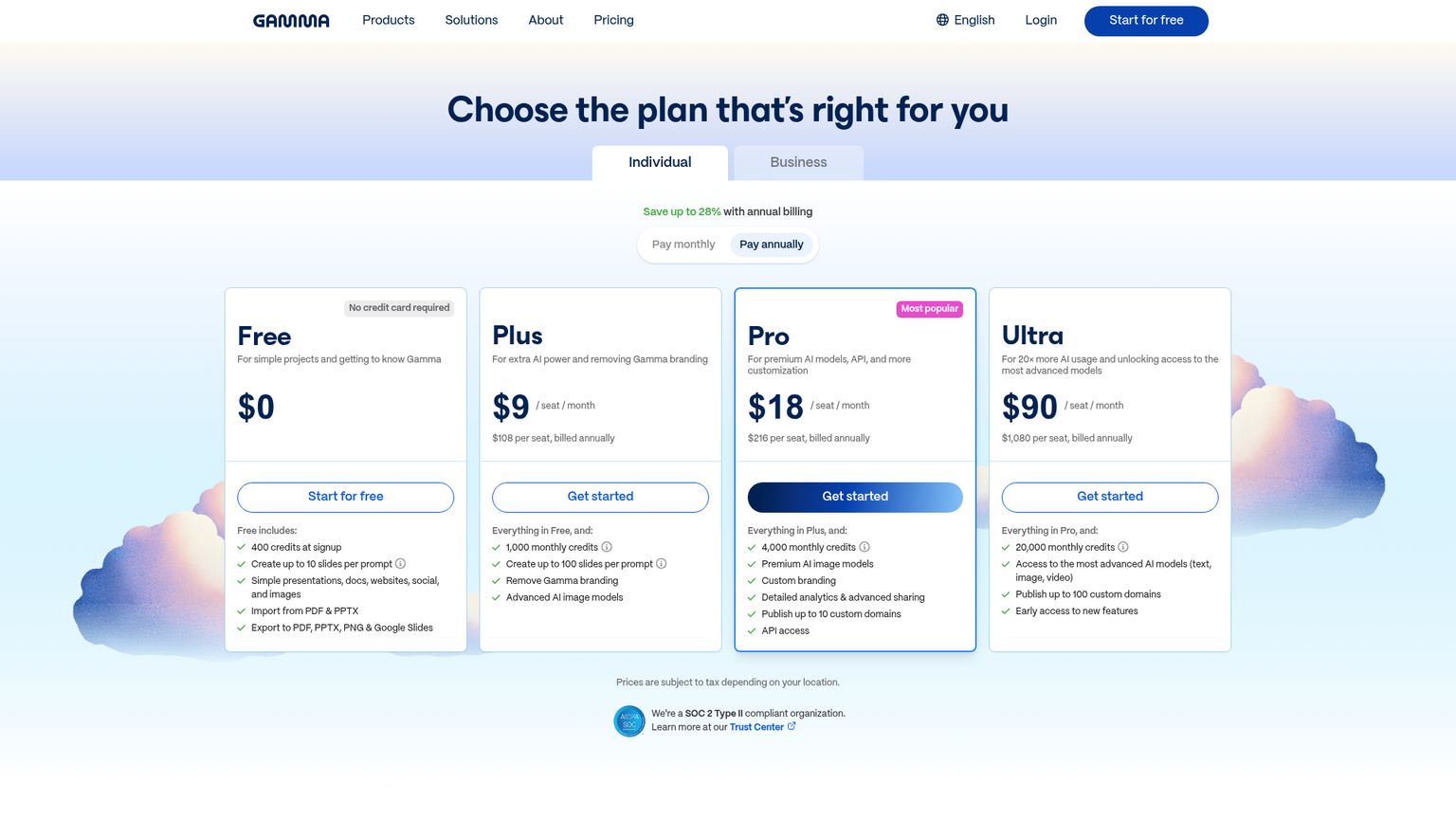
The verified individual plans are Free at $0, Plus at $9 per seat per month, billed $108 annually, Pro at $18, billed $216 annually, and Ultra at $90, billed $1,080 annually. Free starts with 400 credits that do not refill. Plus, Pro and Ultra provide 1,000, 4,000 and 20,000 monthly credits, respectively. Free allows up to 10 slides per prompt; the Plus card raises that to 100. These figures come from Gamma's live plan cards and FAQ.
Plus removes Gamma branding. Pro adds custom branding, detailed analytics and advanced sharing. Those distinctions matter: a consultant who only wants the Gamma badge removed has a different reason to upgrade from a marketing lead who needs company styling. Do not compare every alternative's team tier with Gamma's cheapest personal seat.
There is also a team-pricing ambiguity to resolve before procurement. Gamma's business landing-page FAQ advertises Team at $20/user/month and Business at $40/user/month, while the main pricing navigation uses a Business tab. The business FAQ lists custom company themes on Team and SAML single sign-on plus administrative controls on Business. Its quoted rates do not establish the billing cadence in that passage. Confirm the offered plan and invoice before making a team-cost comparison.
The detailed credit and billing discussion belongs in the Gamma pricing guide. For this decision, the useful baseline is simpler: Gamma combines drafting and publishing in one workspace, while several alternatives concentrate on the slide file or the live presentation.
Gamma AI PPT: Export Availability Is Only the First Check
A PPTX is a PowerPoint file, but the extension alone does not tell you how comfortably someone can edit it. You need to know whether the headline is editable text, whether a chart can be changed, whether the intended font appears, and whether speaker notes arrive with the file. A visually correct deck made of slide-sized pictures can still fail an editable-delivery requirement.
This distinction is documented particularly clearly by Beautiful.ai: it offers both an editable PowerPoint export and a PowerPoint image export. Pitch separately documents unsupported export elements. Those are reasons to inspect the actual delivery file, not evidence that every export from every product fails.
Native creation means building inside the program where the recipient will continue editing. Plus AI works inside PowerPoint and Google Slides; Copilot works inside PowerPoint; Gemini works inside Google Slides on eligible plans. That removes an intermediate conversion step. It does not remove the need to review the writing, charts or layout.

For a consultant, this is the first decision rule: when the client must keep editing the deck, choose the client’s editor first and evaluate AI assistance inside it. When the audience only needs a link, Gamma remains a strong baseline.
Gamma AI Alternatives by Job
The order below follows common reasons to leave Gamma, not a claim that one product wins every assignment. Each recommendation names the work it improves and the part of Gamma's workflow you would give up or need to recreate.
1. Beautiful.ai: Best for On-Brand Team Decks
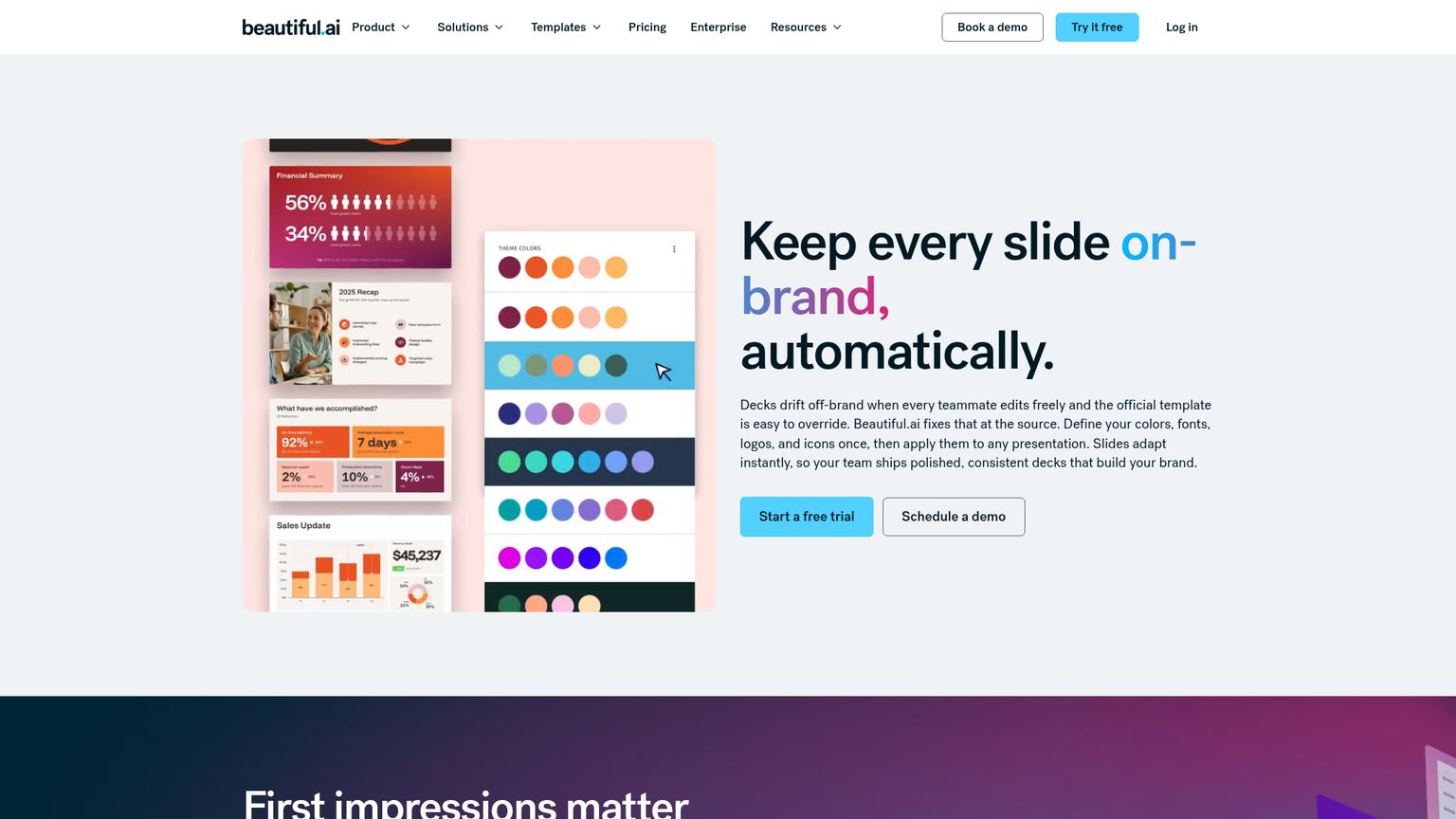
Beautiful.ai, a presentation builder with adaptive slide layouts, is the strongest fit here when colleagues repeatedly rebuild the same approved business story. Its Smart Slides adjust the layout as content changes, while shared libraries and locked slides on Team support reuse. For a marketing lead supplying sales decks, the useful change is moving approved material into a repeatable system. It is a less compelling switch for a solo creator whose Gamma theme already does the job.
Best for: Marketing and sales teams with recurring proposals, company overviews and reporting decks.
Standout: Adaptive layouts plus shared slide and template resources.
Pricing: Pro $14.50/month billed annually, or $45 on the monthly option. Team's FAQ quotes $40/user/month annually or $50 monthly. Enterprise is custom.
Free trial: 14 days for Pro or Team, with a card and an automatic charge unless canceled.
Those published prices come with an unresolved inconsistency: the Team card also describes a price including three users. Obtain the checkout total or a written quote before multiplying the per-user FAQ rate. The separate SMB plans advertise $6,000/year for SMB 50 and $12,000/year for SMB 100, based on company employee bands. They are not simply discounted bundles for that many deck authors.
Brand styling and brand enforcement are different purchases. Pro's theme builder sets colors, fonts, logos and other styling. Team adds shared resources and locked slides. Enterprise explicitly lists configurable brand guardrails and advanced permissions. A theme makes the approved appearance easy to apply; permission controls determine which changes a colleague is allowed to make. The brand-controls page explains the reusable-assets approach.
Imagine a consultancy with approved service descriptions and customer evidence. Start each proposal with those approved slides, then customize the buyer's problem and proposed scope. The payoff is fewer opportunities to rewrite a company claim incorrectly, not a promise that AI will understand the commercial offer without review.
What it lacks against Gamma: Beautiful.ai does not offer Gamma's permanent general-business free entry plan on its pricing page. It is a dedicated deck-production choice, so it is a weaker replacement when your Gamma subscription also produces web pages and documents. Layout automation also needs to suit your material; Classic Slides exist for freer composition, but those exceptions still need design judgment.
Its export documentation confirms editable PowerPoint and Google Slides exports on Pro, Team and Enterprise. It also says external export loses transitions and animations; Google Slides export loses embedded video and audio. Missing destination fonts can change the appearance. Do not buy it on an unsupported promise of perfect export fidelity.
- Reusable slides keep approved company material close to the person building the deck.
- Smart Slides handle layout adjustment as content changes.
- Editable PowerPoint and Google Slides handoffs are documented.
- Team pricing wording conflicts on the live page.
- Individual styling does not establish Enterprise-level control over every edit.
- External delivery loses specific native presentation effects.
Verdict: Choose Beautiful.ai when repeated deck production and brand consistency cost more effort than drafting the first version. For the deeper feature and plan analysis, use the Beautiful.ai review.
A Practical Beautiful.ai Pilot
Use this as a proposed evaluation, not a claim that these steps were executed for this comparison.
Start with approved material
Choose a company overview, a customer-proof slide and a proposal section you already trust. Apply the intended colors, fonts and logo through the theme settings. Keep factual content fixed so you can judge the design workflow.
Separate styling from shared control
Try the slides in Smart Slide layouts. If colleagues need shared resources or locked material, evaluate those Team features explicitly. Ask the vendor to demonstrate any permission restriction your purchase depends on.
Choose the editable export
Open Presentation, then Export Presentation, then Editable PowerPoint, and Export. Use Download Fonts if the recipient's machine needs the fonts. The alternative PowerPoint image export is unsuitable when the client needs editable objects.
Let the recipient make the change
Have the person receiving the file replace a headline and alter a chart or table. Judge the complete handoff, including any cleanup. Keep the subscription only if that workflow improves on your current Gamma process.
2. Plus AI: Best for Editable PowerPoint and Google Slides Output
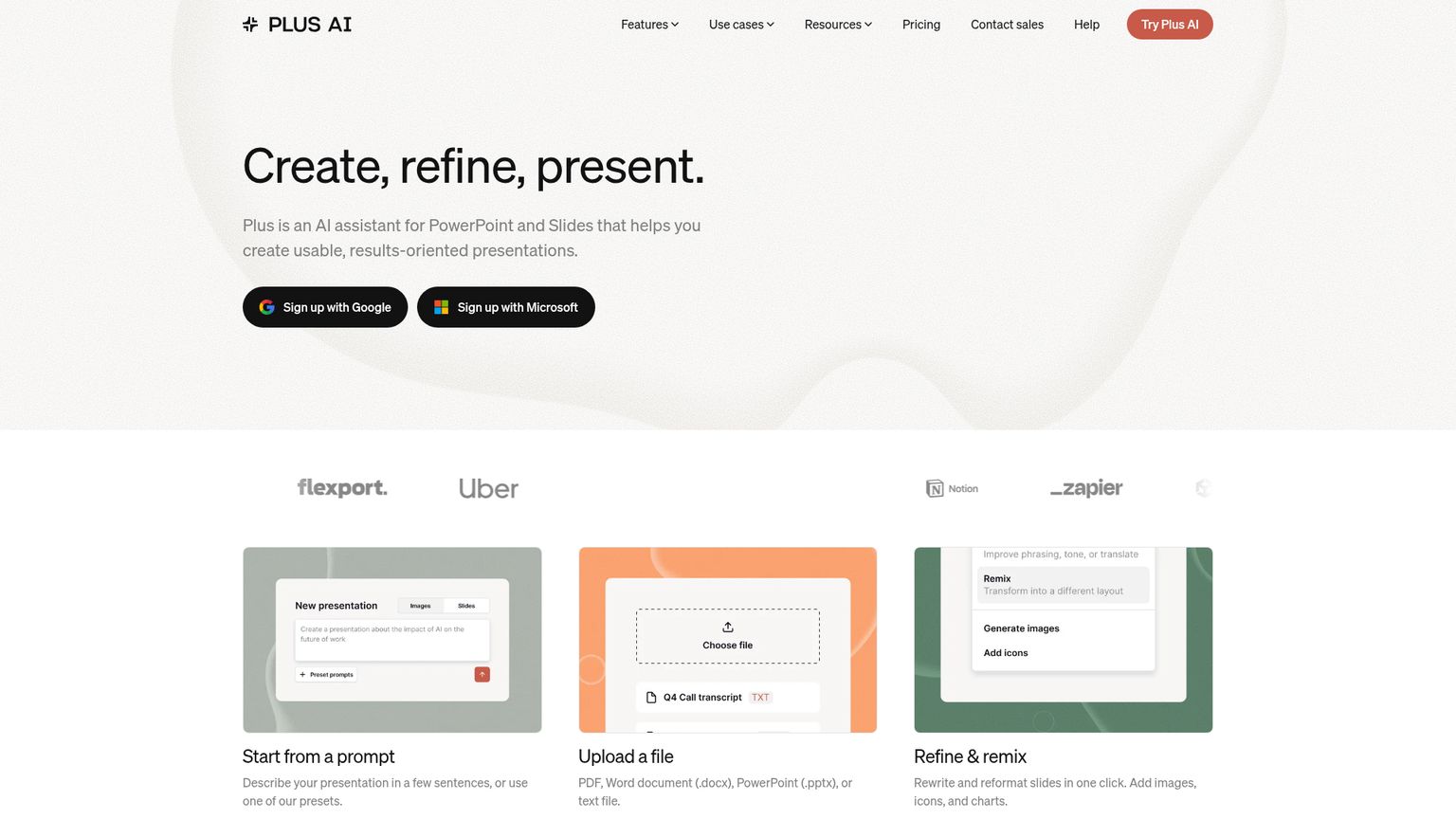
Plus AI, an AI add-on for Microsoft PowerPoint and Google Slides, is the clearest fit when a consultant must deliver an editable file in the client's existing system. It creates and revises slides inside those editors, which removes the need to build in a separate presentation workspace and convert at the end. Use it for proposals, management updates and decks that will pass through several editors. Skip it if the main attraction of Gamma is publishing a finished web experience from one place.
Best for: Consultants and operators whose recipient requires PowerPoint or Google Slides.
Standout: Native creation, single-slide insertion, rewriting and layout remixing.
Pricing: Basic $10/user/month annually or $15 monthly; Pro $20 or $25; Team $30 or $40; Max $200 or $240. Enterprise templates require a quote.
Free trial: 7 days with 1,000 AI credits; card required.
The annual/monthly pairs above come from Plus AI's current pricing page. Basic includes 1,500 monthly credits, Pro 3,000, Team 6,000, and Max advertises unlimited credits. The trial provides the same 1,000 credits regardless of the selected plan, then bills automatically unless canceled. A subscription covers both host applications.
The tier boundary matters more than the entry price. Basic handles generation, insertion, rewriting and remixing. Pro adds document uploads and AI image generation. Team adds custom logos, colors, fonts and shared presets. But the FAQ distinguishes that branding from using an organization's actual slides and slide masters, the reusable layouts underneath a PowerPoint deck. That deeper template setup is an Enterprise conversation.
For a consultant given a client's existing presentation template, start with the template requirement. “Use our colors” is easier than “every slide must use our approved master layouts.” Buying Team because it says branding can leave the second requirement unresolved. Ask to see the exact template path with the client's file before buying an annual subscription.
What it lacks against Gamma: Plus AI is centered on the host slide editors. Its value is editing and delivery there, rather than replacing Gamma's broader combination of decks, documents and websites. It also lacks a permanent free plan on the current price page. You still need access to the host application, and AI drafting remains subject to the chosen allowance.
A useful proposed trial is to install the add-on, choose your destination template, and draft from a short approved brief. Rewrite one dense slide and remix its layout, then ask another person to continue editing. Plus AI's product documentation supports that native workflow; it does not establish how much cleanup your particular deck will need.
- Work stays in PowerPoint or Google Slides throughout authoring.
- A single subscription covers both presentation applications.
- Individual-slide editing can improve an existing deck without regenerating everything.
- Document uploads and shared branding require higher tiers.
- Exact corporate-template setup is separate from basic brand styling.
- It does not replace the broader publishing reason to use Gamma.
Verdict: Choose Plus AI when the deliverable is an editable client asset. Its advantage is the location of the work, not a proven universal advantage in first-draft aesthetics.
3. Prezi: Best for Non-Linear, Conversational Presentations
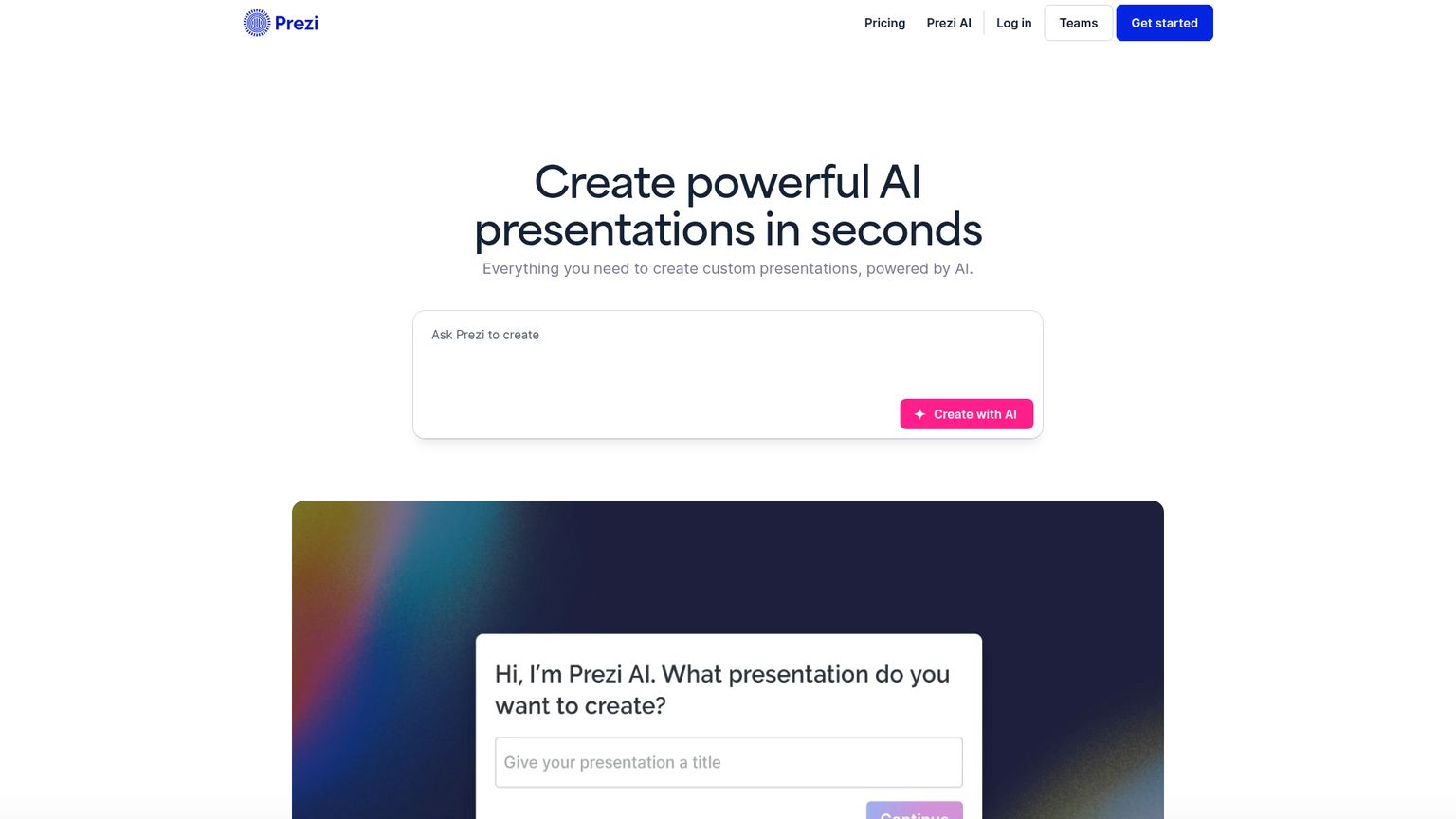
Prezi, a presentation platform built around an open, zoomable canvas, fits talks where the audience should influence the order. A consultant can move from a strategy overview into the topic a buyer asks about, then return to the larger picture. That is a reason to change presentation format. Merely wanting a cheaper AI draft is not.
Best for: Workshops, discovery conversations, training and live sales discussions.
Standout: A spatial overview that supports jumping between topics.
Pricing: Basic free; Standard $7/month, Plus $19/month and Premium $29/month, each billed annually. Business pricing requires a sales conversation.
Free trial: 14 days on the paid plans.
The paid rates come from Prezi's pricing page. The plan guide confirms Basic is free and includes 500 AI credits. Standard also lists 500 credits. Plus adds unlimited Prezi AI as advertised, personal branding, offline access and PDF export; Premium adds analytics. Annual totals calculated from the published rates are $84, $228 and $348.
For business use, the Standard privacy controls can matter more than the lower entry cost of Basic. Read the sharing settings before placing client material in any free workspace. Prezi's Business offering adds organizational features, but a sales-led package needs its own quote rather than the assumption that every employee gets the individual rate.
A good workshop structure might have three visible areas: the current problem, possible options and the recommended action. If a buyer asks about implementation before pricing, move to implementation. The overview helps the audience keep its place. Prezi's audience-engagement documentation explicitly describes this ability to move to a topic during questions and return.
What it lacks against Gamma: Prezi is a change in delivery method, not a like-for-like replacement for Gamma's document and website workflow. Its spatial presentation needs purposeful organization and rehearsal. If nobody will present it live and the buyer will simply skim the file, the additional canvas design may add work without helping the recipient.
Do not repeat the claim that Prezi cannot export PowerPoint. Its current homepage FAQ advertises PPTX and PDF export. However, the public material reviewed here does not establish that every editable object or the live canvas experience survives that handoff. Treat the exported deck as a separate deliverable to inspect. Choose Prezi for the live conversation, then verify the leave-behind file.
- Topic navigation can follow the audience's questions.
- Basic offers a free starting point for evaluating the format.
- Paid options add offline presentation, branding and analytics at different tiers.
- The canvas needs a considered structure and a practiced presenter.
- A PPTX export claim does not establish equivalent live navigation or full editability.
- Plus costs materially more than Standard once you need its additional features.
Verdict: Prezi earns a place when the room should decide where the presentation goes next. For a client who only wants editable conventional slides, start with Plus AI, Google Slides or PowerPoint instead.
4. Pitch: Best for Collaborative Pitch Decks and Follow-Up
Pitch, a collaborative presentation platform, fits founders and agencies whose deck continues working after the meeting. Its paid team features combine presentation links, engagement information and shared pitch rooms, where decks and related resources can be collected. That makes it useful when the next task is coordinating a fundraise or proposal follow-up. The tradeoff is another presentation workspace to maintain if everyone already edits elsewhere.
Best for: Founders refining investor material and teams managing external presentation links.
Standout: Custom templates, collaborative access and paid pitch-room features.
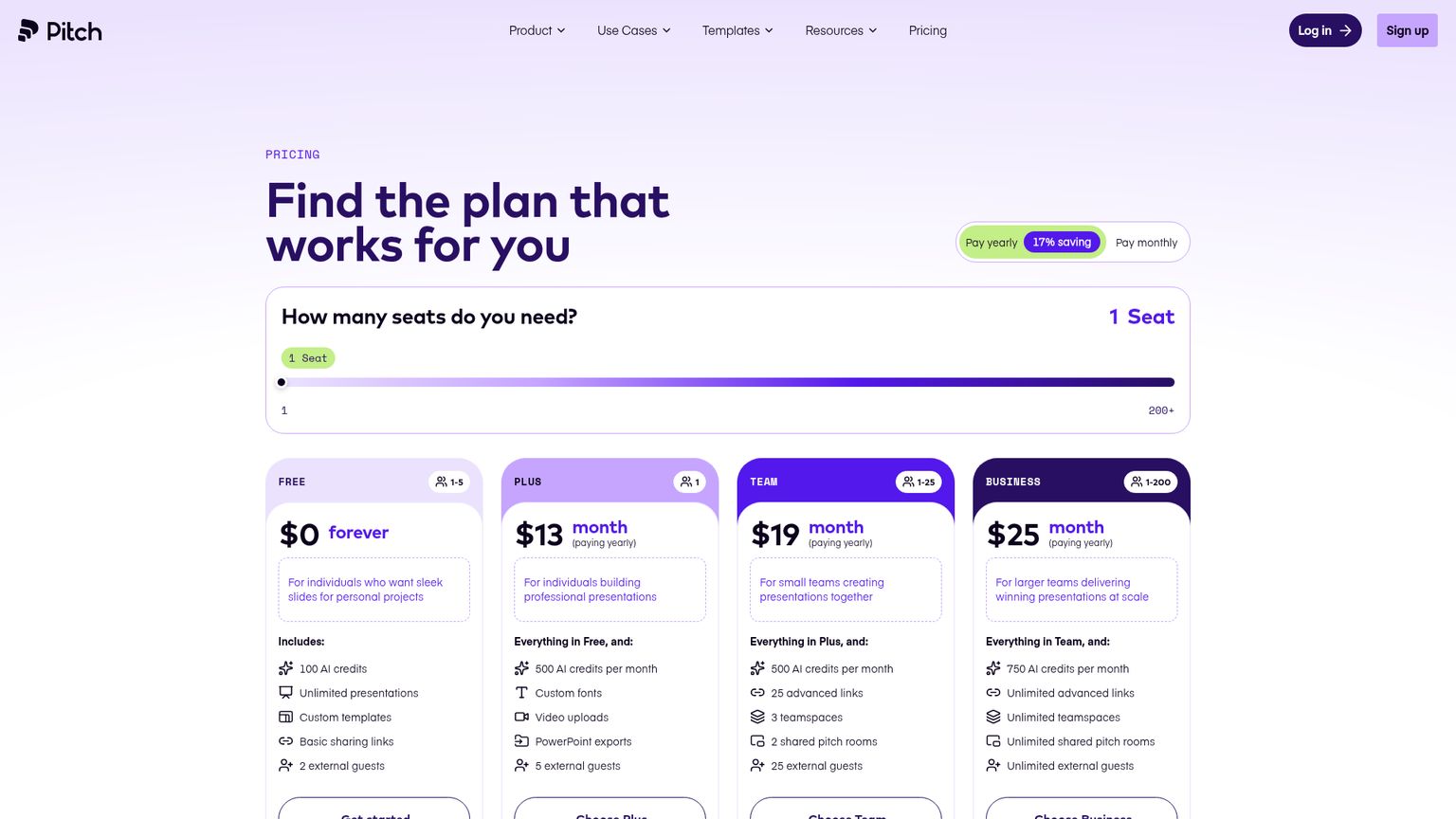
Pricing: Free; Plus $13/month paying yearly. Team displays $19/seat/month and Business $25/seat/month at the one-seat annual setting; Enterprise is custom.
Free trial: Free plan available; paid trials are offered to some customers through support.
On the live pricing page, Free allows one to five members, unlimited presentations, custom templates and 100 AI credits that do not renew. Plus is the individual paid plan; Team and Business are selectable team packages. Prices depend on the seat setting, so confirm the workspace total instead of extrapolating a one-seat card into a volume quote.
Plus and Team list 500 monthly AI credits; Business lists 750. The page describes credits as shared across the team. Do not multiply a displayed workspace allowance by every paid seat unless checkout explicitly confirms that allocation. This is different from comparing only the headline seat price.
For a funded founder, the useful sequence is to agree on the story with colleagues, keep the approved deck in one place, and send the appropriate presentation link. Team's advanced links report visits, slide views and time spent; shared pitch rooms can group decks and resources. Those signals can guide follow-up, but they do not prove investor intent. A long visit is a reason to ask a better question, not evidence that a deal is imminent.
What it lacks against Gamma: Pitch's Free plan has no replenishing AI allowance, and its pricing card places PowerPoint export on paid Plus. Gamma's Free card already lists PPTX export. Pitch also remains a separate authoring environment if the recipient must edit in PowerPoint. Budget for the paid export workflow and inspect the delivered file, rather than treating the two free plans as interchangeable.
The PowerPoint export guide is more useful than a blanket “editable export” label. It lists text, shapes, tables and speaker notes as supported. Charts can look different, fonts may require local installation, and animations are unsupported. Uploaded videos and recordings become thumbnails. A media-heavy live pitch and a downloadable investor file should therefore be reviewed separately.
- Free includes custom templates and unlimited presentation creation.
- Shared pitch rooms suit decks that travel with supporting resources.
- Export documentation names specific supported and unsupported elements.
- The free AI credits do not refill.
- Team credits should not be assumed to multiply per seat.
- PowerPoint handoff changes or omits particular media and effects.
Verdict: Pick Pitch when collaboration and follow-up are the recurring problem. If the bottleneck is only generating an editable deck inside the client's editor, Plus AI is the more direct change.
5. Canva: Best for Marketers Who Also Need Other Assets
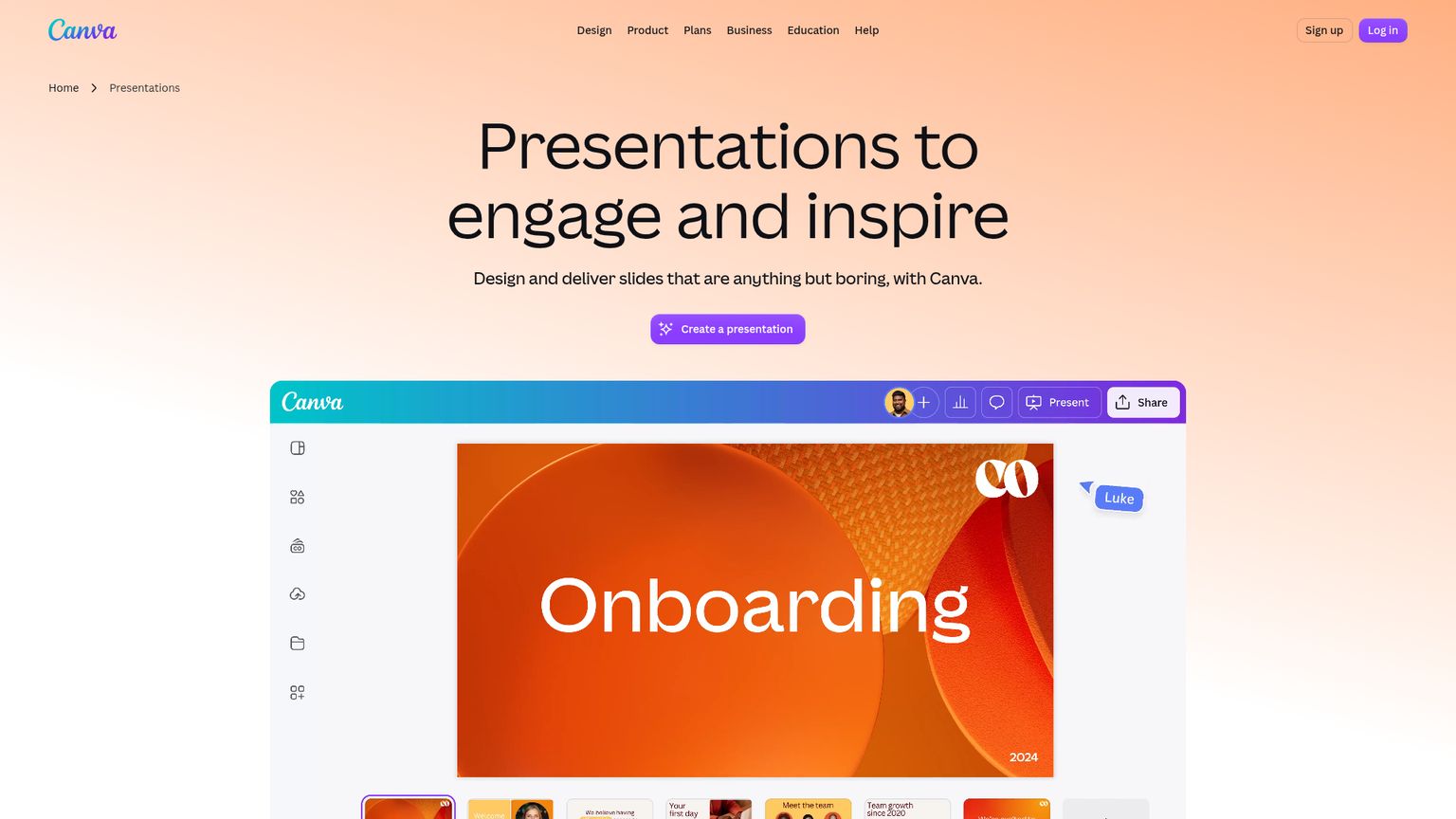
Canva, a broad visual-design platform, makes sense when presentations are one part of a marketer's output. Its templates, drag-and-drop editing and brand resources can sit alongside the other campaign materials you create. A solo marketer can reuse a visual direction across a deck and related assets without buying a dedicated deck tool for every task. The cost is taking more responsibility for visual decisions and consistency.
Best for: Marketers producing presentations alongside campaign and brand material.
Standout: Flexible visual editing and reusable brand resources across design types.
Pricing: Free; Pro $144/year for one person; Business $250/year per person; Enterprise custom.
Free trial: Pro and Business trials are offered; the checked pricing page did not establish a duration.
Those are the annual US prices on Canva's pricing page. Pro works out to $12/month and Business to about $20.83/month, calculated by dividing the annual bills by twelve. These are budgeting equivalents, not quoted monthly payment options. The free plan includes one Brand Kit limited to three colors; Pro lists five Brand Kits, while Business lists 100 and approvals.
The practical question is whether visual flexibility helps or slows the work. A founder creating a distinctive partner pitch may want to reposition every element. A sales manager supervising repeated standard decks may prefer Beautiful.ai's adaptive layouts and reusable slide workflow. Canva's freedom is valuable when someone has a clear design direction; it is less helpful when everyone invents a new design for the same company story.
For an agency marketer, start with the client's approved colors, fonts and imagery, then build the presentation around a small set of repeatable layouts. Decide which slides communicate evidence, which explain the offer and which ask for a decision. The breadth of a design library should not become an excuse to make every slide visually unrelated.
What it lacks against Gamma: Canva replaces a focused Gamma workflow with a broader design workspace. That can be a benefit across campaigns, but it gives a deck-only buyer more choices to manage. AI allowances also need attention. The pricing page advertises an extra-cost AI Pass, and says the AI allowance during a paid-plan trial remains at Free level until the paid subscription begins. A trial can therefore underrepresent the paid AI allowance.
Canva does offer PowerPoint export: its own export lesson describes downloading through the Share menu. That establishes the format, not a guarantee that every element behaves exactly as it did in Canva. If a client will edit the file, inspect the actual output and ask them to change it. No export benchmark was run for this comparison.
- The same design workspace can support decks and broader marketing material.
- Free provides an entry point without a paid trial deadline.
- Paid brand resources support repeatable campaign styling.
- Flexible composition still needs visual judgment and layout discipline.
- More advanced brand administration costs more than the individual plan.
- Trial AI allowances differ from the paid plan's advertised allowance.
Verdict: Choose Canva to consolidate visual production. Do not switch solely because a template preview looks better than your current Gamma deck; compare the editing and delivery work too.
6. Google Slides With Gemini: Best for Existing Workspace Teams
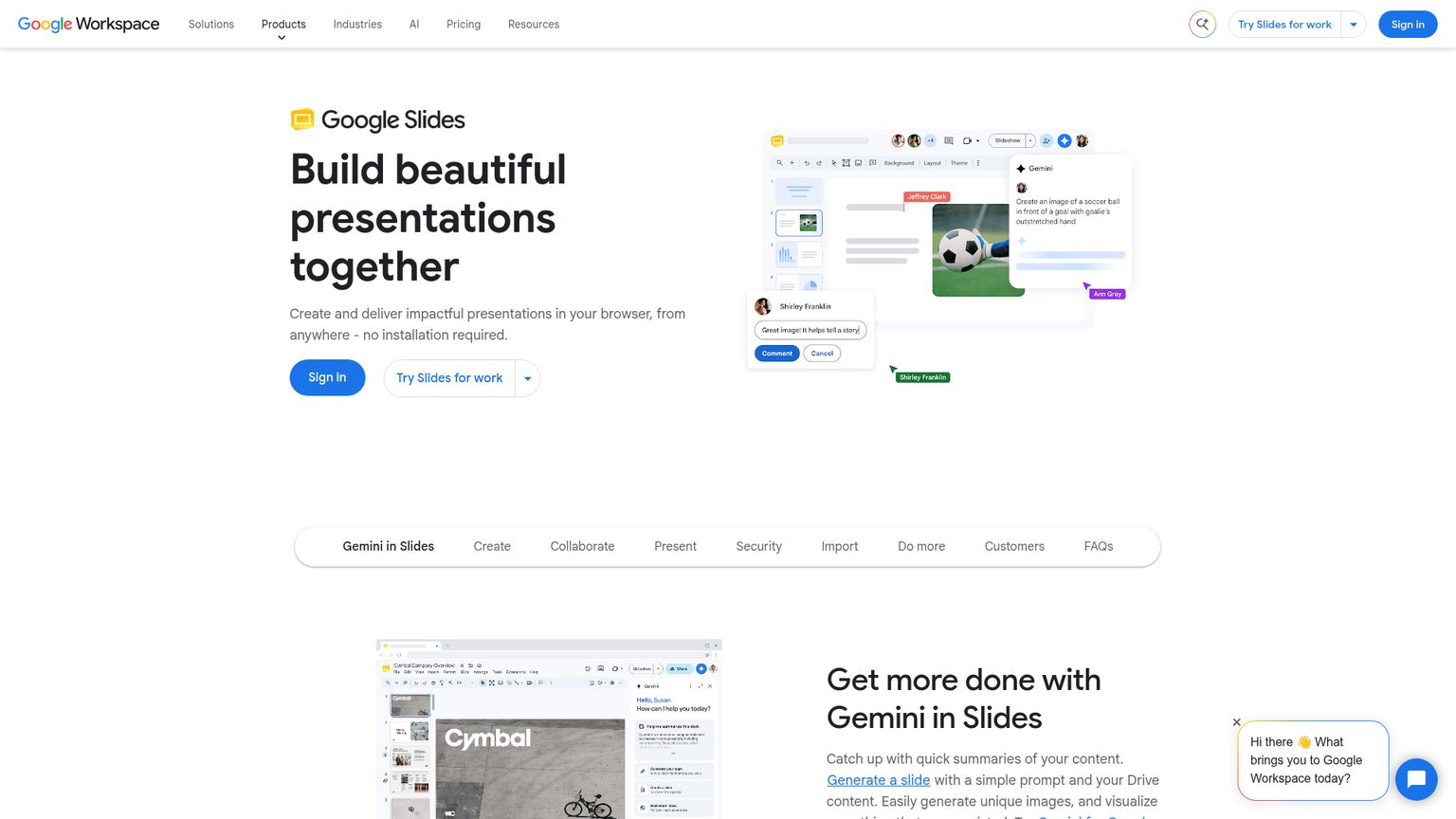
Google Slides with Gemini combines Google's collaborative slide editor with an AI assistant inside eligible Workspace plans. It is the first option to evaluate when colleagues already review and edit presentations in Google Drive. Gemini can generate a slide using a prompt and Drive context, summarize content and create images. The advantage is keeping the deck in the place where people will work on it.
Best for: Teams already creating and approving content in Google Workspace.
Standout: AI assistance inside the shared presentation editor.
Pricing: Google Slides itself has a free entry point. Workspace Business Starter is $7/user/month, Standard $14 and Plus $22 with annual commitment; Enterprise is quoted.
Free trial: Google Workspace offers 14 days.
The decisive detail on Google's pricing matrix is that Gemini in Slides is excluded from Starter and included in Standard, Plus and Enterprise. The cheapest Workspace plan is therefore not the business entry price for this particular feature. The stated rates use the undiscounted annual-commitment prices, billed monthly, rather than introductory promotions.
If you already pay for Standard and the feature is enabled for your account, evaluate it before adding a presentation subscription. For an operations lead building a monthly update, ask for a slide from approved Drive material, then refine it in the same document where colleagues comment. The Slides product page also documents sharing permissions and domain templates on selected business plans.
What it lacks against Gamma: Choosing Gemini in Slides does not replace Gamma's combined deck, document and website publishing workflow. It also does not make the free version of Slides a free version of every Gemini feature. You are choosing an editor and its account entitlements, not merely a generator with a standalone price tag.
For a client deliverable, staying in Google Slides is especially attractive when the client wants a shared, editable Slides document. If they insist on PowerPoint, the file still crosses into another editor. Apply the same handoff inspection you would use for any alternative; “native” is relative to the recipient's destination.
- AI assistance works beside the presentation colleagues already edit.
- Drive context can support drafting from existing approved material.
- Existing Standard subscribers may already have the relevant entitlement.
- Starter's Gemini access does not include Gemini in Slides.
- Domain-template availability depends on the Workspace plan.
- A required PowerPoint deliverable still needs a cross-editor check.
Verdict: Start here if Google Slides is already your company's presentation home. Add a separate tool only after naming the specific task the included assistant cannot adequately solve for you.
7. Microsoft PowerPoint With Copilot: Best for PowerPoint-Based Organizations
Microsoft PowerPoint with Copilot brings AI drafting and editing into the application many clients already expect. It is the strongest default to evaluate when the organization has established PowerPoint templates and the finished file must remain there. Microsoft's current creation guide supports drafting an outline, refining it through conversation and generating slides. Starting from the organization's template gives Copilot existing layouts to use.
Best for: Companies delivering PowerPoint files and maintaining corporate templates.
Standout: AI-assisted work inside PowerPoint with existing presentation layouts.
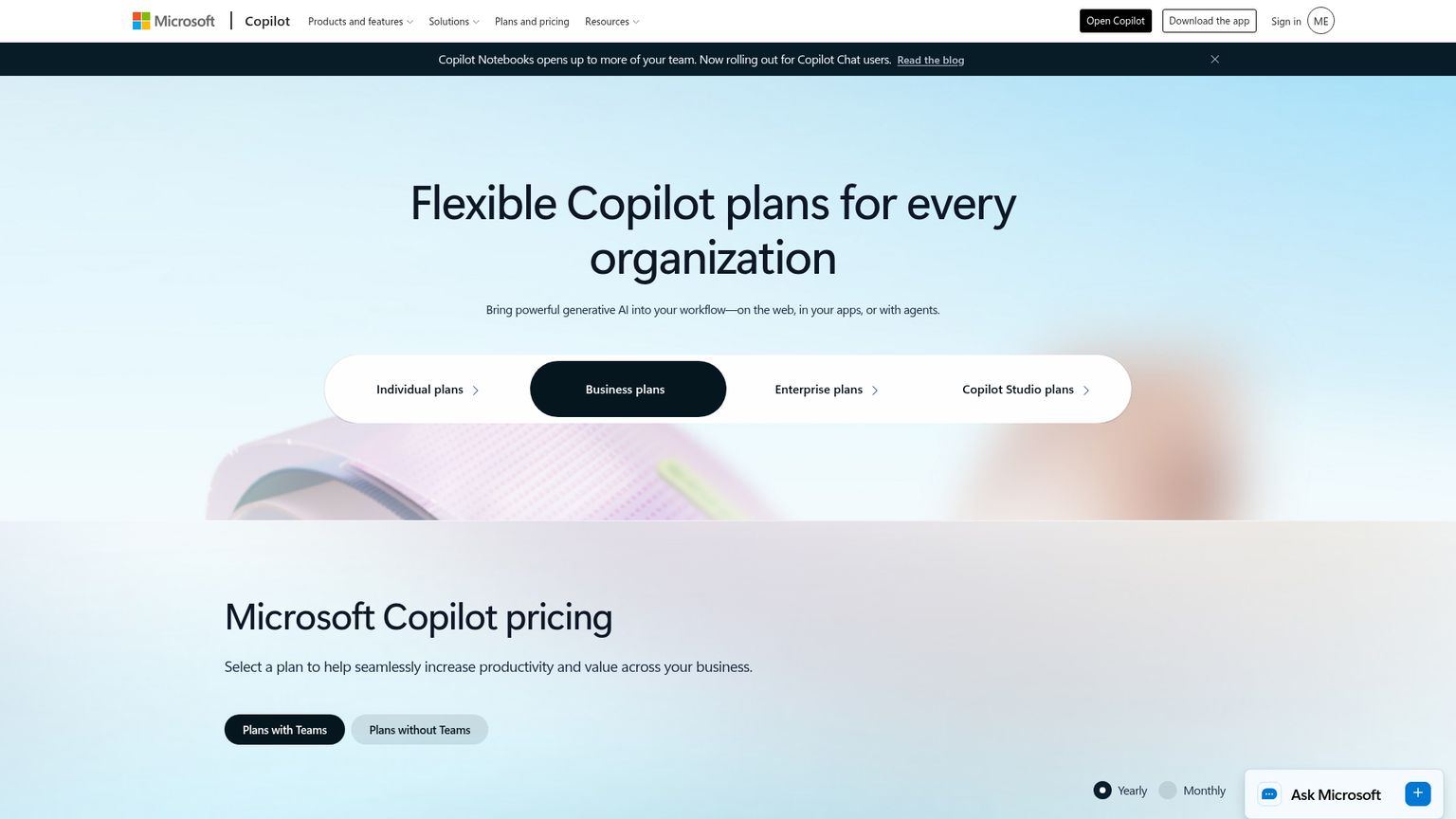
Pricing: Consumer Personal starts at $9.99/month or $99.99/year. Business add-on and bundle prices differ, as detailed below.
Free trial: Microsoft's consumer comparison page advertises one-month trials.
For an individual account, Microsoft's US consumer page lists Personal at $9.99/month or $99.99/year, Family at $12.99/month or $129.99/year, and Premium at $19.99/month or $199.99/year. These include PowerPoint with Copilot, subject to the stated limits and availability. On the shared consumer plans, AI benefits belong to the subscription owner. Do not divide the household price into employee AI seats.
For organizations, the business pricing page lists Microsoft 365 Copilot Business at $21/user/month on annual billing, with a current $18 first-year annual promotion, and $25.20 on monthly billing. The add-on requires an eligible underlying Microsoft 365 Business subscription. The promotional window runs from 1 July through 31 December 2026, with conditions and an annual commitment.
That page also displays Business Standard with Copilot at $23.50/user/month paid yearly or $28.20 monthly, and Business Premium with Copilot at $32 or $38.40, respectively. Treat the displayed offers as checkout-dependent; do not assume a promotional rate is the renewal price. The enterprise page lists Microsoft 365 Copilot at $30/user/month paid yearly, in addition to a qualifying Microsoft 365 plan.
The licensing detail can dominate the decision. A mid-market operator should first ask which employees already have Copilot in PowerPoint and whether administration settings enable it. Buying a second generator before checking that can duplicate spending. Conversely, a free Copilot chat entry point does not establish that the required in-app presentation workflow is included.
What it lacks against Gamma: This is a Microsoft account and application workflow, with licensing and administrative dependencies. It is a weaker substitute when you chiefly want Gamma's compact drafting-and-publishing experience across several content formats. A corporate PowerPoint template also needs useful layouts; an AI assistant cannot turn a poorly maintained template into an approved presentation system by itself.
The official creation guide recommends opening the organization's template before generation. For a quarterly business review, supply the approved business narrative and source figures, refine the proposed outline, then inspect the generated slides against the template. Keep the budget review separate from the AI's wording choices.
- The working document remains a PowerPoint presentation.
- Existing template layouts can guide generation.
- Organizations may already own the relevant licenses.
- Add-on prices are not the total Microsoft 365 subscription cost.
- Consumer sharing does not provide shared employee AI entitlements.
- Account, license and administrator settings affect feature availability.
Verdict: Use Copilot first when PowerPoint is already the contractual deliverable and the organization has enabled it. Compare Plus AI when you need an alternative assistant or work across both PowerPoint and Google Slides.
8. Claude Slides: Best for Turning Research Into a Presentation
Claude Slides, Anthropic's presentation workspace inside Claude, deserves a place when the deck starts with research, reports or a developing argument. Its official documentation describes building slides from notes or work already in the conversation, editing slides directly and presenting inside Claude. That makes it a practical option for a founder who needs to turn a reasoned narrative into a deck. It should no longer be dismissed as only a source of text to paste elsewhere.
Best for: Founders and consultants developing a presentation from substantial source material.
Standout: Drafting and revising the argument alongside the resulting slides.
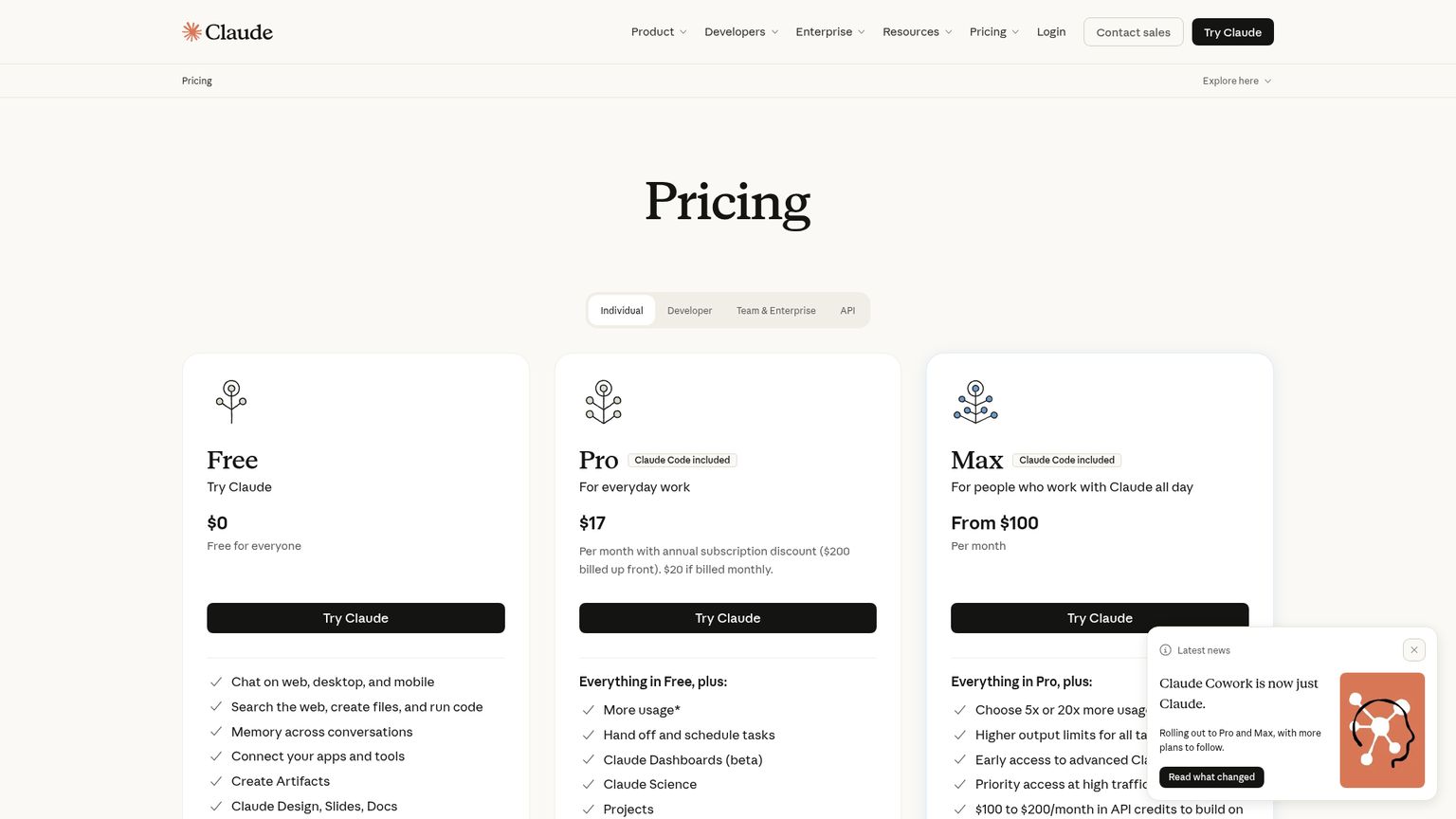
Pricing: Free; Pro $20/month or $200/year; Max from $100/month. Team and Enterprise pricing is below.
Free trial: A Free plan is available; there is no need to buy Pro just to establish that Slides is included.
Claude's current pricing page lists Slides on Free, Pro, Max, Team and Enterprise. Pro displays a rounded $17 monthly equivalent for the $200 upfront annual bill; use the annual invoice for an exact comparison. Max offers higher usage options, but the entry card starts at $100/month. Do not confuse included monthly API credits with a subscription price.
Team Standard seats are $20/seat/month annually or $25 monthly; Premium seats are $100/seat/month with annual billing or $125/seat/month with monthly billing. The page describes Team for two to 150 people. Enterprise is $20/seat/month with annual billing plus usage at API rates. That base seat fee is not the full cost of running presentation tasks. An institutional Education plan is also listed without a public price.
The official artifact guide confirms PowerPoint and PDF exports, plus sending decks to Google Slides as editable files. It also says Cloud code execution and file creation must be enabled. At this verification date, Enterprise owners can enable Slides early; the guide gives 15 October 2026 as the default enablement date for those templates. A plan inclusion check and an account-access check are separate steps.
A useful founder workflow is to supply approved research and ask for a proposed narrative before asking for finished slides. Specify which statements are facts, which are forecasts and which questions remain unanswered. Approve the outline, then generate the presentation and review each chart and claim. For a consultant, this can make the reasoning phase and the drafting phase part of the same conversation.
What it lacks against Gamma: The reviewed pricing and artifact pages do not establish a like-for-like replacement for Gamma's full publishing workflow or for a dedicated team's locked slide library. Verify any required brand restrictions and shared approval process separately. Claude also applies usage limits that depend on the task and model; “Slides included” does not mean unlimited deck production on Free.
- Slides is explicitly included on the Free plan.
- Notes, reports and conversation can become a presentation artifact.
- Direct slide editing and PowerPoint, PDF and editable Google Slides delivery are documented.
- Usage limits prevent treating free access as unlimited production capacity.
- Capabilities and Enterprise settings can affect availability.
- Specific brand enforcement and team-approval requirements need their own evaluation.
Verdict: Try Claude Slides when the hard part is developing the argument from source material. Keep Gamma if its publishing workflow is already the more important part of your process.
How These Were Picked
The recommendations prioritize the finished work: brand consistency, recipient editability, live delivery and the subscription required to achieve those outcomes. Prices, plan names and documented limitations were checked against the vendors' own pages on 11 October 2026. The cost comparisons are calculated from those inputs. No paid accounts were purchased, no export benchmark was run, and no claim of a measured time saving is implied.
The field covers different working destinations rather than several nearly identical prompt-to-deck tools. Beautiful.ai addresses repeatable brand material; Plus AI addresses native authoring; Prezi changes the live format; Pitch supports pitch follow-up; Canva broadens design production; Google and Microsoft serve existing office workflows; Claude connects source reasoning with deck creation.
An export button earned no automatic quality score. Where documentation names losses, they are stated. Where it does not establish fidelity, the recommendation includes a proposed recipient test rather than an invented result. This matters more than a universal ranking because a tool can be an excellent live presenter and a poor fit for a particular client's editing requirement.
Gamma App Alternatives: Who Should Pick What?
For a founder preparing an investor pitch, choose the bottleneck. Use Claude when organizing the evidence and argument is difficult. Use Pitch when shared revisions and follow-up links are the recurring work. Keep Gamma when a published web deck is accepted and the existing process already produces the result you need. A fundraising deck does not become convincing merely by changing its generator.
For a consultant delivering editable client files, begin in the client's editor. Evaluate Plus AI across PowerPoint and Google Slides. In an established Microsoft environment, check Copilot first; in Google Workspace, check Gemini in Slides. This choice reduces handoff changes before you compare design preferences.
For a marketing lead protecting a repeatable company story, evaluate Beautiful.ai's shared resources. If the role also owns a wide set of campaign assets, Canva may consolidate more work. The decision flips on whether the bigger cost is recurring deck consistency or producing many kinds of visual material.
For a facilitator whose presentation follows the conversation, choose Prezi deliberately. Sketch the topic map and rehearse moving between the likely questions. For an asynchronous document that will only be skimmed, prioritize readability and the recipient's format instead of motion.
A cheaper individual alternative can also be the wrong comparison. Beautiful.ai Pro's calculated $174/year is $42 below Gamma Pro's $216, but $66 above Gamma Plus's $108. Name the needed features before deciding which price difference matters. Inputs: Beautiful.ai pricing and Gamma pricing.
Stay on Gamma If
Stay on Gamma when your audience accepts the published presentation, your current theme is adequate, and the same workspace helps you create other content. Its Free plan is useful for an initial evaluation, and the verified Plus annual price remains a modest entry point. Paying more elsewhere needs a named improvement in the work.
Is Gamma AI Good?
Gamma is a sensible choice for a founder, consultant or marketer who wants to generate, refine and share visual material in one workspace. The documented range of formats is its practical strength. It is less obviously the right center of the process when every assignment ends with another person editing a corporate PowerPoint file.
Keep it if your exports already satisfy the recipient. No vendor comparison can establish that your particular deck has an export problem without opening the file. Likewise, buying a brand-control tool is unnecessary if a saved theme and a clear review process already keep your material consistent.
Before switching, identify whether the problem is the software, the prompt, the source material or the approval process. If several people keep adding unapproved claims, a new generator will not appoint an owner for those claims. If the target file is the problem, changing where you author can help much more directly.
The Ones to Avoid
Avoid Prezi as a purchase justified only by PowerPoint handoff. Its live topic navigation is the reason to choose it. Current PPTX export exists, but the reviewed public material does not prove the exact editing and navigation behavior your recipient requires.
Avoid Google Workspace Starter when the purchase requirement is Gemini inside Slides. Google's feature matrix excludes that capability from Starter. The relevant business entry plan in this comparison is Standard.
Avoid Plus AI Basic when your workflow requires document uploads or shared brand settings. The price page places those on higher tiers. A low entry price saves nothing if you immediately have to replace the plan.
Avoid Beautiful.ai Pro when you are budgeting for a shared team library and restrictions on colleagues' edits. Individual brand styling is not the same purchase. Confirm the specific Team or Enterprise feature and resolve the Team invoice ambiguity.
Avoid a Microsoft consumer Family subscription as employee Copilot licensing. The price page limits its AI benefits to the subscription owner. A household subscription headline is not a per-seat business offer.
These are poor fits for the named jobs, not blanket judgments that the products should never be used. The buying mistake is substituting a marketing feature label for the exact action your business needs someone to perform.
Before You Switch: Run a Recipient Handoff Check
A small representative deck is a better purchase test than generating your easiest presentation. Use material you are permitted to upload and keep the source facts identical across the candidates. The purpose is to reveal the work that remains after AI generation.
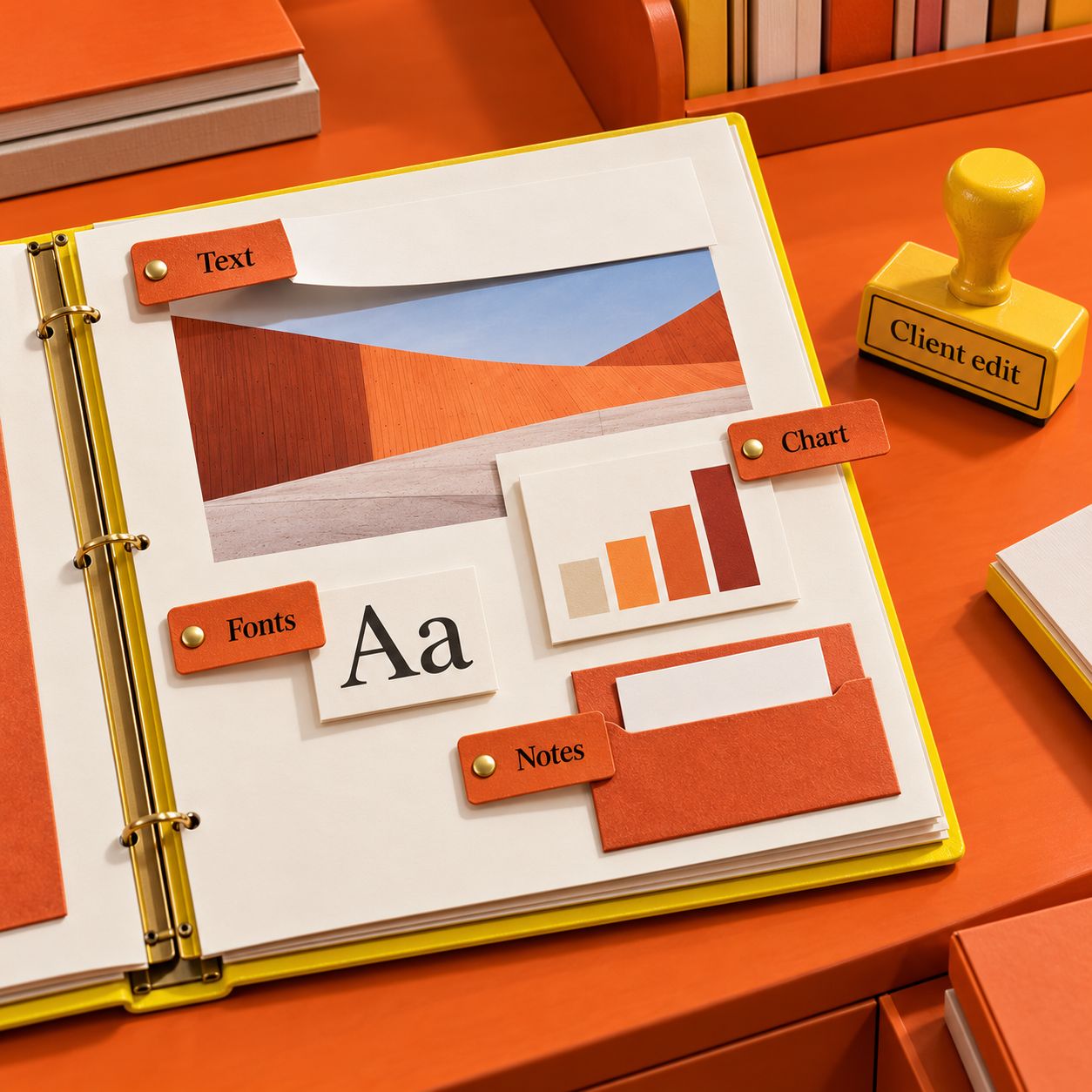
Build a proposed four-slide sample containing dense text, a chart or table, brand typography with an image, and speaker notes. If you present with media, include the media that matters to your assignment. This is an evaluation method for you to run, not a benchmark performed for this article.
Define the destination
Write down whether the deliverable is a web link, a Google Slides document, an editable PowerPoint file or a static PDF. Ask who will change it after delivery and in which application.
Use the difficult material
Include the dense text, chart, font or layout that causes trouble in your current process. A decorative title slide tells you little about the recurring work.
Make a recipient edit
Open the delivered file in the actual destination. Change the headline, update the chart or table, inspect the font and check the notes. If the task requires editable objects, a static picture does not pass.
Count the complete effort
Record drafting, fact checking, formatting, delivery and cleanup effort. Compare the subscription needed for that workflow. Keep Gamma until the replacement produces an accepted deliverable with a worthwhile improvement.
The next practical move is to choose one recurring deck and one alternative matched to its destination. A narrow pilot gives you a clear buying decision. Migrating every old presentation before establishing that result only increases the cost of changing your mind.
Frequently Asked Questions
What are some free alternatives to Gamma AI?
Canva, Pitch, Google Slides, Prezi Basic and Claude Slides offer free entry points. Their AI access differs: Pitch's Free credits do not renew, Google Slides being free does not include every Gemini feature, and Claude applies usage limits. Choose the free plan that lets you evaluate the intended final format.
Is Canva or PPT better?
Canva is the more useful starting point when presentations belong to a broader visual marketing workflow. PowerPoint is the stronger destination when a client requires a PowerPoint file and will continue editing it. If you design in Canva but deliver PowerPoint, inspect that exported file before committing to the workflow.
What is replacing Microsoft PowerPoint?
There is no single replacement for every presentation job. Gamma supports a broader web publishing workflow; Prezi supports conversational delivery; Canva supports marketing design; Google Slides supports shared editing in Google Workspace. PowerPoint with Copilot remains relevant when the required output is PowerPoint.
Is Gamma really free?
Yes. Gamma's Free plan is $0 and includes 400 starter credits that do not refill. It also lists export options. Free access is different from unlimited continuing AI generation; the paid plans provide monthly allowances.
Is Gamma better than ChatGPT?
For this buying decision, judge the presentation deliverable rather than the conversation that drafts its text. Gamma's documented offering includes presentation creation, publishing and export formats. If you consider ChatGPT as part of the workflow, require it to meet the same final-file, editing and review requirements before calling it a replacement. This comparison did not test ChatGPT presentation output.
How much does Gamma AI cost per month?
The verified individual annual plans are Plus at $9 per seat per month, Pro at $18 and Ultra at $90. Their annual invoices are $108, $216 and $1,080 per seat. These are annual-billing equivalents, not a claim about month-to-month checkout prices. The Free plan is $0.
How can I get Gamma AI for free?
Use Gamma's Free signup, which the pricing page says needs no credit card. It includes 400 starter credits. Evaluate your own draft and final export before deciding whether a paid allowance is necessary.
Is Gamma AI any good?
It fits work that benefits from drafting and sharing presentations and related visual content in one place. Whether it is good for your business depends on brand requirements and the final handoff. Keep it when those already work; switch when a specific alternative improves an unmet requirement.
What is the limit of Gamma AI?
The verified Free plan has 400 nonrefilling starter credits and up to 10 slides per prompt. Plus lists 1,000 monthly credits and up to 100 slides per prompt; Pro and Ultra list 4,000 and 20,000 monthly credits. Credits are usage units, not a guaranteed number of finished presentations.
Is Gamma App Free?
Gamma has a free plan, but removing Gamma branding requires Plus and custom branding is listed on Pro. Choose by the feature needed for the final deck, not the existence of a free signup button.
Is Gamma AI Safe?
Gamma states SOC 2 Type II compliance on its pricing page. That statement alone does not authorize uploading a client's confidential material. Check the account's terms, data handling and your client's permission for the material involved. This article did not conduct a security audit.
Use the AI tools map for business owners to choose the next tool around a recurring business task.
- Published
- Category
- AI
- Language

Reflection AI Beam: What It Means for Coding and Agents
Reflection AI Beam explained: October release plans, vendor benchmark claims, beta access and whether builders should wait before switching models.Oct 10, 2026AI
Claude for Google Workspace
How to install and deploy Claude in Docs, Sheets and Slides, control edits, and test the paid-plan beta with three practical team workflows.Oct 10, 2026AI
Claude Dashboards
Set up Claude Dashboards beta, inspect SQL and refresh timestamps, check a sales metric, and decide when to keep your BI tool.Oct 10, 2026AI
Granola AI Review
Granola reviewed for business meetings: bot-free notes, current pricing, templates, recipes, consent, platform limits and who should choose an alternative.Oct 10, 2026AI
Fyxer Review
Fyxer reviewed through current pricing, help docs and public feedback: inbox sorting, drafts, meetings, privacy and who should pay for Pro or Team.Oct 9, 2026AI
GPT 6 Explained: Models, Release Dates, Access, and Prices
GPT-6 Astra, Sol, 6.1 Sol and Luna explained: release dates, ChatGPT plan access, Work and Codex availability, and verified API costs.Oct 9, 2026AI
Is ChatGPT Free? What You Get for $0
Yes. See what ChatGPT Free includes, its work limits, ads, account access, and when the $8 Go or $20 Plus plan is worth paying for.Oct 9, 2026AI