Jev Alternatives in 2026: OpenAI, Microsoft, Clef, d1, Perplexity and Strands (Compared)
Compare Jev alternatives by job, maker-verified input pricing, licences and deployment: OpenAI, Microsoft, Clef, Liquid d1, Perplexity and Strands.
Published
 By Omid Saffari






Perplexity's $0.02-per-million-input-token API is the first of these Jev alternatives to evaluate for a lower hosted bill; Clef-flash is the stronger fit if your application already runs on Cloudflare, and Liquid AI d1-3B is the starting point for local image decisions. At one million monthly decisions using 1,000 billed input tokens each, moving from Jev to Perplexity saves just $22 in base input charges. Choose the alternative that preserves your accepted-error rate and runs where your application needs it.
Prices, licences and deployment documentation verified on 11 October 2026. The prices below come from each maker. The monthly figures are calculations using stated assumptions, not bills from a production test. No model was exercised for this comparison.
Jev Alternatives: Which One for Which Job?
Start with the deployment constraint, then compare quality on your own decisions. A hosted API means the provider operates the model. Open weights means you can obtain the model files and run inference yourself, subject to their licence; it does not mean someone supplies free computing.
The hosted prices do not price self-hosted inference. For the downloadable Liquid and Strands models, not published means the maker pages do not give a fixed input-token tariff. You still pay for hardware, power, hosting and operation. Licence and checkpoint details appear in the individual sections.
TypeSafe's current baseline is Jev 1.13, model ID jev-1.13.0, at $0.042 per million input tokens, with output free. It accepts text and structured text such as JSON, rather than images, audio or video. Microsoft therefore matches Jev's published input rate; OpenAI costs more at its base rate; Perplexity and Clef-flash cost less. TypeSafe model catalog
An existing Jev integration already has something valuable: a definition of the decisions your application needs. Preserve that definition. If billing tickets must go to finance and account-access problems must go to support, the replacement should earn its place on those cases before a headline benchmark influences the choice.
How These Were Picked
The selection favours a model with a maker-maintained API, model card or repository and enough documented detail to make a deployment decision. Community clones without a verified maker page are outside this comparison. The list covers six makers through seven buying choices; Cloudflare's family shares one section, while Liquid's two models need separate recommendations.
The criteria are practical: required input types, hosted versus local operation, weight licence, a documented limit that can break your workload, and the cost of a usable decision. A usable decision is one your application can accept without an expensive correction or unnecessary escalation.
The order starts with the strongest lower-price hosted candidate, then moves through platform fits and local options. It is not an accuracy leaderboard. Vendor tests use different datasets, hardware, input lengths and network paths. Every performance number cited here is vendor-reported, and none establishes that a model will beat Jev on your tickets.
There is also a boundary around the job. These models choose or score among defined outcomes. If you need a written support response or an explanation, keep a generation step. Our Jev vs GLM-5.3-Flash comparison explores that broader choice.
The Seven Buying Choices
1. Perplexity pplx-decider-v1.1-27b: Start Here for a Lower Hosted Rate
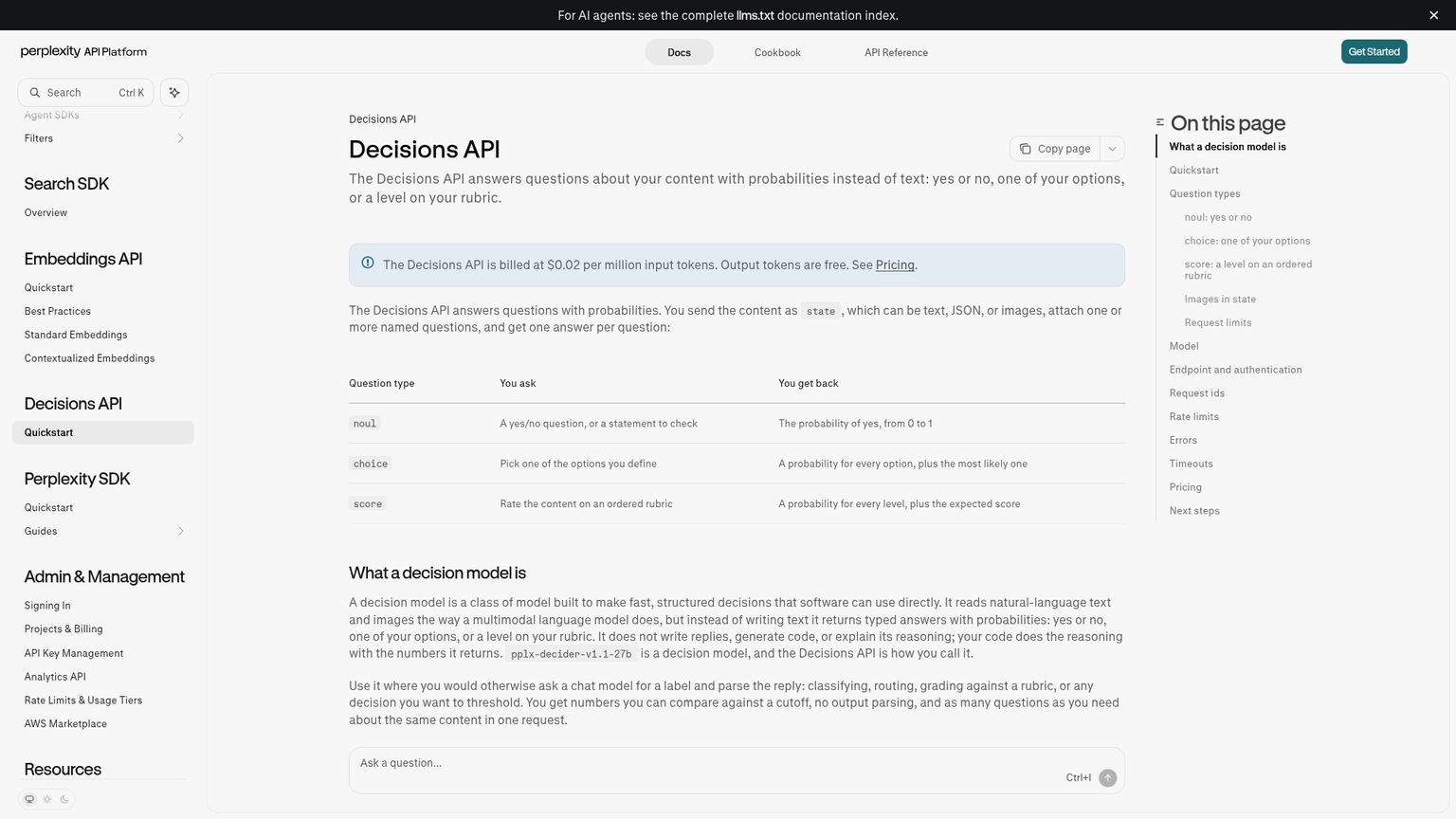
Perplexity pplx-decider-v1.1-27b is a decision model available through Perplexity's hosted Decisions API and a downloadable checkpoint. It is the first candidate I would evaluate for ordinary support routing or bulk labels when the brief is simply to reduce Jev input costs. Its rate is the lowest published hosted rate in this shortlist. The recommendation flips if its request cap, local serving requirements or error rate fails your workload.
Best for: Lower-cost hosted routing, labelling and rubric scoring.
Standout: A direct API plus a separate open-weight deployment path.
Pricing: $0.02 per 1M input tokens; output free; no per-request fee.
Free trial: not published in the cited Decisions guide.
Inputs and runtime: Text, JSON and inline images through Perplexity's API; CUDA hardware for the supplied local implementation.
Licence: Apache-2.0 for the downloadable checkpoint; hosted access remains a separate service. API guide, checkpoint licence
The hosted wall is throughput: Perplexity documents 10 requests per second per organization on every plan. It allows up to 128 questions over shared evidence, with total input under 262,144 tokens. Request limits A batch of separate customer tickets is not automatically one shared-state request just because all tickets need a label. Avoid packing unrelated cases together in a way that changes the task. Hosted limits
At that request cap, one million separate requests would take at least 27.8 hours even with perfect scheduling and no retries. That is a calculated lower bound, not a speed measurement. A nightly backfill and a steady trickle of tickets place very different demands on the same cheap API.
The self-hosted route has another wall. The maker's supplied setup calls for roughly 49 GiB of weights plus working memory, and its prepare implementation rejects combined inputs beyond 8,192 tokens. Its evaluated attention and calibration settings must be preserved. The card also retains a reference to authenticated private-repository access, so verify that your account can download the checkpoint before committing to a local rollout. Perplexity model card
Do not copy the hosted context allowance into a local deployment ticket. A local build must be evaluated as its own runtime, including its actual preprocessing, memory use and model revision. Otherwise the fallback may fail precisely on the long records that made the primary service struggle.
- Lowest published hosted input rate among these alternatives.
- Text and images can share the decision request.
- Apache-2.0 checkpoint provides a route beyond the hosted service.
- The organization request cap can constrain a backfill or traffic burst.
- The supplied local setup needs substantial GPU memory.
- Hosted and reference local input limits differ sharply.
For a first comparison, keep the task small enough that you can inspect mistakes directly.
Keep the existing queue definitions
Take the labels and boundary cases from your Jev implementation. Retain an explicit other or review outcome for tickets outside those definitions. Our Jev support-ticket routing guide provides a baseline workflow to compare against.
Use the native Perplexity request
Set the model to
pplx-decider-v1.1-27band sendstateplus namedquestionstoPOST /v1/decisions. Use achoicequestion withcriteriadescribing each queue. Follow the native API reference for the request and response contract.Record answers without changing assignments
Read the answer under its question name. Store the selected label, returned probabilities, billed input usage and request status alongside the current Jev result. Keep provider failures separate from valid low-confidence decisions.
Choose the switch condition before seeing the winner
Set an acceptable misroute rate, review volume and response deadline. Promote the candidate only if it clears those conditions on representative labelled work. A lower input bill alone does not satisfy the gate.
2. Cloudflare Clef, Clef-flash and Clef-omni: Pick the Input Path You Need
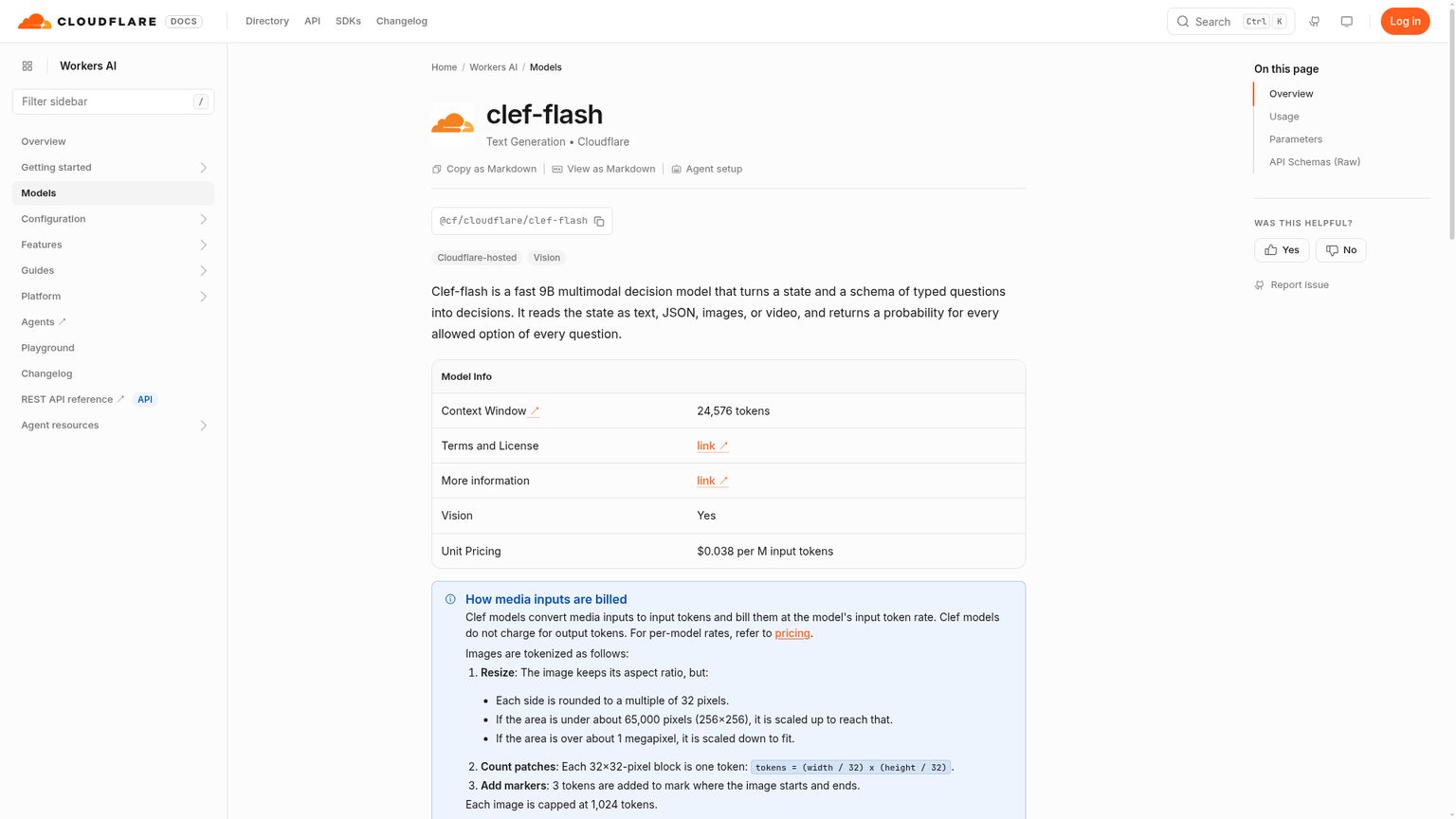
Cloudflare Clef-flash is the practical first choice when the decision belongs inside an existing Workers application. The family combines Workers AI hosting with Apache-2.0 weights, so you can evaluate a managed deployment without giving up a later self-hosting route. Choose among the variants by the evidence they need to read and the limits of the hosted endpoint. The cheapest family member is not a substitute for audio support or sufficient context.
Best for: Routing and classification close to a Workers application.
Standout: Workers AI bindings and REST access, plus downloadable weights.
Pricing: Clef-flash $0.038; Clef $0.240; Clef-omni $0.150 per 1M input tokens.
Free trial: Workers AI provides a shared daily free allocation, not a separate unlimited Clef trial.
Inputs and runtime: Clef and Clef-flash handle text, JSON, images and video frames; Clef-omni adds direct audio and video-with-sound input. Hosted Workers AI or your own serving stack.
Licence: Apache-2.0 weights for all three. Workers AI pricing, original release, Clef-omni card
Clef and Clef-flash arrived on 1 October 2026; the 9 October update added Clef-omni and changed the hosted tradeoffs. Most consequentially, Clef-flash now has a 24,576-token hosted context window. Its text state can be truncated to fit. A long incident history can therefore lose relevant evidence even though the application receives an answer. Current Clef-flash documentation, October update
That makes a short intake form a better initial flash workload than an unbounded conversation archive. Put the queue policy and the decisive customer evidence inside a deliberate input budget. If you shorten the record before sending it, evaluate the shortened version, not an idealized complete transcript.
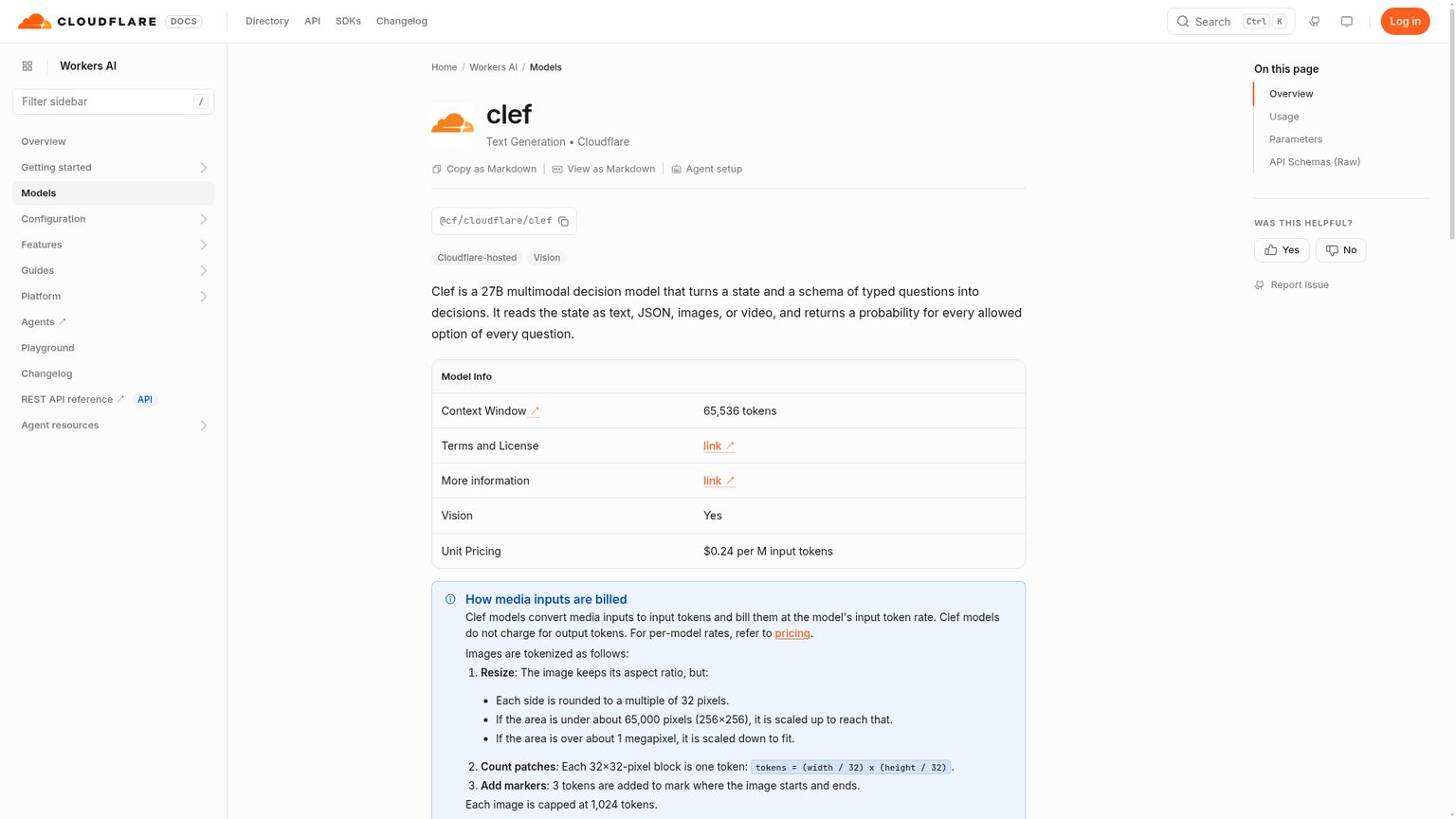
Cloudflare Clef is the larger text-and-image option, with a 65,536-token hosted context. Its higher price earns consideration when your evaluation shows a useful improvement or flash's hosted context is too small. It does not earn an automatic quality win merely because it is larger. Clef documentation
Cloudflare Clef-omni is the relevant candidate when the evidence includes sound. A field-service app might need to classify a machine recording alongside a technician's description. The distinction is direct audio/video input, not just extracting still frames and hoping they contain the answer. Its documentation specifies a 64,000-token context, with separate media limits including audio clips up to 300 seconds and videos up to 60 seconds, plus count and byte caps. Clef-omni documentation
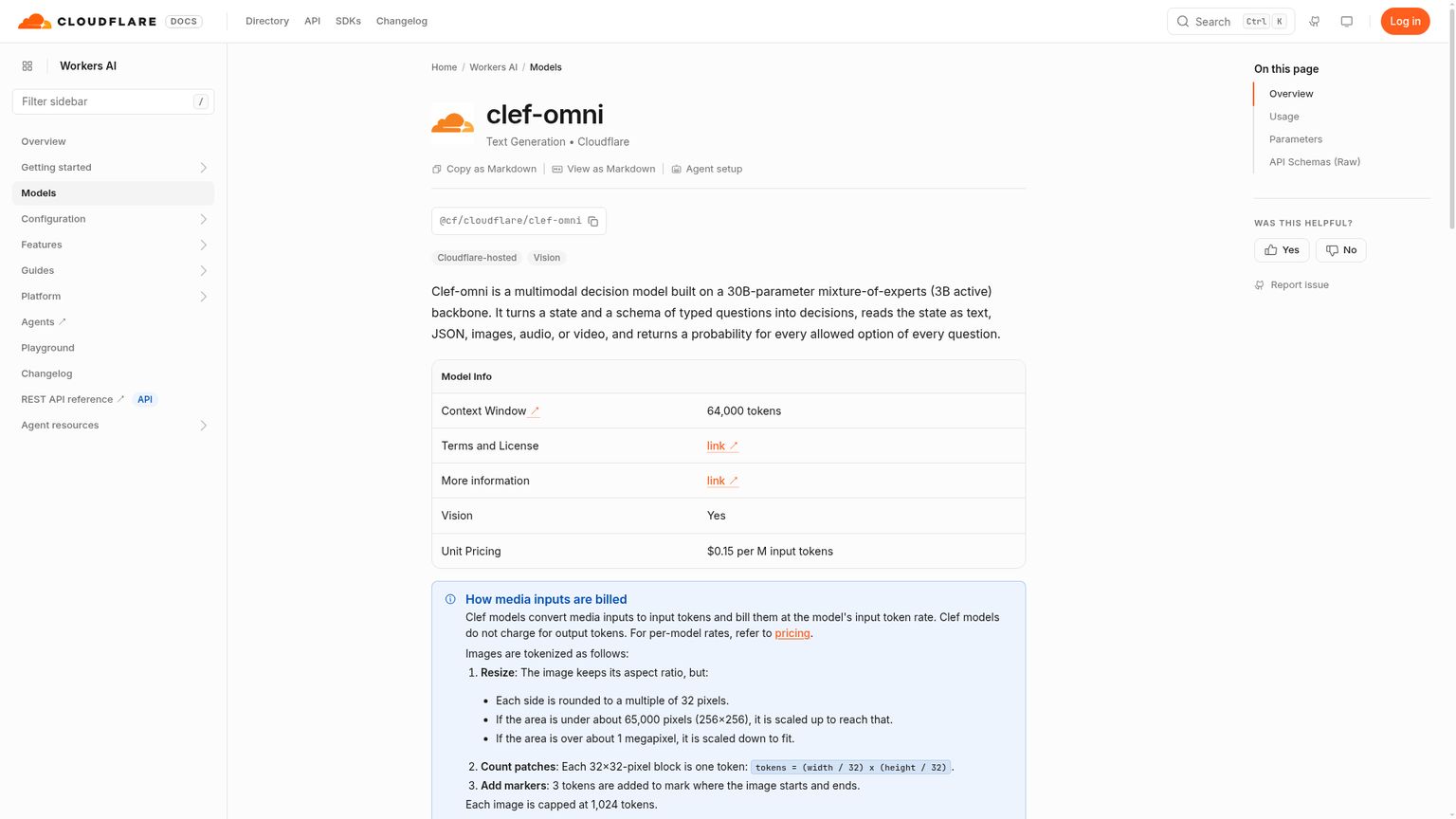
Open weights do not make the omni model a phone deployment. Cloudflare's reference setup describes about 64 GB of GPU memory for its backbone in bfloat16. That is a serving requirement to budget, not a hosted per-token charge. Clef-omni model card
Cloudflare's 10,000 Neurons per day free allocation is shared Workers AI capacity; Neurons are its compute billing unit. Usage beyond the allocation requires Workers Paid. Treat the token rates as model charges and include the rest of your Workers subscription and application usage in the deployment budget. Allocation and billing rules
- Native Workers integration avoids adding a separate application platform.
- Apache-2.0 weights keep self-hosting available.
- The family covers ordinary text routing through audio/video decisions.
- Hosted Clef-flash context is smaller than older launch descriptions suggest.
- Truncating a long state can remove the evidence your decision needs.
- Self-hosting Clef-omni requires substantial memory in the documented setup.
3. Microsoft-Decision-1: For Foundry Labelling and Agent Gates
Microsoft-Decision-1 is a hosted decision-scoring model for builders already operating in Microsoft Foundry. Its $0.042 per million input tokens matches Jev's current published rate, so evaluate it for platform fit and task quality rather than direct token savings. A feedback-labelling job or an agent's continue/retry/escalate gate is a sensible starting point. The documented request accepts text or JSON; do not infer image support from the underlying model family. Microsoft announcement, Foundry guide
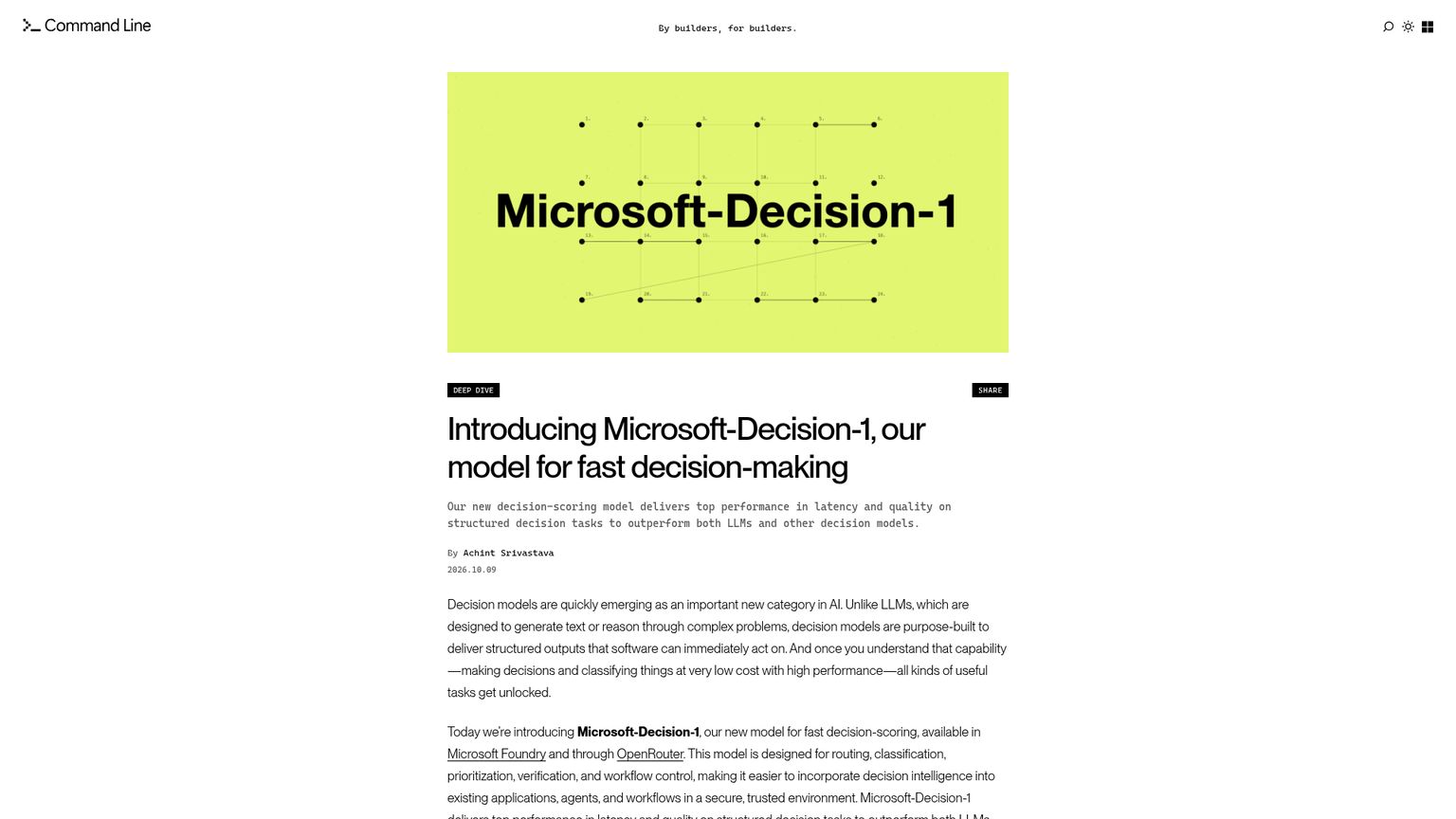
Best for: Labelling, prioritization and agent gates in a Foundry deployment.
Standout: A documented Foundry deployment path using Entra ID or an API key.
Pricing: $0.042 per 1M input tokens; output free.
Free trial: not published in the cited decision-model pages.
Inputs and runtime: Text or JSON; Microsoft Foundry and OpenRouter.
Licence: Hosted service; a downloadable weight licence is not published in these maker pages. Microsoft pricing and access, deployment requirements
Microsoft's 9 October 2026 post identifies the base as Qwen3.5-9B. Its discussion of rebasing on other models is a future plan, not the architecture you are buying today. Equally, an open base model does not establish permission to download Microsoft's post-trained model. This is a hosted candidate unless Microsoft supplies a separate weight release. Architecture source
The operational benefit is that you can put the evaluation inside the platform your application already uses. Suppose customer feedback is currently labelled by a general model before a product manager reads a weekly report. Define the themes and an unclassified outcome, compare both systems on the same feedback, and inspect whether vague comments receive unjustifiably specific labels. A perfectly structured label can still mislead the report.
Microsoft reports the highest average accuracy in its 36-benchmark comparison. That is vendor-reported, and its latency comparison measures Microsoft-Decision-1 through Foundry in the same region. Those conditions matter: they do not establish the response time from your application or the accuracy of your private taxonomy. Microsoft's evaluation description
The deployment wall is concrete. You need a Foundry project, model-deployment permissions and an authentication path, rather than merely a new model string in an unrelated SDK. Its guide documents numerical decisions, not a written explanation. If your workflow must justify a label to a reviewer, preserve supporting evidence and provide that explanation through another step. Foundry setup and output contract
- Fits existing Foundry identity and deployment workflows.
- Supports binary decisions, choices and ordered scoring.
- Microsoft's own announcement states a clear input rate.
- No base input-price saving over Jev.
- No open-weight deployment route established by the maker pages.
- The documented input path is text/JSON, not a promised multimodal substitute.
4. OpenAI Decisions API: For Existing OpenAI Integrations
OpenAI Decisions API turns text and images into typed answers using gpt-6-luna. It is a reasonable candidate when your application already uses OpenAI and you want classification, a bounded choice or rubric scoring in that integration. At $0.10 per million input tokens, it is a more expensive decision layer than Jev at the base rate. Choose it if integration or measured task quality earns the difference. OpenAI Decisions guide
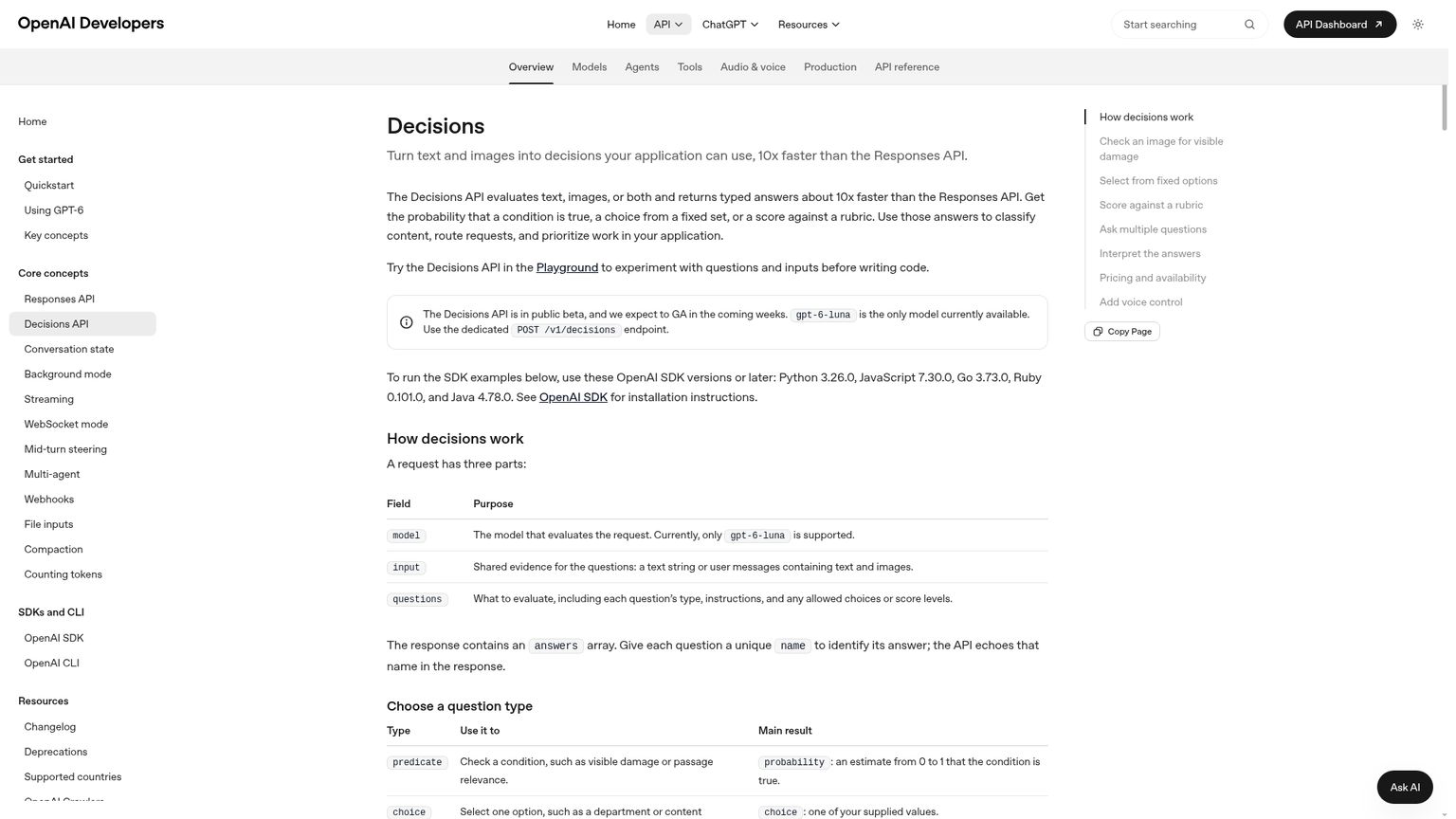
Best for: Text/image labels and gates in an existing OpenAI application.
Standout: predicate, choice and score answers from a dedicated endpoint.
Pricing: $0.10 per 1M input tokens at the base rate; no output, cache-read or cache-write charges. Regional premiums and long-context input multipliers apply.
Free trial: not published in the Decisions guide.
Inputs and runtime: Text and inline images through the hosted POST /v1/decisions endpoint.
Licence: Hosted API access; the guide supplies no open-weight distribution licence. Current guide and pricing
The API entered public beta on 6 October 2026. Keep that status in your rollout decision. A new API can still be worth evaluating, but its fit should be demonstrated through your response parser, exception handling and account access before it becomes your fallback. OpenAI changelog
The migration wall is the request and response contract. OpenAI uses input and an array of named questions; its yes/no type is predicate. An existing Jev-shaped object of questions cannot simply be forwarded unchanged. The response can also contain a refusal that must be handled separately from a probability. Request and answer patterns
For example, a returns workflow can ask whether a product photo shows visible damage and select the appropriate review queue. That does not establish who caused the damage, whether a warranty applies or whether a refund is authorized. Those are separate decisions requiring separate evidence or fixed business rules.
- Text and images can be evaluated together.
- Typed answers remove the need to parse a written label.
- The dedicated guide distinguishes decision billing from other model endpoints.
- Higher base input rate than Jev and the cheapest hosted alternatives.
- Public beta status is relevant to deployment planning.
- Native request shapes and refusal handling need an adapter.
5. Liquid AI d1-3B: The Local Text-and-Image Starting Point
Liquid AI d1-3B is an open-weight decision model for text and image inputs, released on 7 October 2026. It is the first local candidate here I would evaluate for a desktop or edge application that must classify both a description and a picture. The attraction is control over where inference happens. It is not a promise that running a GPU costs less than a very cheap hosted API. Liquid AI release
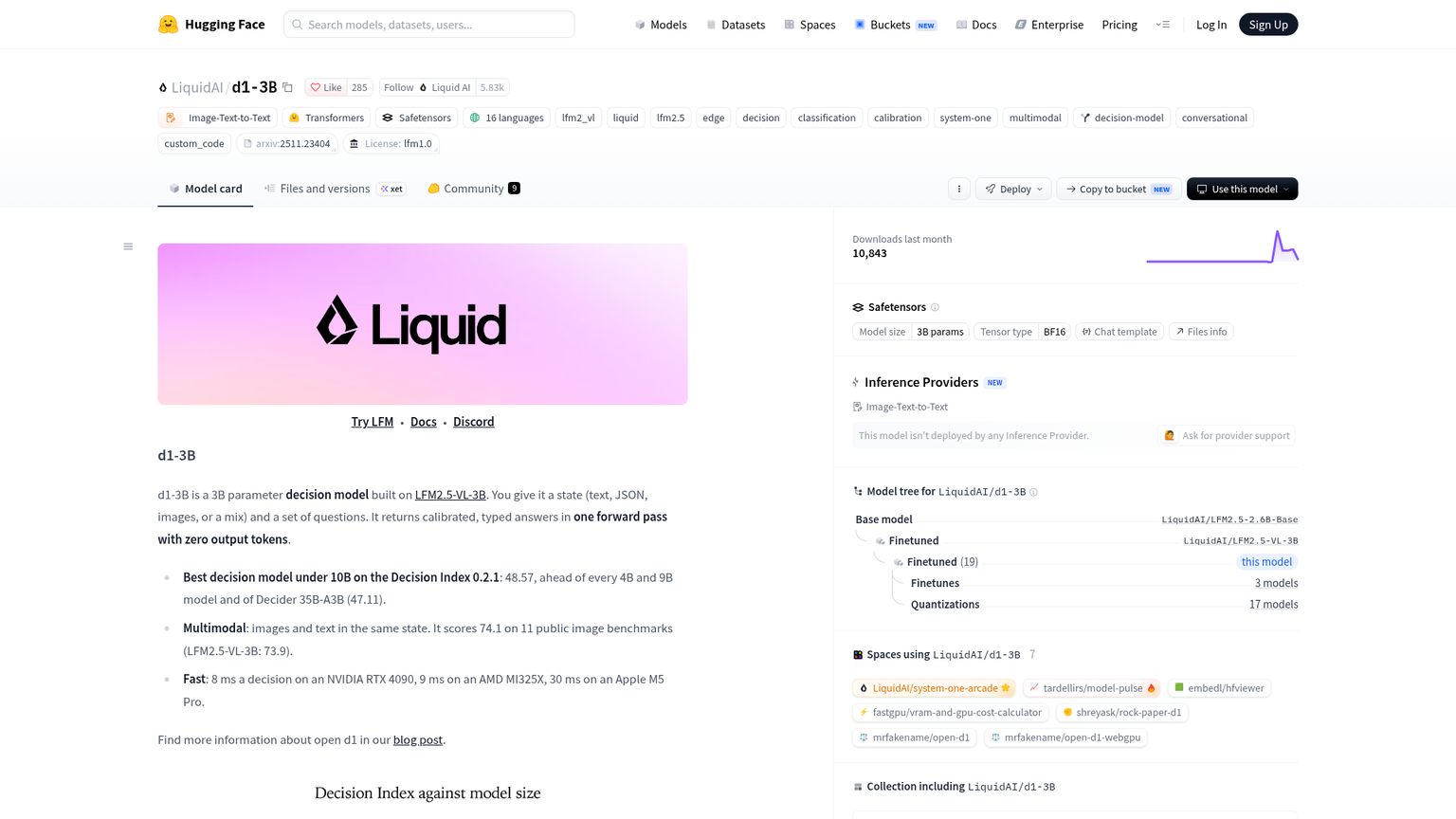
Best for: Local image classification, visual checks and text routing.
Standout: A downloadable model with documented local hardware measurements.
Pricing: Per 1M input tokens: not published for this open checkpoint. Budget your own computing.
Free trial: Downloadable weights subject to the licence; computing is separate.
Inputs and runtime: Text, JSON and images; maker examples support CUDA, Apple MPS and CPU through custom Transformers code.
Licence: LFM Open License v1.0. Model card, weight licence
The model is built on LFM2.5-VL-3B and documents a 32,768-token context. Consider a desktop quality-review tool where an operator supplies a product image and selects a known inspection question. Local operation lets the application keep running without a hosted decision call, provided the rest of the workflow is also local. It does not remove the need to validate camera conditions, image resizing or the definition of a defect. Architecture and context
Liquid reports single-question timings of 16 ms on Jetson AGX Thor, 26 ms on AGX Orin and 50 ms on Orin Nano. These are vendor-reported hardware measurements, not a promise for your input size or a comparison with a complete internet API request. Use them to identify hardware worth evaluating, then measure the complete application. Liquid's timing table
The licence is a purchasing constraint. Both Liquid checkpoints use the LFM Open License v1.0, whose commercial-use condition references an annual-revenue threshold of $10 million. Read the defined legal entity and Section 5 before assuming your deployment qualifies; confirm terms with Liquid if the condition affects you. Do not mark this model Apache-2.0 in a procurement sheet. Licence text
The name also needs care. Liquid lists hosted d1 separately from d1-3B and d1-omni-600M. Its hosted documentation and announcement explain input-only billing but do not publish a dollar-per-million rate on the pages checked for this comparison. The hosted model's tariff and limits should not be transferred to these downloads. Liquid model catalog, hosted d1 guide
For an offline product, the switch condition is whether the model clears your quality and latency bar on the actual target device. Test with the other software running, realistic images and sustained use. A successful isolated inference is only the beginning of a capacity decision.
- Keeps decision inference on hardware you operate.
- Supports both text and images.
- Maker measurements identify concrete edge hardware to evaluate.
- LFM commercial-use conditions require attention.
- You own serving, capacity and runtime maintenance.
- Download access does not provide a fixed or zero inference bill.
6. Liquid AI d1-omni-600M: Small Voice Decisions, With Research-Release Limits
Liquid AI d1-omni-600M is the compact, experimental sibling for text with images or text with audio. It belongs on the shortlist for a device that must distinguish a small set of spoken intents, not as an assumed replacement for every multimodal hosted service. Its size makes the local route interesting, but its input and training limits are decisive. Treat a voice-command pilot as a narrower job than analysing unrestricted recordings. Release status, model card
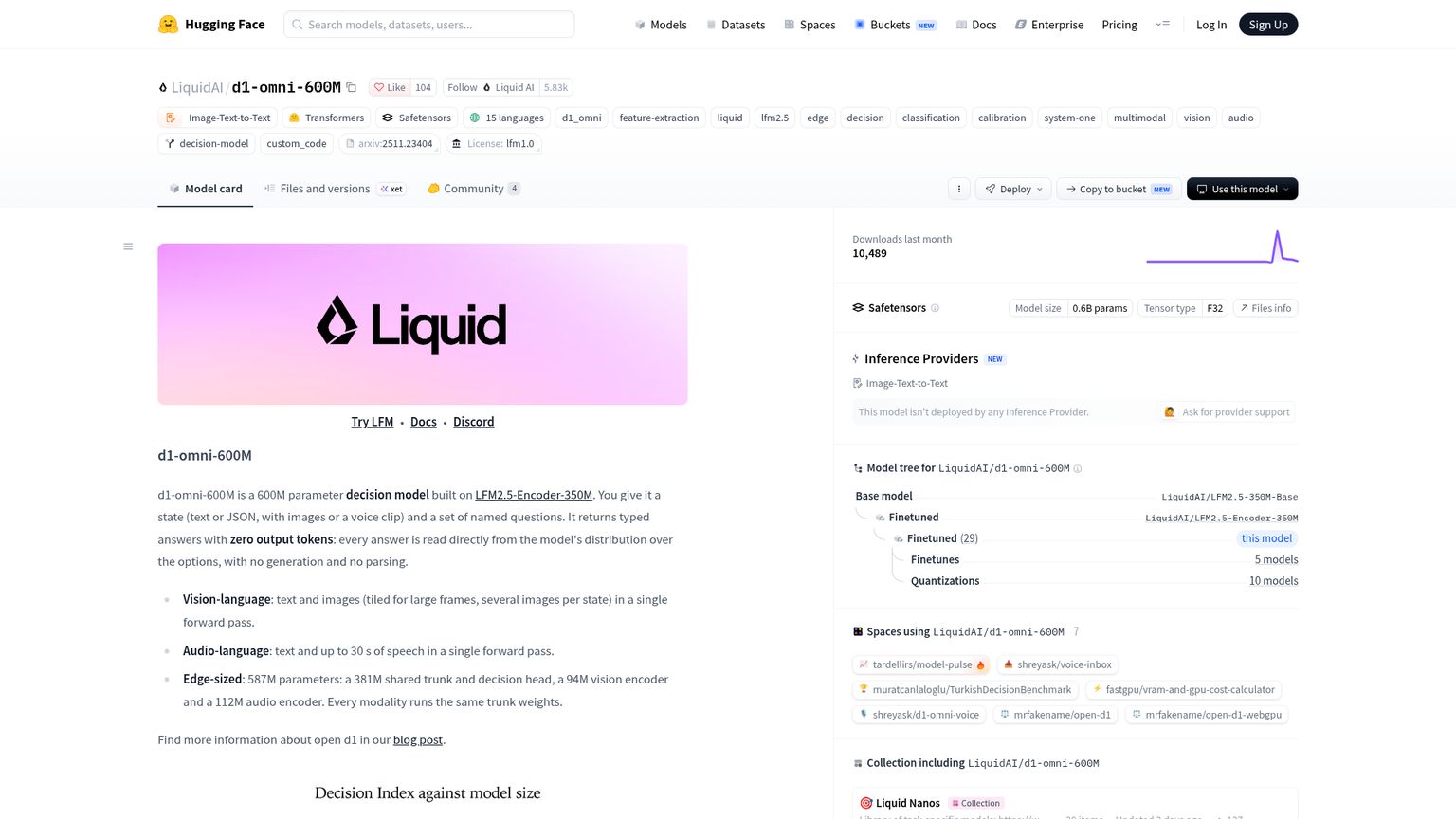
Best for: Small-device experiments with spoken intent or image decisions.
Standout: A compact open checkpoint with an audio input path.
Pricing: Per 1M input tokens: not published for this open checkpoint.
Free trial: Downloadable weights subject to licence; your compute costs remain.
Inputs and runtime: Text/JSON with images or audio; local CUDA, MPS or CPU examples.
Licence: LFM Open License v1.0, with the same commercial-use condition. Model card, licence
The card documents 587 million parameters, with audio training based on requests between an English speaker and an assistant. Audio clips are cut at 30 seconds. A command such as “pause the inspection” is therefore a more appropriate evaluation target than a long multilingual customer call. Supporting audio as an input does not establish performance on every kind of sound. Audio scope
There is a particularly easy limit to miss: the model has 16,384 total context positions, but with images the state and question text is cut to 896 tokens. A long operating manual attached to an image can exceed the relevant text path long before the headline context figure suggests trouble. Context details
For a kiosk, keep the command list and local policy concise, and include a path for unrecognized requests. Evaluate background speech and missing context as deliberately as clean commands. The useful result is a system that abstains when the instruction is unclear, rather than one that always supplies a valid-looking option.
Liquid's launch does not report speed measurements for this experimental model. Do not borrow the larger d1-3B model's timings or infer a latency guarantee from the smaller parameter count. The application still has to process media, load the model and fit its runtime into the device's operating budget. Launch measurement scope
- Small footprint is relevant to constrained local devices.
- Provides an audio decision path alongside an image path.
- Open weights let you inspect and operate the deployment.
- Experimental release with a narrow documented audio-training scope.
- Image requests have a much smaller text allowance than the total context figure.
- The launch supplies no model-specific speed result.
7. Amazon Strands Decider 2B: Local Agent Gates You Can Inspect
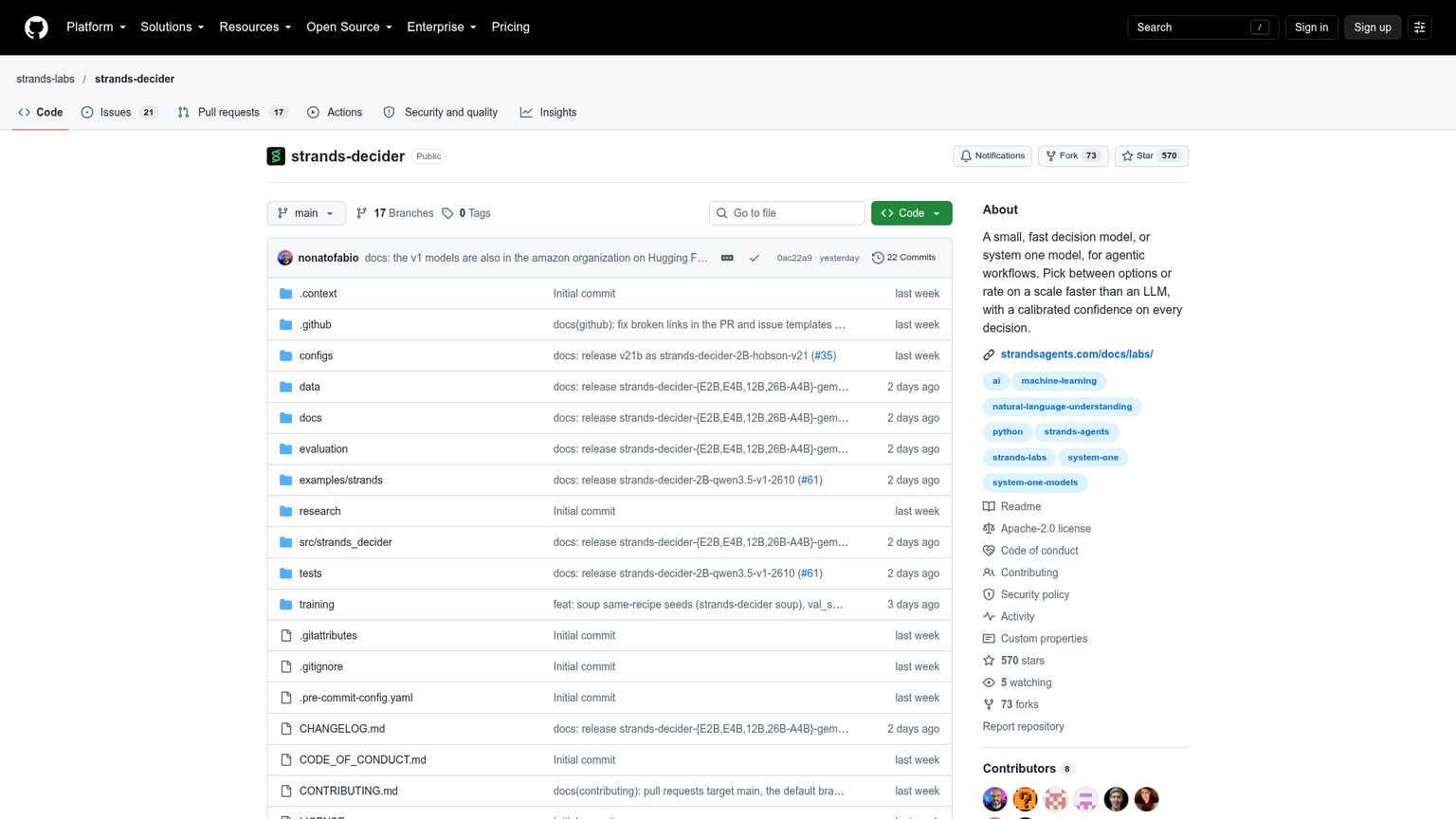
Amazon Strands Decider 2B is an open decision model from Strands Labs with published inference code, training material and evaluations. It is the stronger fit when the reason to leave a hosted Jev call is to control a small decision component inside your own agent runtime. Start with a bounded task such as checking a proposed action against a short policy. Do not treat the supplied local server as a complete hosted product. Maker repository
Best for: Local agent gating, routing and experiments with the training recipe.
Standout: Model weights, code and evaluation details available together.
Pricing: Hosted price per 1M input tokens: not published; you provide the runtime.
Free trial: Downloadable Apache-2.0 model and code; compute is separate.
Inputs and runtime: Text and optional images with the vision path; CUDA, Apple Silicon and CPU options.
Licence: Apache-2.0 for the named Qwen-based checkpoint and project. Current model card
Pin the exact checkpoint: strands-decider-2B-qwen3.5-v1-2610 is the current reference described by the repository. It uses a Qwen3.5-2B-Base backbone with a trained adapter and decision head, the part that scores the allowed answers. Older hobson-v19 and hobson-v21 names remain visible, so a performance statement needs a version beside it. Version and architecture
That distinction affects the often-repeated 115 ms timing. The repository's detailed table assigns that median RTX 3090 result to v19, while the newer columns state that they share the architecture and size. It is vendor-reported historical timing, not a new measurement of the current checkpoint. Use the measurement attached to the checkpoint you plan to deploy. Versioned performance table
The supplied server binds to localhost and has no authentication. That is a useful local experiment, but a network service also needs access control, concurrency planning, deployment ownership and monitoring. For an internal agent, the owner must decide what happens when the model process is cold, busy or unavailable. “Run locally” is a deployment option, not an availability strategy. Serving instructions
A concrete first gate might distinguish “the proposed action only reads a record” from “the proposed action changes a record.” Fixed application rules should still check the user's permissions and allowed operations. If the model thinks an operation is safe but the authenticated user cannot perform it, the operation remains blocked.
- Apache-2.0 model and code support a locally operated component.
- Published training and evaluation material make assumptions inspectable.
- Small-model CPU and Apple Silicon paths broaden evaluation options.
- No maker-hosted input tariff or managed endpoint is established here.
- A local example server is not a finished production service.
- Historical latency figures must stay attached to their measured checkpoint.
What the Monthly Bill Changes, and What It Does Not
The large percentage saving can be a small dollar saving. Assume one million decisions per month, each with 1,000 billed input tokens. That is one billion input tokens. At the verified base rates, the input-only model bill is $20 for Perplexity, $38 for Clef-flash, $42 for Jev or Microsoft-Decision-1, $100 for OpenAI Decisions, $150 for Clef-omni and $240 for Clef. Perplexity, Cloudflare, TypeSafe, Microsoft, OpenAI
This is deliberately a normalized billable-token scenario. Different tokenizers, question layouts and media processing can produce different billed totals for the same business input. The figures exclude free allocations, platform subscriptions, regional or long-context premiums, retries, downstream generation and staff review.
Now assume a candidate creates 0.1 percentage point more errors, and each additional mistake costs $1 to handle. Across one million decisions, that means 1,000 extra errors and $1,000 extra cost. Those are illustrative assumptions, not measured failure rates or a market price for staff time. They show why you should optimize accepted decisions rather than token price alone.

Self-hosting has a similar test. If your additional infrastructure budget were $100 per month, matching Perplexity's $0.02-per-million base rate would require five billion input tokens per month before counting operations or differences in quality. The $100 is an assumption, not a GPU quote. Existing spare hardware can change the calculation; keeping data local or supporting an offline product can justify it even without a token-cost saving.
Measure billing from the actual workload before extrapolating. For example, Liquid's separate hosted d1 service counts each question's text and supplied images again. Sending several questions in one HTTP call therefore does not imply paying for the evidence only once. That billing rule does not assign a dollar rate to its open checkpoints. Liquid's billing explanation
Which One Should You Put in Production?
For ordinary routing, evaluate Perplexity first if lower hosted cost is the objective. Choose Clef-flash first when staying inside Workers simplifies the application. The rule that flips the choice is whether the candidate fits your request rate, input length and measured misroute/review budget. Neither a lower tariff nor a familiar platform compensates for dropping the evidence that determines the correct queue.
For labelling, favour the candidate that preserves your taxonomy on ambiguous examples. Microsoft-Decision-1 is a natural Foundry candidate; Perplexity is the price-led hosted candidate. Test whether a comment can belong to more than one theme. A single-choice question forces one winner, so a multi-label problem should be decomposed into separate checks or otherwise represented deliberately.
For agent gating, choose the runtime you can operate reliably and keep authority in code. Strands is worth evaluating for a local component; Microsoft or OpenAI may fit an established hosted integration. The model can supply an estimate about the proposed action. Your application must separately enforce permissions, spending rules and allowable operations.

For on-device work, begin with d1-3B for text plus images and d1-omni-600M for a narrow voice experiment. Strands is another local option when its licence and inspectable recipe better match the project. The device, input preprocessing and permitted commercial use decide this branch before a hosted price comparison does.
For audio/video decisions in a hosted application, evaluate Clef-omni. Its media path is a substantive distinction. A cheaper text model is only an alternative if you deliberately add a preprocessing step and validate the information that step loses.
For a second source, decide which failure you want it to cover. Two model IDs behind the same gateway still depend on that gateway. A local fallback also fails if it depends on the same unavailable upstream service to retrieve its input. Draw the whole request path and isolate the dependency whose outage you are trying to survive.
Move One Decision Before Moving the Whole Workflow
A replacement succeeds when it preserves the application's decision contract, not when it returns valid JSON. Keep the queue names, rubric meanings and fallback behaviour stable while adapting provider-specific fields. This makes disagreements reviewable instead of mixing a model change with a policy change.
Freeze the decision and the evidence
Choose one existing call, such as the queue assignment on a new support ticket. Record the allowed labels, policy version, input fields and what counts as insufficient information. Include ambiguous and out-of-scope work in the labelled set, not only obvious examples.
Adapt the provider boundary
Map the evidence, question definitions and answer reader explicitly. OpenAI uses an input field and named question array; Perplexity and Microsoft's documented examples use state and keyed questions. Image packaging also differs. Verify against the maker's native guide rather than treating similar primitive names as identical wire formats.
Run the candidate beside the current decision
Let the current workflow keep control while the candidate only records an answer. Compare wrong accepted decisions, handoffs, failed requests, billed usage and the slow end of response times. Keep the same evidence for both models so a preprocessing change does not masquerade as a model improvement.
Set thresholds for this model and task
A Jev cutoff is not portable merely because another API returns a probability or a field called confidence. Recheck the relationship between scores and observed correctness on labelled examples. Set a separate review path for missing evidence, provider failures and refusals.
Promote gradually and keep rollback simple
Change only the selected workflow. Retain the prior model configuration and a way to return to it. Re-evaluate when the checkpoint, model alias, question wording or preprocessing changes, because any of those can change the decisions your thresholds accept.
If your starting point is Jev Router rather than a direct Jev decision call, first identify the billing boundary. A routing service and the downstream model it selects are different parts of the bill. The Jev Router pricing guide explains the distinction; a cheap decision model does not make the generated answer free.
The Ones to Avoid
Avoid Microsoft-Decision-1 as a token-saving migration when Jev's current base rate is your only complaint. The published rates match. It can still be a good platform or quality choice, but that is a different justification.
Avoid hosted Clef-flash for an unbounded evidence archive unless you control its input budget. A valid response after truncation can conceal that a critical fact never reached the decision. Use a workload that fits, or evaluate a path with a suitable context allowance.
Avoid d1-omni-600M for unrestricted long-recording analysis on the strength of the word omni. The documented speech scope, clip cutoff and experimental status are material. Clef-omni is the hosted candidate in this shortlist when richer media is the requirement, subject to its own limits.
Avoid open weights as a synonym for a free production service. Liquid has a conditional licence, Perplexity's reference setup requires substantial memory, and Strands leaves hosting to you. A model download is the start of an operating commitment.
Avoid an unverified clone as your emergency fallback. A similar product name or a compatible-looking endpoint does not establish a maker, usable licence, maintained runtime or independent failure path. That exclusion is about missing evidence, not a claim that every community project performs poorly.
Frequently Asked Questions
Are any Jev alternatives free?
Cloudflare offers a shared Workers AI daily free allocation. Several alternatives also publish downloadable weights, but you provide the computing and must follow the licence. Liquid's hosted documentation separately lists a text-only d1:free model, without publishing an allowance on the page checked here. Do not treat a free access route as a guaranteed zero-cost production deployment. Liquid hosted model guide
Which Jev alternatives have open weights?
The Clef family, Perplexity's named checkpoint, Liquid's two d1 checkpoints and Strands Decider have maker-published weight routes. Clef, Perplexity and the named Strands checkpoint use Apache-2.0; Liquid uses LFM Open License v1.0 with a commercial-use condition. OpenAI Decisions and Microsoft-Decision-1 are hosted choices in this comparison, without an open-weight licence supplied by the cited maker pages.
Which Jev alternative should I choose first?
Evaluate Perplexity first for a lower hosted input rate, Clef-flash for an existing Workers application, Microsoft-Decision-1 for Foundry, and OpenAI Decisions for an OpenAI integration. For local operation, start with d1-3B for text and images, d1-omni-600M for a narrow voice experiment, or Strands for an inspectable agent component. Your workload evaluation decides the final choice.
Your Monday Move
Pick the decision call whose owner can explain what a costly mistake looks like. Choose one candidate for the reason you need it: price, platform, media input or local operation. Compare it beside Jev using the same evidence, then switch only if its accepted errors, review workload and response deadlines are satisfactory. Keep the original configuration ready until the new path has earned your trust on normal work.
Use the AI Business Workflow Audit Checklist to identify the decision worth changing first.
- Published
- Category
- Build
- Language
OpenAI Decisions API
Use OpenAI Decisions API for ticket routing, labels, and action gates. Three guide requests, refusal handling, pricing, limits, and when to keep your LLM.Oct 11, 2026Build
Claude Code Remote Control
Set up Claude Code Remote Control from CLI, VS Code or Desktop, connect your phone or browser, and fix documented login and connection failures.Oct 9, 2026Build
Cursor Remote Control
Set up Cursor Remote Control on iPhone, pair your laptop, keep local agents reachable, and compare cloud agents, Claude Code and Codex.Oct 9, 2026Build
Firecrawl Pricing 2026: What Your Pages Cost
Firecrawl plans and credit packs verified October 2026. Calculate JSON extraction, failed pages and weekly crawl bills at your volume.Oct 9, 2026Build
Claude Code vs GitHub Copilot 2026
Claude Code vs GitHub Copilot: current plans, usage limits, models, team controls, one-seat and ten-seat costs, and when to use both.Oct 8, 2026Build
LangGraph vs CrewAI
Compare LangGraph and CrewAI on the same approval workflow, state, memory, MCP, observability and current hosted-platform prices.Oct 7, 2026Build
How to Build MCP Server
Build an order lookup MCP server with Python, test it in Inspector, connect Claude Code and Cursor, then add HTTP auth and hosting.Oct 7, 2026Build