Apollo vs ZoomInfo
Apollo vs ZoomInfo for small sales teams: verified seat prices, quote-based cost math, regional coverage, credits, intent and switching costs.
Published
 By Omid Saffari

Apollo.io is the better starting point for most sales leaders at a 5 to 100 person company: its paid plans start at $49 per seat per month billed annually, with prospect data and sequencing together. In the Apollo vs ZoomInfo decision, choose ZoomInfo when its account intelligence and buying signals solve a specific sales problem well enough to justify a tailored quote.
Apollo vs ZoomInfo: Which Should You Pick?
Pick Apollo.io if your priority is a usable prospecting workflow at a known seat price. It combines business contact data with sequences, which are scheduled outreach steps. A founder building the first sales process or a small sales team running focused email outreach should start here, then check contact coverage before committing annually.
Pick ZoomInfo if your reps need deeper account intelligence to win complex deals. ZoomInfo combines contact and company data with buying signals and account research. Its case is strongest when your sellers need company hierarchies, buying-group information and signal-driven prioritization, and can show how that information changes which accounts they pursue. Company headcount alone does not make the decision: a small enterprise-sales business can have a more demanding data problem than a much larger transactional seller.
Keep your current sender and evaluate a narrower data provider if missing contacts are the only problem. Replacing a functioning outreach workflow to fix one country's phone coverage creates extra work without proving the data will improve.
The criteria here are total committed cost, coverage of your actual market, usable account intelligence and the work required to reach a prospect. This is a comparison of live vendor documentation and calculated costs, not a hands-on accuracy test.
Pricing verified on 11 October 2026: Apollo's live pricing page publishes annual-billing rates; ZoomInfo's live pricing page requires a quote and publishes no sales subscription prices. All amounts below are USD, before taxes.
Disclosure: Apollo.io is a partner. We may earn a commission through Apollo links.
Pricing: Normalize the Same Sales Workload
Apollo wins on a budget you can calculate before speaking to sales. Whether it is cheaper than your exact ZoomInfo package depends on the quote and what it replaces.
Apollo IO Pricing: Published Seats and Credit Allowances
Apollo.io sells Free, Basic, Professional and Organization plans on its current price page. The annual paid prices are monthly equivalents of an upfront yearly commitment.
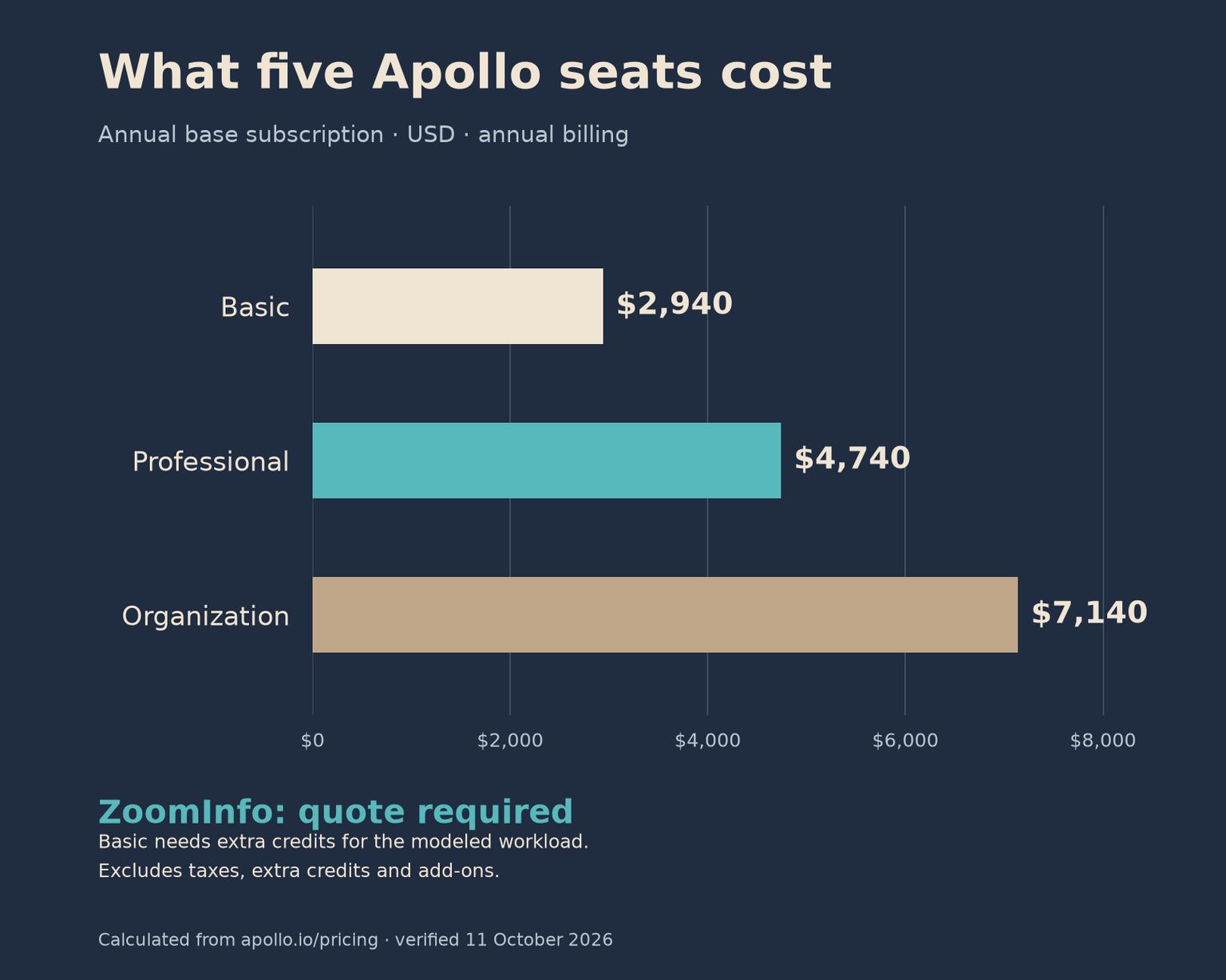
Five Basic seats cost $2,940 annually. Five Professional seats cost $4,740. Five Organization seats cost $7,140, while Organization's minimum three-seat purchase is $4,284. Those are base subscriptions, excluding extra credits and add-ons. The fuller Apollo pricing breakdown covers plan selection and calling costs.
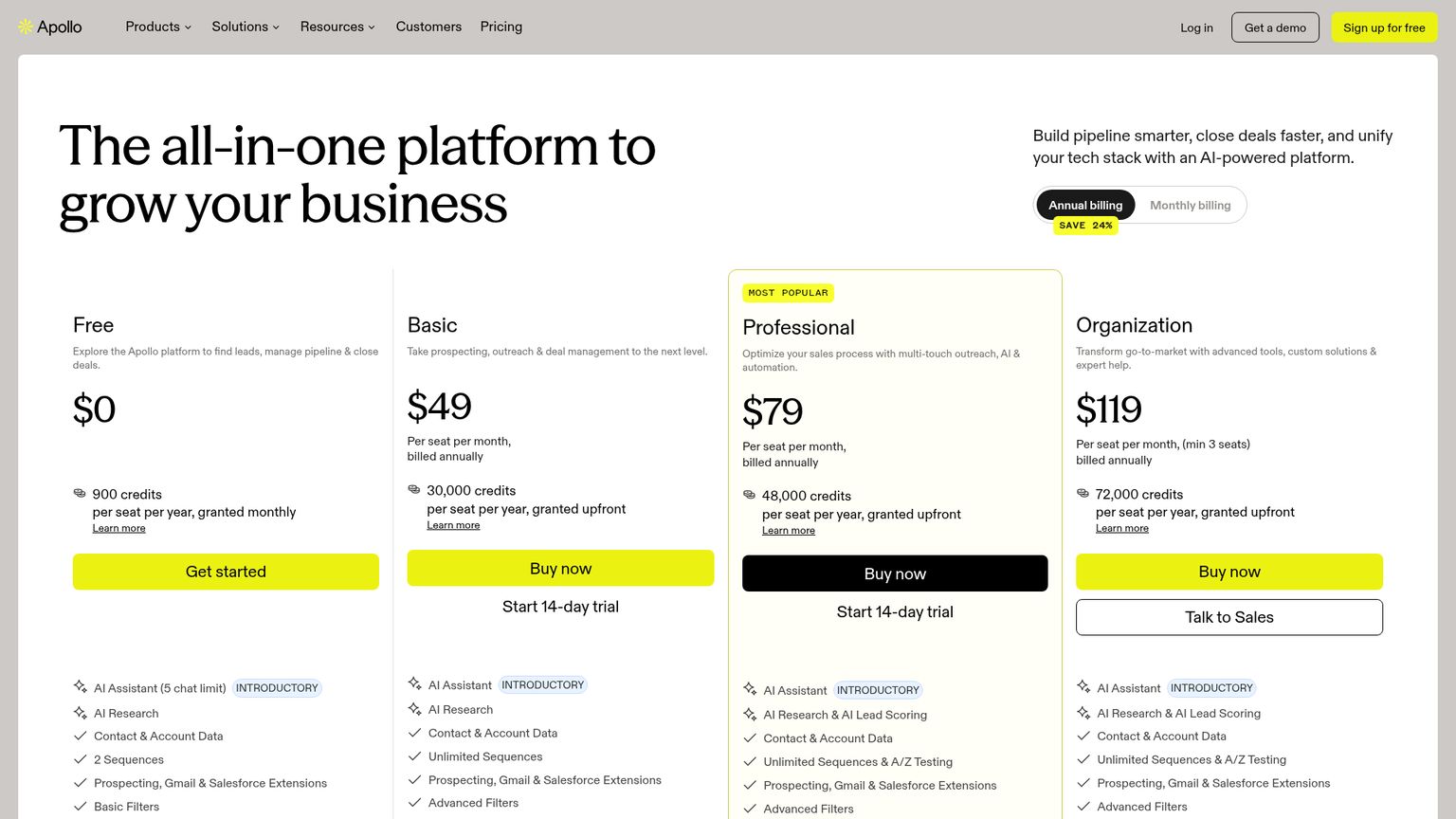
Free's 900 annual credits work out to 75 granted each month. That can support occasional prospecting, but it is a small allowance for a full-time rep. Do not budget as though the entire annual Free balance arrives on signup.
ZoomInfo Pricing: Get the Scope Before Comparing the Number
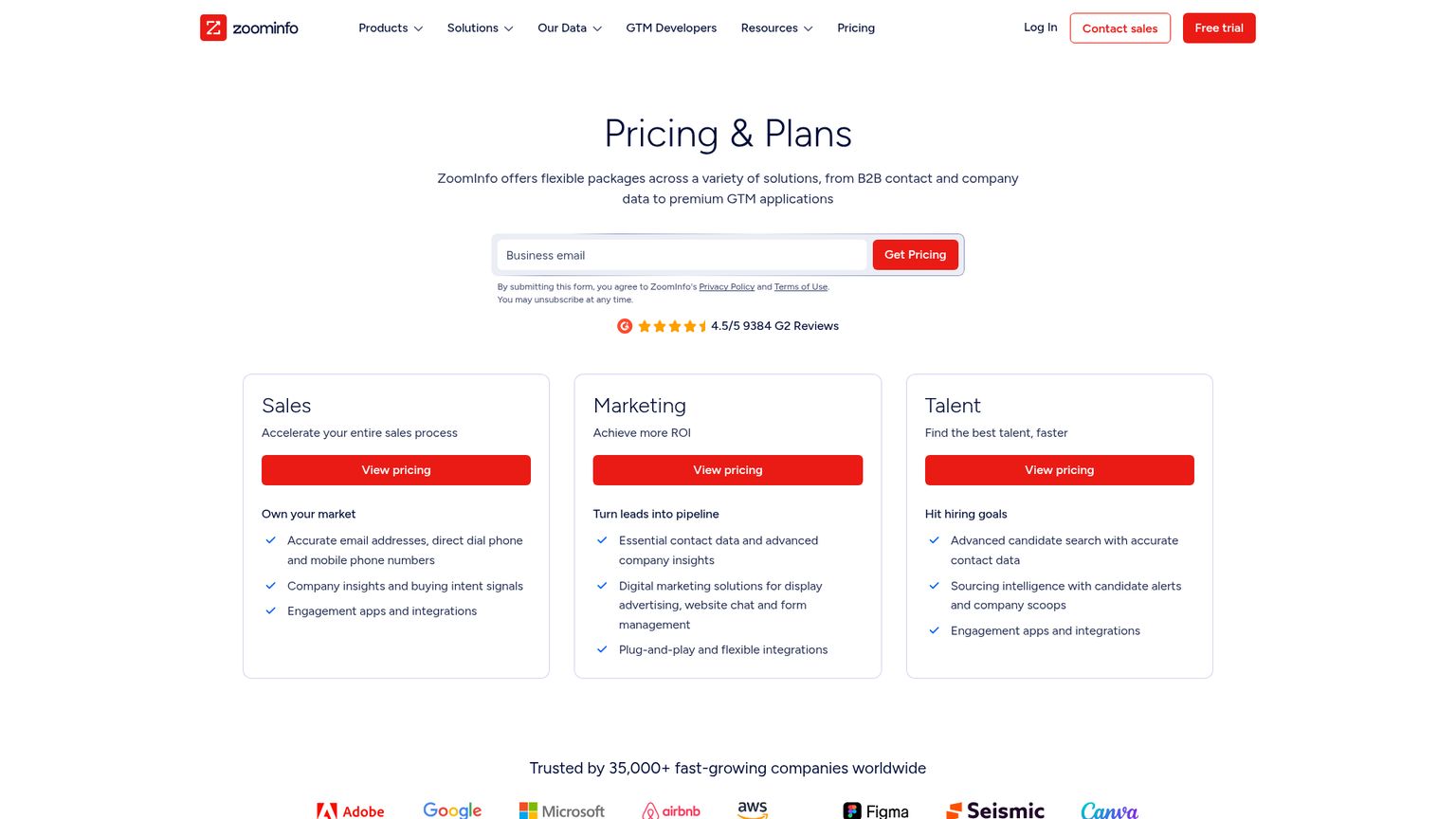
ZoomInfo lists Professional, Copilot Advanced and Copilot Enterprise sales packages, with no public dollar price. Its pricing FAQ says cost depends on licenses, features and credit usage; integrations and add-ons can change the package. A third-party estimate is not a ZoomInfo price. Source: ZoomInfo pricing.
For a useful quote, give the seller your number of users, target countries, required email and phone fields, annual exports, CRM integration and engagement requirements. Ask which intent capabilities are included. A contact-data quote without the required regions or outreach workflow is not the same purchase as a working sales setup.
Do not treat payment frequency as contract flexibility. A vendor can invoice in installments while the buyer remains committed for the full term.
Five Reps, One Defined Data Workload
Consider a planning example: five sellers each need 1,000 new verified emails per month, with phone numbers for 200 of those same people. Assume all requested fields are found. This is a workload model, not observed campaign performance.
Apollo lists one credit per email and eight per phone reveal. Each rep therefore needs 1,000 + (200 × 8) = 2,600 credits per month, or 31,200 per year. Across five reps, that is 156,000 credits annually. These calculations use the published credit rates.
Five Basic seats include 150,000 annual credits, leaving a 6,000-credit shortfall before calling, research or other activity. Five Professional seats include 240,000, leaving 84,000 credits after the modeled reveals. Compare Basic plus a quoted top-up against Professional if credits are your only constraint; the base-price difference alone does not decide that upgrade.
For ZoomInfo, request 60,000 unique contact-profile exports per year, with emails for all and phone fields for the 12,000 contacts that need them. That is 5,000 monthly exports. Its pricing FAQ defines a profile export as one credit; it does not publish a standard allowance or guarantee every requested field is available. Have the quote confirm both. Company-profile exports or additional enrichment may change the scope. Source: ZoomInfo's credit explanation.
Use Z for the complete annual ZoomInfo-side cost of this scope, including any required engagement product, implementation and usage. Use A for Apollo's annual costs above the $4,740 Professional subscription, including the corresponding extras. Keep the treatment of shared infrastructure consistent.
- Apollo cost per seat-month: ($4,740 + A) ÷ 60. ZoomInfo: Z ÷ 60.
- Apollo cost per 1,000 contact profiles: ($4,740 + A) ÷ 60. ZoomInfo: Z ÷ 60. The equal divisors are a coincidence of this example's seats and volume.
- The cost crossover is Z = $4,740 + A. Below that threshold, the fully scoped ZoomInfo setup is cheaper; above it, Apollo is cheaper for this workload. With no Apollo extras, the baseline threshold is $4,740.
At the base subscription alone, Apollo Professional allocates $79 per seat-month and $79 per 1,000 profiles to this example. That is an allocation across the assumed fully filled workload, not a pay-as-you-go contact price. Missing records raise the cost per usable contact.
Data Coverage: Buy Your Market, Not a Global Total
ZoomInfo wins the documented account-depth comparison; neither vendor wins country-level accuracy without a matched sample. A company's reporting structure can matter more than a database's total headcount when a rep needs to find the budget owner inside a large group.
Apollo's data page advertises 240M+ global contacts and 30M+ companies. Its release notes say it increased direct-dial coverage across APAC, LATAM and EMEA, meaning Asia-Pacific, Latin America, and Europe, the Middle East and Africa. Those are vendor statements about coverage, not measured connection rates for your market. Apollo data, Apollo release notes.
ZoomInfo says it covers 200M+ professionals and 34M+ companies outside North America. Its global page also describes a UK team supporting customers across Europe. It would be inaccurate to dismiss the product as US-only. Equally, outside-North-America totals do not establish how well it covers a particular role in Germany, Singapore or Brazil. ZoomInfo's company page, global coverage.
For a North American sales motion, evaluate US and Canadian accounts separately. For EMEA, split the countries you sell into rather than treating the region as one market. Apply the same rule to APAC and Latin America. Neither global total tells a Canadian rep whether the required mobile number is available or a German rep whether the person still holds the named job.
ZoomInfo's advanced package explicitly adds location and hierarchy data, technology insights and buying-group information. That supports a stronger account-research case for a business selling to several stakeholders at once. It does not prove a higher email-delivery or phone-connect rate. Source: package features.
Apollo IO Reviews: Separate Data Claims From Usable Coverage
Treat review scores and vendor accuracy claims as prompts for evaluation, not your expected result. The Apollo.io review covers the wider product; this purchase turns on whether the data reaches your buyers.
A useful starting sample is 100 target accounts and 200 people, distributed across your actual countries, company sizes and buyer roles. Record current employer and role matches, usable email fields, relevant phone fields and the accounts neither vendor covers. Keep missing records in the denominator. Then run the same approved outreach process against comparable segments if you are measuring delivery or connection outcomes.
Also distinguish a contractual remedy from an outcome guarantee. ZoomInfo's license quality provision concerns whether a contact is affiliated with the stated company, with a correction process. It is not a promise that an email will land or a prospect will answer. Source: ZoomInfo license terms, section 1.5.
Credits and Export Limits: Count Actions, Not Logos
Apollo wins on published reveal-cost clarity; ZoomInfo's export model needs a written allowance. A credit is a unit of usage, and the two vendors apply it to different actions.
Apollo's CSV help page says exporting saved contacts consumes no credits. If you select new people from search, Apollo saves them before export, charging one credit for each new verified email. Its credit-usage documentation notes that export credits can still apply to some plans or legacy configurations. Check your own workspace if you are migrating from an older account. CSV export rules, credit-usage rules.
The record-selection limits on Apollo's pricing page are 25, 1,000, 2,500 and 10,000 per action across Free, Basic, Professional and Organization. These determine batch size. They are not monthly export allowances. A Basic user selecting a larger list may need several selection-and-save actions, rather than a new subscription just because the list exceeds one batch. Source: selection-limit definition.
ZoomInfo's pricing FAQ charges a credit when a contact or company profile is exported, including through its platform, extension or integrations. The included number is tailored to the package. Confirm refreshes, repeat exports, company records, API calls and overages in the quote rather than assuming every operation follows the same rule. Source: ZoomInfo credits.
For a phone-heavy seller, Apollo's eight-credit phone reveals make email-volume estimates misleading. Its US dialer also lists one credit per 30 seconds, and research can spend credits too. Unused Apollo credits expire at the billing-cycle boundary, while purchased add-on credits recur until removed. Set a team budget around the complete job. Source: Apollo usage and billing rules.
Intent Data: ZoomInfo Wins on Depth, Apollo on Entry Cost
Choose ZoomInfo for an account-prioritization program that needs its deeper signals; start with Apollo when topic-based company intent is enough. Intent data estimates interest from research behavior. It helps rank an account for attention; it does not prove that a named person has approved a purchase.
Apollo's filters identify companies researching chosen topics and score activity using recency and frequency. Free includes one intent topic, Basic and Professional six, and Organization twelve. A small software vendor selling one focused product may have more use for a few relevant topics than a large unused catalogue. Apollo intent filters, plan limits.
ZoomInfo now promotes Person-Level Intent, aimed at identifying people within intent-active accounts, and Guided Intent for prioritizing relevant topics. Its package page distinguishes buyer-intent signals in Copilot Advanced from real-time signals in Copilot Enterprise. Verify the exact feature, region and entitlement in your quote. These are vendor-described capabilities, not independently measured improvements in conversion. ZoomInfo intent, packages.
A sales leader running a named-account program can use that extra context to decide which stakeholder to approach first. But assign an owner to the signal and define the action before buying more feeds. A notification nobody follows up has no sales value.
Sequencing and Integrations: Apollo Wins for a Lean Workflow
Apollo wins when you want data, email follow-up and core CRM connections in one purchase. CRM means the system holding your customer and prospect records. Reducing duplicate entry matters for a small business without someone dedicated to administering sales software.
Apollo's paid plans include unlimited sequences. Professional adds A/Z testing for sequence variations and supports more connected mailboxes than Basic's one per user. Its pricing page lists Salesforce, HubSpot and Pipedrive CRM integrations. Match the specific synchronization and field requirements to your chosen plan. Source: Apollo plan comparison.
ZoomInfo is not simply a database with no outreach features. Its Sales page advertises multi-touch cadences, a dialer and email tooling. However, during this verification, the former Engage product URL redirected to ZoomInfo's Salesloft solution page, which describes the joint engagement workflow. Ask which engagement product, licenses and implementation your quote includes. Neither a legacy Engage description nor the presence of a sales-automation feature establishes your current entitlement. ZoomInfo Sales, current Salesloft offering.
ZoomInfo Professional lists HubSpot and Salesforce integration, while Copilot Advanced lists exports to Outreach and Salesloft. Its pricing FAQ says integrations can affect cost and involve bulk-credit requirements. That can fit a company already committed to those systems; it needs explicit costing for a small company assembling its first stack. Source: ZoomInfo pricing.
Apollo IO Chrome Extension: Useful When Reps Research Manually
Apollo's Chrome extension can find prospect emails, place calls and add contacts to a list or sequence while the rep works on company websites, in a CRM or in Gmail. It is free to download and requires an Apollo account; data usage still follows the account's entitlements. Source: Apollo extension.
For a founder researching a shortlist manually, this is a practical route from identifying a company to preparing follow-up. For a larger automated process, prioritize deduplication, ownership rules and field mapping over the convenience of the browser button.
Contract Terms and Switching: Price the Exit Before the Entry
Apollo offers the clearer small-team entry route, but its annual price is still an annual commitment. Its public FAQ offers monthly billing, says annual plans are paid upfront and requires all seats in an account to use the same plan. Do not assume you can give one rep Professional and the rest Basic, or obtain a refund when annual needs shrink. Source: Apollo billing terms on its pricing page.
ZoomInfo's license terms put the initial term in the ordering document and describe the agreement as non-cancellable except under its terms. The signed order therefore matters more than a salesperson's description of monthly payments. Request the renewal mechanism, notice deadline, price changes, credit expiry and geographic entitlements in writing; a universal renewal deadline is not established by the pages reviewed here. Source: ZoomInfo license terms.
ZoomInfo vs Apollo IO: What Switching Costs
A switch from ZoomInfo to Apollo is attractive when you are paying for account intelligence your sellers do not use. A switch from Apollo to ZoomInfo makes sense when missing data or buying-group context demonstrably blocks valuable accounts. Neither direction should restart a working sales process without accounting for the transition.
As an explicit planning example, five sellers needing four training hours each at $50 per hour create $1,000 of internal time cost. Ten administrator hours at $75 add $750, for $1,750 before subscription overlap, extra data purchases or further lost selling time. These are illustrative labor assumptions, not vendor migration charges.
Budget the work to move lists, map fields, preserve record ownership and rebuild sequences. Carry suppression, unsubscribe and do-not-contact states with the records so switching tools does not restart outreach to people you have already excluded. Pause old sequences before enrolling the same contacts in the new system.
Do not assume all purchased data must disappear when ZoomInfo ends. Section 3.3.1 permits continued use of licensed materials obtained during the term, subject to the agreement, while technology access ends. Confirm which rights and obligations apply to your signed package before the cutover. Source: ZoomInfo termination provisions.
An agency has an additional scope question. Apollo says its standard plans are for internal business use; customer sharing, resale or powering external products requires a separate agreement. A low seat price is not permission to redistribute a prospect database to clients. Source: Apollo permitted-use FAQ.
Do not switch when the current data passes your market sample, reps use the workflow and the proposed replacement has not demonstrated a worthwhile improvement. Pilot an additional source for missing records before replacing everything.
When a Third Option Fits
Choose a third option when neither vendor solves the specific data gap, or when both bundles exceed the job. If your sending and CRM systems already work, a focused lookup or enrichment evaluation can be a smaller change than buying another full sales platform.
Lusha vs ZoomInfo: Narrow the Job First
Lusha belongs on the shortlist when you want to evaluate a more focused contact-data purchase. That is a reason to compare scope and test a sample, not a claim that its data is universally better or its final bill lower. Start with the Apollo alternatives guide for different replacement jobs, and the Lusha alternatives guide for the wider contact-data shortlist.
Use the same required countries, people and output fields across every candidate. Otherwise the cheapest quote may simply cover less of your market.

A Buying Plan for Monday
Run a scoped buying exercise before signing the annual commitment. Your sales leader should leave it with a contact-coverage result, a complete quote and a named owner for the workflow.
Define the market and the workload
Write down the countries, buyer roles and accounts you sell to. Separate new emails, phone reveals, company records, exports and calling. Count active sellers rather than every employee in the company.
Give both vendors the same sample
Use the representative account-and-person list described above. Mark missing records and wrong employers as failures. Score your crucial markets separately so a strong region does not hide a weak one.
Price the working system
Obtain the ZoomInfo quote for the full scope. Calculate the Apollo tier plus any extra usage, sending tools and integration work. Apply the quote crossover and expected-profit hurdle to your own assumptions.
Prove the handoff and preserve the exit
Verify a record reaches the CRM with the correct owner and suppression state, then enters the intended follow-up workflow. Record renewal dates and export rights before rollout. Buy the smallest scope that meets the requirement.
Frequently Asked Questions
What is better, Apollo or ZoomInfo?
Apollo is the starting choice for a small team needing prospect data and sequencing at a published seat price. ZoomInfo is the stronger choice when deeper account intelligence and buying signals produce enough additional value to justify its scoped quote. Coverage of your buyers is the deciding prerequisite.
Is ZoomInfo a database?
Yes. ZoomInfo provides contact and company data, alongside account intelligence, intent signals and sales workflow products. The data and feature entitlements depend on the package you buy. Source: ZoomInfo Sales.
Is RocketReach better than ZoomInfo?
A universal winner is not established here. If RocketReach is on your shortlist, compare the same target contacts, required fields, export volume and complete workflow cost. Do not transfer a vendor's overall database-size claim into an accuracy claim for your market.
Why is ZoomInfo contacting me?
One possible reason is a Personal Information Notice. ZoomInfo says it may send this when it has your email address, explaining what information it processes and your available choices. That is different from a sales pitch; check the message's purpose and use the official privacy page. Source: ZoomInfo privacy information.
What are some free alternatives to ZoomInfo?
Apollo.io is a verified option here: its Free plan includes 900 credits per seat per year, granted monthly. That is a small recurring allowance, not unlimited prospect data or a substitute for the paid workload modeled above. Source: Apollo Free plan.
Is ZoomInfo outdated?
The useful question is whether the current records match your market. Verify employer, role and usable contact fields against the same sample for both vendors. This comparison does not establish a universal freshness or accuracy winner.
Who are ZoomInfo's top 3 competitors?
Apollo.io, Cognism and Lusha are three relevant names included in ZoomInfo's own competitor list. This is a shortlist, not a market-share ranking. Source: ZoomInfo's company page.
Is ZoomInfo an Israeli company?
ZoomInfo lists its headquarters in Vancouver, Washington, United States. An international office presence is different from headquarters. Source: ZoomInfo company information.
Will ZoomInfo have layoffs in 2026?
Future staffing decisions cannot be predicted from the product and pricing evidence used here. For procurement, evaluate the contracted support, service commitments and current product fit rather than treating layoff speculation as a data-quality benchmark.
Use the AI Business Workflow Audit Checklist to identify which part of your sales process deserves the next investment.
- Published
- Category
- Growth
- Language

GetResponse Pricing: Plans, List Sizes and Upgrade Costs
GetResponse prices from 1,000 to 100,000 contacts, feature upgrade triggers, annual bills, and comparisons with Kit, ActiveCampaign and Mailchimp.Oct 11, 2026Growth
Calendly Alternatives in 2026: Cal.com, TidyCal, Acuity & More
Compare Calendly alternatives by need: Cal.com, TidyCal, Acuity, Bookings and more. Verified prices, routing, branding and reasons to stay.Oct 11, 2026Growth
Mailchimp Alternatives in 2026: Kit, beehiiv, ActiveCampaign and GetResponse Compared
Compare Mailchimp alternatives for newsletters, automation and ecommerce, with verified prices at 1,000 and 10,000 contacts and reasons to stay.Oct 11, 2026Growth
Zendesk Alternatives 2026: Tidio, Chatbase, CloudTalk and Helpdesks
Compare Zendesk alternatives by support model: Tidio, Chatbase, CloudTalk and leading helpdesks, with current prices, AI charges and switching advice.Oct 10, 2026Growth
Best CRM for Small Business in 2026: Pipedrive, Close, folk, Keap and More (Compared)
Compare nine small-business CRMs by how you sell, verified prices for five users, free-plan limits, setup effort and the upgrades that matter.Oct 10, 2026Growth
Later Pricing: Plans, Add-Ons and the Five-Client Bill
Later plans, social sets, users and add-ons priced for a solo brand and five-client agency. Compare annual and monthly bills with three alternatives.Oct 10, 2026Growth
Apollo Alternatives in 2026: Lusha, FullEnrich and Amplemarket Compared
Compare Apollo alternatives for contact data, sequencing or both, with current prices, credit costs and reasons to stay on Apollo.Oct 10, 2026Growth