Apollo Alternatives in 2026: Lusha, FullEnrich and Amplemarket Compared
Compare Apollo alternatives for contact data, sequencing or both, with current prices, credit costs and reasons to stay on Apollo.
Published
 By Omid Saffari



The best Apollo alternatives depend on which job is failing: choose Lusha for focused contact lookups and mobile numbers, FullEnrich for waterfall enrichment, or Amplemarket when you want to replace the outbound workflow as a whole. Apollo.io Basic still starts at $49 per seat per month billed annually, so a switch needs to improve useful contacts, rep time or sending operations enough to cover its full cost.
Pricing and product pages verified on 10 October 2026. Prices below are in US dollars. Annual prices are monthly equivalents with an annual commitment. This is a comparison of published capabilities and costs, not a hands-on accuracy or deliverability test.
Some product links are partner links, including Lusha, FullEnrich, Amplemarket and Bouncer. A purchase through them may earn a commission. Recommendations depend on the job you need done; partner status is not evidence of better data.
Apollo Alternatives: Replace the Part That Is Failing
Keep the parts of Apollo.io that already work. Apollo.io combines prospect data, enrichment, sequences and calling. A sequence is a scheduled set of outreach steps; enrichment fills missing fields on a contact or company record. A disappointing result in one part of that system does not automatically justify replacing the whole subscription.
For a founder who has the right target accounts but cannot find current mobile numbers, the problem is contact coverage. For a sales lead whose reps keep running out of credits, it may be the mix of emails, phones and other paid actions. For an agency managing campaigns across client mailboxes, the constraint may be sending operations and reply handling.
Those situations lead to different shortlists:
- Replace or supplement data: FullEnrich, Lusha, Cognism, ZoomInfo, Clay or Seamless.AI. Choose the level of research and workflow control you need.
- Replace sending: Smartlead or Instantly. Keep a working data source and price the sender, mailboxes and domains together.
- Replace the connected workflow: Amplemarket. The value has to come from how reps find, research and engage buyers in the same system.
These are buying roles, not rigid feature boundaries. Lusha now lists automated email sequences, Clay has a native sequencer, and Seamless.AI offers engagement products. Apollo itself lists waterfall enrichment and deliverability tools. A waterfall checks multiple data providers in succession; its presence alone is no longer a reason to switch. Apollo's current plans establish the baseline.

The decision rule: replace the smallest part that demonstrably improves your target-market results or removes expensive manual work. Expand the migration only when keeping the existing component creates more work than it saves.
Apollo IO Alternatives at a Glance
FullEnrich is the first data-recovery pilot I would shortlist; Amplemarket is the full-workflow comparison. Lusha fits narrower rep-led lookups, while Smartlead and Instantly deserve attention when the contact list is already usable. The table covers nine alternatives; Bouncer appears later as a verification helper.
Sources: FullEnrich, Lusha, Cognism, ZoomInfo, Clay, Seamless.AI, Smartlead, Instantly and Amplemarket. Trial access is not a recurring free allowance. Quote-only prices are deliberately left out.
A lower entry price can buy much less usable capacity. FullEnrich's entry plan has a small shared credit pool; Apollo sells a broader per-seat bundle. Instantly's Outreach price buys sending, while contact acquisition is a separate purchase. Compare the workload you intend to run, not the smallest number on each page.
Replace Contact Data or Enrichment
A data replacement earns its place by finding more of your actual buyers, with fewer wrong records and less manual cleanup. It does not earn that place through a larger advertised database. A US software founder, a recruiter and a team calling European manufacturers can get different results from the same provider.
Keep your existing sender during the first data evaluation. That gives you a cleaner comparison: the source changes while the target market, message and sending setup remain stable. If you change everything together, you may spend more without learning what improved.
FullEnrich: Best for Recovering Missing Contacts
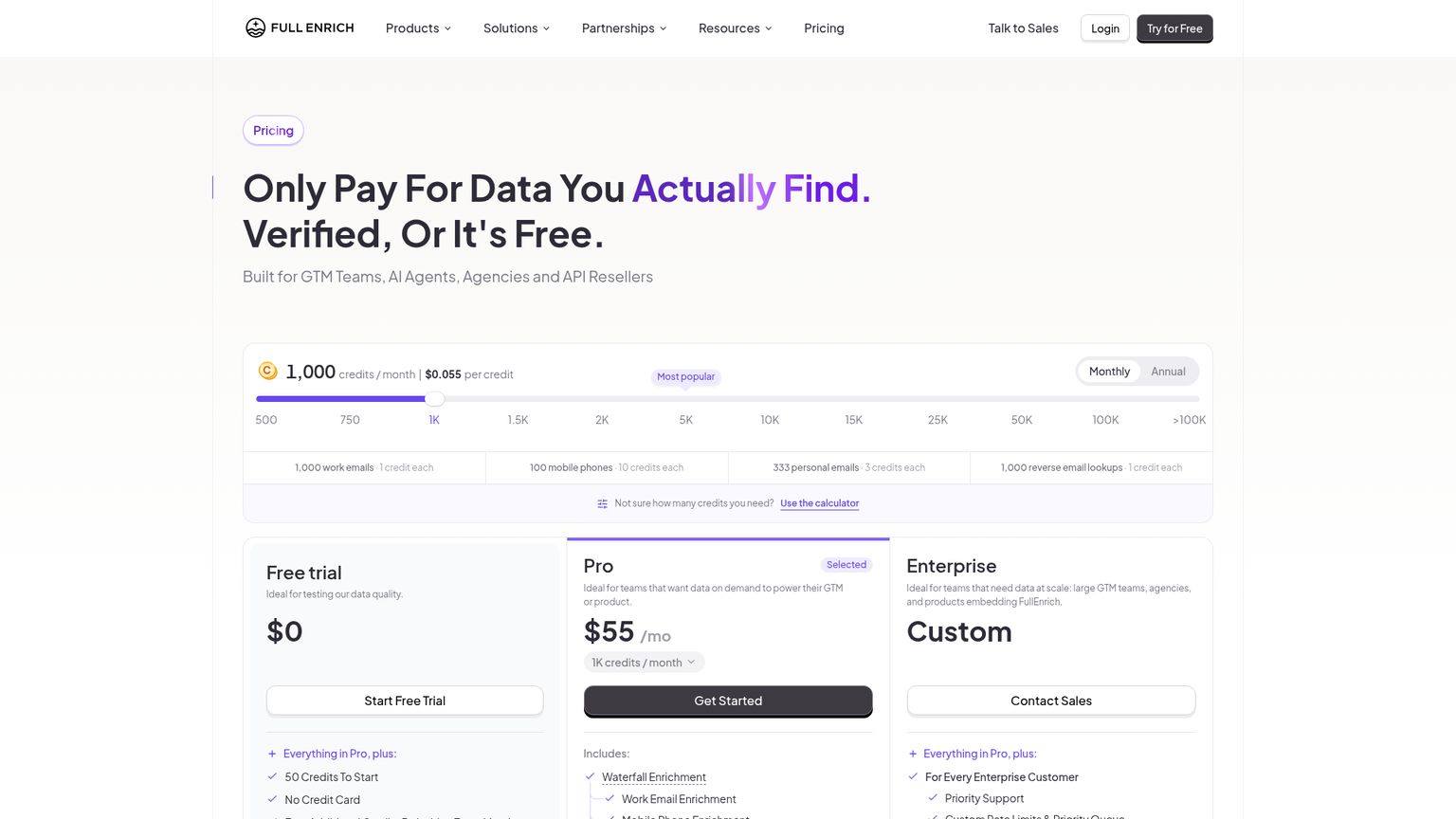
FullEnrich is a contact-enrichment platform that checks multiple sources for verified work emails and mobile numbers. It is the strongest first shortlist choice when Apollo's sending workflow is acceptable but too many target contacts are missing. Its appeal is a dedicated, shared enrichment service with usage-based credits, rather than another paid seat for every rep.
Best for: A founder or sales operations lead repairing gaps in a known prospect list.
Standout: Waterfall enrichment across 25+ sources, with charges for found and verified data.
Pricing: Pro from $29/month for 500 credits, or $26/month billed annually for 6,000 credits per year; Enterprise is custom.
Free trial: 50 credits without a credit card.
The practical advantage over Apollo is the purchasing and workflow boundary. You can treat enrichment as a shared service that supplies whichever CRM or sender you choose. FullEnrich includes unlimited users, bulk CSV enrichment, search, API access and a HubSpot integration. That can fit a sales lead who wants reps to keep their existing routines while someone centrally repairs the data. It does not establish that FullEnrich returns better results for every niche. FullEnrich's published pricing specification describes that scope.
There is an important cost distinction: a work email costs one credit, while a mobile costs ten. A founder who sees “500 credits” and expects 500 complete email-and-phone records will exhaust the plan much sooner. Use it initially on the missing field you need. If you already have a current work email and your campaign is email-only, buying a mobile adds cost without helping that campaign.
The public price selector opens at $55 for 1,000 monthly credits. That is a selected configuration, not the minimum. The current monthly Pro bands are 500/$29, 750/$42.75, 1,000/$55, 1,500/$79.50, 2,000/$104, 5,000/$255, 10,000/$499, 15,000/$720, 25,000/$1,150, 50,000/$1,950 and 100,000/$3,500. Larger volumes require a quote.
For those same bands annualized, the displayed monthly equivalents are $26, $39, $49, $71, $94, $232, $454, $655, $1,046, $1,769 and $3,150 respectively. Annual credit quantities are twelve times the corresponding monthly quantity. Monthly unused credits roll over for three months; annual credits have a twelve-month rollover window. These are vendor-published volume bands, not separate feature tiers.
What it lacks: FullEnrich is not a replacement for Apollo's connected sequence and calling workflow. Its feature list centers on finding, verifying and moving data. Keep a sender and your system of record. Also check the exact integration action: the pricing matrix marks enrichment of existing HubSpot records and the embedded HubSpot experience as “Soon.” An integration logo does not mean every workflow is already supported.
- Shared usage with unlimited users avoids a per-rep enrichment seat bill.
- Email and mobile searches can target only the missing fields.
- CSV and API access support both manual and automated enrichment.
- A failed lookup does not consume credits under its published model.
- Mobile matches consume ten times the credits of work emails.
- Sending, calling and deal follow-up need another system.
- You still have to validate current role and account fit; a verified address is not a qualified buyer.
Verdict: pilot FullEnrich as a repair layer before rebuilding a working outbound stack. Buy more only when the additional accepted contacts justify the bill.
Start with the gaps
Export a representative list you are entitled to process. Keep the identifiers you already know, the missing field, and the reason each account fits. Remove existing customers and suppressed contacts before enrichment.
Request only the field you need
Use the CSV enrichment flow or API to request work emails, mobiles or both. The 50-credit trial can cover at most 50 work-email matches or five mobile matches if spent only on that field. It is an initial quality check, not enough to establish performance across a broad market.
Review the returned records
Compare role, employer and contact detail against the original target. Separate new valid records from duplicates and records you already possessed. Keep unresolved results out of active sequences until reviewed.
Keep sending constant
Pass the accepted records into the sender you already use. Evaluate the incremental contacts and cleanup time before migrating any sequences. A good enrichment result should survive that narrower test.
Lusha: Best for Focused Contact Lookups and Mobile Numbers
Lusha supplies business contact data, a prospecting extension and outreach features. It fits a founder or rep who already knows which accounts matter and wants contact details close to the research workflow. The strongest reason to choose it over Apollo is that this narrower lookup routine fits your work better, with a smaller entry commitment on annual billing.
Best for: Focused prospecting where email and direct phone lookups are the immediate need.
Standout: Browser-based discovery with a published one-credit email and five-credit phone model.
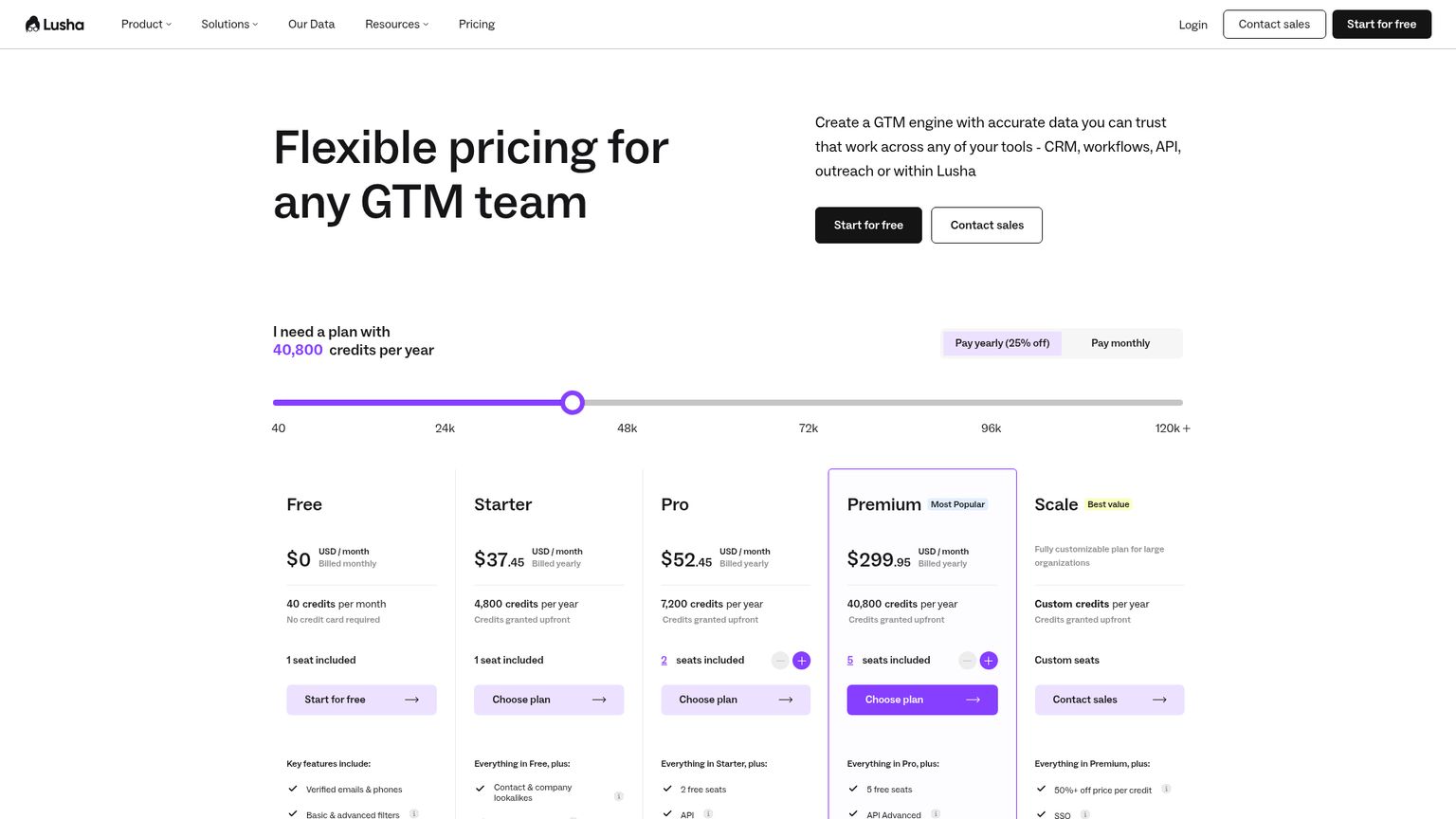
Pricing: Free $0; Starter $37.45/month, Pro $52.45/month and the displayed Premium configuration $299.95/month, all paid prices billed yearly; Scale is custom.
Free trial: A recurring Free plan offers 40 credits a month with one seat and no card required.
The annual credit quantities are 4,800 for Starter, 7,200 for Pro and 40,800 for the displayed Premium configuration. Starter includes one seat. The page advertises extra free seats on higher tiers, but confirm the exact total in your configuration rather than treating every price as a per-seat rate. Lusha's live plan cards are configurable.
For a founder selling a specialized service, the workflow might begin with a short list of named companies and the people responsible for a particular budget. Lusha's extension and contact search can support that person-by-person research. Its useful edge is proximity to that work, not a defensible claim that five credits buys a better mobile than Apollo's eight.
Credit counts are different currencies. Lusha's Starter allocation averages 400 credits per month across the annual term. A hypothetical mix of 200 email reveals and 40 phone reveals uses all 400 before exports or other charged actions. Lusha lists a CSV export charge of one credit for up to 25 records and a CRM export charge of one credit per record. The full path from finding a person to putting that person in your sales system therefore matters.
What it lacks: the small entry allowance leaves less room for broad prospecting and repeated operations. Lusha now includes automated email sequences, so it is inaccurate to say it cannot send. The unresolved question is whether its sequence, calling and team workflow fits what you currently do in Apollo. Demonstrate that path before canceling the old system.
For a sales lead, the evaluation should include the rep's full task: find a buyer, reveal the needed details, check the current role, transfer the record and schedule follow-up. A lookup that takes less time but creates manual cleanup downstream is not automatically a win. Use the Lusha alternatives comparison if the problem turns out to be broad data coverage rather than the lookup interface.
- The free allowance supports a small, low-commitment data check.
- Email and phone consumption is explicitly separated.
- Extension, enrichment and outreach features can support a compact rep workflow.
- The entry credit allowance can disappear quickly with phones and exports.
- Displayed prices depend on the selected annual configuration.
- No verified sample establishes superior accuracy over Apollo for your market.
Verdict: choose Lusha for a focused contact workflow that you can demonstrate end to end. Skip it as a presumed volume bargain based on the starting price alone.
Cognism: Best for a Phone-Led European Sales Motion
Cognism is a sales-intelligence and enrichment platform with a strong European focus and phone-verified contact data. It belongs on the shortlist when reps spend too much time calling wrong or stale numbers in European target accounts. The specific reason to evaluate it against Apollo is its verification process and regional specialization, rather than a promise of universally better records.
Best for: An established phone-led sales team targeting European decision-makers.
Standout: Pro includes on-demand mobile verification for selected prospects.
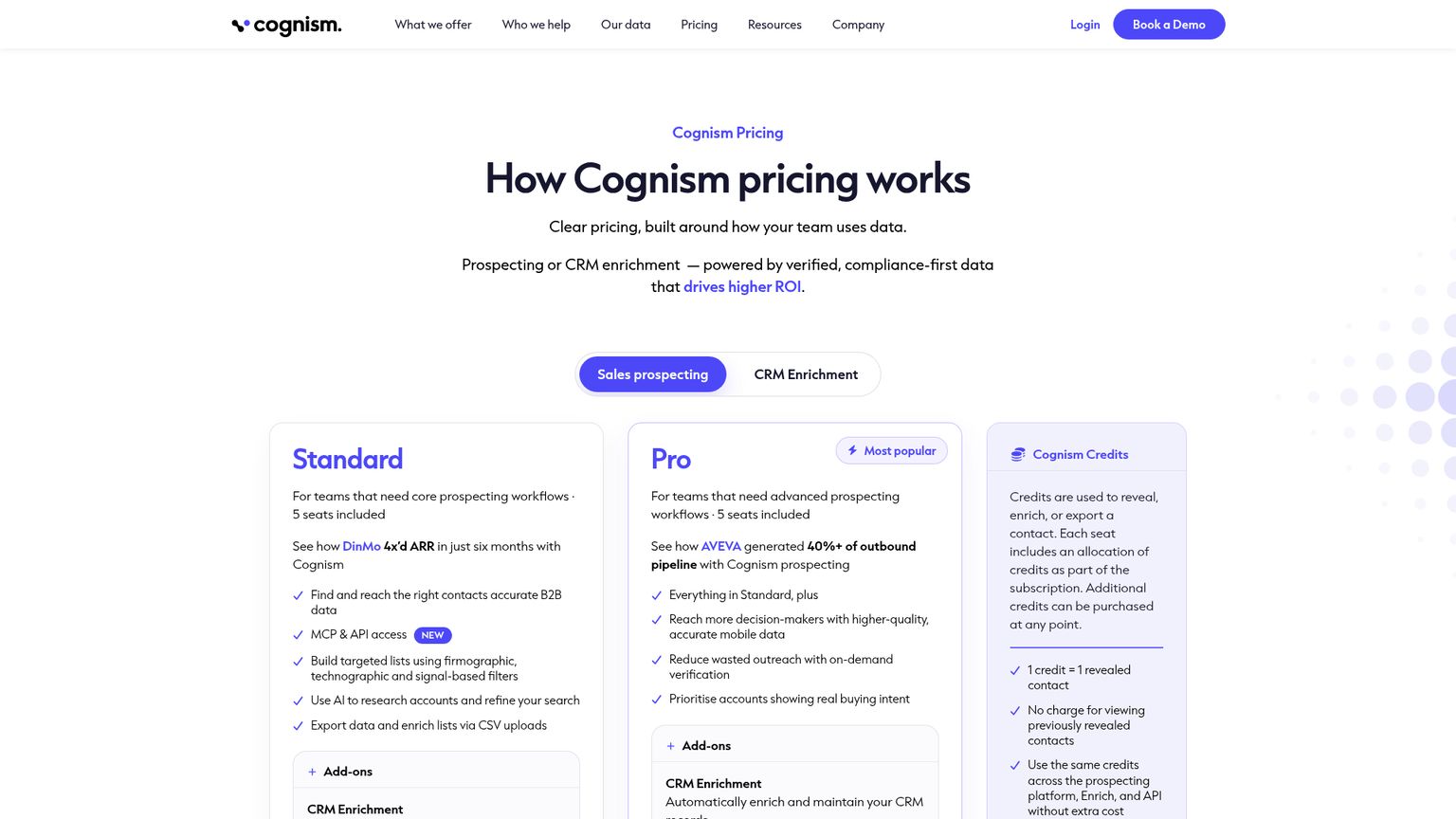
Pricing: Standard and Pro require quotes; each includes five seats. CRM Enrichment is quoted separately as an add-on or standalone product.
Free trial: An interactive demo is available; the pricing page does not publish a self-serve trial allowance.
A sales lead with a defined account list can make a useful evaluation request: provide the same target roles and countries already causing difficulty in Apollo, then ask which contacts meet Cognism's additional verification standard. A general demonstration with a vendor-chosen list tells you much less about whether your reps will reach the buyers they need.
Cognism's product page describes additional manual and automated phone checks, European market coverage and Do-Not-Call screening. Those are concrete mechanisms to investigate. They are not a measured head-to-head result for your list, and a provider's compliance positioning does not decide whether a particular outreach campaign is appropriate.
Standard covers core contact and company data, targeting filters, list exports, CSV enrichment and API access. Pro adds on-demand mobile verification and intent data, which indicates account-level research activity that may help with prioritization. Do not pay for that signal simply because it exists. A rep needs a defined next action when an account shows interest, or the signal becomes another feed to ignore.
The current credit model matters if you are leaving Apollo because of credit friction. Cognism now says one credit is used when a contact record is revealed. The team can reuse that redeemed record through the contract; another credit is used if the contact changes jobs. It should not be described as an unlimited-credit alternative. The current pricing FAQ provides this rule.
What it lacks: public dollar pricing and the simple buying experience of a small self-serve plan. Its published packages center on data, prospecting and enrichment, so price your sending workflow alongside the quote. For a solo founder, a package with five included seats may offer capacity you do not use; that is a buying question to resolve before discussing advanced features.
Ask the quote to distinguish the prospecting package, credit allocation, mobile-verification entitlement, enrichment usage and renewal terms. Then calculate cost per accepted contact in the countries you sell into. If the premium only buys more records you could already reach, the commercial case is weak.
- European focus gives phone-led teams a specific reason to evaluate it.
- On-demand verification lets the evaluation concentrate on high-value targets.
- Redeemed records remain reusable during the contract under the stated credit rules.
- A quote is required to establish the budget.
- Five included seats may be a poor fit for a solo buyer.
- Its current credit model does not remove the need to forecast usage.
Verdict: shortlist Cognism when bad phone records are wasting an established team's calling time. Require a sample and a complete quote before assigning value to the regional positioning.
ZoomInfo: Best for Account Intelligence and Buying Groups
ZoomInfo is a sales-intelligence platform for contact discovery, account research and coordinated go-to-market work. It becomes a more compelling Apollo alternative when the obstacle is understanding a complex account, not merely finding an email. A sales lead targeting a large company may need the relevant business unit, buying group, account signals and territory context before deciding whom to approach.
Best for: Teams selling into complex accounts with an owner for sales operations.
Standout: Higher sales packages combine buying-group information, hierarchy data and account prioritization.
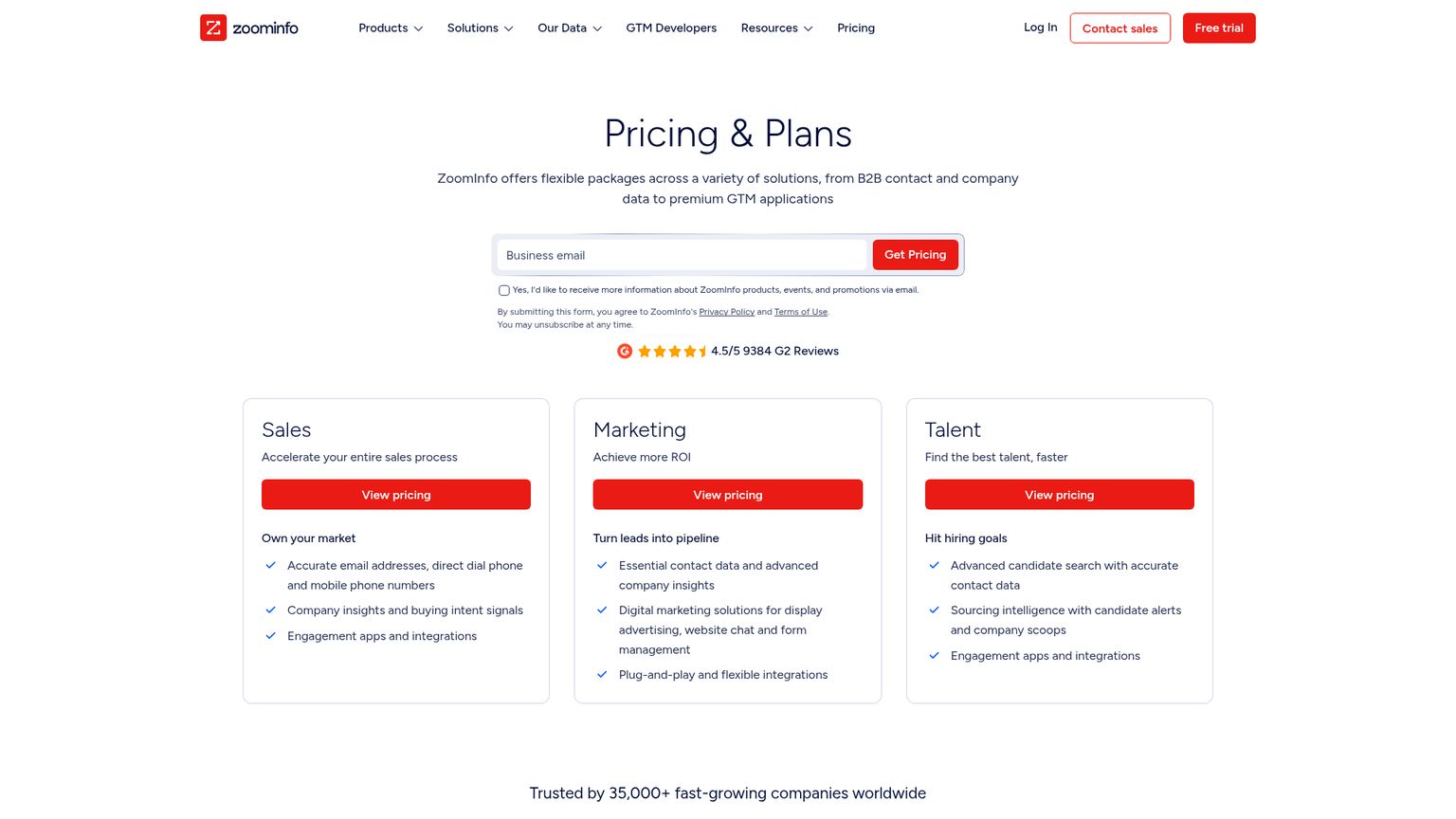
Pricing: Professional, Copilot Advanced and Copilot Enterprise are quote-only.
Free trial: Offered; confirm access and limits for the package being evaluated.
Professional includes contact and company profiles, email and mobile data, search, exports, territory filters and CRM integrations. Copilot Advanced adds location and hierarchy information, buying-group filters, intent and account prioritization. Copilot Enterprise extends the workflow and integration options. The sales-package comparison describes those differences without publishing a dollar price.
Its case against Apollo should therefore be a business-process case. Suppose a sales lead has several reps pursuing different divisions of the same enterprise. A larger undifferentiated contact list may increase collisions. Account structure, territory rules and a shared view of the relevant buying group are more useful if they help the reps coordinate their next action.
The corresponding evaluation should begin with an account that is already difficult. Ask the vendor to show the people and organizational context relevant to that deal. Then follow the information into your CRM, the system where your account ownership and sales activity live. If the useful context does not reach the rep's normal workflow, it is less valuable than the demonstration suggests.
What it lacks: transparent entry pricing and a low-friction way to compare the total bill before a sales conversation. ZoomInfo says licenses, credits, features and integrations affect the package. Do not borrow a rumored annual minimum from a review and treat it as a current offer. A quote from a different team with different modules is not your price.
Ask for line items that separate the required seats, export entitlement, selected intelligence features, integrations, implementation and renewal conditions. Also make the vendor show the export behavior you need. Being able to view information inside an application and being able to move it into your operating workflow can be different entitlements.
ZoomInfo can be excessive for a founder who simply needs a modest list of contacts each month. The time spent buying, configuring and maintaining it belongs in the decision. Conversely, a mature sales organization should not reject it only because a self-serve enrichment product has a lower entry price: those products may be solving a smaller problem.
- Clear progression from contact discovery to richer account intelligence.
- Buying-group and hierarchy features suit complex sales processes.
- CRM and territory features can support coordinated account ownership.
- No public dollar price for the sales packages.
- Useful advanced features sit in higher packages.
- Buying and implementation work can outweigh the benefit for a small team.
Verdict: evaluate ZoomInfo for account complexity. Do not buy it solely on the assumption that an enterprise data contract fixes every Apollo accuracy complaint.
Clay: Best for Custom Research and Enrichment Workflows
Clay is a data and workflow platform that lets you combine providers, research and actions around your own targeting rules. It is the strongest alternative when the work you need to automate does not fit a fixed prospecting flow. It is also the easiest choice here to overbuy if no one can own the workflow.
Best for: A sales operations or growth owner building a repeatable research process.
Standout: Multi-provider enrichment, custom web research and conditional workflow design.
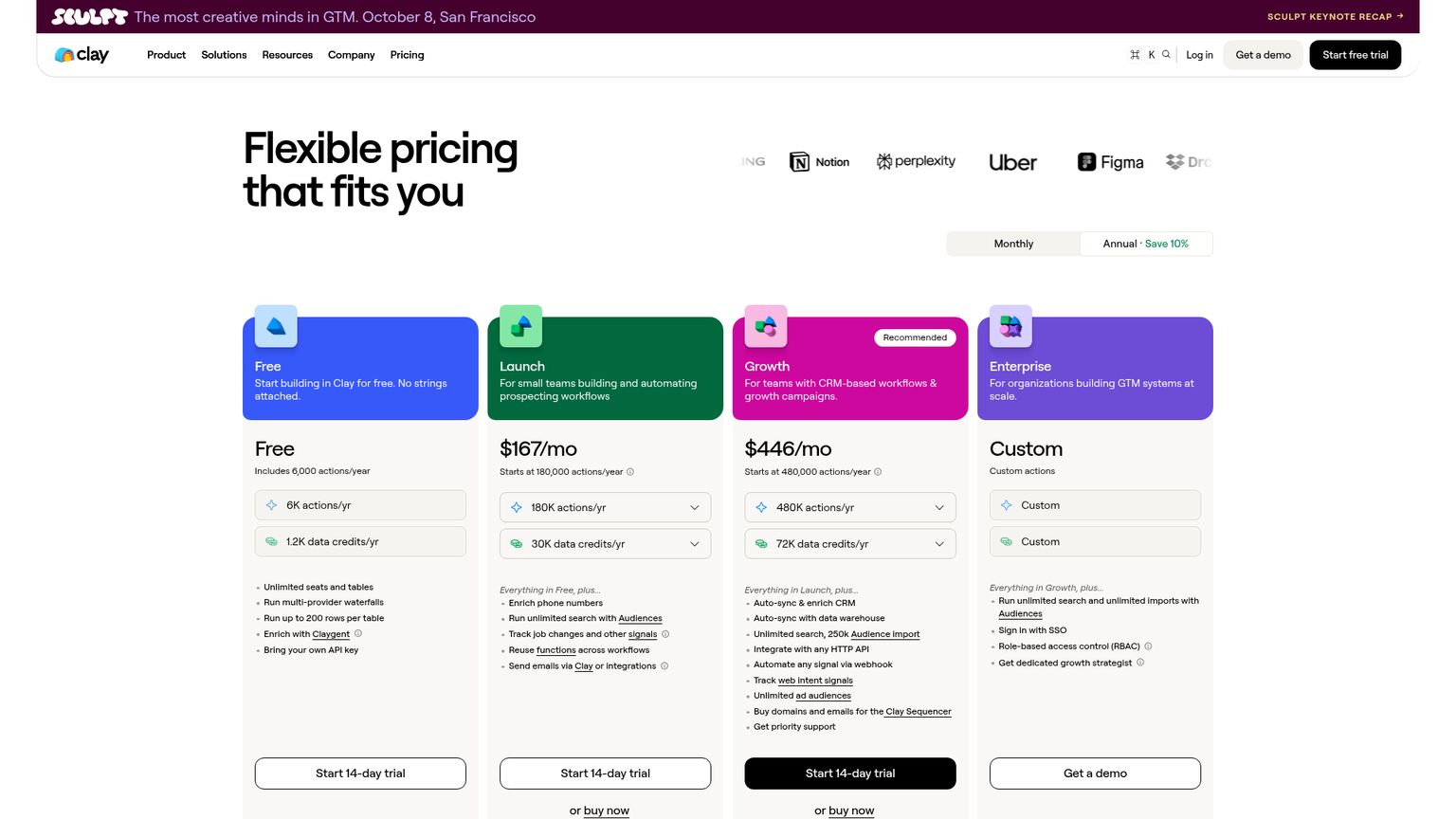
Pricing: Free $0; Launch $185/month or displayed $167/month annually; Growth $495/month or $446/month annually; Enterprise custom.
Free trial: A 14-day trial is offered alongside the Free plan.
Launch starts with 2,500 Data Credits and 15,000 Actions per month. Growth starts with 6,000 Data Credits and 40,000 Actions. Free includes 100 Data Credits, 500 Actions and up to 200 rows per table, with no phone enrichment. The live pricing comparison separates the meters: Data Credits purchase marketplace data and AI, while Actions pay for the work Clay performs.
That split changes how to compare it with Apollo. A single prospect may require several operations: discover the company, inspect its website, classify the business, find a relevant person and obtain a contact detail. Counting rows does not tell you the cost. Prototype the entire accepted-contact workflow and inspect both meters.
Consider a founder selling software for a particular operating process. A company-size filter may be too broad; the founder needs evidence on the company's website that the process exists. Claygent, Clay's web-research agent, can supply custom research fields. Those fields can determine which rows deserve paid enrichment. The value lies in avoiding research and contact purchases on accounts that never qualified.
Clay's current plans also include sending through its native sequencer on paid tiers. “Clay cannot send email” is no longer a useful comparison. Its difference from Apollo is the amount of workflow construction and control it asks you to own. Launch supports prospecting workflows and signals; Growth adds CRM synchronization, HTTP API integrations and webhooks, which let systems trigger or receive automated work.
What it lacks: the simplicity of a fixed sales workflow and a single contact-credit budget. Bringing your own provider API key can avoid Clay Data Credits for that provider, but the underlying provider still charges you and Clay Actions still apply. This changes where the bill arrives; it does not make the work free.
A team should appoint someone to own failed runs, provider changes, field definitions and duplicated records. Without that ownership, the spreadsheet-like interface can make a fragile process look more complete than it is. The deeper Clay vs Apollo comparison covers the architectural choice; the immediate buying question is whether custom qualification saves more work than maintaining the process creates.
- Multiple providers and custom research support targeting beyond basic list filters.
- Qualification can happen before paid contact enrichment.
- Native sequencing means the design need not always include a separate sender.
- Unlimited users avoid a simple per-rep seat calculation.
- Two usage meters complicate forecasts.
- CRM synchronization and broader integration work require Growth.
- Someone must maintain the workflow and review its output.
Verdict: choose Clay when you can name a valuable research rule Apollo does not handle the way you need. Skip it when the brief is only “find more emails” and no one will own the system.
Seamless.AI: Best Evaluated as a Specific Coverage Challenger
Seamless.AI is a prospecting platform that now also offers engagement and automation products. It belongs in an Apollo evaluation when its discovery process might reach contacts your current source misses. It does not deserve a purchase simply because its marketing promises more data or more meetings.
Best for: A sales lead willing to evaluate a second discovery source against a known coverage gap.
Standout: Prospecting, job-change and buyer-intent products, with an engagement expansion path.
Pricing: The current pricing page routes to a quote request; no public paid entry price is established.
Free trial: Free signup is advertised; confirm the allowance and available features in the account.
Its product structure matters. Data Engine includes Prospector, Buyer Intent, Job Changes and CRM Enrich. Engagement Hub includes emailing, calling and social-selling products. Calling Seamless.AI a contact database with no outreach capability would miss that scope. Equally, the existence of those product names does not establish that the package in your quote includes every component. The current product overview is the starting point for that conversation.
For a founder, a sensible trial question is narrow: can this source identify the right buyer at the accounts where Apollo returned nothing or an outdated role? Keep that difficult cohort separate from a general sample. The difficult cohort measures additional coverage; the general sample tells you whether replacing the existing source would introduce new gaps elsewhere.
A higher match count is insufficient on its own. Check whether a result belongs to the current employer, whether the person owns the relevant problem, and whether it duplicates a record already in your CRM. A second vendor that returns more fields but fewer usable buyers can increase cleanup work while appearing better in a demonstration.
What it lacks: a publicly verifiable dollar price and package boundaries sufficient for a full budget comparison. The pricing inquiry page offers tailored arrangements for users, credits and products. Do not carry forward old Basic or Pro price figures unless the current offer confirms them.
Ask the sales proposal to state what is included for finding, exporting and engaging contacts. If credit-back protection influences the purchase, request the written eligibility rules and the process for your sending setup. The homepage advertises protection for invalid email data, but that is not enough to assume every failed send or disputed record receives a refund.
A smaller business should also examine the cost of undoing the choice. Before committing, establish how records leave the system, how suppression information is preserved, and which activities would stay in a separate sender. These are acceptance criteria, not claims that the product cannot handle them.
- A relevant second source can expose coverage gaps in the incumbent.
- Job-change and intent products support more than static contact lookup.
- Engagement products create a possible broader replacement path.
- Current paid entry pricing is not public.
- Product names alone do not establish package entitlements.
- Neither database size nor credit-back marketing proves better data on your list.
Verdict: keep Seamless.AI on a sample-driven shortlist. Avoid buying a larger commitment before the quote and the accepted-contact results are clear.
Replace the Sending System
A different sender is useful when the data works but campaign operations do not. Sending operations include mailbox connections, scheduling, replies, suppression and handoff to sales. They are distinct from whether an address exists and whether the person wants your message.
Apollo already offers deliverability features. The reason to evaluate a specialized sender is therefore the operating model: how you manage mailboxes, campaigns, clients and replies. Neither an unlimited-account label nor automated warmup guarantees inbox placement. Google's sender requirements make authentication, message practices and unwanted-mail handling relevant regardless of the application you use.
Smartlead: Best for Mailbox and Client Operations
Smartlead is an outreach platform centered on email campaigns, connected mailboxes and a shared reply workflow. It is a strong sending-layer shortlist choice for an agency or operator managing several campaigns. Its practical advantage over a basic Apollo setup is the dedicated mailbox and campaign operating model, not a promise that changing software repairs a damaged reputation.
Best for: An operator who already has a data source and needs structured sending operations.
Standout: Mailbox rotation and a Master Inbox for campaign and client replies.
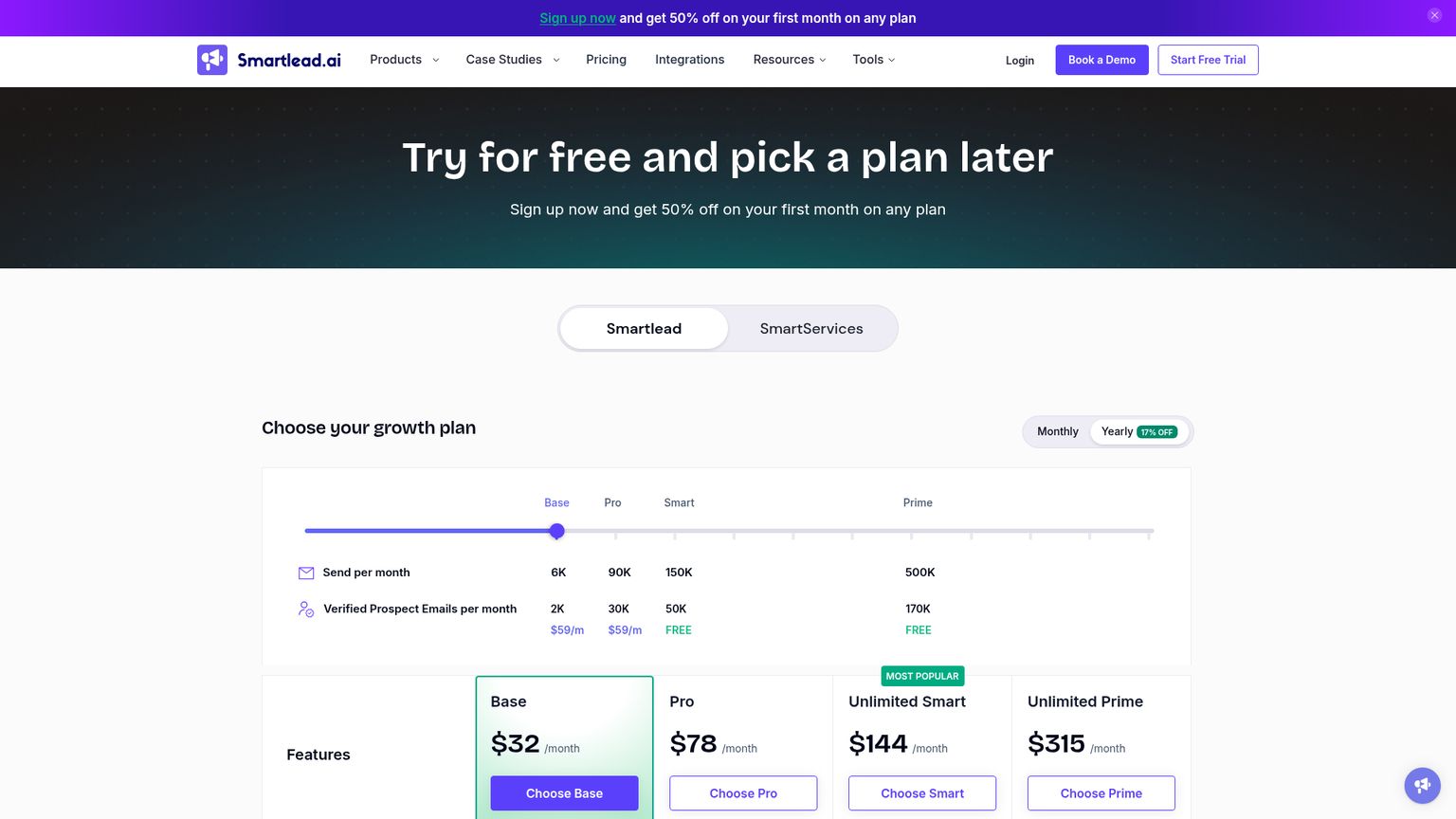
Pricing: Base $39/month, Pro $94, Unlimited Smart $174 and Unlimited Prime $379; displayed annual equivalents are $32, $78, $144 and $315.
Free trial: Offered; confirm the trial's current limits before importing a campaign.
The capacity jumps are substantial. Base lists 2,000 contacts and 6,000 sends per month; Pro lists 30,000 contacts and 90,000 sends. Unlimited Smart removes the contact-storage cap but has 150,000 sends, while Unlimited Prime lists 500,000 sends. Those are platform allowances, not recommendations for how much any individual mailbox should send. Smartlead's pricing page separates the limits.
For a small agency, a better trial than a large send is a complete reply-handling exercise. Import a small approved cohort, create the intended sequence, route a reply to its owner, suppress a contact and confirm the next step stops. The value of a central inbox disappears if the wrong person gets the response or the prospect continues receiving follow-ups after replying.
The product overview describes unlimited connected mailboxes, sender rotation and a Master Inbox that consolidates campaign and client responses. These functions can reduce operating friction. Compare them with the Apollo tier you actually use, since Apollo Professional also offers multiple Google and Microsoft mailbox connections.
What it lacks: an all-inclusive promise at the Base price. Contact sourcing through SmartProspect, mailbox and domain purchases, client workspaces and other services have their own entitlements or charges. The comparison shows API and webhook access from Pro. Client workspaces are listed as a $29 add-on for Pro and Unlimited Smart; Unlimited Prime includes a workspace allowance. Confirm the unit and required quantity in your purchase.
Do not treat every “verified emails” row as an included supply of new sales prospects. Verification, contact storage, purchased lead data and sends are different things. If you already have a list, your quote should explain which charge covers checking it and which covers sending to it.
- Dedicated campaign and reply operations suit a specialist sending role.
- Published contact and send caps make the main capacity boundary visible.
- Higher tiers support integrations and client workflows.
- Base is not the full agency configuration.
- Mailboxes, domains and data can add separate bills.
- Unlimited contact storage still comes with a finite sending allowance.
Verdict: choose Smartlead when you can show how its campaign and reply workflow saves operating time. Keep the data evaluation separate so you can identify which change improved results.
Instantly: Best for Modular Email Outreach
Instantly combines an email-outreach product with separately priced data credits and other sales products. It fits a founder or small team that wants to buy the sending component first and add prospecting capacity deliberately. Its advantage over a per-seat all-in-one purchase is that modular choice, provided the selected contact and send limits fit.
Best for: Email-led outbound with a clear separation between sourcing and sending.
Standout: Unlimited connected email accounts on the entry Outreach tier, with explicit contact and send caps.
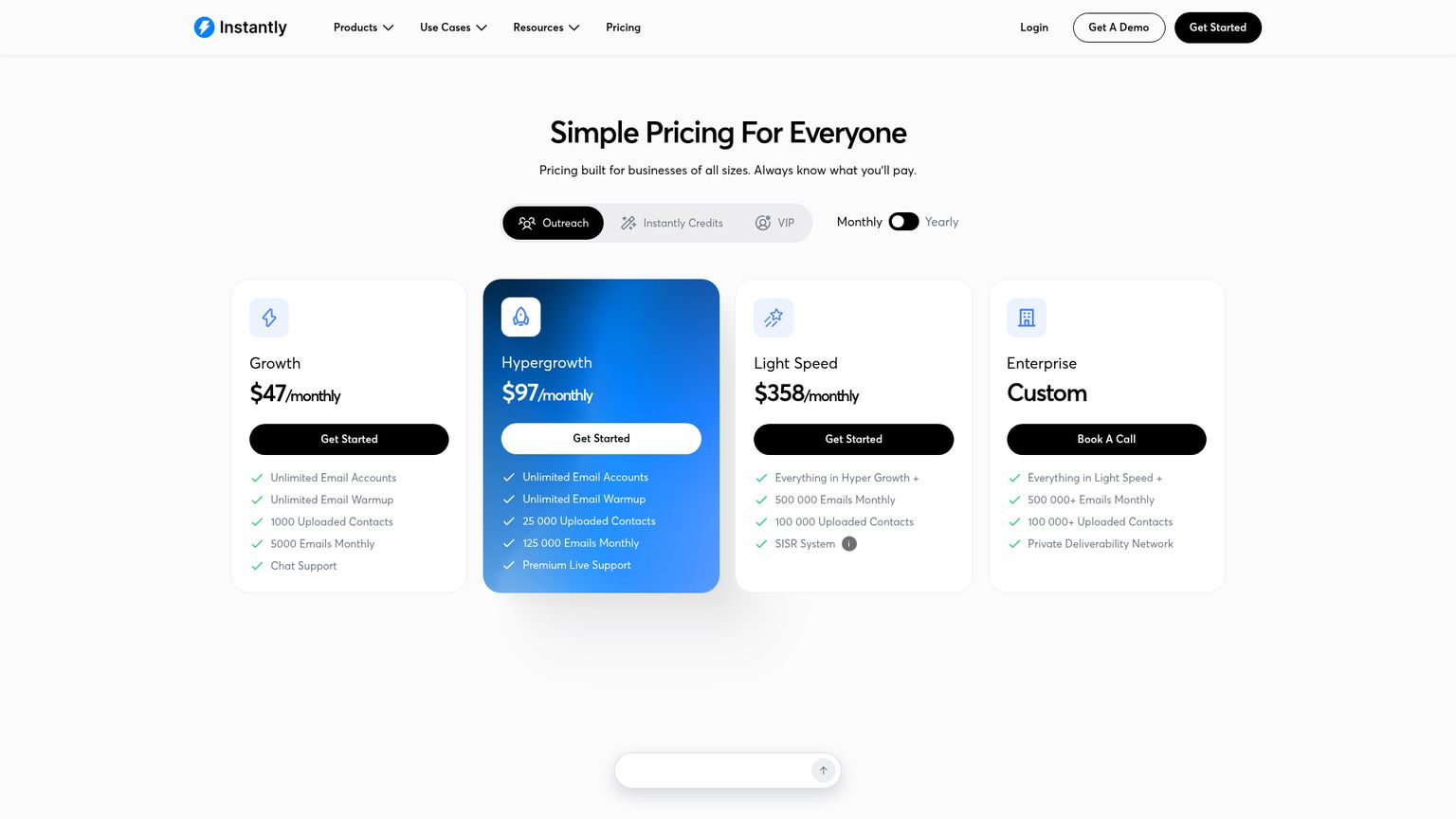
Pricing: Outreach Growth $47/month, Hypergrowth $97 and Light Speed $358; Enterprise custom. Annual equivalents are $37.60, $77.60 and $286.30.
Free trial: The retrieved pricing cards do not specify trial duration or allowance; verify those at signup.
Growth includes 1,000 uploaded contacts and 5,000 emails a month. Hypergrowth lists 25,000 contacts and 125,000 monthly emails on its standalone Outreach card. Light Speed lists 100,000 contacts and 500,000 monthly emails. Unlimited email accounts do not remove those contact and sending caps. The current Outreach prices are the relevant figures when another provider supplies your data.
If you also buy Instantly Credits, the current tiers are Growth at $47/month, Supersonic at $97 and Hyper Credits from $197, with Enterprise quoted. Their displayed annual equivalents are $37.60, $87.30 and $177.30. Credits fund data and related research activities; they are not the same allowance as Outreach sends.
The page also advertises bundles: Starter at $94/month, Growth at $194 and Agency at $555, with annual equivalents of $85, $175 and $500. Those offers combine products. Comparing Apollo Basic with an Outreach-only price, then expecting the data bundle to be included, creates an avoidable budget surprise.
A founder already using a CRM can evaluate Instantly with a narrowly defined workflow: accepted contacts go in, replies get a named owner, suppressed contacts stop, and interested buyers return to the CRM. Adding every adjacent module during the trial makes it harder to know whether the sending product itself is worth changing.
What it lacks: a single entry price that covers every part of the replacement. A cheap sender can become a more expensive stack after data, mailboxes, domains, verification and research are added. The page's bundle and standalone cards also use different sending-capacity descriptions in places; use the entitlement for the exact offer in checkout rather than combining the most generous number from each section.
For an operator who already likes Apollo's data, the most useful comparison may be keeping that data source and changing only the sender. For a founder seeking fewer subscriptions, Instantly's modular model can work against the original goal. Decide which of those buyers you are before evaluating the interface.
- Sending and contact-data purchases can be selected separately.
- Entry Outreach includes unlimited connected accounts and warmup.
- Published contact caps make a low-volume pilot easy to scope.
- Growth's 1,000-contact allowance is a meaningful constraint.
- Credits and bundles add a separate pricing decision.
- Sender changes do not prove better contact data or inbox placement.
Verdict: choose Instantly for a deliberate email-outreach setup. Budget the complete workflow before calling its entry plan cheaper than Apollo.
Replace Data and Sequencing Together
Amplemarket deserves the full-stack comparison when research, prioritization and engagement all need to change. A founder who only needs a better phone number should not buy a larger operating system. A sales lead losing time between research, list preparation and campaign execution may have a stronger case.
Amplemarket: Best for a Connected Outbound Workflow
Amplemarket is an all-in-one sales platform combining prospect data, signals, research and multichannel engagement. It is the closest direct workflow replacement among these featured choices. Its strongest argument against Apollo is the way Duo Copilot turns account context into proposed outreach, not a lower entry price.
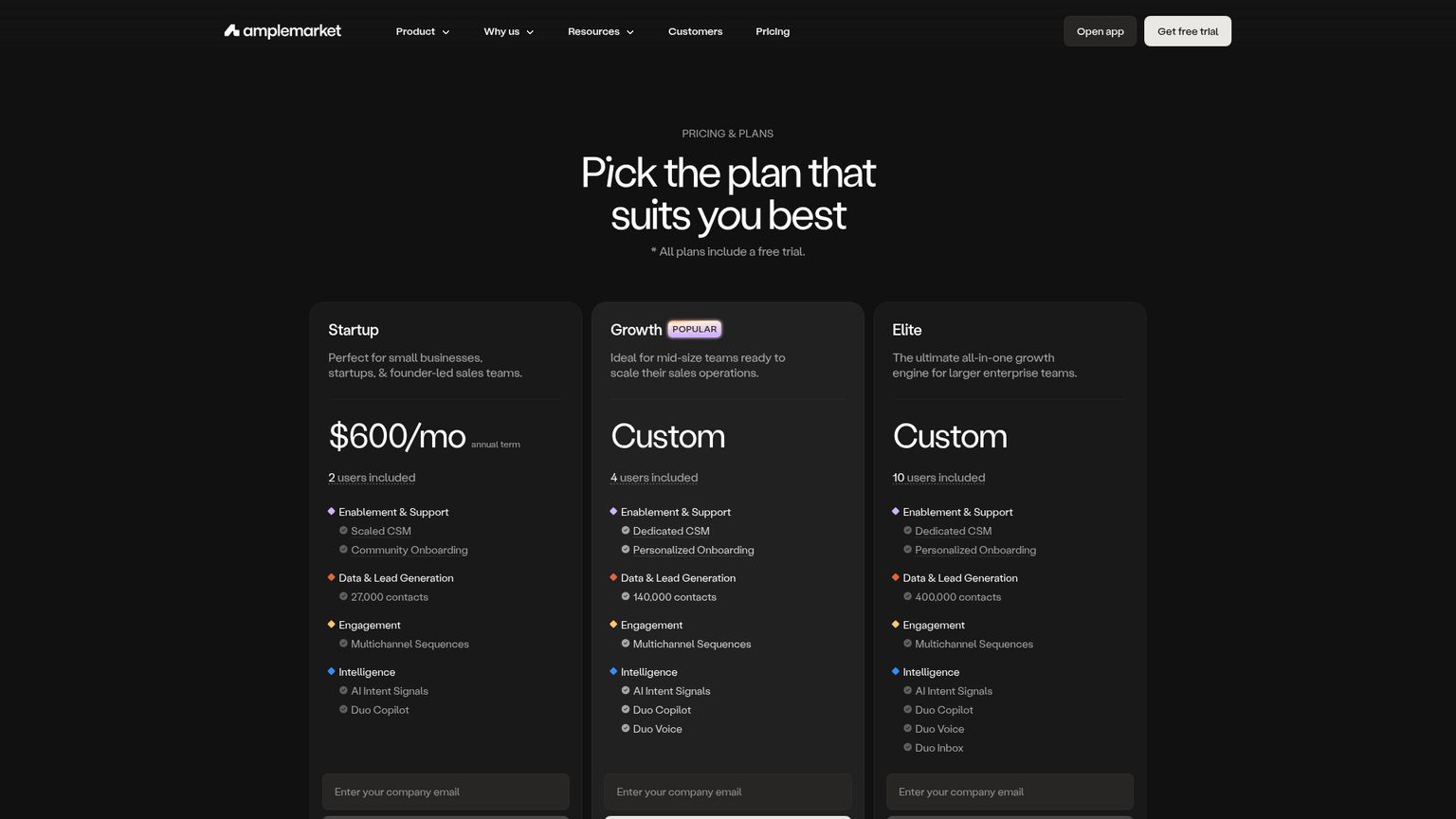
Best for: A founder-led or established sales team replacing research and engagement together.
Standout: Duo Copilot connects account signals, research and multichannel sequence preparation.
Pricing: Startup $600/month on an annual term with two users; Growth is custom with four users; Elite is custom with ten. Additional users can be purchased.
Free trial: Offered on every plan.
Startup includes multichannel sequences, AI intent signals and Duo Copilot. Growth adds Duo Voice, and Elite lists Duo Inbox. The detailed plan comparison gives annual per-user data allowances: Startup has 13,500 email-address credits and 600 phone-number credits; Growth has 35,000 and 5,000; Elite has 40,000 and 9,600.
Those quantities matter for a team switching because of credits. Amplemarket's cards also show a larger aggregate contact number, but that should not be mistaken for a monthly per-user allowance. Forecast email and phone requirements separately against the annual entitlements in the offer you receive.
The useful workflow example is a rep pursuing a known account where something relevant changes. Duo can research context and propose outreach steps across email, calls and social channels. The product's explanation describes a rep approving the proposed sequence. That makes the evaluation about whether the suggestions are useful and reviewable, rather than how much text the system can produce.
Ask the trial to use your own positioning and an account you understand. Can the rep distinguish a relevant trigger from a weak one? Does the suggested message connect that trigger to a credible business reason to speak? Can a reviewer catch a wrong inference before it reaches a prospect? Those are more consequential questions than whether the generated wording sounds polished.
Alternatives to Apollo: What the Full Stack Costs
Amplemarket needs to earn its premium through workflow value. Startup's annual commitment is $7,200. Two Apollo Professional seats at the published annual rate total $1,896 a year. The difference is $5,304 a year, or $442 per month, before other tools, services or usage changes. Inputs: Amplemarket and Apollo.
The plans are not feature-equivalent, and time savings are not the only benefit that could matter. But the calculation gives a founder something concrete to investigate. Record the manual research, list preparation and sequence work that the new process removes. If most of it still happens elsewhere, the premium needs another defensible source of value.
What it lacks: a low-cost single-user entry and a guarantee that a more integrated product produces better meetings. It also creates a broader migration: data fields, sequence behavior, activity history and team routines all need attention. That is justified when the connected process is the benefit you are buying.
- A coherent replacement path for prospecting and engagement together.
- Signals and research feed sequence preparation within the same platform.
- Published Startup pricing allows an initial business case before a quote.
- A $7,200 annual Startup commitment is substantial for a small team.
- Higher-tier prices and extra users require a quote.
- AI-generated research and outreach still need an accountable reviewer.
Verdict: choose Amplemarket when the trial shows that the whole rep workflow improves enough to justify the commitment. Keep Apollo when the problem is a small data gap that a narrower purchase can repair.
Compare Credits by the Work You Need Done
Credits are not a common unit across vendors. A founder comparing the size of two credit bundles without their consumption rules can buy less useful capacity while believing the allowance increased.
Take a hypothetical workload with 1,000 successfully returned work emails and 100 successfully returned mobile numbers. Assume the standard published reveal rates, with no other paid actions. These are consumption calculations, not observed match rates:
Sources: Apollo's credit rates, Lusha's consumption breakdown and FullEnrich's data-point costs. This excludes exports, enrichment beyond the requested fields, research, dialing and other actions. Different credit totals do not tell you which vendor is cheaper or more accurate.
FullEnrich's 2,000-credit monthly band costs $104. Add Smartlead Base at $39 and the software subtotal becomes $143 per month, before mailbox hosting, domains and operating time. The initial $29-plus-$39 pairing costs $68, but only includes 500 FullEnrich credits. The same data entry plan plus Instantly Growth costs $76 monthly. Those are small-workload configurations, not equivalent replacements for every Apollo plan.
The founder's useful number is total workflow cost divided by accepted, reachable target contacts, followed by cost per qualified meeting once a campaign has enough evidence. Include the portion of subscriptions used, extra credits, verification, sending infrastructure and cleanup time. Separate recurring costs from migration work so that one expensive setup week does not get confused with the steady-state bill.
Also track what an extra source contributes. If it returns the same accepted records you already have, its apparent match rate exaggerates its incremental value. A supplementary provider earns its place through additional usable contacts or saved work.
Fix Verification Before Replacing the Platform
Bouncer is an email-verification and deliverability-testing tool, not a full Apollo replacement. It fits when you already have the right people but need another check on address validity or sending setup. Buying a small verification batch can be a more proportionate next step than migrating all your prospecting.
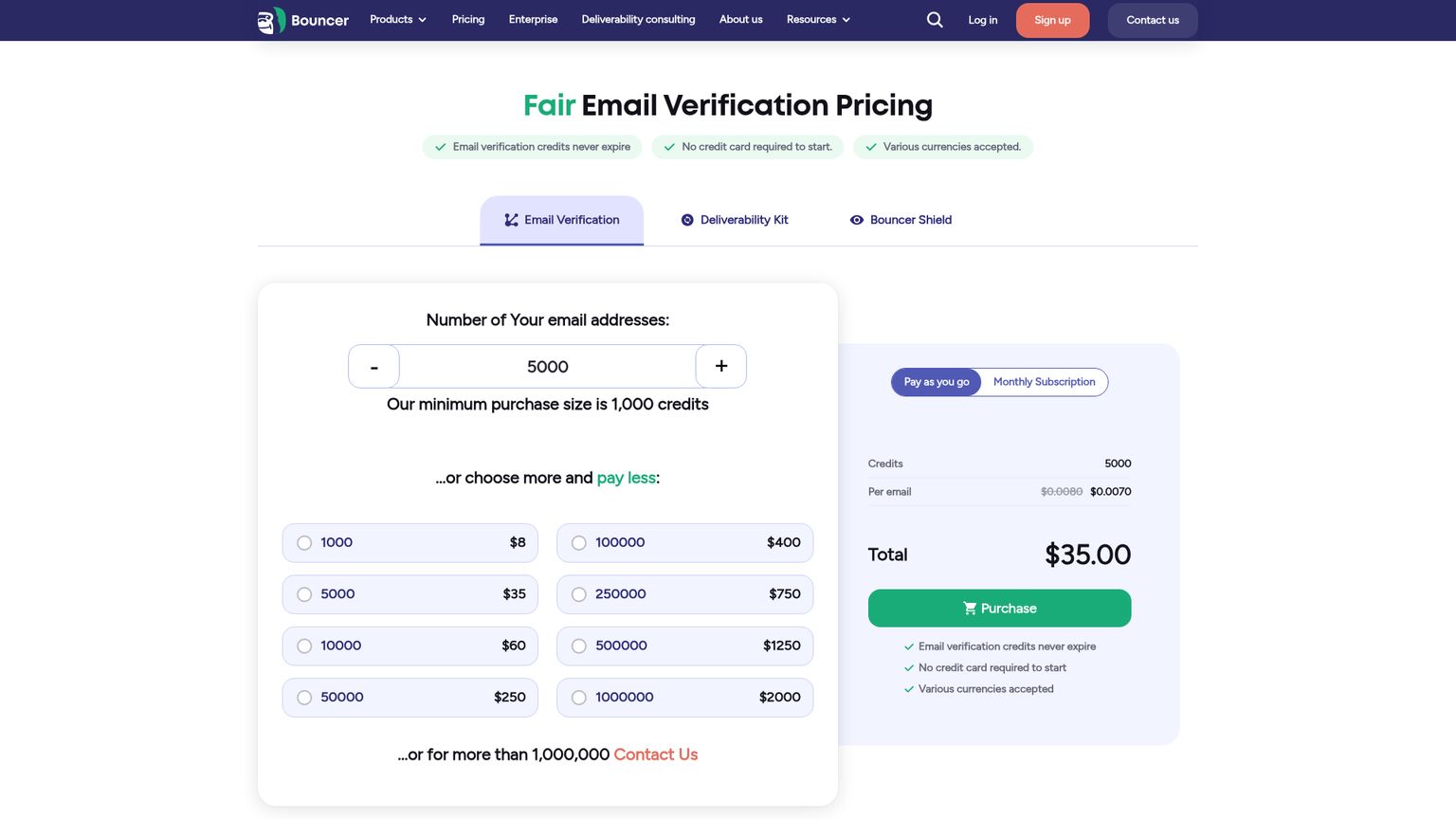
Best for: Checking an existing email list or investigating delivery problems.
Standout: Pay-as-you-go email verification with credits that do not expire.
Pricing: From $8 for 1,000 verification credits; separate Deliverability Kit plans start at $25/month.
Free trial: The page offers a free start without a card; confirm the current allowance at signup.
The published verification bands are 1,000/$8, 5,000/$35, 10,000/$60, 50,000/$250, 100,000/$400, 250,000/$750, 500,000/$1,250 and 1,000,000/$2,000. Larger quantities require contact with sales. The separate Deliverability Kit has Starter at $25/month, Standard at $125, Pro at $250 and Enterprise at a custom price. It covers checks such as inbox placement, authentication and blocklists. Bouncer's pricing page distinguishes these purchases.
A founder investigating a bounce problem should first distinguish a rejected address from a message delivered into an unwanted folder. Address verification concerns the first problem. Inbox-placement and authentication checks concern different parts of the sending setup. Neither tells you that the person is still in the right job or interested in the offer.
Use verification statuses as evidence, not a substitute for judgment. An unresolved result should be reviewed under your sending rules rather than automatically treated as a safe contact. Keep the source and the date of each result so you can investigate disagreements without repeatedly purchasing the same check.
What it lacks: buyer discovery, mobile-number sourcing and an Apollo-style sales workflow. If the target role is wrong, another email check does not fix the list. If the offer is irrelevant, a valid address does not make the campaign useful.
- A small one-off purchase can investigate an existing list.
- Non-expiring verification credits suit uneven usage.
- Separate testing tools help distinguish address and sending-setup issues.
- It does not replace prospect discovery or sequences.
- Verification does not prove role fit or guarantee inbox delivery.
Verdict: Bouncer is a relevant supporting purchase when verification is the missing step. It should not be ranked beside a full outbound platform as if both perform the same job.
How These Were Picked
The shortlist is based on replacement fit, published costs and a testable buying decision. Vendor pricing and product pages were checked on 10 October 2026. No paid account, production campaign or comparative contact-accuracy test was run for this article.
The evaluation turns on five things: the component being replaced, the unit that consumes capacity, the full cost of the required workflow, the ability to move data into your operating system, and the effort required to own the process. A feature is valuable only when it changes one of those decisions.
FullEnrich, Lusha and Amplemarket are featured partners because each fits a different problem in the brief. Cognism, ZoomInfo, Clay, Seamless.AI, Smartlead and Instantly remain in the comparison because a buyer could reasonably choose them instead. Bouncer is included in a smaller supporting role because verification can resolve a narrower problem.
Pure website-visitor identification and broad account-based advertising products were left out of the main shortlist. They can support sales, but they are not direct answers to a founder replacing contact discovery or sequence execution. More product names would not make those substitutions equivalent.
The recommendations are judgments about fit, not measured performance rankings. Claims of universal accuracy, guaranteed inbox placement and a single biggest competitor by market share are not established here. The useful next proof is your own controlled sample.
How to Choose Alternatives to Apollo IO
Choose the bottleneck first, then the operating model you can maintain. A founder who needs a handful of current mobile numbers should begin with Lusha. A sales lead who wants missing fields recovered across a list should pilot FullEnrich. A phone-led European team should include Cognism, while complex enterprise account work makes ZoomInfo more relevant.
Choose Clay when custom qualification and research are valuable enough to justify an owner. Treat Seamless.AI as a coverage challenger whose package and sample need to earn the purchase. Choose Smartlead or Instantly when sending operations are the bottleneck. Evaluate Amplemarket when you want research, data and engagement to move together.
The rule that flips the recommendation is ownership. If you want configurable components and can maintain their connections, a specialist stack makes sense. If the founder is already the person debugging every handoff, a connected workflow may be worth a higher subscription. Count that work explicitly.

Run a Controlled Contact Evaluation
Use a representative sample, such as 200 unique contacts, with the same countries, company types and buying roles you plan to target. Keep a general sample and a missing-data cohort separate. Run the candidates using consistent identifiers and requested fields, close enough in time that job changes do not dominate the result.
Record whether each result matches the current employer and role, whether the required field is present, whether it duplicates something already owned, and whether it is usable under your outreach rules. Count manual corrections and time spent resolving conflicts. A nominally cheaper source can lose when a rep has to repair every export.
Here is a hypothetical calculation, not a result from any tool: a $100 evaluation produces 160 accepted contacts from 200 targets, while a $150 evaluation produces 180. The first costs $0.625 per accepted contact; the second costs about $0.83. The second source adds 20 accepted contacts for $50, or $2.50 per additional accepted contact. It may still be the right purchase if those extra buyers are valuable enough.
That is a more useful decision than declaring the second source better because 180 exceeds 160. Quality, incremental coverage and cost answer different questions. Keep qualified meetings separate until the outreach has enough evidence; do not infer them from email validity or a vendor's demonstration.
Make the First Migration Reversible
A practical first-week schedule is to define the failure and sample on Monday, compare candidate data on Tuesday, check field mapping and suppression on Wednesday, and run a small monitored workflow on Thursday. Review the result on Friday before expanding. This is a suggested sequence, not a promise that every migration can be completed in a week.
Preserve account and contact identifiers, ownership, existing customer exclusions, unsubscribes, active conversations and sequence state. When moving a sender, stop the old automation before starting the same contacts in the new one. The expensive mistake is a prospect receiving overlapping follow-ups because both tools think they own the next step.
Give every live process a named owner. That person should know which system stores the authoritative record, where failed transfers are reviewed and who handles replies. If those questions are unanswered, adding a better data provider can make the workflow more complicated without making sales more effective.
Stay on Apollo If
Stay on Apollo.io when its integrated workflow is doing the job at a lower total operating cost. You do not need to migrate because another vendor has a persuasive accuracy claim. A small enrichment or verification purchase may solve the specific gap while preserving the system your reps already understand.
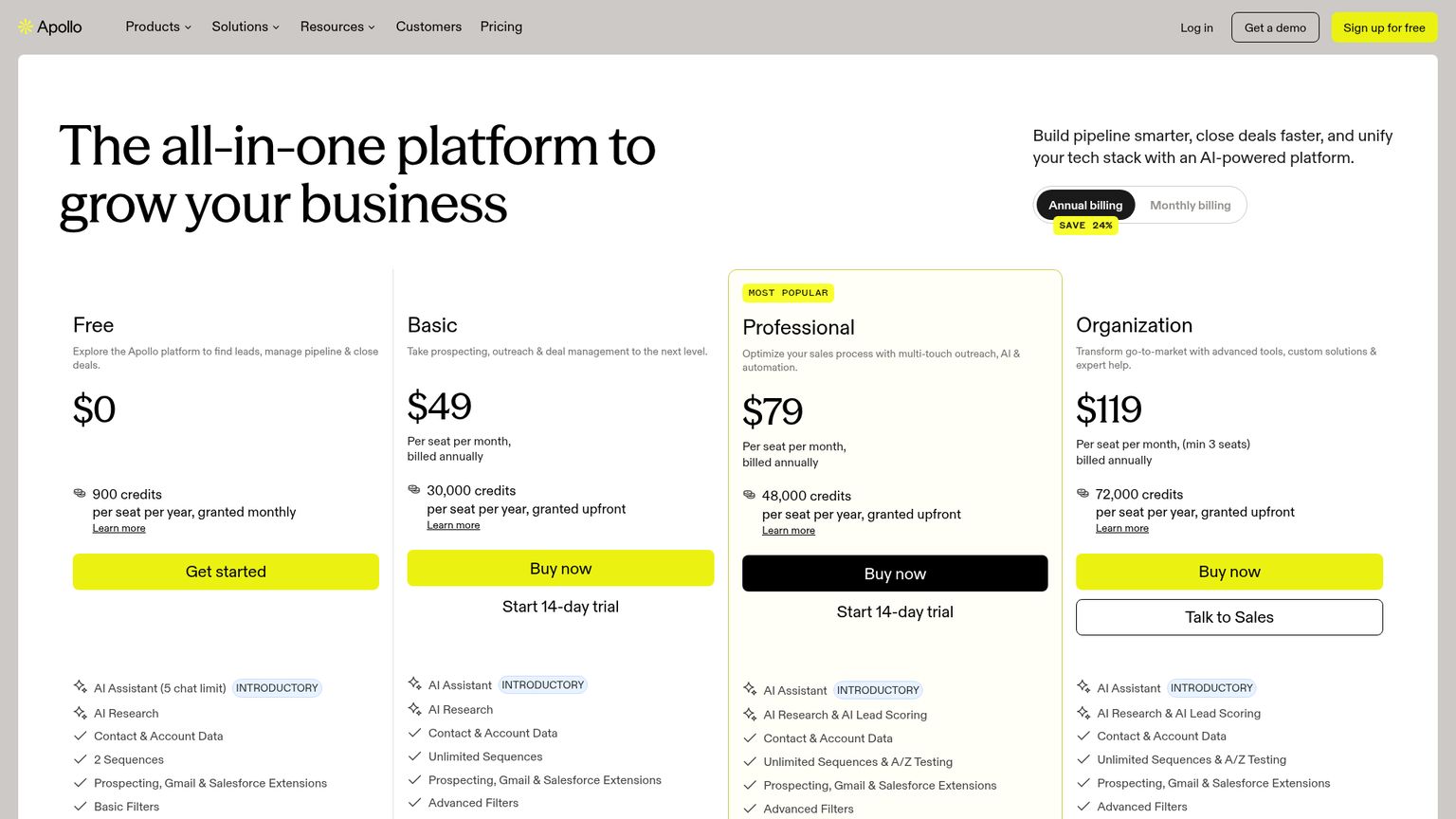
The verified annual-billing baseline is Free at $0 with 900 credits per seat per year, granted monthly; Basic at $49 with 30,000 annual credits; Professional at $79 with 48,000; and Organization at $119 with 72,000 and a three-seat minimum. Paid prices are per seat per month. That minimum makes Organization $357 per month equivalent, or $4,284 per year. Sources: Apollo's pricing page and the live plan data used by that page.
Keep it when the data passes your sample, reps use the connected sequence and calling workflow, and a proposed replacement creates more subscriptions or manual handoffs than it removes. Also examine an internal plan change before a migration: Basic's single-mailbox allowance and Professional's broader mailbox support create a specific reason an upgrade might address the problem.
Stay temporarily when there is no clear owner for migration. That does not mean accepting poor results indefinitely. It means defining the failing task, checking what the current plan already includes, and evaluating a smaller replacement with measurable acceptance criteria.
For detailed seat, credit and add-on economics, use the Apollo pricing breakdown. For the broader strengths and limitations of the connected platform, use the Apollo.io review. Those questions should not be resolved by comparing entry prices alone.
The Ones to Avoid
Avoid the wrong fit, even when the product is capable. These are purchasing mismatches, not allegations that the vendors are bad products.
- Avoid Amplemarket for a tiny data-only gap. Its annual Startup commitment needs a wider workflow case than a few additional contact lookups.
- Avoid Clay without a workflow owner. If nobody will maintain the research rules, integrations and usage budget, customization becomes unfinished work.
- Avoid ZoomInfo or Cognism without a complete quote. Neither public pricing page establishes the dollar cost of your required package.
- Avoid FullEnrich as a presumed sequencer replacement. It can supply the data while leaving sending and calling to another system.
- Avoid Lusha's entry plan for an unpriced phone-and-export workload. The reveal price alone understates the actions you may consume.
- Avoid Smartlead or Instantly as a cure for every delivery problem. A new sender does not establish valid data, relevant targeting or a healthy sending setup.
- Avoid a large Seamless.AI commitment based only on a demonstration. Establish the package and accepted-contact results first.
- Avoid Bouncer when the problem is finding the right buyer. It checks the address and sending conditions, not the business case for contacting that person.
The Monday move is straightforward: name the single failure that costs your reps the most time, choose the smallest relevant shortlist, and compare it with Apollo on the same work. Spend more only after you know what the extra money buys.
Frequently Asked Questions
Who is Apollo's biggest competitor?
ZoomInfo is a central comparison for enterprise contact and account intelligence, while Amplemarket is a close comparison for a connected outbound workflow. A biggest-competitor ranking by revenue or market share is not established by the product and pricing evidence used here.
Is there anything better than Apollo?
Yes, for a specific job. FullEnrich can fit a dedicated enrichment service, Lusha a focused lookup workflow, Clay custom research, and Smartlead or Instantly specialized sending operations. Better data quality for your market requires a representative sample rather than a universal ranking.
Is there another app like Apollo?
Amplemarket combines contact data, research and multichannel engagement in a connected platform. It is a relevant full-workflow alternative, though its Startup plan starts at $600 per month on an annual term with two users, a larger commitment than Apollo's entry paid plan.
What can I use instead of Apollo?
For contact data, shortlist FullEnrich, Lusha, Cognism, ZoomInfo, Clay or Seamless.AI. For sending, compare Smartlead and Instantly. For data and engagement together, evaluate Amplemarket. Verify the exact package because several of these vendors now span more than one role.
Which tool is better than Apollo?
For an existing Apollo customer whose sender works but contact coverage does not, FullEnrich is the first narrow pilot to consider. Choose another option when the failing job is different: Cognism for a European phone evaluation, Clay for custom research, or Amplemarket for a broader workflow change.
Is there a free version of Apollo?
Yes. Apollo's Free plan lists 900 credits per seat per year, granted monthly. That is an average of 75 a month, not 900 a month. Lusha and Clay also have recurring free plans; FullEnrich's 50 credits are a trial allowance.
Why was Apollo shut down?
The Apollo Reddit app is a different product from Apollo.io. Its developer's shutdown notice says it closed on 30 June 2023 because of Reddit's API pricing changes. Apollo.io remains available with the sales-platform plans compared here.
How much does Apollo cost?
The verified annual-billing prices are $49 per seat per month for Basic, $79 for Professional and $119 for Organization, which requires at least three seats. Free is $0. These are base subscription prices, not a complete budget for every credit purchase or add-on.
How to get a free Apollo membership?
Use the Free signup option on Apollo's pricing page. Distinguish the ongoing Free plan from a trial of a paid tier. Check the current allowances before importing a workload you expect the free account to support.
Use the AI Business Workflow Audit Checklist to identify the sales task worth changing before you add another subscription.
- Published
- Category
- Growth
- Language

9 Semrush Alternatives in 2026: SE Ranking, Ahrefs and DataForSEO
Compare nine Semrush alternatives by job, price and limits, including SE Ranking and DataForSEO. Know what you save and what you give up.Oct 10, 2026Growth
WhatConverts Pricing: Plans, Usage and Agency Bills
WhatConverts plans, usage credits and fees explained, with bills for one business and 20 clients, plus a fair CallRail cost comparison.Oct 10, 2026Growth
Beehiiv Review
Beehiiv reviewed for business newsletters: current pricing, growth, monetization, AI, MCP, analytics and the costs that change the buying decision.Oct 10, 2026Growth
Trainual Review
Trainual review for SOPs and onboarding: AI drafting, knowledge search, read-only MCP, quote-only plans, implementation and who should skip it.Oct 10, 2026Growth
SocialBee Review
SocialBee review of evergreen scheduling, AI Copilot and client workspaces, with all six plans, add-on costs, and Buffer and Later comparisons.Oct 10, 2026Growth
SurveyMonkey Pricing: Plans, Response Caps and Annual Bills
SurveyMonkey prices, response caps and AI limits, with annual bills for one person and three-seat teams. See when overages change the best plan.Oct 10, 2026Growth
ActiveCampaign Alternatives: GetResponse, Kit and More
Compare ActiveCampaign alternatives at 2,500, 10,000 and 25,000 contacts, with vendor prices, workflow trade-offs and a migration checklist.Oct 9, 2026Growth