WhatConverts Pricing: Plans, Usage and Agency Bills
WhatConverts plans, usage credits and fees explained, with bills for one business and 20 clients, plus a fair CallRail cost comparison.
Published
 By Omid Saffari



WhatConverts pricing starts at $30 a month, but a business using 5 local tracking numbers and 1,500 billable minutes spends $80 on Call Tracking, or $110 with every minute transcribed. Plus costs $140 for that same transcribed workload; an agency with 20 equally busy clients spends $2,225 on Agency Plus. The included usage credit matters as much as the subscription price.
Choose Plus for calls, forms and chats together. Choose Pro when custom and scheduled reporting earns its extra cost. Choose CallRail instead when your form volume makes its included allowance cheaper, or its conversation-analysis tools match your sales workflow better.
Verified against WhatConverts' pricing page, 10 October 2026. Prices below are US-dollar monthly charges using US local-number rates. Worked bills are calculated subscription-and-usage subtotals before taxes, surcharges and unlisted optional services, not observed invoices or product-test results.
WhatConverts connects incoming leads to the marketing that generated them. It is a partner; the WhatConverts partner link may earn a commission. Recommendations here turn on the complete bill and the reporting job.
WhatConverts Pricing per Month: Plans and Included Credit
The entry price is $30, but $60 Plus is the starting point for a business that needs to track website forms and chats alongside calls. Every individual plan covers one account. Agency plans cover unlimited accounts, with one shared plan allowance rather than a fresh allowance for each client.
The following monthly prices and included usage credits were verified on 10 October 2026. Source: WhatConverts pricing.
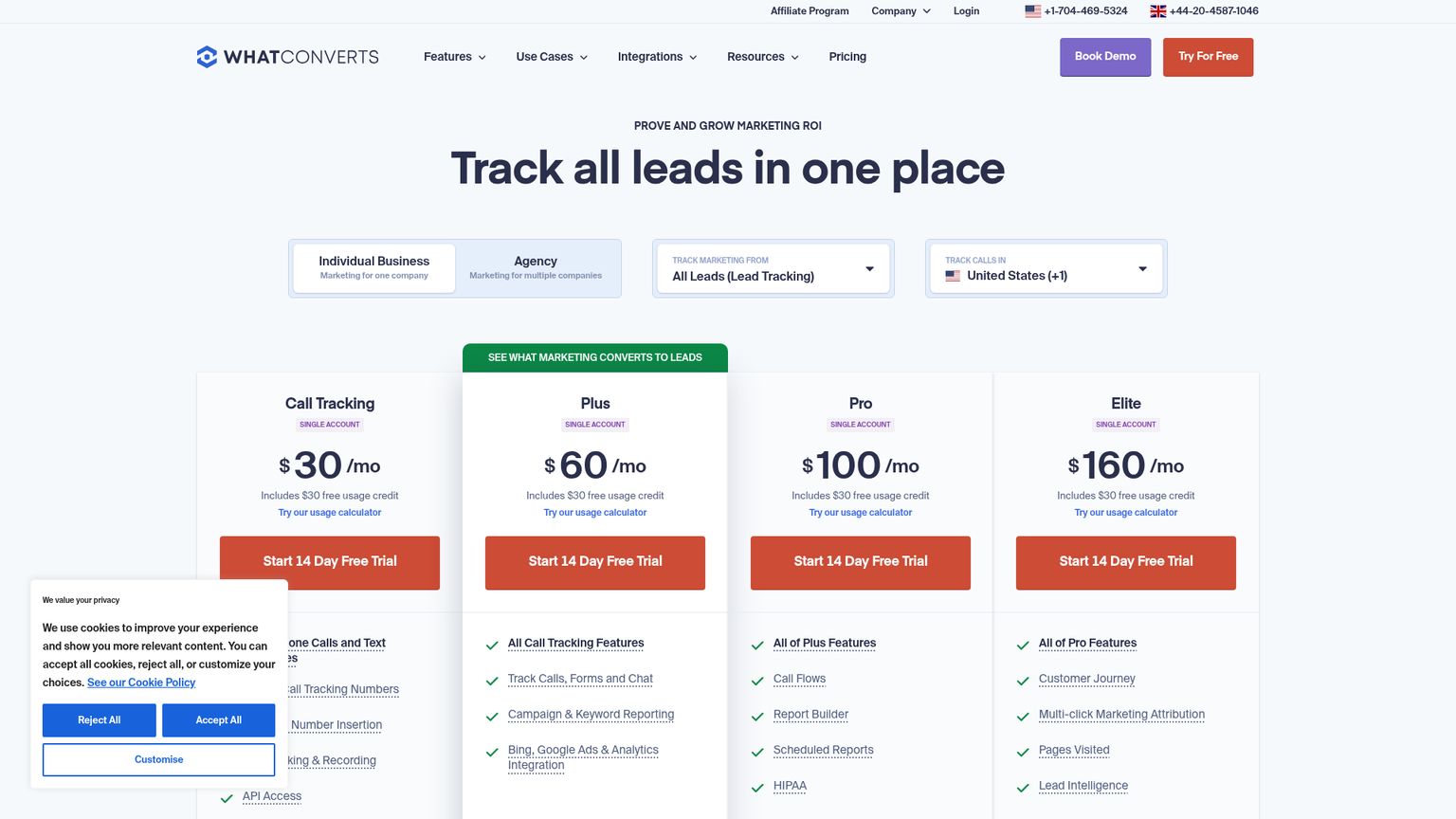
A usage credit is a spending allowance for metered activity, not a discount on the subscription itself. You still pay the plan fee when usage is light. When usage passes the allowance, the excess adds to your cost. The included-usage documentation says unused credit expires at renewal rather than rolling into the next month.
WhatConverts Call Tracking: The Calls-Only Starting Point
Call Tracking fits a local business whose marketing inquiries arrive by phone. It includes tracking numbers, call recording and dynamic number insertion, which swaps the phone number on a website so a call can be associated with its source. Inbound text tracking and API access are also listed. Transcription has a separate usage price.
A plumber measuring phone inquiries from advertising can start here. A clinic promising to report website appointment requests as well as calls needs a broader plan. Buying the lowest tier and ignoring form leads can make the wrong campaign look productive. Features by plan.
Plus is the sensible default for mixed lead channels. It adds form and chat tracking, campaign and keyword reporting, and the listed advertising and analytics integrations. Pro adds the report builder, scheduled reports and call flows, meaning rules that direct callers to the appropriate destination. Elite adds customer journeys, multi-click marketing attribution, visited pages and Lead Intelligence rules for qualification.
Those are different reporting jobs. A single-location contractor should be able to name the decision that needs journey analysis before paying for Elite. An agency that has sold customized recurring reports should price Pro into its service fee. Plan boundaries.
Usage Fees: What Gets Added to the Plan
Numbers, billable minutes and enabled extras determine the amount above your credit. Agency pricing reduces number rental and voice rates; it does not reduce every line item.
For an individual account, the US rate card lists:
- Local tracking numbers: $2.50 each per month; local calling costs 4.5¢ per minute.
- Toll-free numbers: $3.50 each per month; toll-free calling costs 6.5¢ per minute.
- Transcription: 2¢ per transcribed minute, added to calling charges.
- Inbound texts: 3¢ each.
- Forms, chats and transactions: 10¢ each on eligible plans, beginning with Plus.
Agency local numbers cost $1.75 each per month, and local minutes cost 4¢. Agency toll-free numbers cost $3 each, with 6¢ calling minutes. Transcription remains 2¢, texts 3¢, and tracked forms, chats and transactions 10¢. White Label, which applies your branding to the service, adds $50 a month. Agency and add-on rates.
The budgeting formula is: plan fee + core usage above the included credit + separately charged add-ons. Count the credit once. The pricing page shows up to 148 call leads for individual plans and up to 300 forms, chats or transactions for individual Plus and above. Agency Plus, Pro and Elite show up to 1,908, 2,325 and 3,158 call leads, or up to 2,500, 3,000 and 4,000 forms, chats or transactions, respectively. These displayed capacities should not be added together as independent free pools: the billing documentation describes a shared monetary credit. Call count alone cannot establish capacity when call lengths vary.
Transcription is not the same purchase as AI analysis. A transcript converts speech into text. WhatConverts documents additional call-analysis and AI-analysis charges, plus optional extended recording storage. The worked examples include ordinary transcription only. Get the applicable rates before promising summaries or automated analysis inside a fixed client fee. Country, number type and some mobile forwarding can also change charges. How pricing works.
Worked Bill: One Business, 5 Numbers and 1,500 Minutes
Budget $140 a month for Plus with this workload and full transcription, before any forms or texts are tracked. Assume one US local-service business, five local tracking numbers, 1,500 billable local minutes and transcription on every minute. No toll-free traffic, AI analysis or White Label is included.
The calculation using WhatConverts' published rates is:
- Five numbers × $2.50 = $12.50.
- 1,500 calling minutes × $0.045 = $67.50.
- Combined core usage = $80; subtract the $30 included credit to leave $50 of excess usage.
- 1,500 transcribed minutes × $0.02 = $30.
- Plus subscription $60 + excess usage $50 + transcription $30 = $140.

Changing the plan changes the subscription, not these individual-account usage rates. With the same numbers and minutes but no transcription, the totals are $80 Call Tracking, $110 Plus, $150 Pro and $210 Elite. Transcribing every minute raises those totals to $110, $140, $180 and $240, respectively.
Plus at $140 has the ability to track forms, but the example has not consumed any form events. Add an assumed 100 tracked forms, and the extra $10 makes its subtotal $150. That distinction prevents “forms included” from being mistaken for unlimited free form usage.
For an owner, the useful denominator is qualified inquiries. If this business receives 50 qualified leads, the $140 Plus bill represents $2.80 per qualified lead, before advertising spend. That is an illustration, not a promised result. Tracking earns its keep when it changes which campaigns receive money or helps identify valuable inquiries that would otherwise be missed.
Worked Bill: An Agency With 20 Client Accounts
Twenty clients cost $2,225 on Agency Plus when each uses the same five numbers and 1,500 transcribed minutes. Client count alone cannot produce a complete quote, so this example holds each client's workload equal to the business example above.
Across the agency, that means 100 local numbers, 30,000 billable local minutes and 30,000 transcribed minutes. Forms, texts, AI analysis and White Label remain excluded.
Using the agency rates, number rental is 100 × $1.75 = $175. Calling is 30,000 × $0.04 = $1,200. Core usage totals $1,375, while transcription adds 30,000 × $0.02 = $600.
- Agency Plus: $500 + $1,375 − $250 credit + $600 transcription = $2,225, or $111.25 per client.
- Agency Pro: $800 + $1,375 − $300 credit + $600 transcription = $2,475, or $123.75 per client.
- Agency Elite: $1,250 + $1,375 − $400 credit + $600 transcription = $2,825, or $141.25 per client.
Without transcription, Agency Plus would cost $1,625. Calling the plan “$25 per client” merely divides its $500 subscription by 20; it leaves the workload out of the budget.
Twenty separate individual Plus accounts would cost 20 × $140 = $2,800 at this workload. Agency Plus saves $575 a month. An agency can use the $111.25 figure as a starting allocation per client, but should charge or reserve more for clients with longer calls and larger number pools.
When Does the Agency Plan Become Cheaper?
Agency Plus first becomes cheaper at seven clients in this specific workload. Dividing $500 by the $60 individual subscription misses both the usage discounts and the different credit allowances.
Each agency client generates $68.75 of core usage and $30 of transcription. The agency subtotal is therefore $500 plus combined core usage above $250, plus transcription. Individual Plus accounts remain $140 each.
At six clients, separate Plus accounts cost $840, while Agency Plus costs $842.50. At seven, separate accounts cost $980, while Agency Plus costs $941.25. Those totals are calculated from the same published rates, with the credit shared once across the agency.

A quieter agency can cross over later; a busier one can cross over earlier. Uneven client activity also matters because unused individual allowances cannot offset another separately billed account's overage. Quote the aggregate expected workload, then check the account-management features you need.
WhatConverts vs CallRail: When the Price Advantage Changes
CallRail is the better price choice for the form-heavy version of this example; WhatConverts costs less for the calls-only and lower-form-volume versions. CallRail is a call-attribution and lead-analysis platform. Its current monthly pricing view lists Lead Tracking at $55 and Lead Tracking Complete at $105.
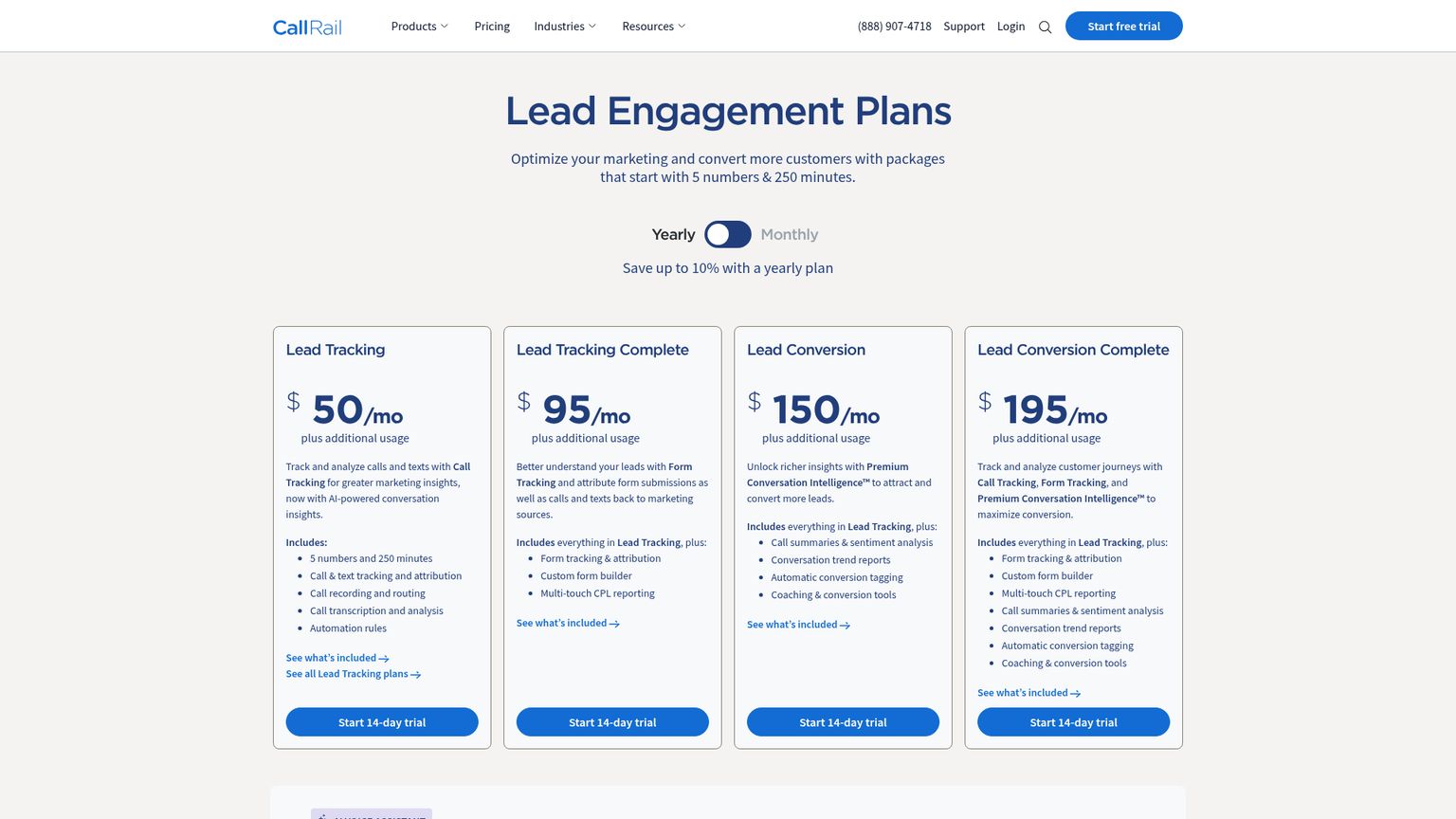
The monthly rates were checked with Monthly selected on 10 October 2026. Both plans include five local numbers and 250 local minutes, and the active comparison table bundles transcription with local minutes. Additional local minutes cost 6¢, additional local numbers $3, and Complete includes 1,000 forms, then 2¢ per additional form. CallRail's rate card.
For the business with five numbers and 1,500 transcribed minutes, CallRail Lead Tracking costs $55 + (1,500 − 250) × $0.06 = $130. WhatConverts Call Tracking costs $110 with transcription, a $20 monthly difference. Comparing WhatConverts' $80 untranscribed bill against CallRail's transcribed bundle would overstate the saving.
Now add 100 forms and compare the plans that support them. WhatConverts Plus costs $150. CallRail Lead Tracking Complete costs $105 + $75 calling overage = $180, with those forms inside its allowance. WhatConverts saves $30 for this mix.
The choice flips at 400 forms. Holding numbers and transcribed minutes constant, WhatConverts Plus costs $140 + $0.10 per form. At 400 forms, both configurations reach $180. Above 400 and through CallRail's included 1,000 forms, CallRail is cheaper. At 1,000 forms, the comparison is $240 WhatConverts versus $180 CallRail.
Pick CallRail if your appointment requests arrive heavily through forms, its call routing fits your intake process, or you specifically need its premium summaries, sentiment and coaching workflow. Premium Conversation Intelligence belongs to higher packages and is not included in the $130 example. Existing customers should also compare their available plans before accepting migration work for a small monthly saving. CallRail package details.
Pick WhatConverts when combined call, form and chat reporting fits the client deliverable and its complete usage bill wins. Its metered model is straightforward once calculated, but it exposes you to longer calls, more forms and optional analysis. CallRail's bundled allowance can suit a predictable workload better; its overages still require a budget.
The CallRail pricing breakdown covers its broader package choices. The CallRail alternatives guide covers the wider switching shortlist.
A Second Agency Shortlist: CallTrackingMetrics
CallTrackingMetrics (CTM), another call-tracking platform, deserves an agency quote when account structure and cost matter more than matching WhatConverts' reporting workflow. Its Marketing Pro plan is $179 a month on monthly billing and includes 25 subaccounts. CTM pricing.
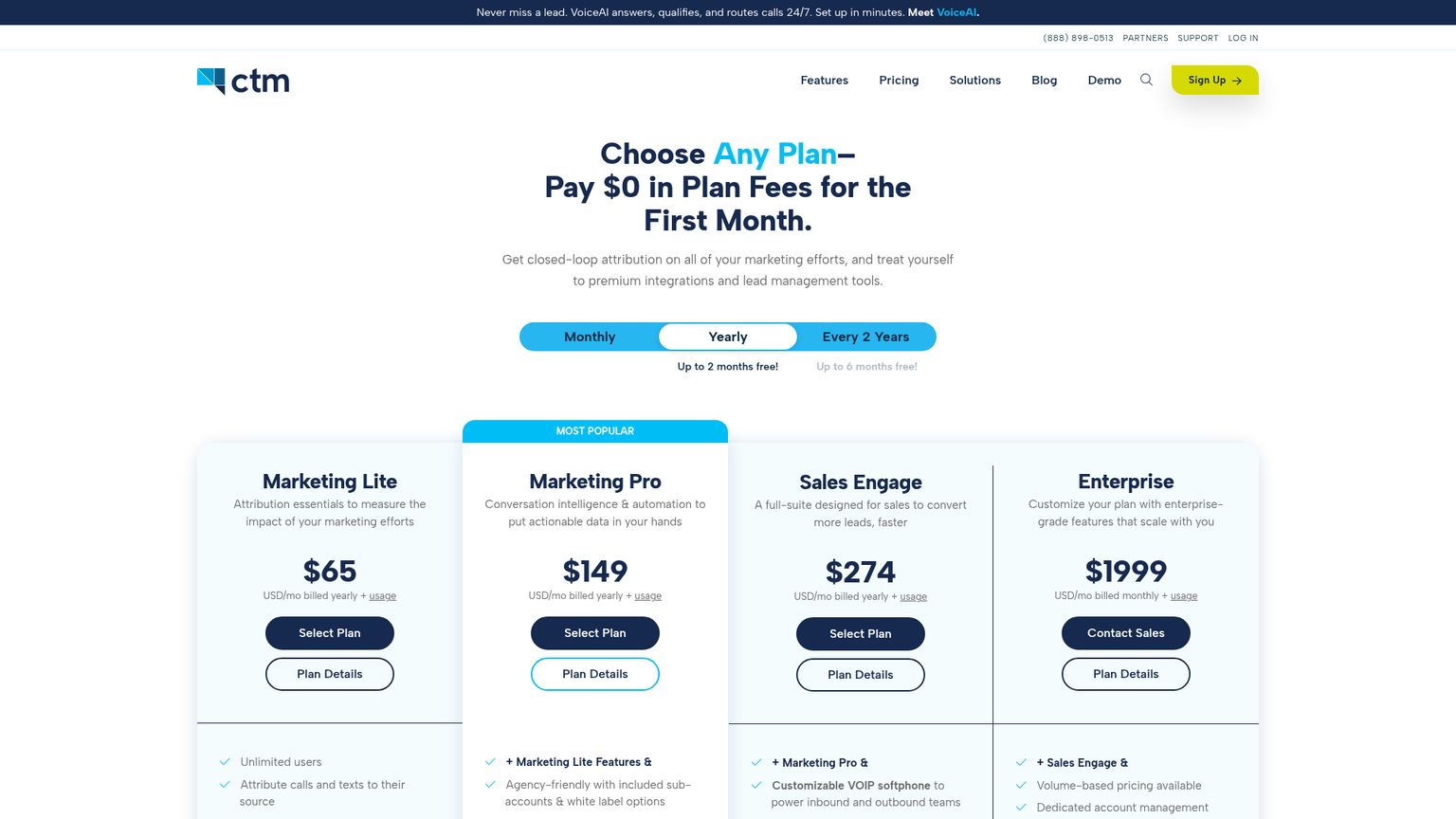
Normalize the same 20-client workload at its published $2 per local number, 4¢ per forwarding minute and 2¢ per transcribed minute: $179 + $200 + $1,200 + $600 = $2,179, or $108.95 per client. That is $46 less than WhatConverts Agency Plus before other charges. It is a cost comparison for the specified activities, not a claim that the products have identical reporting features.
The important limitation is CTM's initial transcription allowance: its page says the included 3,000 minutes per subaccount do not renew monthly. The $2,179 estimate therefore represents steady usage after those initial allowances are consumed. Do not project introductory transcription savings into every future month. Rates and allowance wording.
Which Plan Pays for Itself?
Buy the least expensive plan that supports the decision or client deliverable you can name. More usage is not, by itself, a reason to upgrade an individual account: the individual tiers have the same $30 credit and the same listed usage rates.
Moving from individual Plus to Pro adds $40 a month; moving from Pro to Elite adds $60. Those upgrades purchase features. For an agency already using all its included credit, Pro costs $250 more than Agency Plus, because its higher credit offsets part of the $300 subscription increase. Elite similarly costs $350 more than Agency Pro after the additional credit. These are calculated differences from the plan table.
For an agency valuing staff time at an assumed $50 an hour, Agency Pro would need to save five hours a month to recover its $250 incremental cost through labor alone. That gives the scheduled-reporting purchase a concrete hurdle. If your existing reporting workflow is already quick, a higher tier may add little value.
For a local business, suppose one additional completed job contributes $250 after its direct delivery costs. One such job exceeds the $140 Plus example's tracking cost, before setup labor. But attribution software does not create that job automatically. Someone must act on the information: stop paying for poor inquiries, improve intake, or invest in the source producing qualified work.
WhatConverts Integrations
Plus is the relevant tier when advertising integrations are part of the job. The pricing page explicitly lists Bing, Google Ads and Analytics integration, alongside campaign and keyword reporting. For a local-service marketer, the useful question is whether the resulting report distinguishes valuable inquiries from noise, rather than merely moving more events between tools. Included integrations.
WhatConverts API
API access, a way for software to exchange lead data, is listed on Call Tracking and inherited by higher tiers. The public pricing page does not give a separate API request-price schedule. That supports “API access included”; it does not establish unlimited free requests or every integration you might want. Budget any outside implementation work separately. API and plan features.
WhatConverts Pricing Calculator
Use the calculator to select features, then reconcile its estimate with your actual billable workload. The official guide says it estimates cost from lead volume and selected features; it does not promise the eventual invoice. Calculator instructions.
Inventory a representative month
Record active and retained numbers, billable minutes, transcribed minutes, forms, chats and inbound texts. For an agency, collect them per client before adding them together.
Select the reporting job
Open Try Our Pricing Calculator on the pricing page. Enter expected lead volume and select the features you need, especially multiple accounts and custom reporting.
Rebuild the subtotal
Multiply each usage type by its applicable rate, apply the shared credit once, and add transcription or other paid features separately. Check country and number type.
Set the commercial decision
During the trial, decide which report would change spending or save recurring work. Assign an owner to that action and compare its value with the complete monthly cost.
Is WhatConverts Free? Trial, Discounts and Billing Limits
WhatConverts lists a 14-day free trial, not a permanent free plan. Its pricing page does not establish unlimited trial usage, so confirm the trial allowance for your proposed workload before moving production tracking. Trial and plans.
Who never needs to pay? A business that does not need ongoing source-level lead tracking can decide during evaluation that its existing records are sufficient and decline a subscription. There is no listed forever-free WhatConverts tier to recommend for continuing production use.
Annual pricing: no annual prices are shown on the WhatConverts pricing page, so no annual rate or discount is assumed here. Student discounts and refunds: the current pricing page publishes neither a student offer nor a refund promise. Confirm the written terms before buying rather than treating an unverified policy as a benefit. Price history: today's verified rates do not establish when a price changed.
The recurring usage credit expires each month. Beyond it, WhatConverts uses a paid balance that can be funded manually or automatically. Review that funding setup alongside the recurring plan; a budget estimate and a cash top-up are different things. Credit and paid-balance behavior.
FAQ
What is WhatConverts?
WhatConverts tracks leads and associates them with marketing sources. Call Tracking covers phone inquiries and texts; Plus and higher plans bring forms and chats into the reporting picture.
What is the best call tracking software?
WhatConverts is a strong fit for combined lead reporting. CallRail is the better price choice for the form-heavy workload above. Agencies should also quote CallTrackingMetrics. Choose using the full bill and required reporting workflow.
Does WhatConverts charge per lead?
Forms, chats and transactions cost 10¢ per tracked event on eligible plans. Calls are metered through number rental and minutes, with separate transcription charges if enabled. The included usage credit offsets eligible tracking costs. Published rates.
What is the WhatConverts free trial?
The advertised trial lasts 14 days. A permanent free plan and unlimited trial usage are not promised on the pricing page. Trial details.
Can you give me an example of a marketing conversion?
A homeowner submitting a completed estimate request is a conversion if that is the action you chose to measure. A submitted request, a qualified prospect and a paid job are different outcomes; use the relevant one when judging tracking cost.
What is conversion marketing?
It means improving the path from an interested visitor to a chosen business action, such as requesting an appointment. Lead tracking measures part of that path; someone still has to improve the offer, page or follow-up.
What is a good conversion rate?
Use a rate that produces acceptable acquisition cost and contribution for the action being measured. A high form-submission rate is not useful if most inquiries are unqualified. Compare like-for-like outcomes rather than adopting a universal percentage.
How much does it cost to advertise on WhatsApp?
That requires a separate advertising budget. The WhatConverts pricing page prices lead tracking and does not provide a WhatsApp advertising quote.
What is the 3-3-3 rule for marketing?
It is not a billing or forecasting rule specified in WhatConverts' pricing. For this purchase, use your observed number count, billable minutes and tracked events instead of a marketing mnemonic.
What are the 7 principles of conversion?
WhatConverts' rate card does not define a seven-principle framework. For the buying decision here, define the action you want, separate qualified leads from raw inquiries, and judge the tracking bill against the value of decisions it enables.
Use the AI Business Workflow Audit Checklist to identify which reporting steps deserve automation before increasing the software budget. Get it through the newsletter.
- Published
- Category
- Growth
- Language

Beehiiv Review
Beehiiv reviewed for business newsletters: current pricing, growth, monetization, AI, MCP, analytics and the costs that change the buying decision.Oct 10, 2026Growth
Trainual Review
Trainual review for SOPs and onboarding: AI drafting, knowledge search, read-only MCP, quote-only plans, implementation and who should skip it.Oct 10, 2026Growth
SocialBee Review
SocialBee review of evergreen scheduling, AI Copilot and client workspaces, with all six plans, add-on costs, and Buffer and Later comparisons.Oct 10, 2026Growth
SurveyMonkey Pricing: Plans, Response Caps and Annual Bills
SurveyMonkey prices, response caps and AI limits, with annual bills for one person and three-seat teams. See when overages change the best plan.Oct 10, 2026Growth
ActiveCampaign Alternatives: GetResponse, Kit and More
Compare ActiveCampaign alternatives at 2,500, 10,000 and 25,000 contacts, with vendor prices, workflow trade-offs and a migration checklist.Oct 9, 2026Growth
CallRail Alternatives: WhatConverts and More Compared
Compare six CallRail alternatives by vendor pricing, usage fees, AI and reporting. Includes WhatConverts cost math and a pre-switch checklist.Oct 9, 2026Growth
Monday.com Pricing: Seat Buckets and the Yearly Bill
Calculate monday.com Work Management costs for 5, 12 and 40 people, including seat buckets, annual vs monthly billing and AI credit charges.Oct 9, 2026Growth