Cloudflare AI Search with GLM-5.3 Flash, explained
Cloudflare AI Search now generates answers with GLM-5.3 Flash. Here's how the pipeline works, what it costs, and when to switch.
Published
 By Omid Saffari

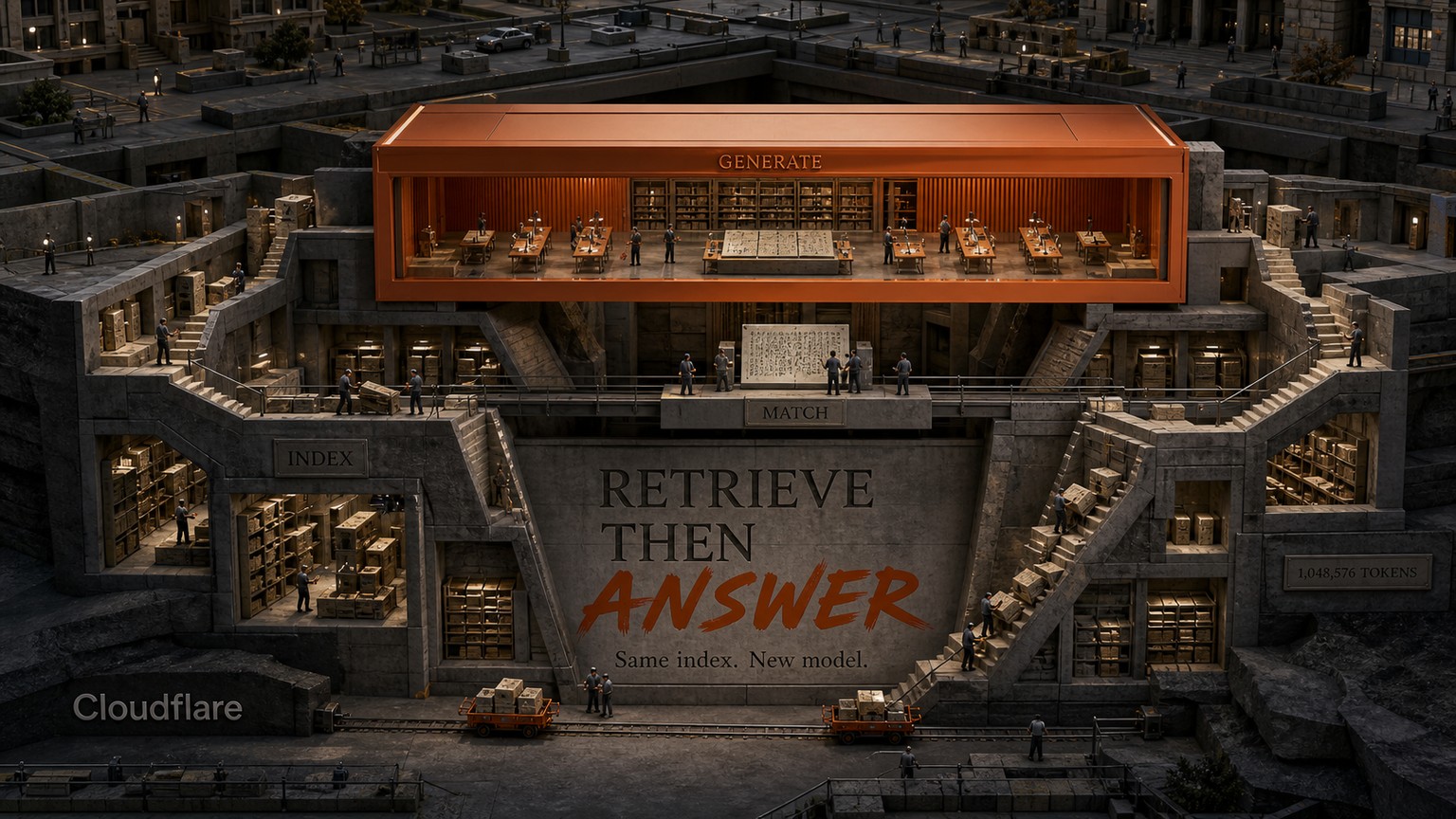
On August 30, 2026, Cloudflare added GLM-5.3 Flash to AI Search as a text-generation option. The useful change isn't another model in a menu. You can keep Cloudflare's managed retrieval pipeline and swap only the model that writes the final answer, with a 1,048,576-token context window and Workers AI pricing of $0.15 per million input tokens and $0.50 per million output tokens.
What Cloudflare actually changed
Cloudflare AI Search is a managed search service for your own content. You give it a website, an R2 bucket, which is Cloudflare's object storage, or uploaded files. It parses that content, breaks it into useful pieces, indexes those pieces, and retrieves the relevant ones when someone asks a question. Workers AI is the hosted model service that runs GLM-5.3 Flash inside this setup.
That pattern is called retrieval-augmented generation, or RAG. In everyday words, the system finds source passages first and asks a model to answer from those passages second.
GLM-5.3 Flash enters at that second part. It doesn't crawl the website. It doesn't create the embeddings, which are numerical representations used to find similar text. It doesn't run the keyword search or rerank the results, which means scoring them again for relevance. It takes the retrieved context and writes the answer. Hybrid search combines semantic vector matching with exact keyword matching.
That separation is the whole point. You can change the generation model without rebuilding the index or changing the embedding model. Cloudflare also lets you set the model once in an instance's Settings or override it on a single request.

Why the 1,048,576-token window matters, and why it can mislead you
The new model's listed context window is eight times the 131,072-token window shown for GLM-4.7 Flash in AI Search's supported-model list. Context is the material a model can consider in one request, including instructions, retrieved passages, conversation history, and the answer it produces.
That larger ceiling gives AI Search more room for long retrieved passages and longer conversations. It can matter for technical manuals, policy libraries, or support threads where the answer depends on details spread across several sources.
It does not mean AI Search now feeds your whole knowledge base into every prompt. Retrieval still selects a bounded set of chunks. The Workers binding returns 10 results by default and allows between 1 and 50. A million-token context window can't rescue weak indexing, the wrong filters, or a retrieval threshold that drops the useful passage.
There is another useful distinction. The direct Workers AI model supports reasoning, function calling, and vision. Inside AI Search, this release adds it specifically as the text-generation model. Images in your source material are converted to Markdown during indexing before the answer stage, so this update does not turn AI Search chat into a raw image-analysis endpoint.
Who can use this tomorrow
A solo SaaS founder with a support backlog
Index your public documentation, choose GLM-5.3 Flash for generation, and put the resulting chat behind your help button. The payoff isn't a generic chatbot. It is one managed path from the customer's question to a retrieved source passage and then to an answer.
You can test that path in the dashboard before writing application code.
Create the instance
Open AI Search in the Cloudflare dashboard, select Create Instance, name it, and connect your product website or an R2 bucket. You can also create the instance first and upload files later.
Wait for indexing
Open the instance's Items tab and confirm the content has been indexed. Uploading a file starts indexing automatically.
Choose the generation model
Open Settings, switch from Smart Default to an explicit generation model, and select
@cf/zai-org/glm-5.3-flash. The embedding model stays unchanged.Test both modes
Use Search in the Playground to inspect the retrieved chunks, then use Chat to inspect the generated answer. If Search misses the source, changing the generation model won't fix the problem.
A small agency running client knowledge bases
Keep each client's content in its own AI Search instance, then standardize the generation layer on GLM-5.3 Flash where it passes the client's evaluation. The practical payoff is operational: your team keeps one indexing and retrieval system while each client can have its own content, prompt, and rollout decision.
Do not merge client data just to simplify model selection. The model can be set at the instance level, and Cloudflare also supports namespaces when you need to manage several instances from one binding.
An operations team searching internal runbooks
Connect the runbooks stored in R2, use hybrid retrieval to catch both exact error codes and semantically similar procedures, and let GLM-5.3 Flash turn the retrieved steps into a readable response. The payoff is faster access to the right procedure, while the returned chunks remain available for source checking.
For an incident workflow, show those source chunks beside the answer. The generated paragraph is a convenience layer, not the authority that changes a production system.
A platform engineer testing a model without migrating the stack
Use the per-request model field to route a measured slice of traffic to GLM-5.3 Flash. Record input tokens, output tokens, returned chunks, answer acceptance, and latency. Keep the current instance-level model for the rest of the traffic.
That gives you a clean comparison because the index, retrieval settings, and source corpus stay the same. Only the answer model changes.
If your agent needs live public-web retrieval rather than search over content you already index, that is a different job. The AI search API guide covers providers built for that path.
A runnable Worker with GLM-5.3 Flash
Cloudflare's current Workers guide starts with a Worker-only TypeScript project:
npm create cloudflare@latest -- ai-search-tutorial
cd ai-search-tutorial
Add a namespace binding to wrangler.jsonc. A binding is a named connection that lets your Worker call another Cloudflare resource. remote: true matters because AI Search does not run inside your local process. Wrangler proxies the request to the deployed service during local development.
{
  "$schema": "./node_modules/wrangler/config-schema.json",
  "ai_search_namespaces": [
    {
      "binding": "AI_SEARCH",
      "namespace": "default",
      "remote": true
    }
  ]
}
Then replace src/index.ts with this complete example. Visit /setup once to create the instance and index a sample document. Every other request retrieves matching content and asks GLM-5.3 Flash to write the answer.
export interface Env {
	AI_SEARCH: AiSearchNamespace;
}

export default {
	async fetch(request, env): Promise<Response> {
		const url = new URL(request.url);

		if (url.pathname === "/setup") {
			const instance = await env.AI_SEARCH.create({ id: "my-instance" });
			const item = await instance.items.uploadAndPoll(
				"getting-started.md",
				"AI Search indexes uploaded content for retrieval.",
			);
			return Response.json({ created: "my-instance", status: item.status });
		}

		const query = url.searchParams.get("q") ?? "What does AI Search do?";

		const response = await env.AI_SEARCH.get("my-instance").chatCompletions({
			messages: [
				{
					role: "system",
					content: "Answer only from the indexed content. If the answer is missing, say so.",
				},
				{ role: "user", content: query },
			],
			model: "@cf/zai-org/glm-5.3-flash",
			ai_search_options: {
				retrieval: { max_num_results: 5 },
			},
		});

		return Response.json(response);
	},
} satisfies ExportedHandler<Env>;
Run it locally with npx wrangler dev. After the local check, use npx wrangler login and npx wrangler deploy.
The binding means your Worker code does not have to carry an AI Search API token. If you call the REST API instead, the token needs both AI Search:Edit and AI Search:Run permissions.
The common mistake is debugging the model when the source never made it through retrieval. Check response.chunks before changing the prompt, adding more context, or blaming GLM. A clean answer can't be grounded in a passage the model never received.
The honest cost and limit math
AI Search itself is free during the open beta within your Workers plan limits. Workers AI usage is still billed separately, and AI Gateway can add its own bill if you connect it. Cloudflare says it will give at least 30 days' notice before AI Search billing begins.
GLM-5.3 Flash costs $0.15 per million input tokens and $0.50 per million output tokens. A request with 5,000 uncached input tokens and 500 output tokens works out to $0.001:
0.005 × $0.15 + 0.0005 × $0.50 = $0.001
At 20,000 requests with that exact shape, Workers AI generation would cost $20. This is an illustration, not a forecast. Your input includes the system prompt, conversation, and retrieved chunks, so verbose retrieval changes the bill faster than the low headline rate suggests.
The Workers Free plan allows 20,000 AI Search queries per month, 100 instances, 100,000 files per instance, and 500 crawled website pages per day. The maximum file size is 4 MB. Workers Paid raises the instance limit to 5,000, removes the monthly query and daily crawl caps, and allows 1 million files per instance, or 500,000 when hybrid search is enabled. The 4 MB file limit remains.
Cloudflare's pages do not publish AI Search-specific latency or answer-quality results for this model. The model page describes its architecture and capabilities, but that is not a result on your documents. Test questions with known answers before sending production traffic, especially for policy, financial, medical, or incident-response content.
What to do now
Act this week if you already use AI Search Chat Completions, want a Cloudflare-hosted generation model, and can replay a set of known questions. Pin GLM-5.3 Flash on a test instance or override it per request, then compare the retrieved chunks, accepted answers, token use, and latency against your current model.
Wait if Smart Default already meets your quality and cost targets. A new option is not a migration requirement. Wait as well if your corpus is still indexing badly, because changing the final model will not repair missing or poorly chunked sources.
You are unaffected if you call only the Search endpoint and generate answers in your own model layer. You are also unaffected if you do not use AI Search. GLM-5.3 Flash is available directly on Workers AI, but this specific release is about putting it inside AI Search's generation stage.
If you want more operator-level breakdowns when the tools change, join the newsletter.
- Published
- Category
- Explained
- Language

How Much Does an AI Agent Cost? Three Monthly Bills, Explained
Compare packaged agents, no-code builders and model APIs, with current maker prices and three worked budgets for 1,000 support emails a month.Oct 7, 2026Explained
Grok Voice Transcribe 2.0 Keeps Batch Audio at $0.10/Hour
Grok Voice Transcribe 2.0 keeps batch and streaming rates unchanged. Check the default-model transition and test transcript quality before switching.Sep 20, 2026Explained
Cloudflare Lets You Debug a Failed Browser Job Before Rerunning
Cloudflare Browser Run now records more evidence for debugging. Learn what to inspect before rerunning a broken browser job.Sep 19, 2026Explained
v0 Can Now Reuse Your Private Component Library
v0 can now install private npm packages. See how to reuse your team's components and check the work still needed before shipping.Sep 19, 2026Explained
Claude Code Cuts Auto Mode Classifier Charges
Claude Code 2.1.278 removes classifier charges for eligible sessions. Check /status and gateway fallback before changing your agent budget.Sep 19, 2026Explained
Vercel Lets You Pay for Faster Builds One Deploy at a Time
Use Vercel Turbo for an urgent deployment while keeping routine build defaults. Compare the extra build cost with the time saved.Sep 18, 2026Explained
ChatGPT for Word Cuts Document Copying Between Apps
Draft and revise inside Word with ChatGPT. Check add-in access, shared usage limits and a practical document-editing workflow.Sep 18, 2026Explained