Best AI Agent Code Sandboxes 2026
The 10 best AI agent code sandboxes in 2026, ranked by isolation, persistence, startup model, developer fit, and real current pricing.
Published Updated
 By Omid Saffari



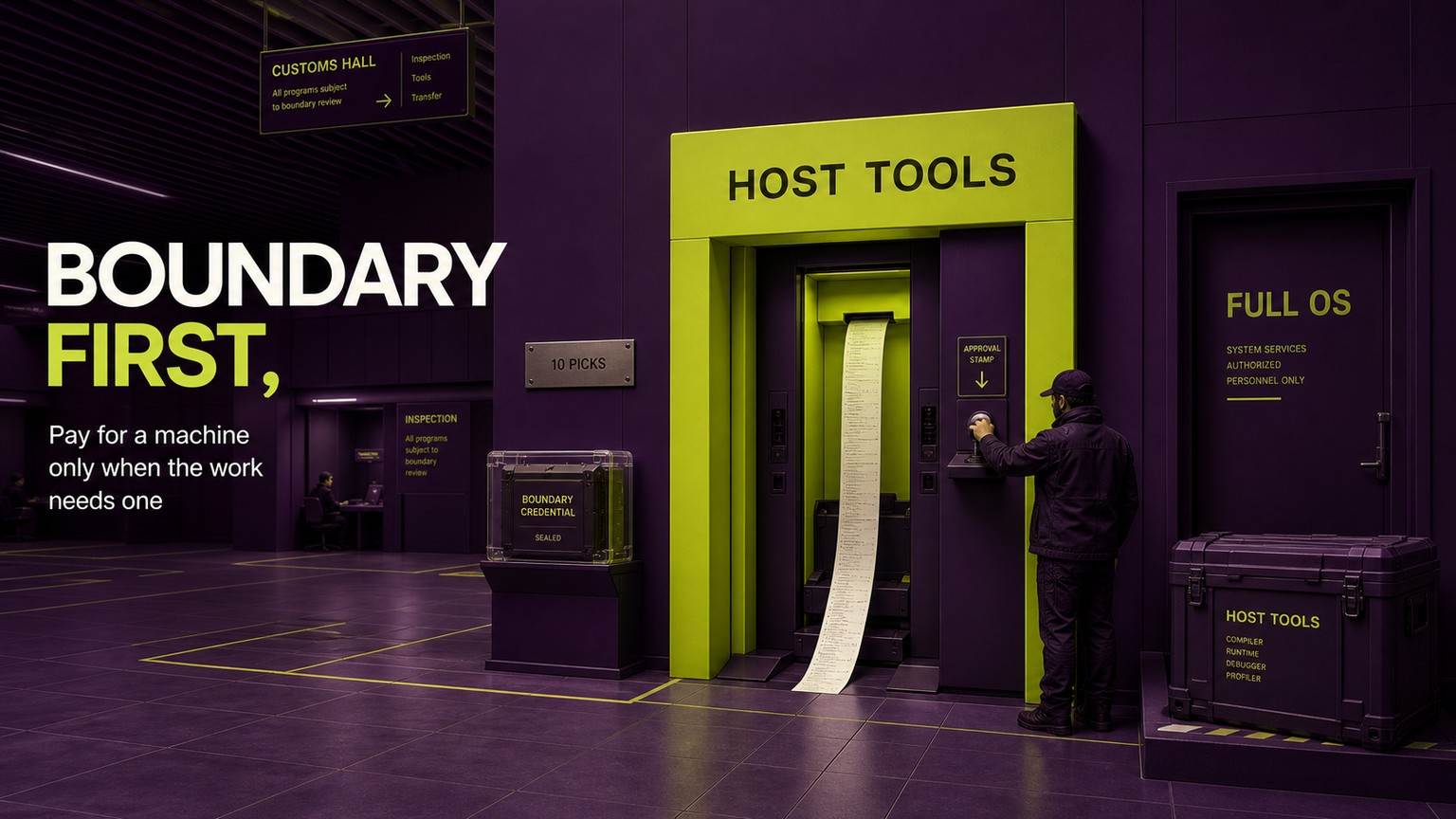
At one million 30-second agent jobs, the execution layer can cost roughly $139 or $1,110 before storage and plan fees–even when the model and task are identical. The best AI agent code sandbox in 2026 is therefore the smallest trustworthy boundary that matches the job: Vercel Run SDK for approved in-app tools, E2B for a general remote Linux microVM, and Vercel Sandbox for Vercel-native agents that need a real operating system.
The short answer: three winners for three different jobs
The new default is not “send every generated program to a remote machine.” Vercel Run SDK gives agent-written JavaScript and TypeScript a fresh QuickJS context with no ambient Node.js, filesystem, module, environment-variable, or network access. Your application exposes only the host functions the program may call. If the work is “list invoices, filter them, request approval, then issue a refund,” that narrower boundary can remove an entire remote-sandbox line from the architecture.
It does not replace a machine. Choose E2B when the agent must clone a repository, install arbitrary packages, compile code, or work in any Linux-compatible language. Choose Vercel Sandbox when those same OS-level jobs already sit beside Vercel Functions, the AI SDK, or Claude Managed Agents. The decision flips on one question: does generated code need an operating system, or merely permissioned tools?
All prices below were verified against live vendor pages on August 28, 2026. Usage rates exclude model tokens and any external database, API, network, or observability charges unless stated.

The boundary budget: what one million agent tasks actually cost
A sandbox bill is mostly a meter-selection problem disguised as an infrastructure choice. Some providers charge for the whole time a machine is running. Others separate active CPU from provisioned memory. Run SDK keeps execution inside the application, so there is no second remote runtime to meter at all.
Use a normalized workload: one million tasks per month, each holding an environment open for 30 seconds, using one vCPU and one GiB of memory, but keeping the CPU busy for only five seconds. That is 8,333.33 environment-hours and 1,388.89 active CPU-hours. It is intentionally I/O-heavy–the shape of an agent that waits on tools, APIs, approvals, or model calls.
At live rates, E2B or Daytona is about $555 for one vCPU plus one GiB during the full open time. Upstash Box is about $138.89 for one fully active core, plus storage, because idle time does not create active-CPU charges. Fly.io Sprites is about $461.81 for active CPU plus memory while awake, before storage. Runloop is about $1,110 for one CPU and one GB during the full runtime, before storage or its optional Pro plan.
Vercel Sandbox lands around $531.11 before included credits, creations, transfer, and snapshots. That calculation uses one vCPU and the platform's required two GB of RAM per vCPU: $177.78 of active CPU plus $353.33 of provisioned memory. Blaxel is about $345 at one allocated GB, plus snapshot storage. These are rate-card comparisons, not invoices; startup behavior, minimum instance sizes, included credits, storage, egress, and concurrency can reorder a real workload.
Run SDK changes the equation more radically. Its Apache-2.0 package has no separate SDK subscription, so the remote-sandbox line can become $0 when the generated program only coordinates your approved host functions. The model, application host, database, and API calls still cost money. The saving is the machine you did not need, not free computing.

1. Vercel Run SDK: best for bounded tool orchestration
Vercel Run SDK is the best first boundary when an agent writes JavaScript or type-stripped TypeScript to coordinate capabilities your application already owns. Each invocation gets a fresh hardened QuickJS context inside a worker thread; it can reach the outside world only through functions you explicitly expose. The database client, API credentials, and authorization logic remain in trusted application code. Its wall is equally clear: it is not Linux, cannot install packages, and should not be stretched into an operating-system sandbox.
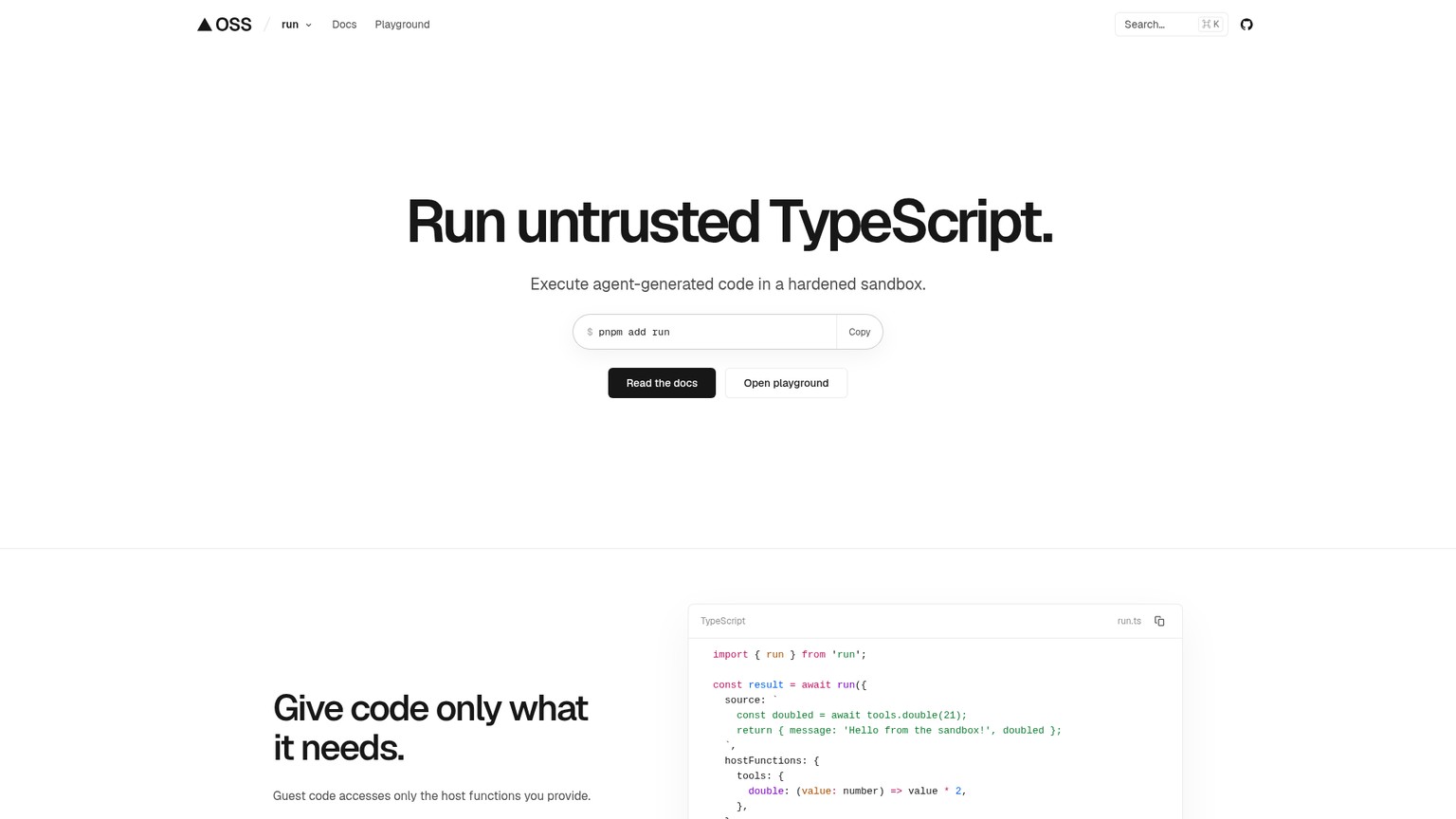
A useful example is a support agent that must fetch an order, inspect invoices, calculate an allowed refund, request a manager's approval, and publish the result. The generated program can perform the branching and parallel calls, while orders.get, billing.listInvoices, and orders.refund remain narrow host functions. If execution pauses for approval or authentication, the SDK returns a signed continuation; when the decision arrives, completed host calls are replayed from their recorded results instead of firing twice.
That replay behavior matters commercially. A normal restart can duplicate a charge, send a second message, or rerun a slow lookup. Run SDK makes “pause, approve, resume” an execution primitive, while your host functions remain responsible for authorization and idempotency. It also lets the application set timeout and memory limits globally or per run.
Best for: TypeScript agent plans that calculate, branch, and call a small approved tool surface
Standout: Signed approval/auth continuations without repeating settled host calls
Pricing: Apache-2.0 package with no separate SDK subscription; host compute, model, database, and API costs remain
Free trial: Open source; supports Node.js 22.13+ and Bun
- Removes Node.js, filesystem, environment-variable, module, and network access by default
- Keeps credentials and business authorization in the host application
- Fresh context, disabled dynamic evaluation, hardened prototypes, time limits, and memory limits
- Powers Code Mode inside the Vercel AI SDK
- JavaScript and type-stripped TypeScript only
- No shell, native package installation, arbitrary process tree, or full Linux filesystem
- Security still depends on the host functions enforcing ordinary authorization rules
Inventory ambient authority
List every database client, secret, filesystem path, network destination, and service method the current agent code can touch. Anything not required for the task should disappear from the generated program's world.
Define narrow host functions
Expose business operations such as
orders.list,refunds.quote, ordrafts.publish, not a generic HTTP client. Validate the user, tenant, resource, and allowed action again inside every host function.Set a hard execution envelope
Choose memory and timeout limits from observed payload sizes and latency. Treat serialization across the boundary as a feature: it prevents a live database client or secret-bearing object from leaking into generated code.
Add the approval seam
Interrupt before irreversible actions, store the signed continuation beside the approval request, and resume only after a recorded decision. Keep the host operation idempotent even though settled calls are not repeated.
Route OS jobs elsewhere
If a task asks for
apt, Docker, a compiler, a repository checkout, Python, or a server process, send it to the remote-sandbox pool. Do not weaken the Run SDK boundary to make one exceptional job fit.
2. E2B: best general-purpose microVM default
E2B is the strongest general default when “run this code” genuinely means “give the agent a Linux computer.” Every sandbox uses Firecracker microVM isolation, and the platform supports commands, files, custom templates, package installation, code-interpreter sessions, and any language or framework that runs on Linux. It is the clean middle ground between an application-scoped evaluator and a persistent personal machine. The main wall is economic: E2B meters CPU and memory for every second the sandbox is running, not only the moments when code is busy.
E2B fits a repository-repair agent that starts from a prepared template, clones a project, installs missing dependencies, runs tests, changes files, and returns a patch. Code Interpreter adds a convenient stateful notebook surface for analysis, while the lower-level Sandbox API handles normal Linux commands and files. A custom template can move repeated setup out of the hot path.
The free Hobby plan is unusually usable for evaluation, but its one-hour session cap becomes a hard boundary for larger builds. Pro stretches sessions to 24 hours and raises concurrency, but its $150 monthly floor arrives before usage. Teams should calculate whether that plan buys needed session length and concurrency or merely turns an inexpensive prototype into a fixed bill.
Best for: Multi-language code execution, repository work, data analysis, and package-heavy agents
Standout: Firecracker microVMs with a mature Linux sandbox and Code Interpreter surface
Pricing: Hobby $0 + usage with $100 one-time credits, 1-hour sessions, 20 concurrent · Pro $150/mo + usage, 24-hour sessions, 100 concurrent and purchasable capacity to 1,100 · Ultimate/Enterprise custom + usage; CPU $0.0504/vCPU-hr, memory $0.0162/GiB-hr
Free trial: Hobby includes one-time $100 usage credits; 10 GiB storage on Hobby and 20 GiB on Pro are free
- Hardware-isolated Firecracker environment for untrusted Linux work
- Broad language and package compatibility
- Custom templates reduce repeated dependency setup
- Clear per-second CPU and memory rates
- Pro begins at $150/month before usage
- Idle waits inside a running session still accrue CPU and memory charges
- Hobby sessions stop at one hour
3. Vercel Sandbox: best for Vercel and AI SDK teams
Vercel Sandbox is the best full-machine choice when the application, agent loop, and deployment already live on Vercel. Each sandbox is a Firecracker microVM with its own Linux filesystem and network; Ubuntu, apt-get, sudo, Docker, FUSE, package installs, background services, snapshots, and up to 15 exposed ports are supported. Active CPU pricing makes bursty execution attractive. The hard wall is provisioned memory: even while the CPU is idle, RAM remains on the bill while the sandbox is open.
The fit sharpened in August 2026. Claude Managed Agents can now keep Anthropic's model, harness, tools, and session state while using a Vercel Function as the control plane and one Vercel Sandbox per session. Credential brokering at the firewall means an outbound request can receive a secret without that credential entering the microVM. The same pattern works for an AI SDK agent: broad package access during setup, then a tighter network policy before untrusted execution.
Hobby is useful for non-commercial experimentation, but it cannot buy overages and caps a sandbox at 45 minutes and four vCPUs. Pro raises the duration to 24 hours and compute to eight vCPUs; Enterprise reaches 32. The default five-minute duration is a helpful cost guard, not a workload limit–set longer only where the task warrants it.
Best for: Vercel-hosted agents, AI SDK code execution, Claude Managed Agents, previews, and I/O-heavy Linux work
Standout: Firecracker isolation plus active CPU billing, runtime network policy, credential brokering, and snapshots
Pricing: Hobby $0 for personal non-commercial use · Pro $20/mo with $20 usage credit · Enterprise custom; Sandbox CPU from $0.128/active vCPU-hr, memory from $0.0212/provisioned GB-hr, creations from $0.60/million, transfer from $0.15/GB, snapshot storage from $0.08/GB-mo
Free trial: Hobby plan and a Pro free trial
- Full Linux microVM with Docker and elevated capabilities inside the boundary
- Active CPU avoids charging CPU during network or approval waits
- Credentials can be injected at egress instead of stored in the guest
- Strong fit with Vercel Functions, AI SDK, and Claude Managed Agents
- Memory remains provisioned and billable while the environment is open
- Hobby is non-commercial and cannot purchase overages
- The deepest capacity and 32-vCPU ceiling require Enterprise
4. Daytona: best for speed, runtime choice, and GPU range
Daytona is the best choice when startup latency and runtime variety matter more than a single isolation model. It offers sub-90-millisecond container creation alongside Linux VMs, Windows sandboxes, GPU machines, snapshots, volumes, SSH, browser VS Code, and web terminals. Secrets can stay outside the sandbox and be inserted at network egress. The wall is operational choice: a container, a VM, Windows, and a GPU box do not carry the same isolation, lifecycle, or cost profile, so teams must choose deliberately rather than treating “Daytona” as one homogeneous runtime.
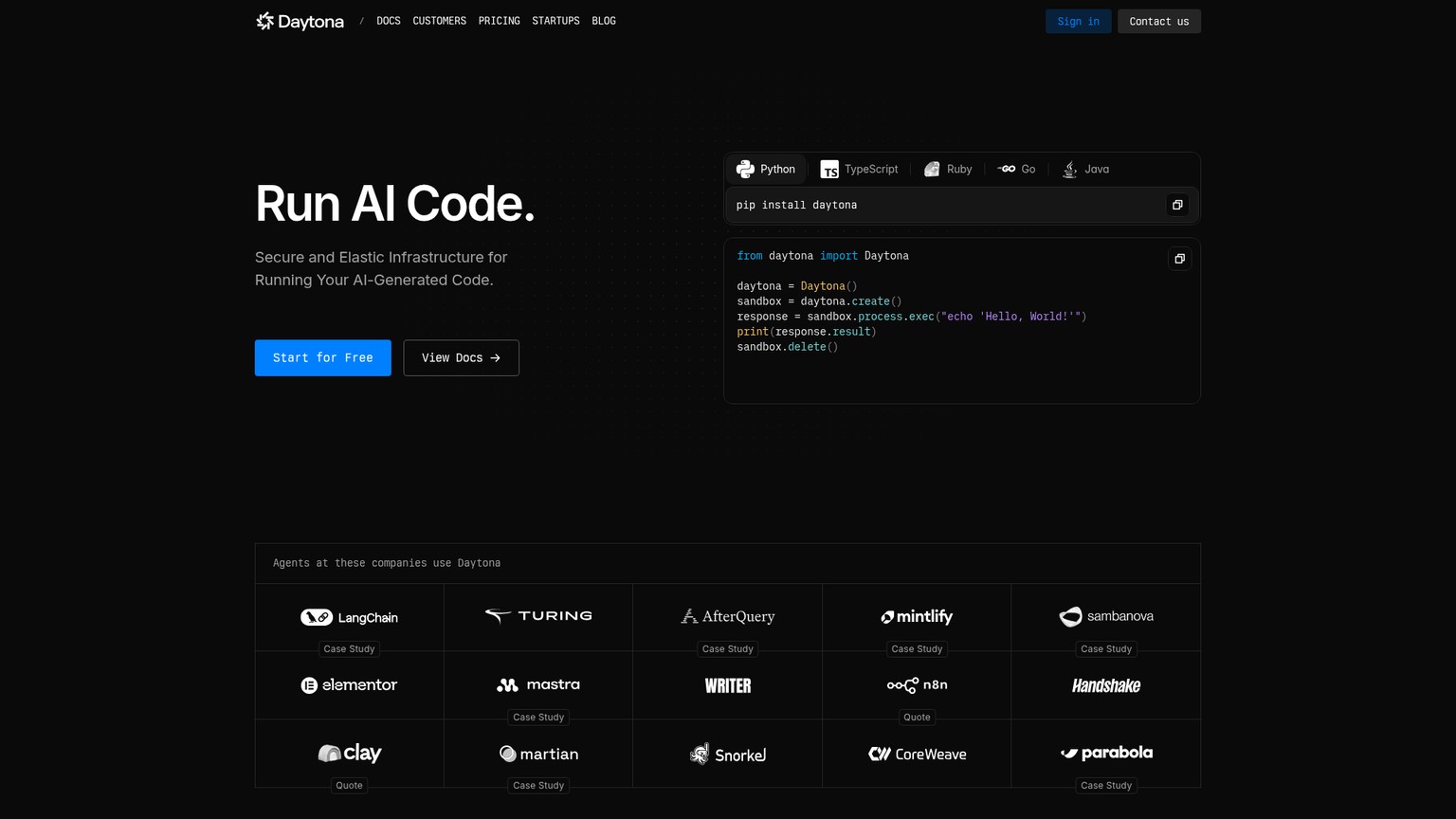
Daytona suits a coding product that must start thousands of short environments quickly, but occasionally route a build to Windows or a GPU. The default container path keeps the fast lane fast; a Linux VM is the stronger boundary for tasks that need VM semantics; GPU choices support inference, rendering, or model-adjacent work without introducing a second sandbox vendor. Stateful environments and snapshots keep repository setup reusable.
There is no recurring entry plan on the public rate card. Access expands through verified quota tiers: email verification starts with 10 vCPU, while a card and $25 top-up opens 100 vCPU; $500 and recurring $2,000 top-ups open the larger pools. That system is friendly to growing usage but should be recorded in capacity planning because top-ups change quotas as well as account balance.
Best for: High-churn coding sessions, heterogeneous runtimes, Windows tasks, and optional GPU execution
Standout: Sub-90ms container creation with container, Linux VM, Windows, and GPU choices
Pricing: $0.0504/vCPU-hr, $0.0162/GiB-hr, storage $0.000108/GiB-hr after 5 GiB, Windows $0.0858/vCPU-hr; GPU rates range from $0.57/hr RTX 4090 to $2.61/hr H200
Free trial: $200 in compute credits; Tier 1 email-verified, Tier 2 with card + $25 top-up, Tier 3 at $500 top-up, Tier 4 at $2,000 top-up every 30 days, Enterprise custom
- Fast container start for high-volume agent workloads
- One platform spans containers, VMs, Windows, and multiple GPU classes
- Stateful sandboxes, snapshots, volumes, and direct human access
- Secrets can stay out of the guest environment
- The buyer must choose the correct isolation model per route
- Larger resource quotas require increasingly large top-ups
- Stopped and paused states change what remains billed; lifecycle automation matters
5. Upstash Box: best persistent container with a coding agent included
Upstash Box is the most practical all-in-one option for a persistent container that already understands coding-agent work. Every Box has a filesystem, shell, process tree, network stack, git, and optional Claude Code or Codex agent; state survives across runs and a standard Box freezes when idle. Active CPU billing can make bursty repository work unusually cheap. Its hard wall is security policy: Box uses isolated Docker containers, not hardware microVMs, and currently runs only in AWS us-east-1.
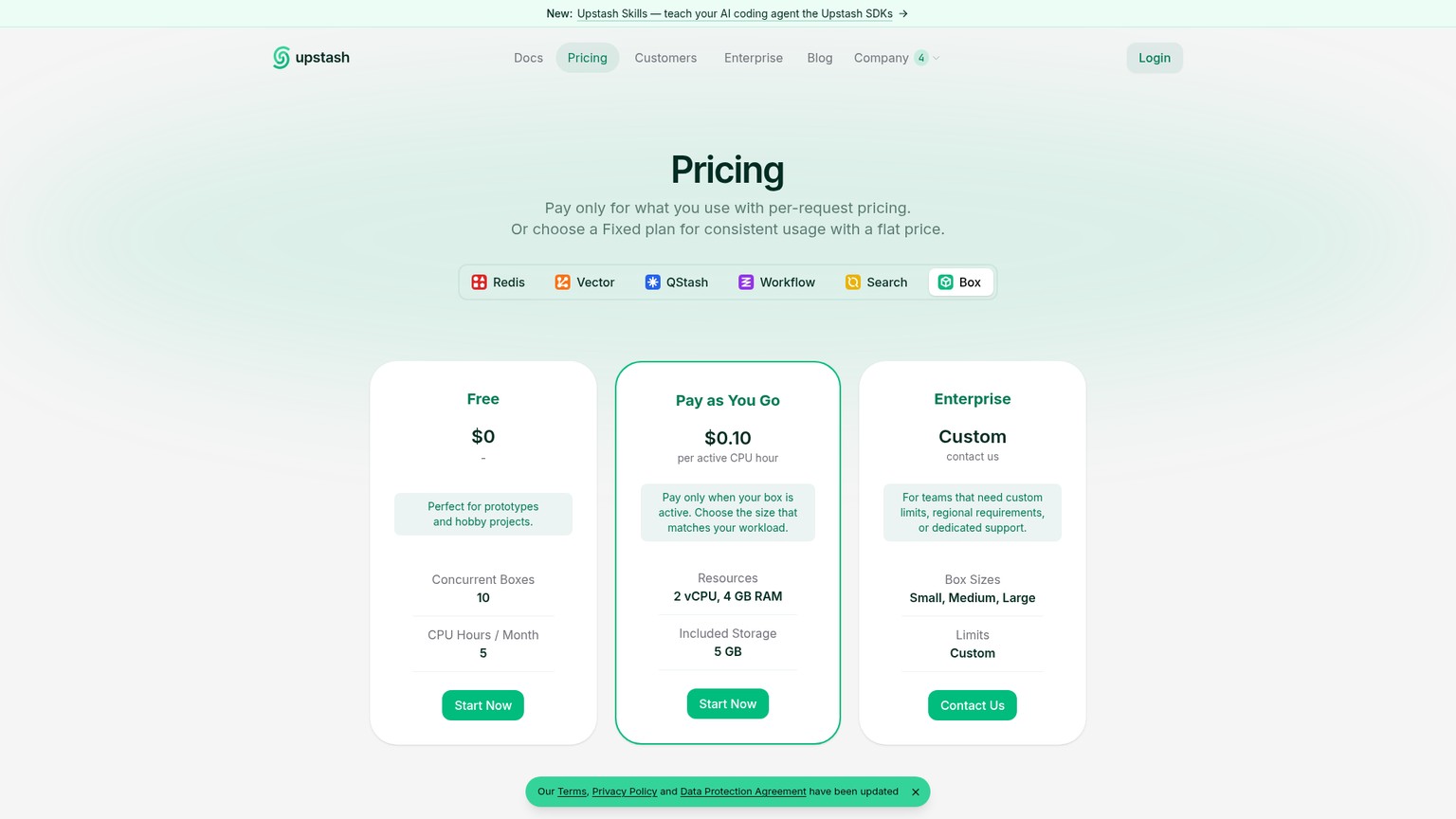
This is a strong fit for a small product team that wants one durable environment per project or customer. The agent can clone a repo, install packages, leave files and git history in place, pause, and reconnect later. A network policy can reduce the default open outbound access, which should be part of setup rather than a later hardening task.
The billing model rewards CPU-light waits. At the normalized million-task workload, one fully active core for five seconds per task is about $138.89, versus $555 for a one-vCPU/one-GiB environment billed across the full 30-second window. That is not a universal fourfold saving–the minimum Box has two vCPUs and four GB RAM, and sustained CPU or keep-alive changes the math–but it shows why the meter belongs in the buying decision.
Best for: Persistent repository agents, built-in Claude Code or Codex sessions, and bursty CPU use
Standout: Durable filesystem and coding agent with active-core billing and automatic pause
Pricing: Free $0 with 10 Boxes, 5 active CPU hours, $1 monthly agent-LLM budget · PAYG no monthly fee, 1,000 Boxes default, $100 LLM budget, Small $0.10/active CPU-hr, Medium $0.20, Large $0.40, storage $0.10/GB-mo · Enterprise custom; Keep Alive $8/$16/$32 per month by size
Free trial: Free plan; BYOK is available on all plans
- Built-in coding agent, shell, files, git, packages, and persistent state
- Paused Boxes stop active CPU charges
- Simple sizes and low fixed Keep Alive alternatives
- High default PAYG concurrency of 1,000 Boxes
- Docker-container boundary may not satisfy hardware-isolation requirements
- Only AWS us-east-1 is available today
- Outbound network is open by default until policy is configured
- Custom Docker images are planned, not currently available
6. Cloudflare Sandbox: best for Workers-native execution at the edge
Cloudflare Sandbox is the best fit when the control plane is already a Cloudflare Worker and the agent needs Linux execution near that edge application. The TypeScript SDK runs commands, manages files and background processes, creates persistent code contexts, exposes services, supports browser terminals and WebSockets, and can intercept outbound traffic so credentials stay in the Worker. The runtime is built on Cloudflare Containers and coordinated through Durable Objects. Its wall is the bill's shape: Sandbox usage is only one layer; Workers, Durable Objects, logs, and regional egress may add separate lines.
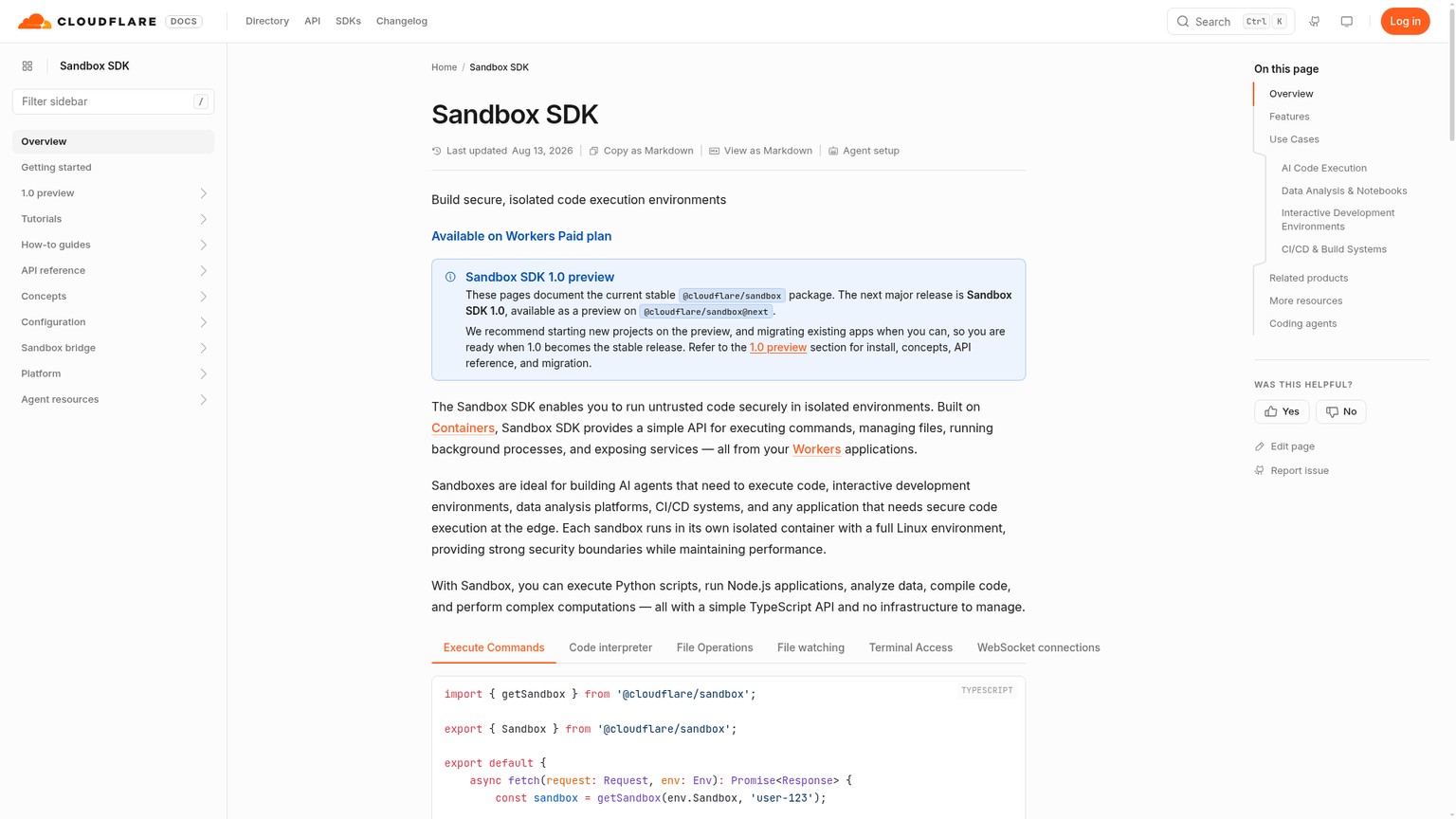
Choose it for an edge-hosted coding playground, data-analysis surface, or agent that must expose a preview service through the same Cloudflare application. S3-compatible object storage can be mounted for persistent files, and outbound handlers can allow, block, or rewrite requests. The current package also has a 1.0 preview track, so a new implementation should pin its release line instead of drifting between stable and @next behavior.
Cloudflare's entry fee is the $5 Workers Paid plan. The included container allowance is useful for prototypes, but the instance size matters: memory and disk are provisioned, while CPU is active-use. The smallest lite instance is 1/16 vCPU, 256 MiB RAM, and 2 GB disk; standard-4 reaches four vCPU, 12 GiB RAM, and 20 GB disk.
Best for: Workers-native applications, edge previews, browser terminals, and controlled outbound access
Standout: One TypeScript control plane for Worker, Durable Object, container, preview URL, and egress interception
Pricing: Workers Paid $5/mo includes 25 GiB-hours memory, 375 vCPU-minutes, 200 GB-hours disk; overage $0.009/GiB-hr memory, $0.072/vCPU-hr active CPU, $0.000252/GB-hr disk; egress after allowances is $0.025–$0.05/GB by region
Free trial: No free Containers tier; Workers, Durable Objects, and logs are billed separately
- Natural fit for Cloudflare Workers and Durable Objects
- Rich command, file, terminal, service, WebSocket, and code-context APIs
- Active CPU billing and scale-to-sleep container behavior
- Outbound interception can keep secrets in the Worker
- Container rather than microVM isolation
- Multi-product billing is harder to estimate than one sandbox rate
- Memory and disk charge on selected instance size while active
- Stable and 1.0-preview package lines require deliberate version pinning
7. Modal Sandboxes: best for data and GPU workloads
Modal Sandboxes are the strongest pick when sandboxed code sits beside serverless data or GPU work. The standard path uses gVisor, can burst beyond requested CPU and memory, and supports GPU Sandboxes; an experimental VM runtime provides a real Linux kernel and is the recommended route for Docker. The key wall is the split: VM Sandboxes do not currently support GPUs, while GPU Sandboxes can be preempted. A team that needs both full VM semantics and GPU execution in the same sandbox must look elsewhere.
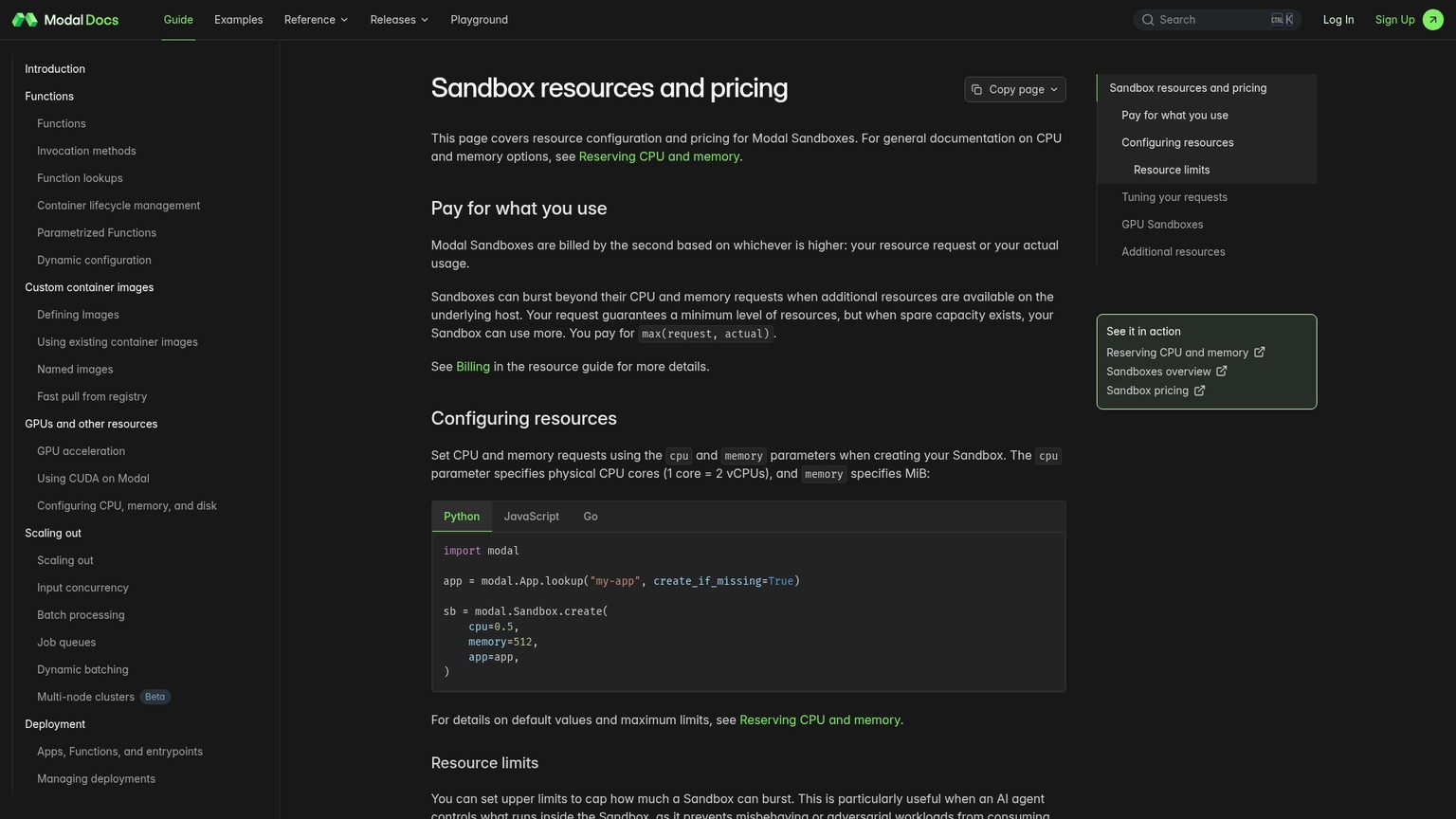
Modal makes sense for an analysis agent that executes Python, transforms a dataset, renders a result, then occasionally escalates a job to a GPU. Resource limits can cap bursts when an agent controls the workload. Billing uses the higher of requested or actual CPU and memory, so requests should be set near observed demand rather than an imagined peak; the vendor recommends tuning CPU around the middle of observed use and memory nearer the upper tail.
The Starter plan's $30 monthly compute credit can cover meaningful evaluation. Team's $250 floor is justified by far higher container capacity, more GPU concurrency, and unlimited seats–not by a lower unit price. VM users should also note that one Modal physical core equals two vCPUs when comparing rate cards.
Best for: Python analysis, scientific workloads, burstable compute, and agents that sometimes need GPUs
Standout: Serverless sandbox execution beside a broad GPU catalog and resource caps
Pricing: Starter $0 with $30 monthly compute credit, 3 seats, 100 containers, 10 GPU concurrency · Team $250/mo with $100 credit, unlimited seats, 5,000 containers, 50 GPU concurrency · Enterprise custom; Sandbox CPU $0.141912/physical core-hr, memory $0.024012/GiB-hr, listed GPUs $0.000164–$0.001972/sec
Free trial: Starter's recurring $30 monthly compute credit
- Strong fit for data, ML, and GPU-adjacent agent workloads
- Resource requests and hard upper limits can constrain generated work
- Starter credit recurs monthly
- VM runtime adds Docker and real-kernel behavior when GPUs are not needed
- GPU Sandboxes are preemptible
- VM Sandboxes currently do not support GPUs
- Billing at max(requested, actual) punishes persistent over-allocation
- Team starts at $250/month before usage
8. Runloop Devboxes: best for coding-agent evaluations
Runloop Devboxes are the best choice when the sandbox is part of a coding-agent evaluation system, not merely a place to execute a command. Devboxes combine microVM and container isolation, then add Blueprints, snapshots, branching, repository connections, SSH/CLI/IDE access, public benchmarks, and custom evaluation scenarios. Runloop publishes support for more than 10,000 parallel sandboxes. The wall is price positioning: its raw compute rate is higher than several general sandbox vendors, and the production-oriented Pro plan starts at $250 per month before usage.
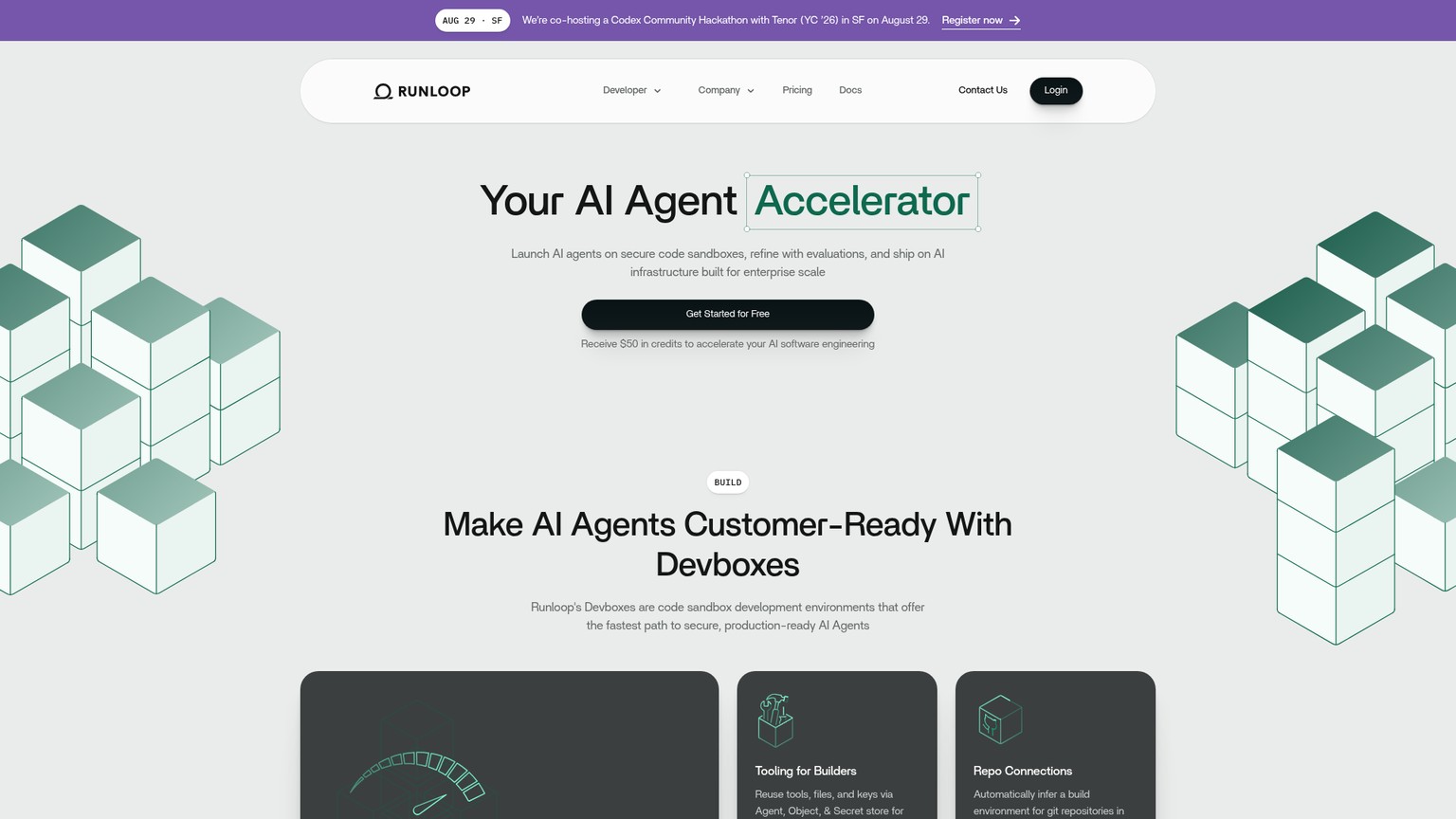
That premium can be rational when it replaces an internal evaluation stack. A team shipping a repository-editing agent needs reproducible starting states, scenario definitions, pass/fail criteria, production-like private cases, and a way to compare versions–not just Linux. Runloop puts those artifacts beside the Devbox lifecycle, which shortens the path from “the agent ran” to “this release improved on the cases that matter.”
Basic is enough to prove the workflow. Pro buys suspend/resume, connected repositories, custom benchmarks, beta access, Slack support, and ten times the included storage. Enterprise is where VPC deployment and regulated workloads enter.
Best for: Coding-agent benchmarks, regression evaluation, reproducible repository tasks, and enterprise rollout
Standout: Devboxes and benchmark infrastructure under one platform
Pricing: Basic $0 + usage with 100 GB free storage · Pro $250/mo + usage with 1 TB free storage · Enterprise custom; compute $0.108/CPU-hr + $0.0252/GB-hr, Devbox storage $0.00034236/GB-hr, Blueprint/snapshot/object storage $0.000072/GB-hr
Free trial: Pro trial with $50 usage credit; trial limits include 3 running Devboxes, 5 Blueprints, 10 snapshots, and 3 objects
- Evaluation, benchmarks, templates, snapshots, and Devboxes are integrated
- Hardware and container isolation layers
- Repository, IDE, CLI, and SSH workflows suit coding agents
- Clear path to VPC and regulated deployments
- Higher raw compute price than several general-purpose alternatives
- Pro is $250/month before usage
- Overkill for a simple code-interpreter or one-off shell command
9. Blaxel Sandboxes: best for instant-resume stateful fleets
Blaxel Sandboxes are the best choice when an agent needs a personal microVM that can disappear from the compute bill and wake with memory, processes, and files intact. A sandbox shifts to standby after roughly 15 seconds without an active connection and resumes in under 25 milliseconds. REST and MCP surfaces expose processes and files, while ports, previews, proxy/firewall rules, volumes, custom images, and code-generation tools fill out the machine. The wall is standby storage: active memory stops billing, but snapshots or attached volumes continue, and premium support can dwarf compute spend.
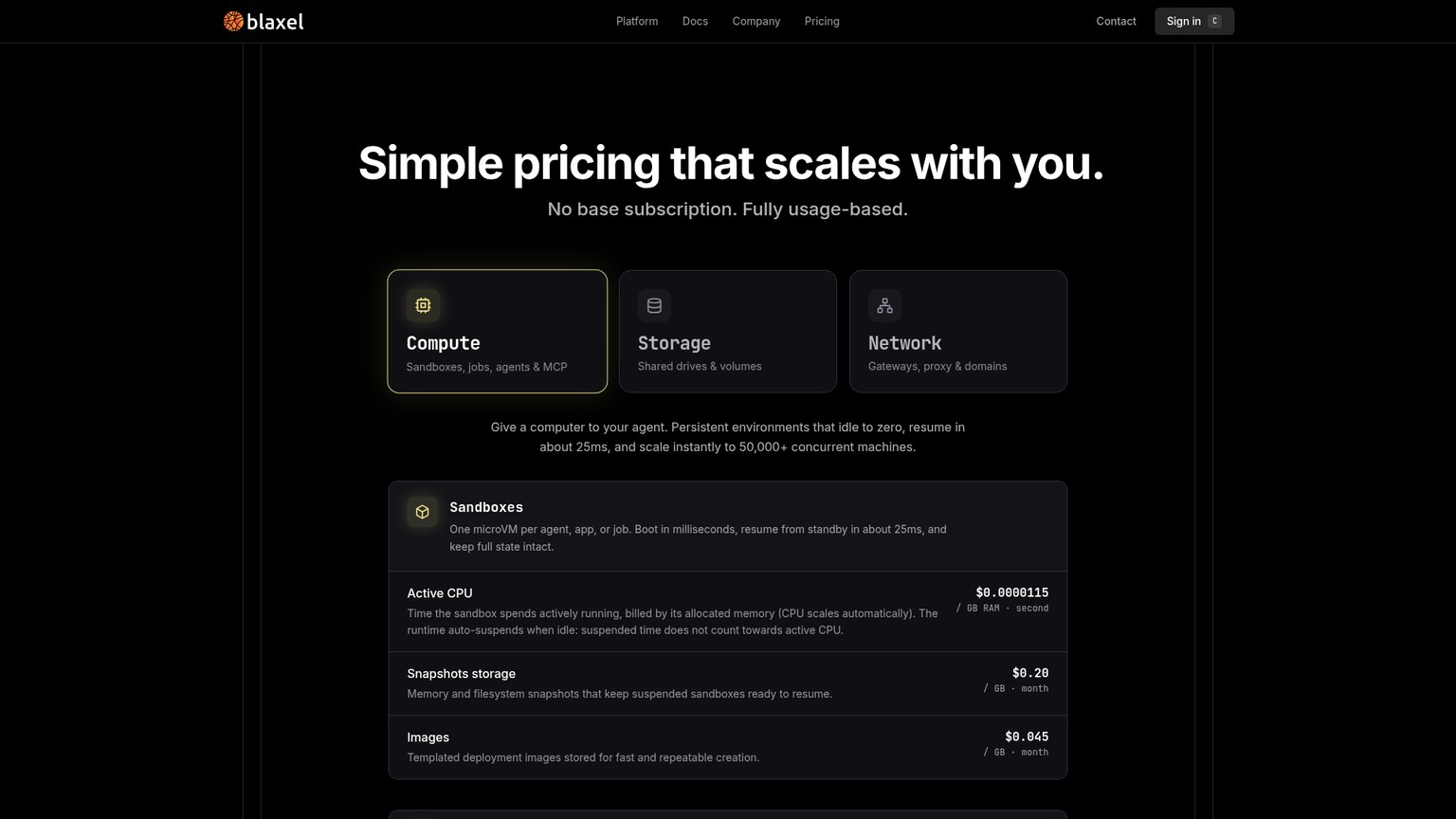
This lifecycle fits a customer-facing coding agent whose environment should feel continuous across many short visits. The process tree and filesystem can return from warm standby rather than rebuilding a repository and development server. Long-cold projects can be archived to preserve files without preserving live memory, which is cheaper but slower to recover.
Blaxel has no base subscription on PAYG and includes up to $200 in credits. The active rate is tied to allocated RAM, with CPU scaling alongside memory instead of appearing as a separate line. Quota tiers start free at 10 sandboxes, then publicly disclose $20 and $50 top-up levels for 50 and 200; the remaining levels continue through Tier 9 at 100,000-plus and are exposed in the console.
Best for: Stateful agent sessions, per-customer computers, MCP-driven environments, and fast resume
Standout: MicroVM standby that restores memory, processes, and filesystem in under 25ms
Pricing: PAYG $0 + usage with up to $200 credits · Custom pricing adds up to 256 GB RAM and private networking; active sandbox $0.0414/allocated GB RAM-hr, snapshots $0.20/GB-mo, images $0.045/GB-mo; optional email support $800/mo, Slack $1,600/mo, HIPAA $250/mo
Free trial: Free Tier 0 quota for 10 sandboxes; higher top-up tiers scale to 100,000-plus
- Hardware-isolated microVM per agent, app, or job
- Warm standby preserves live memory and process state
- REST and MCP control surfaces suit agent integration
- No base subscription on PAYG
- Snapshot and volume storage continue while compute sleeps
- Most intermediate quota-tier details live behind the console
- Premium support add-ons are expensive for small teams
- External network connections do not survive standby restoration
10. Fly.io Sprites: best persistent Linux computer for one agent
Fly.io Sprites are the best fit when the product metaphor really is “one durable Linux computer per agent.” A Sprite has a normal POSIX filesystem, 100 GB volume capacity billed on actual use, live and automatic checkpoints, restore, service URLs, and Connectors that let the machine call external services without holding provider credentials. Running is billable; warm and cold compute states are not. The wall is memory economics: Fly itself warns that RAM usually dominates the invoice, and subscription allowances do not make overages unlimited.
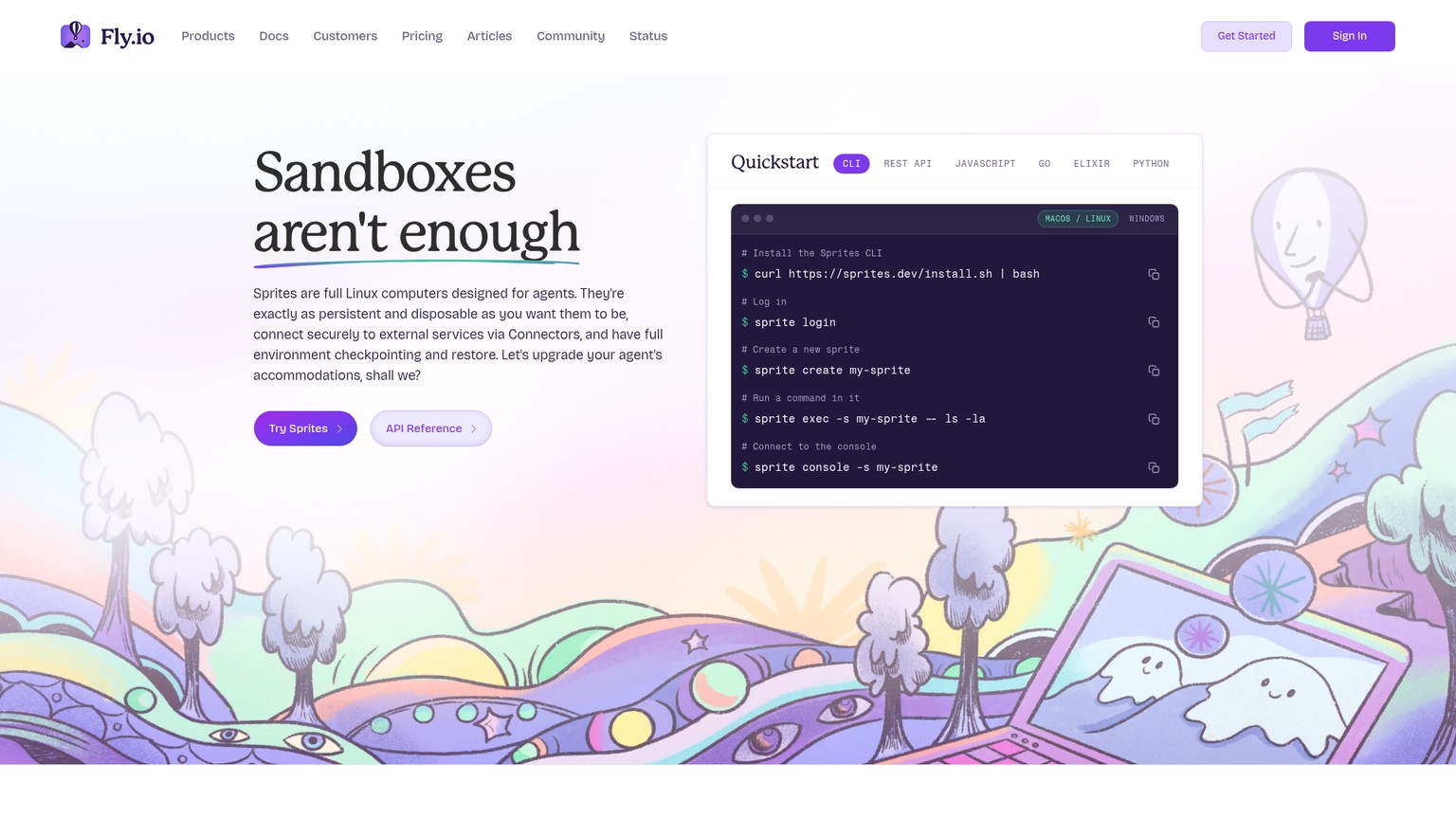
Sprites suit a long-running coding agent that installs tools once, keeps its repository and local database in familiar paths, serves previews, and returns to earlier disk checkpoints after a bad change. The whole writable filesystem is captured, not a suspended instruction pointer, so restore rewinds files and packages. Connectors separate credentials from the guest while preserving the ordinary Linux workflow.
PAYG is enough for a few intermittent machines. Paid plans mainly buy bundled CPU, RAM, storage, concurrency, and support. Because overage is still billed at standard rates, the correct plan is the cheapest allowance around measured use–not the highest badge the budget permits.
Best for: Durable Linux workspaces, long-lived coding agents, local databases, and checkpoint-based recovery
Standout: A persistent ordinary filesystem with automatic checkpoints and zero compute charge while warm or cold
Pricing: PAYG $0 + usage · Adventurer $20/mo · Veteran $50 · Hero $100 · Champion $200 · Legend $500 · Epic $1,000 · Mythic $2,000 · Guild custom; usage $0.07/CPU-hr, $0.04375/GB RAM-hr, hot storage $0.000683/GB-hr, cold storage $0.000027/GB-hr; overages use standard rates
Free trial: $30 credit, once per granting user and receiving organization; Sprites egress is currently unmetered
- Normal persistent Linux and POSIX filesystem
- Automatic and live checkpoints with full-disk restore
- Warm and cold states stop compute billing
- Connector model keeps external credentials outside the machine
- Memory can dominate total cost
- Plans bundle allowances rather than eliminating usage overage
- Seven paid price steps make plan selection less simple
- Persistence is unnecessary overhead for disposable tasks
Who should pick what
Pick Vercel Run SDK when the generated program can be described as “calculation plus approved application calls.” The choice flips away from Run SDK the first time the task truly needs a shell, arbitrary network client, native dependency, another language, or an untrusted repository.
Pick E2B when a cloud-neutral Linux microVM is the product primitive. It is the sensible default for code interpreters, repository agents, and package-heavy execution, especially before special persistence, GPU, or edge requirements appear.
Pick Vercel Sandbox when the application is already on Vercel and active CPU, AI SDK integration, Claude Managed Agents, network policy, and credential brokering remove more engineering than a neutral vendor would save. Compare its provisioned-memory line carefully for slow, wait-heavy sessions.
Pick Daytona when speed and compute diversity are real requirements: fast containers for most jobs, Linux VMs for stronger semantics, Windows for platform-specific tasks, and GPUs for the exceptional route. If the team cannot state which route uses which boundary, the flexibility will become ambiguity.
Pick Upstash Box when state should persist, the CPU is bursty, and container isolation passes the threat model. It is the most direct choice for a small team that wants Claude Code or Codex inside each durable workspace without assembling the agent layer separately.
Pick Cloudflare Sandbox when Workers and Durable Objects are already the control plane. Its edge-native value disappears if the rest of the stack lives elsewhere, so ecosystem fit should be treated as the primary criterion rather than a bonus.
Pick Modal when sandboxed execution is attached to a data, scientific, or GPU pipeline. The decision flips to Daytona if one environment must combine VM semantics and GPUs, or to E2B if the workload is ordinary Linux without serverless ML adjacency.
Pick Runloop when the business problem is shipping a more reliable coding agent, and repeatable benchmarks, scenarios, and regressions are more valuable than the cheapest CPU. Its premium is hard to justify for a generic code interpreter.
Pick Blaxel when thousands of agent computers must feel present while mostly sleeping. Pick Fly.io Sprites when durable Linux, conventional paths, and checkpoint recovery matter more than the fastest process-memory resume.
For a deeper threat-model pass, pair this guide with the AI sandbox security tools comparison. If the sandbox is only one layer in a larger coding-agent product, the embeddable coding-agent harness roundup covers the agent loop above it, while the AI code hosting guide covers where the resulting applications live.
How these were picked
This is a compared and verified ranking, not a claim that every vendor was deployed under production load. Each listed price, tier, limit, isolation statement, and named capability was checked against the vendor's live product, documentation, or pricing page on August 28, 2026. The cost model is transparent arithmetic from those rates, with credits, storage, egress, and control-plane charges called out rather than hidden.
The selection criteria were:
- Boundary clarity: Is this QuickJS, a container, gVisor, a microVM, or a persistent full computer–and does the vendor say so plainly?
- Agent fit: Can it manage commands, files, processes, packages, previews, repositories, approvals, or agent-specific state without a homemade control plane?
- Lifecycle economics: What is billed while code runs, waits, sleeps, snapshots, or persists?
- Operational escape hatches: Are there timeouts, resource caps, network policies, secret brokering, snapshots, regions, and an enterprise route?
- Honest wall: Every winner needs a reason to skip it. A ranking with ten universal recommendations is sales copy, not buying advice.
The order rewards the architecture that prevents unnecessary spend first, then the strongest general remote default, then increasingly specialized wins. That is why a lightweight SDK can rank above a more capable VM without pretending it does the VM's job.
The ones to avoid for this exact job
Raw eval() and Node's vm module
Do not treat a language feature as a multi-tenant security boundary. Generated code should not inherit application secrets, network clients, or filesystem reach merely because it is convenient to execute. If the job is small enough for in-process execution, use a hardened evaluator with explicit capabilities; if it needs ambient OS access, move it to an actual isolated environment.
Plain shared-host Docker as the only untrusted-code boundary
Docker is valuable packaging, but a container shares the host kernel. Upstash and Cloudflare make their container model explicit and surround it with managed isolation and lifecycle controls; that can be correct for many workloads. A homemade docker run on a shared production host is a different risk decision. Use a microVM when hostile tenant code, regulation, or the blast radius demands hardware isolation.
Human-first cloud IDE workspaces used as a per-task backend
GitHub Codespaces, Replit workspaces, and similar developer environments can be excellent places for a person to build. They are not automatically the right API primitive for creating and destroying thousands of untrusted agent jobs. Buy them for the human development experience; buy an agent sandbox for programmable lifecycle, isolation, metering, concurrency, and machine-readable outputs.
A persistent computer for a disposable calculation
Fly.io Sprites and Blaxel are compelling precisely because state survives. If every task begins from a clean template and returns one result, persistence adds snapshot storage, cleanup policy, and tenant-state risk without creating user value. Use the cheapest disposable boundary that satisfies the work.
The Monday move
Start with the generated-code paths already in production, not a vendor bake-off. One hour of inventory usually reveals that “agent code execution” is three different jobs hiding behind one queue.
Label the authority
Mark each path host tools, full OS, or persistent computer. Host tools means every effect can be an explicit application function. Full OS means packages, processes, repositories, or arbitrary languages. Persistent computer means yesterday's filesystem or process state is part of the product.
Route the light path first
Move one reversible, high-volume TypeScript plan behind Run SDK-style host functions. Keep the existing remote sandbox as the fallback for unsupported jobs. This makes the saving measurable without betting the workflow on a full migration.
Instrument all the clocks
Log environment-open seconds, active CPU seconds, provisioned memory, startup time, storage growth, transfer, retries, and approval waits. A provider comparison without these fields will optimize the rate-card headline instead of the invoice.
Prove the security seam
Attempt forbidden network calls, secret reads, filesystem escape, excessive output, infinite loops, and duplicate side effects around approval. Route failures by class; do not silently widen the boundary.
Review after one billing cycle
Keep the lightweight route if it removes remote runtime without increasing failures. Keep the heavier provider only for jobs that used its OS, persistence, GPU, evaluation, or region advantage. The goal is not one vendor–it is one explicit reason for every meter on the bill.

Frequently asked questions
Which sandbox tool is considered the best?
Vercel Run SDK is the best first boundary for agent-written JavaScript or TypeScript that only coordinates approved application tools. E2B is the best general-purpose remote Linux microVM. Vercel Sandbox is the best full-OS fit for teams already using Vercel, the AI SDK, or Claude Managed Agents. The requirement that flips the choice is operating-system access.
What are the best free AI agent code sandboxes in 2026?
Run SDK is an Apache-2.0 package with no separate SDK subscription. E2B Hobby is $0 plus usage and includes one-time $100 credits. Vercel Hobby is $0 for personal non-commercial use. Upstash Box has a $0 Free plan, Modal Starter includes $30 of monthly compute, Runloop Basic is $0 plus usage, Blaxel offers up to $200 credits, Daytona offers $200 compute credits, and Fly.io Sprites offers $30. Read the time, concurrency, commercial-use, and overage limits before treating any of them as free production infrastructure.
How do I set up an agent sandbox to continue Codex?
Use a persistent environment such as Upstash Box, Blaxel, or Fly.io Sprites when Codex should return to the same repository and installed tools. Store the sandbox ID against the project, pause rather than delete after a session, checkpoint before risky changes, and keep repository or provider credentials outside the guest through scoped tokens or credential brokering. If every job starts clean, use a snapshot-backed disposable microVM instead.
How do you deploy AI agents on Kubernetes?
Treat Kubernetes as the control plane, not the security boundary by itself. Give every untrusted job a clearly isolated pod or VM-backed runtime, apply CPU/memory/ephemeral-storage limits, default-deny egress, inject short-lived credentials outside generated code, and delete or archive state on an explicit lifecycle. A managed Kubernetes platform can reduce that operational load, but a purpose-built sandbox API is usually faster for the first production agent.
Want the authority, risk, and cost questions in one working sheet? Download the AI Business Workflow Audit Checklist and classify the first three execution paths on Monday.
- Last Updated
- Category
- Build
- Language

Gumloop vs n8n (Verified October 2026)
Gumloop vs n8n: current pricing, credits vs executions, self-hosting and the same AI lead workflow, with a verdict for each builder.Oct 7, 2026Build
AI Agent Frameworks in 2026: LangGraph, CrewAI, OpenAI Agents SDK, Claude Agent SDK, Mastra and Google ADK (Compared)
Compare eight AI agent frameworks by language, state, MCP, approvals and current hosted prices. Pick the right runtime for production.Oct 7, 2026Build
Codex Cloud
Set up a reusable Codex Cloud environment, keep coding tasks running with your laptop off, steer from your phone, and choose cloud or local CLI.Oct 7, 2026Build
GitHub Copilot Pricing (2026): The Seat Is the Floor, Credits Are the Bill
GitHub Copilot plans, AI Credits, model rates, and three worked monthly bills. Choose Pro, Pro+, Max, Business, or Enterprise with spending limits.Oct 6, 2026Build
GitHub Copilot CLI
Install GitHub Copilot CLI, sign in, fix tests and open a PR. Current GitHub plans, AI credits, models, permissions, MCP and instructions.Oct 6, 2026Build
Best Web Scraping Tools in 2026: Firecrawl, Bright Data, Browse AI, and Context.dev (Compared)
Choose web scraping tools by the job: agent-ready pages, no-code monitoring, or collection at scale. Eight tools with verified prices and billing units.Oct 6, 2026Build
Agent Memory Explained: Context, Sessions, Stores and Costs
Agent memory explained for builders: context, sessions, long-term stores, files and skills, provider costs, and fixes for stale facts and user leaks.Oct 5, 2026Build