Best AI Agent Token Tracking Tools 2026
Eight AI agent token tracking tools compared on cost attribution, controls, live pricing, and when built-in usage stops being enough.
Published
 By Omid Saffari



The best AI agent token tracking tools 2026 list has a blunt winner: Langfuse gives a production team cost attribution and unlimited users from $29/month. Claude Code's new /usage loop rows make a separate dashboard unnecessary for one developer; buy one only when you need cross-model chargeback, hard budgets, or trace-level accountability.
Best AI Agent Token Tracking Tools 2026: At a Glance
Langfuse is the best overall choice for most product and platform teams. Its $29/month Core plan combines token and cost tracking with unlimited users, useful retention, trace context, and a billing model a budget owner can explain. Portkey takes the lead when requests must stop at a budget boundary. OpenLIT is the stronger answer when data ownership matters more than avoiding infrastructure work.
Prices and limits below were verified against every vendor's live pages on September 1, 2026. Starting price means the first paid platform tier that a small production team can plausibly use. Model inference, storage overages, self-hosting infrastructure, and implementation labor remain separate unless stated otherwise.
The Eight Picks at a Glance
A free dashboard is not a free control plane. Claude Code, Langfuse, Braintrust, Arize, LangSmith, and Datadog can make spend visible, but visibility does not automatically prevent the next expensive run. Portkey exposes granular budgets and rate limits on Enterprise and select Pro plans. Helicone can cap request count or cost in cents by user or another custom property. That distinction should decide the shortlist before interface preference does.
Agent Observability Starts Where Token Counting Stops
Agent observability is the ability to explain what an agent did, what each step cost, who caused it, and whether the result was worth the spend. A token counter answers only one part of that chain. An agent may call a model five times, retrieve context, invoke tools, retry an error, and finish with a bad answer. The finance question is not “how many tokens?” It is “which customer workflow consumed them, and did that workflow succeed?”
Claude Code has moved the baseline. Its current /usage documentation says the Session view shows detailed token statistics and a locally estimated dollar amount. On subscription plans, Claude Code v2.1.242 or later also shows a Loops row for the heaviest /loop or scheduled tasks, including run count, total tokens, tokens per run, and the most recent run. A solo technical builder can now identify a runaway recurring task without buying another dashboard.
That local view has a hard boundary. Day and Week are approximate views computed from local session history for the past 24 hours or 7 days. They exclude work on other devices and claude.ai. The documented route for near-real-time, per-user metrics across an organization is OpenTelemetry export into the company's own observability stack.
AI Agent Observability Adds Workflow Context
Imagine a support agent that spends $0.18 on one ticket and $1.40 on another. A token screen identifies the expensive ticket. AI agent observability shows that the second ticket retried the same tool four times, used a premium model after an escalation, and still ended in a human handoff. Now the owner can change routing, set a budget, and measure cost per resolved ticket instead of cost per prompt.
The useful record has four layers:
- Run: one complete agent attempt, including model calls and tools.
- Attribution: customer, user, team, environment, workflow, or feature that owns the run.
- Outcome: success, failure, escalation, latency, quality score, or revenue event.
- Control: an alert before the budget becomes painful, plus an enforceable cap when the workflow must stop.
This is why a cheap dashboard can be expensive. If the team spends two hours each Friday joining model invoices to customer IDs, a $29 platform can repay itself quickly. If no one reviews the data or owns a unit-cost target, even a free open-source stack becomes another system to operate.
How These AI Agent Observability Tools Were Picked
These AI agent observability tools were priced and compared against their live product pages, not presented as hands-on trials. Eight tools made the list because each can connect model usage to a richer production record. Products that only display a provider invoice, estimate a generic chatbot total, or describe observability without current public evidence were cut.
Agent Observability Tools Need Four Tests
The ranking turns on four practical tests.
- Can it calculate cost accurately? The tool must accept provider-reported usage or map model and token counts to a current price. Private models need a custom-price path. A silent
$0.00is worse than a visible “unknown.” - Can it attribute the cost? User, customer, workflow, model, environment, and outcome tags turn a bill into a decision. A total without an owner cannot support chargeback.
- Can it control the next request? Alerts score partial credit. Cost budgets, request limits, or gateway policies score more because they can change execution.
- Can a buyer understand the meter? Traces, spans, requests, observations, scores, and processed gigabytes are not interchangeable. Public pricing receives more weight than an opaque sales quote.
Trace context and evaluation break ties. A platform that shows the failed tool call behind a cost spike is more useful than one that only draws a rising line. Data ownership matters too, particularly for companies that cannot send prompts, outputs, or customer metadata to another SaaS product.
LLM Observability Tools Must Earn the Dashboard
The best LLM observability tools earn their place by changing a weekly decision. A product owner should be able to answer three questions in minutes: Which workflow's unit cost rose? Was the increase caused by volume, model choice, retries, or longer context? What routing, prompt, cache, or policy change should happen next?
A platform that cannot answer those questions is telemetry storage, not cost management. That may still be useful for debugging, but it should not be bought from the token budget. The distinction also explains why this list includes evaluation-centered products such as Braintrust and Arize, yet ranks enforcement-oriented Portkey and Helicone higher for a pure cost-control job.
The 8 Ranked Tools
1. Langfuse Agent Observability: Best Overall
Langfuse Agent Observability is the best overall choice because Langfuse gives a production team cost attribution, trace context, flexible hosting, and unlimited users at a $29/month entry point. A B2B SaaS platform can tag every generation by customer, feature, environment, and release, then use dashboards or the Metrics API to compare cost per completed workflow. Its wall is enforcement: Langfuse documents threshold alerts, while a gateway or application policy still needs to reject an over-budget request. The quotable verdict is simple: pick Langfuse when the ledger and the trace belong together, then add enforcement only where loss exposure justifies it.
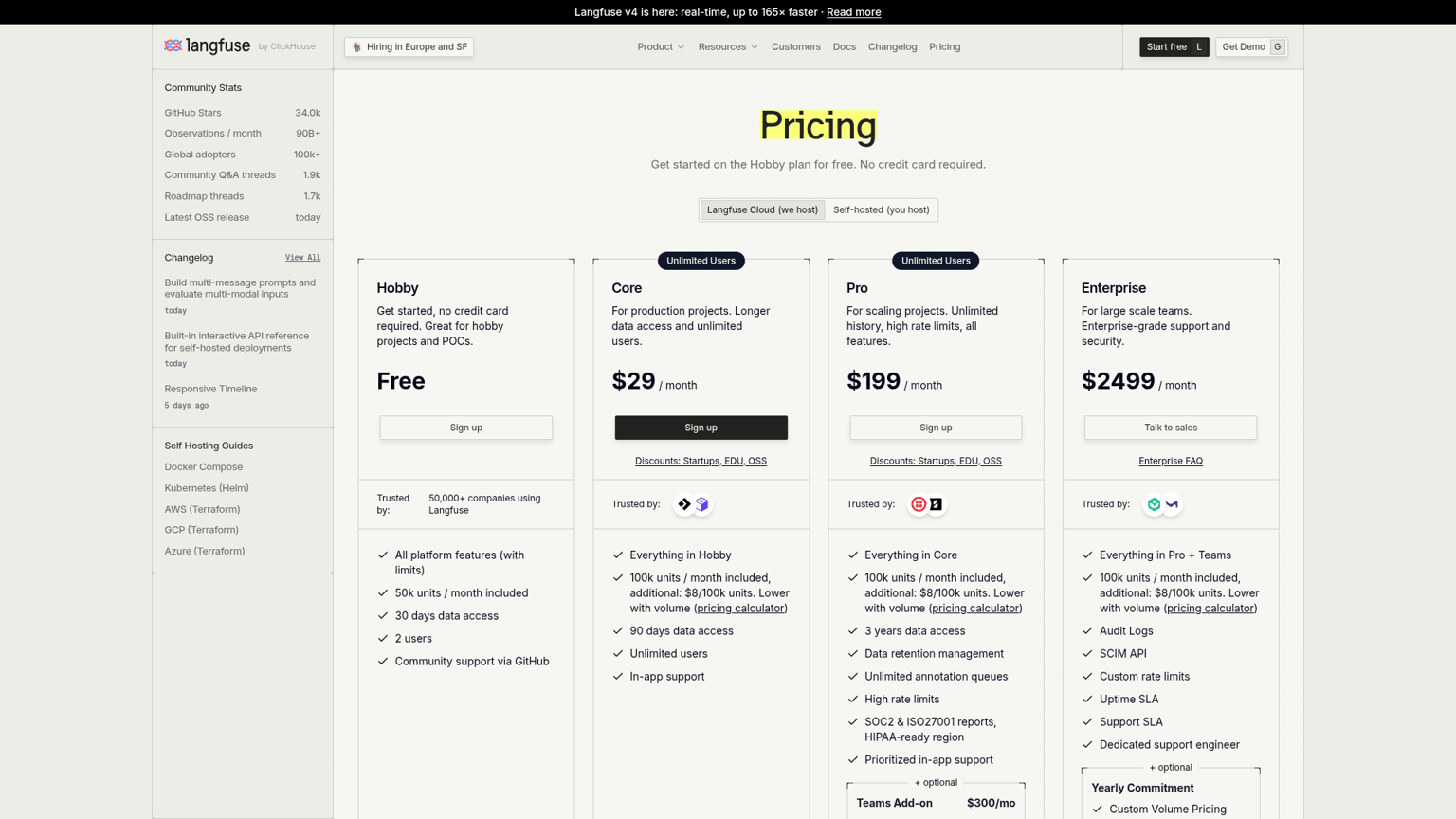
Langfuse pricing defines one billable unit as one trace, observation, or score, so a run with several observations consumes several units. The Cloud Hobby plan is free with 50,000 units each month, 30 days of data access, and two users. Core costs $29/month for 100,000 units, 90 days of data access, and unlimited users; additional usage starts at $8 per 100,000 units and falls with volume. Pro costs $199/month for 100,000 units, three years of data access, retention management, high rate limits, and unlimited users; the optional Teams add-on is $300/month. Enterprise costs $2,499/month with 100,000 included units and custom yearly volume pricing. Self-hosted Open Source is free under the MIT license with unlimited included usage, while self-hosted Enterprise is custom-priced.
Langfuse can infer cost from its model definitions, but it prioritizes values supplied with the trace when both exist. That is the right behavior for negotiated provider rates or internal models. Cost can be filtered by tags and users, then exported through the Metrics API for a finance dashboard or customer margin report.
Best for: Product and platform teams that need trace-level cost ownership without per-seat pricing
Standout: User and tag filters, custom ingested costs, cloud or self-hosted deployment
Pricing: Hobby $0; Core $29/month; Pro $199/month; Teams add-on $300/month; Enterprise $2,499/month; self-hosted Open Source $0; self-hosted Enterprise custom
Free trial: Free Hobby plan; no timed trial required
- Core includes unlimited users, which keeps a ten-person review loop at $29/month before usage
- Ingested cost values override estimates, useful for custom or discounted rates
- Metrics API and tag filters support customer, feature, and workflow chargeback
- MIT-licensed self-hosting creates a credible data-ownership route
- A run with many observations and scores consumes more units than its trace count suggests
- Threshold alerts do not replace a gateway hard limit
- Pro jumps from $29 to $199/month before the optional $300 Teams add-on
A practical Langfuse cost ledger
The fastest rollout is one workflow, not a company-wide instrumentation project.
Choose the unit of business value
Pick one completed outcome such as resolved ticket, qualified lead, accepted code change, or processed invoice. Avoid “agent run” as the business unit because a run can fail without producing value.
Attach four dimensions
Send customer or account, workflow, environment, and model as trace metadata or tags. Add an outcome field such as success, escalation, failure, or score so cost can be divided by useful work.
Supply the price when inference is private
Use Langfuse's model definitions for supported providers. When the rate is negotiated, self-hosted, or private, ingest the usage and cost values directly so an unknown model does not appear free.
Set one threshold alert
Alert on a daily workflow total or a unit-cost boundary. Send the alert to the person who can change routing or prompts, not a general channel where it becomes background noise.
Review failures beside spend
Open the costly traces and separate productive complexity from retries, excessive context, and tool failures. If failures dominate spend, use the agent failure analysis comparison to choose the deeper debugging layer.
2. Portkey: Best for Gateway-Level Budgets
Portkey is the best choice when token tracking must sit on the same path that can enforce a budget. A platform team can route model traffic through the gateway, tag requests by user, team, workflow, or feature, and monitor input tokens, output tokens, total cost, and budget utilization. The wall is plan placement and model coverage: cost and token budgets are available on Enterprise and select Pro plans, and an unsupported model appears as $0.00 and does not count toward a provider budget limit. Pick Portkey when the control path matters more than owning a separate evaluation suite.
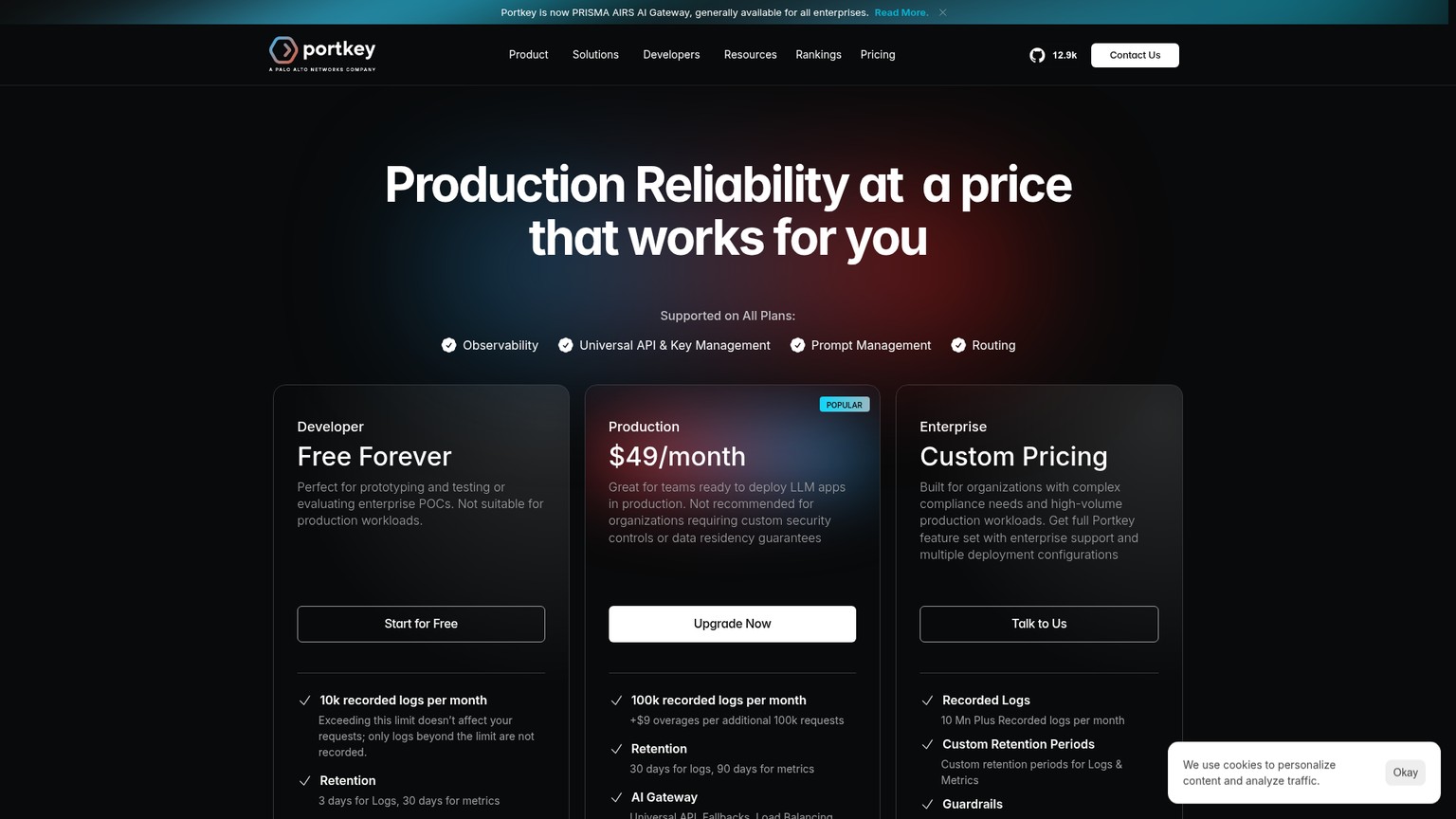
Portkey's live pricing starts with an Open Source self-hosted gateway that states no request limit and no plan fee. Developer is free forever with 10,000 recorded logs per month, three days of log retention, and 30 days of metric retention. Requests continue after the allowance, but excess logs are not recorded, which creates an evidence gap precisely when traffic rises.
Production costs $49/month with 100,000 recorded logs, 30 days of logs, 90 days of metrics, alerts, RBAC, and service-account keys. Each additional 100,000 requests costs $9 up to 3 million. Enterprise is custom-priced, begins at 10 million-plus recorded logs per month, and adds granular budgets and rate limits, custom retention, private deployment, data export, and enterprise support.
The unsupported-model behavior is the buying test. A private fine-tune or newly released model needs an explicit price definition before a budget can be trusted. Otherwise the dashboard may look calm while the provider bill grows.
Best for: Teams that want cost attribution and enforcement in one gateway path
Standout: Metadata-based chargeback plus granular budgets and rate limits on qualifying plans
Pricing: Open Source $0 stated plan fee; Developer $0; Production $49/month plus $9 per extra 100,000 requests up to 3 million; Enterprise custom
Free trial: Free Developer plan; no timed Production trial stated on the locked pricing page
- Gateway placement can connect measurement to routing and enforcement
- Metadata supports cost views by user, team, workflow, or feature
- Production includes alerts, RBAC, and service-account keys at $49/month
- Self-hosted Open Source has no stated request limit
- Developer silently stops recording logs above 10,000 while requests continue
- Unsupported models show $0.00 and do not count toward provider budget limits
- Granular budgets require Enterprise or a qualifying select Pro plan
3. Helicone: Best for Fast Proxy-Based Cost Control
Helicone is the fastest route from raw model requests to cost controls when a team is comfortable putting traffic through a gateway or proxy. A product with several model-backed features can attach custom properties for user, feature, environment, or workflow, group multi-call sessions, and cap requests or cost in cents at those same boundaries. The wall is precision across integrations: Helicone describes gateway calculations as accurate from its Model Registry, while direct-provider paths use a best-effort price repository covering more than 300 models. Choose Helicone when a short route to cost-based rate limits beats deeper evaluation or infrastructure correlation.
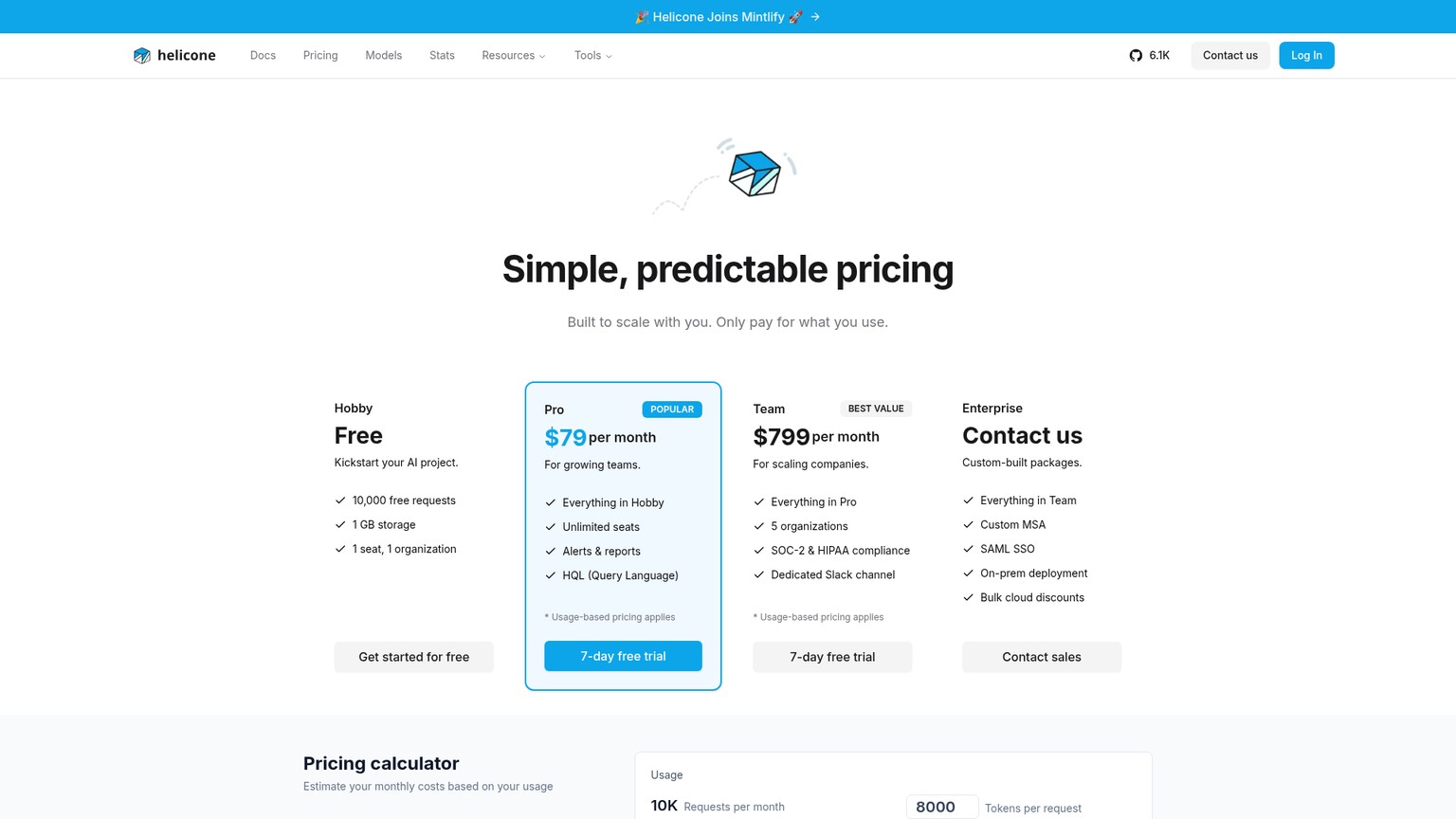
Helicone pricing starts with Hobby at $0 for 10,000 requests per month, 1 GB of storage, one seat, one organization, and seven-day retention. Pro is $79/month with unlimited seats, one organization, alerts, reports, HQL, one-month retention, and usage-based charges after the included 10,000 requests and 1 GB. Team is $799/month for five organizations, three-month retention, SOC 2 and HIPAA support, and a dedicated Slack channel. Pro and Team each offer a seven-day trial. Enterprise is custom-priced with unlimited organizations, forever retention, SAML SSO, on-premises deployment, bulk cloud discounts, and ingestion up to 30,000 logs per minute.
Helicone's rate limits can apply globally, per user, or per custom property. They can cap request count or cost in cents. Token-based rate limiting is still listed as coming soon, so a buyer who needs a literal token ceiling should not assume cost limits provide the same behavior.
Best for: SaaS teams that need quick proxy instrumentation and cost-based request controls
Standout: Sessions and custom properties connect multi-call workflows to user or feature economics
Pricing: Hobby $0; Pro $79/month plus usage; Team $799/month plus usage; Enterprise custom
Free trial: Seven days for Pro and Team; Hobby is free
- Cost limits can operate by user or custom property, not only at account level
- Unlimited seats on Pro avoid a collaboration charge as engineering grows
- Sessions combine several calls into one workflow view
- On-premises deployment is available at Enterprise
- Direct-integration price accuracy is best effort rather than the gateway's stated standard
- Token-based rate limiting is not available yet
- Team jumps to $799/month, a large step for five organizations and compliance support
4. OpenLIT: Best for Self-Hosted Coding-Agent Tracking
OpenLIT is the best self-hosted option for builders who want coding-agent sessions, token cost, and repository activity in an OpenTelemetry-native stack. A company already operating ClickHouse and an OpenTelemetry Collector can keep prompts, traces, and history inside its own environment while instrumenting coding agents and model calls together. The wall is ownership: the $0 license leaves deployment, upgrades, storage, backups, and access control on the engineering budget. Choose OpenLIT when keeping telemetry in your environment is a requirement, not merely a preference.
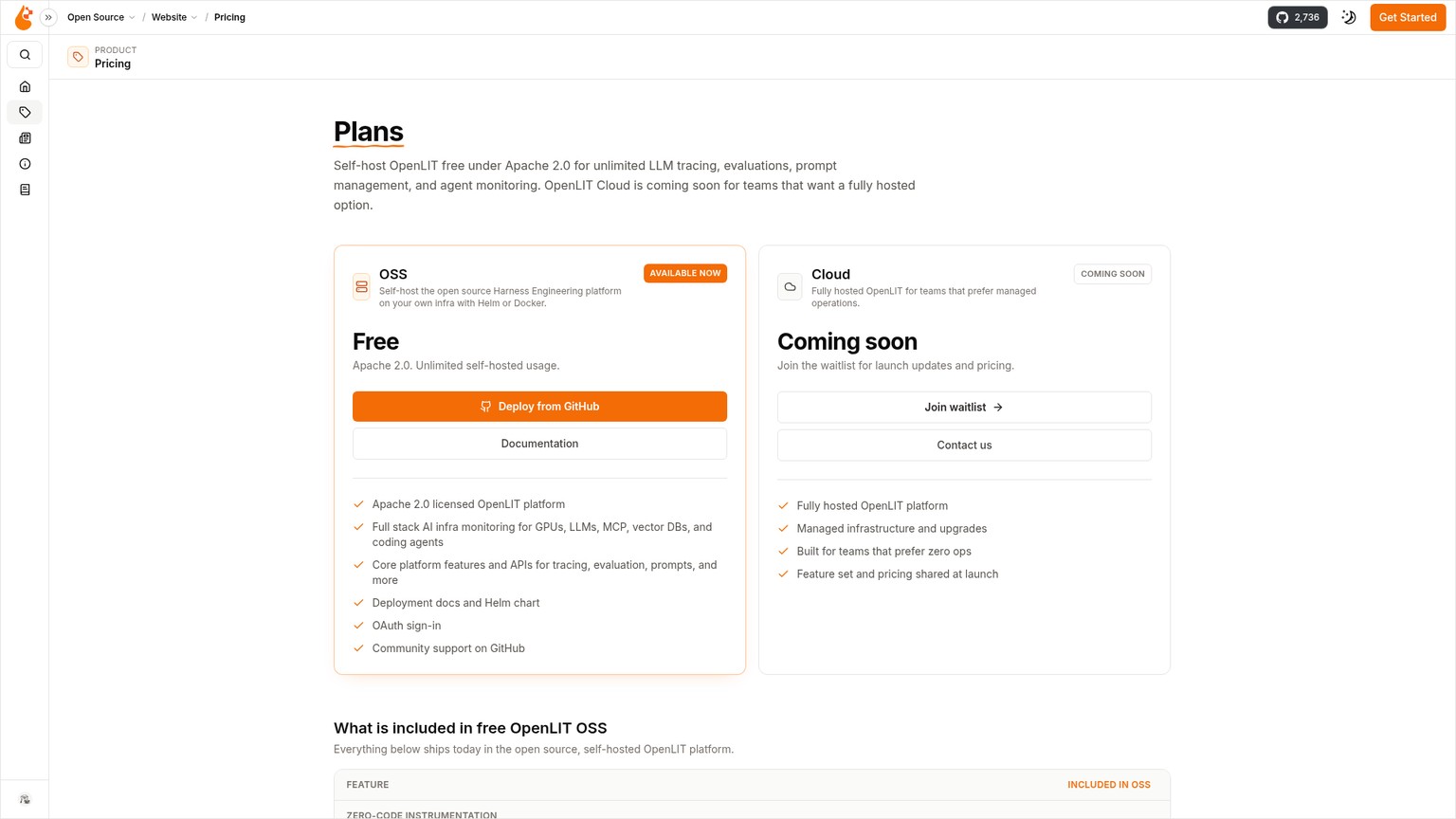
OpenLIT pricing lists the Apache 2.0 Open Source tier at $0 with unlimited self-hosted usage, users, projects, environments, and historical data. Cloud is marked “coming soon,” with no published price. The open-source package includes OpenTelemetry-native tracing, coding-agent session, cost, token, and repository-activity tracking plus custom dashboards.
OpenLIT ships an updateable default pricing file and accepts a custom pricing JSON for private, fine-tuned, or unsupported models. That explicit override matters because a self-hosted platform is often paired with a model that a SaaS catalog does not recognize. The planning number is still not zero: database storage, collector capacity, upgrades, incident response, and an owner must be added to the license line.
Best for: Infrastructure-capable teams with strict data ownership or coding-agent telemetry needs
Standout: Apache 2.0, OpenTelemetry-native tracking with custom model pricing
Pricing: Open Source $0 license with unlimited self-hosted usage; Cloud coming soon with no published price
Free trial: No trial needed for Open Source; Cloud is not available to price
- Unlimited self-hosted users, projects, environments, and history on the open-source tier
- Coding-agent sessions connect token cost to repository activity
- Custom pricing JSON prevents private models from appearing costless
- OpenTelemetry makes the data portable into an existing telemetry architecture
- The buyer operates OpenLIT, ClickHouse, and the OpenTelemetry Collector
- Cloud is not yet a purchasable shortcut
- A $0 license can cost more than SaaS after on-call and upgrade labor are counted
5. Braintrust: Best AI Observability and Evaluation Platform for Cost-to-Quality Decisions
Braintrust is the strongest AI observability and evaluation platform when the budget owner must connect model spend to scores, errors, and product quality. A support automation team can aggregate prompt, completion, cache-read, cache-creation, and total tokens beside estimated cost, tool calls, errors, and latency, then group the measures by user or model with SQL. The wall is enforcement: Braintrust documents custom monthly spend alerts for Starter and Pro, but not hard spending limits. Pick Braintrust when a cheaper model is only acceptable if its evaluated output remains good enough.
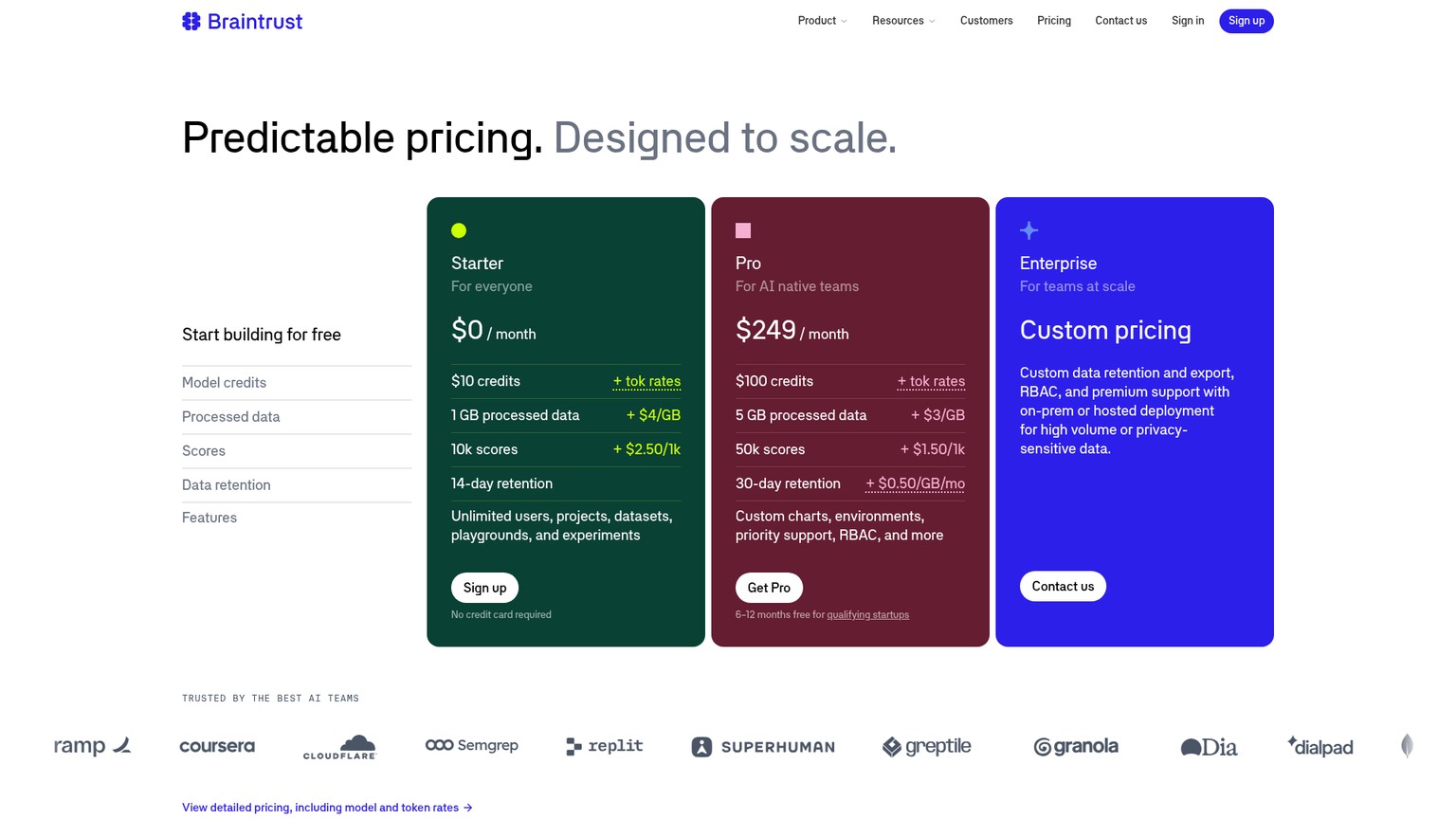
Braintrust pricing lists Starter at $0/month with $10 in model credits followed by token rates, 1 GB of processed data followed by $4 per GB, 10,000 scores followed by $2.50 per 1,000, 14-day retention, and unlimited users. Pro costs $249/month with $100 in model credits followed by token rates, 5 GB of processed data followed by $3 per GB, 50,000 scores followed by $1.50 per 1,000, and 30-day retention. Extended retention on Pro costs $0.50 per GB each month. Enterprise is custom-priced with custom retention and export, RBAC, premium support, and hosted or on-premises deployment.
The multiple meters are meaningful. Processed data pays for trace volume, scores pay for evaluation activity, and model tokens pay for inference. A team comparing prompt versions should model all three rather than treating the $249 platform fee as the full bill.
Best for: Product teams deciding whether lower model cost preserves evaluated quality
Standout: Token and cost summaries sit beside scores, errors, tool calls, and SQL analysis
Pricing: Starter $0 plus usage; Pro $249/month plus usage; extended retention $0.50/GB/month; Enterprise custom
Free trial: Free Starter plan with included model credits and allowances
- Cost, cache use, tool calls, errors, latency, and evaluation scores share one trace model
- SQL supports attribution analysis by user or model
- Unlimited users on Starter and Pro remove a seat-count decision
- Hosted and on-premises Enterprise routes cover stricter deployment needs
- Spend alerts do not stop requests
- Processed data, scores, model usage, and retention create several variable meters
- Pro's $249 base is difficult to justify for cost tracking without evaluation work
6. Arize AX and Phoenix: Best for OpenTelemetry Plus Evaluation
Arize AX and Phoenix fit teams that want OpenTelemetry-compliant traces, token and cost tracking, and evaluation without committing first to a gateway. Arize AX is the managed product, while Phoenix is the open-source, local-first tracing and evaluation route. A platform owner can begin with Phoenix during development, then use AX when managed retention, ingestion, and shared operations matter. The wall is control placement: this combination explains and evaluates runs, but the request path still needs a gateway or application policy when a hard budget must stop execution. Choose Arize when open telemetry and evaluation depth matter more than native spend enforcement.
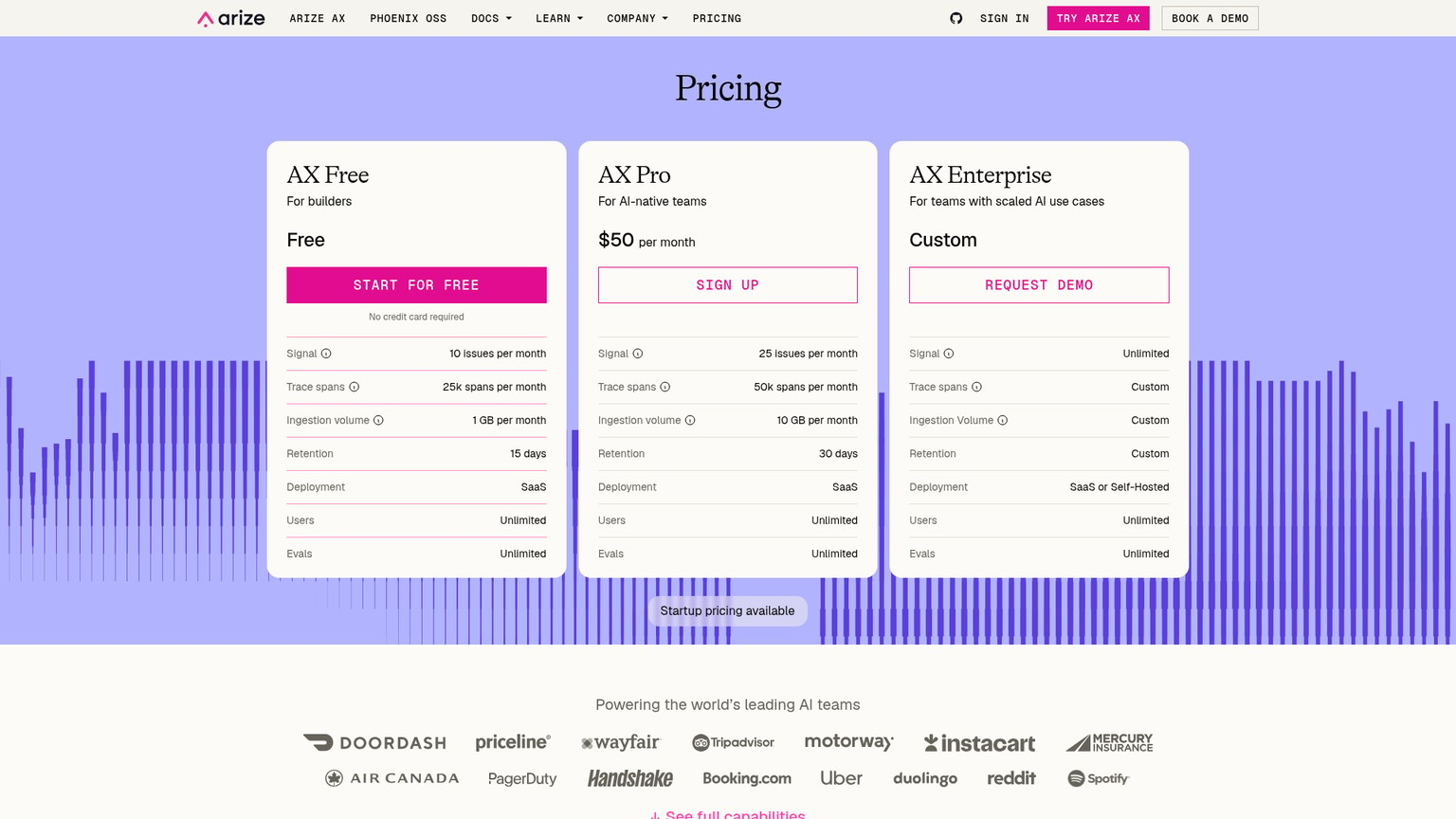
Arize pricing lists AX Free at $0 with 25,000 trace spans per month, 1 GB of ingestion, 15-day retention, unlimited users, and unlimited evaluations. AX Pro costs $50/month with 50,000 spans, 10 GB of ingestion, 30-day retention, unlimited users, and unlimited evaluations. Enterprise is custom-priced with custom span, ingestion, and retention levels plus SaaS or self-hosted deployment. Phoenix is open source and local first.
The meter to watch is spans, not top-level traces. An agent run with many model calls and tools can emit many spans, so the 50,000-span allowance may cover far fewer than 50,000 end-user jobs. Instrument one representative workflow and count its median spans before forecasting the bill.
Best for: Teams standardized on OpenTelemetry that need managed or local-first evaluation
Standout: Unlimited users and evaluations with AX, plus an open-source Phoenix route
Pricing: AX Free $0; AX Pro $50/month; AX Enterprise custom; Phoenix open source
Free trial: Free AX tier and open-source Phoenix
- OpenTelemetry-compliant tracing reduces instrumentation lock-in
- Free and Pro include unlimited users and evaluations
- Phoenix gives developers a local-first open-source starting point
- AX tracks tokens, latency, and cost beside evaluation data
- Span counts can grow much faster than end-user workflow counts
- Managed retention is 15 days on Free and 30 days on Pro
- A separate control layer is needed when requests must be stopped by budget
7. LangSmith: Best for a LangChain-Heavy Improvement Loop
LangSmith is the right token-tracking choice when the team already uses LangChain and observability feeds a continuous evaluation and improvement loop. It maps model names and token counts to prices, accepts custom model-price entries, and distinguishes base traces with 14-day retention from extended traces with 400-day retention. The wall is seat economics: Plus costs $39 per seat each month, so a ten-person group pays $390/month before additional trace usage. Choose LangSmith for integrated tracing and evaluation in a LangChain-heavy stack, not as the cheapest shared cost dashboard.
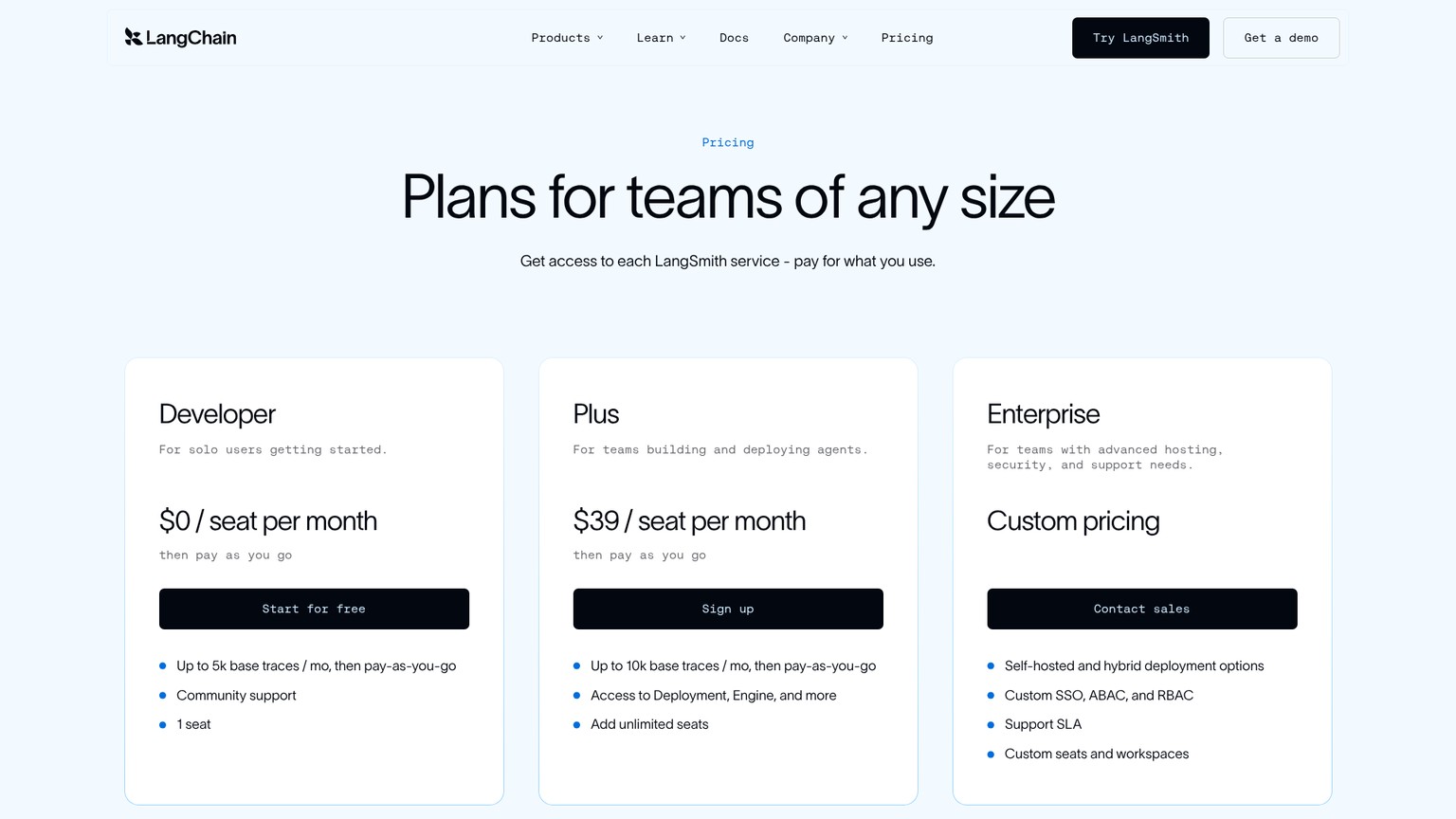
LangSmith pricing lists Developer at $0 per seat per month for one seat and 5,000 base traces per month, followed by pay-as-you-go usage. Plus costs $39 per seat per month and includes 10,000 base traces each month across the organization, with more seats available and pay-as-you-go after the allowance. Enterprise is custom-priced and adds self-hosted and hybrid options, custom SSO, ABAC, RBAC, workspaces, seats, and a support SLA.
Additional base traces cost 0.005 LangSmith usage units, or LSUs, each. One LSU costs $1.00, while one LangChain usage unit, or LCU, costs $1.50. The unit vocabulary is another reason to model the actual workflow before comparing LangSmith with a per-request or per-span product.
Best for: LangChain teams where trace review and evaluation are part of normal product development
Standout: Model cost mapping with custom prices inside the broader LangSmith improvement loop
Pricing: Developer $0 for one seat; Plus $39/seat/month; Enterprise custom; extra base traces 0.005 LSU each, with 1 LSU at $1 and 1 LCU at $1.50
Free trial: Free Developer plan; no timed Plus trial stated on the locked pricing page
- Cost tracking sits inside a mature tracing and evaluation workflow
- Custom model-price entries cover private or negotiated inference
- Extended traces can retain data for 400 days
- Enterprise offers self-hosted and hybrid deployment
- Plus charges per seat while several competitors include unlimited users
- Ten Plus seats cost $4,680 per year before extra usage
- Base and extended traces have different retention behavior and economics
8. Datadog Agent Observability: Best for Existing Datadog Teams
Datadog Agent Observability is the strongest fit when agent cost needs to correlate with application, infrastructure, and user-session telemetry already inside Datadog. It automatically estimates text-model request costs from token counts for more than 800 models and accepts manually supplied costs for private or unsupported models. The wall is greenfield economics: Pro starts at $160/month on an annual commitment, a premium that pays back when cross-system correlation replaces manual incident work, not when a solo builder only wants a token chart. Choose Datadog when the agent is one part of an existing production system, not an isolated experiment.
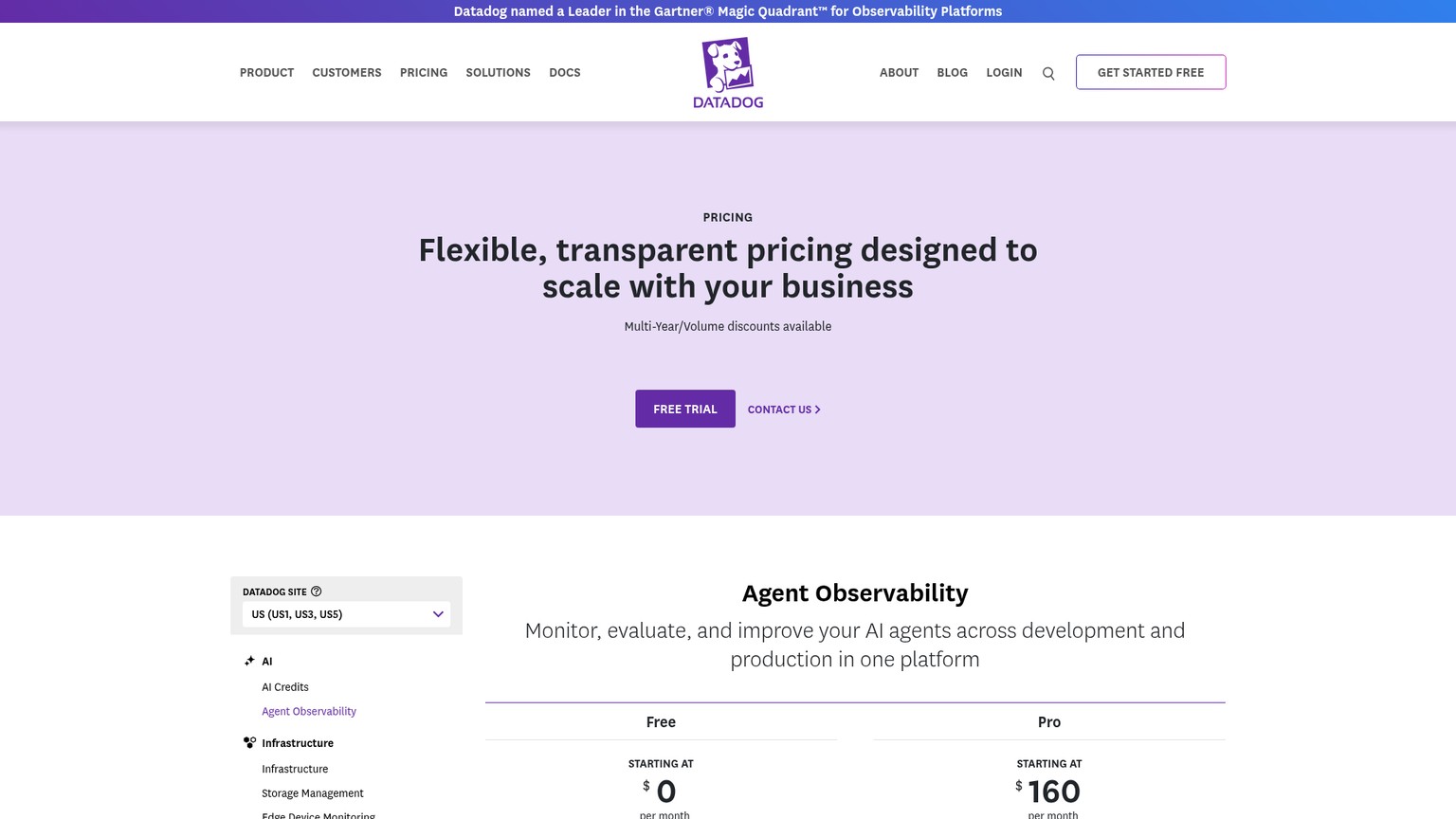
Datadog Agent Observability pricing lists Free at $0 with up to 40,000 LLM spans per month, 15-day trace retention, unlimited context and evaluations, and full feature access. Pro includes 100,000 LLM spans per month and costs $160/month on an annual commitment, $200 month to month, or $240 on demand. Additional spans per 10,000 cost $3.50 annually, $4.20 month to month, or $5 on demand.
Default trace retention is 15 days. Retention add-ons per 10,000 LLM spans each month cost $1.50 for 30 days, $3 for 60 days, or $4 for 90 days. At one million monthly LLM spans on annual pricing, Pro reaches $475/month before retention add-ons: the $160 base plus 90 overage blocks at $3.50.
Best for: Operations teams that already investigate services, infrastructure, sessions, and agents in Datadog
Standout: Agent traces correlate with the rest of the production telemetry estate
Pricing: Free $0; Pro $160/month annually, $200 month to month, or $240 on demand; overages and retention add-ons extra
Free trial: Free tier with full feature access up to its allowance
- Automatic cost estimates cover more than 800 text models
- Manual costs support private and unsupported models
- Existing Datadog users can connect agent behavior to service and infrastructure incidents
- Free includes 40,000 LLM spans and full feature access
- Pro is the highest base price among the cost-first SaaS picks near the top of this ranking
- A multi-step agent can consume many spans per user workflow
- Longer retention adds another per-span meter
Who Should Pick Which LLM Monitoring Tools
The decision rule is enforcement first, hosting second, evaluation third, and price fourth. Start with the action the system must take when spend rises. If it must block, route, or slow traffic, shortlist Portkey or Helicone and verify the needed budget control is on the purchased plan. If it only needs to alert and explain, the field opens.
AI Agent Monitoring Tools: The Decision Rule
Choose Langfuse for a general-purpose, model-agnostic cost ledger with trace context and low collaboration cost. Choose OpenLIT when traces cannot leave your environment and the organization already runs the supporting infrastructure. Choose Braintrust or Arize when every cost change must be evaluated against output quality. Choose LangSmith when LangChain integration is more valuable than avoiding per-seat pricing. Choose Datadog when the incident review already starts there.

Best LLM Observability Tools: The Flip Point
The best LLM observability tools become worth buying at the moment a second owner needs the same evidence. That owner may be finance assigning model cost to a customer, security requiring local data, support explaining a failed automation, or product comparing cost per accepted outcome. Until then, built-in usage can be enough.
The flip points are concrete:
- One developer, one device, one model workflow: stay with Claude Code
/usageand provider billing. - Several developers or devices: export OpenTelemetry or adopt a shared platform.
- Several customers or product features: require metadata-based attribution.
- A runaway loop can create material loss: require an enforceable gateway budget.
- A cheaper model might reduce quality: add evaluation before changing routing.
- Prompt data cannot leave the environment: compare OpenLIT, Langfuse self-hosting, Phoenix, or an enterprise self-hosted plan.
This is also where gateways fit. They control the request path, while an observability product explains what happened after and across the path. The managed agent gateway comparison is the next decision when routing, failover, and policy need to live together.
The Budget Math: What the Dashboard Must Repay
A token dashboard should repay its full platform fee by preventing waste or removing reconciliation work. Using a transparent planning assumption of $100 per loaded engineering hour, Langfuse Core's $29 monthly fee equals 17.4 minutes. Portkey Production at $49 equals 29.4 minutes. Arize AX Pro at $50 equals 30 minutes. Helicone Pro at $79 equals 47.4 minutes. Datadog Pro at $160 annually billed equals 96 minutes. Braintrust Pro at $249 equals 149.4 minutes. Ten LangSmith Plus seats at $390 equal 234 minutes.
Those figures are break-even planning lines, not promised savings. A funded founder should ask which recurring task disappears. If the answer is “someone manually joins provider CSVs to customers for three hours each month,” almost every paid option clears the line. If the answer is “the graph looks nicer,” none does.

Annual base cost makes collaboration pricing visible. Langfuse Core is $348, Portkey Production is $588, Arize AX Pro is $600, Helicone Pro is $948, Datadog Pro on an annual commitment is $1,920, Braintrust Pro is $2,988, and ten LangSmith Plus seats are $4,680. OpenLIT's license is $0, but its infrastructure and engineering labor remain unpriced.
Do not turn that list into a false unit-price race. Langfuse bills traces, observations, and scores. Portkey bills recorded requests. Datadog bills LLM spans. Braintrust bills processed data and scores alongside model use. LangSmith bills traces through its own usage units. One customer workflow can create one request, several generations, dozens of spans, and several scores.
The correct forecast uses a representative workflow:
- Count its median model calls, traces, observations, spans, and scores.
- Multiply by expected successful and failed runs each month.
- Add retention, seats, processed data, and model inference.
- Apply a retry scenario, because a broken tool can multiply cost without multiplying value.
- Divide the total by the successful business outcome, not the agent run.
That final number is the operating metric. Cost per resolved ticket, accepted code change, processed claim, or qualified lead can be compared across prompts and models. Total token count cannot.
The Ones to Avoid for Cost Control
Avoid buying a broad observability platform when its strongest capability is unrelated to the budget problem. The wrong product can measure more while controlling less.
- Claude Code
/usagealone for team chargeback: it is useful for one developer and one local history, but it does not include other devices or claude.ai. It cannot become a shared customer cost ledger by itself. - OpenLIT Cloud for a procurement deadline today: the pricing page still says coming soon and publishes no price. Use the open-source route only if someone can own it.
- LangSmith Plus for cost-only collaboration: ten seats cost $4,680 annually before extra traces. Pay that when the LangChain tracing and evaluation loop is valuable, not for a shared total that Langfuse Core can expose at $348 annually.
- Braintrust Pro for alert-only monitoring: $249/month makes sense when scores and experiments guide model choice. It is difficult to defend when the only requirement is a spend notification.
- Datadog Pro for a greenfield solo agent: $160/month on an annual commitment buys valuable production correlation. A local
/usageview or free tier is the better first move until that correlation has an owner. - Any gateway budget with unknown model prices: Portkey documents that unsupported models appear at $0.00 and do not count toward a provider budget. Define private and new model prices before trusting a ceiling.
The category's most dangerous product is not a particular vendor. It is a dashboard that reports a precise-looking cost with incomplete model coverage or missing runs. Require a visible unknown-cost state, reconcile it to the provider invoice, and test the budget with a controlled request before relying on it.
The Monday Move: Instrument One Expensive Workflow
On Monday, instrument the single workflow most likely to create a surprise bill. Do not start with every model call. Pick the recurring coding loop, support escalation, research agent, or document pipeline whose retries and context size already make someone uneasy.
Tag each run with four fields: customer or account, workflow, environment, and outcome. Add the model and release as dimensions. Set an alert at a unit cost that deserves investigation. If a runaway run can create material loss, put a cost or request limit in the gateway and define the fallback behavior before enabling it.
By Friday, review three groups: successful runs near the median, the most expensive successful runs, and expensive failures. The comparison separates necessary complexity from waste. A premium model may cost more and still win if it prevents retries or human escalation. A cheap model may lose if it creates longer traces and more failure handling.
Use one weekly decision as the adoption test. Change a routing rule, shorten context, fix a tool retry, update a custom price, or cancel the dashboard. A measurement system that produces no decision after four reviews has not earned a wider rollout.
Frequently Asked Questions
What is the best AI agent in 2026?
No AI agent is best across every job. For cost control, the relevant choice is the observability layer around the agent already doing production work. Use Langfuse for broad cost attribution, Portkey or Helicone for enforcement, and an evaluation-centered tool when quality must be judged beside price.
What are the best AI tools to learn in 2026?
Learn the tool that matches the stack you operate. A solo Claude Code user should first understand /usage and OpenTelemetry. A product team should learn metadata-based tracing and unit-cost analysis. A platform team that owns model routing should learn gateway budgets and fallback policies.
What are the top AI agent tools?
Separate agent runtimes from the tools that observe them. This ranking covers Langfuse, Portkey, Helicone, OpenLIT, Braintrust, Arize AX and Phoenix, LangSmith, and Datadog Agent Observability for token, cost, trace, and control work. It does not rank the agents that perform the underlying business task.
What is the best AI app in the world in 2026?
There is no defensible universal winner because the job, workflow, data boundary, and budget determine value. For agent token tracking, Langfuse is the best general choice in this comparison, but Portkey wins when enforceable budgets are the primary requirement.
What AI is better than ChatGPT?
Model preference does not replace cost attribution. A production agent may use OpenAI, Anthropic, Google, an open model, or several providers in one workflow. The tracking layer should preserve customer, workflow, outcome, and cost evidence across those choices.
What is the most advanced AI in 2026?
Capability changes too quickly for one permanent answer. An observability purchase should stay model-agnostic, accept custom prices, and keep historical cost and outcome data comparable when the underlying model changes.
Which AI does Elon Musk use?
A public figure's model choice is not a useful token-tracking criterion. Select this infrastructure by the models your workflows call, the metadata your budget owner needs, the data boundary you must protect, and whether the system must enforce a limit.
Which AI tool is the most powerful?
In this category, power means connecting spend to a workflow and changing the next action. A deep trace without attribution is incomplete. A precise alert without enforcement is incomplete when loss containment matters. The strongest tool is the one that covers the required boundary without adding unused scope.
Which is better in 2026, Claude or ChatGPT?
Choose Claude or ChatGPT for the task quality, latency, context, and commercial terms you need. Choose the tracking layer separately so the organization can compare cost per successful outcome across models instead of rebuilding its ledger after every model switch.
Audit the Workflow Before You Add Another Dashboard
The tracking tool is the last step, not the first. Get the AI Business Workflow Audit Checklist free to identify the workflow, owner, outcome, and control point before another platform enters the budget.
- Published
- Category
- Build
- Language

CLAUDE.md: Write It Once, Start Every Session Right
Write a useful CLAUDE.md, scope project rules, and manage Claude Code auto memory with a 35-line starter and a monthly cleanup routine.Oct 11, 2026Build
Jev Alternatives in 2026: OpenAI, Microsoft, Clef, d1, Perplexity and Strands (Compared)
Compare Jev alternatives by job, maker-verified input pricing, licences and deployment: OpenAI, Microsoft, Clef, Liquid d1, Perplexity and Strands.Oct 11, 2026Build
OpenAI Decisions API
Use OpenAI Decisions API for ticket routing, labels, and action gates. Three guide requests, refusal handling, pricing, limits, and when to keep your LLM.Oct 11, 2026Build
Claude Code Remote Control
Set up Claude Code Remote Control from CLI, VS Code or Desktop, connect your phone or browser, and fix documented login and connection failures.Oct 9, 2026Build
Cursor Remote Control
Set up Cursor Remote Control on iPhone, pair your laptop, keep local agents reachable, and compare cloud agents, Claude Code and Codex.Oct 9, 2026Build
Firecrawl Pricing 2026: What Your Pages Cost
Firecrawl plans and credit packs verified October 2026. Calculate JSON extraction, failed pages and weekly crawl bills at your volume.Oct 9, 2026Build
Claude Code vs GitHub Copilot 2026
Claude Code vs GitHub Copilot: current plans, usage limits, models, team controls, one-seat and ten-seat costs, and when to use both.Oct 8, 2026Build