Firecrawl Pricing 2026: What Your Pages Cost
Firecrawl plans and credit packs verified October 2026. Calculate JSON extraction, failed pages and weekly crawl bills at your volume.
Published
 By Omid Saffari


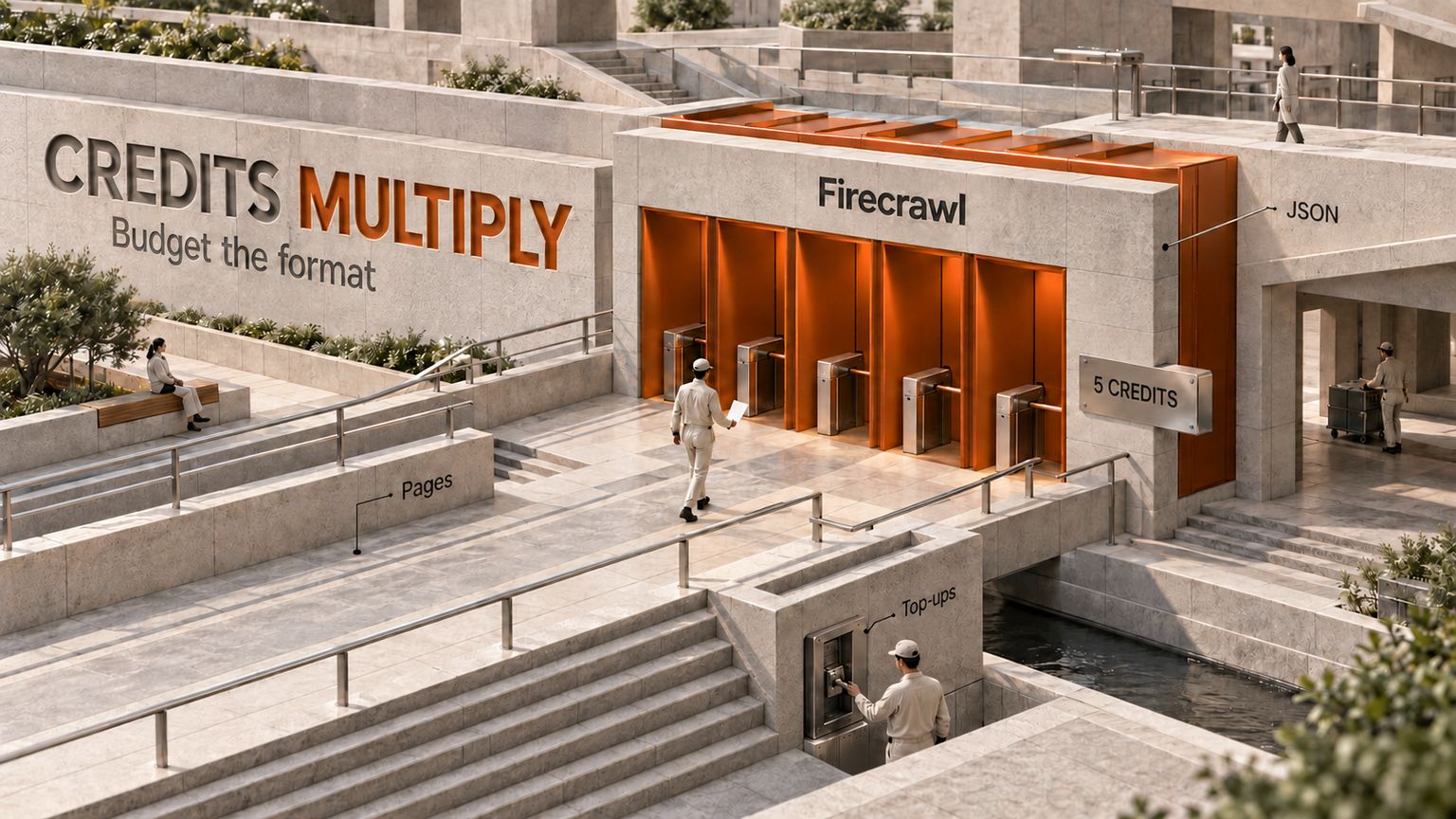
Firecrawl pricing starts at $19/month for 5,000 credits, but 10,000 JSON scrapes need 50,000 credits and fit Standard at $99/month. For an AI agent or a retrieval-augmented generation (RAG) pipeline, which fetches documents to ground AI answers, budget the returned pages, output formats and repeat visits together.
Verified against Firecrawl's live pricing page, October 2026, on October 9. The page labels these prices effective September 4, 2026. Its linked pricing Markdown explicitly supplies the monthly billing prices and annual invoice totals below. All Firecrawl prices are in USD; worked bills exclude tax and optional features unless specified.
Firecrawl is a web-data API that turns URLs into content an agent can use. Its credit is a billing unit, not a guarantee that a page contains useful information. A returned error page can consume the same base credit as the document you wanted.
Firecrawl Pricing at a Glance
Hobby suits small recurring jobs; Standard becomes cheaper when extraction or top-ups push usage beyond Hobby's economical range. Buying a larger allowance is only one option. Every paid self-serve plan also sells extra credits in $5 increments.
Source: Firecrawl pricing and its own Markdown view, checked October 9, 2026. Concurrency means pages that can render simultaneously; additional work waits in a queue.
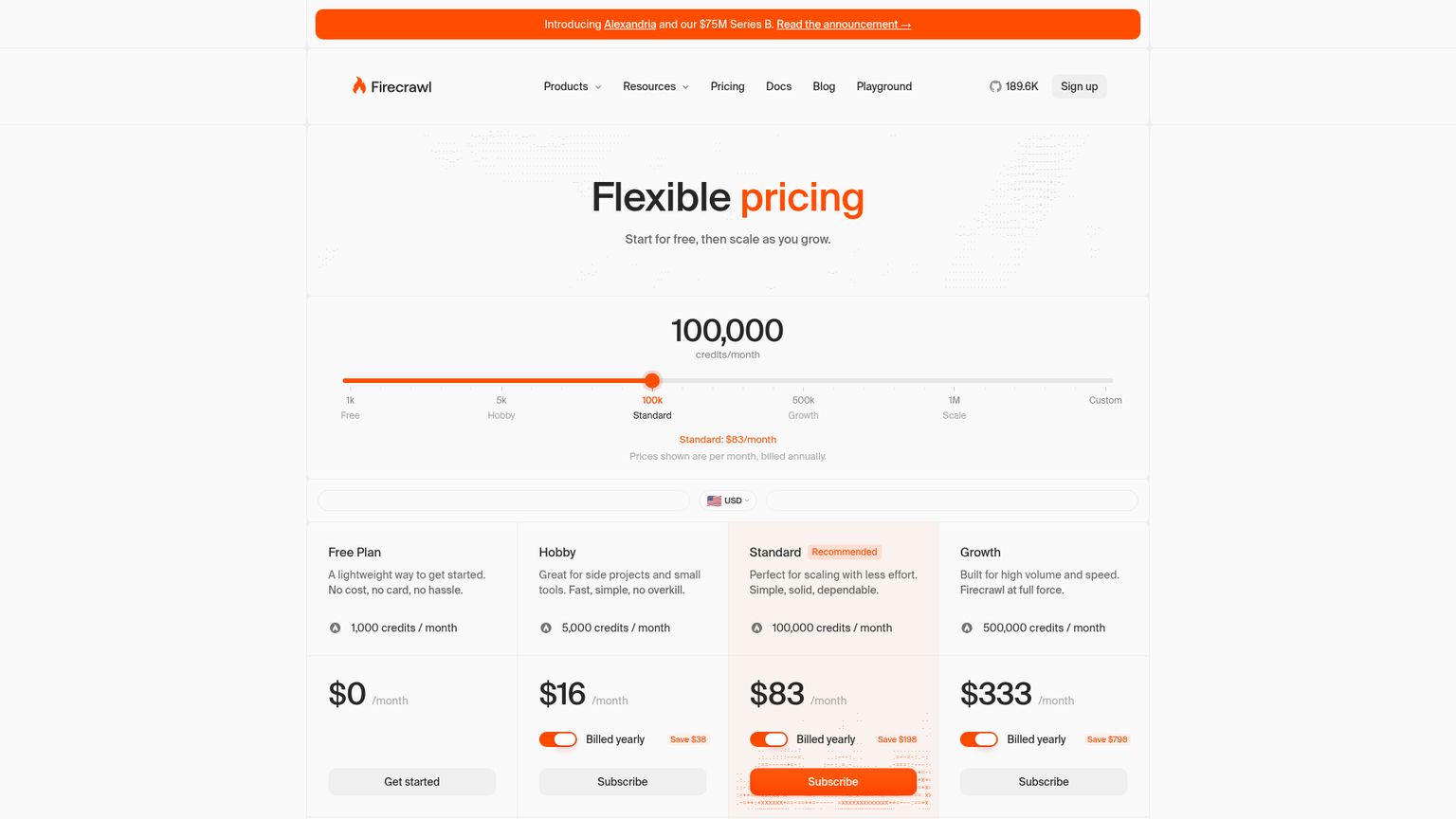
The annual cards show rounded monthly equivalents. The published yearly invoices are Hobby $190, Standard $990, Growth $3,990 and Scale $7,190. Use those totals for cash planning rather than multiplying the rounded card by twelve. Annual billing buys monthly credit refreshes, not the entire year's credits to spend immediately.
Free's wall is its small recurring balance and low request rate. It allows two simultaneous requests and 10 requests per minute on scrape, map and search. It has no extra-credit packs. A prototype that performs many operations in a burst can hit the rate limit before exhausting its credits.
Hobby's wall is expensive additional usage. Its five concurrent requests and 100 requests per minute on scrape, map and search suit a modest background job. Each extra 1,000 credits costs $5, so repeated JSON extraction can make the entry subscription a small part of the bill.
Standard's advantage is the jump to 100,000 credits and cheaper top-ups. It includes 25 concurrent requests and a 500-per-minute rate on those endpoints. It is the sensible starting comparison for a founder collecting structured fields across thousands of pages.
Growth buys capacity and speed together. It includes 50 concurrent requests and a 5,000-per-minute scrape/map/search rate. Its 500,000-credit allowance suits a large refresh workload, but unused subscription credits do not roll over.
Scale adds one month of credit rollover. Its 100 concurrent requests and 10,000-per-minute scrape/map/search rate accompany 1,000,000 monthly credits. Enterprise has custom allowances, concurrency and rollover, plus dedicated support, a service-level agreement, single sign-on and zero-data retention. Get a custom quote before comparing Enterprise with a self-serve tier.
Firecrawl API Pricing: What Each Endpoint Uses
A page costs one credit only when you use the basic operation. The pricing page lists these base rates, shared across all plans:
- Scrape: 1 credit per page. Fetch content from a URL.
- Crawl: 1 credit per page. Follow links and fetch pages across a website; one crawl job can bill many pages.
- Map: 1 credit per page in the pricing table. This is URL discovery, with an accounting discrepancy described below.
- Search: 2 credits per 10 results. Results and scraped content share your account balance.
- Interact: 2 credits per browser minute. Time in an interactive browser is a separate unit from page count.
- Monitor: 1 credit per page per check. A recurring check spends credits again each time it runs.
JSON, Question and Highlight formats add four credits per page on Scrape and Crawl. JSON produces structured fields, Question produces an answer from the page, and Highlight selects relevant passages. For one such format, the basic page charge plus the format charge is 1 + 4 = 5 credits. Ten thousand pages therefore consume 50,000 credits, not 10,000.

The billing documentation adds distinctions that matter for an agent's budget. Search rounds up in blocks of ten: 11 results cost four search credits. If you also scrape the results, the page charges are additional. An agent that searches and reads has two billable operations.
Interact's two-credit rate applies to code-only sessions. Prompt-driven sessions cost seven credits per browser minute, with a one-minute minimum. Monitor's deterministic extraction is another separate mode: the pricing summary sets it at seven credits per page per check, rather than the five-credit JSON Scrape calculation.
Map needs special attention. The pricing page says one credit per page, while the billing documentation says one credit per Map call and describes discovering URLs without scraping their contents. Confirm the accounting for your discovery workflow instead of multiplying every URL returned by a map by the scrape rate. None of the worked bills below uses Map.
Firecrawl Extract: Which Operation Are You Buying?
The five-credit example means a Scrape or Crawl using JSON format. It is not a universal quote for everything Firecrawl calls extraction. The separate /extract documentation describes token-based credit billing and names Agent as its successor. Agent has five free daily runs in preview and dynamic pricing.
For a predictable ingestion budget, specify the actual route and format in your worksheet. “Extract 10,000 pages” is too ambiguous; “10,000 basic Scrape calls with JSON format” gives you a calculable 50,000-credit workload. Extra options can still add charges.
Three Worked Monthly Bills
Use the subscription plus whole credit packs to price the month. These are calculated scenarios, not observed invoices. They assume ordinary returned pages, no previously purchased credit balance, no promotional credits and no additional options. They do not stack the Free allowance on a paid plan.
For any plan, the calculation is:
Monthly bill = subscription + $5 × ceiling(max(0, billed credits − included credits) ÷ credits per pack).
“Ceiling” means round up to the next whole pack. A small deficit still buys an entire $5 increment. The inputs come from Firecrawl's published plans and packs.
10,000 Plain Scrapes: $44 on Monthly Hobby
Hobby plus five top-ups is cheaper than Standard for this job. A founder fetching 10,000 ordinary pages for a document index needs 10,000 credits. Hobby includes 5,000, leaving a 5,000-credit deficit.
Five packs of 1,000 cost $25. Add the $19 monthly subscription: $19 + $25 = $44. Standard would cost $99 with unused capacity. The Hobby bill works out to $4.40 per 1,000 delivered pages.
With annual Hobby, the base invoice is $190/year and the modeled month still needs $25 in extra credits. That gives an amortized monthly cost of about $40.83. The rounded card calculation is $16 + $25 = $41; the small difference comes from the displayed annual equivalent, not a different pack rate.
10,000 JSON Extractions: $99 on Monthly Standard
Standard beats Hobby once each page needs structured fields. The same 10,000 URLs now consume 10,000 × 5 = 50,000 credits. A product-catalog pipeline asking for name, price and availability is the kind of job that needs this format.
Hobby would need 45 additional packs: $19 + 45 × $5 = $244. Standard includes the entire workload for $99/month, leaving 50,000 credits available for other work. The subscription bill is $9.90 per 1,000 JSON pages at this actual volume.
Annual Standard costs $990/year, equivalent to $82.50 a month, displayed as $83/month. The verdict is unchanged: buy Standard for sustained 10,000-page JSON Scrape usage. Do not pay Hobby's much higher marginal rate simply because its entry card looks cheaper.
A 50,000-Page Crawl Every Week: $349 or $399, Depending on the Month
Four runs favor Standard plus packs; five runs favor Growth on monthly billing. Count scheduled executions inside the billing cycle, because “weekly” does not always mean four times.
Four complete runs need 50,000 × 4 = 200,000 credits. Standard includes 100,000. The remaining 100,000 require 50 packs of 2,000: $99 + 50 × $5 = $349. Growth's $399 monthly subscription would cost $50 more for the same basic crawl workload.
Five runs need 250,000 credits. Standard then requires 75 packs: $99 + 75 × $5 = $474. Growth includes the workload for $399, making it $75 cheaper in that month.

Annual billing changes the boundary. At 200,000 credits, annual Standard's $82.50 amortized base plus $250 of packs equals $332.50, the same amortized base as annual Growth. The cards round both modeled options to $333. At 250,000 credits, annual Growth remains $332.50 amortized, while annual Standard plus packs reaches $457.50. Commit only after the schedule and usage are stable.
Adding JSON to every crawled page changes the scale again. Four runs consume 1,000,000 credits, covered by monthly Scale at $749. Five runs consume 1,250,000 credits: Scale plus 50 packs costs $749 + $250 = $999. The output format can matter more than the subscription's entry price.
When the Next Plan Becomes Cheaper
Upgrade when the larger plan beats your current plan plus packs, or when concurrency is constraining the job. The allowance boundary by itself is not the upgrade boundary.
On monthly billing, Hobby reaches $99 at 21,000 credits, tying Standard. Above 21,000, the next pack makes Hobby $104 while Standard remains $99. Annual billing moves this crossover earlier: Standard becomes cheaper once usage exceeds 18,000 credits.
Monthly Standard reaches $399 at 220,000 credits, tying Growth. Above 220,000, Growth becomes cheaper. On annual billing, the corresponding boundary is 200,000 credits. This is why the four-run weekly crawl and the five-run crawl produce different recommendations.
Monthly Growth reaches $749 at 675,000 credits, tying Scale. Above that, Scale costs less and supplies a larger pool, cheaper marginal credits and rollover. These boundaries are calculated from the published subscription and pack rates, assuming empty purchased-credit balances.
At full use of each monthly allowance, the base cost per 1,000 plain pages is $3.80 on Hobby, $0.99 on Standard, $0.798 on Growth and $0.749 on Scale. Those figures describe fully used plans, not the bill for a small job that leaves credits unused. Standard filled with 20,000 JSON pages works out to $4.95 per 1,000 JSON pages; at the 10,000-page example, it is $9.90.
Concurrency can justify upgrading earlier. A weekly job with a tight completion window may need Growth's 50 simultaneous renders even when Standard plus packs is cheaper. Credit arithmetic establishes the budget; a representative workload establishes whether the slower tier finishes on time. No throughput test is claimed here.
Failed Pages and Billing Details That Change the Budget
A charged page and an accepted document are different things. Firecrawl's pricing FAQ says a scrape returning no result is not charged, but a returned page with a 403 or 404 costs one credit. The billing docs explain that it is the returned document that determines the basic charge.
Suppose a hypothetical 10,000-request plain scrape job returns 2,000 blocked or missing pages and 8,000 usable documents. It can still consume 10,000 credits and cost $44 on monthly Hobby. Your useful-output cost is now $44 ÷ 8,000 × 1,000 = $5.50 per 1,000 accepted documents, rather than $4.40.
Retrying those 2,000 URLs once can add another 2,000 basic credits if they return documents again. On Hobby that is two extra $5 packs, or $10. Track the target status in metadata.statusCode and decide which errors deserve another attempt. A missing page should not remain in an automatic refresh list indefinitely.
There are exceptions to the no-document rule. If an enabled prompt-injection check has already run, the docs say a subsequent failed scrape can still bill five credits. Browser sessions bill for time even when they do not produce the desired result. The examples above exclude those options; a returned 403 is also not the same thing as an outright uncharged failure.
Purchased credits and subscription credits have different lifetimes. Free, Hobby, Standard and Growth subscription credits do not roll over. Scale rolls unused subscription credits for one month; Enterprise has a custom arrangement. Extra credits you buy remain until used while subscribed, but expire when your subscription ends. Annual billing does not remove the monthly reset on the lower tiers.
The automatic top-up cap is not a cap on everything you can spend. Paid plans add credits in $5 increments up to the monthly limit you set. A blank limit permits unlimited automatic top-ups; zero turns them off. Manual credit purchases do not count toward this limit. Keep the subscription, automatic additions and manual purchases separate in your budget.
An upgrade can produce another full subscription charge. The billing docs say upgrades take effect immediately, charge the full new-plan price without proration and reset the cycle. Unused previous credits carry over, but switching tiers is not simply paying the difference between two cards. Downgrades take effect at renewal. If a five-run month needs more credits, compare packs with the actual upgrade charge before changing an already active subscription.
Firecrawl's terms, section 6.e state that ordinary refunds are not provided; cancellation ends subsequent billing after the current period. They describe a prorated exception if Firecrawl can no longer provide the service. Treat the annual commitment as money already committed, and check tax separately from these usage examples.
Is Firecrawl Free Enough for Your Pipeline?
You can stay free indefinitely if the entire recurring job fits 1,000 monthly credits and the low limits. No credit card is required, and the allowance refreshes every month. It is a recurring free tier, rather than a one-time trial.
Used exclusively for one basic workload, 1,000 credits cover 1,000 plain pages, 200 JSON pages, or 5,000 search results requested in groups of ten. Search and scrape draw on one balance. The advertised search allowance is not a second pool you can spend after using all the scrape credits.
A personal agent reading 150 JSON pages a month uses 750 credits. A small documentation refresh of 200 plain pages weekly uses 800 credits in a four-run cycle or the entire 1,000 in a five-run cycle. Those users may never need to pay, provided other operations fit inside the remaining balance.
The Free-plan documentation says requests return HTTP 402 when the allowance runs out; Free has no pay-as-you-go. Use it to establish the format and target mix before committing to annual billing.
Verified students have a separate Firecrawl student program offering 10,000 free credits for educational or personal projects. Eligibility includes an academic email and enrollment in a college, university or accredited program. The page does not establish a recurring commercial allowance, so a founder should not budget a startup on that assumption.
When Self-Hosting Firecrawl Is Cheaper
Self-hosting wins when its complete operating cost is below the hosted bill for the same accepted output. Removing Firecrawl's subscription replaces it with infrastructure and responsibility; it does not remove the cost of rendering pages or running extraction models.
Use this comparison:
Self-host monthly cost = infrastructure + storage and egress + proxies + model usage + operator time + amortized migration.
For the required examples, compare that total with $44 for 10,000 plain monthly scrapes, $99 for 10,000 JSON scrapes, or $349 for the four-run weekly crawl. Your machine must actually finish the same workload and pass the same acceptance checks. Do not divide a cheap server invoice by an unverified page capacity.
Self-hosting is most plausible when you already operate the supporting services, your sources are accessible, and sustained volume spreads that fixed work across many useful pages. It is harder to justify for a small agent whose entire hosted scrape bill is $44, particularly when nobody owns browser failures and upgrades.
The official open-source comparison includes core scrape, crawl, map and search in the default stack. LLM-backed formats need a configured model provider or Ollama. Agent, Browser, Interact, the managed dashboard and enterprise controls are outside that default stack. A cloud workflow depending on those surfaces cannot be priced as a simple server substitution.
Our Firecrawl self-host guide walks through the deployment and operating decision. Use it when control or sustained utilization justifies the work; keep hosted Firecrawl when the managed output and support save more than the credits cost.
Firecrawl Alternatives at the Same Volume
Compare the same number of useful outputs and name the work each quote includes. A fetched page, extracted rows and arbitrary JSON fields are different purchases. Firecrawl, Bright Data and Browse AI are partners. These comparisons use their live vendor pricing.
Bright Data: Lower Fetch Cost When You Own the Next Step
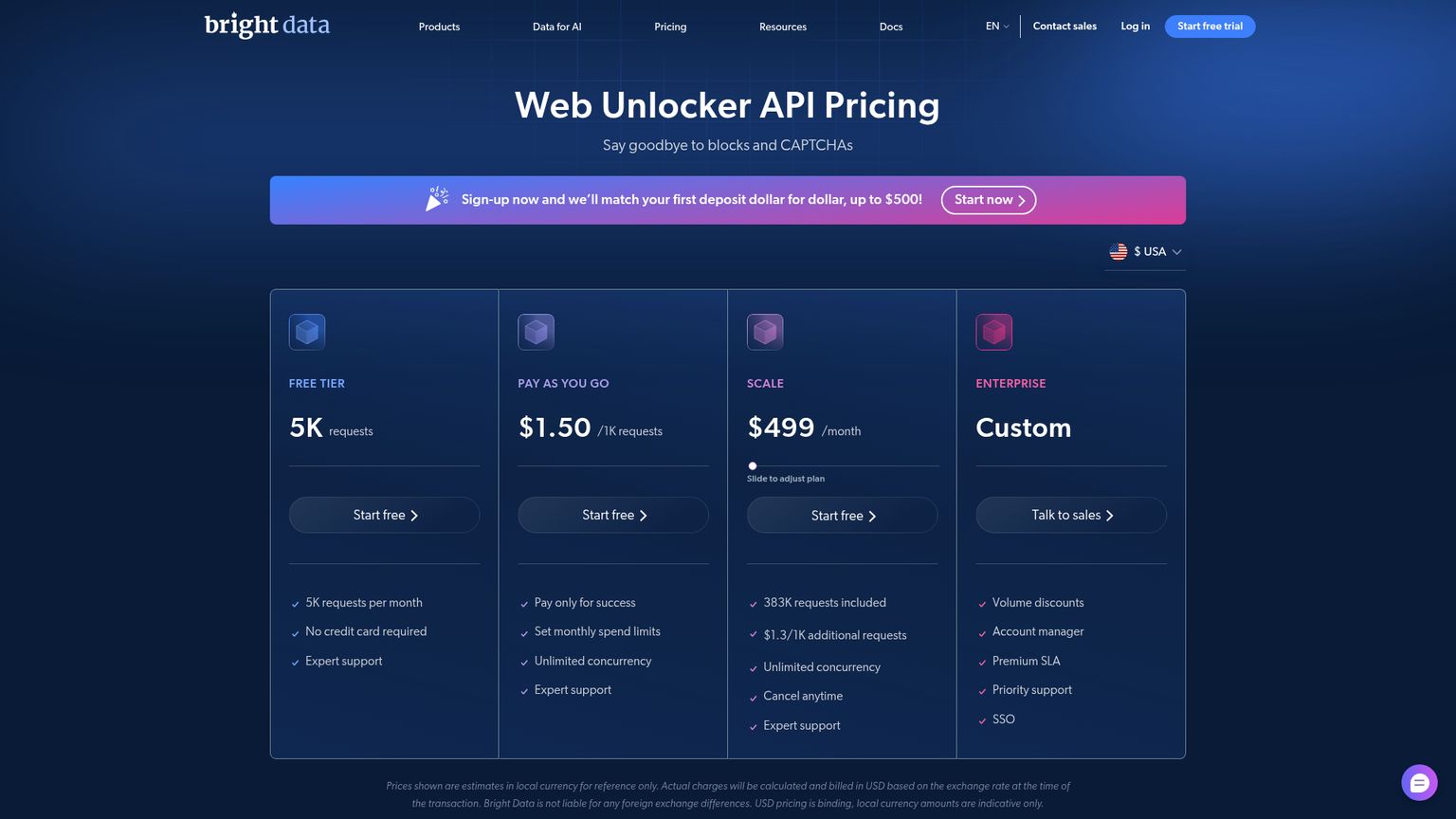
Bright Data's Web Unlocker is an access API priced per successful request. Its own pricing page lists pay-as-you-go at $1.50 per 1,000 requests, successful-request billing, spend limits and unlimited concurrency.
At that paid rate, 10,000 successful page requests cost $15; 200,000 cost $300; 250,000 cost $375. These are rate multiplications, not quotes for matching Firecrawl's arbitrary JSON extraction or a finished RAG document pipeline. They exclude additional work in your application and do not assume its free allowance stacks with paid usage.
Against Firecrawl's $44 plain-scrape month or $349 four-run crawl, Bright Data gives you room to fund the remaining processing. Choose it when access is the bottleneck and you already own that processing. Keep Firecrawl when its document output and crawling workflow are the work you would otherwise need to build. A cheaper request is only cheaper overall if the missing work costs less than the difference.
Browse AI: Price the Robot's Rows and Domains
Browse AI is a visual extraction service for reusable click-and-extract robots. Its own pricing page charges one credit for a standard page visit or one credit per ten rows, whichever is higher. Premium sites can require two to ten credits per run.
For a sustained 10,000 standard-page visits a month, assume one credit per visit and no premium targets. That is 120,000 credits a year. The annual Professional plan provides 60,000 credits at $69/month billed yearly, or $69 × 12 = $828/year. Another 60,000 at the conservative published top-up rate of $0.017 costs $1,020: $1,848/year, or $154/month equivalent. Its page publishes a $0.017 to $0.013 top-up range; use a lower rate only when your quote confirms it.
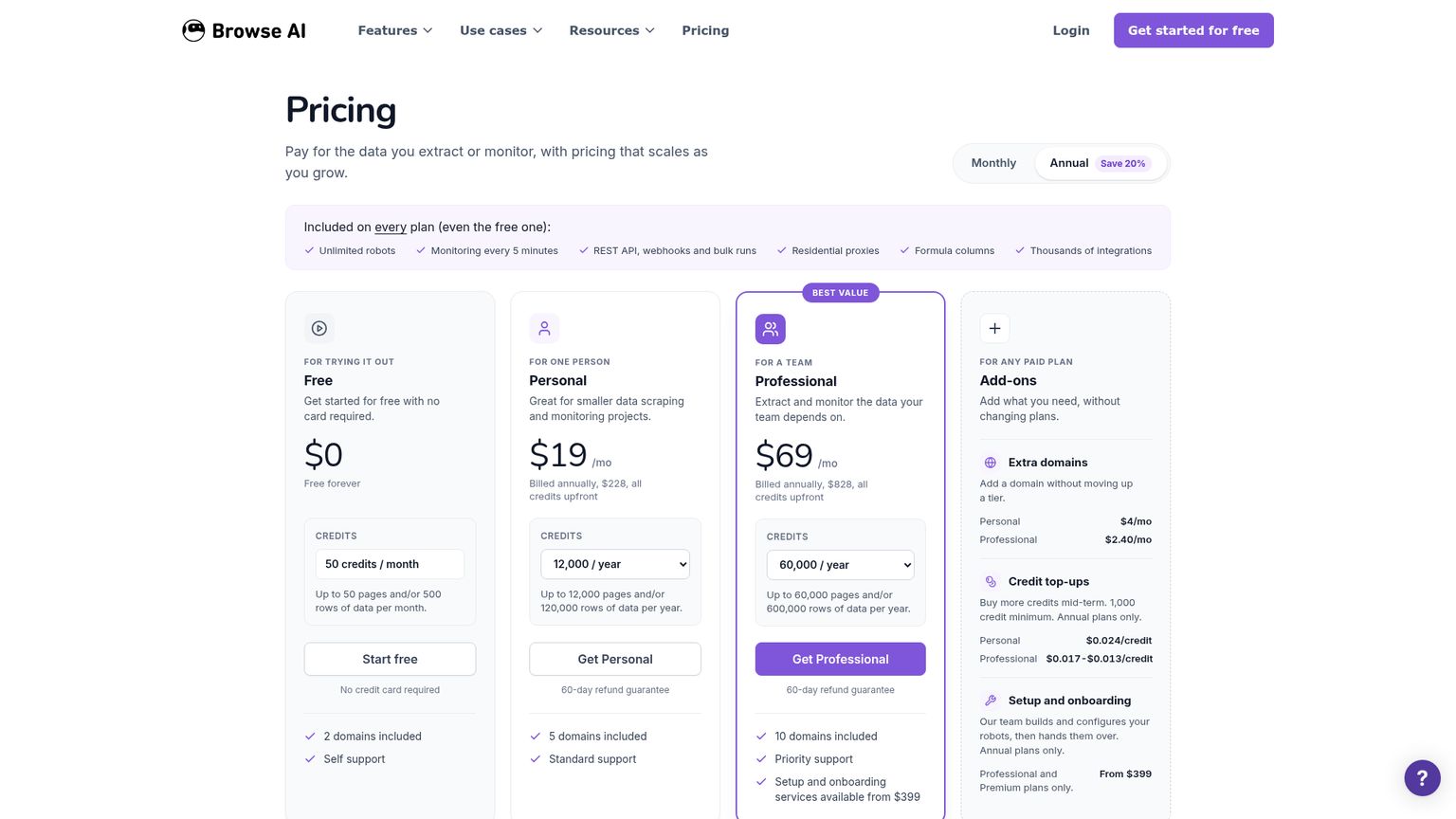
That model is more expensive than Firecrawl's $99 JSON-scrape example, but it buys a different operating interface. It can suit a founder whose operator should maintain the extraction robot without writing the scraper. The Professional plan includes ten domains; a broad web corpus or row-heavy page can break the assumptions quickly.
A 200,000-page monthly workload is 2,400,000 standard credits per year before multipliers. Request a volume quote rather than pretending the $69 entry card covers that crawl. Browse AI belongs on the shortlist for selected recurring sources, not automatically for unrestricted site-wide ingestion.
Apify: Require an Actor-Specific Estimate
Apify runs Actors, packaged scraping and automation programs. Its pricing model includes platform usage and the chosen Actor's charging model. Page count alone does not specify compute, proxies, storage or the program's own fees.
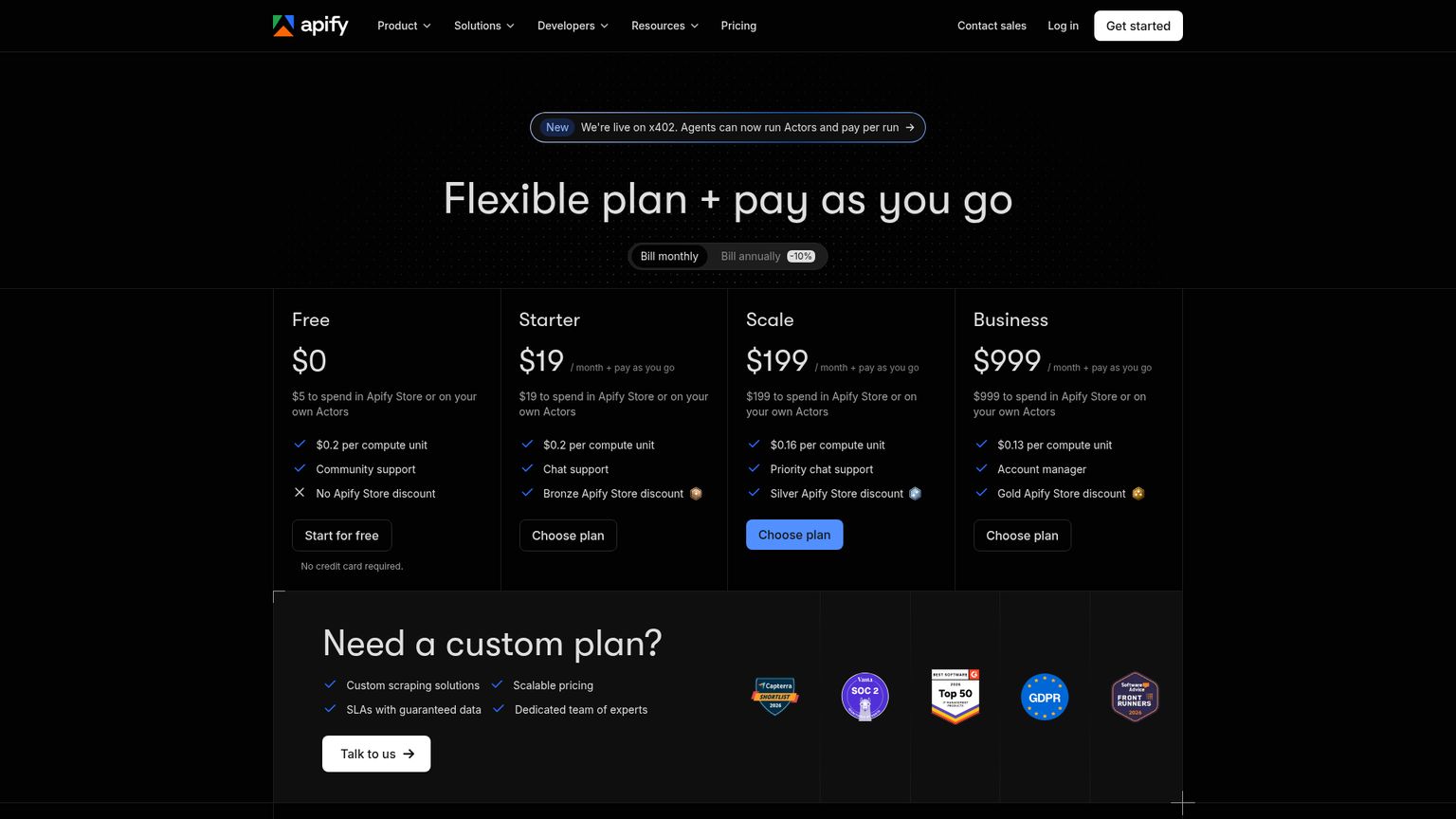
For the same 10,000 or 200,000 pages, obtain an estimate from the actual Actor and target mix before choosing it over Firecrawl. It fits a buyer who finds an existing program for the exact target. Skip a comparison that substitutes Apify's subscription entry price for the finished job's cost.
See Firecrawl alternatives for replacement choices and best web scraping tools for the wider output and ownership comparison.
Set the Budget Before the Next Crawl
Fix the route, schedule and acceptance rule before choosing a tier. A document index that needs plain text should not request JSON on every page merely because the option exists. A structured catalog should budget the additional format explicitly.
Specify the unit of work
Record the endpoint, required format, target URLs and executions in the billing cycle. For the weekly example, write 50,000 pages per run and check whether the next cycle contains four or five runs. Use an explicit crawl page limit; a submitted job is not a fixed-price promise.
Calculate the whole-pack bill
Multiply pages by the credit cost of the selected mode. Subtract the plan allowance and round the deficit up to $5 packs. Compare the current plan plus packs with the next plan, then check the upgrade charge if you already subscribe.
Set an automatic top-up limit
In Billing settings, enter a monthly pay-as-you-go limit in whole multiples of $5. For the four-run plain crawl on Standard, $250 funds the modeled top-ups. Zero disables automatic additions; leaving the field empty removes the automatic spending limit. Manual purchases sit outside that cap.
Measure accepted documents
Record billed credits, returned target status, required fields and accepted output. Stop repeatedly retrying persistent missing pages. Compare the completed job's cost per accepted document with the budget before increasing its frequency or enabling another format.
For a founder refreshing a RAG index next week, start by separating the URLs that need plain documents from those that need structured fields. Then size the coming billing cycle and set the credit cap. That decision usually has a larger budget effect than chasing the smallest annual headline.
Frequently Asked Questions
Can I use Firecrawl for free?
Yes. The Free plan refreshes 1,000 credits every month without a card. That can cover 1,000 basic pages or 200 JSON Scrape pages if you spend the entire balance on that operation.
Is Firecrawl free?
Firecrawl has a recurring free tier and paid hosted plans. The open-source route is also available, but you pay its infrastructure, optional providers and operating costs yourself. Free hosted credits do not roll over or support paid top-ups.
What is the price of Firecrawl?
Monthly Hobby is $19, Standard $99, Growth $399 and Scale $749; Enterprise is custom. The annual cards show $16, $83, $333 and $599 per month respectively. These monthly prices are explicitly published in Firecrawl's linked pricing Markdown, and usage above the included balance adds $5 packs.
Do credits roll over to the next month?
The pricing page gives Scale one month of rollover and Enterprise custom rollover. Free, Hobby, Standard and Growth subscription credits do not carry forward. Purchased credits remain while subscribed but expire when the subscription ends.
How do I get the student credits?
The student program offers verified eligible students 10,000 credits. Sign up with an academic email and redeem STUDENTEDU in Settings, Billing. The stated uses are educational or personal projects; no recurring commercial allowance is promised here.
What is your refund policy?
For Firecrawl, section 6.e of its terms says ordinary refunds are not provided. Cancellation stops future billing after the current period; the stated exception is a prorated refund if Firecrawl can no longer offer the service. Check that policy before paying annually.
What is the difference between Firecrawl and Apify?
Firecrawl meters its hosted page operations and options in credits. Apify runs Actors with program-specific charging plus platform usage. Compare the exact required output and target mix; identical page counts do not by themselves establish an Apify bill.
What is the cheapest web scraping API?
There is no universal cheapest choice across plain documents, premium targets and structured fields. At the stated paid rate, Bright Data Web Unlocker costs $15 for 10,000 successful requests, while Firecrawl Hobby costs $44 for 10,000 basic scrapes. Price the remaining processing before treating those as equivalent finished outputs.
What are some alternatives to Firecrawl?
Bright Data suits access-focused work, Browse AI suits visually maintained extraction robots, and Apify suits workflows with an appropriate existing Actor. Choose against the required output, accepted-page cost and operating owner.
How can I run Firecrawl locally?
Follow Firecrawl's Docker Compose self-hosting guide, verify a real scrape and configure the providers your formats need. The default stack does not include every Cloud surface, and the vendor does not publish a verified minimum host size for it.
Can Firecrawl scrape LinkedIn?
Its current billing documentation says LinkedIn profile and company URLs route to third-party data providers and use provider pricing. Do not apply the basic one-credit scrape bill to those URLs or assume a standard plan guarantees your target's availability. Confirm the exact provider-routed workflow first.
Can Chatgpt do web scraping?
Firecrawl documents a native ChatGPT connector for web-data tools. Account access and the required operation still determine Firecrawl usage; the chat interface does not make the underlying paid scrape calls free.
Is web scraping illegal in the US?
The answer depends on access and use. The US Department of Justice's CFAA charging policy says a public website's terms-only access violation is not, by itself, a basis for an exceeds-authorized-access prosecution. That is a narrow charging policy, not blanket permission to scrape or reuse data. Resolve the rights for your actual workflow before production.
Get the AI Business Workflow Audit Checklist through the newsletter to map the sources, output, schedule and owner of your next web-data workflow.
- Published
- Category
- Build
- Language

Claude Code vs GitHub Copilot 2026
Claude Code vs GitHub Copilot: current plans, usage limits, models, team controls, one-seat and ten-seat costs, and when to use both.Oct 8, 2026Build
LangGraph vs CrewAI
Compare LangGraph and CrewAI on the same approval workflow, state, memory, MCP, observability and current hosted-platform prices.Oct 7, 2026Build
How to Build MCP Server
Build an order lookup MCP server with Python, test it in Inspector, connect Claude Code and Cursor, then add HTTP auth and hosting.Oct 7, 2026Build
Gumloop vs n8n (Verified October 2026)
Gumloop vs n8n: current pricing, credits vs executions, self-hosting and the same AI lead workflow, with a verdict for each builder.Oct 7, 2026Build
AI Agent Frameworks in 2026: LangGraph, CrewAI, OpenAI Agents SDK, Claude Agent SDK, Mastra and Google ADK (Compared)
Compare eight AI agent frameworks by language, state, MCP, approvals and current hosted prices. Pick the right runtime for production.Oct 7, 2026Build
Codex Cloud
Set up a reusable Codex Cloud environment, keep coding tasks running with your laptop off, steer from your phone, and choose cloud or local CLI.Oct 7, 2026Build
GitHub Copilot Pricing (2026): The Seat Is the Floor, Credits Are the Bill
GitHub Copilot plans, AI Credits, model rates, and three worked monthly bills. Choose Pro, Pro+, Max, Business, or Enterprise with spending limits.Oct 6, 2026Build