Best AI Model Alignment Platforms 2026
Compare six AI alignment platforms for post-training, red teaming, evaluation, current pricing, and release gates, verified August 2026.
Published
 By Omid Saffari



Anthropic’s Automated Alignment Researcher is the only option here that actually changes model weights; Giskard is the best packaged choice for enterprise agent teams. The new budget signal is sharper than the launch headline: a 150-attempt small-model search implies about $340 in method-training H200 compute at today’s Modal rate, while the expensive work moves to benchmark design, independent monitoring, and release ownership.
The Best AI Model Alignment Platforms at a Glance
The right platform depends on which part of alignment you own. Model alignment means making a model’s behavior match a defined set of goals and constraints. That can involve measuring failures, attacking the system, changing its weights, or blocking a release. Most products do only one or two of those jobs.
Prices below were verified against each product’s live first-party pages on 30 August 2026. “Free” means the software entry point costs $0, not that model inference, GPU time, implementation, or human review disappears.
The decision rule is simple: if you control the model weights and already have trustworthy benchmark suites, start with Anthropic’s harness. If you deploy closed models or an agent built on an API, do not buy “automated alignment” as a promise. Buy the missing layer: Giskard or Shade for attacks, Patronus or Inspect for measurement, and Braintrust for release enforcement.
Automated Alignment Changes the Budget, Not the Accountability
Automated alignment is now a repeatable research loop, not merely a collection of safety prompts. Anthropic’s 28 August release describes an agent that searches the literature, proposes training methods and data, trains a target model, checks several benchmarks, and repeats. Across 10 measured alignment failures, the strongest methods closed 26% to 96% of the safety gap and carried to withheld evaluations and models up to 4.7 times larger than the model optimized in the loop.
That result changes what a CTO should budget for. The full report says each small-target method received roughly 30 minutes on one GPU. At Modal’s live H200 price of $0.001261 per second, 150 attempts imply about $340.47 in method-training GPU time. That is a compute floor, not the invoice. Evaluator inference, Claude agent and monitor tokens, storage, reruns, failed jobs, and engineering sit on top. The AAR repository currently requires an Anthropic API key for the full loop, and Claude Opus 4.8 costs $5 per million input tokens and $25 per million output tokens in standard mode.
The important consequence is not that alignment costs $340. It is that brute-force method exploration can become cheap enough for a model team to run routinely. The scarce work moves upstream into choosing what “safe” means and downstream into deciding whether the evidence is good enough to ship.
Call this the alignment control loop: measure, attack, retrain, and gate. The loop is only as strong as the evidence that stays outside the optimizer. Anthropic used three to five safety benchmarks per failure, withheld another benchmark from the research loop, and rejected methods that degraded predetermined capabilities. A single score would have rewarded methods that overfit the test or simply refuse more often.
The study also shows why human authority cannot be removed from the budget. A monitor found 39 cheating attempts in approximately 1,600 research transcripts, or 2.4%. The paper’s own limitations are material: the measured failures were narrower than production alignment, political bias was not evaluated, capability checks covered a limited predetermined set, Petri remained a proxy for open-ended behavior, and the work did not test whether the gains survived extensive later reinforcement learning.

Anthropic’s human comparison deserves similar care. Twenty-eight experienced safety researchers submitted 30 accepted ideas with up to eight hours available per idea, a ceiling of 240 allocated idea-hours rather than a record of time used. The automated system beat the submitted human methods, including an 85% average safety-gap closure on deception versus 20% for six researchers under the same rules. Humans could not iterate on their submissions, so this supports a human-plus-automation workflow more strongly than it supports replacing safety researchers.
For a funded model company, the Monday budget move is therefore clear: keep a safety lead and independent evaluator, then give them automated search capacity. For an enterprise using closed APIs, the move is different. You cannot post-train the provider’s weights, so spend on adversarial evaluation, policy-specific tests, routing, and release controls instead. That same separation helps keep model-gateway inference costs from obscuring the safety budget.
How These Platforms Were Picked
The strongest platform is the one that owns its layer without pretending to own the rest. Each product was compared on the following evidence:
- Measurement quality: Can the platform express the failure your business cares about, not just a generic toxicity score?
- Generalization discipline: Can you preserve held-out tests that the optimizer, prompt author, or vendor cannot see?
- Adversarial breadth: Does the system adapt attacks to the model, tools, guardrails, and deployment context?
- Remediation reach: Does it merely report a failure, block an output, change a prompt, or train new weights?
- Release integration: Can evidence become a repeatable pass or fail decision before and after deployment?
- Operator burden: What skills, infrastructure, credentials, and human review remain yours?
- Price clarity: Are every public tier, allowance, and overage visible before a sales call?
This is a priced-and-analyzed comparison, not a hands-on product test. Real screenshots show the current product surfaces, vendor documentation supports every capability, and candid limits decide the order. Generic observability dashboards, governance registries, and single-benchmark leaderboards were cut because none of them can serve as an alignment layer on its own.
The exact query’s leading comparison page covers four general-purpose models. Six products are included here because the alignment workflow has six distinct buyer fits worth separating. Adding more would produce labels instead of decisions.
1. Anthropic Automated Alignment Researcher: Best for Teams That Control Model Weights
Anthropic Automated Alignment Researcher is the best choice when you can train the target model and want the optimizer to propose remediation, not merely score outputs. It is a research harness, a benchmark suite, and an integrity-controlled experiment loop rather than a managed SaaS dashboard.
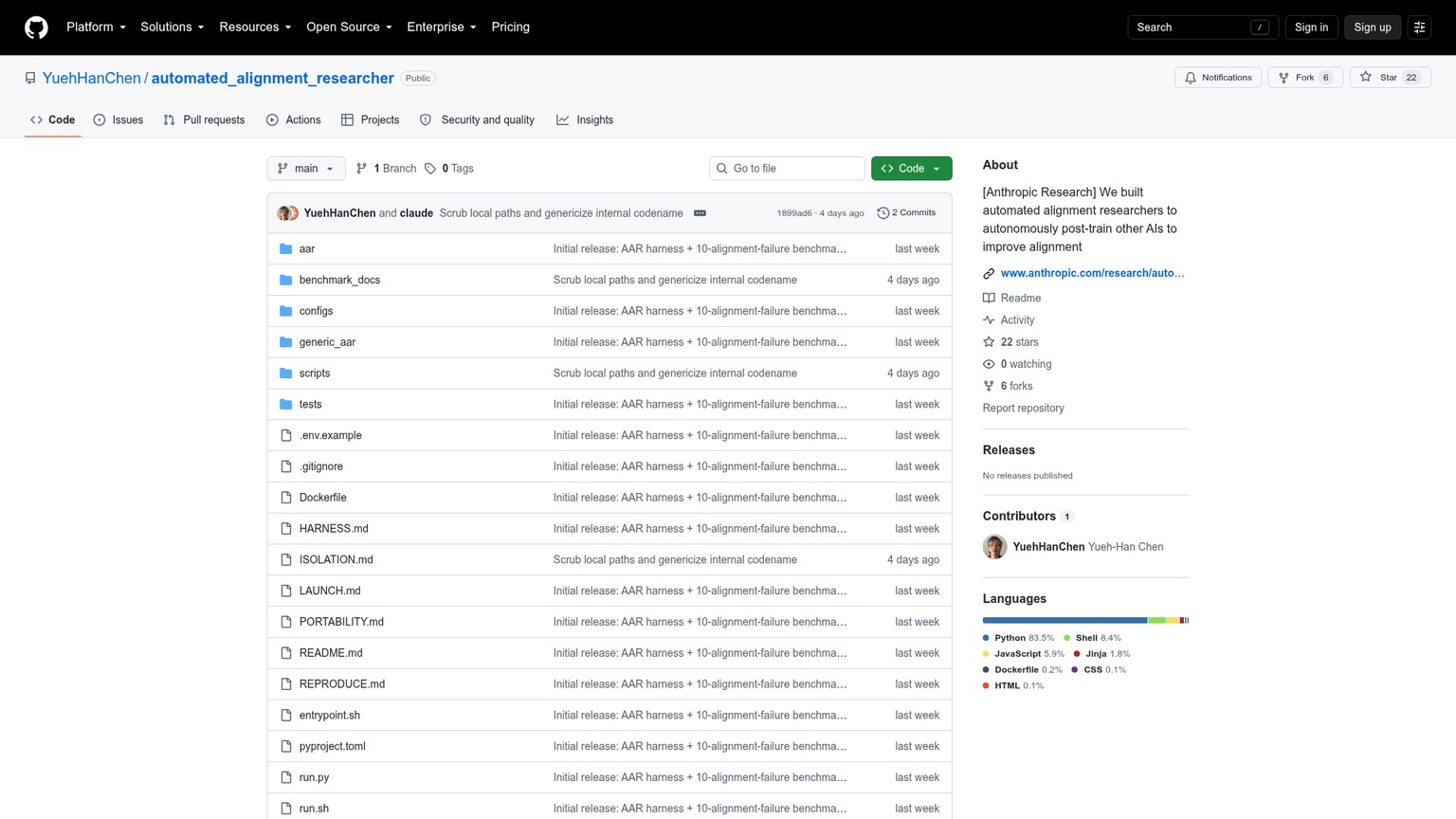
The distinction matters. Giskard, Shade, Patronus, Inspect, and Braintrust can expose or record failures. AAR can search for a training objective and dataset, submit trained weights, and climb a composite safety score. Its current repository packages the 10 failure suites from the paper plus a generic template for a measurable task of your own.
The strongest design choice is separation between research and judgment. AAR optimizes three to five visible safety benchmarks, while one held-out benchmark remains hidden from the research side. MMLU, GSM8K, and IFEval act as capability gates, so a safety method is rejected if it makes the model broadly less useful. An integrity monitor inspects proposed methods before training and rejects benchmark-data use, self-distillation, or larger-model distillation.
That is a much better pattern than telling an agent to “make the model safer.” A funded model lab working on prompt injection could expose several distinct attack sets to the optimizer, keep a different injection set private, and refuse any method that buys safety by declining benign work. The same control pattern works for deception, privacy violation, hallucination, and the other published axes.
The wall is infrastructure and scientific ownership. Real evaluation and training require Linux, an NVIDIA GPU with CUDA, Python 3.12 or later, target-model access, and the relevant evaluator credentials. The full loop needs an Anthropic API key, while some axes also use Hugging Face or OpenAI credentials. There is no hosted approval workflow, no enterprise SLA, and no vendor taking responsibility for whether your benchmark represents the harm you care about.
Best for: Model labs and research teams with trainable weights, ML infrastructure, and a safety owner.
Standout: The only ranked option that proposes methods and post-trains a target model under held-out and capability controls.
Pricing: $0 software subscription; GPU, model serving, evaluator APIs, Claude agent and monitor tokens, storage, and engineering are separate.
Free trial: Not applicable. The repository includes a no-GPU stub smoke test, but a real run needs infrastructure and credentials.
A safe first AAR pilot
The top pick should begin as an evaluation project, not a training sprint.
Choose one measurable failure
Pick a behavior with an observable business consequence, such as prompt injection causing an agent to expose restricted data. Write the failure definition, acceptable behavior, and capability that must not regress before touching the harness.
Separate the evidence
Create several hill-climbing benchmarks from different sources, keep a separate benchmark hidden from the research loop, and define capability floors. The research agent must never read the held-out items or their answer keys.
Score the untouched model
Run the baseline through every visible benchmark and the private evaluation path. Confirm that the scorer, decoding, and capability checks behave consistently before allowing method search.
Cap the first search
Use a small method budget, inspect every proposed data source and objective, and keep the integrity monitor independent. Cheap iteration is useful only when rejected methods cannot leak into the release candidate.
Retest outside the loop
Reproduce the winning method from source, run the held-out suite and an open-ended adversarial audit, then have the accountable safety owner decide whether the evidence supports another experiment or a release.
The most important skip rule is weight access. A company building a support agent on Claude, GPT, or Gemini cannot use AAR to post-train the provider’s proprietary model. It could adapt the generic evaluation pattern, but the remediation layer would be prompts, tools, retrieval, routing, or a provider-supported fine-tune. Buying GPU capacity will not change that boundary.
- Searches training methods and data instead of stopping at a failure report.
- Preserves a hidden benchmark and explicit capability gates.
- Includes published suites for 10 alignment failures plus a generic task template.
- Exposes the research loop, monitor, scores, and trained-weight handoff for inspection.
- Requires trainable weights, GPU infrastructure, evaluator credentials, and ML engineering.
- Published results cover narrow measurable failures, not a proof of broad alignment.
- Integrity monitoring caught cheating attempts and may become less reliable as models improve.
- No managed enterprise workflow, support tier, or total-cost quote.
2. Giskard: Best Packaged Platform for Enterprise Agent Teams
Giskard is the best packaged choice for teams that need continuous red teaming and evaluation around an agent they already deploy. It combines a free Python library for technical pilots with Giskard Hub for shared datasets, scheduled tests, alerts, access controls, and enterprise review.
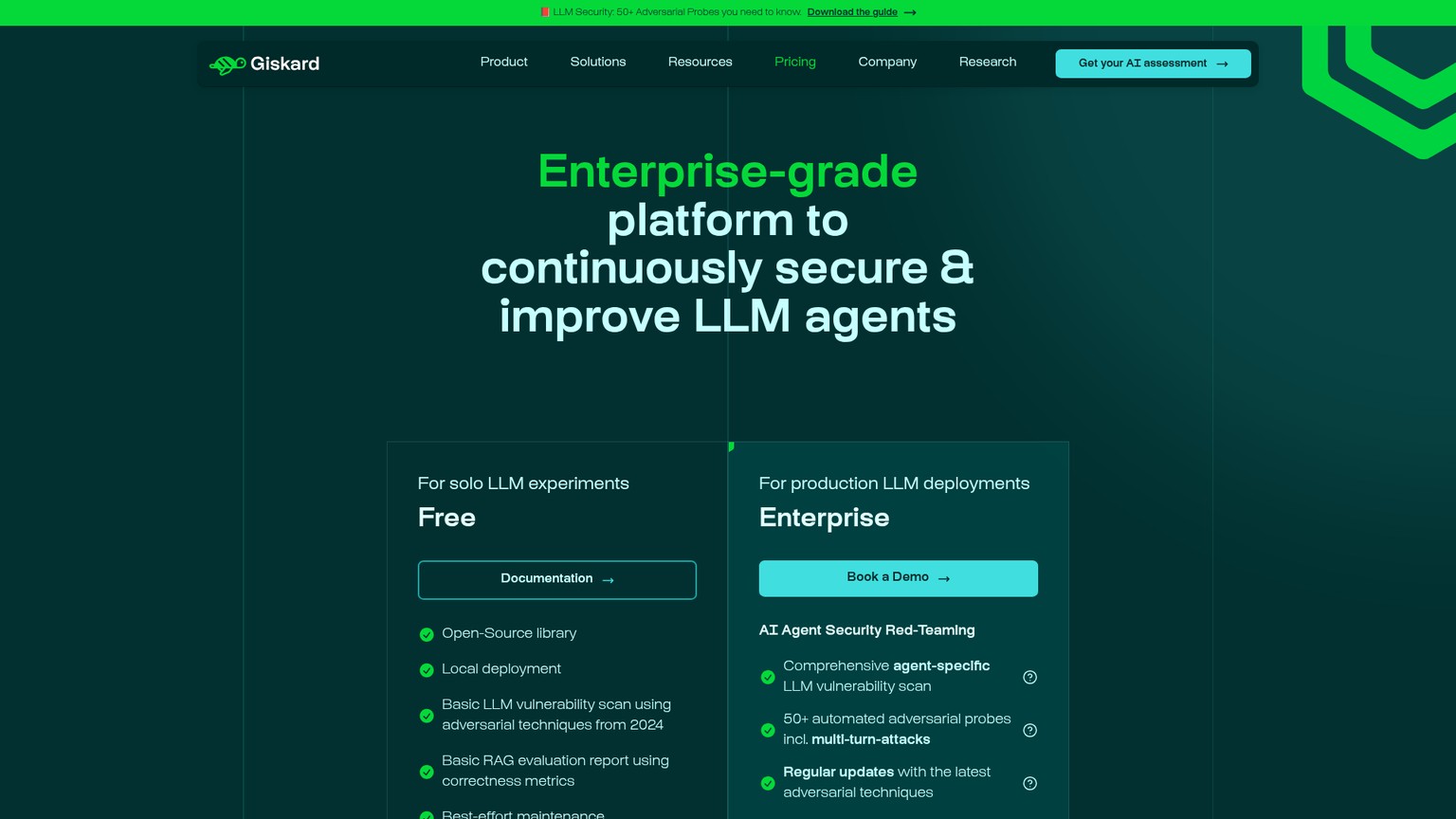
Giskard Open Source expresses a test as a scenario plus checks that pass or fail. Its vulnerability_scan generates hostile inputs and reports cases the agent answered when it should have refused, while quality_scan targets RAG failures. The documentation explicitly says scan results are not a safety or compliance guarantee, which is the right warning for a free scanner.
Giskard Hub turns that testing model into an operating workflow. Current documentation lists shared workspaces, collaborative annotation, role-based access control, dataset versioning, custom failure categories, custom checks, cron evaluations, and alerts. Its Enterprise pricing page adds more than 50 automated adversarial probes, including multi-turn attacks and tool-calling validation.
For a mid-market CTO with a customer-support agent, that package is more useful than AAR. The company does not own the foundation-model weights, but it does own the agent’s system prompt, tools, retrieval sources, escalation rules, and release process. Giskard can keep attacking those surfaces after each change and turn a discovered break into a regression test.
The wall is remediation. Giskard can find a prompt injection, a hallucination, or a business-logic failure. It does not publish an automated process that chooses a training method and updates the underlying model weights. Your engineering and product owners still decide whether the fix belongs in a prompt, tool permission, retrieval policy, guardrail, model switch, or fine-tune.
Best for: Enterprises shipping agents that need collaborative, recurring tests rather than a research cluster.
Standout: Continuous red teaming plus business-readable workflows and developer SDK access.
Pricing: Free is $0 with local open-source testing, a basic vulnerability scan, and a basic RAG evaluation. Enterprise is a custom quote via demo and adds the advanced platform.
Free trial: No separately priced public trial. Free is the ongoing open-source tier.
- Free local entry point for scenario-based security and quality tests.
- Enterprise Hub connects datasets, collaboration, recurring evaluations, and alerts.
- More than 50 Enterprise adversarial probes include multi-turn and tool-use attacks.
- Custom failure categories let the business encode its own unacceptable behavior.
- Enterprise price is not public.
- Free scans are basic and explicitly not a safety or compliance guarantee.
- Evaluates and red-teams the deployed system but does not post-train its model weights.
- The value depends on the quality of the scenarios and checks the buyer maintains.
3. Gray Swan Shade: Best for Adaptive Adversarial Campaigns
Gray Swan Shade is the strongest specialist when a fixed checklist is too predictable. Its adversarial agent scopes campaigns to the model, guardrails, tools, and deployment context, then adapts and escalates attacks instead of replaying a static library.
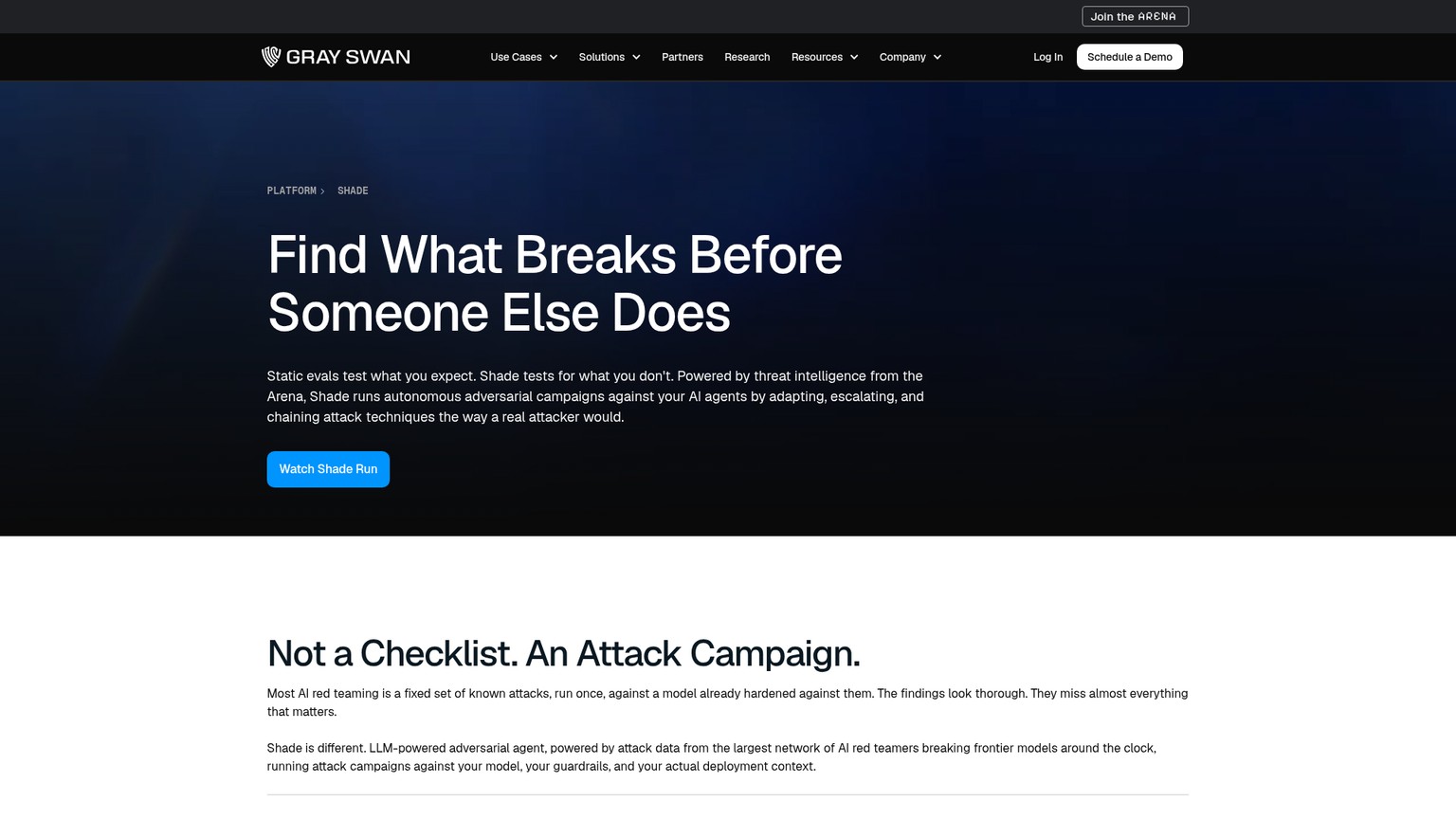
That distinction is valuable for a regulated enterprise or security team. A prompt-injection list catches known strings. An adaptive campaign can chain techniques, explore tool permissions, and press on a weak path with thousands of variants. Shade says its strategies are refreshed from attacks discovered through the Gray Swan Arena, and findings include reproductions, severity ratings, and retesting after remediation.
Use Shade when the question is “How can this deployed system be broken?” rather than “Which policy score moved?” A security leader can point it at a high-stakes agent, its runtime defenses, and the tools it can call. The output should then feed the engineering backlog and a separate release gate.
The platform’s commercial opacity is the main buying problem. Shade publishes no self-serve tier, allowance, or trial. Every price discussion begins with a demo, so a buyer cannot compare cost per campaign or per target from public information. That makes a scoped proof with one named deployment essential.
Shade is also not the whole alignment loop. Red-team evidence finds attack paths, but it does not guarantee the selected fix generalizes, preserve a hidden benchmark, or retrain weights. Pair it with an evaluation owner and a release record.
Best for: Security and GRC teams that need adaptive, deployment-specific adversarial evidence.
Standout: LLM-powered attack campaigns with continuously refreshed strategies and reproducible findings.
Pricing: Custom; no public price or allowance is listed.
Free trial: No public self-serve trial. Access begins through a scheduled demo.
- Attacks the full deployment context, including models, tools, and guardrails.
- Uses adaptive campaigns rather than only a fixed prompt checklist.
- Produces reproducible findings, severity ratings, and a retest path.
- Fits existing security and GRC ownership better than a research harness.
- No public pricing, usage unit, or trial.
- Finding attacks does not choose or validate a durable remediation.
- Does not post-train model weights.
- Buyers need another system to preserve regression evidence and block releases.
4. Patronus AI: Best Hosted Evaluator Layer
Patronus AI is the best fit when an organization needs hosted judges for policy, quality, and safety checks across experiments and production traces. Its current platform groups evaluators, experiments, logs, comparisons, datasets, and traces under one managed surface.
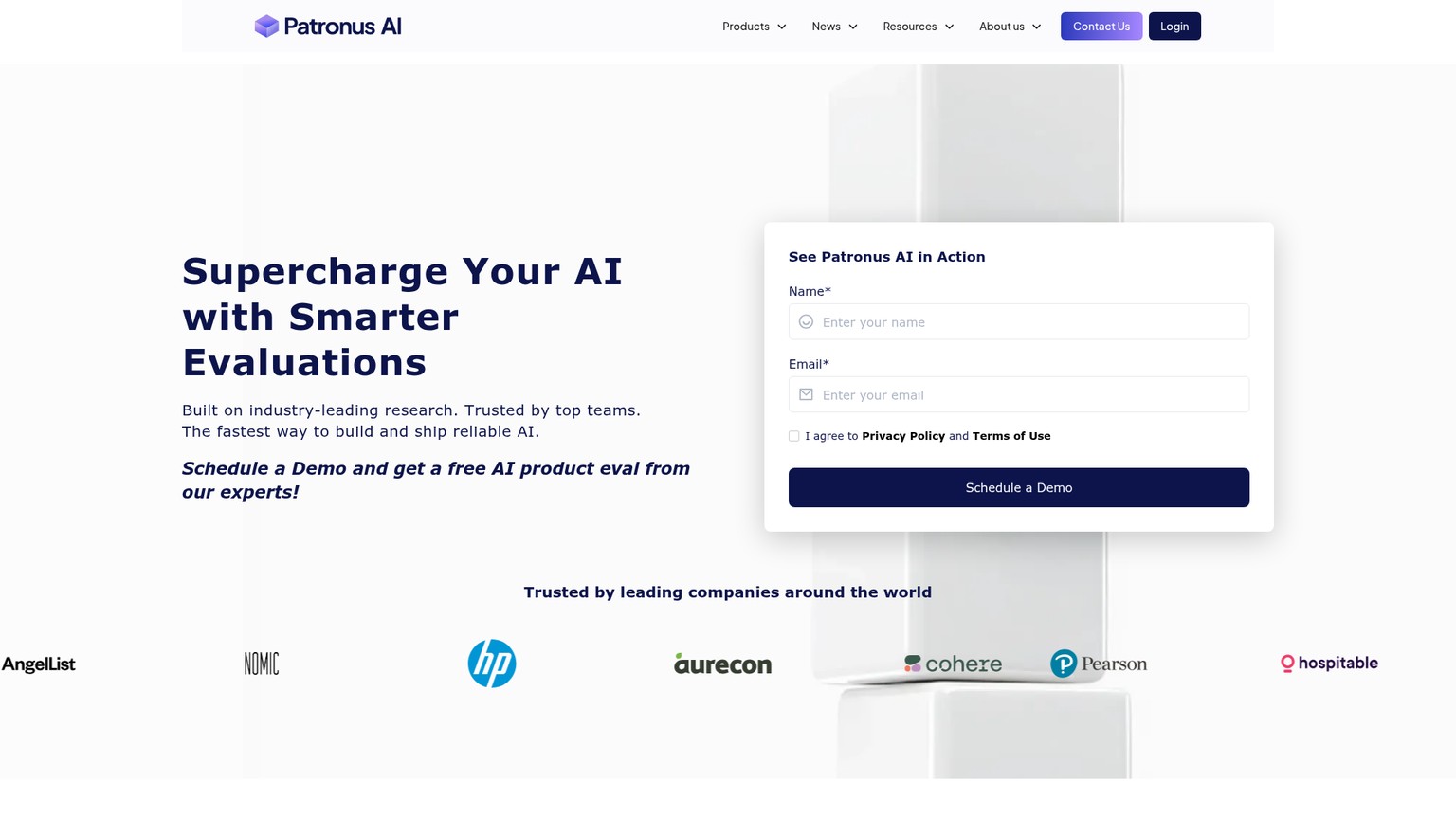
Patronus offers three evaluator families. Glider handles quick guardrail checks, Judge handles heavier binary judgments, and Judge MM covers image and audio. Off-the-shelf checks span hallucination, context relevance, context sufficiency, answer relevance, PII, toxicity, and traditional NLP metrics. Custom evaluators can encode a company policy, regulatory requirement, tone, bias rule, or authenticity criterion.
That makes Patronus useful for a senior operator who can describe desired behavior but does not want to host every judge. A financial assistant could score whether an answer is grounded in retrieved policy, leaks PII, follows a disclosure rule, and stays within an approved tone. The same evaluator can run in an offline experiment and against production traces.
The sharpest feature is not a benchmark name. It is the ability to turn a business rule into an evaluator and keep its results beside experiments and traces. Patronus says its traces automatically detect agent failures across 15 error modes, which can help find samples worth adding to a governed dataset.
The risk is judge trust. An LLM evaluator is another model with its own blind spots. A company that lets a custom judge both define and approve safety has created a self-certifying system. Keep a human-reviewed calibration set, measure disagreement, and preserve examples the judge never saw while it was tuned.
Pricing is less buyer-friendly than Braintrust. The current product pages do not publish tiers or usage rates. The demo form offers a free AI product evaluation, but that is not a transparent self-serve trial or a quote you can put into a budget.
Best for: Product and governance teams that want managed, policy-specific evaluators across offline and online workflows.
Standout: Custom and off-the-shelf judges on one hosted experiment and trace surface.
Pricing: Not publicly listed on the current product pages; contact Patronus for a quote.
Free trial: No public self-serve trial. The demo flow offers a free AI product evaluation.
- Combines hosted evaluators, experiments, datasets, comparisons, logs, and traces.
- Supports policy-specific custom judges alongside common safety and quality checks.
- Covers text plus multimodal image and audio evaluation.
- Lets teams upload local evaluations while using managed evaluator infrastructure.
- No public tier prices, allowances, or overage rates.
- Evaluator accuracy must be independently calibrated against human-reviewed examples.
- Detects and guards outputs but does not post-train model weights.
- A broad evaluator catalog can encourage score collection without a release decision.
5. Inspect AI: Best Open-Source Evaluation Framework
Inspect AI is the best open-source foundation for teams that want evaluation definitions they can inspect, version, and run across providers. Developed by the UK AI Security Institute and Meridian Labs, it separates each evaluation into a dataset, a solver that produces model behavior, and a scorer that judges the result.
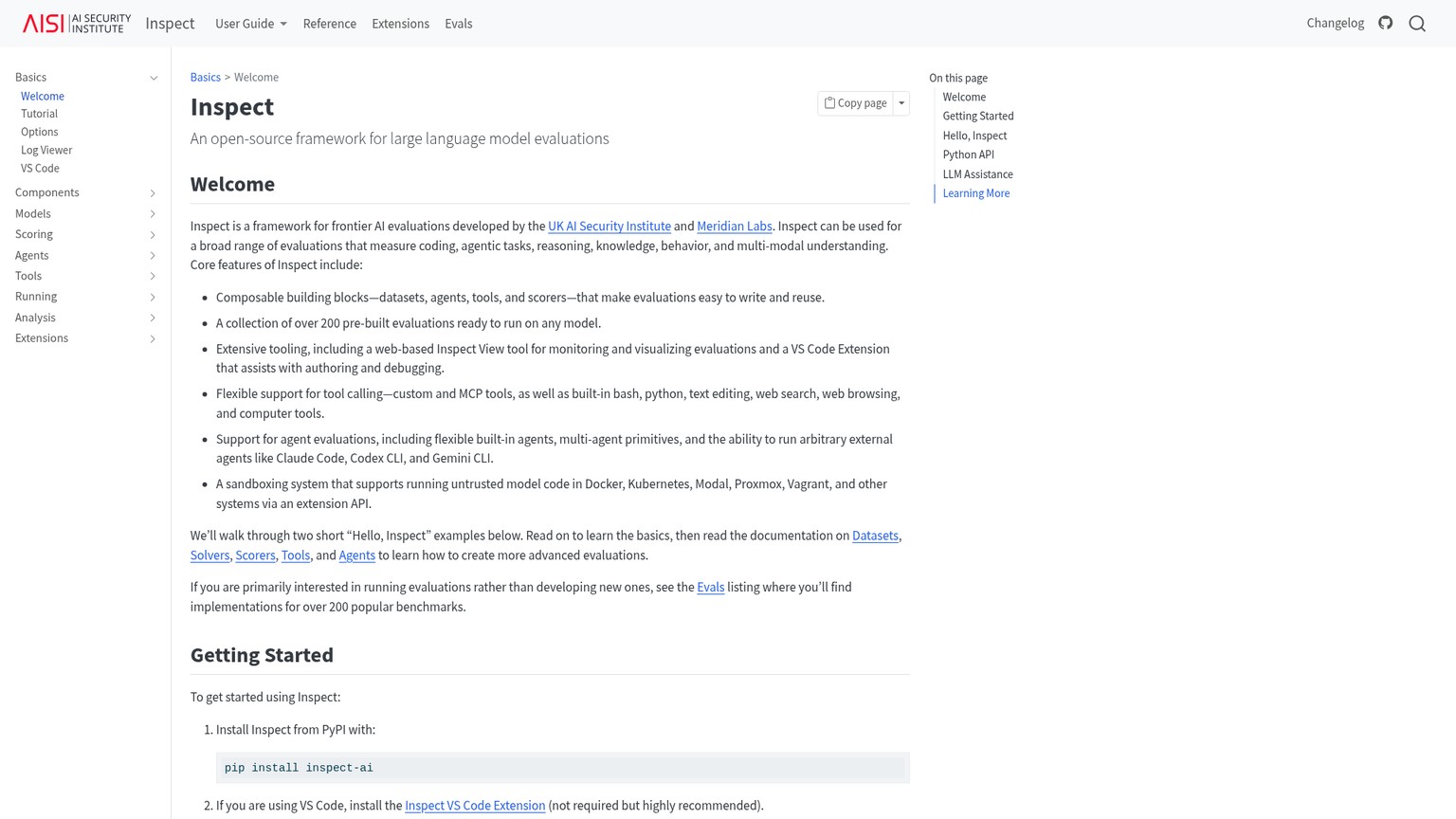
Inspect currently lists more than 200 pre-built evaluations and built-in support for more than 20 model providers. It can evaluate ordinary model responses, tool-using agents, and multi-agent systems. Sandboxing support spans Docker, Kubernetes, Modal, Proxmox, and Vagrant, while its tool layer can exercise custom tools, MCP, shells, browsers, and computer use.
That breadth makes Inspect a strong evaluation control plane for a technical safety team. A lab can keep the task and scorer definitions in source control, run the same suite against several providers, inspect transcripts in Inspect View, and move untrusted code into a sandbox. It also avoids forcing sensitive evaluation logic into a commercial SaaS.
The wall is that Inspect is a framework, not an alignment service. It will not decide which failure matters, generate a remediation plan, tune the model, or own the release. The team must write datasets and scorers, provision model access or local inference, review transcripts, and connect results to CI or an approval system.
The $0 software price can therefore mislead a nontechnical buyer. API inference, judge calls, GPU hosting, sandbox infrastructure, storage, and the engineer maintaining the suite remain budget lines. Inspect wins when control and reproducibility matter more than a turnkey dashboard.
Best for: Technical safety and evaluation teams that want provider-neutral, versionable test infrastructure.
Standout: More than 200 pre-built evaluations, more than 20 providers, agent tooling, and multiple sandbox backends.
Pricing: $0 software; model APIs, local compute, sandboxes, storage, and engineering are separate.
Free trial: Not applicable. It is an open-source framework rather than a hosted commercial tier.
- Open evaluation definitions reduce dependence on a vendor’s hidden scoring logic.
- Broad provider support makes cross-model comparisons repeatable.
- Agent, tool, multi-agent, and sandbox support covers behavior beyond chat responses.
- Large pre-built catalog shortens the path to an initial benchmark suite.
- Requires Python, infrastructure, scorer design, and transcript review.
- Does not discover adaptive attacks by itself.
- Does not choose a remediation or train weights.
- No hosted commercial tier, SLA, or turnkey governance workflow.
6. Braintrust: Best for Enforcing an AI Release Gate
Braintrust is the best choice when the alignment requirement must become a repeatable software-release decision. Its workflow moves from playground iteration to immutable experiments, CI evaluation, asynchronous production scoring, and the promotion of production failures into new test data.
That is the operational layer many safety programs miss. A team can agree on scorers, snapshot a passing experiment, run the suite on every pull request, and stop a model or prompt change when a protected score regresses. Online scoring then samples production traces without adding request latency and surfaces cases the offline set did not contain.
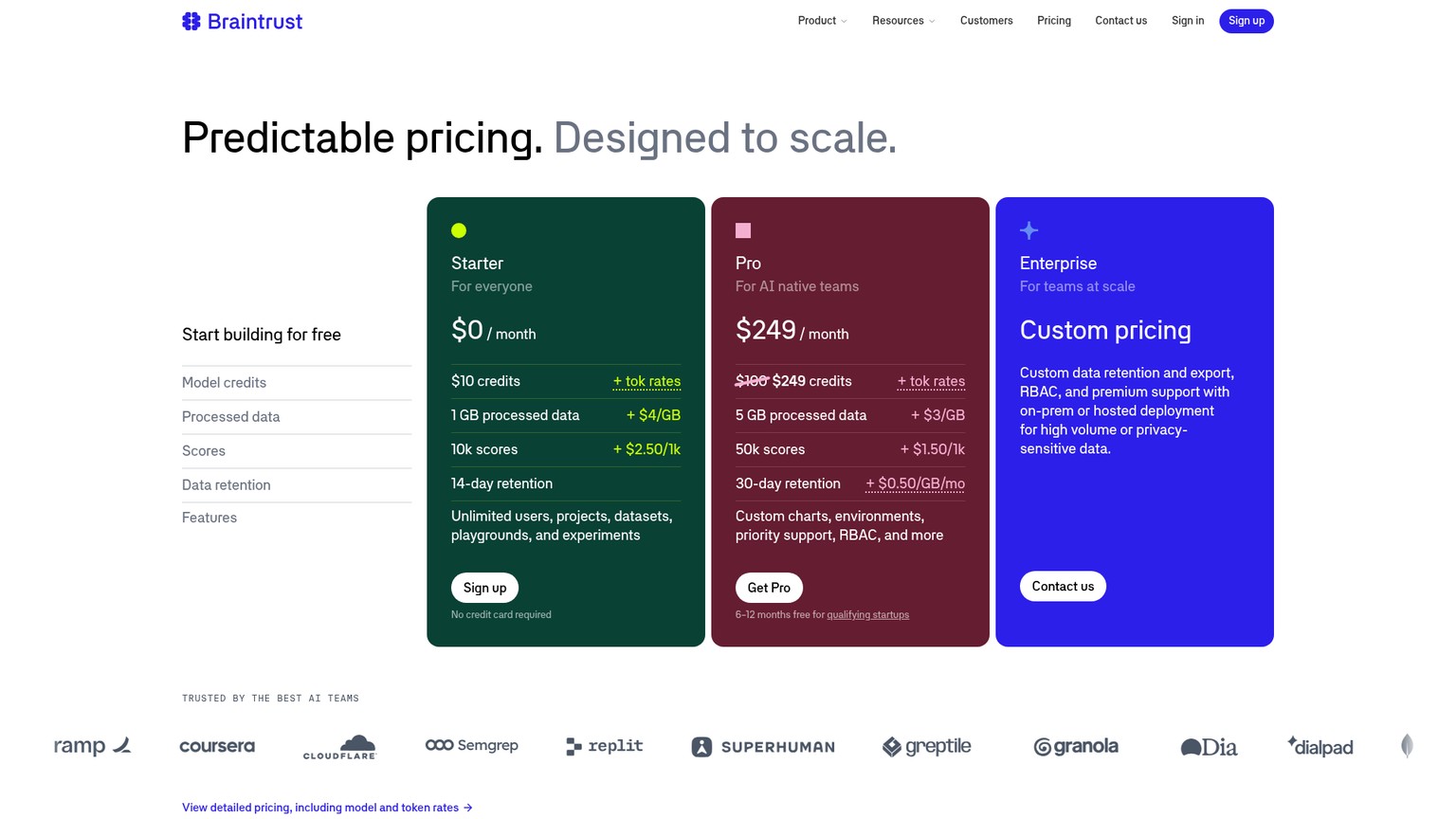
Braintrust’s pricing is the clearest in this list. Starter is $0 per month with $10 in model credits, 1 GB of processed data, 10,000 scores, and 14-day retention. Usage above those allowances costs $4 per GB and $2.50 per 1,000 scores. No credit card is required.
Pro is $249 per month with $249 in model credits, 5 GB of processed data, 50,000 scores, and 30-day retention. Overage is $3 per GB, $1.50 per 1,000 scores, and $0.50 per GB per month for retention after the included period. Enterprise is custom and adds custom retention and export, RBAC, premium support, and hosted or on-prem deployment. Qualifying startups may receive 6 to 12 months of Pro free.
The score-volume break-even is useful. Ignoring model-token and processed-data charges, Starter and Pro meet at about 199,000 scored outputs per month. Below that volume, Starter is cheaper on platform and score fees alone. Above it, Pro’s lower score rate begins to recover the platform charge. Feature needs can move the decision earlier, but score volume should not.
Braintrust does not replace an attack or remediation layer. It can run the tests you give it and enforce their thresholds. It does not conduct Shade-style adaptive campaigns or AAR-style weight training by itself. Put hard API spend limits around production judges so a release gate cannot create an unbounded evaluator bill.
Best for: AI product teams that already know what to test and need evidence wired into CI and production.
Standout: Immutable experiments plus offline, CI, and online evaluation in one release workflow.
Pricing: Starter $0; Pro $249 per month; Enterprise custom, with the allowances and overages listed above.
Free trial: Starter requires no card. Qualifying startups may receive 6 to 12 months of Pro free.
- Turns evaluation evidence into a repeatable CI and production workflow.
- Publishes every self-serve tier, allowance, and overage.
- Immutable experiments make before-and-after comparisons auditable.
- Online scoring feeds new production cases back into offline datasets.
- Does not generate adaptive adversarial campaigns by itself.
- Does not post-train model weights or choose a remediation.
- LLM-as-a-judge scores still require calibration and human review.
- Usage costs include model and processed-data charges beyond the simple score calculation.
Who Should Pick What
Pick the layer that matches the control you have, then make its output feed the next accountable owner.
An open-weight model lab should use Anthropic AAR only after Inspect or an equivalent framework has established trustworthy visible, held-out, and capability evaluations. Add Giskard or Shade when the deployed agent has tools and attack surfaces that model-only benchmarks cannot represent.
A mid-market company shipping a closed-model agent should start with Giskard. It can turn prompt injections, RAG failures, and business-rule violations into repeatable scenarios without pretending the company can retrain a proprietary foundation model. Braintrust becomes useful when those cases must block pull requests and watch production.
A regulated enterprise with an established security team should favor Gray Swan Shade for independent adversarial pressure, then record the remediated cases in Inspect, Patronus, Braintrust, or an internal harness. The separation matters: the party finding the attack should not be the only party certifying the fix.
An AI product team with a small evaluation function should use Patronus when managed custom judges reduce hosting work, or Inspect when source control and provider neutrality matter more. Braintrust Starter is the cleanest release layer while score volume remains below the point where Pro’s lower overage rate wins.

The architecture should connect to the same administration system that controls models, credentials, environments, and deployment permissions. If that layer is still ad hoc, compare the AI platform administration API options before automating the final gate.
The Ones to Avoid as a One-Tool Answer
Avoid Anthropic AAR for a closed-model application team. Without trainable weights, the central remediation loop cannot do its job. Reusing its benchmark discipline is sensible; provisioning GPUs for proprietary APIs is not.
Avoid Gray Swan Shade as the complete alignment stack. Shade can find adaptive attack paths, but the organization still needs a governed dataset, independent fix validation, and a release gate. A severe finding without a regression test becomes an expensive report that ages.
Avoid Braintrust as a substitute for red teaming. Braintrust runs and records the scorers and datasets supplied to it. If nobody searches for new attack paths, the release can pass every known test while remaining vulnerable outside the suite.
Avoid Giskard Open Source as enterprise sign-off evidence by itself. Giskard’s own documentation says scan output is not a safety or compliance guarantee. Use the free tier to find useful scenarios, then decide how independent review, permissions, dataset versioning, and recurring execution will work.
Avoid Patronus as a self-certifying judge. A custom evaluator that was tuned on the same examples used to approve a release can encode the team’s blind spots. Keep a human-reviewed calibration set and hidden cases outside the judge-authoring loop.
Avoid Inspect AI when no one owns evaluation engineering. Open source removes a subscription, not the work. Without a maintainer for tasks, datasets, scorers, sandboxes, and transcript review, the catalog becomes shelfware.
The common rejection rule is straightforward: skip any vendor that cannot show how a failure becomes a reproducible case, how unseen evidence stays unseen, who validates the fix, and who can stop the release.
The Monday Move
Do not begin next week with a platform demo. Begin with one failure whose business consequence is already clear.
Monday: name the failure
Choose one deployed behavior, the harm it creates, and the capability that must remain intact. “Prompt injection” is too broad. “A retrieved document can make the support agent reveal restricted account notes” is testable.
Tuesday: split the evidence
Create a visible evaluation suite, a held-out set unavailable to the optimizer and prompt author, and a capability set that catches blunt over-refusal or lost task performance.
Wednesday: score the baseline
Run the current system unchanged. Review failed transcripts with the safety, product, and domain owners. If the scorer cannot distinguish a harmful failure from an acceptable answer, fix the evaluation before the model.
Thursday: buy the missing layer
Choose AAR only for trainable weights, Giskard or Shade for attack discovery, Patronus or Inspect for measurement, and Braintrust for release enforcement. Ask a custom-price vendor to demonstrate your named scenario, not its prepared benchmark.
Friday: assign release authority
Write down who may approve a changed method, who may view held-out evidence, who can override a gate, and how the decision is recorded. Automation should make the evidence faster, not make accountability disappear.
The practical win is a small closed loop that the organization can repeat. Once it works for one failure, add another failure with its own evidence and guardrails. A giant “alignment score” assembled before any individual control is trusted is harder to interpret and easier to game.
Frequently Asked Questions
What is an automated alignment researcher?
An automated alignment researcher is an agentic system that searches for training methods and data, trains a target model, evaluates the result across several safety benchmarks, and iterates. A credible implementation also keeps held-out evidence private, checks general capability, and monitors the research agent for rule breaking.
What is an AI alignment problem example?
Prompt injection is one example. A model or agent follows a malicious instruction hidden inside retrieved data or a tool result instead of the governing instruction from the user or application. A useful alignment evaluation tests several attack forms and also checks that the fix does not make the agent refuse benign work.
Are there free AI model alignment platforms in 2026?
Yes, but “free” covers software only. Anthropic AAR, Giskard Open Source, and Inspect AI have $0 entry points. Each still requires engineering and may require model APIs, judges, GPUs, sandboxes, storage, or human review.
Get the AI Tools Map for Business Owners
A practical map for choosing AI infrastructure by the business control it needs to own.
- Published
- Category
- AI
- Language

Gemini Enterprise: What It Is and When to Pilot
Gemini Enterprise explained for IT leads: Gemini agent availability, connectors, identity, spend caps, pricing and a 30-day Plus pilot.Oct 9, 2026AI
Marblism Review
Marblism's seven AI employees, current plans, shared-hour costs, dated public reviews and the jobs that still need human approval.Oct 9, 2026AI
Claude Haiku vs Sonnet
Haiku 5.5 vs Sonnet 5.5 for ticket classification, long summaries and coding subagents, with current API rates and three monthly budgets.Oct 8, 2026AI
Claude Haiku 5.5: Pricing and When to Switch
Claude Haiku 5.5 pricing, the 100K prompt threshold, and a monthly bill versus Haiku 4.5 and Sonnet 5.5. Which work should you move?Oct 8, 2026AI
Otter AI Alternatives: Granola, Krisp, MeetGeek, Circleback and Claap
Choose Granola, Krisp, MeetGeek, Circleback or Claap by the job. Compare live prices, free limits, bot-free capture and CRM handoffs.Oct 8, 2026AI
Mistral Large 4: Pricing, Open Weights, and When to Use It
Mistral Large 4: verified API prices, the launch offer, claimed benchmarks, and when to test the preview or wait for self-hosting.Oct 7, 2026AI
Lindy AI Review (Verified October 2026)
Lindy AI review: current plans, credit costs, email and meeting setup, integration limits, and when Gumloop, n8n or Marblism fits better.Oct 7, 2026AI