Managed vs Self Hosted Coding Agents 2026
Vercel eve wins for most teams. See when GLM-5.3 self-hosting clears its GPU cost, control, and workflow crossover.
Published Updated
 By Omid Saffari
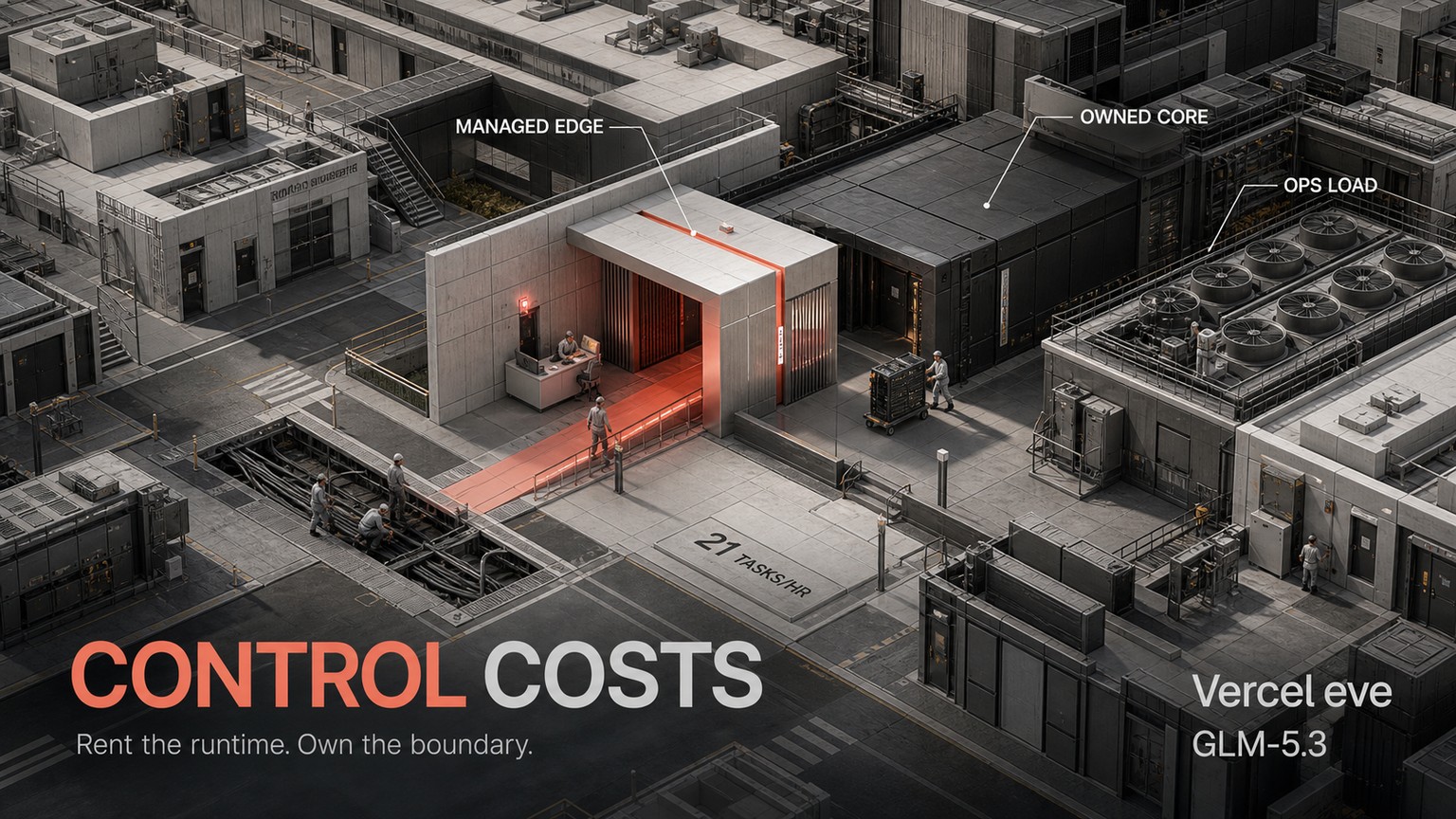
Pick managed Vercel eve for most teams: at 100 modeled repo-heavy tasks a month, the decision model lands near $182 versus $3,448 for 100 hours on an eight-H200 self-hosted GLM-5.3 cluster. Fully self-host when model inputs or traces cannot cross the boundary. If full self-hosting is discretionary, demand more than 21.28 task equivalents per paid cluster-hour; if only the checkout and tool execution must stay inside, Cursor Self-Hosted Machines now fills the middle.
Which one should you pick?
Choose managed Vercel eve when demand is uncertain, the agent needs approvals and durable sessions quickly, or the company would rather buy variable usage than operate GPU capacity. It is the lower-risk choice for a founder, product team, or internal platform group proving which coding workflows deserve automation.
Choose self-hosted GLM-5.3 when a hard policy keeps code, prompts, or model traces inside infrastructure you control. That choice also needs an inference team, an agent runtime, a sandbox boundary, observability, and enough concurrent work to keep expensive accelerators busy. Owning the weights does not supply those pieces.
The decision now flips on three gates. First, can file contents needed for inference and model traces cross a managed boundary? If no, full self-hosting may be mandatory regardless of cost. If yes, but the checkout and tool execution must remain inside your network, Cursor Self-Hosted Machines is the middle route. If both can cross, ask whether measured demand can fill more than 21.28 modeled task equivalents in every paid cluster-hour. Below that line, rented self-hosted GPU time loses before storage and engineering enter the budget.
This is not a perfectly symmetrical product contest. GLM-5.3 is a model; eve is an agent framework and managed operating path. A self-hosted GLM-5.3 coding agent still needs a harness around the model. A managed eve agent still needs a model behind the harness. Cursor makes another split explicit by keeping the loop and inference managed while customers own tool execution. The useful comparison is therefore about which operational boundary you own.
Vercel eve is the default for shipping the workflow
Vercel eve packages the parts that turn a model call into an operating agent: checkpointed steps, isolated execution, approval gates, subagents, evaluation, tracing, and channel delivery.
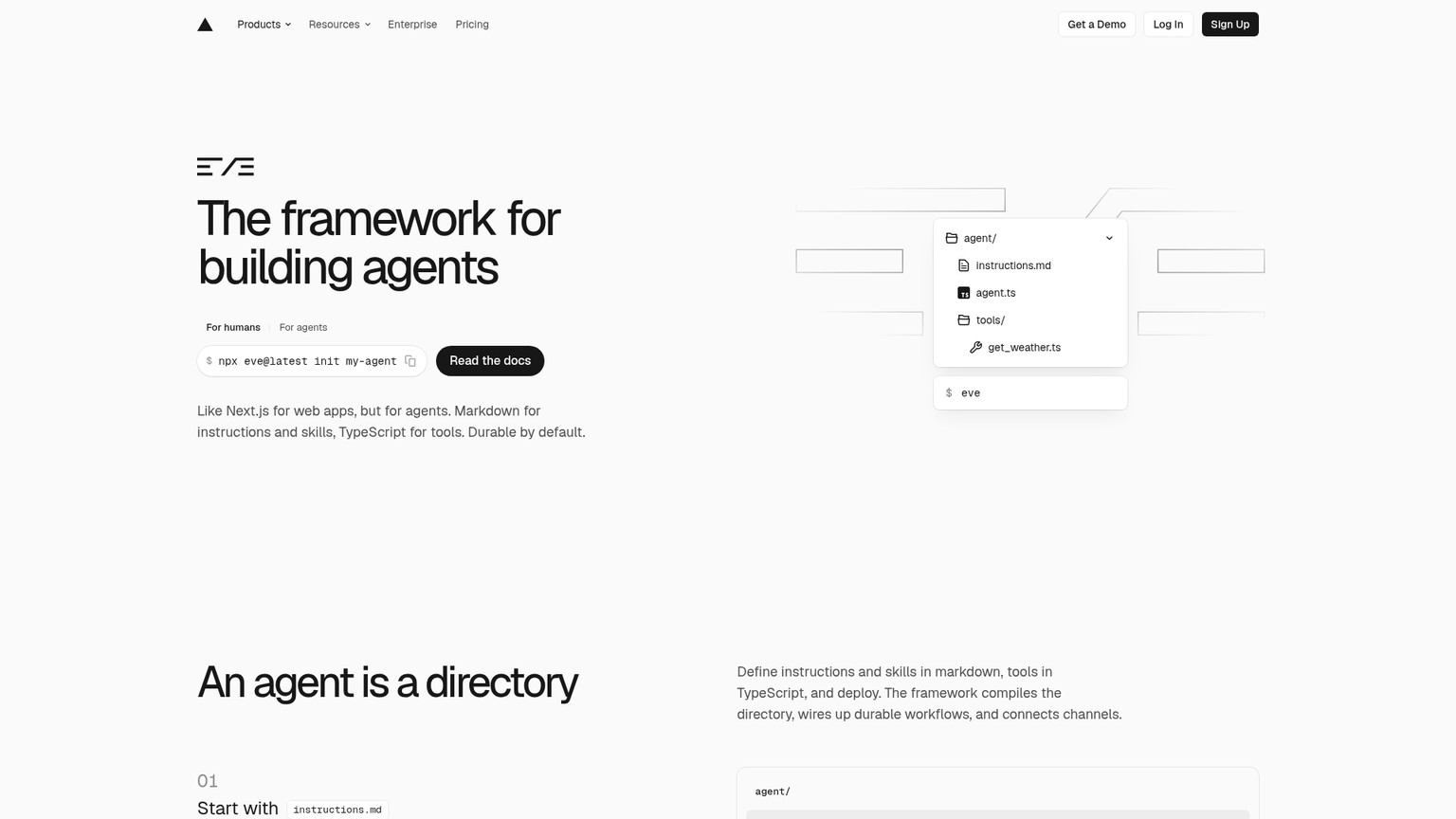
Its strongest advantage is not a single feature. It is that a session can park while waiting for a person, resume after a message, and preserve a structured history without charging active compute for the wait. That is the right default for a pull-request bot awaiting approval or an issue agent waiting for missing context.
The wall appears at the deployment boundary. Vercel's official launch material says local development can use Docker, microsandbox, just-bash, or a custom sandbox backend, while the managed deployment swaps to Vercel Sandbox. At launch, other deployment platforms were still described as on the way. The framework is open, but the complete managed experience is still a Vercel choice.
Winner for time to a governed workflow: Vercel eve. Skip it when the managed boundary itself violates policy or when a platform team already owns an equivalent durable agent runtime.
GLM-5.3 is the choice for owning the model boundary
GLM-5.3 became a different procurement decision once its weights were live by August 28, 2026. The official repository now displays at 756 GB, and the model card lists 753 billion parameters with BF16 and FP8 tensor types.
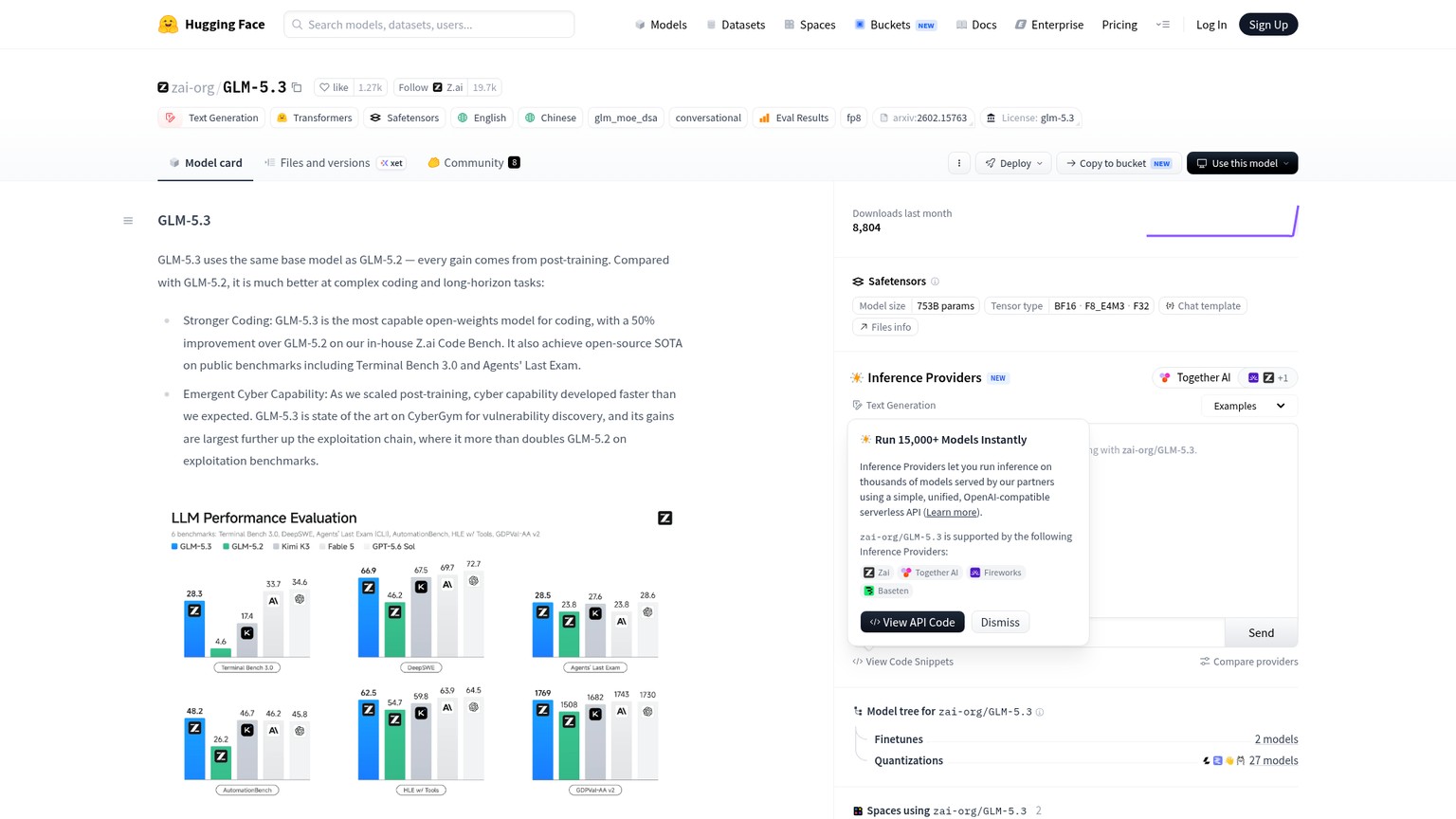
The official repository links deployment paths for SGLang, vLLM, TokenSpeed, Transformers, KTransformers, Unsloth, and Ascend hardware. That gives an infrastructure team choices over the serving engine, network boundary, capacity plan, logging, and patch schedule.
The wall is memory residency before the first agent task runs. NVIDIA specifies 141 GB of HBM3e per H200, so four GPUs provide 564 GB, less than the repository payload before KV cache and runtime buffers. Eight H200s provide 1,128 GB, which is why the cost model starts there. More context, concurrency, or replicas can require more headroom.
Winner for model and infrastructure control: self-hosted GLM-5.3. Skip it when the purpose is merely to avoid a token invoice. A GPU fleet replaces that invoice with capacity risk and an on-call obligation.
The cost crossover: $182 versus $3,448
Prices were checked against the live vendor pages on September 3, 2026. The comparison uses one workload on both sides so a cheap token rate is not compared with an unrelated monthly server number.
The modeled unit is one repo-heavy agent task with 1 million uncached input tokens, 50,000 output tokens, and one active sandbox hour using one CPU and 2 GB of memory. It is a planning assumption, not a measured customer average. Your repositories may be much smaller, or a long-running migration may be larger.
Managed eve cost
The current Z.AI route for zai/glm-5.3 in the Vercel AI Gateway model catalog charges $1.40 per 1 million input tokens, $4.40 per 1 million output tokens, and $0.26 per 1 million cache-read tokens. Normalized to 1,000 tokens, that is $0.0014 for input, $0.0044 for output, and $0.00026 for a cache read.
For the modeled task, hosted model spend is:
1 x $1.40 + 0.05 x $4.40 = $1.62
At 100 tasks, model spend is $162. Vercel's current pricing puts Pro at $20 per month with one developer seat and $20 of included usage credit. The current Sandbox allowance includes 5 active CPU hours and 420 GB-hours of provisioned memory. The modeled 100 hours produce 95 billable CPU hours, or $12.16 at $0.128 per hour, while 200 GB-hours of memory remain inside the included allowance. That CPU overage fits within the $20 platform credit.
The one-developer estimate is therefore about $182: $162 for GLM-5.3 tokens plus the $20 Pro floor. It excludes data transfer, other Vercel resources, taxes, payment fees, and human review time. AI Gateway says it adds no markup or platform fee to provider token prices.
At five developer seats, the same shared 100-task workload is about $262: $162 of model usage plus $100 of seat fees. That is $52.40 per developer for the month under this exact workload. The platform price rises with people, while model spend rises with work.
Self-hosted GLM-5.3 cost
RunPod currently lists an H200 SXM in a cluster at $4.31 per GPU-hour. An eight-GPU cluster therefore costs $34.48 per hour. If each modeled task occupies one whole cluster-hour, 100 task-hours cost $3,448 before storage, networking, monitoring, inference engineering, security work, and incident response.
For five developers, that 100-hour GPU rental is $689.60 per developer. Leaving the same cluster on for a 730-hour month costs $25,170.40, or $5,034.08 per developer across five seats. RunPod standard network storage is $0.07 per GB per month below 1 TB and $0.05 above 1 TB, which puts one 756 GB copy of the model repository near $52.92 before replicas, snapshots, and working data.
The open-weight license removes a model purchase fee. It does not make inference free.

The one-developer comparison is $182 managed versus $3,448 in GPU rental, a difference of $3,266 and a ratio of 18.95x. That result does not mean self-hosting can never win. It shows what utilization must overcome.
Divide the $34.48 cluster-hour by the $1.62 hosted model cost per task. The result is 21.28 modeled task equivalents per hour. A self-hosted cluster has to complete more than that sustained amount merely to beat hosted token spend. Storage and engineering push the full break-even higher. If the tasks cannot be batched or run concurrently at that rate, the GPU is an expensive waiting room.
There is no defensible self-hosted price per 1,000 tokens until the chosen serving stack is measured on the chosen hardware at the target context, reasoning effort, and concurrency. A vendor API rate is a billable token unit. A GPU-hour is capacity. Converting one to the other without measured throughput creates false precision.
Winner for cost at uncertain or moderate demand: Vercel eve. Self-hosting earns a financial hearing only after measured concurrency clears the utilization line and a control requirement justifies the operating burden.
Workflow and reliability
Vercel eve wins the workflow category because it provides an agent operating model, not only inference. A coding agent needs somewhere to run commands, a way to survive restarts, a record of each tool call, a human gate for risky actions, and a route back to the user. eve makes those parts explicit.
Checkpointing matters when an agent opens a pull request, requests approval, and waits until the next morning. A conventional process either stays alive, reconstructs state, or fails. eve records each step, parks the workflow, then resumes when the response arrives. An approval can appear in a connected channel, and a subagent can take a bounded task without losing the parent session.
A self-hosted GLM-5.3 endpoint supplies none of that by itself. The platform still needs an agent harness, repository credentials, command policy, sandbox lifecycle, durable state, queues, retries, evaluation data, trace retention, and alerting. If you are comparing those runtime options, the embeddable coding-agent harness guide covers that layer directly.
The binary label now hides two useful hybrids. You can use eve as the agent framework while routing model calls to a GLM-5.3 endpoint you operate; local eve adapters can keep the sandbox in your environment, and its model configuration is designed to be swapped. Or Cursor can keep the agent loop and inference in its cloud while moving file edits, terminal commands, browser actions, and local MCP execution to your worker. Both splits still require careful testing of credentials, networking, durability, data flow, and failure behavior before production.
The remaining eve dependency is deployment and managed infrastructure. The remaining GLM dependency is the model's API behavior and license, even when the bytes sit on your machines. Neither route removes dependency; each moves it.
Winner for workflow completeness and restart safety: Vercel eve. Self-hosted GLM-5.3 wins only when it sits behind an agent platform you already know how to operate.
Model quality and deployment control
GLM-5.3's benchmark story is strong enough to justify a pilot, but it does not decide whether the pilot should be managed or self-hosted. The same model can be called through eve and Vercel AI Gateway, so model quality is not exclusive to the infrastructure you own.
Z.ai reports that GLM-5.3 rose from 4.6 to 28.3 on Terminal-Bench 3.0, from 46.2 to 66.9 on DeepSWE v1.1, and from 23.8 to 28.5 on Agents' Last Exam versus GLM-5.2. On Z.ai Code Bench at high effort, the vendor reports 31.4% at about 50,000 output tokens, compared with 29.5% at 120,000 for Claude Opus 4.8. These are Z.ai's measurements, not results produced for this comparison. Z.ai also says its benchmark pipelines still require meaningful human-in-the-loop work.
The independent signal is more restrained. As checked on September 3, 2026, Artificial Analysis measured GLM-5.3 at 60 on its Intelligence Index. It measured 62.8 output tokens per second through Z AI's API, below the displayed peer median of 65.0. It also recorded 170 million output tokens across the index versus a median of 110 million. That composite covers more than coding, but the verbosity result matters to an agent budget because output tokens cost money and time.
Do not use the hosted 62.8-token-per-second result as a forecast for an eight-H200 deployment. Self-hosted throughput changes with the serving engine, quantization, batch size, prompt length, output length, reasoning setting, and concurrency. This is why a self-hosting decision needs a pilot on the intended stack rather than a spreadsheet built from an API speed.
GLM-5.3 also changes one migration contract. It supports low, high, and max reasoning effort, with max as the default, and it no longer accepts disabled thinking. An application still sending thinking.type: "disabled" fails until it switches to enabled thinking and an allowed effort setting. That is small in code and material in a rollout because it can break every request at once.
Winner for serving and model-level control: self-hosted GLM-5.3. Winner for receiving the same model without owning serving capacity: Vercel eve. The benchmark does not choose between them; the operational boundary does.
Security, privacy, and lock-in
Self-hosted GLM-5.3 wins when the requirement is literal: repository contents and inference traces cannot leave a network you control. Owning the weights lets the security team place the model endpoint, logs, storage, credentials, and egress rules inside that boundary.
That control is not automatic safety. The self-hosted operator owns image provenance, dependency patching, command containment, secrets, tenant isolation, audit retention, abuse monitoring, and the consequences of an agent with shell access. A model behind a private endpoint can still run inside an unsafe agent.
Vercel eve gives a smaller team clearer primitives for containment. Its managed path includes isolated Sandbox execution and approval gates, and a session can pause until a person resolves a sensitive action. For many companies, buying a maintained boundary is safer than building a less mature one. For a company with a firm no-egress rule, the managed boundary is disqualifying even if the controls are good.
Since September 2, 2026, Cursor Self-Hosted Machines has occupied the middle: the checkout, build cache, machine-local credentials, and tool execution stay on a customer worker, while Cursor's documented boundary keeps the agent loop, inference, and planning in its cloud and sends needed file contents, tool results, and artifacts to its services. Team Pools require the custom-priced Enterprise plan and a service-account key, and the customer pays for and operates worker capacity. It is private execution, not full no-egress; the focused Cursor breakdown maps the boundary.
Two contractual details deserve a place in the architecture review:
- Vercel's eve launch post said managed deployment targeted Vercel while support for other platforms was on the way. Local and custom adapters improve flexibility, but a production exit plan should be demonstrated before the system becomes critical.
- GLM-5.3's license grants broad rights to use, modify, distribute, and deploy the model. It also says a Model-as-a-Service business with more than $10 billion in aggregate affiliate revenue over any consecutive 12 months must pass Z.AI's security review before commercial use. That clause will not affect most buyers, but it is not a standard detail to discover after launch.
Lock-in is therefore different, not absent. Managed eve couples the full operating path to Vercel services. Self-hosted GLM-5.3 couples the platform to a very large model, its request behavior, its serving compatibility, and your GPU plan. The right question is which dependency has a tested exit.
Winner for a hard no-egress boundary: self-hosted GLM-5.3. Winner for obtaining sandboxing and approval controls without staffing the entire platform: Vercel eve. Policy decides this category before preference does.
What switching costs
Moving from managed eve to self-hosted GLM-5.3 is not a URL swap unless eve remains the agent framework and only inference moves. A full departure also moves durable sessions, sandbox creation, approval state, channel integrations, traces, evaluations, budgets, credentials, and incident response.
Start with the artifacts that must remain portable:
- Keep prompts, tool schemas, repository scopes, and expected outputs in version control.
- Export evaluation cases and store acceptance results outside the runtime's proprietary dashboard.
- Define a sandbox contract for filesystem, network, command, timeout, and secret access.
- Make session identifiers and approval events part of the application record rather than UI-only state.
- Replay the same tasks against the new model endpoint before moving production traffic.
The GLM-5.3 thinking change belongs in that replay. Requests that disabled thinking must be migrated before the model ID changes. Differences in output length also affect budgets, timeouts, and the amount of state the agent must preserve.
Moving in the other direction, from a self-hosted stack to managed eve, trades infrastructure work for a boundary review. Security must approve where code, prompts, traces, sandboxes, and credentials live. Finance must decide who controls AI Gateway credits and team budgets. The application must preserve any self-hosted state or audit records that eve does not import.
Do not switch to full self-hosting when demand is spiky, the platform team cannot cover inference incidents, or the only motive is avoiding per-token prices. Do not switch to managed eve when a binding contract prohibits external inference or sandbox execution. Use Cursor's split runtime only when external inference is allowed and the execution location is the blocker. And do not switch any route without a replayable evaluation set. A broad coding-agent shortlist can identify alternatives, but it cannot replace a workload-specific migration test.
The Monday move
Do not buy GPUs on Monday. Put one bounded coding workflow on managed eve with the hosted GLM-5.3 route and measure it for seven days.
Use a task that resembles paid work, such as repairing a failing test, upgrading a dependency, or reviewing a pull request under a read-only policy. Set the repository scope, allowed commands, approval points, timeout, and expected output before the first run. Then log input tokens, cache-read tokens, output tokens, active Sandbox CPU hours, provisioned memory, wall time, approval waits, retries, failures, and concurrent task equivalents.
At the end of the week, make the budget decision from the observed distribution rather than the average alone:
- If file contents needed for inference or model traces cannot cross the managed boundary, approve a bounded full self-hosting pilot and price the security and operations work beside the GPU line.
- If cloud inference is allowed but the checkout and tool execution must remain inside, run the same task on a capped Cursor Self-Hosted Machine and record the worker bill separately.
- If code can leave and sustained packing stays below 21.28 modeled task equivalents per cluster-hour, keep the managed route.
- If the boundary requires self-hosting and measured packing clears 21.28, rent an eight-H200 pilot for the representative workload. Do not begin with an always-on commitment.
- If the result varies sharply by task, route only the constrained, batchable work to self-hosted infrastructure and leave bursty work managed.

The approval memo should carry three budget lines: managed model and platform spend, self-hosted infrastructure spend, and the staff time required to operate the boundary. If the third line is blank, the comparison is not finished.
For teams building a wider platform around several agents, the AI agent platforms comparison covers the orchestration layer. The Monday decision here is narrower: buy the managed operating path, use a split runtime for private tool execution, or prove that full model ownership earns its capacity and staffing cost.
FAQ
Is a self-hosted coding agent better than a managed coding agent?
A fully self-hosted coding agent is better when model inputs or inference traces cannot leave your controlled network, or when measured utilization is high enough to amortize GPU capacity and operations. Managed is the stronger default for bursty demand and fast deployment. Cursor's split runtime fits the narrower case where tool execution must stay inside but cloud inference is allowed.
Can Vercel eve run GLM-5.3?
Yes. eve selects its model in agent.ts, and Vercel AI Gateway currently exposes GLM-5.3 as zai/glm-5.3. A hybrid can also keep eve as the agent framework while pointing model calls at an endpoint you operate, subject to integration and deployment testing.
What is the price difference between managed and self-hosted coding agents?
Under the stated 100-task workload, managed eve with hosted GLM-5.3 is about $182 for one developer, while 100 hours of eight-H200 rental is $3,448 before self-hosted storage and operations. The difference is $3,266, or 18.95x in this model.
Is Codex a coding agent?
Yes. OpenAI Codex is a coding agent. It is not either entity priced in this comparison, so its capabilities and commercial terms should be evaluated separately rather than mixed into the GLM-5.3 versus eve budget.
The AI business workflow audit checklist
Use the free checklist to identify which coding workflows are ready for an agent and which still need a human gate.
- Last Updated
- Category
- Build
- Language

Firecrawl Pricing 2026: What Your Pages Cost
Firecrawl plans and credit packs verified October 2026. Calculate JSON extraction, failed pages and weekly crawl bills at your volume.Oct 9, 2026Build
Claude Code vs GitHub Copilot 2026
Claude Code vs GitHub Copilot: current plans, usage limits, models, team controls, one-seat and ten-seat costs, and when to use both.Oct 8, 2026Build
LangGraph vs CrewAI
Compare LangGraph and CrewAI on the same approval workflow, state, memory, MCP, observability and current hosted-platform prices.Oct 7, 2026Build
How to Build MCP Server
Build an order lookup MCP server with Python, test it in Inspector, connect Claude Code and Cursor, then add HTTP auth and hosting.Oct 7, 2026Build
Gumloop vs n8n (Verified October 2026)
Gumloop vs n8n: current pricing, credits vs executions, self-hosting and the same AI lead workflow, with a verdict for each builder.Oct 7, 2026Build
AI Agent Frameworks in 2026: LangGraph, CrewAI, OpenAI Agents SDK, Claude Agent SDK, Mastra and Google ADK (Compared)
Compare eight AI agent frameworks by language, state, MCP, approvals and current hosted prices. Pick the right runtime for production.Oct 7, 2026Build
Codex Cloud
Set up a reusable Codex Cloud environment, keep coding tasks running with your laptop off, steer from your phone, and choose cloud or local CLI.Oct 7, 2026Build