Can Coding Agents Handle Long-Running Production Tasks 2026
Long-running coding agents can now carry bounded work for hours. The real gain is less supervision, but only with tests, review, and rollback.
Published
 By Omid Saffari



Yes, coding agents can now carry a bounded production task for hours or days and return a reviewable pull request. The proof is no longer a toy demo: Cursor reports 25 to 36 hour runs, while T3 Code has cut a worst-case long-thread load from hundreds of megabytes to under 40 KB. The business gain is not fewer engineers. It is a new asynchronous implementation lane, where people spend less time steering every edit and more time defining, checking, and approving the work.
Yes, but “handle” needs a hard boundary
A coding agent can handle a long-running production task in 2026 if “handle” means this:
- receive a specific outcome and acceptance tests
- work in an isolated branch or disposable worktree
- preserve its plan and progress across context resets
- stop at explicit approval points
- produce code, tests, and an evidence packet for review
- leave deployment to the normal release process
That is a meaningful change. It lets a team delegate a 30-hour refactor without keeping an engineer in a 30-hour chat loop. It does not make the agent the owner of customer data, credentials, architecture, or the production button.
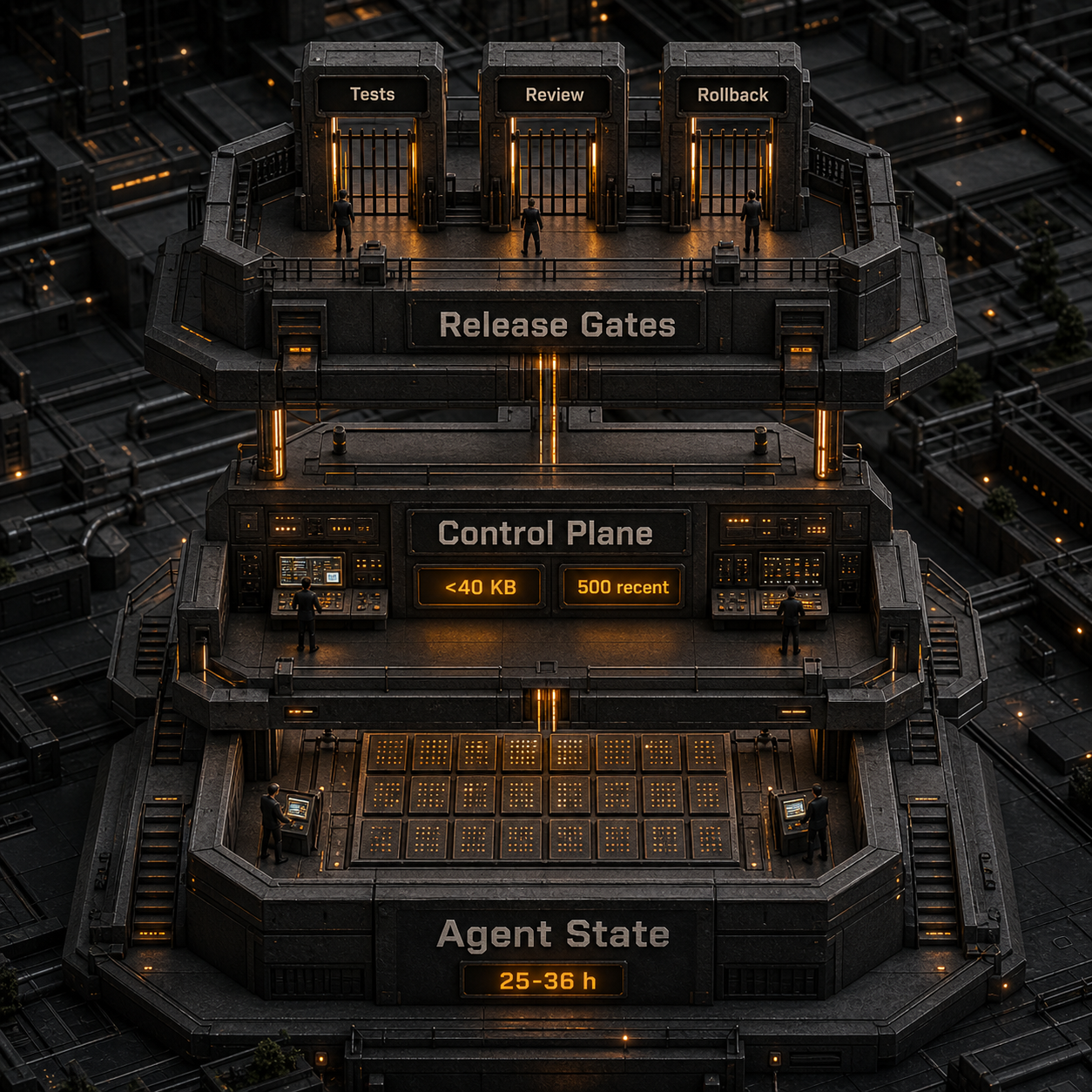
The strongest public evidence comes from two different parts of the stack. Cursor's long-running agent preview includes a 36-hour chat-platform build, a 30-hour mobile port, and a 25-hour authentication and role-based access refactor. Cursor says these agents produced substantially larger pull requests with merge rates comparable to its other agents. Separately, T3 Code founder Theo Browne reported reducing the data needed to load a worst-case large thread from hundreds of megabytes to just under 40 KB.
Those numbers answer two different questions. Cursor shows that the worker can stay on a large job. T3 Code shows that the operator's control surface can survive the resulting history.
What changed is the control plane
Long agent sessions create a mundane systems problem. Every command, file edit, approval, and progress update becomes another item in the thread. If the app reloads all of that history whenever one new update arrives, the control room eventually collapses under the log it is meant to display.
Think of a warehouse that photocopies its entire inventory ledger every time one box moves. The robot may be working correctly, but the office freezes.
T3 Code's recent work attacks that failure at several points:
- Thread detail reads now load the newest 500 activities before decoding them. Pending approvals and unanswered questions remain pinned even when they fall outside that window.
- Streaming tool updates now store a slim projected record of about 1 KB instead of repeatedly persisting the full accumulated output. One measured 65 KB tool result had previously expanded to 238.7 MB across 2,226 updates.
- A 20,000-activity work log benchmark fell from a 163.6 millisecond median to 10.1 milliseconds by reusing unchanged rows.
- Routine agent events no longer force a full history rescan. Events that can change an operator decision, including approvals, user input, and plans, still refresh the relevant summary.
This is not a smarter model. It is a better operating surface. That distinction matters because a fast thread does not make a bad plan good. It does make multi-hour work inspectable, resumable, and cheaper to supervise.
T3 Code v0.0.34, published on August 26, carried this work inside a release of more than 380 changes. T3 Code itself is open source, runs against provider subscriptions already installed on your machine, and supports Codex, Claude Code, Cursor, Grok Build, and OpenCode. You can try its local server and web interface with npx t3@latest.
How a long job survives the night
The agent needs a shift handover, not an infinite memory.
Anthropic's engineering work on long-running agents describes the problem as a team of engineers changing shifts, where each new engineer arrives without the previous shift's memory. Context compaction helps, but Anthropic found it was not sufficient by itself. Agents still tried to do too much at once or declared victory before the full job was done.
The practical pattern has five parts:
- A written contract. Turn the request into a feature list with observable pass conditions.
- An initial setup pass. Create the run command, baseline tests, worktree, and progress artifact before changing the product.
- Incremental work. Complete one coherent slice, test it, commit it, and update the handover record.
- Fresh-session recovery. Read the progress record and git history, run a baseline test, then choose the next unfinished slice.
- Independent verification. Run end-to-end checks and review the change as a user would, not only as the agent that wrote it.
Cursor adds two useful controls. Its long-running agents propose a plan and wait for approval before execution, then use multiple agents to check one another's work. T3 Code adds per-thread permission modes. Its own guidance says Full access belongs in a worktree or sandbox you can throw away, while Supervised mode fits a repository where an unwanted command is expensive.
That is the operating model: durable artifacts carry the state, the interface carries the supervision, and ordinary software controls decide what can merge.

The business math moves from typing to verification
The useful question is not “How many hours did the agent run?” It is “How many verified human hours did this run displace?”
Use a simple model. Replace the rate and hours with your own numbers:
This does not predict a $3,500 saving. It defines the break-even line. If the pull request needs another 35 human hours of correction, the advantage is gone before model cost. If five human hours are enough, the team can tolerate substantial agent usage and still come out ahead.
The budget line also changes. Cursor lists Teams Standard at $40 per user per month, so ten seats create a $400 monthly base before on-demand usage. A separate review product can add another seat layer. CodeRabbit lists Essentials at $24 per developer on annual billing or $30 month-to-month, which adds $240 to $300 for ten developers. That combined base is $640 to $700 per month before extra usage.
T3 Code changes one part of that equation because its control surface is open and works with existing provider subscriptions. It does not make model usage free, and it does not automatically replace an editor or code-review product. It gives a team the option to keep the operator layer portable instead of buying another closed seat for the same job.

Seven production tasks worth delegating
These are ranked by how clearly the outcome can be specified and verified, not by how impressive the generated diff looks.
1. Expand a thin regression suite
A SaaS team with a fragile checkout flow could give an agent the existing app, a list of user journeys, and browser-test access. The agent writes one scenario at a time, runs it, fixes obvious test setup problems, and records which journeys pass. The payoff is broader coverage without pulling a product engineer into days of repetitive test authoring. The human still reviews whether the tests prove the right behavior.
2. Migrate a framework behind an unchanged interface
A platform team moving a service from one supported library version to another has a bounded target: same inputs, same outputs, green tests. The agent can update call sites in batches, compile after each batch, and keep a migration ledger. This is ideal long-running work because the acceptance boundary is stable and reversibility comes from git.
3. Remove a measured performance bottleneck
A media company with a slow rendering pipeline could provide the benchmark, reference outputs, and a performance target. The agent profiles, changes one layer, reruns the benchmark, and rejects changes that alter output. Cursor reports using a long-running agent for a video-renderer migration to Rust and custom kernels. The commercial payoff is shorter deployment time or lower compute cost, but only if the benchmark and output comparison survive independent review.
4. Port a mature product surface
A B2B company with a stable web app and a missing mobile client could delegate one screen or workflow at a time. The web behavior becomes the reference, screenshots and end-to-end tests define parity, and each slice lands separately. Cursor's preview includes a 30-hour mobile-app port based on an existing web app. This pays when the source product is already clear. It is a poor fit when the team is still deciding what the mobile experience should be.
5. Refactor authorization without changing policy
An enterprise app with duplicated role checks could ask an agent to centralize them while preserving a written permission matrix. Cursor reports a 25-hour authentication and role-based access refactor in its preview. This can remove tedious cross-file work, but the blast radius is high. Use supervised permissions, security tests, and a human security review. Never make the agent's own test report the only release gate.
6. Harden a build or sandbox boundary
An infrastructure team can specify allowed network destinations, denied cases, and failure behavior, then let the agent implement and test the policy in an isolated environment. Cursor describes an internally merged task that added JSON-driven network policy controls and a local proxy for sandboxed code. The payoff is concentrated engineering time on a control that crosses many subsystems. The catch is that security invariants must come from the team, not be invented during the run.
7. Turn a vague bug report into a reproducible issue
An open-source maintainer receiving “the app is slow” can let an agent collect environment facts, inspect logs, reproduce the failure, check whether the fix already exists upstream, and draft a useful issue. T3 Code ships npx t3 triage for this pattern using the user's own Codex or Claude installation. The payoff is not automatic repair. It is converting support noise into an evidence-rich handoff that a maintainer can act on.
The common thread is boring on purpose: stable acceptance criteria, reversible changes, and evidence the reviewer can inspect. Product discovery, policy creation, emergency production response, and irreversible data changes are still human-led work.
Three products worth building now
1. A production-task control plane
This is the strongest opportunity. Build a vendor-neutral queue where an engineering lead can submit a task contract, choose an agent, approve its plan, watch only meaningful checkpoints, and receive a pull request plus an evidence packet.
The demand is already explicit: ai powered coding agent receives about 8,100 US searches a month, with commercial intent. The smallest sellable version needs isolated worktrees, plan approval, a progress ledger, cost and runtime caps, resumable sessions, CI status, and one-click cancellation. It does not need its own model.
The honest catch is platform pressure. Coding-agent vendors are adding their own remote queues and team controls. The defensible layer is policy and evidence across providers, not a prettier chat window. Start with teams that must use two or more providers or keep execution on their own machines.
2. An evidence-first migration and testing runner
Sell the proof, not the code generation. A team describes a migration, pins the before-and-after contract, and gets a branch with test results, benchmark deltas, changed interfaces, failed cases, and a rollback note.
automated software testing receives about 2,900 US searches a month, and advertisers pay an average $14.23 per click. The MVP can target one ecosystem, such as React upgrades or Python dependency migrations, with a fixed recipe and a browser or test runner. The catch is fixture quality. If the customer's baseline tests are weak, the product can produce a clean report for the wrong behavior.
3. An agent-output review queue
As agents produce larger pull requests, teams need a review surface that separates policy failures, risky files, test evidence, and human decisions from thousands of generated lines. The buyer is an engineering manager who wants review throughput without turning merge approval into a rubber stamp.
ai powered code review platform receives about 1,600 US searches a month. Existing pricing establishes a real budget: CodeRabbit ranges from $24 to $90 per developer per month across its paid tiers. A narrow MVP can ingest one repository's pull requests, require a task contract, map changes back to acceptance criteria, and block approval when evidence is missing.
The catch is crowding. Git hosts, editors, and review incumbents can bundle basic summaries. A new product needs a stronger wedge, such as regulated change records, cross-provider provenance, or review policies for agent-generated code.
For a broader choice between owning this layer and buying it, use the build-versus-buy framework for coding agents. If the immediate question is which worker belongs behind the control plane, compare Codex, Claude Code, and Cursor by job rather than brand.
What this still does not solve
Long-running does not mean reliable, and responsive does not mean correct.
- Ambiguous outcomes compound. A slightly wrong assumption can survive for hours and shape hundreds of files.
- Compaction loses detail. Anthropic still calls consistent progress across context windows an open problem. Progress files and git reduce that risk; they do not erase it.
- Self-testing can be self-deception. The same agent that misunderstood the requirement can write a test that blesses its misunderstanding.
- Permissions remain dangerous. T3 Code's Full access mode permits unattended commands and edits. Its own guidance limits that mode to disposable worktrees or sandboxes.
- The evidence is early. Cursor's data comes from a research preview, not a guarantee for every repository, language, or team.
- Control-plane efficiency is not model quality. Loading a thread in under 40 KB fixes an operator bottleneck. It does not prove the next edit is sound.
Do not start with a live database migration, credential rotation, billing logic, or an incident where recovery time matters more than experimentation. Start where rollback is cheap and acceptance can be observed.
The Monday move
On Monday, pick one backlog item that a capable engineer estimates at 8 to 20 hours. A flaky end-to-end flow, contained dependency migration, or measured performance fix is a better pilot than a greenfield product.
Before the run:
- Write five to twenty acceptance checks and a short list of forbidden actions.
- Create a disposable worktree with no production credentials.
- Require the agent to propose a plan and wait for approval.
- Require a progress file, small commits, and a baseline test at every fresh session.
- Set a midpoint checkpoint and a hard spend or runtime cap.
- End at a pull request. Run normal CI, human review, staging, and rollback checks before release.
Track five numbers: elapsed time, human intervention time, model and tool cost, failed acceptance checks, and correction hours after review. Run three pilots. Keep the lane only if correction hours stay low enough to beat your break-even line.
That is the 2026 decision. Do not ask whether the agent can keep typing all night. Ask whether your system can preserve intent, surface exceptions, and prove the result in the morning.
What are AI coding agents?
AI coding agents are software workers that can inspect a repository, edit files, run commands and tests, and return a result rather than only suggest a code snippet. For long-running work, the model is only one part. The plan, progress record, permissions, execution environment, and review gates determine whether the result is usable.
What are the top 10 AI code agents?
A top-ten list is less useful than matching the agent to the job. Compare repository access, model quality, context recovery, sandboxing, plan approval, remote execution, cost controls, and evidence at handoff. A strong short-run assistant can still be the wrong choice for a 30-hour migration.
Is there a free AI-powered coding agent?
There are open-source control surfaces and agents, but execution is rarely costless. T3 Code is open source and works with provider subscriptions already on your machine. Model usage, hosted compute, review tools, and the human time required to verify the result still belong in the budget.
How should I compare AI coding agent benchmarks?
Prefer task completion, merge rate, correction hours, test evidence, and cost over lines changed or raw runtime. For your own team, three controlled pilots on real backlog items are more valuable than a public benchmark that uses a different repository and acceptance standard.
If you want a long-running coding-agent workflow built around your repositories, approval rules, and release gates, see AI agent development.
- Published
- Category
- Build
- Language

CLAUDE.md: Write It Once, Start Every Session Right
Write a useful CLAUDE.md, scope project rules, and manage Claude Code auto memory with a 35-line starter and a monthly cleanup routine.Oct 11, 2026Build
Jev Alternatives in 2026: OpenAI, Microsoft, Clef, d1, Perplexity and Strands (Compared)
Compare Jev alternatives by job, maker-verified input pricing, licences and deployment: OpenAI, Microsoft, Clef, Liquid d1, Perplexity and Strands.Oct 11, 2026Build
OpenAI Decisions API
Use OpenAI Decisions API for ticket routing, labels, and action gates. Three guide requests, refusal handling, pricing, limits, and when to keep your LLM.Oct 11, 2026Build
Claude Code Remote Control
Set up Claude Code Remote Control from CLI, VS Code or Desktop, connect your phone or browser, and fix documented login and connection failures.Oct 9, 2026Build
Cursor Remote Control
Set up Cursor Remote Control on iPhone, pair your laptop, keep local agents reachable, and compare cloud agents, Claude Code and Codex.Oct 9, 2026Build
Firecrawl Pricing 2026: What Your Pages Cost
Firecrawl plans and credit packs verified October 2026. Calculate JSON extraction, failed pages and weekly crawl bills at your volume.Oct 9, 2026Build
Claude Code vs GitHub Copilot 2026
Claude Code vs GitHub Copilot: current plans, usage limits, models, team controls, one-seat and ten-seat costs, and when to use both.Oct 8, 2026Build