Build vs Buy Coding Agents for Internal Workflows 2026
Buy the agent; build the private context layer only when it becomes the bottleneck. Ramp Inspect, current prices, crossover, and switching costs.
Published
 By Omid Saffari


Build vs buy coding agents for internal workflows 2026 has a blunt answer: buy the coding agent, then build only the context, permissions, and verification layer the vendor cannot supply. In a transparent 100-developer model, GitHub Copilot Enterprise costs $3,900 a month while a lean internal harness averages $21,270 in year one; the build crosses below the seat baseline only at roughly 696 developers.
Build vs Buy Coding Agents for Internal Workflows 2026: Which One Should You Pick?
Pick buy when you need better coding output this quarter. Pick build when your agent is already capable of writing the code but cannot reach, understand, or verify the systems that make the code safe to merge. For most companies, the right answer is hybrid: buy the agent loop and build the private context layer.
That recommendation changes by situation:
- A smaller developer organization should buy. A managed agent gives the team a controlled rollout, current models, usage reporting, and no internal platform backlog. Add repository instructions, MCP tools, and review policy before funding a new runtime.
- A mid-market platform team should go hybrid. Keep the managed coding agent, then own the adapters for internal APIs, test data, telemetry, feature flags, approvals, and evidence. Those are the pieces a vendor cannot know in advance.
- A large engineering organization should consider building the harness layer. The case becomes credible when remote concurrency, cross-system debugging, or company-specific verification is already constraining valuable workflows. Seat savings alone are a weak reason.
The explicit decision rule is simple: if a bought agent can complete and verify the target workflow with supported customization, do not rebuild it. Build only after repeated failures point to a missing internal capability that you can name, own, and measure. A vague desire for control is not enough.
This is why the comparison uses GitHub Copilot Enterprise as a public buy-side baseline, not as a claim that it is the only product to shortlist. Teams choosing among Codex, Claude Code, and Cursor can use the coding-agent comparison, then apply the same boundary test to the winner.
What Ramp Inspect Proves, and What It Does Not
Ramp Inspect proves that an internal context and execution layer can become a company-wide advantage. It does not prove that writing a proprietary coding agent from scratch is the best use of a smaller team's engineers.
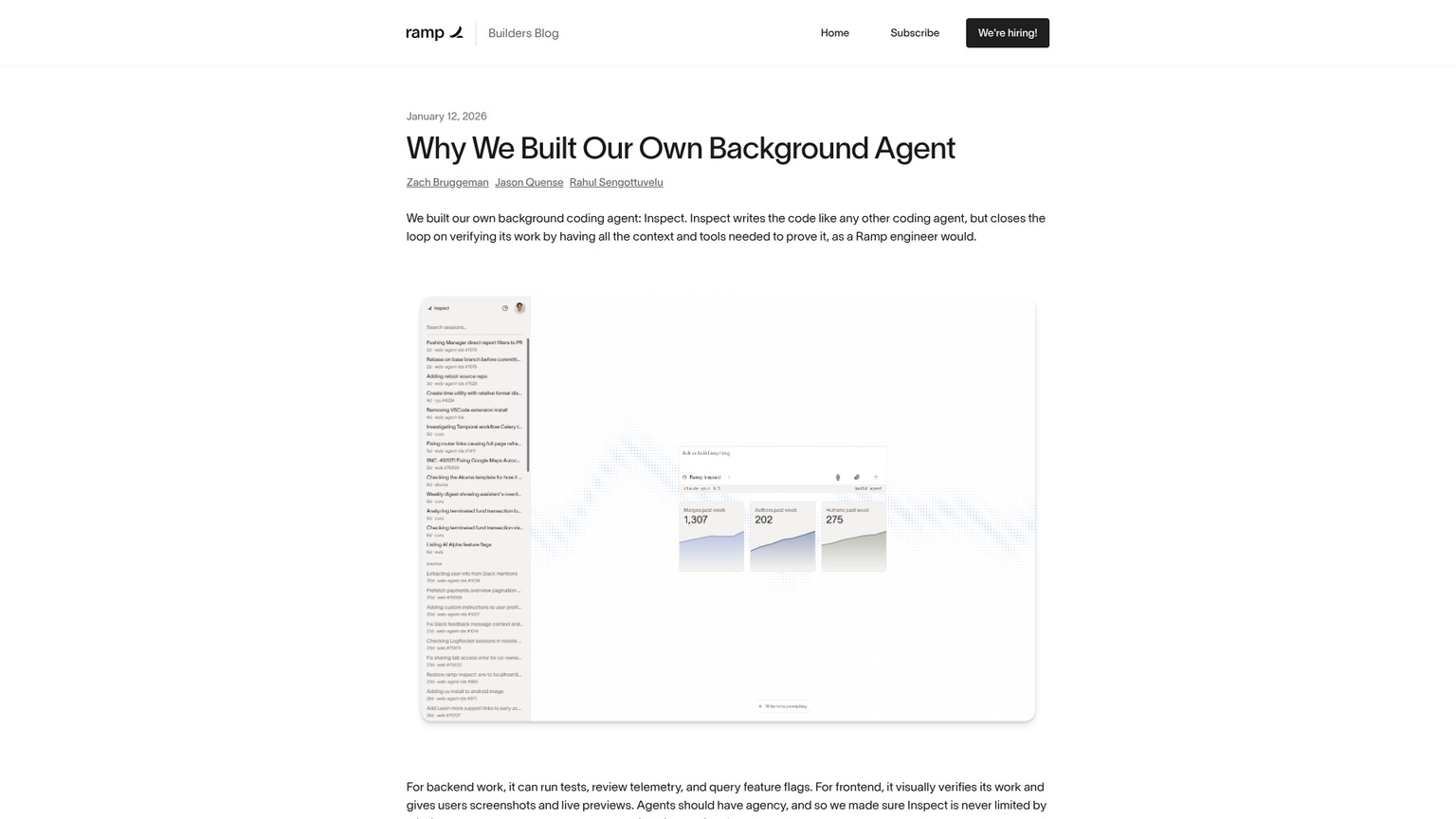
Ramp's own Inspect write-up describes a hybrid stack. The agent inside the sandbox is OpenCode, an open-source, model-agnostic coding agent. Modal supplies sandboxed development environments. Frontier model providers supply the intelligence. Ramp built the company-specific system around them: synchronized clients, internal tools, secure access, workflow state, feedback loops, and verification.
That distinction matters. Inspect can run backend tests, review telemetry, and query feature flags. For frontend work, it can produce screenshots and live previews. Its environment includes the services a Ramp engineer needs and connects to systems such as Sentry, Datadog, LaunchDarkly, Braintrust, GitHub, Slack, and Buildkite. A generic seat cannot arrive with those relationships prewired.
The adoption result is unusually strong. The Pragmatic Engineer reported, after interviewing Ramp's CTO, head of engineering, and Inspect's founding engineer, that Inspect produced 75% of all merged pull requests by May 2026, three of every four, and passed one million total sessions in July. The report also names a 5.5-person core team, more than 150 internal contributors, more than 200 agents on the platform, and provisioned environment startup in under five seconds.
The operator consequence is not “copy Ramp.” It is “identify what Ramp owned.” Ramp bought or adopted commodity layers, then invested in the parts tied to its codebase and operating model. The proprietary asset is the credentialed development environment and the evidence loop, not a new language model.
There is also a missing denominator. Neither source publishes total build spend, fully loaded staffing cost, cost per merged pull request, defect rate, or revert rate. Seventy-five percent is an adoption and throughput signal, not a return-on-investment statement. It also means one in four merged pull requests still came through another path.
Build vs Buy AI Agents Cost: The Same-Workload Model
The buy option is cheaper for most organizations in year one. The internal build becomes cheaper in this model only near 696 developers on Copilot Enterprise, and that crossing assumes a lean maintenance burden that Ramp's reported 5.5-person core team does not resemble.
All vendor prices in this section were verified against live pages on September 1, 2026. GitHub lists Copilot Business at $19 per user per month with 1,900 AI credits, and Copilot Enterprise at $39 with 3,900 credits. Usage beyond the pooled allowance costs $0.01 per credit. GitHub also says cloud-agent work consumes both AI credits and GitHub Actions minutes, with credit use varying by model and tokens. That makes a fixed “sessions included” claim impossible.
The build side uses current component prices. Anthropic lists Claude Sonnet 5 at $2 per million input tokens and $10 per million output tokens. Its August 10 update made those rates permanent, replacing a planned September 1 increase. That is $0.002 per 1,000 input tokens and $0.01 per 1,000 output tokens. Modal lists sandbox compute at $0.00003942 per physical CPU core per second and $0.00000667 per GiB of memory per second, with the Team plan at $250 per month plus compute.
The workload assumptions
The model makes every input replaceable:
- 10 agent sessions per developer per month.
- 30 minutes per session on two physical CPU cores and 8 GiB of memory.
- 250,000 Sonnet 5 input tokens and 25,000 output tokens per session.
- Two platform engineers for 12 weeks at 40 hours per week to launch.
- $250,000 annual fully loaded planning cost per engineer.
- Half of one engineer for ongoing ownership.
- Upfront labor amortized across the first 12 months.
These are planning assumptions, not Ramp's spend. Replace them with your session traces, finance rate, environment size, and ownership model before approving a build.
Under those inputs, model usage costs $0.75 per session and sandbox compute costs $0.23796, for $0.98796 per session or $987.96 per 1,000 sessions. The lean launch costs $115,384.62 in labor. Amortization, half an engineer of maintenance, and the Modal Team base produce $20,282.05 in fixed monthly cost during year one.
The seat baseline is simpler. At 10 assumed sessions per developer-month, Copilot Enterprise's $39 base price is equivalent to $3.90 per session before overages. Copilot Business is $1.90. This does not imply that GitHub bills by session; it puts unlike price structures on one workload.
At 100 developers, 1,000 monthly sessions cost $3,900 in Copilot Enterprise base seats. The internal harness averages $21,270.01, or $212.70 per developer-month. At 500 developers, the comparison is $19,500 versus $25,221.85. At 1,000 developers, it changes direction: $39,000 for seats versus $30,161.65 for the modeled build.

The calculated crossover is approximately 696 developers for Copilot Enterprise and 2,224 developers for Copilot Business. Treat those as scenario outputs, not market constants. More sessions per developer improve the build case because its modeled variable cost is lower. More platform staffing, enterprise infrastructure, or security work pushes the crossover upward.
The model excludes GitHub Actions and AI-credit overages on the buy side. It excludes Modal Enterprise pricing, storage, egress, observability, security review, incident response, additional integrations, and outside contributors on the build side. The omission is intentional: any comparison that presents one all-in number without these lines is hiding a budget decision.
Build vs Buy AI Agents Pros and Cons by Decision Category
Buy wins implementation speed and near-term cost. Build wins proprietary context, unconstrained orchestration, and portability. The category verdicts are not balanced because the burdens are not balanced.
Cost and time winner: Buy
GitHub Copilot is the buy-side winner because a paid plan turns on a working cloud agent without a platform build. It can research a repository, plan changes, work on a branch, run tests and linters in an ephemeral GitHub Actions environment, and prepare a pull request.
For a smaller organization, the $19 Business or $39 Enterprise seat is easier to budget than a six-figure pilot plus permanent ownership. The managed option also buys continuous model and product updates. Its candid downside is variable usage: AI credits and Actions minutes can exceed the included pool, and the conversion depends on the model and tokens used.
Buy vs Build Coding Agents for Deep Internal Context
Winner: Build. A vendor can expose customization surfaces, but it cannot infer your production data contracts, incident vocabulary, feature-flag semantics, test fixtures, approval chain, and tolerated failure modes. Those relationships must be encoded and authorized by the organization.
This is the Ramp Inspect advantage. The agent can inspect telemetry, query feature flags, run the full environment, and return screenshots or previews as evidence. Building that layer is justified when engineers repeatedly stop to gather the same private context or manually prove the same conditions after every agent run.
The wall is clear: context without permission is inert, and permission without evidence is dangerous. The build needs least-privilege credentials, auditable tool calls, resource ceilings, and a human merge gate. A larger context window does not solve any of those.
Verification and safety winner: Buy first, build when proven
Winner for a new rollout: Buy. Winner for a mature, company-specific loop: Build. A managed product starts with administrative policy, metering, and a defined execution boundary. That is safer than a rushed internal runtime whose agent can reach production-adjacent systems before its audit and approval model is ready.
Build takes the category only when the managed boundary prevents meaningful verification. An internal harness can query a sanitized read-only database, inspect an observability trace, reproduce a bug in a full service graph, or compare a frontend screenshot with the intended state. The safety advantage comes from better evidence, not broader credentials.
Best AI Coding Agents 2026: Why the Buy Side Is Already Capable
Winner: Buy for commodity coding work. The best AI coding agents 2026 market already covers repository research, background execution, tests, pull requests, IDE work, and cloud sessions. A company does not need to recreate those primitives to automate backlog tasks, refactors, test generation, or routine fixes.
Teams that need private deployment or model control can also start from open-weight coding models for private agents rather than inventing a model. The build should begin one layer above the commodity: environment, tools, identity, evidence, and workflow state.
Portability and concurrency winner: Build
Winner: Build, if the company will fund the owner. Ramp's design uses an open, model-agnostic agent and company-owned APIs, which reduces dependence on one model provider. It also lets the organization define how many sessions run, where they run, which clients can join, and how state moves among Slack, web, browser, and pull requests.
The managed wall is specific. GitHub's current cloud-agent documentation says a task can change only one specified repository, work on one branch, open exactly one pull request, and run for no more than 59 minutes. It also requires the repository to be hosted on GitHub. MCP servers, hooks, skills, and custom agents extend the product, but they do not remove those execution limits.

The hybrid route keeps the exit open. Store instructions and skills in version control. Define tools with portable schemas. Keep evaluation cases outside a vendor's session history. The managed agent can change while the company's operating knowledge remains owned.
Switching Costs: What Migration Really Takes
The expensive part of switching is not moving prompts. It is rebuilding trust around credentials, state, and proof. A migration from a bought agent to an internal harness touches five assets:
- Context: repository instructions, skills, coding conventions, examples, and retrieval sources.
- Tools: MCP servers, internal APIs, browser actions, database access, and command hooks.
- Identity: user attribution, service accounts, secret issuance, role mapping, and approval rights.
- Environment: sandbox images, dependencies, caches, test services, network policy, and resource ceilings.
- Evidence: session logs, evaluations, merge outcomes, incident history, screenshots, and audit retention.
Prompts and versioned instruction files are relatively portable. Vendor memory, session state, approval behavior, usage analytics, and proprietary orchestration are not. A clean migration also requires parallel operation long enough to compare completion, merge, review, and failure outcomes on the same task class.
Do not switch if the current agent completes and verifies the work, the only argument is a lower token rate, or nobody owns the runtime after launch. Do not switch merely because Ramp reached 75% adoption. Ramp's environment, contribution culture, scale, and platform staffing are part of that result.
Switch when the same named boundary blocks valuable work repeatedly. Examples include a hard task-duration ceiling, a single-repository workflow that must span services, a private system the vendor cannot reach under acceptable policy, or a verification step the product cannot express.
For a tool-to-tool move, preserve your context before changing the execution surface. The coding-agent context migration guide covers the portable artifacts worth extracting first.
The Monday Move: Run a Bounded Hybrid Pilot
Next week, keep the managed agent and build one missing capability around one repeatable workflow. This tests the reason to build without creating a platform program on faith.
Name the blocked workflow
Choose a task that already has an owner and a measurable finish, such as reproducing a production bug and opening a reviewed fix. Write down the exact point where the managed agent stops.
Add one private capability
Expose the smallest read-only tool, test fixture, or verification hook that closes the gap. Keep credentials scoped to the chosen repository and workflow.
Keep the merge human
Require a person to review the diff and the evidence. The pilot tests completion and verification, not autonomous production authority.
Record the whole cost
Log seat usage, model tokens, sandbox compute, setup labor, review time, failures, and maintenance. Cost per accepted pull request is more useful than cost per session.
Apply the stop rule
Continue only if the added layer removes the named bottleneck without creating an unowned security or maintenance burden. Otherwise keep buying and improve instructions, tools, or task selection.
The Monday decision is deliberately narrow. You are not choosing an agent platform for the next decade. You are testing whether proprietary context changes a workflow enough to justify ownership.
Frequently Asked Questions
What is Ramp Inspect?
Ramp Inspect is Ramp's internal background coding agent system. It runs an OpenCode agent in remote Modal sandboxes and surrounds it with Ramp-specific tools, clients, context, permissions, and verification workflows.
Why should I build my own AI agent?
Build only when proprietary context, permissions, verification, or orchestration is the named constraint on a valuable workflow. If a managed agent can already complete and prove the work, buying remains the better use of engineering time.
How difficult is it to build your own AI agent?
The agent loop is the easy part. Production difficulty sits in secure sandboxes, identity, internal integrations, environment startup, observability, evaluations, review policy, and ongoing maintenance.
How much does it cost to create my own AI agent?
This lean scenario models $115,384.62 of launch labor and $20,282.05 of fixed monthly cost in year one before variable usage. Ramp's public reporting names a 5.5-person core team but does not disclose its total spend, so no Ramp cost should be inferred from this scenario.
What are the downsides of using GitHub Copilot?
GitHub Copilot cloud agent uses AI credits and Actions minutes, and its current workflow is limited to one repository, one branch, one pull request, and 59 minutes per task. It also requires GitHub-hosted repositories. Those limits are acceptable for many tasks and decisive for some internal workflows.
Build vs buy coding agents for internal workflows 2026 cost
At 100 developers, the modeled monthly comparison is $3,900 for Copilot Enterprise base seats versus $21,270.01 for the internal build in year one. The build crosses below the Enterprise seat baseline near 696 developers under the stated assumptions, before omitted costs on either side.
Get the AI Business Workflow Audit Checklist
Turn one coding-agent workflow into a scoped pilot with an owner, budget, permission boundary, verification step, and stop condition. Subscribe to get the checklist free.
- Published
- Category
- Build
- Language

Claude Code Remote Control
Set up Claude Code Remote Control from CLI, VS Code or Desktop, connect your phone or browser, and fix documented login and connection failures.Oct 9, 2026Build
Cursor Remote Control
Set up Cursor Remote Control on iPhone, pair your laptop, keep local agents reachable, and compare cloud agents, Claude Code and Codex.Oct 9, 2026Build
Firecrawl Pricing 2026: What Your Pages Cost
Firecrawl plans and credit packs verified October 2026. Calculate JSON extraction, failed pages and weekly crawl bills at your volume.Oct 9, 2026Build
Claude Code vs GitHub Copilot 2026
Claude Code vs GitHub Copilot: current plans, usage limits, models, team controls, one-seat and ten-seat costs, and when to use both.Oct 8, 2026Build
LangGraph vs CrewAI
Compare LangGraph and CrewAI on the same approval workflow, state, memory, MCP, observability and current hosted-platform prices.Oct 7, 2026Build
How to Build MCP Server
Build an order lookup MCP server with Python, test it in Inspector, connect Claude Code and Cursor, then add HTTP auth and hosting.Oct 7, 2026Build
Gumloop vs n8n (Verified October 2026)
Gumloop vs n8n: current pricing, credits vs executions, self-hosting and the same AI lead workflow, with a verdict for each builder.Oct 7, 2026Build