Best AI Inference Orchestration Platforms 2026
Six AI inference orchestration platforms compared on live pricing, GPU control, portability, and the Nvidia Vera shift. Verified September 2026.
Published
 By Omid Saffari



Baseten is the best overall choice, but the budget test matters more than the badge: recovering 10 percentage points of utilization across four always-warm H100s is worth $1,165 per month at Together AI's current public rate. The best AI inference orchestration platforms 2026 keep expensive compute fed, route each request to the right capacity, and make a rollback cheaper than an outage.
That verdict is for teams serving open or custom models, not teams choosing a hosted chatbot. Every plan, rate, limit, and capability below was verified against live vendor pages on September 1, 2026. The platforms were priced and analyzed in this run, not exercised with production traffic, so no latency or reliability result is presented as a test.
Best AI inference orchestration platforms 2026 at a glance
Baseten gives the strongest managed balance of deployment control, autoscaling, and a credible path from its cloud to self-hosted or hybrid infrastructure. Together AI makes the cleanest move from serverless calls to dedicated capacity. Modal is the sharpest fit for bursty Python workloads, Fireworks AI for managed serving paths and batch economics, Anyscale for Ray-native multi-model systems, and NVIDIA Dynamo for a fleet your own platform team already operates.
Starting price is not the same as production cost. Modal's $0 Starter plan still meters every GPU second. NVIDIA Dynamo has no software license line, but it creates an infrastructure and on-call job. Together AI's $3.99 H100 rate is a promotion through September 30, while the same page displays a regular $5.49 rate. The winner is the platform that lowers the complete cost of an accepted output after idle capacity, retries, storage, networking, support, and operator time.
The inference control plane has four jobs
An inference control plane is worth buying only when it owns four operational jobs: package the model, place capacity, route requests, and expose enough evidence to roll a release forward or back. Inference means running a trained model on new input to produce an output. Orchestration is the layer that keeps those model replicas available and economical while traffic changes.
The distinctions matter because four products can all claim to route AI traffic while selling different work:
- A model gateway sits in front of third-party APIs and handles provider routing, budgets, caching, or policy. The model-gateway comparison covers that layer.
- An inference engine such as vLLM, SGLang, or TensorRT-LLM executes the model efficiently on accelerators. It is an engine, not necessarily a deployment, billing, rollout, and incident-control product.
- An inference orchestration platform deploys those engines, allocates replicas or nodes, routes live traffic, records performance, and manages changes.
- A hardware platform supplies the CPUs, GPUs, memory, networking, and storage underneath the control plane. It changes the ceiling and the unit economics, but does not remove the need for operating software.
ai inference vs training
Training changes model weights; inference spends compute to use those weights. A training platform optimizes long jobs, checkpoints, data movement, and distributed gradient work. An inference platform optimizes time to first token, output throughput, request queues, batching, cache reuse, replica placement, and service-level objectives.
That difference changes the budget. A training cluster can finish and shut down. An interactive inference endpoint may need warm capacity all month, even when requests arrive unevenly. Scale-to-zero lowers idle spend, but it introduces a cold start while weights load. A minimum replica removes that wait, but turns quiet hours into a fixed infrastructure line.
The purchase therefore turns on four questions:
- Can the platform package the exact model and engine? A polished catalog is irrelevant when the production artifact is a custom fine-tune or a non-LLM model.
- Can it match capacity to traffic without breaking latency? The useful controls are minimum and maximum replicas, concurrency targets, headroom, warm pools, and a hard cost ceiling.
- Can it place a request where useful state already exists? Long-context agents make KV cache, the stored attention state from prior tokens, valuable enough to affect routing.
- Can the team compare and reverse a release? Shadow traffic, weighted splits, metrics, logs, and rollback are part of the serving product, not administrative decoration.
ai inference hardware changed the buying question
Nvidia Vera moves orchestration from a background software concern into the hardware budget. On August 27, Nvidia said Vera CPU systems had begun shipping at scale and that AWS had received its first Vera CPU server and Vera Rubin GPU. The company describes Vera as handling the orchestration, control, and data movement that keep GPUs supplied, at 2x the energy efficiency of traditional infrastructure. That is a vendor claim, but the buying consequence is concrete: GPU utilization can be constrained by work outside the GPU. Nvidia's delivery update is the relevant change.
Three days earlier, Nvidia announced Groq 3 LPX in full production as part of the Vera Rubin rack-scale system. Nvidia reported an Artificial Analysis result of 3,400 output tokens per second on Gemma 4 31B at a 100,000-token context, four times the nearest alternative in that test. That benchmark is evidence of a new serving architecture, not a reason to rank NVIDIA Dynamo first. It uses one model, one configuration, and vendor-selected platform conditions. The full-production announcement supplies the dated fact.
The useful shift is architectural. Agent workloads add retrieval, tool calls, sandboxes, code execution, long context, and multiple model hops. CPUs schedule those tasks and move their data while GPUs perform model computation. A faster accelerator cannot recover time lost to an empty request queue, misplaced cache, overloaded prefill worker, or slow data path.
That makes utilization a buying metric beside token price. A platform that costs more per GPU-hour can still win if it serves more accepted work with the same fleet. A cheaper GPU can lose if poor placement leaves capacity idle or causes retries. The relevant denominator is not tokens alone; it is accepted outputs per complete infrastructure dollar.
agentic ai orchestration platform: Vera moves CPU work into the budget
An agentic workload should be budgeted as a coordinated system, not as a model endpoint with free surrounding work. Nvidia says SpaceXAI plans to use Vera CPUs for orchestration, tool use, code execution, data processing, and simulation. Each of those steps can delay the next GPU request or create another one.
The decision rule is the 10-point utilization test. Ask whether a platform can recover 10 percentage points of useful GPU time through faster scheduling, better batching, cache-aware routing, or more accurate autoscaling. On four continuously provisioned H100s at Together AI's current $3.99 rate, that 10-point slice costs $1,165.08 per month. At Fireworks AI's current $8 rate, it costs $2,336 per month. Those are not promised savings. They are the maximum monthly budget attached to the hypothesis.
For a funded founder, the test stops infrastructure work from turning into a prestige project. If a managed platform costs less than the idle slice and preserves output quality, buy the control plane. For a mid-market CTO with committed cloud capacity, the choice may reverse: BYOC or open source can use capacity already on the balance sheet. For a senior operator, the acceptance rate matters more than raw throughput. For a solo technical builder, a managed serverless endpoint usually wins because 10 points on a tiny fleet is worth less than becoming the platform team.
what is inference cost in ai? Start with warm capacity
Inference cost is the complete price of turning production requests into accepted outputs: model or GPU usage, idle capacity, the serving plan, storage, networking, retries, review, and the people who operate the system. A public token rate or GPU rate is only one term.
The cleanest common baseline available across four vendors is one continuously used H100 for 730 hours. The rates below were live on September 1, 2026. They are deliberately not presented as an apples-to-apples performance comparison: H100 variants, regions, software stacks, support, and service behavior differ.

The table is a budget baseline, not a benchmark. Modal Team would turn its $2,882.92 compute line into $3,032.92 after adding the $250 plan and subtracting its $100 monthly credit. Together AI's displayed regular $5.49 H100 rate would make the same month $4,007.70, a $1,095 increase when the $3.99 promotion ends if no new deal replaces it. Fireworks AI's H100 rate rose from $7 through August 31 to $8 from September 1, adding $730 to a 730-hour month.
Bursty usage changes the ranking. Baseten can scale a deployment to zero, so using an H100 for 25% of the normalized month produces $1,186.21 in compute before startup minutes and other charges, not $4,744.85. Modal also scales to zero and bills by the second. An always-warm comparison therefore overstates both platforms for intermittent jobs and understates the cost of a cold start for latency-sensitive ones.
If a hosted model API already clears the quality and latency bar, compare this capacity budget with the cheapest AI API options before owning a deployment. A custom serving stack earns its complexity only when customization, data control, predictable capacity, or utilization makes the complete bill better.
1. Baseten: best overall managed control plane
Baseten is the best overall pick because it combines a legible $0 platform entry, production autoscaling, and a path from Baseten Cloud to self-hosted or hybrid deployment.
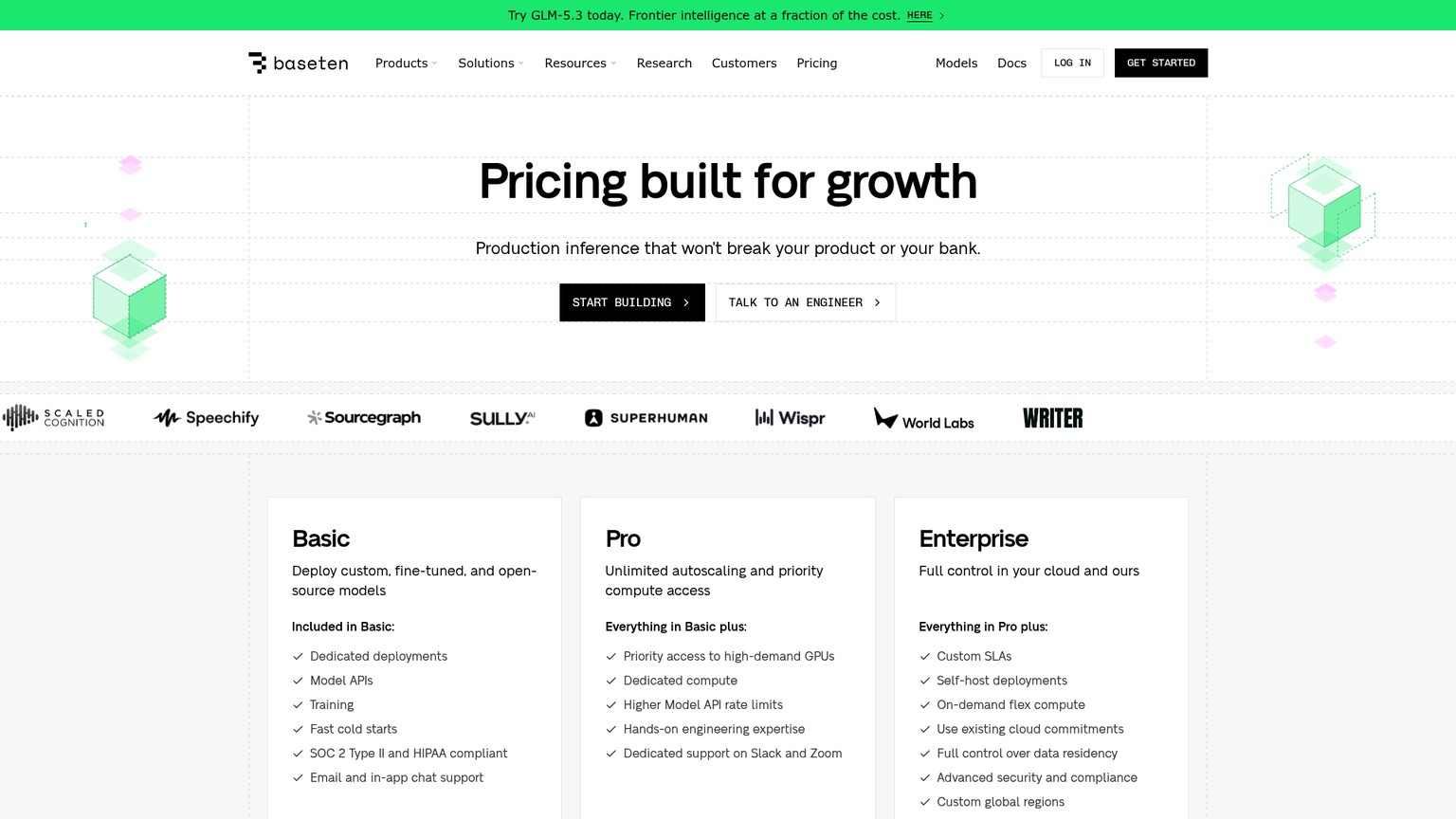
The live Baseten pricing page lists Basic at $0 per month plus usage, with dedicated deployments, Model APIs, training, fast cold starts, and email or in-app support. Pro is quote-based and adds unlimited autoscaling, priority access to high-demand GPUs, dedicated compute, higher Model API limits, engineering help, and Slack or Zoom support. Enterprise is also quote-based and adds self-hosted and hybrid deployment, custom SLAs, use of existing cloud commitments, data-residency controls, custom regions, and advanced role-based access. New accounts receive free credits, but the page does not publish their amount.
Baseten's public dedicated H100 80 GiB price is $0.10833 per minute, or $6.4998 per hour. The platform bills each running replica by the minute. A deployment at zero replicas incurs no GPU charge, although the startup and model-loading period is billable. That is a strong fit for a custom speech, image, embedding, or LLM workload that arrives in bursts and can tolerate a controlled cold start.
The autoscaler is unusually transparent. Baseten's live autoscaling documentation says the default minimum is zero, the default maximum is one, the default observation window is 60 seconds, and the default scale-down delay is 900 seconds. Those defaults are safe for an experiment and a hidden wall for production. A team that never raises the maximum replica count has not enabled real burst scaling, however polished the dashboard looks.
The choice flips away from Baseten in two cases. First, a pure serverless model call may be cheaper when no custom artifact or infrastructure control is needed. Second, a large organization already standardized on Ray or Kubernetes may prefer Anyscale or NVIDIA Dynamo because another managed control plane duplicates its platform investment.
Best for: A funded product team serving custom or open models that wants managed operations now and deployment options later.
Standout: Cloud, self-hosted, and hybrid modes under one product, with scale-to-zero and explicit autoscaler controls.
Pricing: Basic $0/month plus usage; Pro and Enterprise by quote; H100 80 GiB at $0.10833/minute.
Free trial: New-account credits, with no amount stated publicly.
- Basic has no monthly platform fee.
- Self-hosted and hybrid options preserve a route out of fully managed compute.
- Autoscaling parameters and billing behavior are documented precisely.
- Custom models and multiple workload types are first-class, not catalog-only.
- Pro and Enterprise prices require a sales conversation.
- The public H100 rate is higher than the four-vendor baseline leaders.
- Scale-to-zero trades idle savings for a billable cold start.
- The default maximum of one replica must be changed for production bursts.
The first production evaluation should be narrow and reversible:
Lock the acceptance set
Choose one model, one representative request set, and one output rule that can pass or fail without subjective rescue. Record current latency, accepted-output rate, and complete serving cost.
Deploy at the safe floor
Start with a development deployment and minimum replicas at zero. Benchmark cold-start tolerance and one-replica throughput before raising the maximum replica count.
Set measured headroom
Set concurrency from observed model capacity, then use the target-utilization control to leave enough room for a traffic spike. Do not confuse request-slot utilization with GPU utilization.
Shadow before switching
Mirror an approved slice of live-shaped requests without serving the candidate response. Promote only if acceptance, latency, and complete cost stay inside the prewritten limits.
2. Together AI: best path from serverless to dedicated
Together AI is the best choice when one application should move from serverless inference to dedicated GPUs without changing its inference API.
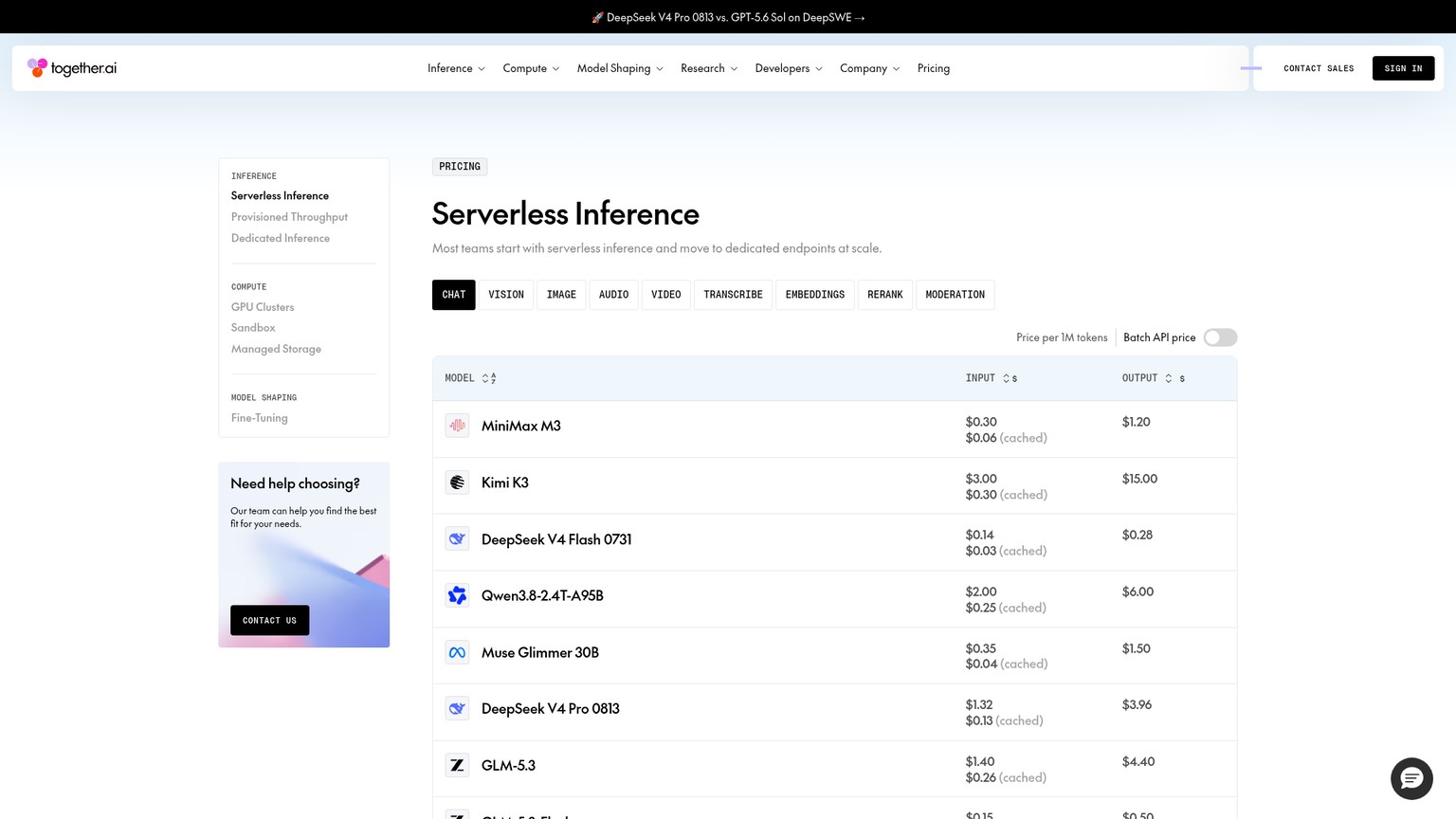
The live Together AI pricing page spans Serverless Inference, Provisioned Throughput, Dedicated Inference, GPU Clusters, Sandbox, Managed Storage, and Fine-Tuning. GLM-5.3-Flash currently costs $0.15 input, $0.03 cached input, and $0.50 output per million tokens on serverless. Provisioned throughput is listed at $0.05 per PTU-minute for the models in its estimator. A PTU is a fixed slice of throughput capacity, not a token bundle, so the tokens delivered per minute depend on the model and token type.
Dedicated Model Inference bills each running replica by GPU-minute. Together AI's dedicated documentation supports autoscaling, weighted traffic splits, A/B tests, shadow experiments, built-in monitoring, and an event feed. The same inference API serves both serverless and dedicated models. That continuity is the product's strongest operational advantage: prototype on metered tokens, then reserve hardware when utilization makes it cheaper.
The current H100 numbers need a calendar entry. Dedicated H100 is displayed at $3.99 per GPU-hour through September 30, beside a regular $5.49 rate. GPU clusters list H100 at $3.99, H200 at $5.99, and B200 at $8.19 per GPU-hour. Reserved H100 rates step down to $3.69 for 7 to 30 days, $3.45 for 31 to 90 days, and $3.19 for 91 to 180 days; longer commitments require sales.
The wall is promotion risk. A continuously used H100 costs $2,912.70 for the normalized month at $3.99 and $4,007.70 at $5.49. Do not sign an architecture around the $1,095 difference without a post-September quote. Together AI can still win at the regular rate because its traffic controls and API continuity have value, but the promotion cannot be annualized as if it were permanent.
Best for: A team proving demand on serverless now and expecting predictable dedicated load later.
Standout: One API across serverless and dedicated, plus shadowing, A/B tests, and weighted traffic.
Pricing: Per-model serverless; PTUs at $0.05/minute for listed models; H100 dedicated promotion $3.99/GPU-hour through September 30; GPU clusters from $3.99/H100-hour.
Free trial: No public free-trial or recurring credit statement on the pricing page.
- The serverless-to-dedicated migration does not require an application API rewrite.
- Dedicated endpoints include real release controls, not just replica creation.
- Current H100 pricing is the lowest listed rate in the normalized four-vendor comparison.
- Serverless, PTU, dedicated, and cluster modes cover several demand shapes.
- The decisive H100 promotion expires September 30.
- Several newer hardware options require sales contact.
- PTU economics require model-specific throughput calculations.
- No public evaluation credit is stated on the current pricing page.
3. Modal: best for bursty Python inference
Modal is the strongest fit for a Python team whose inference jobs are intermittent enough for per-second billing and scale-to-zero to matter.
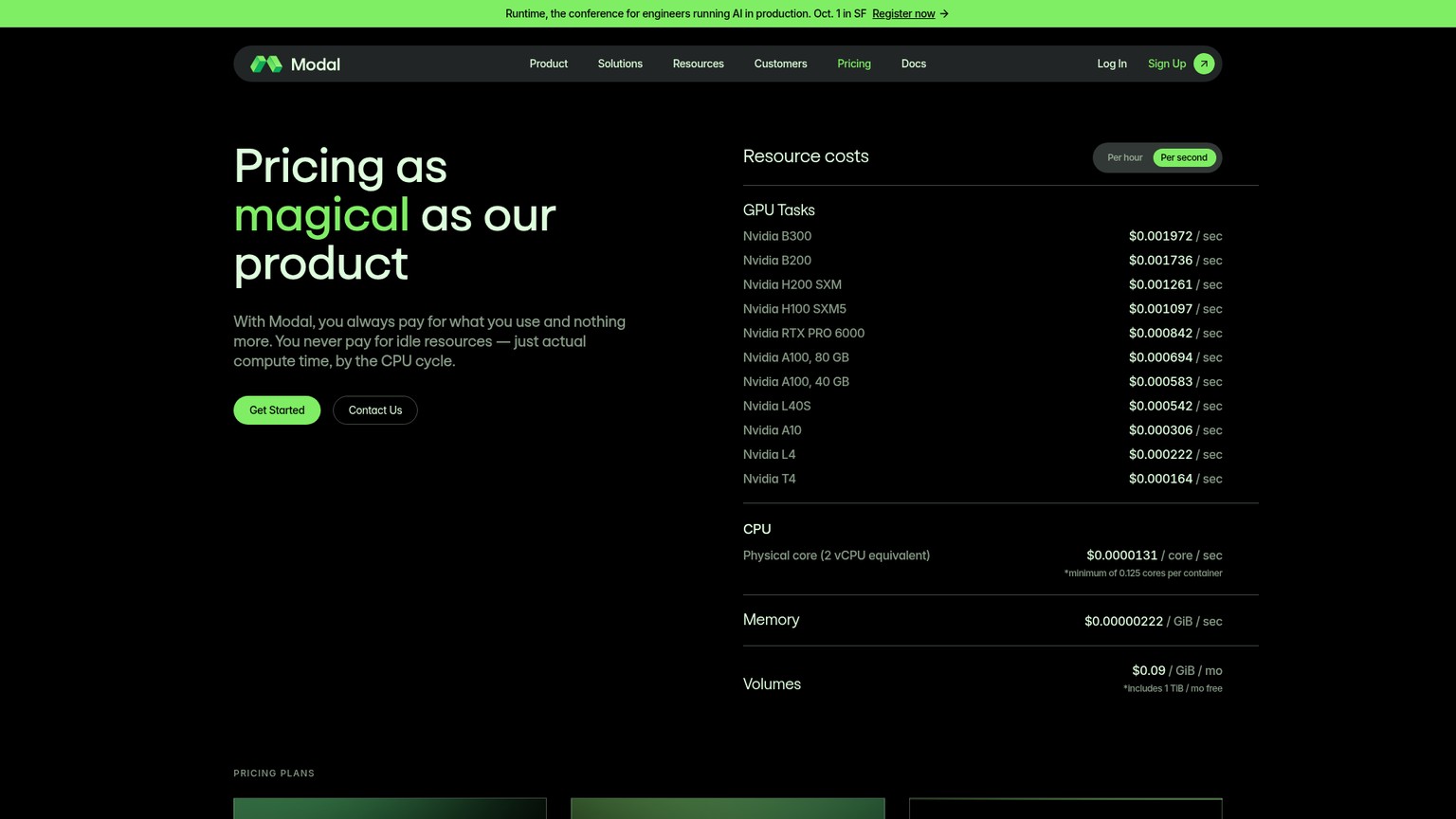
The live Modal pricing page lists Starter at $0 plus compute, with $30 in monthly credits, three seats, 100 containers, and 10 concurrent GPUs. Team costs $250 per month plus compute, includes $100 in monthly credits, unlimited seats, 5,000 containers, 50 concurrent GPUs, custom domains, a static IP proxy, deployment rollbacks, and environment budgets. Enterprise is custom, with higher GPU concurrency, volume discounts, private Slack support, audit logs, Okta SSO, and HIPAA support.
Modal meters the Nvidia H100 SXM5 at $0.001097 per second, which normalizes to $3.9492 per hour. One continuously busy H100 is $2,882.92 for 730 hours before the plan. On Team, adding the $250 base and subtracting the $100 monthly credit makes that scenario $3,032.92. The practical win is not the always-on number. It is paying for seconds when an image job, transcription queue, evaluation run, or internal batch actually executes.
Modal's scaling documentation says every function maps to an autoscaling container pool and can scale to zero when no inputs remain. Minimum and maximum containers can also be updated dynamically without redeploying the app. That is useful for a product launch or scheduled campaign where an operator wants to prewarm capacity, absorb the event, then return the floor to zero.
The wall is the abstraction boundary. Modal makes Python functions easy to scale, but a complex multi-model service may need more explicit composition, traffic policy, and infrastructure topology than the function model provides. Its plan limits also matter: Starter stops at 10 concurrent GPUs, Team at 50, and one function has a hard limit of 4,000 concurrent containers.
Best for: A solo technical builder or small ML team running bursty Python inference, batch jobs, or scheduled GPU work.
Standout: Per-second compute with scale-to-zero and dynamic autoscaler changes.
Pricing: Starter $0 plus compute; Team $250/month plus compute; Enterprise custom; H100 SXM5 at $0.001097/second.
Free trial: Starter includes $30 in monthly compute credits.
- The lowest public normalized H100 rate in the four-vendor baseline.
- Scale-to-zero and per-second billing fit intermittent jobs.
- Starter is genuinely useful for a small team, not only a demo shell.
- Dynamic autoscaler changes support planned bursts without a redeploy.
- Team adds $250 per month before compute.
- Starter's 10-GPU concurrency can become a fast ceiling.
- The function abstraction is less natural for a deeply customized serving topology.
- Cold-start behavior still needs measurement for interactive endpoints.
4. Fireworks AI: best for managed serving paths and batch economics
Fireworks AI is the strongest managed pick when one model needs distinct Standard, Priority, Fast, batch, and dedicated lanes rather than one undifferentiated endpoint.
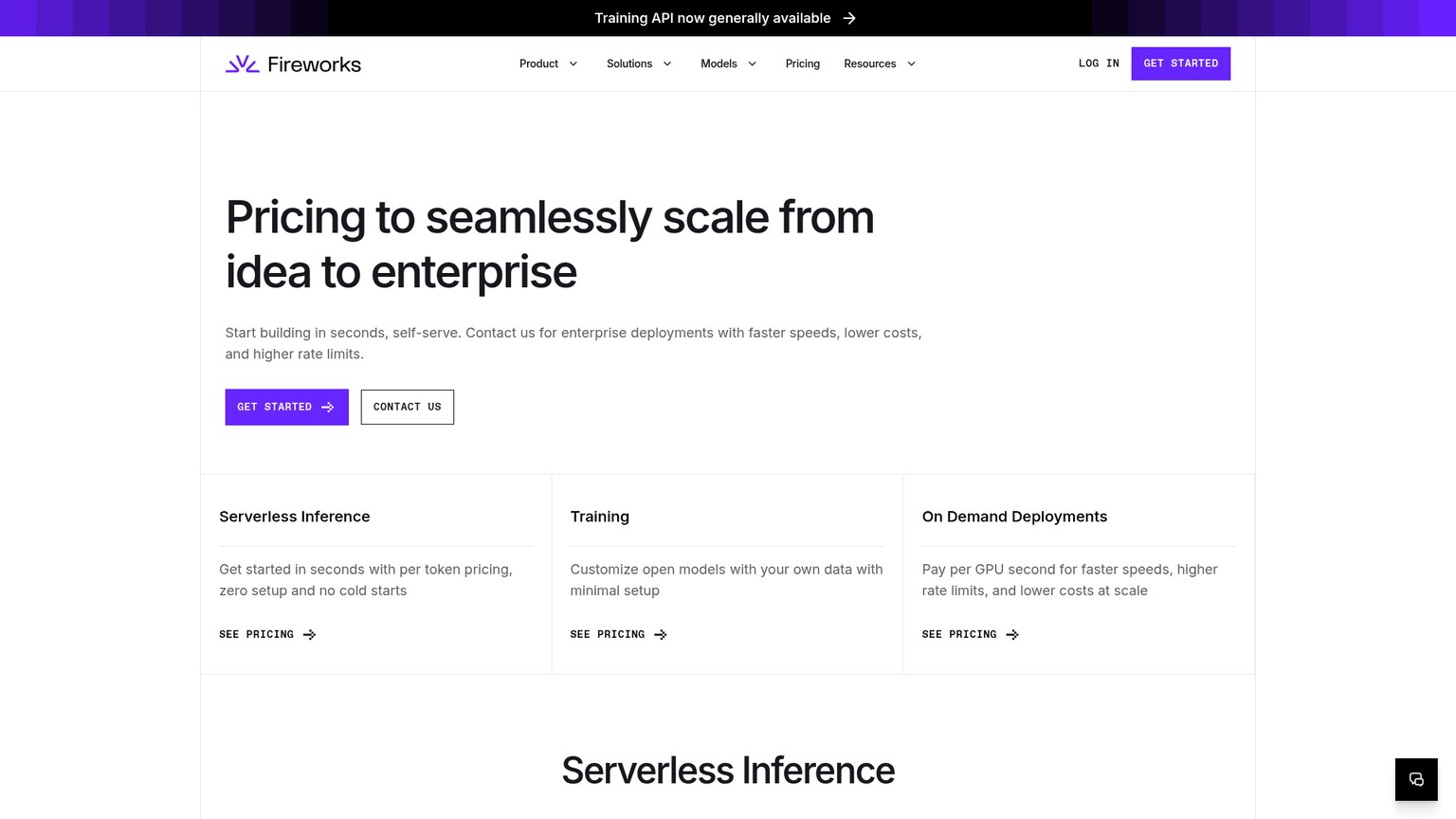
Fireworks separates service behavior before it separates hardware. Its serving-path documentation defines Standard as the default, Priority as the higher-priced route less likely to be load-shed during peaks, and Fast as the high-speed route targeting more than 100 generated tokens per second on supported models. That lets an operator spend reliability or speed only on the requests that need it.
The price difference is model-specific. Fireworks' live serverless page lists GLM-5.3 Standard at $1.40 input, $0.26 cached input, and $4.40 output per million tokens. Priority raises those figures to $1.75, $0.325, and $5.50. GLM-5.2 Fast is $2.10 input, $0.21 cached input, and $6.60 output. Batch inference is billed at 50% of serverless input and output prices, which can be the decisive saving for overnight classification, enrichment, or evaluation work that does not need an immediate response.
Dedicated capacity changed price on the day of this verification. The live Fireworks pricing page lists H100 and H200 at $8 per GPU-hour, B200 at $13, B300 at $15, and GB300 at $20 from September 1. H100 had been $7 through August 31, so one continuously used H100 now adds $730 to a 730-hour month. Region-restricted deployments carry a 1.5x premium, turning that H100 into $12 per hour and $8,760 for the normalized month.
Fireworks earns its place when the application can exploit different lanes. A B2B product could keep normal requests on Standard, route a narrow paid workflow to Priority, push interactive work to Fast when supported, and move asynchronous evaluation to batch. It loses when the buyer needs one custom deployment with hybrid portability, or when region restrictions turn a competitive base rate into a premium one.
Best for: A product team serving open models that can route interactive, peak-reliability, and asynchronous work to different price lanes.
Standout: Standard, Priority, Fast, and half-price batch paths under one managed provider.
Pricing: Per-model serverless; $1 starting credit; on-demand H100 and H200 at $8/GPU-hour from September 1; other current GPU rates listed above.
Free trial: $1 in free credits.
- Serving paths let reliability and speed spend follow request value.
- Batch is explicitly half the serverless input and output rate.
- Dedicated deployments bill per GPU second with no extra startup-time charge.
- Public serverless prices show cached input separately.
- H100 pricing rose by $1 per hour on September 1.
- Region restriction adds a 1.5x premium.
- Priority and Fast availability depends on the model.
- The many serving choices create more pricing work than one endpoint suggests.
5. Anyscale: best for Ray and multi-model systems
Anyscale is the best choice when Ray already fits the architecture and the service must compose, scale, or multiplex several models and Python components.
The live Anyscale pricing page offers pay as you go with no monthly fixed fee and committed contracts with volume terms. Deployment can be Hosted, on Anyscale-managed infrastructure, or Bring Your Own Cloud, in a customer's cloud, region, or on-premises environment. New self-serve accounts are offered $100 in starting credit.
The page expresses self-serve compute in Anyscale Credits rather than a simple dollar GPU table. It lists 0.5682 AC per hour for T4, 0.9542 for L4, 1.3635 for A10G, and 4.9591 for A100; H, B, and GB GPU families require contact. That is enough to compare shapes inside Anyscale and not enough to normalize a large H100 purchase without a quote. Price opacity at the hardware tier is the main buying wall.
The technical case is stronger. Anyscale's current serving documentation combines Ray Serve for orchestration, vLLM for inference, and Anyscale for infrastructure management. It supports autoscaling and load balancing, multiple models behind one deployment, an OpenAI-compatible API, and dynamic multi-LoRA, which loads different low-rank adapters against one base model. Node pools can scale to zero when idle.
Ray earns its complexity when a request passes through several independently scaled steps. A document workflow might run a parser, embedding model, retriever, reranker, and generator, each with different CPU, GPU, and latency needs. Ray Serve can compose those stages and scale them separately. A one-model endpoint does not receive the same benefit and may be easier on Baseten, Together AI, or Modal.
The hidden wall is two-layer autoscaling. Anyscale documents that the service must scale Ray Serve replicas and the underlying worker nodes. A replica policy can look correct while the cluster policy keeps idle GPUs alive, or the cluster can downscale before the service has enough fallback capacity. Ray familiarity is therefore a selection criterion, not a bonus.
Best for: A mid-market platform team already using Ray, or a product with multi-model composition and shared infrastructure.
Standout: Ray Serve composition plus managed infrastructure, Hosted and BYOC, and scale-to-zero node pools.
Pricing: No fixed monthly fee plus usage; $100 starting credit; committed contracts by quote; large H, B, and GB GPU rates by contact.
Free trial: A free account with $100 in starting credit.
- Hosted and BYOC cover fast adoption and existing-cloud commitments.
- Ray Serve handles model composition and independent component scaling.
- Services add high availability, zero-downtime upgrades, and automatic rollback.
- Scale-to-zero and shared infrastructure can improve utilization for varied workloads.
- Large-GPU dollar pricing requires contact.
- Teams must understand both replica and worker-node scaling.
- Ray is unnecessary surface area for a simple single-model endpoint.
- BYOC transfers more cloud and networking responsibility to the buyer.
6. NVIDIA Dynamo: best for an owned Nvidia fleet
NVIDIA Dynamo is the best option when a platform team already owns a multi-node Nvidia fleet and needs an open distributed-serving framework rather than another managed cloud bill.
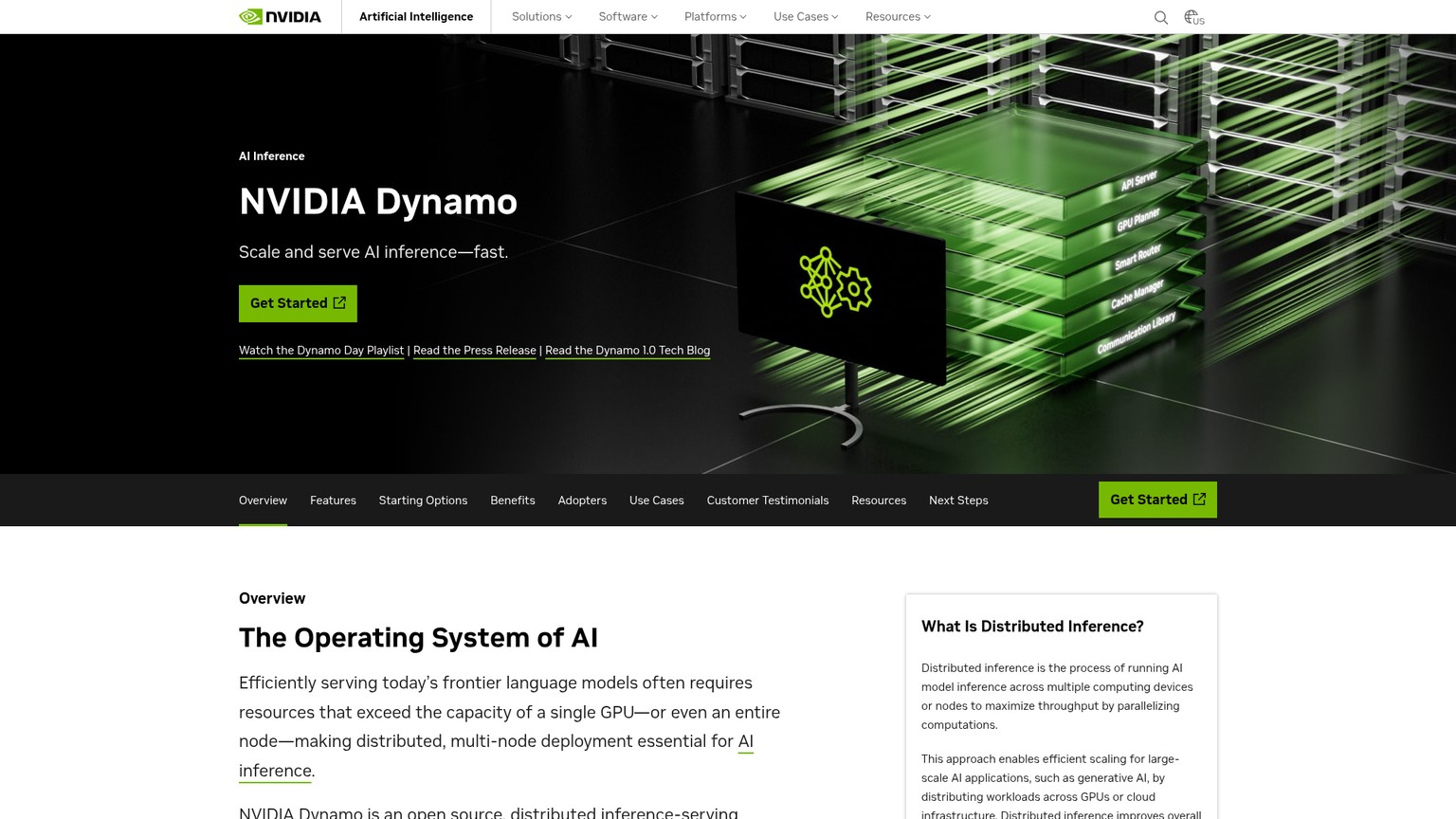
NVIDIA's live Dynamo page describes it as fully open source. It supports SGLang, NVIDIA TensorRT-LLM, and vLLM, then coordinates them with disaggregated serving, an LLM-aware router, KV cache offload, topology-aware Kubernetes serving through Grove, a GPU Planner, the NIXL data-movement library, AIConfigurator, and AIPerf. The software license line is zero; the GPU fleet, storage, network, Kubernetes estate, and operators are not.
Disaggregated serving separates prefill, which processes the prompt and context, from decode, which generates output tokens. Those phases stress hardware differently. Dynamo can allocate them to different workers, move KV state between memory tiers, and route a request toward useful cached context. That is where the Vera thesis meets deployable software: expensive accelerators stay useful only when surrounding compute and data arrive on time.
nvidia ai inference platform: Dynamo is software, Vera is infrastructure
NVIDIA Dynamo and Nvidia Vera should not be treated as one subscription. Dynamo is the open serving framework. Vera is the CPU and system architecture now shipping into hyperscale environments. Dynamo can be evaluated on existing supported Nvidia infrastructure; Vera becomes relevant when a cloud or hardware purchase exposes it.
Nvidia currently says Dynamo plus wide expert parallel on GB200 NVL72 produces up to 7x the mixture-of-experts throughput of B200-based systems. That is a vendor-reported platform result, not a cross-vendor score used in this ranking. The more durable buying signal is modularity: Dynamo supports several engines, and its routing, cache, planner, and data-movement pieces address the same non-GPU bottlenecks highlighted by the Vera rollout.
The wall is ownership. Assume a self-managed deployment consumes 12 platform-engineering hours per month at an explicit planning rate of $100 per hour. That is $1,200 before an incident, even though it is not a market salary claim. If a managed platform removes those hours and costs less than the complete self-hosted difference, open source is the expensive option. If a platform group already owns Kubernetes, GPU scheduling, storage, observability, and on-call, Dynamo's marginal operating cost can be much lower.
Best for: A large technical organization with an existing Nvidia fleet, Kubernetes practice, and named inference owner.
Standout: Open, modular distributed serving with cache-aware routing, disaggregated phases, GPU planning, and storage offload.
Pricing: Fully open source; compute, storage, networking, support, and operating labor are separate.
Free trial: Not applicable; the open-source software can be evaluated on owned infrastructure.
- No software license price is stated.
- Supports vLLM, SGLang, and TensorRT-LLM rather than one engine.
- Addresses routing, cache, placement, topology, and data movement at fleet scale.
- Fits infrastructure teams that need component-level control.
- It is a framework, not a managed production service.
- The buyer owns deployment, upgrades, observability, and incidents.
- The strongest performance claims are tied to Nvidia hardware configurations.
- Small fleets rarely justify the operating surface.
ai inference companies are not all selling the same layer
The useful shortlist begins by removing products that solve a neighboring problem. Together AI and Fireworks AI combine model access with managed serving. Baseten and Modal focus on deploying custom code or models on managed capacity. Anyscale manages a Ray-based distributed runtime. NVIDIA Dynamo is open infrastructure software.
An API gateway sits above those systems and can route between model providers without operating the models. A raw engine sits below the platform and executes a model efficiently without necessarily owning billing, rollout, or incidents. Hardware sits lower still. Calling all four layers a platform makes every comparison look broad and none of it actionable.
That is why Domo, Apache Airflow, UiPath, LangChain, Kore.ai, Botpress, AutoGen, and SuperAGI were not ranked: they do not all own the GPU capacity, inference-engine lifecycle, and live model-serving rollout this query requires. It is also why raw vLLM was cut: vLLM is a strong engine, but an operator still needs a control plane and owner around it.
BentoML was the closest technical cut. Its open-source project is relevant, but the live vendor pricing page returned a client-side application error during the September 1 verification. A product that cannot be priced from its current purchase page does not earn a buyer recommendation in a price-verified ranking.
Who should pick what
Pick Baseten when the organization wants a managed default and cannot yet predict whether data residency or cloud commitments will force a hybrid move. The decision flips when Pro or Enterprise quotes exceed the value of that portability, or when an existing platform team already owns the same controls.
Pick Together AI when traffic starts serverless and is likely to become steady enough for dedicated capacity. The decision flips if the post-September H100 rate erases the advantage, or if custom deployment requirements outgrow its hosted workflow.
Pick Modal when work is bursty, written in Python, and can return from zero without violating the user experience. The decision flips when an interactive endpoint must stay warm, Starter's 10-GPU ceiling binds, or a multi-stage topology needs a more explicit control plane.
Pick Fireworks AI when Standard, Priority, Fast, and batch can map to different request values. The decision flips when the model lacks the desired serving path, a restricted region adds 1.5x, or a custom hybrid deployment matters more than managed speed.
Pick Anyscale when Ray is already an asset and several models or Python stages need independent scaling. The decision flips when the product is one endpoint, the team does not know Ray, or a large-GPU quote cannot beat the managed alternatives.
Pick NVIDIA Dynamo when the company already has the fleet and the platform team. The decision flips to managed as soon as Dynamo creates a new owner or pager. If the workload's only non-negotiable is interactive agent latency, use the adjacent real-time inference platform comparison to narrow the performance-first route before choosing the broader control plane.
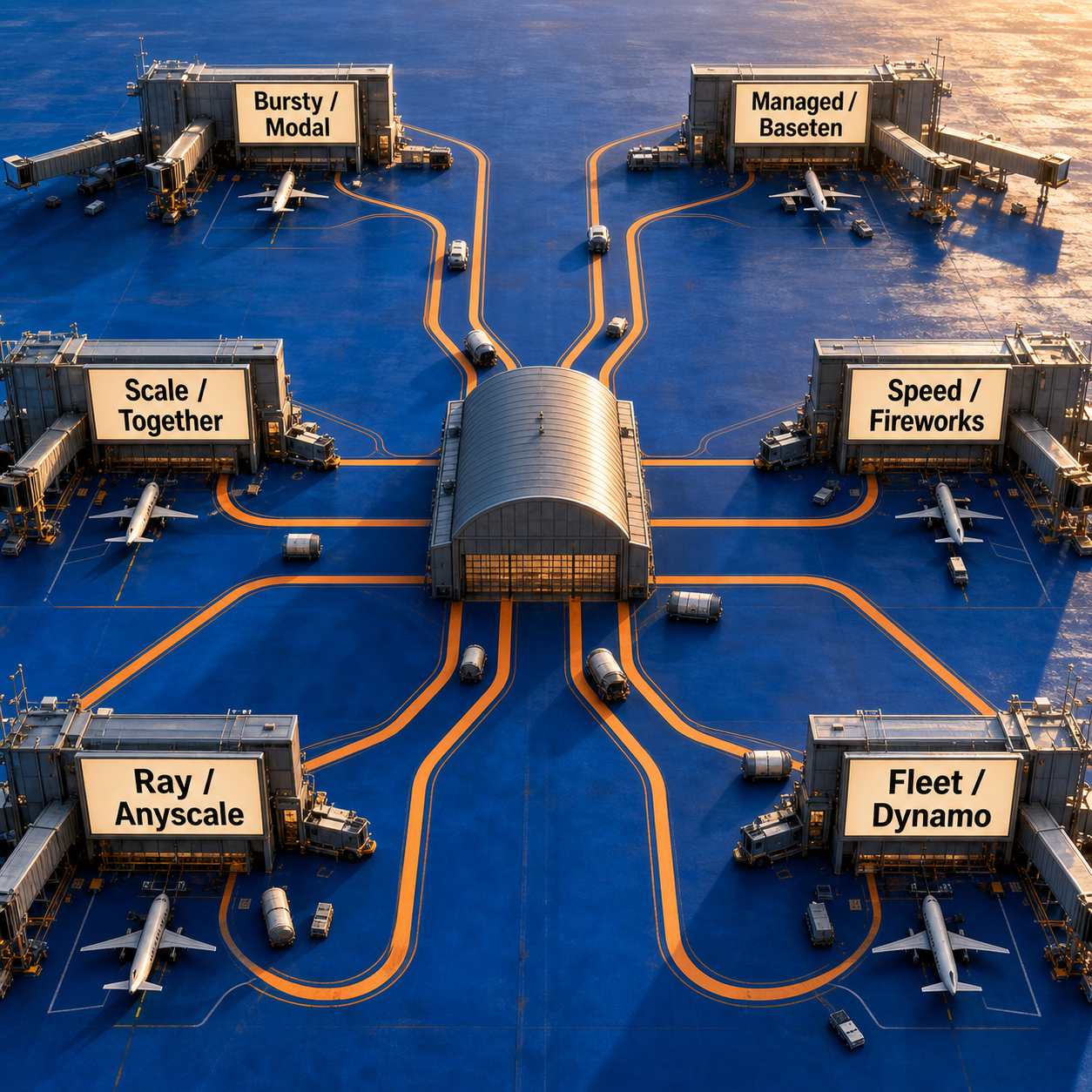
The explicit decision rule is simple: buy managed until the monthly managed premium is larger than the capacity waste and operating work it removes. Move toward BYOC or open source only when the organization already owns the missing responsibilities.
How these were picked
The ranking starts with orchestration completeness: deployment, capacity control, request placement, observability, traffic migration, and rollback. Pricing transparency comes next, followed by deployment portability, engine flexibility, and operating burden. A catalog size or vendor benchmark cannot compensate for a missing production control.
Six platforms made the final list. Expanding the count would force gateways, raw engines, workflow tools, and control planes into the same bucket. Six decision-grade sections provide useful depth per entity, current plan lines, and a named wall for every buyer.
All public prices and product claims were verified on September 1, 2026. The normalized H100 baseline is original analysis from those live rates, and the 10-point utilization test is an explicit scenario, not a measured result. Vendor performance claims are labeled as vendor claims and were not used as cross-vendor benchmark scores.
This is a pricing-and-spec comparison, not a production-traffic test. The page says compared and verified, never tested.
The ones to avoid
Domo-style business orchestration for GPU serving
Domo's broad category includes business automation, agents, integration, and analytics. Those can be valuable, but they do not substitute for model packaging, replica capacity, engine operations, GPU placement, or a serving rollback. Do not buy a workflow-orchestration product to solve an infrastructure-serving problem simply because both use the word orchestration.
Raw vLLM without a control-plane owner
vLLM is an inference engine, not a complete operating model. It can execute continuous batches and manage KV memory efficiently, while leaving deployment, capacity, traffic policy, observability, upgrades, and incidents to the team around it. Use it inside Baseten, Anyscale, NVIDIA Dynamo, or an owned stack. Do not mistake engine throughput for a finished production service.
Bento Inference Platform when the purchase price is still opaque
BentoML's open-source packaging model remains technically relevant. Its live pricing page returned a client-side application error on September 1, 2026. A team can still evaluate the open project, but a buyer who needs cloud cost certainty should wait for a working, current price surface or obtain a complete written quote before ranking it against transparent options.
NVIDIA Dynamo below the ownership threshold
NVIDIA Dynamo is a poor default for a small team with no GPU platform practice. Open source removes a license line and adds deployment, storage, networking, upgrades, observability, and on-call. Start managed, measure the premium, and self-manage only when the savings exceed the owner cost with room for incidents.
The Monday move: shadow one workload before moving spend
Choose one production workload with a clear acceptance rule and a meaningful serving bill. Export its current p95 latency, which is the response time that 95% of requests beat, accepted-output rate, retries, warm hours, GPU or token spend, and operator time. Remove or approve any customer data before it enters an evaluation route.
Select the platform whose mechanism matches the workload. Use Baseten for a custom model with a possible hybrid future, Together AI for a serverless-to-dedicated path, Modal for bursty Python, Fireworks AI for serving-path separation, Anyscale for Ray composition, or NVIDIA Dynamo for an already-owned fleet.
Shadow approved live-shaped requests without returning the candidate output to users. Set stop conditions before the first request: lower acceptance, a p95 breach, a privacy or residency failure, an unexpected cold start, or complete cost above the budget. Measure utilization and cost per accepted result, not demo throughput.
At the end of the week, apply the 10-point utilization test. If the platform recovered useful capacity or operating time worth more than its full premium, expand gradually. If the value is smaller, keep the current route. If the result is close, do not sign an annual commitment; improve the measurement and repeat.
The Monday output is one shared decision for finance and engineering: managed, BYOC, or self-managed, with a written reason and a rollback route.
Frequently asked questions
Which AI orchestration platform is considered the best?
Baseten is the best overall managed inference-orchestration choice in this comparison because it combines a $0 Basic entry, documented autoscaling, and Cloud, self-hosted, and hybrid deployment modes. Together AI is better for a serverless-to-dedicated migration, Modal for bursty Python, Fireworks AI for serving lanes, Anyscale for Ray, and NVIDIA Dynamo for an owned Nvidia fleet.
What are the most used AI platforms in 2026?
No current, credible usage ranking establishes that answer, and broad AI-platform usage would not identify the best inference control plane. Select on workload shape, current price, rollout controls, portability, and operating ownership instead of an unverified popularity claim.
What are the most popular AI frameworks in 2026?
Framework popularity is a different question from platform fit. Ray Serve composes distributed services, while vLLM, SGLang, and TensorRT-LLM are inference engines; NVIDIA Dynamo can orchestrate several engines. The right layer matters more than a popularity list.
What is the best AI coding tool in 2026?
This comparison does not rank coding tools. Coding agents are applications that may consume model APIs or self-hosted inference; the platforms here operate the serving layer underneath those applications.
What are the big 5 AI platforms?
There is no stable big-five definition that helps an inference buyer. Managed model providers, control planes, engines, gateways, and hardware vendors solve different jobs, so a five-name popularity list would hide the deployment decision.
Which AI is better than Claude for coding?
That depends on the coding task, model version, agent runtime, and evaluation set, not on inference orchestration. This ranking answers where and how models are served, not which coding model produces the best patch.
Why is everyone switching to Claude?
The premise is not established. Even if a product changes models, its serving decision still turns on API access, custom deployment needs, capacity, latency, and cost.
What are the top 5 AI tools for coding?
Coding tools are outside this infrastructure ranking. An inference platform can power a coding agent, but it does not replace the editor, terminal agent, repository context, sandbox, or review workflow.
What can Claude do that ChatGPT can't?
Model capabilities and product features change independently of the serving control plane. Compare the exact current models for the intended task, then choose an orchestration platform only if custom hosting or capacity control is required.
Get the AI Tools Map for Business Owners
Place inference orchestration beside gateways, models, and agent frameworks without buying duplicate layers. Subscribe to get the AI Tools Map free.
- Published
- Category
- AI
- Language

Gamma Alternatives in 2026: Beautiful.ai, Prezi and More
Compare Gamma alternatives for brand control, editable PowerPoint and Google Slides, pitch decks and live talks. Current plans and clear tradeoffs.Oct 11, 2026AI
Reflection AI Beam: What It Means for Coding and Agents
Reflection AI Beam explained: October release plans, vendor benchmark claims, beta access and whether builders should wait before switching models.Oct 10, 2026AI
Claude for Google Workspace
How to install and deploy Claude in Docs, Sheets and Slides, control edits, and test the paid-plan beta with three practical team workflows.Oct 10, 2026AI
Claude Dashboards
Set up Claude Dashboards beta, inspect SQL and refresh timestamps, check a sales metric, and decide when to keep your BI tool.Oct 10, 2026AI
Granola AI Review
Granola reviewed for business meetings: bot-free notes, current pricing, templates, recipes, consent, platform limits and who should choose an alternative.Oct 10, 2026AI
Fyxer Review
Fyxer reviewed through current pricing, help docs and public feedback: inbox sorting, drafts, meetings, privacy and who should pay for Pro or Team.Oct 9, 2026AI
GPT 6 Explained: Models, Release Dates, Access, and Prices
GPT-6 Astra, Sol, 6.1 Sol and Luna explained: release dates, ChatGPT plan access, Work and Codex availability, and verified API costs.Oct 9, 2026AI