Automate Google Ads Analytics With AI
Google's new Ask Advisor beta turns Ads and Analytics data into summaries, reports, benchmarks, and approval-based actions.
Published
 By Omid Saffari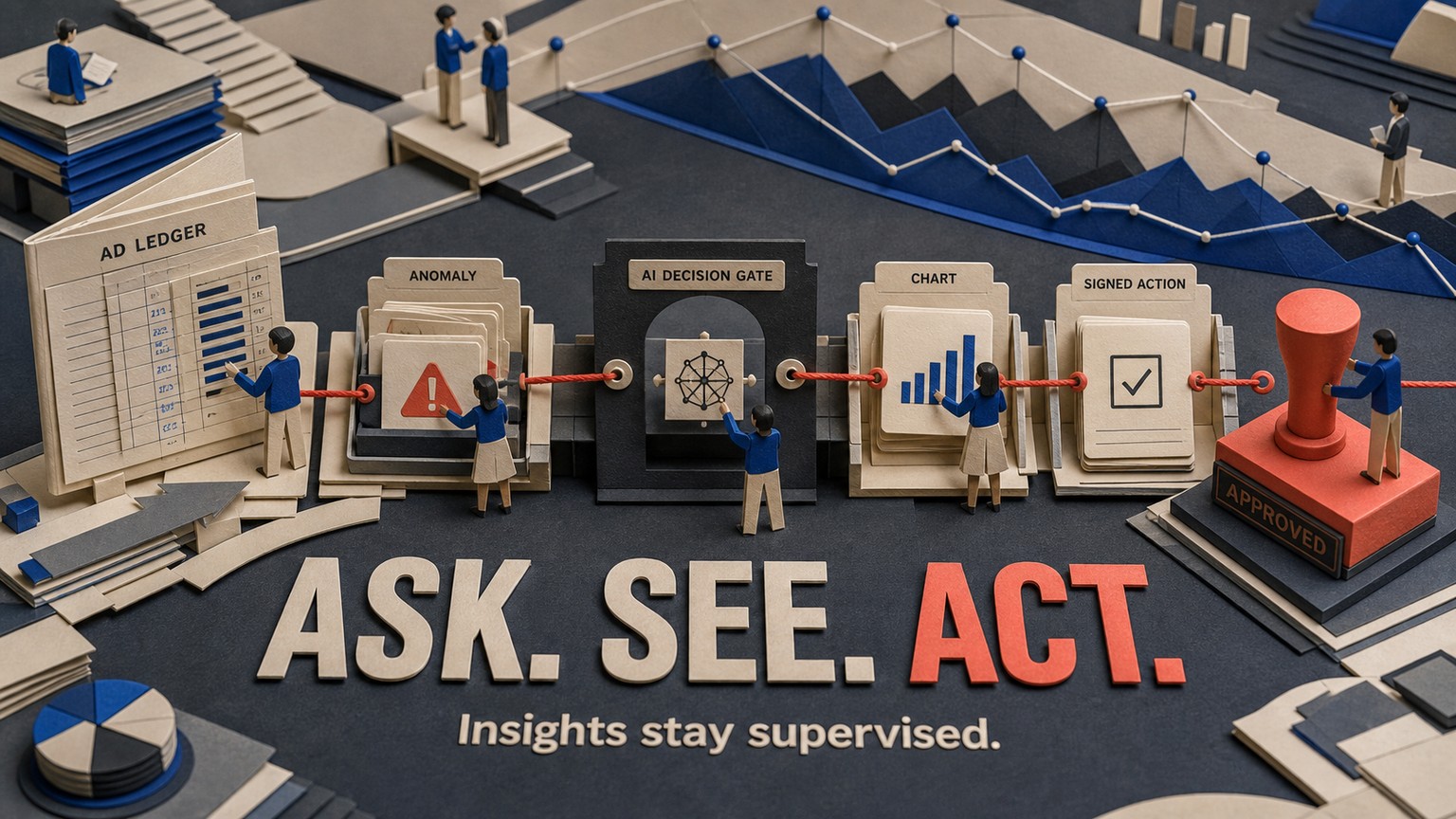
Your next Google Ads review can start with a question instead of an export. Google's new AI layer spots performance shifts, explains what may be driving them, turns prompts into reports, and proposes campaign actions that you approve before they go live. The immediate payoff is less analyst preparation and fewer single-purpose reporting tasks, but this is still a supervised beta, not an autopilot for ad spend.
What Google Ads and Analytics AI actually automates
The new workflow automates the first pass through your marketing data: noticing, investigating, presenting, and recommending. It does not automate accountability.
Google's August 10 update adds four connected pieces:
- Notice: AI Overviews on the Google Analytics homepage summarize important changes since your last visit. Personalized insight cards do a similar job on the Google Ads homepage.
- Ask why: A click can carry an Analytics data card into Ask Advisor, where you can investigate the change conversationally. In Ads, a prompt box can generate a custom insight about the issue on your mind.
- Show the evidence: New Dashboards in Google Ads turn plain-text prompts into visual reports with a real-time explanation of the data. The Dashboard capability is coming soon to Analytics.
- Act with a checkpoint: Ask Advisor can recommend campaign improvements and implement them in Google Ads only after you approve them.
Think of it as a morning analyst sitting beside a campaign operator. The analyst flags the odd movement and prepares the chart. The operator suggests a response. You still decide whether the evidence is sound and whether the change fits the business.

The two products give Ask Advisor different context. The Google Ads version works with campaign performance, serving problems, policy issues, keywords, reports, and creative suggestions. The Analytics version answers from one Analytics property, creates visualizations, diagnoses changes, reads configuration, and points you to relevant reports.
Google also describes Ask Advisor as a cross-product collaborator that can use Ads and Analytics signals while retaining the marketer's original goal. That broader unified experience is rolling out through 2026, so do not assume every account has every cross-product action today.
How the workflow works in practice
The best way to use this is as a review loop, not an open-ended chat.
- Start with the flagged change. Read the Analytics AI Overview or Ads insight card before asking a broad question. That gives the agent an actual event to investigate.
- Name the business metric and period. Ask which campaign drove the largest week-over-week conversion change, or why revenue fell on a particular date. Specific campaign names, metrics, and dates produce a tighter investigation.
- Request the evidence in a useful shape. Ask for a trend, campaign comparison, or chart. In Ads, the new Dashboard can build that visual from a text prompt and attach a real-time explanation.
- Stress-test the explanation. Ask what changed, what data supports the conclusion, and which alternative cause remains possible. A plausible story is not the same as a proven cause.
- Review the proposed action. Check the targeting, budget effect, creative, policy implications, and measurement quality. Google explicitly leaves that responsibility with you.
- Approve narrowly, then watch the result. Apply one justified change, record the baseline, and review what happened before approving a batch.
Analytics summaries can also arrive by phone or email at a frequency you choose. That makes the loop useful between login sessions, but an alert should open an investigation, not trigger an automatic budget change.
The business math: which budget line changes
The first budget under pressure is reporting and optimization software, not media spend.
Google has not published a separate price for Ask Advisor or these August features on the official pages used for this piece. A current third-party anchor shows why the native layer matters: Optmyzr lists its standalone Campaign Automator at $249 per month for one account, plus $89 for every additional account. That works out to $605 per month for five accounts and $1,050 for ten, before any assisted feed setup.
Those products are not equivalent. A dedicated automation platform can run scheduled rules and multi-account operations that Ask Advisor does not cover. The decision is narrower:
- A business with one eligible account that mainly pays for change summaries, ad-hoc reports, and basic optimization suggestions should test the Google beta before renewing another seat.
- An agency managing several accounts should not cancel its control layer. Ask Advisor is not currently available in Google Ads manager accounts, also known as MCC accounts.
- A team with weak conversion tracking will not fix the problem by adding a smarter explanation layer. The agent reflects the data already present in Analytics.
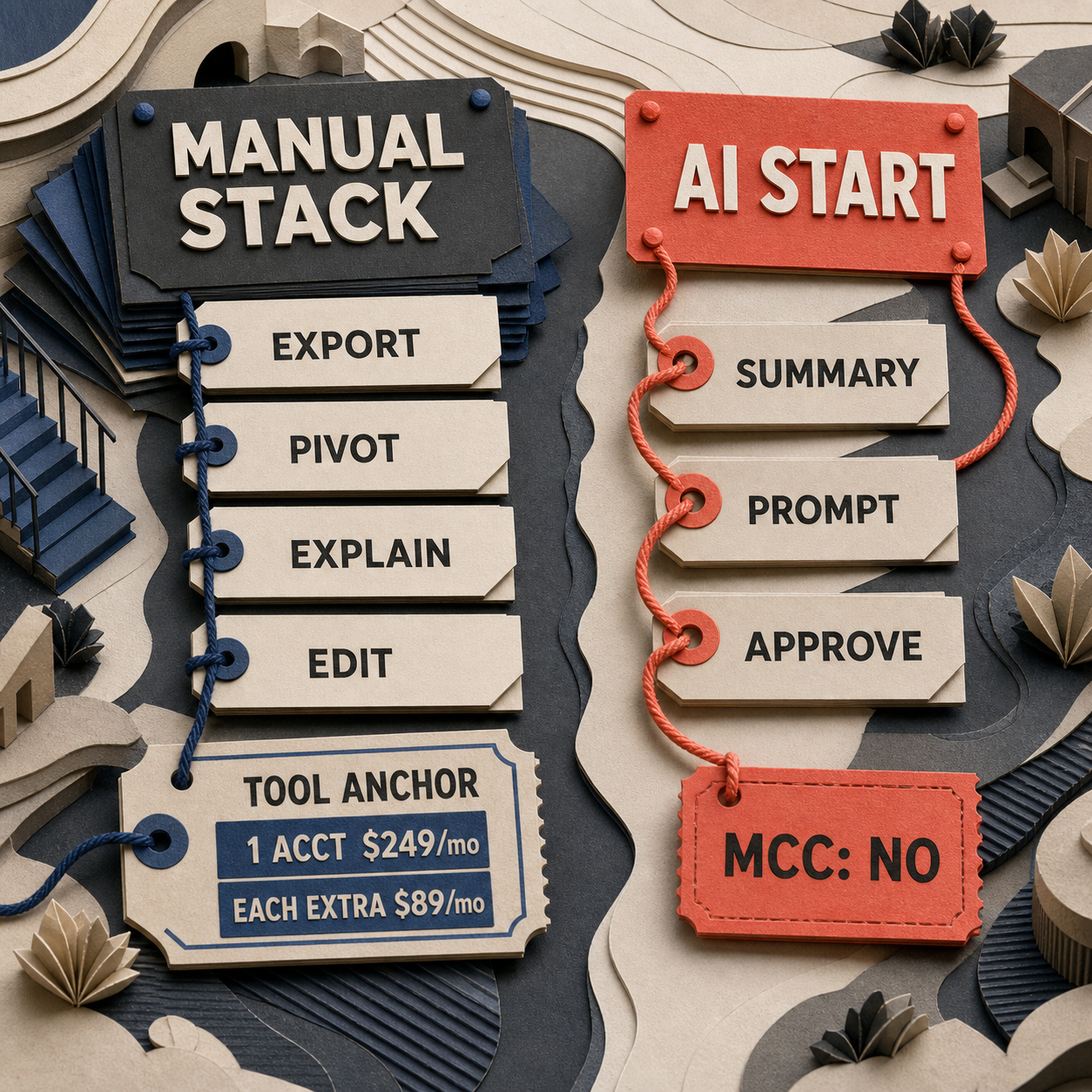
The practical test is not whether AI can make a chart. It is whether the native workflow removes enough recurring preparation to retire a tool or return meaningful operator time without reducing oversight.
Seven use cases, ranked by who gains most
1. The in-house ecommerce performance lead
An ecommerce lead opens Analytics after a promotion and sees an AI Overview flag a seasonal revenue peak and traffic change. They carry the card into Ask Advisor, ask which campaigns and device segments explain the movement, then build a Google Ads Dashboard for the executive review. If Advisor proposes a campaign adjustment, they inspect and approve it separately.
This group gains most because one person often owns the whole loop from anomaly to budget decision. Removing exports and first-draft commentary gives them more time for offer, margin, and inventory questions that the agent cannot decide.
2. The paid-search manager diagnosing a conversion drop
A paid-search manager asks why a branded campaign's conversions fell, which changes happened near the drop, and whether an ad-serving or policy problem is involved. Ask Advisor can investigate those categories inside Google Ads and propose a fix with an approval step.
The payoff is a shorter triage path. Instead of checking separate performance, history, and policy views before forming a hypothesis, the manager starts with a joined explanation and verifies its evidence.
3. The founder running one modest ad account
A founder without a dedicated analyst can ask which campaign produced the most mobile conversions this month, request a graph, and use Analytics benchmarking to compare campaign performance with anonymized averages from similar businesses.
The payoff is access to a competent first review without commissioning a custom report. The benchmark is directional context, not permission to copy another company's budget or targets.
4. The marketing analyst preparing the weekly business review
An analyst turns a request such as "compare spend, conversions, and revenue by campaign for the last four weeks" into a visual Google Ads report, then uses the generated explanation as a first draft for the meeting.
This pays by reducing report assembly. It does not remove the analyst's job of checking definitions, attribution, and the difference between correlation and cause. Analytics support for prompt-built Dashboards is still marked as coming soon.
5. The Performance Max creative owner
A creative owner asks for stronger text and image ideas for an existing campaign. Ask Advisor can suggest headlines and descriptions, source images from the landing page, or generate images with Google AI. The owner reviews brand accuracy, product claims, and landing-page fit before accepting anything.
The payoff is a faster first batch of options. The human still owns truth, brand standards, and whether the creative deserves spend.
6. The growth operator fixing measurement setup
A growth operator can ask Analytics for a measurement ID, the number of data streams, guidance on creating an audience, or help linking the property to Google Ads. They can then ask whether the repaired data changes the diagnosis.
This pays because measurement errors contaminate every optimization after them. The same principle matters in newer ad channels too: measurement has to exist before an audience test.
7. The agency testing the direction on one client
An agency can test Ask Advisor inside an eligible client account, compare its explanations with the team's existing review, and document where the agent helps or misses context. It cannot yet serve as the agency's central operating layer because MCC accounts are excluded.
The payoff is learning which native tasks may disappear next. The mistake would be treating a single-account beta as a multi-client production system.
What is worth building around this shift
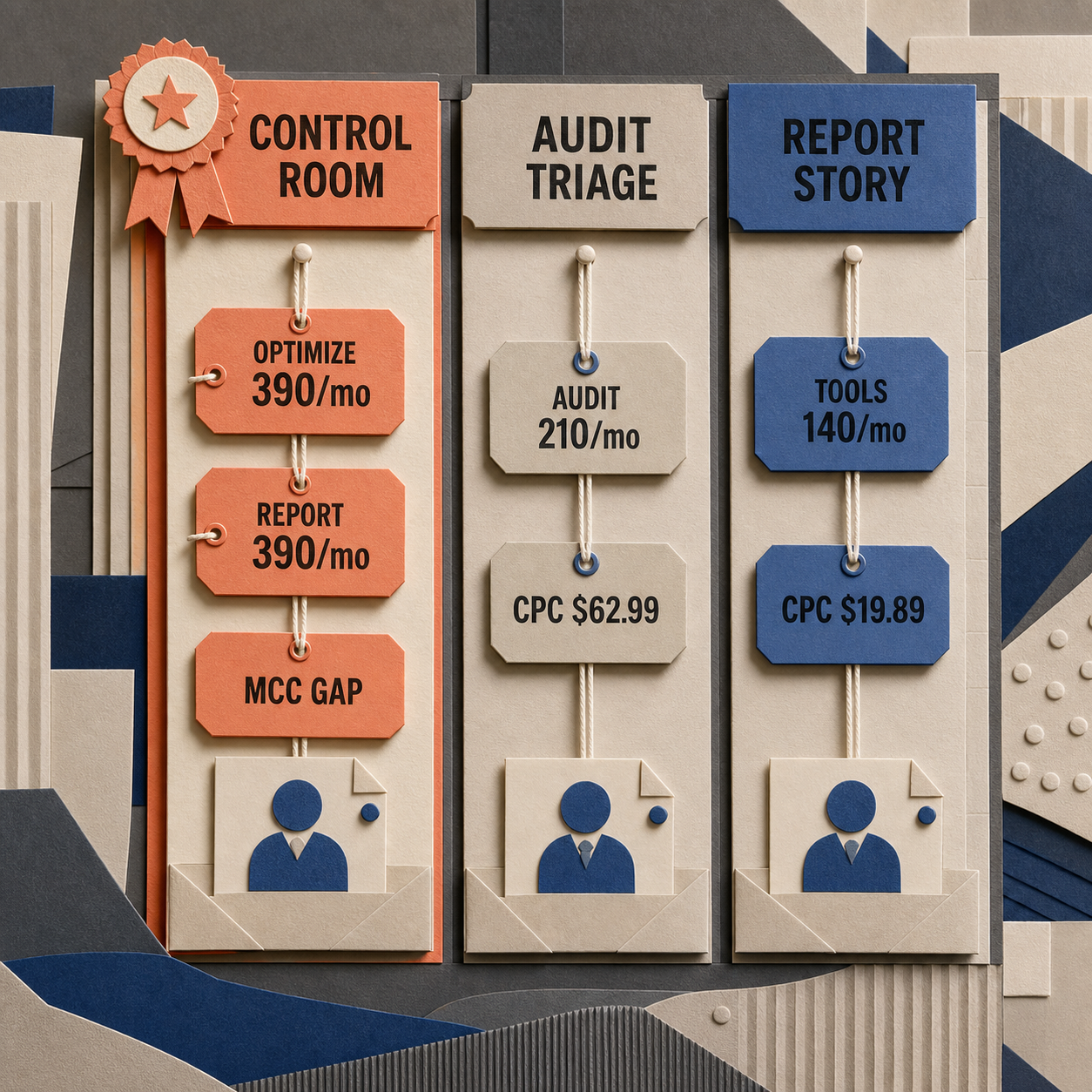
The best products are in the gaps Google leaves open, not thin wrappers around a chat box. Live US keyword data shows 390 monthly searches each for Google Ads optimization and Google Ads reporting, plus 210 for Google Ads audits. The paid-click prices, from $42.57 to $68.39, show that businesses already attach money to getting these jobs done.
1. A multi-account agency control room
This is the strongest opportunity. The buyer is a PPC agency or fractional growth team that needs one morning priority list across every client, exactly where Ask Advisor's MCC exclusion hurts.
Demand is concrete: Google Ads optimization and reporting each receive about 390 US searches a month. Existing automation also establishes a budget anchor at $249 per month for one account plus $89 per additional account.
The smallest sellable version imports account performance in read-only mode, ranks anomalies by business impact, links every claim to its source view, and creates a proposed-change queue with an approval log. It does not need to execute changes on day one.
The catch is platform risk. Google could add MCC support, and agencies will reject any product that cannot explain where a recommendation came from. The moat has to be multi-client prioritization, agency rules, approvals, and client communication, not generic AI prose.
2. A read-only Google Ads audit triage product
The buyer is a small business considering an agency, or an agency qualifying a prospect before a sales call. The product finds the highest-risk measurement, serving, policy, and performance issues and turns them into a short evidence-backed briefing.
About 210 people a month search Google for "google ads audit." The query has keyword difficulty 0 and a $62.99 CPC. The narrower "google ads audit service" query is smaller at 20 searches, but its CPC is $128.06 and its yearly trend in the live suggestion data is up 100%.
The MVP is a permissioned read-only intake, a fixed set of checks, three severity levels, and a report that shows the evidence before suggesting work. The catch is trust: a confident false alarm can kill the sale, and Google's native agent will keep absorbing basic diagnostic questions.
3. A client-ready reporting narrator
The buyer is an agency that already has the numbers but still spends time turning them into a clean weekly client story. The product schedules a small set of charts, explains what changed, flags uncertain causes, and routes the draft through an account manager before sending it.
Google Ads reporting draws about 390 searches a month. The explicitly commercial query "google ads reporting tools" adds 140 searches a month with a $19.89 CPC. AI assistants receive about 54 monthly requests for Google Ads reporting, although that volume has declined from 199 in August 2025, so the demand case rests on search and existing workflow spend rather than AI hype.
The MVP is five opinionated charts, one editable narrative, a client glossary, approval, and scheduled delivery. The catch is obvious: Google's prompt-built Dashboards will make generic charts cheap. The defensible layer is white labeling, cross-client consistency, approvals, and delivery outside the Google console.
If you want a wider view of where reporting, optimization, and content tools fit, the current AI marketing tools comparison is the useful companion. The important distinction is whether a product owns a workflow or merely produces another answer.
Limits and the honest take
Google has moved the starting line for single-account analysis, but it has not removed the need for a performance marketer.
- It is a beta for eligible English-language accounts. Availability and capability can differ by account.
- Manager accounts are excluded. That blocks the cleanest agency-wide automation story today.
- Analytics context stays at the property level. Ask Advisor answers from the information available in that property, so it cannot rescue missing or incorrect measurement.
- Changes require approval. That is a feature, not friction. Google also says you are responsible for checking accepted suggestions.
- Analytics Dashboards are not here yet. Google Ads has the prompt-built reporting capability; Analytics is listed as coming soon.
- The official material describes an in-product experience. It does not present Ask Advisor as an external developer surface for embedding in another product.
- Benchmarking is context, not causality. An anonymized peer average can show that a gap exists. It cannot tell you whether copying the peer will improve your profit.
- There is no separate published price in the launch material. Check what your eligible account actually offers before building a savings case around it.
My take: a single-account operator should test this immediately. An agency should treat it as a signal about which manual tasks are becoming commodity work, then invest in the multi-account judgment and approval layer Google does not yet provide.
Your Monday move
Choose one eligible account and one recurring review, preferably the weekly performance check. Ask Advisor three questions: what changed, why it changed, and what action it recommends. Request one visual report, verify every material claim against the underlying view, and approve no changes in the first session. Then compare the time and quality with last week's process. That comparison tells you whether to retire a task, keep a tool, or design a better control layer.
How do I optimize my Google Ads?
Start with a business outcome and a verified measurement setup, then ask which campaign changed, what evidence explains it, and which single action is most justified. Use Ask Advisor to shorten the investigation, but inspect the proposed change before approval.
Can I automate Google Ads analytics with AI for free?
Google's launch pages do not publish a separate price for Ask Advisor, so "free" is not a safe claim. Check whether the beta appears in your eligible account and compare its reporting and diagnosis against any paid tool you already use.
What is a good Google Ads optimization score?
Treat the score as a platform signal, not the business result. A recommendation matters only if it supports your real conversion value, margin, budget, and measurement quality. Ask Advisor can explain an opportunity, but it cannot define your economics for you.
What are common mistakes to avoid in Google Ads?
The expensive AI-era mistakes are accepting suggestions without checking relevance, optimizing against broken conversion data, changing several variables at once, and treating a benchmark as proof. Keep the approval step and record a baseline before each material change.
Is $10 a day enough for Google Ads?
AI cannot answer that from the daily number alone. Sufficiency depends on click costs, conversion rate, conversion value, sales cycle, and how much data is needed to judge the campaign. Use the agent to show those inputs, then make the budget decision from the economics.
If you want a reporting and approval workflow built around your ad accounts, I can help you design the automation.
- Published
- Category
- Growth
- Language
Beehiiv Review
Beehiiv reviewed for business newsletters: current pricing, growth, monetization, AI, MCP, analytics and the costs that change the buying decision.Oct 10, 2026Growth
Trainual Review
Trainual review for SOPs and onboarding: AI drafting, knowledge search, read-only MCP, quote-only plans, implementation and who should skip it.Oct 10, 2026Growth
SocialBee Review
SocialBee review of evergreen scheduling, AI Copilot and client workspaces, with all six plans, add-on costs, and Buffer and Later comparisons.Oct 10, 2026Growth
SurveyMonkey Pricing: Plans, Response Caps and Annual Bills
SurveyMonkey prices, response caps and AI limits, with annual bills for one person and three-seat teams. See when overages change the best plan.Oct 10, 2026Growth
ActiveCampaign Alternatives: GetResponse, Kit and More
Compare ActiveCampaign alternatives at 2,500, 10,000 and 25,000 contacts, with vendor prices, workflow trade-offs and a migration checklist.Oct 9, 2026Growth
CallRail Alternatives: WhatConverts and More Compared
Compare six CallRail alternatives by vendor pricing, usage fees, AI and reporting. Includes WhatConverts cost math and a pre-switch checklist.Oct 9, 2026Growth
Monday.com Pricing: Seat Buckets and the Yearly Bill
Calculate monday.com Work Management costs for 5, 12 and 40 people, including seat buckets, annual vs monthly billing and AI credit charges.Oct 9, 2026Growth