AI Finance Presentation Automation
Model ML shows how finance teams can turn source data into editable, traceable PowerPoint decks, with GPT-5.6 using 39% fewer tokens per deck.
Published Updated
 By Omid Saffari


Finance teams can now turn updated models, filings, data rooms, prior decks, and house templates into editable PowerPoint files without rebuilding every slide by hand. The practical shift is not faster slide design. It is a source-grounded production line that finds what changed, updates the story, preserves the deck, and leaves a trail a reviewer can check. In Model ML's FinBench, GPT-5.6 Sol used 39% fewer tokens per deck than Claude Fable 5 across 20 client workflows and hundreds of decks, while producing work that needed less revision before sharing.
What AI finance presentation automation actually is
AI finance presentation automation is a repeatable workflow for moving from changing financial evidence to a review-ready deck. Think of it as mail merge crossed with a junior analyst, a presentation specialist, and a reconciliation clerk. The agent does not merely write bullets. It gathers approved inputs, compares the new facts with the old deck, edits native slide objects, and records where each changed number came from.
Model ML's finance platform is built around purpose-specific agents and an application layer for these end-to-end jobs. Its agents can work across structured data, such as tables, and unstructured data, such as reports and meeting notes. OpenAI's case study says Model ML has built for environments spanning hundreds of tables and as much as 20 terabytes across sources such as SharePoint, Capital IQ, FactSet, and Crunchbase.
The recent model improvement matters because presentation work is both analytical and visual. OpenAI says GPT-5.6 can create fully editable presentations from prompts and source files, infer a reference deck's design system, including Slide Master rules, and apply its layouts, typography, spacing, colors, and recurring patterns to new material. Model ML's FinBench result adds a business signal: 39% fewer tokens per deck than Fable 5, plus less rework. That is a token-efficiency result, not a promise of 39% lower cost, since the models have different token prices.

How it works without the black box
The safe workflow starts with rules, not a prompt. A finance team decides which file is authoritative for each class of fact. The current financial model might govern forecast and valuation, actuals might govern monthly performance, and the prior deck might govern what the company previously communicated.
From there, the process has five parts:
- Assemble the source pack. Give the agent the current model, actuals, commentary, prior deck, house template, and any approved market data.
- Plan before editing. Compare the prior deck with the current evidence. For every affected slide, list the old value, new value, source range, narrative change, conflict, and judgment call.
- Resolve the rules. A person confirms which source wins when numbers disagree and which open questions must remain flagged.
- Update native objects. Revise charts, tables, text, headlines, dates, and version labels while preserving editable structure and the firm's visual language.
- Reconcile and review. Produce a change log with the slide, metric, prior value, updated value, delta, source file, and exact range. A senior reviewer signs off before distribution.
That pattern is not hypothetical. In an OpenAI Academy finance workflow, all eight slides in a synthetic executive deck were refreshed while the structure and editable objects were preserved. The workflow kept a valuation discrepancy visibly flagged and generated a line-by-line change log for review.
Model ML adds more operating surfaces around the same core loop. Its June 2026 release lets teams run workflows inside PowerPoint, Excel, and Word, edit the open file, insert comments, attach project assets, and use AutoFix to cross-check a deck against other documents and systems. A team can also trigger research or deck review by email, save a recurring method as a Skill, retain conventions in Memory, and loop the workflow across a list of companies.
The business math is analyst capacity, not slide software
The expensive part of a finance deck is rarely the presentation seat. It is the hours spent tracing numbers, updating visuals, checking sources, fixing formatting, and repeating the cycle after a late model change.
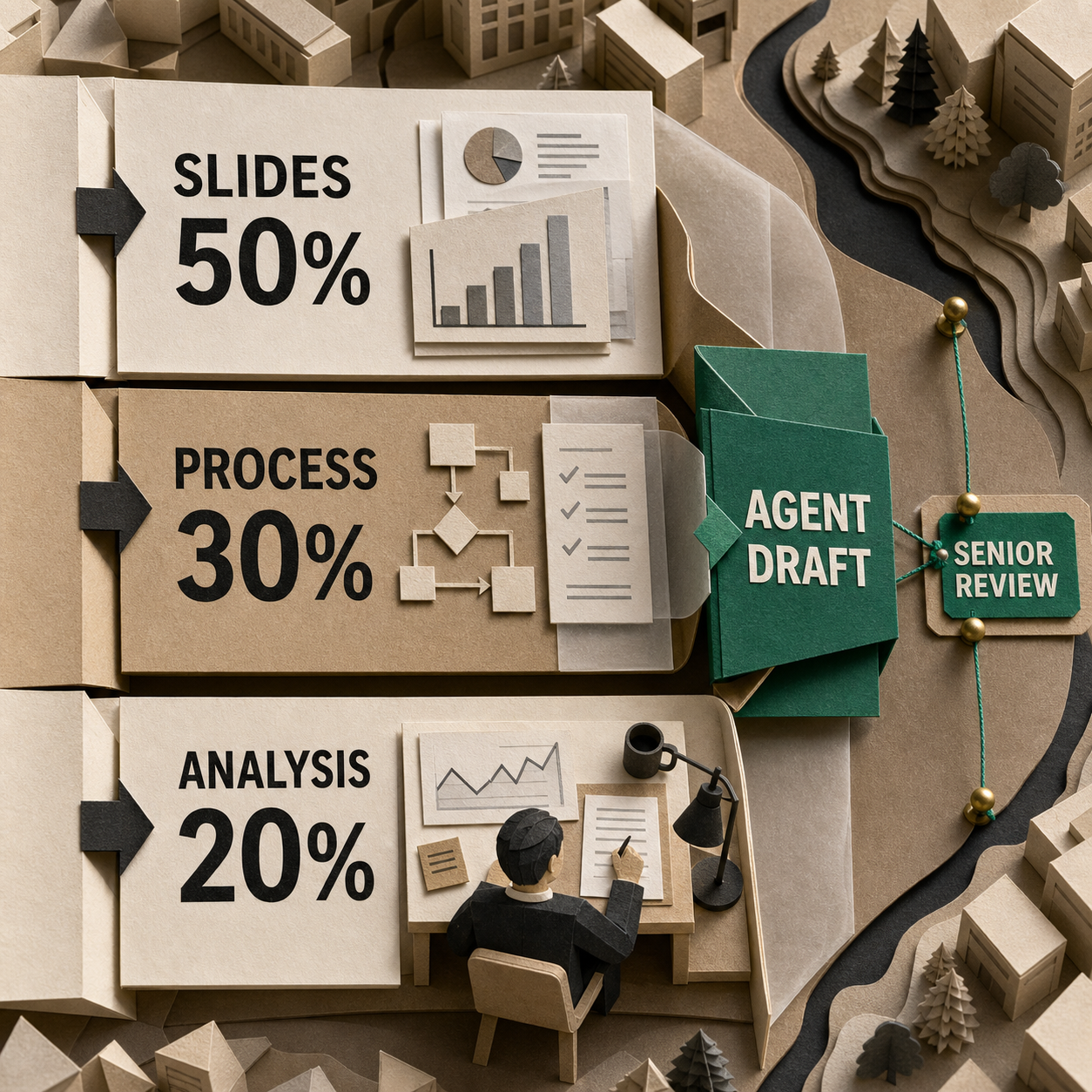
Model ML says a junior banker spends 50% of the day building PowerPoint decks and another 30% on process or data tasks, leaving 20% for analysis. Applied literally to a ten-person junior team, slide construction absorbs five person-days every day, and process or data work absorbs another three. Even a partial reduction changes the staffing capacity available for analysis and client work.
The software comparison shows why buying a generic presentation maker is not the same decision. Beautiful.ai lists its team plan at $40 per user per month when billed annually, so ten seats cost $4,800 a year. That buys design assistance and collaboration. It does not, by itself, define which forecast is authoritative, reconcile a board deck to an Excel range, or document why a number changed.
Model ML does not publish list pricing. The honest ROI test is therefore a controlled pilot: annual platform and implementation cost versus deck-production hours, review rounds, corrections after source changes, and time to first reviewable draft. GPT-5.6 Sol's 39% token reduction strengthens the compute economics, but the budget line that really moves is skilled finance labor.
Seven use cases, ranked by who gains most
The biggest gains go to teams with recurring decks, changing source data, rigid templates, and expensive review. One-off keynote design sits much lower on the list.
The first use case is the most broadly profitable because monthly reporting repeats, the source set is knowable, and correctness has an owner. It is also easier to evaluate than a broad "build any deck" promise: choose one deck, measure every change, and compare review effort month over month.
Three products worth building
1. The finance deck reconciler, the strongest opportunity
Build a controlled workspace that takes a prior management deck plus the latest model and actuals, then returns an update plan, an editable PowerPoint, and a change log. Controllers, FP&A leaders, and finance transformation teams would pay because the product sits directly between close and executive communication.
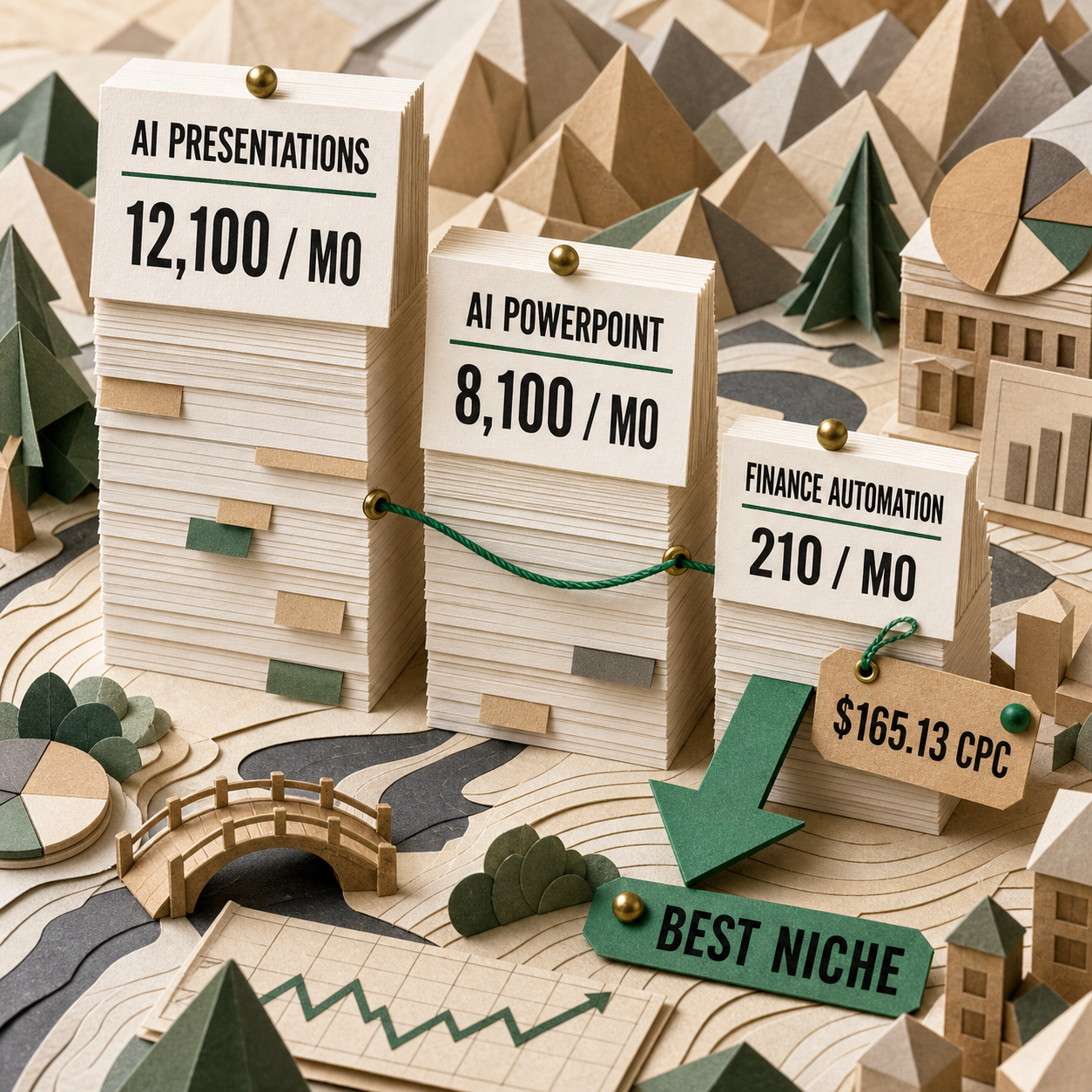
The demand is narrow but valuable. financial reporting automation gets about 210 US searches a month, has commercial intent, keyword difficulty of 4, and a $165.13 CPC. That CPC is unusually high for such a small keyword and suggests a buyer with an expensive operational problem. The broader market is much larger: ai PowerPoint generator gets about 8,100 searches a month.
The smallest sellable version needs four things: an upload area for the model and prior deck, a source-hierarchy form, a slide-by-slide proposed-change screen, and exported PowerPoint plus CSV change log. Start with a fixed monthly board-report template and one spreadsheet schema. The catch is trust. A generic file converter is easy to copy; a reliable reconciliation system, evaluation set, and approval trail are not.
2. A house-style deal-book factory
Build a template-trained workflow for boutique banks, private-equity firms, and specialist advisers. It would turn a controlled source pack into a first-draft pitchbook, investment-committee deck, or buyer update in the firm's exact visual system.
Demand already exists at the presentation layer: ai presentation maker gets about 12,100 US searches a month and ai PowerPoint generator gets about 8,100. Beautiful.ai charges $40 per team user per month on annual billing, which anchors what teams already accept for horizontal presentation software. A finance-specific product can justify a higher contract only if it adds source lineage, native financial charts, and review controls.
The MVP is one document type, two approved data connectors, one reference deck, and ten reusable slide patterns. The catch is template entropy. Real firms have unofficial exceptions, poorly maintained Slide Masters, and partners who want last year's anomaly repeated. Capturing those rules is the implementation work and part of the moat.
3. A presentation QA and lineage add-in
Build a PowerPoint add-in that checks every displayed number against approved Excel ranges and documents, highlights stale dates and inconsistent labels, and writes a review report before the file can be marked ready.
This product meets the same 210 monthly searches for financial reporting automation, while the high CPC shows that control and accuracy are commercially meaningful. It also answers the assigned query's live related searches for AI finance presentation templates and finance case studies more directly than another slide generator would.
The MVP can begin with numeric tie-outs, date freshness, source links, and native review comments. The catch is false confidence. A green check cannot mean "the argument is correct." It can only mean that the displayed value matches an approved source and passed defined rules.
Where this still breaks
The agent cannot invent your source policy. If actuals, the forecast model, a CRM note, and an old deck disagree, a human must decide which evidence controls each claim. Automating before that policy exists only makes inconsistency move faster.
Template matching is much better, but the benchmark is not a guarantee for every deck. Broken Slide Masters, pasted images of charts, locked objects, custom macros, and unofficial formatting conventions can turn a clean workflow into exception handling. The first deployment should use a recurring deck with editable objects and a stable owner.
The token result also needs restraint. Using 39% fewer tokens than Fable 5 in Model ML's FinBench does not automatically mean 39% lower cost. Model choice, input size, output size, caching, tool calls, and provider pricing all affect the bill.
Most importantly, automation does not own the decision. Model ML's own product description keeps senior review and validation in the loop, and OpenAI's finance demo preserved unresolved discrepancies rather than hiding them. Use the agent for collection, comparison, editing, and evidence. Keep people responsible for materiality, narrative, disclosure, and release.
The Monday move
Pick the recurring finance deck that causes the most late-night checking, not the most glamorous one. On Monday, give its owner the latest model, actuals, prior deck, and template. Write a one-page source hierarchy, then require an update plan before any file changes. Run one cycle in parallel with the existing process and score four outcomes: affected slides found, numeric tie-outs passed, review comments raised, and minutes to a reviewable draft. If the system cannot beat the manual process on traceability, do not expand it.
What is the best AI presentation maker?
For general slides, the best tool is the one that matches your editing and design workflow. For finance, the decisive features are different: editable PowerPoint output, source hierarchy, spreadsheet tie-outs, change logs, template fidelity, and an approval gate. A broader comparison is in the 2026 AI presentation tools ranking.
Is there a free AI presentation maker?
Free and limited-use presentation tools exist, but a free first draft is not the same as controlled finance automation. Test whether the output stays editable, preserves the template, cites numbers, and shows every change before trusting it with a board or client deck.
Can an AI presentation maker work from text?
Yes. Model ML can work from notes, filings, data rooms, prior materials, market-data sources, and other documents, then combine the analysis with a firm template. Text is only one input. The useful finance workflow also connects the narrative to tables, models, and source ranges.
Can a free AI presentation maker work from a PDF?
Some presentation tools accept PDFs, but ingestion alone proves little. For finance work, check whether the system can identify the exact source behind a number, reconcile it against the governing model, preserve editable slide objects, and flag conflicts for review.
What are examples of AI in finance?
Strong examples include monthly board-deck refreshes, earnings presentations, pitchbooks, investment-committee materials, portfolio client reports, consulting steering packs, and pre-send presentation QA. The best candidates repeat often and have explicit source and approval rules.
If you want a source-grounded finance deck workflow built around your models, templates, and approval rules, AI automation is the right starting point.
- Last Updated
- Category
- Growth
- Language

Beehiiv Review
Beehiiv reviewed for business newsletters: current pricing, growth, monetization, AI, MCP, analytics and the costs that change the buying decision.Oct 10, 2026Growth
Trainual Review
Trainual review for SOPs and onboarding: AI drafting, knowledge search, read-only MCP, quote-only plans, implementation and who should skip it.Oct 10, 2026Growth
SocialBee Review
SocialBee review of evergreen scheduling, AI Copilot and client workspaces, with all six plans, add-on costs, and Buffer and Later comparisons.Oct 10, 2026Growth
SurveyMonkey Pricing: Plans, Response Caps and Annual Bills
SurveyMonkey prices, response caps and AI limits, with annual bills for one person and three-seat teams. See when overages change the best plan.Oct 10, 2026Growth
ActiveCampaign Alternatives: GetResponse, Kit and More
Compare ActiveCampaign alternatives at 2,500, 10,000 and 25,000 contacts, with vendor prices, workflow trade-offs and a migration checklist.Oct 9, 2026Growth
CallRail Alternatives: WhatConverts and More Compared
Compare six CallRail alternatives by vendor pricing, usage fees, AI and reporting. Includes WhatConverts cost math and a pre-switch checklist.Oct 9, 2026Growth
Monday.com Pricing: Seat Buckets and the Yearly Bill
Calculate monday.com Work Management costs for 5, 12 and 40 people, including seat buckets, annual vs monthly billing and AI credit charges.Oct 9, 2026Growth