Buffer Review
Buffer review with current pricing, six product screenshots, four workflows, exact cost math, alternatives, limitations, and a clear verdict.
Published Updated
 By Omid Saffari






Buffer is worth paying for when one person runs 4 to 10 social channels and wants the shortest path from idea to scheduled post. Essentials starts at $6 per channel monthly, so five channels cost $30; the decision flips toward Metricool for multi-brand analytics, Planable for client approvals, and Hootsuite for listening and message routing.
Prices, limits, and feature availability in this Buffer review were verified against the vendors' live pages on 12 August 2026. Buffer remains easy to buy because the core workflow is focused. The harder question is whether that focus matches the work you need done.
What Buffer is
Buffer is a publishing-first social media workspace that keeps ideas, drafts, scheduled posts, public comments, and performance data beside the accounts they belong to. Each connected social account is a channel. You prepare platform-specific versions in one composer, place them in a queue or calendar, reply to public comments, and review results without opening every network separately. That makes Buffer a strong operational layer for consistent posting, but it is not a broad listening suite, a customer-care desk, or a deep competitive-intelligence platform.
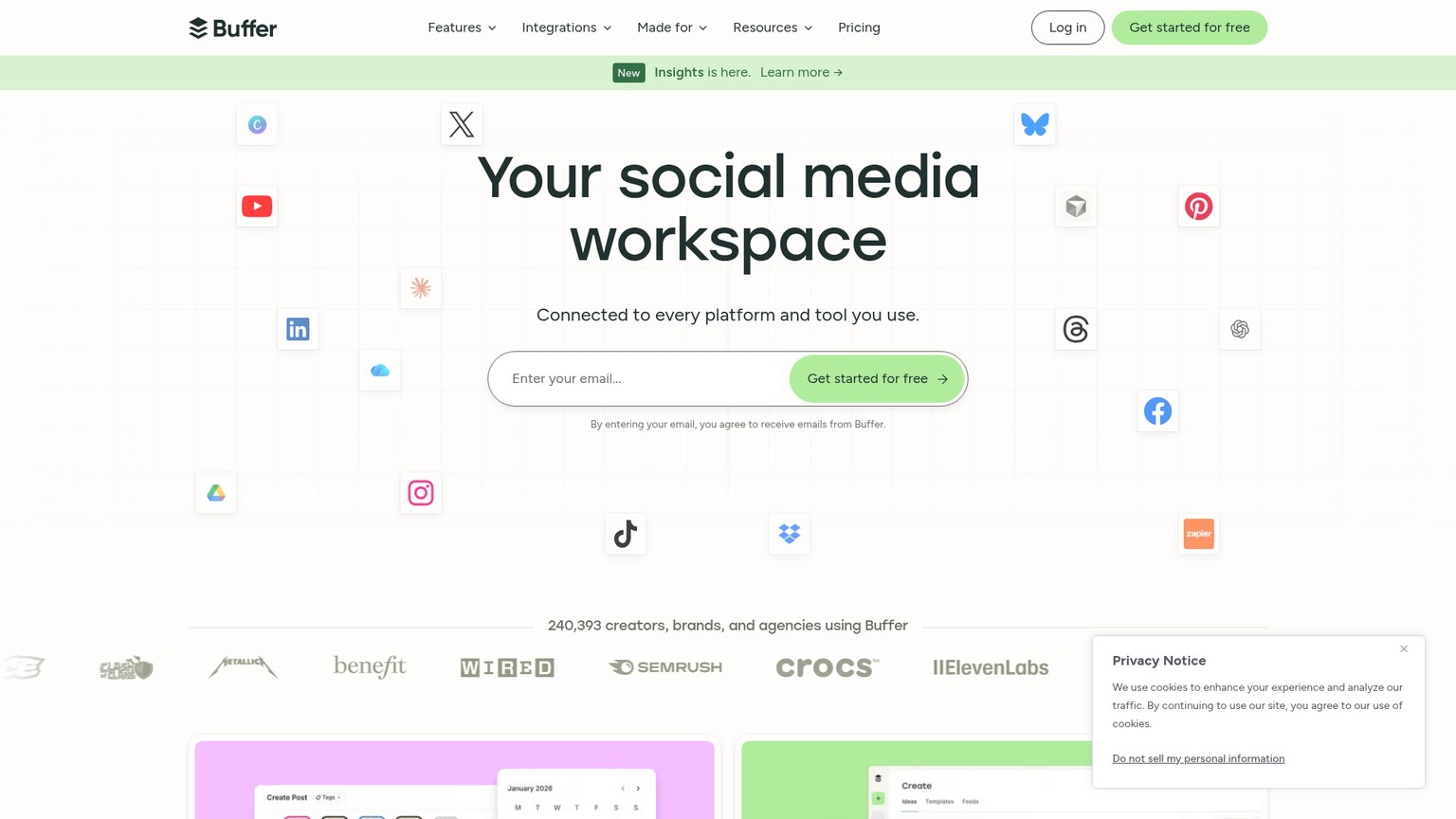
Buffer versus the shortlist at a glance
Buffer wins on accessible publishing and a useful free tier. The alternatives earn their place when analytics, approvals, or social listening become the main job.
The comparison is not about which product has the longest feature list. It is about which recurring task deserves the software budget. Buffer should own publishing. Metricool should own multi-brand measurement. Planable should own client review. Hootsuite should own a wider listening and care operation. The broader social media management shortlist is useful if your requirements cross more than one of those jobs.
Who Buffer is for and who should skip it
Buffer fits a creator, local business, founder-led brand, or compact marketing team that needs a dependable weekly publishing rhythm more than a complex command center. Its plan boundaries make the buyer groups unusually clear.
Use Free when one person manages three channels or fewer and can work inside ten queued posts per channel. That is 30 live queue slots across three accounts, and each slot refills after a post publishes. Free also includes the AI Assistant, Community, 30 days of Insights, and basic API access. It is sufficient for a consultant posting to LinkedIn, Instagram, and Threads a few times a week.
Use Essentials when the same operator needs more than three channels, an unlimited queue, first-comment scheduling, saved hashtags, longer analytics history, or exportable reports. A five-channel setup costs $30 month to month or $25 per month on annual billing. One user is included, so Essentials is not the plan for a shared client workflow.
Use Team when content must pass between writers, approvers, and channel owners. Team starts at $12 per channel monthly or $10 on annual billing and adds unlimited users, approval workflows, access levels, custom permissions, and branded reports. That is a workflow upgrade, not merely more storage.
Buffer should be skipped when the surrounding work is more demanding than publishing:
- Choose Metricool for a multi-brand analytics portfolio. Five brands with three networks each become 15 Buffer channels. Essentials costs $80 per month under Buffer's tiered rates. Metricool Starter covers up to five brands for $25 per month, a $55 monthly or $660 annual difference, assuming those brands use three supported networks each.
- Choose Planable when client review is the bottleneck. Planable Pro costs $59 per workspace monthly, includes unlimited users, required approvals, 150 monthly posts, private team drafts, and internal notes. Its cost rises by client workspace, but its review model is more deliberate than Buffer's lighter Team workflow. The Later alternatives comparison places Buffer, Metricool, and Planable in the same buyer context.
- Choose Hootsuite when messages, monitoring, listening, or service routing matter. Hootsuite Standard starts at $99 per user monthly on annual billing and includes one inbox for messages plus brand and competitor monitoring. Advanced adds approvals and message routing at $399 per user monthly. The complete Hootsuite pricing breakdown shows why that broader scope needs to earn its premium.

Publishing is Buffer's strongest workflow
Buffer Publish is the reason to buy the product: one queue and calendar turn a pile of channel tabs into a repeatable release process. The live feature page lists Facebook, Instagram, TikTok, LinkedIn, Threads, Bluesky, YouTube Shorts, Pinterest, Google Business Profile, Mastodon, and X.
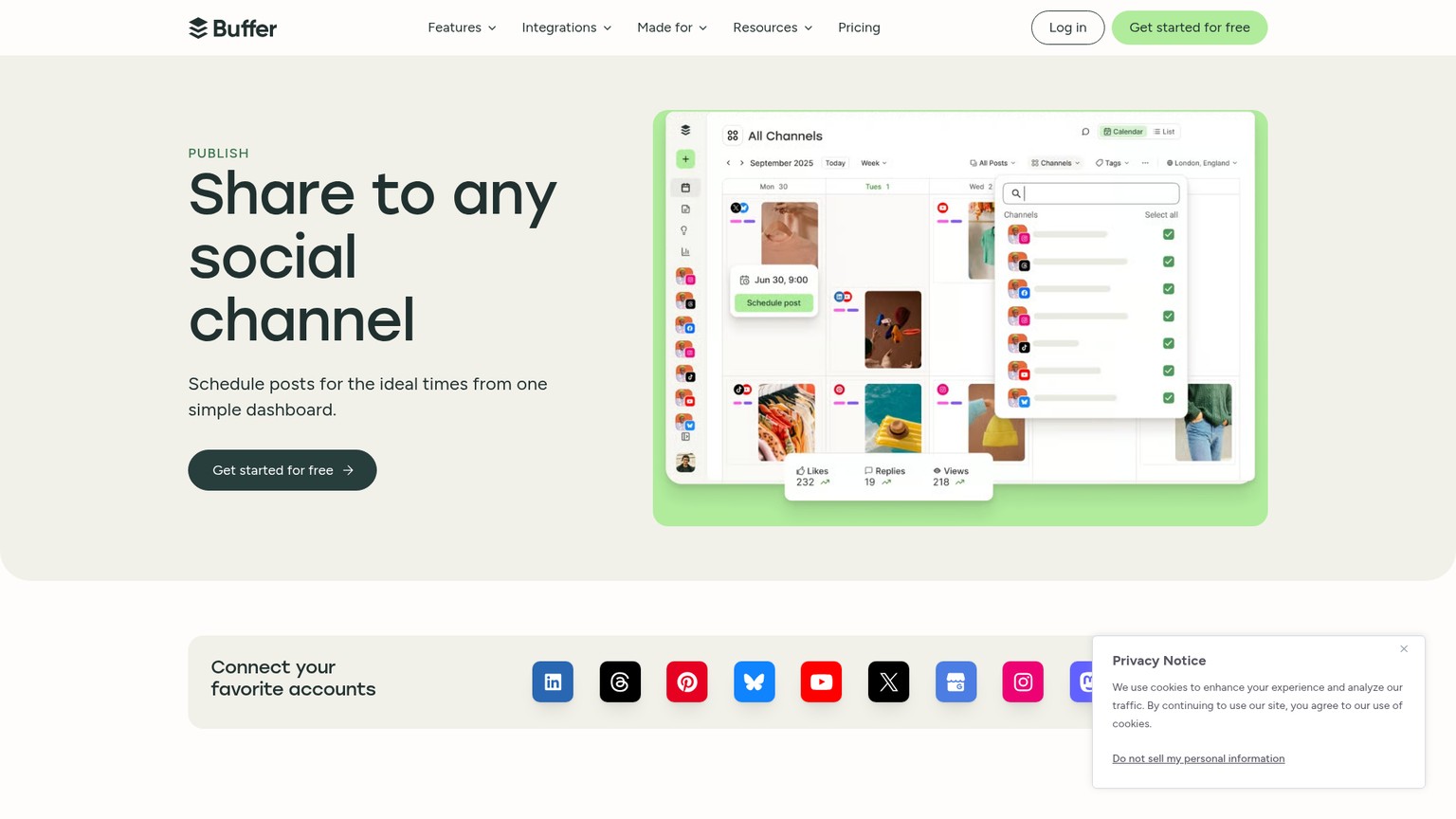
The value is not merely scheduling a post at a future time. It is producing one source message, adapting it to each network's format, and seeing every version before it leaves. A B2B SaaS growth lead can turn a product announcement into a concise LinkedIn post, a thread for X, a shorter Threads version, and a vertical-video caption while keeping one campaign date.
Set the channel rhythm
Connect the accounts, then give each channel its own recurring queue slots. LinkedIn might receive two weekday posts while Threads receives shorter updates more often. The schedule becomes the default, so the operator chooses the content rather than rebuilding the calendar every time.
Build one source draft
Open the composer, select the relevant channels, and create the common message. Attach the image or video once, then edit each platform version instead of forcing identical copy everywhere.
Use native-format controls
Turn longer ideas into threaded posts, attach carousels or video where supported, and choose automatic or reminder-based publishing. On paid plans, place hashtags, a source link, or a disclosure in the scheduled first comment when that is the cleaner presentation.
Check the calendar before release
Review channel density, campaign collisions, and empty days in the visual calendar. Move a post by dragging or rescheduling it, then treat each platform version as its own item after scheduling.
Essentials and Team can hold up to 2,000 scheduled posts simultaneously. Free holds ten per channel. Buffer also describes paid scheduling as unlimited under a fair-use policy capped at 5,000 posts per channel. In practice, the simultaneous queue limit matters sooner for normal operators.
The limitation appears when a platform's API cannot publish a format or native effect. Buffer then uses reminder publishing: it sends a mobile notification and the operator finishes the post inside the network. That is a platform constraint, but it means the workflow is not fully unattended for formats such as native-only effects.
Create keeps the backlog attached to distribution
Buffer Create gives ideas a home before they become scheduled posts. It combines a gallery, a kanban-style board, tags, templates, media imports, RSS intake, a browser extension, and the AI Assistant in the same workspace as Publish.
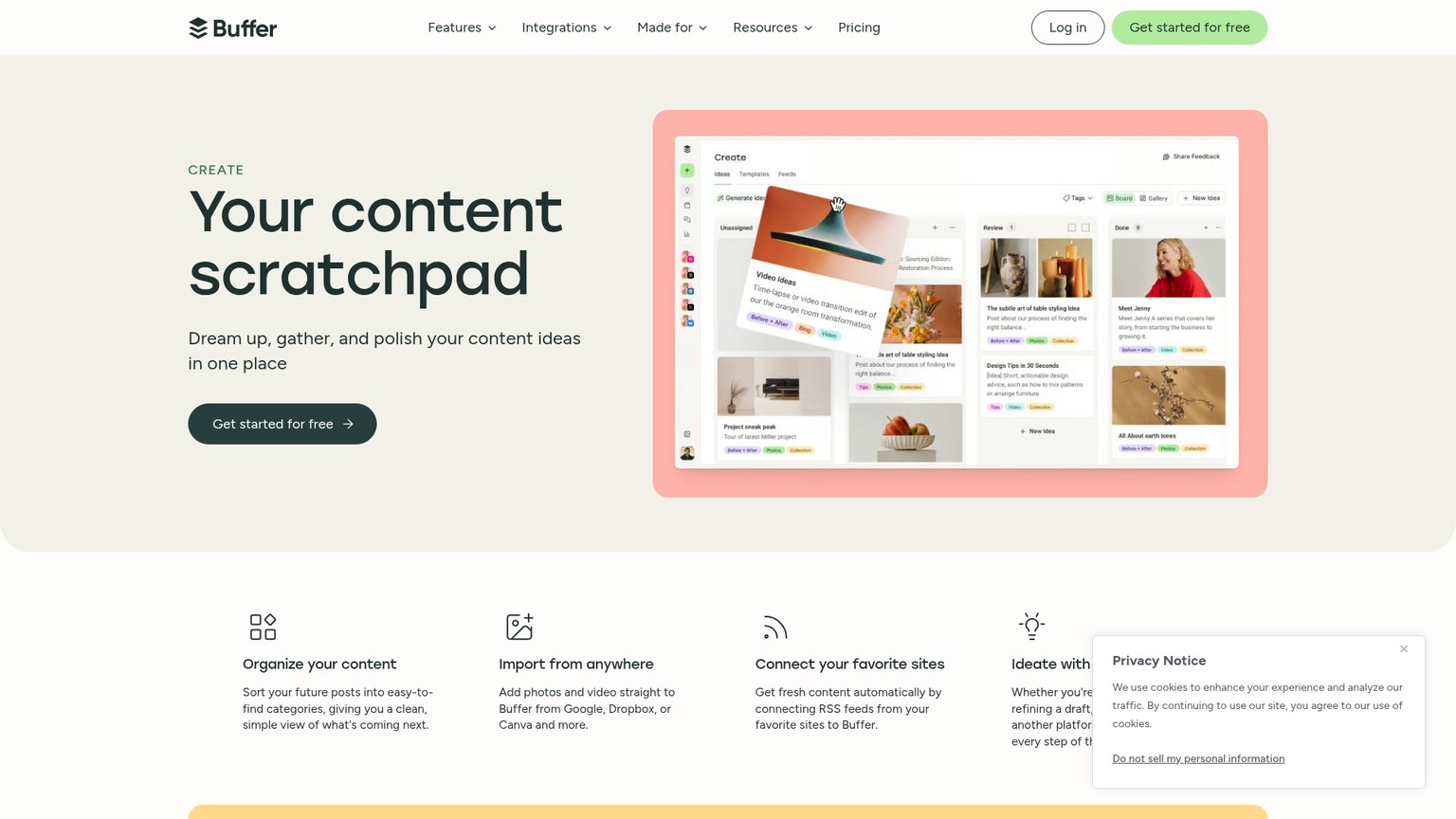
For a solo agency owner, the useful workflow starts with content pillars rather than finished captions. Create tags such as Customer Proof, Point of View, and Product Education. Save an idea from a browser tab or RSS source, attach a Canva or Google Drive asset, and move the card through Ideas, Drafting, and Ready. When it becomes a post, it can move directly into Publish instead of being copied from a separate planning document.
The AI Assistant is best treated as a transformation tool. Give it an approved source paragraph, then ask it to shorten the copy, adjust the tone, or adapt the message for another platform. That reduces blank-page work without pretending a generic draft is a strategy. The human still supplies the claim, evidence, audience, and brand judgment.
Buffer's price matrix says Free includes 100 ideas and paid plans include unlimited ideas. The live Create FAQ separately says paid customers can create up to 2,000 ideas per organization. Because those first-party pages disagree, a buyer with a large evergreen library should ask support which limit the account will enforce before migrating a backlog.
Community is useful for public comments, not a full social inbox
Buffer Community centralizes public comments from Instagram, Facebook, LinkedIn, Threads, Bluesky, X, TikTok, Google Business Profile, YouTube, and Mastodon. Its focused scope makes it approachable, but buyers should not mistake it for an omnichannel customer-care inbox.
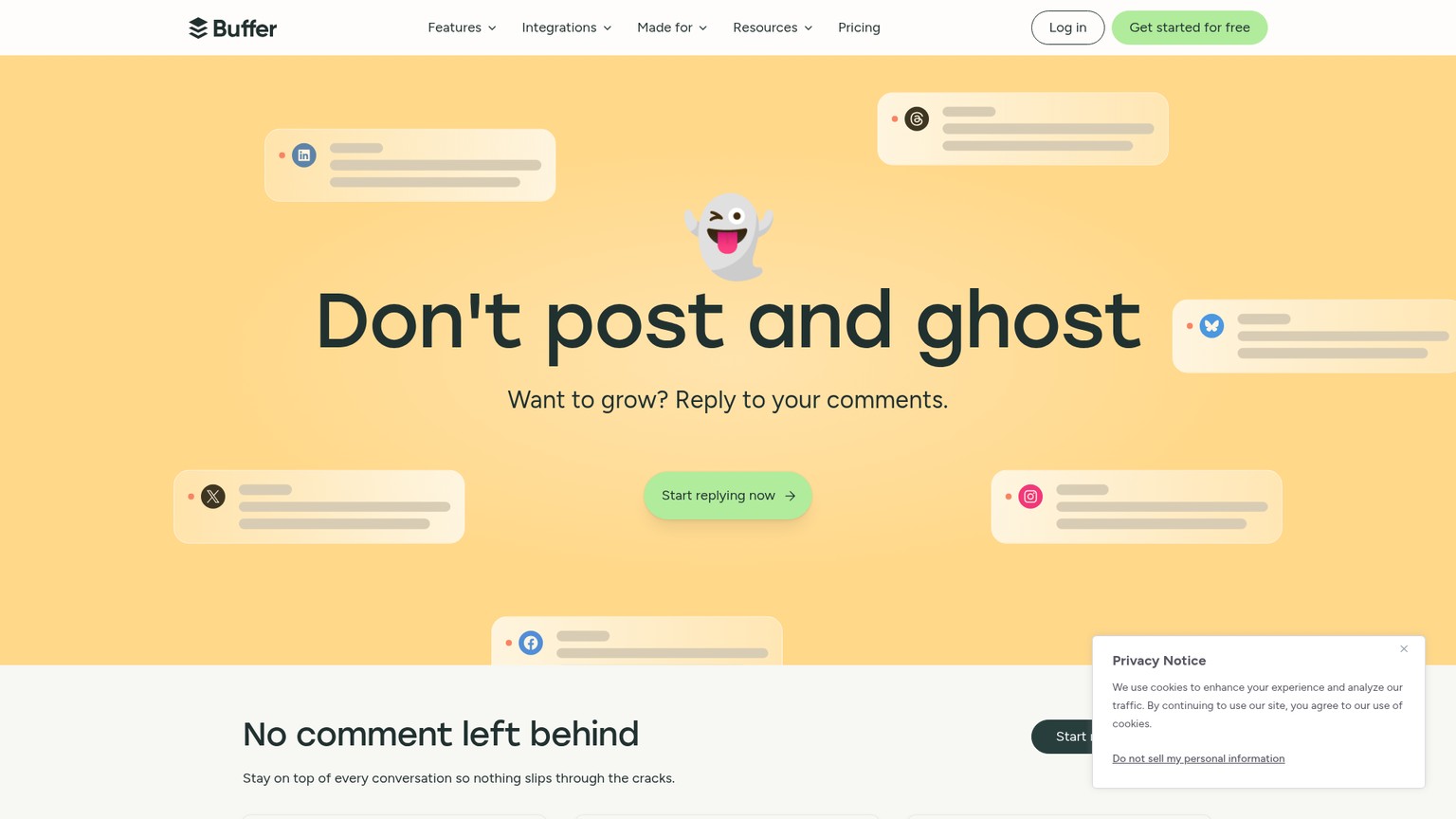
A DTC brand handling daily product questions can filter for unanswered comments, sort oldest first, and clear the queue without opening ten feeds. Repeated questions can become saved replies. AI reply suggestions can produce a draft in the brand's tone, and a useful exchange can be turned into a future post. Comment Score tracks response rate, speed, and consistency, which gives a manager a simple behavior signal without building a support dashboard.
Free is more capable than expected here. It includes Community, five AI reply suggestions per week, one saved reply, notifications, filters, and Comment Score. Essentials and Team remove the weekly AI-suggestion limit and allow unlimited saved replies.
The boundary is equally important. Buffer's Community page names comments across supported networks. It does not promise a unified direct-message inbox or broad social listening. Planable sells a Social Inbox add-on for $9 per workspace monthly, while Hootsuite includes messages and monitoring in Standard. A business that treats social as a customer-service channel should price that missing scope before choosing Buffer for its clean interface.
There is also an availability mismatch. Buffer's pricing table marks Comment Insights as included on Free, Essentials, and Team, yet the live Community page labels the feature "Coming soon!" A buying decision should treat Comment Insights as unavailable until the product page and the account agree.
Insights closes the weekly reporting loop with uneven network depth
Buffer Insights puts channel and post performance next to the content that produced it. It can show reach, engagement, follower changes, top posts, cross-channel comparisons, and plain-language Takeaways that suggest a next action.
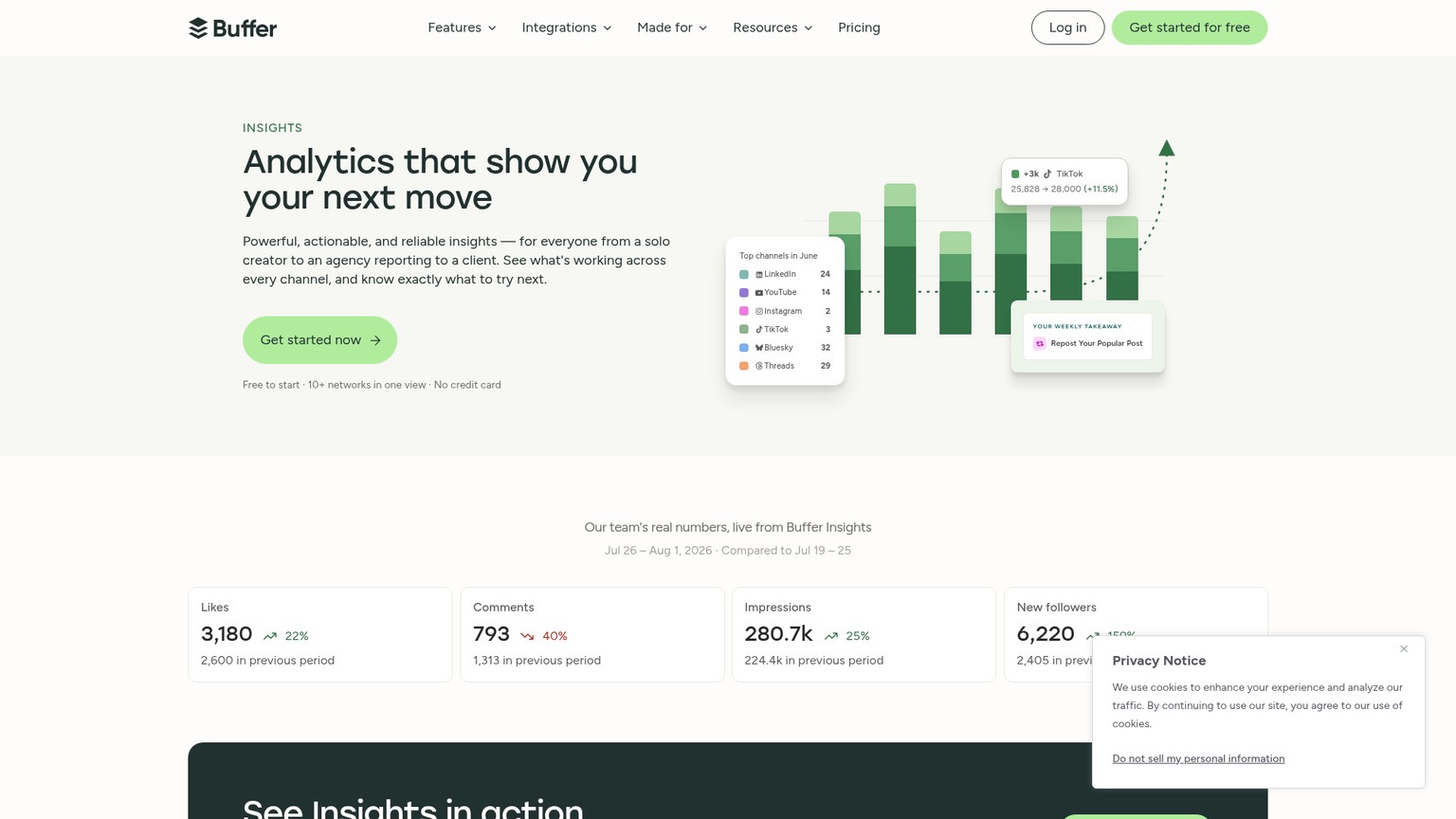
For a B2B SaaS growth lead, the useful weekly workflow is narrow. Tag posts by campaign or content pillar, compare the current period with the previous one, identify the posts that created meaningful engagement, and decide whether to repeat the format, change the schedule, or stop the theme. Paid plans can export reports as CSV, PDF, or markdown and add custom UTM parameters, so the social summary can connect to web analytics rather than ending at likes.
Free includes 30 days of Insights history. Essentials and Team include unlimited history, performance overviews, custom analytics, Takeaways, reports, and custom UTM parameters. Team adds branded reports. Buffer also exposes a public API and an MCP server, a connector that lets compatible AI tools request structured data, so Claude, ChatGPT, or another agent can query recent performance within the allowed API limits.
The phrase "all channels in one view" needs qualification. Buffer's own channel-support table does not include advanced analytics for LinkedIn profiles, TikTok, YouTube Shorts, Pinterest, Threads, Bluesky, Mastodon, Google Business Profile, or Start Page. Facebook pages, Instagram business and creator accounts, LinkedIn pages, and X have broader support. The visual dashboard may be unified while the depth of data is not.
That distinction changes the value for a creator whose audience lives on newer networks. Cross-channel visibility is useful, but a report assembled from uneven fields cannot support every comparison. Keep native analytics in the review loop for the networks where Buffer lacks advanced coverage.
Buffer pricing: every tier and the cost at real channel counts
Buffer pricing is simple at first and more favorable at scale than the headline per-channel rate suggests. Paid channels are charged in marginal bands, and annual billing saves 20 percent, approximately two months.
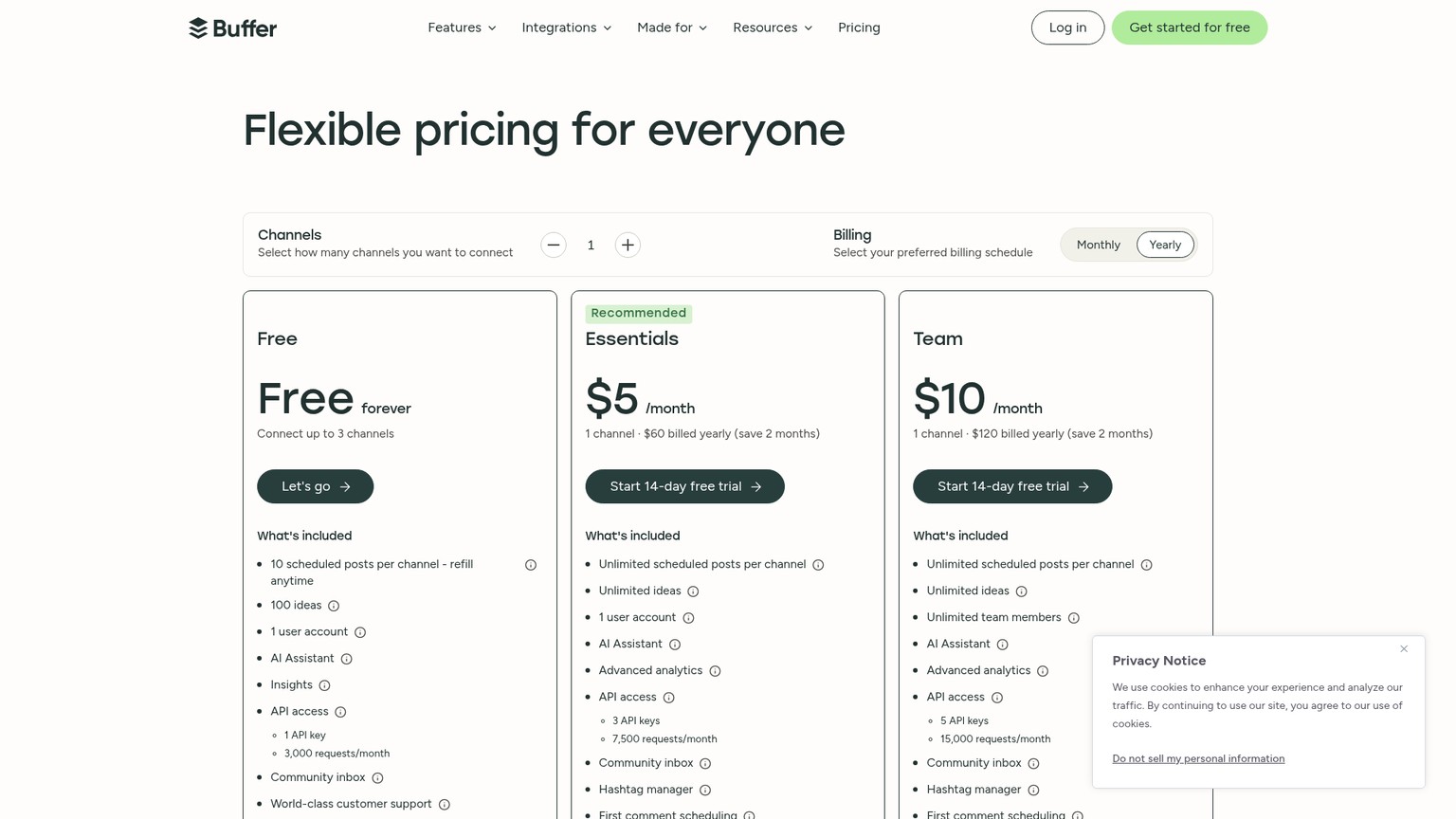
Every Buffer tier available to a new buyer is represented above. There is no separate enterprise card on the current pricing page. Paid plans include a 14-day free trial, and the account falls back to Free if no payment method is added at the end.
The monthly volume bands apply to each additional channel inside the band:
- Channels 1 through 10: Essentials $6 each; Team $12 each.
- Channels 11 through 25: Essentials $4 each; Team $4 each.
- Channels 26 through 50: Essentials $3 each; Team $3 each.
- Channel 51 and above: Essentials $1 each; Team $2 each.
That marginal structure produces totals the single-channel headline cannot show. Three channels cost $18 per month on Essentials or $36 on Team. Ten cost $60 or $120. Twenty-five cost $120 or $180. Fifty cost $195 or $255. On annual billing, the corresponding monthly equivalents are $15/$30 at three channels, $50/$100 at ten, $100/$150 at twenty-five, and $163/$213 at fifty.
The feature boundary matters as much as the channel count. Essentials is the paid solo plan because it still includes one user. Team is the first plan with unlimited members, approval workflows, and custom permissions. Paying Team rates without using those controls is an avoidable doubling of the first ten channels.

The API limits also change by tier. Free includes one key and 3,000 requests per 30 days. Essentials includes three keys and 7,500 requests. Team includes five keys and 15,000 requests. Each plan allows 100 requests per 15 minutes; the 24-hour limit is 250 on Free and Essentials and 500 on Team.
Nonprofits and charities can apply for a 50 percent discount. Buffer says the current prices were last updated in November 2025, which is why the verification date matters more than a review's publication year.
The limitations that change the buying decision
Buffer's limitations are not obscure edge cases. They define the point where a focused publishing tool becomes the wrong operational system.
Per-channel pricing can punish a broad portfolio
The volume bands soften the curve, but every connected account remains a billable channel on paid plans. One brand on five networks costs $30 monthly on Essentials. Five brands on three networks each cost $80. Metricool Starter covers up to five brands for $25 monthly, so an analytics-led agency can save $55 per month before considering feature differences.
Buffer is still competitive when many people share a moderate number of channels because Team includes unlimited users. The cost problem appears when channel count grows faster than collaboration value.
Community is not direct-message or listening software
Community covers public comments on owned posts. The official page does not include DMs, broad keyword listening, service assignments, or escalation. That is acceptable for a creator protecting engagement habits. It is inadequate for a brand whose social operation includes sales questions, support cases, crisis monitoring, or competitor mentions.
Hootsuite's higher price buys a wider system: Standard includes a message inbox and brand monitoring, while Advanced adds routing and team measurement. Buffer should not be expected to match that scope at a fraction of the price.
Analytics depth depends on the network
Insights creates a clean combined view, but Buffer's support matrix withholds advanced analytics from several important networks. A TikTok-heavy creator, a YouTube Shorts publisher, or a founder building on Threads and Bluesky will not get the same depth as a team using Instagram business accounts and Facebook pages.
The precise limitation is not that Buffer has "basic analytics." Analytics quality changes by account type within the same dashboard, which makes the network mix a buying criterion.
Collaboration begins at the most expensive self-serve tier
Essentials includes notes but only one user and no approval workflow. Team doubles the first-band monthly channel price from $6 to $12 to add unlimited members, approvals, access levels, and custom permissions. A five-channel team therefore moves from $30 to $60 monthly.
That can still undercut a per-seat suite, but a two-person team with a simple sign-off should calculate whether an external approval step costs less than the Team upgrade. Planable is the better fit when review trails, client visibility, and required approvals are the center of the work.
Buffer's own current pages disagree on two limits
The live pricing table says Comment Insights is included on every plan. The live Community page says it is coming soon. The pricing page says paid ideas are unlimited. The Create FAQ says paid organizations can create up to 2,000 ideas.
These conflicts do not make the core scheduler unreliable, but they weaken procurement confidence at the edges. If either capability affects migration or plan choice, ask support for the enforced account limit in writing and treat the answer as unresolved until Buffer aligns the pages.
- A useful free plan with three channels and ten queue slots per channel
- Focused publishing workflow across eleven named social networks
- Platform-specific variants, calendar, queue, first comments, and threaded posts
- Community and 30 days of Insights included on Free
- Volume discounts reduce the paid per-channel rate above ten channels
- Team includes unlimited users rather than charging per seat
- Paid cost rises with every connected account
- Community does not promise DMs or broad listening
- Advanced analytics coverage varies substantially by network and account type
- Approval workflows require Team
- Two live first-party feature pages conflict with the pricing matrix
Verdict: use Buffer while publishing is the bottleneck
Buffer earns a place in the budget when the main constraint is getting good content adapted, scheduled, and published consistently. Free is one of the few plans in the category that can support a genuine small workflow. Essentials is reasonably priced for one operator. Team is defensible when unlimited collaborators and approvals are used every week.
Choose Buffer when all of these are true:
- You manage three to ten channels, or a larger portfolio that benefits from the volume bands.
- One queue, platform-specific versions, and a calendar remove recurring manual work.
- Public comments are the engagement scope; DMs and listening are not required.
- The networks you depend on have enough analytics coverage for the decisions you make.
Choose Metricool when five brands across several networks make Buffer's channel model expensive and analytics matter more than interface simplicity. Choose Planable when content spends more time in client review than in the scheduler. Choose Hootsuite when the organization needs a wider inbox, monitoring, listening, routing, and governance layer.
The explicit flip point is simple: keep Buffer while one weekly publishing cycle is the work it replaces; leave when the team still needs a second paid tool for its primary analytics, approval, inbox, or listening job.
The Monday move
List every social account, who touches it, and the one outcome required from the software. Price Buffer at three, five, ten, and fifteen channels. Then use the 14-day trial to run one complete weekly cycle: capture an idea, create platform variants, schedule them, reply to comments, and export the report. Record the minutes saved and every step that still happens elsewhere. Buy only if the saved time clears the monthly plan cost and the missing steps are secondary.
Frequently asked questions
Is Buffer trustworthy?
Buffer is an established social media software company, and every current plan includes two-factor authentication and email support. Trust should still be operational: review the permissions granted to Buffer on each network, remove channels no longer in use, and keep account recovery controlled by the business rather than one employee.
How much does Buffer cost per month?
Buffer Free costs $0. Essentials starts at $6 per channel on monthly billing or $5 per channel equivalent on annual billing. Team starts at $12 per channel monthly or $10 annually. Marginal rates fall above ten channels, and paid plans include a 14-day trial.
Is Buffer good or bad?
Buffer is good for focused content planning, scheduling, platform-specific publishing, public-comment replies, and lightweight reporting. It is a poor fit when the primary need is direct-message support, social listening, complex client approvals, or equally deep analytics across every network.
Is Buffer as good as Hootsuite?
Buffer is the better-value choice for straightforward publishing. Hootsuite is broader: Standard starts at $99 per user monthly on annual billing and adds a message inbox plus monitoring, while higher tiers add automation, routing, approvals, and governance. The better product depends on whether the buyer needs a scheduler or a wider social operations suite.
Is there a free alternative to Buffer?
Metricool Free supports one brand and 20 scheduled posts per month, but it excludes LinkedIn and X. Planable provides 50 posts total with no time limit, though the allowance does not reset and X publishing is unavailable during the trial. Buffer Free remains the stronger simple scheduler for up to three channels when ten queued posts per channel is enough.
Is Buffer free?
Yes. Buffer Free supports up to three channels, ten scheduled posts per channel at a time, 100 ideas, one user, Community, the AI Assistant, 30 days of Insights, and one API key with 3,000 requests per 30 days.
Is Buffer safe and reputable?
Buffer supports two-factor authentication, publishes company metrics through its open dashboard, and has operated for more than a decade. No third-party scheduler removes account risk, so use unique credentials, enable two-factor authentication, audit connected channels, and grant only the permissions the workflow needs.
Use the AI Business Workflow Audit Checklist to decide whether Buffer replaces enough recurring work to deserve a paid line item.
- Last Updated
- Category
- Growth
- Language

Kit (ConvertKit) Alternatives in 2026: beehiiv, ActiveCampaign and GetResponse
Compare eight Kit (ConvertKit) alternatives by growth, automation, pricing at 1,000 and 10,000 subscribers, and migration effort.Oct 11, 2026Growth
Apollo vs ZoomInfo
Apollo vs ZoomInfo for small sales teams: verified seat prices, quote-based cost math, regional coverage, credits, intent and switching costs.Oct 11, 2026Growth
GetResponse Pricing: Plans, List Sizes and Upgrade Costs
GetResponse prices from 1,000 to 100,000 contacts, feature upgrade triggers, annual bills, and comparisons with Kit, ActiveCampaign and Mailchimp.Oct 11, 2026Growth
Calendly Alternatives in 2026: Cal.com, TidyCal, Acuity & More
Compare Calendly alternatives by need: Cal.com, TidyCal, Acuity, Bookings and more. Verified prices, routing, branding and reasons to stay.Oct 11, 2026Growth
Mailchimp Alternatives in 2026: Kit, beehiiv, ActiveCampaign and GetResponse Compared
Compare Mailchimp alternatives for newsletters, automation and ecommerce, with verified prices at 1,000 and 10,000 contacts and reasons to stay.Oct 11, 2026Growth
Zendesk Alternatives 2026: Tidio, Chatbase, CloudTalk and Helpdesks
Compare Zendesk alternatives by support model: Tidio, Chatbase, CloudTalk and leading helpdesks, with current prices, AI charges and switching advice.Oct 10, 2026Growth
Best CRM for Small Business in 2026: Pipedrive, Close, folk, Keap and More (Compared)
Compare nine small-business CRMs by how you sell, verified prices for five users, free-plan limits, setup effort and the upgrades that matter.Oct 10, 2026Growth