Step 5 Preview Pricing
Compare Step 5 Preview API rates with Step Plan Credits, cached-input discounts, and reasoning costs before choosing your billing route.
Published
 By Omid Saffari


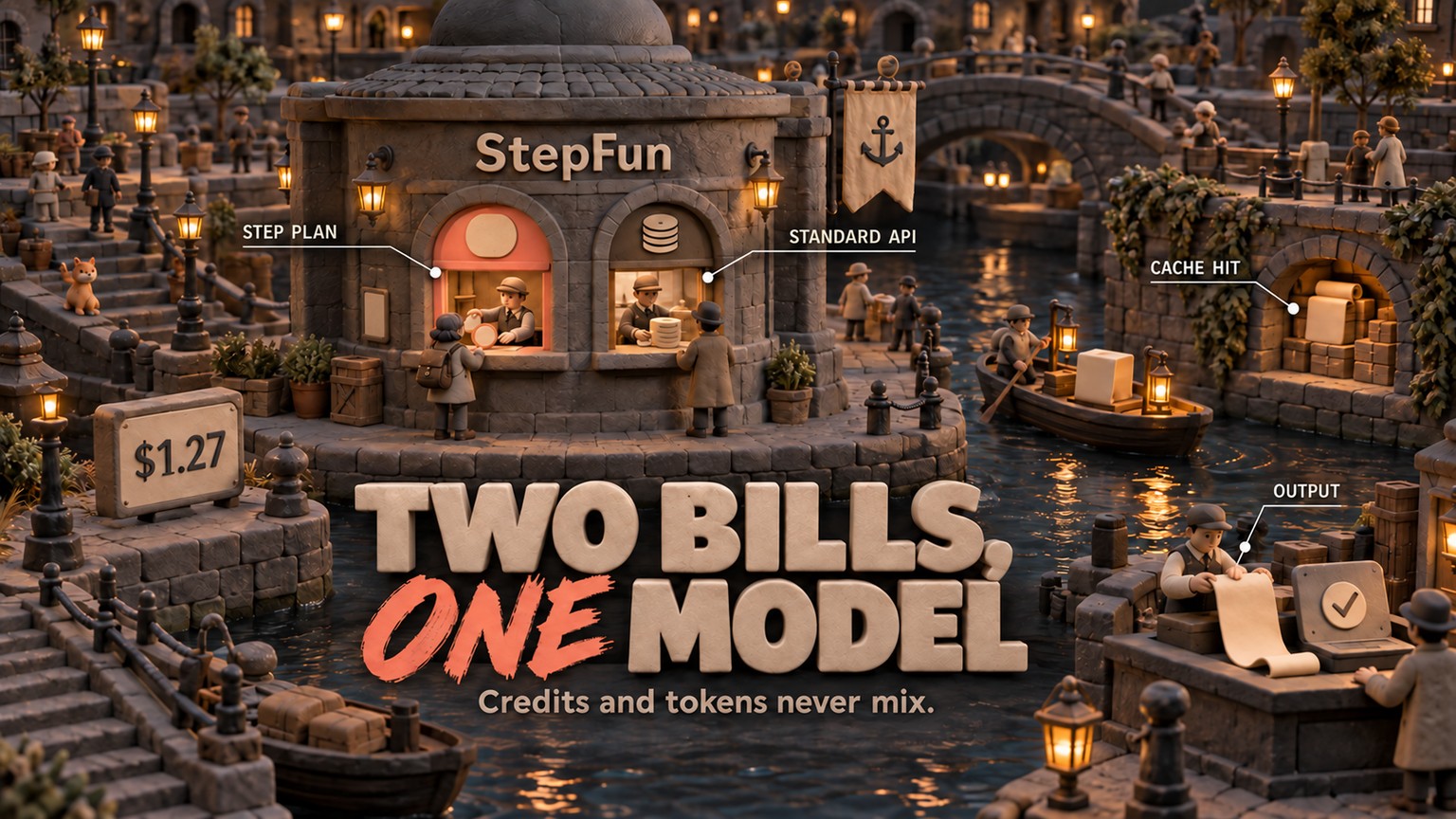
Step 5 Preview pricing is $1.00 per million uncached input tokens, $0.05 per million cached input tokens, and $2.70 per million output tokens on the standard API. The harder decision is the billing route: Step Plan Credits and pay-as-you-go tokens are separate systems, and a successful request can hit the wrong one.
The rates and plan terms below were verified against StepFun's live pricing documentation on 21 September 2026, one day after the model announcement. Step 5 Preview is available now through StepFun products and the API; StepFun says the open weights will arrive on 15 October, so they are not available yet.
Step 5 Preview pricing: the short answer
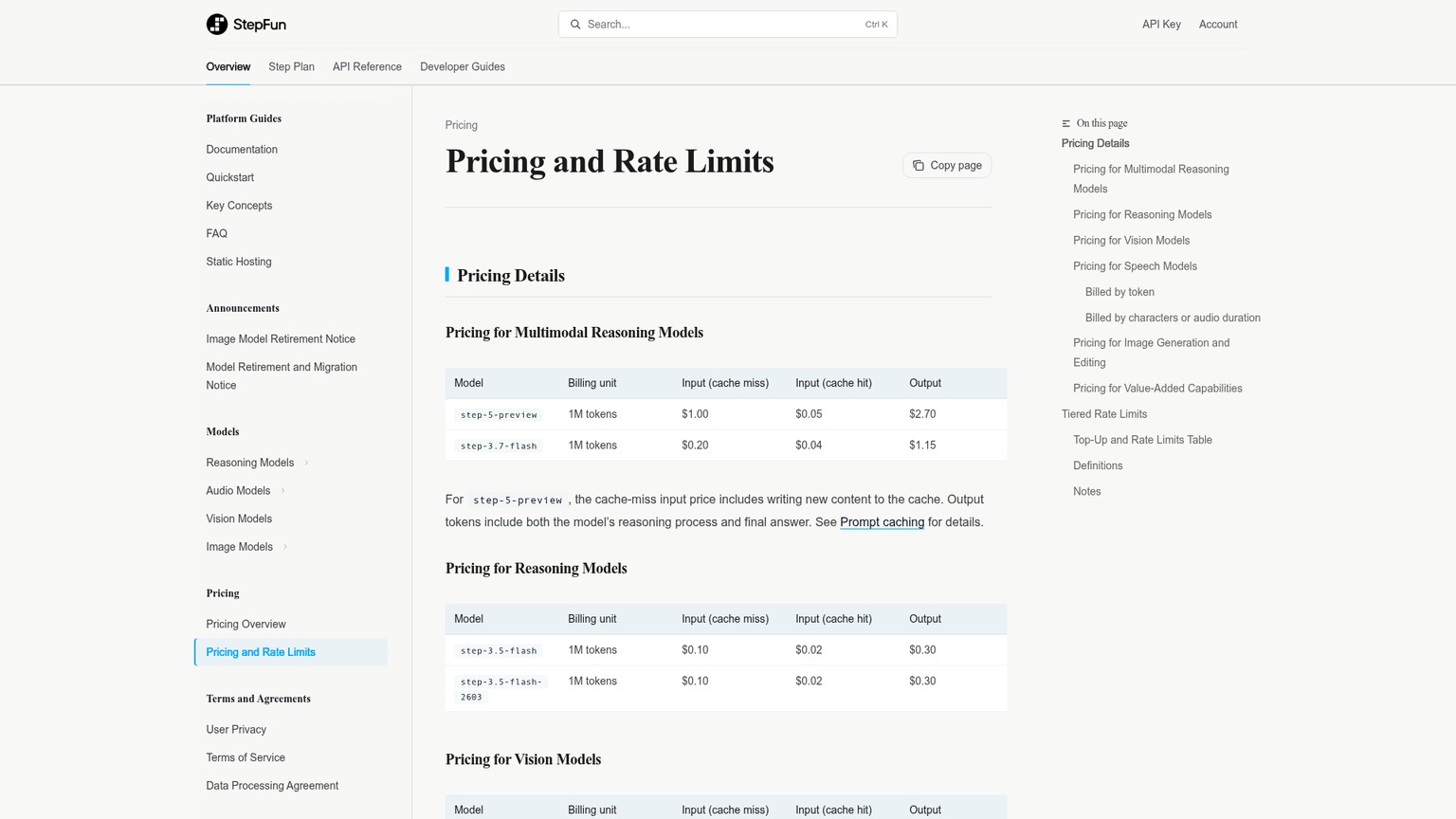
The standard API is cheap on input and much more sensitive to output. StepFun's live pricing page lists three rates for step-5-preview:
- Uncached input: $1.00 per 1M tokens
- Cached input: $0.05 per 1M tokens
- Output: $2.70 per 1M tokens
The output line includes both the model's internal reasoning and its final answer. A short visible answer can therefore carry a larger output bill when the model reasons at length before responding. That is the first budget variable to monitor on an agentic model.
The cache discount is substantial, but it is not a switch you can price in before measuring it. StepFun automatically checks for a repeated prompt prefix on inputs longer than 256 tokens. A hit is billed at $0.05 per million; a miss, including the first cache write, is billed at $1.00. Stable system instructions, examples, and conversation history at the front of a prompt improve reuse. Dynamic content at the front destroys it.
The second variable is the payment rail. Standard API requests draw from pay-as-you-go account balance. Step Plan requests draw from a subscription's monthly Credit allowance. The model name can be identical while the bill lands in a different place.
StepFun Step Plan tiers at a glance
Step Plan is the better sticker-value route for supported coding tools and agent platforms when usage is recurring and the monthly allowance will be consumed. Every tier gets the same high-speed model performance; the purchase changes the Credit allowance, not model speed.
These are the Step Plan prices verified in September 2026. Quarterly and yearly purchases are charged upfront, but Credits are still issued month by month. Buying a year does not create a pool you can pull forward into a heavy launch month.
The price per 1B monthly Credits falls sharply with each tier: about $17.48 on Mini, $6.24 on Plus, $3.63 on Pro, and $2.48 on Max. That makes Mini a strict entry tier, not the sensible default for regular use. Plus costs only $3 more and carries four times the allowance.
The clean breakpoints are the allowances themselves. Pick Mini only when the month stays at or below 400M Credits, Plus through 1.6B, Pro through 8B, and Max through 40B. Boosters can cover an unusual spike, but repeated overage is a sign that the next tier should carry the base load.
Mini makes the choice especially clear. Adding one 400M Small booster to Mini would cost $13.98 for 800M total Credits, while Plus costs $9.99 for 1.6B. If you expect to cross 400M, buy Plus at the start rather than rescuing Mini later.
Step Plan Credits are not tokens or cash
Credits are StepFun's internal subscription unit. They are not input tokens, output tokens, dollars, or an account balance you can withdraw.
StepFun gives an approximate conversion of $1 of model usage to 7M Credits. That helps estimate the plan's intended usage value, but it does not make one Credit equal to one token. Models can consume Credits differently, and a reasoning-heavy response can use more billable output than the visible answer suggests.
For scale, 400M Credits divided by 7M is about $57.14 of nominal model usage. At the other end, 40B Credits corresponds to about $5,714.29. Those are illustrations of StepFun's own approximate conversion, not cash balances and not guaranteed token quantities.
That distinction matters when procurement asks for a per-token comparison. A Step Plan subscriber cannot take 7M Credits, divide by a specific token rate, and assume the result is a guaranteed allowance for every model and workload. The plan converts actual usage into Credits after the call. Standard API billing exposes the token rates directly.
Use the conversion for rough capacity planning. Use the Credit ledger for subscription control. Use prompt_tokens, cached_tokens, and output usage for standard-API forecasting. Mixing those three views creates a budget that looks precise and is wrong.
Step 5 API pricing depends on the Base URL
The Base URL decides which billing system receives the request. An API key alone does not select Step Plan.
StepFun documents these subscription endpoints:
- Claude Code or Anthropic SDK:
https://api.stepfun.ai/step_plan - OpenAI SDK Chat Completions:
https://api.stepfun.ai/step_plan/v1
The standard API uses its standard address and separate quota. StepFun states plainly that a request succeeding on that channel does not mean subscription Credits were consumed. It only proves that the standard channel accepted the key and account state.

This creates a quiet failure mode in coding tools. A developer enters a valid key, leaves an old provider URL in the client, receives a good response, and assumes the new subscription paid for it. The model worked, so the setup feels complete. The wrong balance can still be falling.
Check the route in four places:
- Confirm the exact Base URL in the client configuration.
- Confirm that
step-5-previewis selected, not an older alias or automatic fallback. - Send one small, sanitized request.
- Verify which ledger changed: Step Plan Credits or standard account balance.
Step Plan also sits outside the standard API's cumulative-top-up rate-limit table. The standard V0 row shows concurrency 5, 10 requests per minute, and 5,000,000 tokens per minute at $0 cumulative top-up. That is a rate-limit class, not a free token grant. Step Plan usage is governed by its Credit allowance instead.
Step 5 Preview cost for 100 calls
A declared workload makes the cache and output effects visible. Take 100 calls, each with 10,000 input tokens and 1,000 total output tokens, including reasoning. Across the batch, that is 1,000,000 input tokens and 100,000 output tokens.
With no cache hits:
- Input: 1M × $1.00 = $1.00
- Output: 0.1M × $2.70 = $0.27
- Total: $1.27
With a measured 90% input-cache hit rate:
- Uncached input: 0.1M × $1.00 = $0.10
- Cached input: 0.9M × $0.05 = $0.045
- Output: 0.1M × $2.70 = $0.27
- Total: $0.415
The 90% cache scenario saves $0.855, or 67.32%. It does not save 95% on the whole bill because the output charge does not change. Once input becomes cheap, reasoning length becomes the dominant cost.

This example is calculated, not an observed invoice. No authorized StepFun account was available for this verification, so no request was sent and no usage deduction was recorded. The inputs come directly from StepFun's current rate card, and the arithmetic is reproducible.
The calculation also assumes the stated output total already includes reasoning. If the model reasons beyond that assumption, aggregate output and the final bill rise even when the visible answers stay short.
For a production forecast, do not set an output budget from visible answer length. Log total output usage from the API response, separate accepted results from retries, and price the accepted unit. A model that needs fewer retries can beat a lower token rate; a verbose model can erase its input advantage.
Why the $0.51 blended price is not your invoice
The $0.51 figure circulating for Step 5 Preview is a normalized comparison, not a fourth StepFun rate. Artificial Analysis blends prices at a 7:2:1 ratio: seven parts cached input, two parts regular input, and one part output.
Apply that mix to StepFun's rates:
- 0.7 × $0.05 cached input = $0.035
- 0.2 × $1.00 input = $0.20
- 0.1 × $2.70 output = $0.27
- Total = $0.505, rounded to $0.51 per 1M blended tokens
That blend is useful for ranking providers on one common workload. It is a poor budget if your agent generates long chains of reasoning, rarely repeats prefixes, or sends a different ratio of input to output.
The decision rule is simple: replace 7:2:1 with your measured shares of cached input, uncached input, and output. If there are no logs yet, budget the no-cache case and treat savings as upside.
Step 5 Preview pricing API comparison
On the same no-cache workload of 1M input and 100K output tokens, Step 5 Preview is materially cheaper than two frontier alternatives named in StepFun's launch comparisons.
This table normalizes token volume, not completed-task quality. A $1.27 run is not cheaper if it fails the acceptance test and sends work to a person or a second model. Conversely, a strong result does not make a $15 run economical for a low-value classification job.
Use Step 5 Preview as a cost-led challenger on a bounded production sample. Keep the alternative that already clears your quality bar as the control, then compare cost per accepted result. For a wider view of rate cards, see the cheapest AI API comparison; for another example of how cache behavior changes a nominally cheap model bill, see DeepSeek pricing.
Free access and the October weights date
No guaranteed free Step Plan or API allowance appears in the current official documentation. Step Plan lists four paid tiers and no trial. The standard API lists a V0 rate-limit class at $0 cumulative top-up, but its model calls still carry the published token prices. A zero-dollar rate-limit row is not a promise of free usage.
The clean no-subscription option is to wait. StepFun says the open weights are scheduled for 15 October 2026. Someone evaluating self-hosting who has no immediate API need can avoid buying Step Plan or standard API tokens until then. Open weights remove the provider usage charge, not the cost of GPUs, serving, observability, and engineering.
Who never needs to pay StepFun? A researcher who only needs to inspect the released weights and already has compute access may not. A developer who needs live hosted inference now should budget either the standard token bill or a paid Step Plan tier.
Do not describe the future weights as a current free plan. On 21 September, the hosted model is live and the open-weight release is still scheduled.
Hidden costs: expiry, boosters, and the annual lock
The expensive Step Plan mistake is unused allowance, not overage. Monthly Credits are cleared at the end of the month and do not roll forward, even when the subscription was paid quarterly or yearly.
That makes the annual discount conditional. Flash Plus costs $95.99 yearly versus $119.88 across 12 monthly payments, a $23.89 sticker saving. But one quiet month can erase part of that value because its 1.6B Credits expire on schedule. The annual buyer locks the payment while still accepting monthly use-it-or-lose-it allowances.
Boosters solve a temporary spike without changing the renewal date:
- Small: $6.99 for 400M Credits
- Large: $9.99 for 1.6B Credits
They are available only with an active Step Plan subscription and expire on their own 30-day cycles. If monthly and booster Credits coexist, StepFun deducts whichever expires first. That helps, but it does not combine all Credits into one durable balance.
There is no conventional per-credit overage. Once the allowance is gone, buy a booster, move to a higher tier, or wait for the next monthly issuance. Treat boosters as burst capacity. If they appear in two consecutive cycles, reprice the next tier.
Cancellation is another hard edge. StepFun says you can cancel at any time, paid fees are not refunded, and service continues until the current billing cycle ends. A yearly purchase therefore trades a discount for refund risk and twelve separate expiry windows.
Price history matters for older accounts. On 24 July 2026, StepFun moved from the request-based Coding Plan to the Credit-based Token Plan. Existing Coding Plan subscribers can retain their current route under documented conditions, but moving to the Token Plan is one-way. A legacy screenshot showing prompt limits does not describe the current public plan.
Who should choose Step Plan versus standard API
Choose Step Plan when the workload lives inside a supported coding or agent tool, repeats through the month, and fits a predictable Credit band. The subscription offers far more nominal usage per dollar than pay-as-you-go, but only if the integration uses the subscription endpoint and the Credits do not expire unused.
Choose the standard API when you are building a production service, need transparent per-token accounting, want usage to scale with customer demand, or cannot tolerate a monthly expiry clock. The published rates make unit economics easy to model, and the response usage fields expose the input, cache, and output mix.
Choose neither yet when the workload has no acceptance test. A cheap model bill can hide expensive retries and review. Define one result that a reviewer can score, then compare cost per accepted result against the current model.
For a solo technical builder using Claude Code daily, Flash Plus is the sensible first subscription, provided the Base URL is verified. For a funded founder routing customer-facing automation, the standard API is easier to allocate by product and customer. For a mid-market CTO, Step Plan belongs in developer-tool spend while production inference belongs in a separately metered service account.
The choice flips on predictability. Stable monthly interactive use favors Step Plan. Bursty, attributable, programmable traffic favors the standard API. A team can use both, but the keys, endpoints, and ledgers should be named by route so no one mistakes one balance for the other.
The Monday move: prove the route before moving budget
On Monday, validate one billing path with one sanitized request before buying a larger tier or migrating production traffic.
Name the route
Decide whether the test is Step Plan or standard API. Record the expected ledger and the exact Base URL beside the test case.
Send one bounded request
Use a non-sensitive prompt longer than 256 tokens if cache behavior matters. Record the model ID, prompt tokens, cached tokens, total output tokens, and request ID.
Match the deduction
Open the relevant console after the call. Confirm that Step Plan Credits fell for the subscription route or account balance changed for the standard route.
Run the 100-call sample
Only after the route is proven, replay 100 representative sanitized requests. Compare the observed cache mix, total output, retries, and accepted results with the $1.27 no-cache baseline.
The output is a decision-ready unit: dollars or Credits per accepted result on the intended billing rail. That is enough to choose the plan without pretending a benchmark blend is an invoice.
Frequently asked questions
How much do 1000 tokens cost?
For Step 5 Preview, 1,000 tokens cost $0.001 as uncached input, $0.00005 as cached input, or $0.0027 as output. Reasoning and final-answer tokens both use the output rate.
How much is 20,000 tokens?
At current rates, 20,000 tokens cost $0.02 as uncached input, $0.001 as cached input, or $0.054 as output. A request containing both input and output adds the relevant lines.
How big is 1,000,000 tokens?
One million tokens is StepFun's billing unit and the maximum context window listed for Step 5 Preview. The amount of text it represents varies with language, formatting, images, and tokenization, so it is safer to measure with the API than convert it to a fixed page count.
How many tokens is $1?
At the standard Step 5 Preview rates, $1 buys 1M uncached input tokens, 20M cached input tokens, or about 370,370 output tokens. Step Plan is different: StepFun says $1 of model usage corresponds approximately to 7M Credits, which are not tokens.
Is 200,000 tokens a lot?
It is one fifth of the model's 1M-token context window. At current rates, 200,000 tokens cost $0.20 as uncached input, $0.01 as cached input, or $0.54 as output.
How much is 1 billion tokens worth?
At Step 5 Preview's current standard rates, 1B tokens cost $1,000 as uncached input, $50 as cached input, or $2,700 as output. A mixed workload falls between those figures according to its measured input, cache, and output shares.
Is Step 5 Preview free?
The official documentation verified in September 2026 lists no free Step Plan tier or guaranteed API allowance. Open weights are scheduled for 15 October, but self-hosting will still carry infrastructure costs.
Does StepFun offer a student discount?
No student-specific price is listed on the current Step Plan overview or API pricing page. Students face the same published tiers and token rates unless their account shows a separate promotion at checkout.
Can I get a Step Plan refund?
StepFun says fees already paid are not refunded. You can cancel at any time, and service continues until the end of the current billing cycle.
Did Step Plan pricing change in 2026?
Yes. StepFun changed Step Plan on 24 July 2026 from request-based Coding Plan limits to Credit-based Token Plan allowances. The current system issues Credits monthly, clears them at month end, and makes the legacy-to-current upgrade one-way.
Get the AI Tools Map for Business Owners
Assign each model to a measurable business outcome before paying for overlapping access. Get the AI Tools Map for Business Owners and use its cost, quality, and routing checks for the next adoption decision.
- Published
- Category
- AI
- Language

Gamma Alternatives in 2026: Beautiful.ai, Prezi and More
Compare Gamma alternatives for brand control, editable PowerPoint and Google Slides, pitch decks and live talks. Current plans and clear tradeoffs.Oct 11, 2026AI
Reflection AI Beam: What It Means for Coding and Agents
Reflection AI Beam explained: October release plans, vendor benchmark claims, beta access and whether builders should wait before switching models.Oct 10, 2026AI
Claude for Google Workspace
How to install and deploy Claude in Docs, Sheets and Slides, control edits, and test the paid-plan beta with three practical team workflows.Oct 10, 2026AI
Claude Dashboards
Set up Claude Dashboards beta, inspect SQL and refresh timestamps, check a sales metric, and decide when to keep your BI tool.Oct 10, 2026AI
Granola AI Review
Granola reviewed for business meetings: bot-free notes, current pricing, templates, recipes, consent, platform limits and who should choose an alternative.Oct 10, 2026AI
Fyxer Review
Fyxer reviewed through current pricing, help docs and public feedback: inbox sorting, drafts, meetings, privacy and who should pay for Pro or Team.Oct 9, 2026AI
GPT 6 Explained: Models, Release Dates, Access, and Prices
GPT-6 Astra, Sol, 6.1 Sol and Luna explained: release dates, ChatGPT plan access, Work and Codex availability, and verified API costs.Oct 9, 2026AI