VArtGlass Stained Glass Software Pricing
Decode VArtGlass trial access, monthly and annual plans, free patterns and the costs to check before preparing stained glass files.
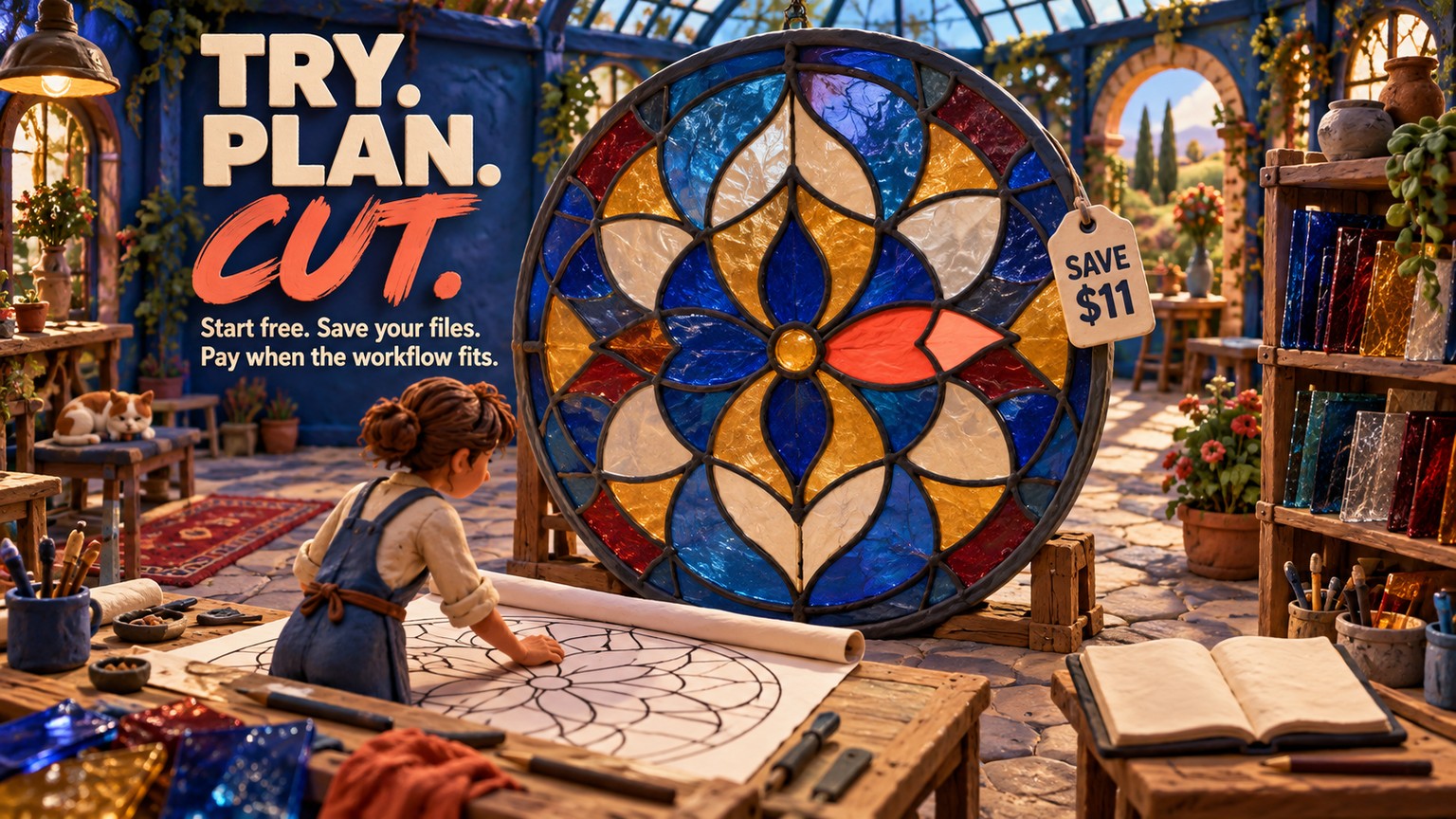
VArtGlass stained glass software pricing is $5.50 per month or $55 per year after up to 17 days of sequential free access, but the annual plan only wins once you need more than 10 paid months. The best default is Monthly: prove the full-size print and export workflow on a real pattern, save the editable .vart file locally, then switch to Annual only if you will use the editor for 11 or 12 months.
VArtGlass Stained Glass Software Pricing at a Glance
VArtGlass has one paid feature set, sold with two billing periods. The live VArtGlass pricing page lists a Monthly plan at $5.50 and an Annual plan at $55. Annual does not add a higher tier. It buys the same paid access for a lower effective monthly price.
These prices and terms were verified against VArtGlass's pricing, terms, support, and gallery pages on 17 September 2026. The pricing page showed VArtGlass V.108K.
One disclosure is missing: the public page uses the $ symbol but never names the currency. It does not say USD, CAD, AUD, or another dollar. Confirm the charge currency on the Allpay checkout page before paying, especially if your card is not dollar-denominated.
VArtGlass Pricing: The Short Verdict
VArtGlass is inexpensive for a craft-specific editor, but the subscription only makes sense if its production steps replace tools or manual setup you already do. The value is not another drawing canvas. It is the path from reference image to editable vector lines, real dimensions, glass preview, material estimates, export, and a full-size 1:1 pattern.
Monthly is the safer purchase because the annual discount is only $11 across a full year. A maker with one commission season, one restoration drawing, or an uncertain workflow should keep the option to stop after a month. A regular pattern designer who will use the editor for 11 or 12 paid months should take Annual.
- Low $5.50 entry price after two free access windows
- Same editor features on Monthly and Annual
- Craft-specific dimensions, material calculation, export, and full-size printing in one browser workspace
- Fifty gallery patterns available free, plus the full Store library while paid
- No documented permanent free editor plan
- Manual seam placement, not automatic photo-to-pattern generation
- Automatic renewal on both paid options
- No named dollar currency, blanket refund promise, or public price-history log
VArtGlass Free Trial: How the 7-Day and 10-Day Windows Stack
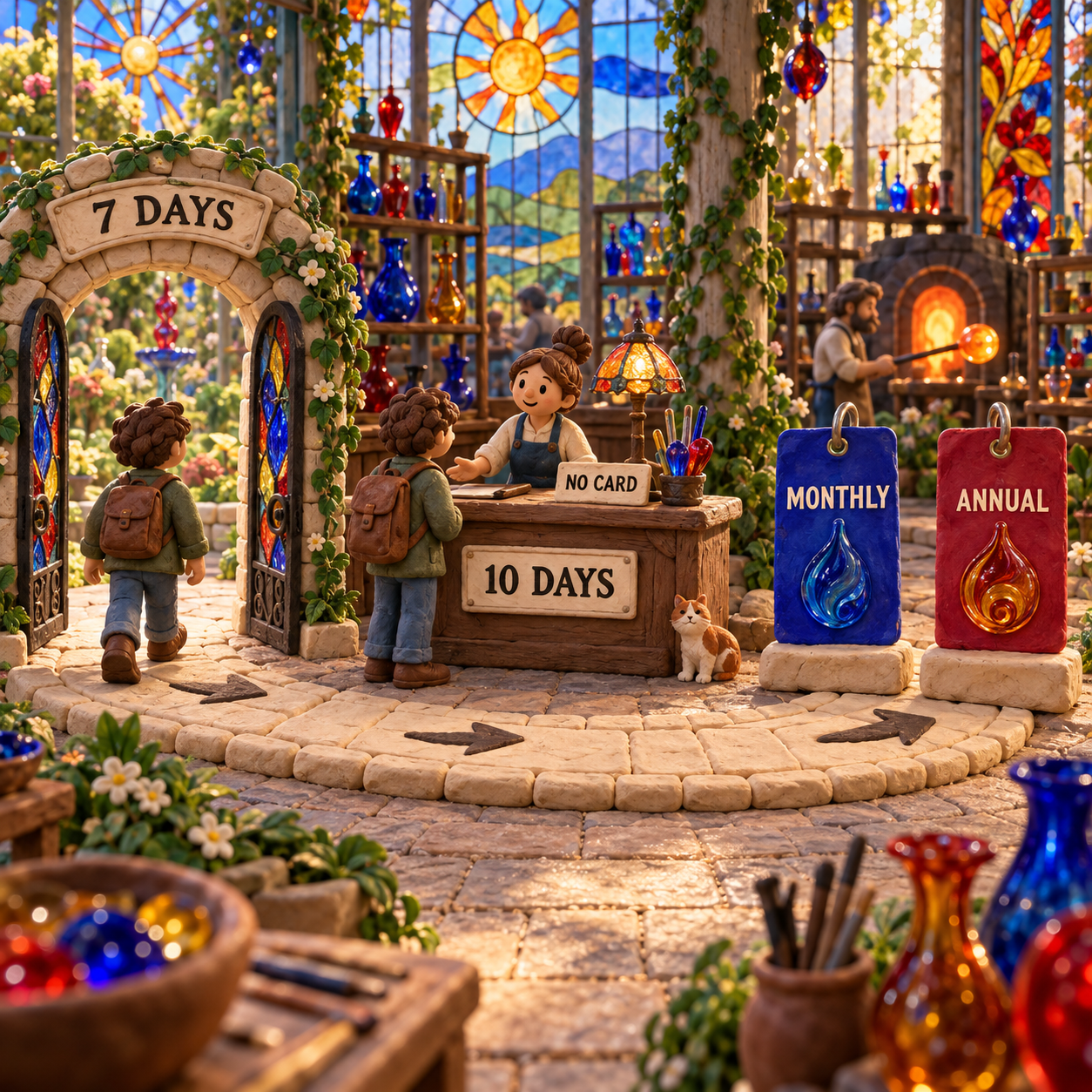
The VArtGlass free trial is really two access windows. An unregistered visitor gets 7 days of guest editor access on the browser and device where the editor is first opened. Registration then opens a 10-day full-editor trial without a payment card, unless a different offer is shown.
Used in that order, the published sequence gives you up to 17 days before payment. Registering immediately may be more convenient, but it gives up the chance to use the guest period first. Neither window silently converts into a paid plan because the registered trial does not require a card.
Use the time for an outcome test, not a tour. Pick one pattern you may genuinely make. Place its photo or sketch beneath the drawing, build the vector seams, set the intended physical size, preview glass, calculate materials, save the project, export the linework, and prepare the 1:1 print. A workflow that reaches a checked working pattern is worth pricing. A pleasant hour clicking tools is not.
The registered trial includes the full editor, but paid Store patterns remain separate purchases except for items marked free. That distinction matters if the pattern library is part of the reason you are evaluating the subscription.
Free Patterns Do Not Mean a Permanently Free Editor
The first 50 VArtGlass Store patterns are free and available to everyone. The VArtGlass gallery can be browsed without registration, and free patterns can be viewed or downloaded. This is a real free library, not a claim that the editor remains free forever.
Someone who needs a ready-made pattern and does not need continued editing may never need to pay. A maker who completes one original design during the guest and trial windows, saves the editable project locally, and exports the required production files may also finish without a subscription.
Pay when you need continued editor access or the full Store library. During a paid Monthly or Annual subscription, every Store pattern is included at no additional charge. During the trial, non-free Store patterns remain individual purchases. The library therefore changes the value of paid access, but it does not create a permanent free software plan.
There is also a license boundary. VArtGlass permits an available pattern to be used for physical stained-glass work, including customer work, but the original pattern file may not be resold, republished, or redistributed. A free download is not a free digital-resale license.
VArtGlass Monthly vs Annual: The 10-Month Break-Even
The VArtGlass Monthly vs Annual choice turns on one number: 10 paid months. Monthly costs $5.50, so 10 payments total $55, exactly the Annual price.
The decision rule is clean:
- 1 to 9 paid months: Monthly costs less.
- 10 paid months: both options cost $55.
- 11 or 12 paid months: Annual costs less.
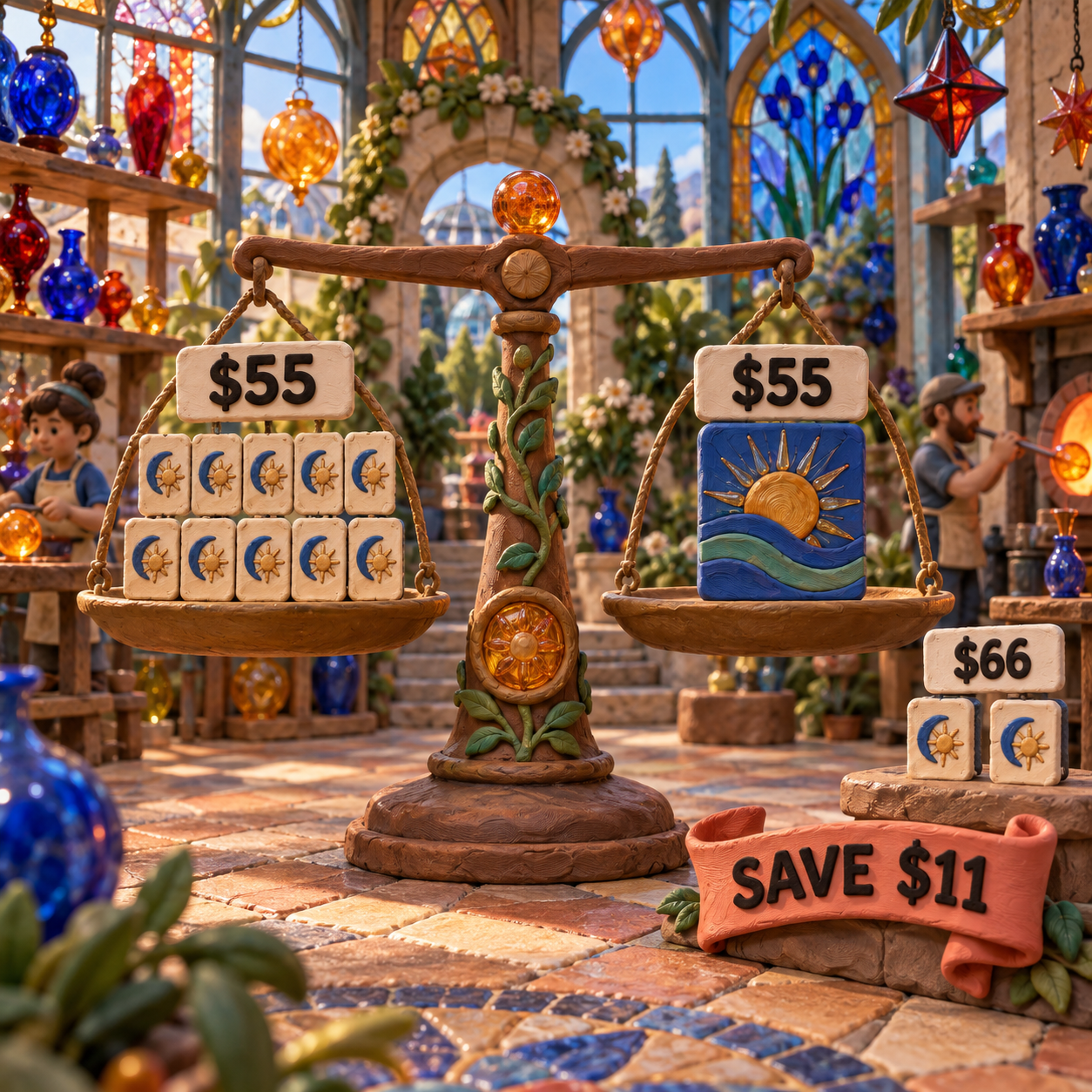
A full year paid monthly costs $66. Annual costs $55, so the saving is $11, or 16.7%. VArtGlass describes the annual rate as $4.58 per month and presents it as two months free. That is accurate against 12 Monthly payments.
The annual-lock risk is not the amount. It is paying for months you may not use. If you work intensively for a spring commission cycle and then stop designing, nine Monthly payments cost $49.50, which is $5.50 less than Annual. If VArtGlass stays open all year for new work, the $11 saving is straightforward.
Both plans renew automatically. A lower effective rate does not remove the renewal decision, so set a calendar reminder before the next charge rather than treating Annual as a one-time purchase.
What the VArtGlass Subscription Includes
The VArtGlass subscription pays for a browser-based manual vector editor built around stained-glass production. It is not an automatic generator. A reference photograph or sketch sits beneath the drawing like tracing paper, while you decide where every seam and piece belongs.
Paid access includes the full vector editor and complete Store library during the active period. The editor can create and change vector lines, points, curves, corners, and closed pieces; set exact real-world dimensions; preview photographed glass textures; maintain personal glass palettes; estimate glass area, copper foil, and lead came; export PNG, JPEG, or SVG; and print a full-size 1:1 line pattern.
The craft distinction is important. Vector means the linework is stored as editable points and curves rather than a fixed grid of pixels. That lets you reshape a seam cleanly and export an SVG at the project's real dimensions. It does not make every shape cuttable.
A Before-to-After Buying Test
Use one concrete brief: a small transom based on a customer's photograph. Before VArtGlass, the photo is only a visual reference. It has no deliberate seam network, no verified working size, no material estimate, and no full-scale cutting pattern.
The useful after-state is not a pretty colored preview. It is a saved editable project with intentional seams, exact dimensions, checked piece geometry, a materials estimate, an SVG line pattern, and a physically verified 1:1 print. VArtGlass can support that chain, but the maker still owns the decisions.
1. Load the reference
Place the photograph or sketch beneath the working lines. Treat it as tracing guidance, not an automatic pattern.
2. Draw for fabrication
Build the vector seams manually. Simplify deep inside curves, fragile slivers, crowded junctions, and details that become impractical at the finished size.
3. Set the physical size
Resize the design to the real dimensions of the opening or panel before judging the smallest pieces and material estimate.
4. Save the editable master
Use File > Save or Save As to keep a local
.vartproject. That file preserves the editable lines, dimensions, glass assignments, palette, and working information.5. Export and print
Export SVG for clean vector linework, PNG for a sharp image or transparency, or JPEG for an ordinary preview. Use Print Pattern, not image export, for the exact full-size working drawing.
The VArtGlass terms explicitly put the final checks on the maker: dimensions, scale, print settings, material quantities, structural choices, and cut feasibility all need independent verification. That is the craft bar. The subscription organizes the work; it does not certify the cut.
VArtGlass Stained Glass Software Cost per Finished Pattern
The VArtGlass stained glass software cost falls quickly when the editor produces more accepted patterns because the public pricing page lists no per-pattern, per-export, or credit allowance. Monthly access costs $5.50 whether one finished pattern or ten make it through your checks.
At one finished pattern in a paid month, the software cost is $5.50. At four finished patterns, it is $1.38 each. At ten, it is $0.55 each. On Annual, using the exact $55 yearly charge across 12 months, the equivalents are $4.58, $1.15, and $0.46.
Those figures only mean something if “finished” is strict. Count a pattern after its dimensions, seam geometry, local project file, export, and print scale have been checked. Counting every draft makes any design tool look cheap while hiding the rework that decides whether glass can be cut.
For a hobbyist producing one occasional panel, software cost is a small part of the project. For a pattern seller or commission designer, the stronger question is whether the editor prevents one redraw, print setup error, or lost editable file. VArtGlass can be worth $5.50 without high volume, but only if its craft-specific handoff replaces real friction.
Renewal, Cancellation, Refunds, Currency, and Your Files
VArtGlass renews both paid plans automatically until cancelled. The account page can stop future renewal, and paid access remains available through the end of the current billing period. Payment is processed by Allpay; VArtGlass says it does not receive or store the complete card number.
Cancellation is not the same as a refund. The terms say refund rights depend on applicable law and the circumstances of the payment. They do not promise a universal refund window or money-back guarantee. Annual buyers should therefore treat the $55 as a real year commitment, not as a reversible monthly experiment.
The public pricing and terms pages also do not name the dollar currency. The honest reading is “$5.50” and “$55,” not “US$5.50” or any other inferred code. Check the Allpay page for the charge currency and any card conversion cost before confirming payment.
Your work needs a two-file habit. The support page says File > Save or Save As creates an editable .vart project on your computer, while Save Project to Cloud keeps a project in your signed-in account. Export creates PNG, JPEG, or SVG output, but it does not replace the editable project.
The terms say you retain rights in designs, photographs, glass samples, and other material you create or upload. Taken together with local saving, that means cancellation does not transfer those rights or erase files already downloaded to your computer. It does not promise continued paid editor or cloud-library access after the billing period ends.
Before cancelling, save each accepted project locally as .vart, export the SVG line pattern, keep a PNG or JPEG preview if useful, and save the full-size print PDF or physical calibration copy. An exported SVG preserves clean vector lines and real project dimensions, but it is still not a second editable VArtGlass project.
How VArtGlass Compares on Price
VArtGlass is not the most automated stained-glass option, and a one-time license can become cheaper over a long enough horizon. Its price makes sense when manual craft control, materials planning, browser access, and full-size printing belong in one workflow.
Pattrn-AI: Cheaper Automation With a Meter
Pattrn-AI is the alternative when automatic image generation and conversion matter more than deliberate manual tracing. Its live pricing lists Inspiration at $5 per month or $49 per year with 20 generations per month. VArtGlass costs $0.50 more monthly and $6 more annually, while its public page lists no credit allowance.
That is not a like-for-like bargain. Pattrn-AI meters AI operations and aims to accelerate conversion. VArtGlass makes the artist place the seams and pays back through craft-specific production control. The detailed Pattrn-AI review explains where generated centerlines still need a fabrication check.
Glass Eye 2000: Higher Upfront Cost, No Subscription Comparison
Glass Eye 2000 starts at a $150 one-time price for Standard. That equals 27.27 VArtGlass Monthly payments or 2.73 VArtGlass Annual payments. Three VArtGlass Annual cycles total $165, which is $15 more than Glass Eye 2000 Standard's sticker price.
The crossover is only a price comparison. It does not make the products or editions equal. Choose Glass Eye 2000 when its one-time model and edition features fit a long-lived production setup; choose VArtGlass when browser access and the lower initial commitment matter more.
Who Should Pay for VArtGlass
Pay for VArtGlass if you want to place every seam yourself and need the drawing to continue into dimensions, materials, exports, and a full-size pattern. Start Monthly when demand is seasonal, you are still learning the interface, or one project will decide the purchase. Use Annual only when the next 11 or 12 paid months already contain enough work to justify continuous access.
Skip it if the core need is automatic generation from a photograph, if a general vector editor already covers your process, or if a higher-cost one-time suite better matches a permanent production station.
The Monday move is simple: open one difficult but non-critical pattern during guest access, finish the full handoff during the registered trial, and save both .vart and SVG locally. If the printed pattern measures correctly and the seam network survives a cutability review, pay Monthly. Put the Annual decision on the calendar after the tenth paid month, not before the first.
Frequently Asked Questions
Is VArtGlass free?
VArtGlass offers 7 days of guest access, a 10-day registered trial with no card, and the first 50 gallery patterns free to everyone. It does not document a permanent free editor plan.
Does VArtGlass offer a student discount?
No student or education discount is documented on the live pricing, terms, support, or subscription pages reviewed on 17 September 2026. Ask support before paying if eligibility would change the decision.
What is the VArtGlass refund policy?
VArtGlass says refund rights depend on applicable law and the circumstances of the payment. Its public terms do not provide a blanket money-back guarantee.
Has VArtGlass pricing changed?
VArtGlass publishes no public price-history log. The live prices verified on 17 September 2026 were $5.50 per month and $55 per year, so use the vendor page as the current authority.
What is the typical cost of stained glass windows?
Physical window cost is separate from VArtGlass software pricing. It varies with dimensions, glass, design complexity, labor, framing, installation, and restoration requirements, so price the actual build with a qualified maker.
How much does stained glass encapsulation cost?
Encapsulation is a specialist fabrication or conservation service, not a VArtGlass feature or subscription cost. Get a project-specific quote based on the panel, glazing system, access, and conservation needs.
How much to charge for stained glass?
Treat the $4.58 to $5.50 effective monthly editor cost as one overhead line. Quote design time, glass, foil or came, solder and consumables, labor, breakage, framing, installation, tax, and margin separately.
Is stained glass a profitable hobby?
It can become a business, but profitability depends on demand, labor pricing, waste, and overhead rather than on the editor fee alone. Track accepted commissions and actual fabrication hours before assigning the software a return.
Is stained glass making a comeback?
Interest can support more commissions or pattern sales, but it does not change the plan math. Choose Monthly or Annual from paid months and completed work, not from trend claims.
What is the rarest stained glass color?
Rarity varies by manufacturer, glass family, production run, and supplier stock. VArtGlass's texture preview helps plan color, but it is not a live inventory or rarity source.
What stained glass pieces sell best?
There is no universal winner across audiences and channels. Use your own inquiries, orders, and production time to decide which patterns justify repeated work.
Where is the most beautiful stained glass in the world?
That judgment is subjective and does not affect VArtGlass pricing. The software decision should rest on whether its pattern workflow improves your own work.
Does stained glass lose color over time?
Color behavior depends on the physical glass and any painted, stained, laminated, or surface-treated layer. A software texture preview is a design aid, not durability evidence.
Get the AI Business Workflow Audit Checklist
Map the trial, accepted output, file handoff, renewal point, and true cost before adding a design tool to your workflow.
- Last Updated
- Sep 17, 2026
- Category
- Design
Prefer this site in Google


Mark omidsaffari.com as preferred and Google lifts it in Top Stories, AI Overviews and AI Mode for you.
Best Software for Bobbin Lace Patterns
Compare bobbin lace design tools by repeat editing, pin spacing, printable prickings, learning effort and the cost of making usable patterns.Sep 17, 2026Design
How to Add Bridges to a Stencil in Inkscape
Keep the centers of letters and enclosed shapes attached. Add stencil bridges in Inkscape, inspect the paths and check the design before cutting.Sep 16, 2026Design
MakeBead Export Cost
MakeBead says PNG and PDF exports are free. Check the watermark, account requirements and file limits before preparing a pattern to print.Sep 16, 2026Design
Best AI Tools for Scroll Saw Portrait Patterns
Compare AI portrait drafts and pattern converters by facial detail, connected pieces, editable files and full-size print output.Sep 16, 2026Design
PreQuilt Review for Fabric Color Planning
A PreQuilt review for choosing fabric colors and scaled prints before cutting, with a clear look at the demo, paid features and yardage planning.Sep 16, 2026Design
Best AI Tools for Handloom Weaving Drafts
Compare tools for handloom weaving drafts, threading and tie-ups. See which outputs reach a loom and where AI only supplies visual inspiration.Sep 16, 2026Design
Texloom Studio Review for Seamless Textile Prints
A Texloom Studio review focused on seamless repeats, color control and print exports, with clear limits on what was tested and what needs checking.Sep 16, 2026Design